
Web Call A Rich Context Mobile Research Platform
Web. Call - A Rich Context Mobile Research Platform Zhigang Liu, Hawk Yin Pang, Jun Yang, Guang Yang, Peter Boda (Special thanks to August Joki) Nokia Research Center 10/27/09
Outline • Introduction • System Architecture • Features · Viral Distribution · Context Sharing · Localization (Outdoor/Indoor) · Human-Powered Q&A · Privacy Control • Lessons Learned • Future Work
Introduction • “Social network” is quite a buzzword these days. • … but, one of the largest and most important social networks has long been in your pocket - i. e. the phone book or contacts. • Our goal - further socialize the phone book · Utilize sensing capabilities on modern mobile phones to share context (beyond content upload/download and status update). · Enable easy R&D prototyping of mobile social apps for other researchers on a common platform and framework.
Web. Call Architecture • Name of “Web. Call” came from past work but has since evolved. • Client-server architecture on Symbian • Client • · Nokia Web Run-Time (WRT): Web. Kit-based widget system · HTTP server in Py. S 60 to serve local resources Server · Apache HTTP server · My. SQL database · Django framework in Python to implement service logic · All logic is implemented on server; client needs no update when new features are added.
![People - Places - Stories PEOPLE PLACES [flickr use Savannah Grandfather] 5 2/14/2022 ©](http://slidetodoc.com/presentation_image_h2/b6b5fb5967b674121968d5f37a8473e1/image-5.jpg "People - Places - Stories PEOPLE PLACES [flickr use Savannah Grandfather] 5 2/14/2022 ©")
People - Places - Stories PEOPLE PLACES [flickr use Savannah Grandfather] 5 2/14/2022 © 2008 Nokia / PPB STORIES
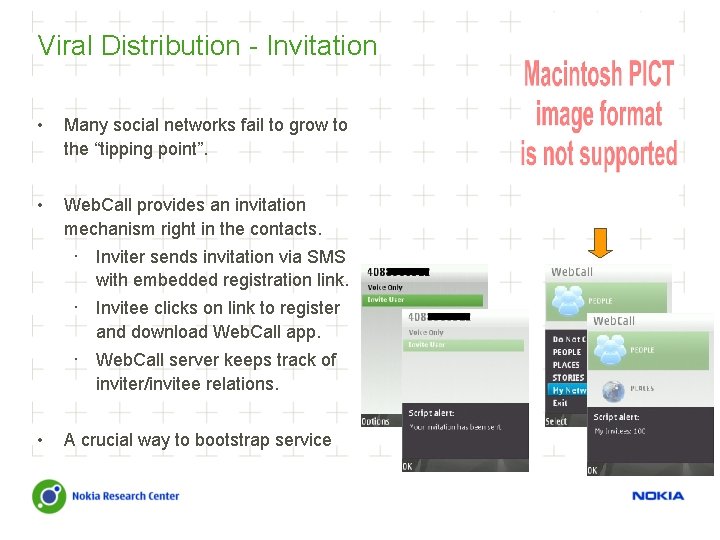
Viral Distribution - Invitation • Many social networks fail to grow to the “tipping point”. • Web. Call provides an invitation mechanism right in the contacts. · Inviter sends invitation via SMS with embedded registration link. · Invitee clicks on link to register and download Web. Call app. · Web. Call server keeps track of inviter/invitee relations. • A crucial way to bootstrap service
Viral Distribution - Registration • Mobile-optimized registration process · New user follows link in invitation SMS to registration page. · Some fields are pre-populated for quick registration. · Links are provided for easy verification and download.
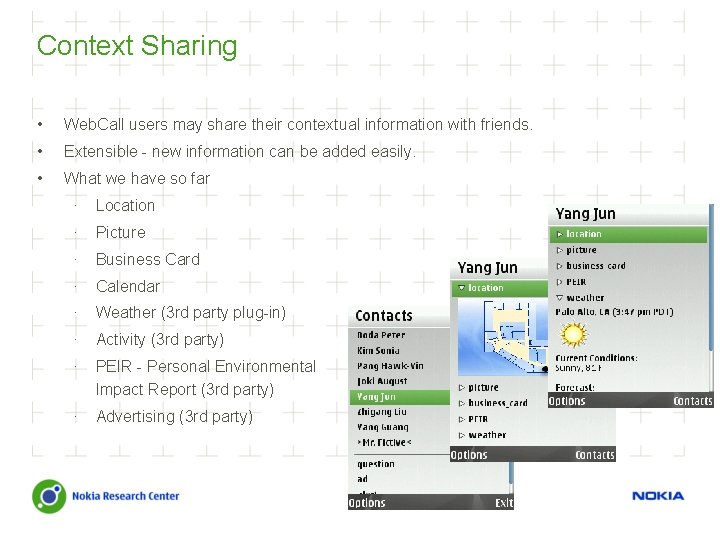
Context Sharing • Web. Call users may share their contextual information with friends. • Extensible - new information can be added easily. • What we have so far · Location · Picture · Business Card · Calendar · Weather (3 rd party plug-in) · Activity (3 rd party) · PEIR - Personal Environmental Impact Report (3 rd party) · Advertising (3 rd party)
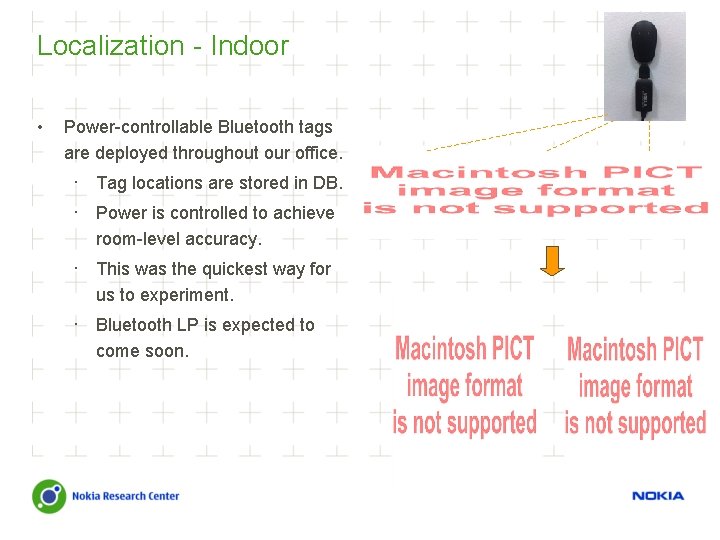
Localization - Indoor • Power-controllable Bluetooth tags are deployed throughout our office. · Tag locations are stored in DB. · Power is controlled to achieve room-level accuracy. · This was the quickest way for us to experiment. · Bluetooth LP is expected to come soon.
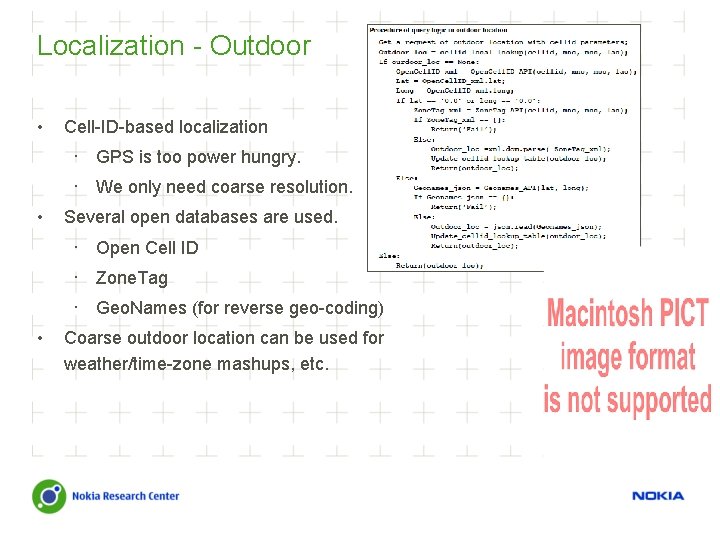
Localization - Outdoor • Cell-ID-based localization · GPS is too power hungry. · We only need coarse resolution. • Several open databases are used. · Open Cell ID · Zone. Tag · Geo. Names (for reverse geo-coding) • Coarse outdoor location can be used for weather/time-zone mashups, etc.
Human-Powered Q&A • User may post simple questions to Web. Call community. • Questions are routed to real people who may have the best answers. · Match personal history and expertise with questions • Multiple-choice questions make it easy to use on mobile phones.
Privacy Control • Privacy level of each feature may be individually set. • Groups may be defined to allow flexibility.
Lessons Learned • Deployment of indoor localization is challenging · Bluetooth range (i. e. transmission power) is difficult to fine tune • Flexible/extensible database design is crucial. · We face requests of new features throughout development. · Database schema in constant evolvement. • Mobile widget systems are still in infancy. · Nokia WRT 1. 0 lacks access to local resources. · Latest WRT adds certain access but is still limited. • User study should start early.
Future Work • User study • Research trial and scalability study • Machine learning for better Human Q&A • User behavior prediction
Video Demo
- Slides: 15