
Web Applications Security SQL IT College Andres Kver

Web Applications Security SQL IT College, Andres Käver, 2017 -2018, autumn semester Web: http: //enos. Itcollege. ee/~akaver/Web. Sec Skype: akaver Email: akaver@itcollege. ee
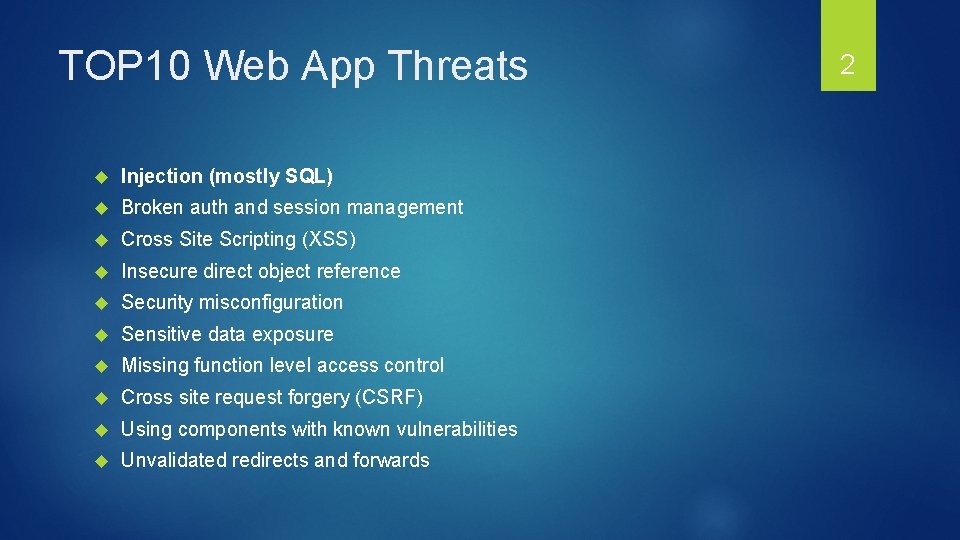
TOP 10 Web App Threats Injection (mostly SQL) Broken auth and session management Cross Site Scripting (XSS) Insecure direct object reference Security misconfiguration Sensitive data exposure Missing function level access control Cross site request forgery (CSRF) Using components with known vulnerabilities Unvalidated redirects and forwards 2
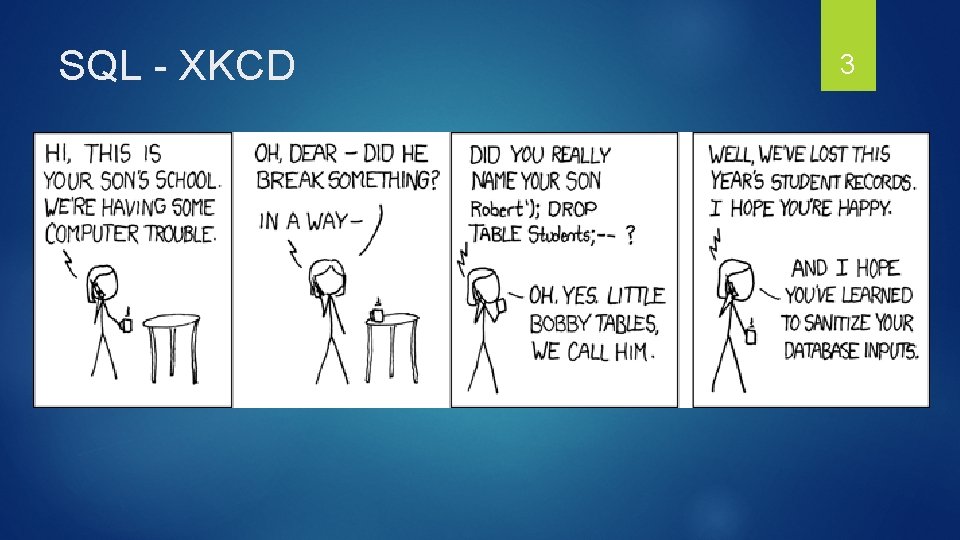
SQL - XKCD 3

SQL 4
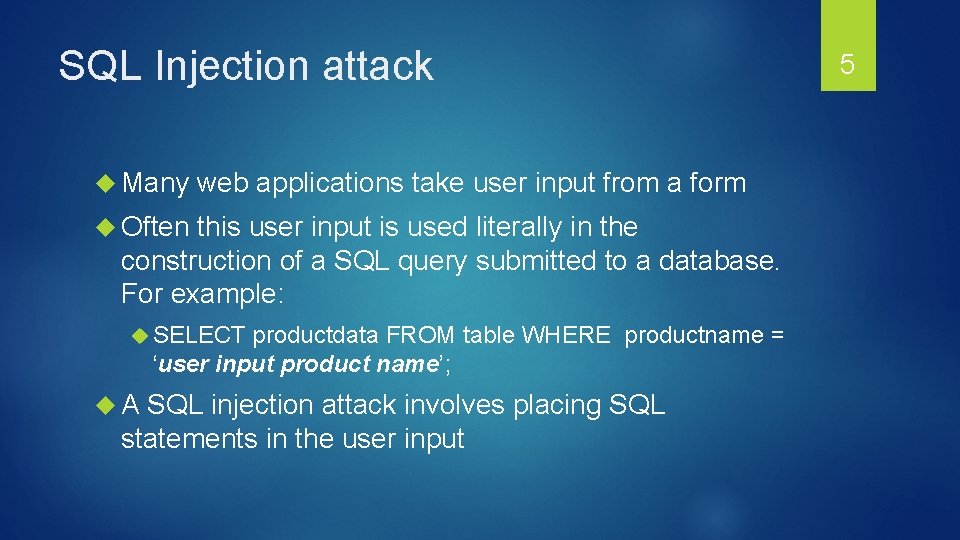
SQL Injection attack Many web applications take user input from a form Often this user input is used literally in the construction of a SQL query submitted to a database. For example: SELECT productdata FROM table WHERE productname = ‘user input product name’; A SQL injection attack involves placing SQL statements in the user input 5
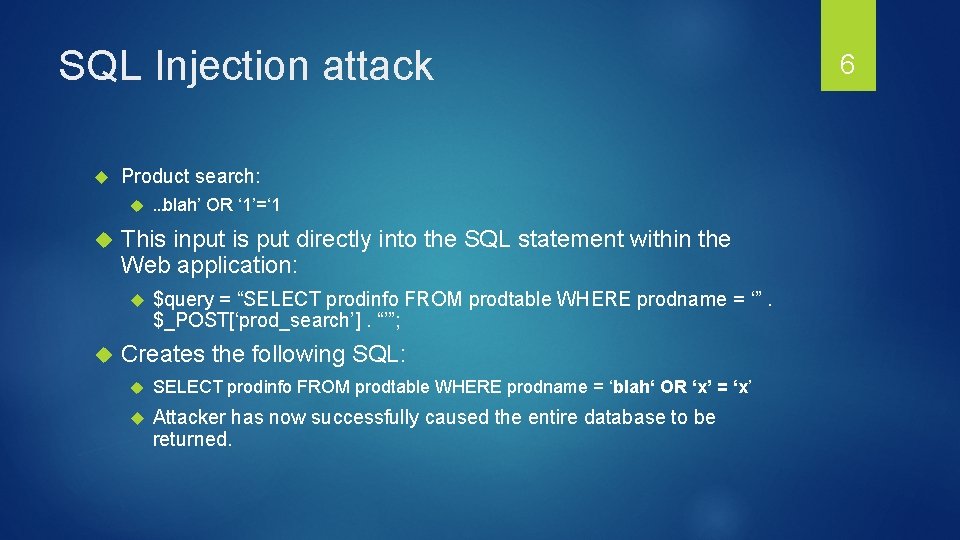
SQL Injection attack Product search: This input is put directly into the SQL statement within the Web application: …blah’ OR ‘ 1’=‘ 1 $query = “SELECT prodinfo FROM prodtable WHERE prodname = ‘”. $_POST[‘prod_search’]. “’”; Creates the following SQL: SELECT prodinfo FROM prodtable WHERE prodname = ‘blah‘ OR ‘x’ = ‘x’ Attacker has now successfully caused the entire database to be returned. 6
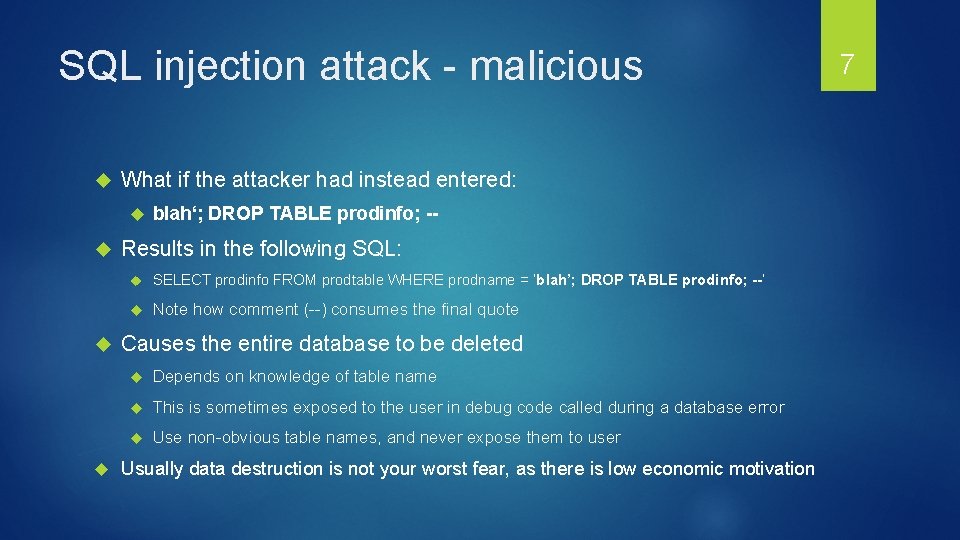
SQL injection attack - malicious What if the attacker had instead entered: blah‘; DROP TABLE prodinfo; -- Results in the following SQL: SELECT prodinfo FROM prodtable WHERE prodname = ‘blah’; DROP TABLE prodinfo; --’ Note how comment (--) consumes the final quote Causes the entire database to be deleted Depends on knowledge of table name This is sometimes exposed to the user in debug code called during a database error Use non-obvious table names, and never expose them to user Usually data destruction is not your worst fear, as there is low economic motivation 7
SQL Injection - others Using SQL injections, attackers can: Add new data to the database Could be embarrassing to find yourself selling politically incorrect items on an e. Commerce site Perform an INSERT in the injected SQL Modify data currently in the database Could be very costly to have an expensive item suddenly be deeply ‘discounted’ Perform an UPDATE in the injected SQL Often can gain access to other user’s system capabilities by obtaining their password 8
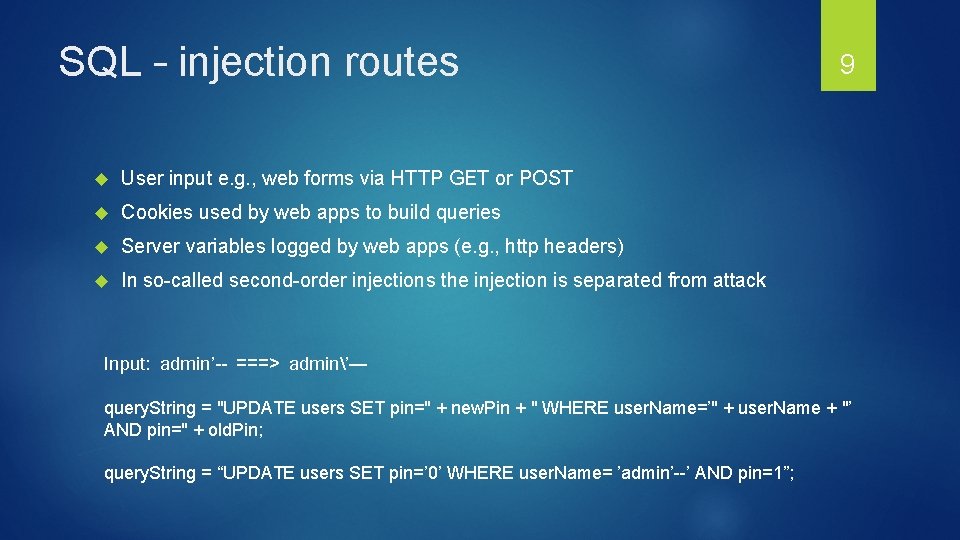
SQL – injection routes User input e. g. , web forms via HTTP GET or POST Cookies used by web apps to build queries Server variables logged by web apps (e. g. , http headers) In so-called second-order injections the injection is separated from attack 9 Input: admin’-- ===> admin’— query. String = "UPDATE users SET pin=" + new. Pin + " WHERE user. Name=’" + user. Name + "’ AND pin=" + old. Pin; query. String = “UPDATE users SET pin=’ 0’ WHERE user. Name= ’admin’--’ AND pin=1”;
SQL – injection forms Tautologies Illegal/incorrect queries Union query Piggy-backed queries Inference pairs Stored procedures and other DBMS features Additionally, the injection may use alternate encodings to try to defeat sanitization routines that don’t interpret them (e. g. , char(120) instead of x). 10
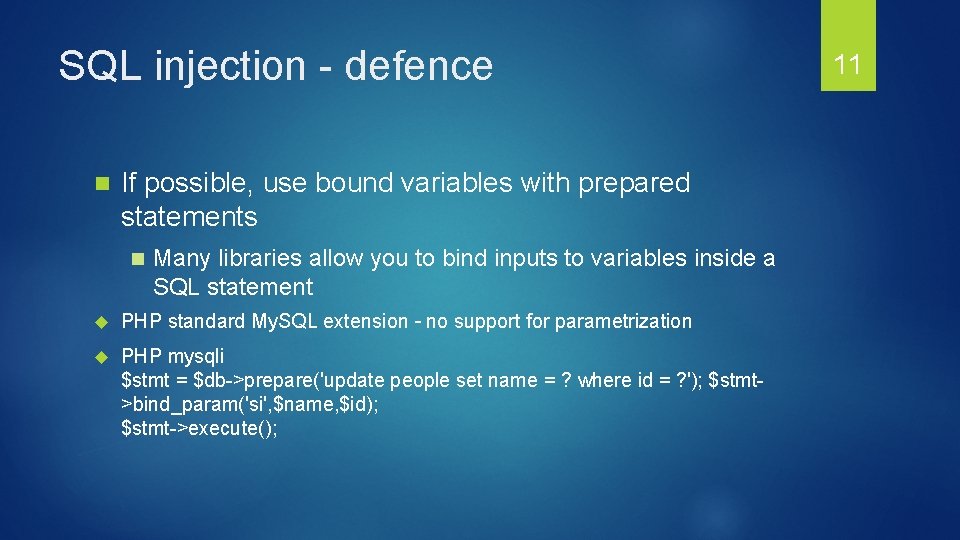
SQL injection - defence n If possible, use bound variables with prepared statements n Many libraries allow you to bind inputs to variables inside a SQL statement PHP standard My. SQL extension – no support for parametrization PHP mysqli $stmt = $db->prepare('update people set name = ? where id = ? '); $stmt>bind_param('si', $name, $id); $stmt->execute(); 11
SQL injection - parametrization The SQL statement you pass to prepare is parsed and compiled by the database server. By specifying parameters (either a ? or a named parameter like : name) you tell the database engine what to filter on. Then when you call execute the prepared statement is combined with the parameter values you specify. It works because the parameter values are combined with the compiled statement, not a SQL string. SQL injection works by tricking the script into including malicious strings when it creates SQL to send to the database. So by sending the actual SQL separately from the parameters you limit the risk of ending up with something you didn't intend. 12
SQL – other defences Use provided functions for escaping strings Many attacks can be thwarted by simply using the SQL string escaping mechanism ‘ ’ and “ ” mysql_real_escape_string() Will is the preferred function for this not guard against all attacks Consider: SELECT No fields FROM table WHERE id = 23 OR 1=1 quotes here! 13
SQL – more defenses Check syntax of input for validity Many classes of input have fixed languages Email addresses, dates, part numbers, etc. Verify that the input is a valid string in the language Some languages allow problematic characters (e. g. , ‘*’ in email); may decide to not allow these Exclude quotes and semicolons Not always possible: consider the name Bill O’Reilly Want to allow the use of single quotes in names Have length limits on input Many SQL injection attacks depend on entering long strings 14
SQL – more defenses Scan query string for undesirable word combinations that indicate SQL statements INSERT, DROP, etc. If you see these, can check against SQL syntax to see if they represent a statement or valid user input Limit If database permissions and segregate users you’re only reading the database, connect to database as a user that only has read permissions Never connect as a database administrator in your web application 15
SQL – more defenses Configure database error reporting Default error reporting often gives away information that is valuable for attackers (table name, field name, etc. ) Configure user so that this information is never exposed to a 16
SQL – access control in My. SQL The primary function of the My. SQL privilege system is to authenticate a user who connects from a given host and to associate that user with privileges on a database such as SELECT, INSERT, UPDATE, and DELETE There are some things that you cannot do with the My. SQL privilege system: You cannot explicitly specify that a given user should be denied access. That is, you cannot explicitly match a user and then refuse the connection. You cannot specify that a user has privileges to create or drop tables in a database but not to create or drop the database itself. A password applies globally to an account. You cannot associate a password with a specific object such as a database, table, or routine. 17
SQL - security Limitations: Often no row level access control Note: DB specific – fine-grained access control is an active area of improvement Only ~30% assign privileges to users/roles And then to protect entire tables, not columns 18
SQL - demo http: //sqlzoo. net/hack/index. html http: //www. frein. net/injection/ 19

SQL 20

SQL 21

SQL 22

SQL 23

SQL 24

SQL 25
- Slides: 25