
Web Applications Security Cryptography 2 Tal TEch IT

Web Applications Security Cryptography 2 Tal. TEch IT College, Andres Käver, 2018 -2019, Fall semester Web: http: //enos. Itcollege. ee/~akaver/Web. Sec Skype: akaver Email: akaver@itcollege. ee
Crypto Encryption and decryption are functions which transform one text into another. In functional notation: C=E(P) and P=D(C) where C denotes ciphertext, E is the encryption rule, D is the decryption rule, P is the plaintext. In this case, we also have: P = D(E(P)) It is obviously important to be able to recover the original message from the ciphertext. 2
Crypto Often the encryption and decryption algorithms use a key K. The key selects a specific algorithm from the family of algorithms defined by E. We write this dependence as: C=E(P, KE) and P=D(C, KD) If KE = KD , then the algorithm is called symmetric. If not, then it is called asymmetric. In general, P = D(E(P, KE), KD) An algorithm that does not use a key is called a keyless cipher. 3
Crypto Often the notation E(P, K) and D(C, K) becomes cumbersome. An alternative notation is often used, particularly in cryptographic protocols. Typically {P}K is used to denote E(P, K), and sometimes to denote D(P, K). For example, P =D(E(P, KE), KD)={{P}KE}KD. This is usually appropriate since, in many important commercial cryptosystems, the same algorithm is used for both encryption and decryption (i. e. , the algorithm is its own inverse). 4
Crypto An encryption algorithm is called breakable if, given enough time and data, an analyst can recover the plaintext. Most encryption algorithms are breakable since the analyst can try all keys systematically. Being breakable doesn’t mean that it’s feasible to break. The analyst must be able to recognize success. For that reason, having plaintext/ciphertext pairs available is often required. 5
Crypto A cryptosystem is strong if there is no analytic approach that is substantially faster than brute force—i. e. , trying all of the keys one by one. Most strong algorithms are still breakable. The larger the keyspace, the longer to find the key by search. Many ciphers use a n-bit string as key. Given a small number of plaintext/ciphertext pairs encrypted under key K, K can be recovered by exhaustive search in an expected time on the order of 2 n− 1 operations. 6
Crypto The simplest building blocks of encryption are: Substitution in which each symbol is exchanged for another (not necessarily uniformly), and Transposition in which the order of symbols is rearranged. It might seem that these are too naive to be effective. But almost all modern commercial symmetric ciphers use some combination of substitution and transposition for encryption. 7
Crypto Two things an encryption step can provide are: Confusion transforming information in plaintext so that an interceptor cannot readily extract it. Diffusion spreading the information from a region of plaintext widely over the ciphertext. Substitution tends to be good at confusion; transposition tends to be good at diffusion. 8
Crypto An encryption algorithm is breakable if a systematic process will permit extracting the message. It is strong if there is not better attack that brute force. Most symmetric encryption algorithms use some combination of substitution and transposition to accomplish both confusion and diffusion. 9
Crypto A substitution cipher is one in which each symbol of the plaintext is exchanged for another symbol. If this is done uniformly this is called a monoalphabetic cipher or simple substitution cipher. If different substitutions are made depending on where in the plaintext the symbol occurs, this is called a polyalphabetic substitution. 10
Crypto A simple substitution cipher is an injection (1 -1 mapping) of the alphabet into itself or another alphabet. A simple substitution is breakable; we could try all k! mappings from the plaintext to ciphertext alphabets. That’s usually not necessary. Redundancies in the plaintext (letter frequencies, digrams, etc. ) are reflected in the ciphertext. Not all substitution ciphers are simple substitution ciphers. 11
Crypto The Caesar Cipher is a monoalphabetic cipher in which each letter is replaced in the encryption by another letter a fixed “distance” away in the alphabet. For example, A is replaced by C, B by D, . . . , Y by A, Z by B, etc. The Vigenere Cipher is an example of a polyalphabetic cipher, sometimes called a running key cipher because the key is another text. Start with a key string: “monitors to go to the bathroom” and a plaintext to encrypt: “four score and seven years ago. ” Align the two texts, possibly removing spaces: plaintext: fours corea ndsev enyea rsago key: monit orsto gotot hebat hroom ciphertext: rcizl qfkxo trlso lrzet yjoua Then use the letter pairs to look up an encryption in a table 12

Crypto Vigenere table 13
Crypto The Vigenere Cipher selects one of twenty-six different Caesar Ciphers, depending upon the corresponding letter in the key. Running key ciphers are susceptible to statistical analysis. Both key and plaintext are English language strings and so have the entropy characteristics of English. In particular, the letters A, E, O, T, N, I make up approximately 50% of English text. Thus, at approximately 25% of indices, these can be expected to coincide. This is an example of a regularity in the ciphertext that would not be expected merely from chance. 14
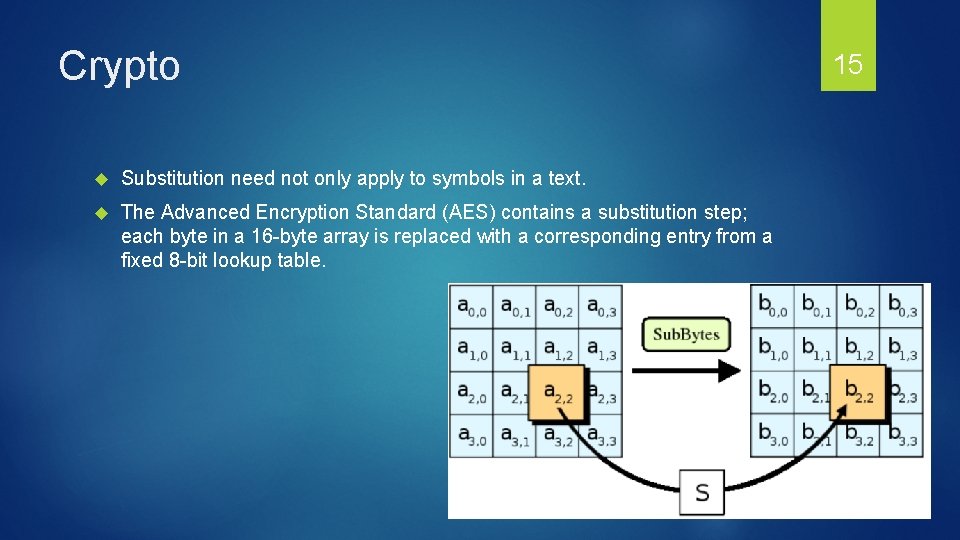
Crypto Substitution need not only apply to symbols in a text. The Advanced Encryption Standard (AES) contains a substitution step; each byte in a 16 -byte array is replaced with a corresponding entry from a fixed 8 -bit lookup table. 15
Crypto Substitution is one of the building blocks of encryption. Simple substitution means replacing symbols uniformly by others. The Caesar Cipher. Polyalphabetic substitution means that the substitution varies according to the position in the text. The Vigenere Cipher is an example. 16
Crypto Using information Question 1: Suppose you know that “xyy” encodes a string in the English alphabet (26 letters) using a substitution cipher. How many decryptions are possible? Answer 1: 263 = 17576 Question 2: Add the information that it’s a simple substitution cipher. Answer 2: 26 × 25 = 650. (Reduce search space by a factor of 27. ) Question 3: Add that you know the plaintext is an English word: Answer 3: around 40. (Reduce original search space by a factor of 439. ) 17
Crypto A perfect cipher would be one for which no reduction of the search space is gained from knowing: the encryption algorithm the ciphertext. The attacker’s uncertainty (the likelihood of guessing the plaintext) of the message is exactly the same whether or not she has access to the ciphertext. The cryptanalytic task is to reduce the uncertainty in the message (plaintext) using all available information. 18
Crypto Perfect cipher A one-time pad, invented by Miller (1882) and independently by Vernam and Mauborgne (1917), is a theoretically perfect cipher. The idea is to use a key that is the same length as the plaintext, and to use it only once. The key is XOR’d with the plaintext. Given a 15 -bit binary message: plaintext: 10110010111001 key: 11010001010100 ciphertext: 01100011101101 19
Crypto The main problem with the one-time pad is practical, rather than theoretical. Given the need to communicate securely, how do the sender and receiver agree on a secret (key) that they can use in the algorithm. If sender and receiver already have a secure channel, why do they need the key? If they don’t, how do they distribute the key securely? This is the key distribution problem. 20
Crypto – transposition cipher A transposition cipher hides information by reordering the symbols in a message. The goal of transposition is diffusion. Example: Columnar transposition involves writing the plaintext characters in a number of fixed length rows such as the following: c 01 c 02 c 03 c 04 c 05 c 06 c 07 c 08 c 09 c 10 c 11 c 12 etc. Form the ciphertext by reading down the columns: c 01 c 06 c 11 c 02… 21
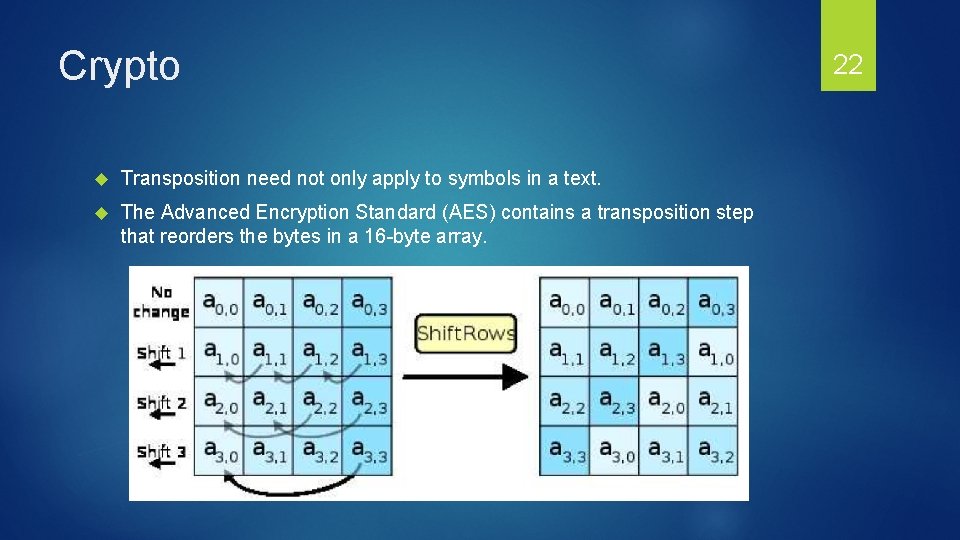
Crypto Transposition need not only apply to symbols in a text. The Advanced Encryption Standard (AES) contains a transposition step that reorders the bytes in a 16 -byte array. 22
Crypto Question: Given a text you believe to be the encryption of a text by transposition. How could you increase your confidence that’s the case? Answer: Since transposition reorders characters, but doesn’t replace them, the original characters still occur in the result. Letter frequencies are preserved in the ciphertext, but the frequencies of digrams, trigrams, etc. are not. 23
Crypto Substitutions and transpositions can be regarded as building blocks for encryption. Many important commercial algorithms use combinations of these. A combination of two or more ciphers is called a product cipher or cascade cipher: E 2(E 1(P, k 1), k 2) A combination is not necessarily stronger than either cipher individually. It may even be weaker. 24
Crypto Recall that there are two basic types of encryption: symmetric algorithms: (also called “secret key”) use the same key for both encryption and decryption; asymmetric algorithms: (also called “public key”) use different keys for encryption and decryption. For any encryption approach, there are two major challenges: Key distribution: how do we convey keys to those who need them to establish secure communication. Key management: given a large number of keys, how do we preserve their safety and make them available as needed. 25
Crypto In asymmetric or public key encryption, different keys are used for encryption and decryption. Each subject S has a publicly disclosed key KS (“S’s public key”) that anyone can use to encrypt, and a privately held key KS− 1 (“S’s private key”). The relationship is: M = {{M}KS }KS− 1. Anyone wishing to send a message M confidentially to S sends {M}KS. Only the holder of KS− 1 can decrypt this message. Asymmetric encryption largely solves the key distribution problem. Why? 26
Crypto - keys Typically, in a symmetric encryption system keys are: randomly generated k-bit strings, simple to generate, have no special properties. In a public key system, keys: have special structure (e. g. , are large primes), are expensive to generate. Key sizes are not comparable between the two approaches. A 128 -bit symmetric key may be equivalent in strength to a 3000 -bit public key. 27
Crypto Using symmetric encryption, security requires that each pair of users share a secret key. In an asymmetric system, each user has a public/private key pair. Keys in the two approaches have very different characteristics and are not directly comparable. 28
Crypto – stream and block An important distinction in symmetric cryptographic algorithms is between stream and block ciphers. Stream ciphers convert one symbol of plaintext directly into a symbol of ciphertext. Block ciphers encrypt a group of plaintext symbols as one block. Simple substitution is an example of a stream cipher. Columnar transposition is a block cipher. Most modern symmetric encryption algorithms are block ciphers. Block sizes vary (64 bits for DES, 128 bits for AES, etc. ). 29
Crypto – stream encryption Advantages: Speed of transformation: algorithms are linear in time and constant in space. Low error propogation: an error in encrypting one symbol likely will not affect subsequent symbols. Disadvantages: Low diffusion: all information of a plaintext symbol is contained in a single ciphertext symbol. Susceptibility to insertions/ modifications: an active interceptor who breaks the algorithm might insert spurious text that looks authentic. 30
Crypto – block encryption Advantages: High diffusion: information from one plaintext symbol is diffused into several ciphertext symbols. Immunity to tampering: difficult to insert symbols without detection. Disadvantages: Slowness of encryption: an entire block must be accumulated before encryption / decryption can begin. Error propogation: An error in one symbol may corrupt the entire block. 31
Crypto – Advanced Encryption Standard Most modern symmetric encryption algorithms are: block ciphers: take input in fixed size blocks; implemented in rounds: perform similar operations repeatedly to a “state”; . Such an algorithm is called an iterated block cipher. Designed to process large volumes of text quickly, they use machine operations (arithmetic, bitwise, table lookup) that are cheap and easy to implement. 32
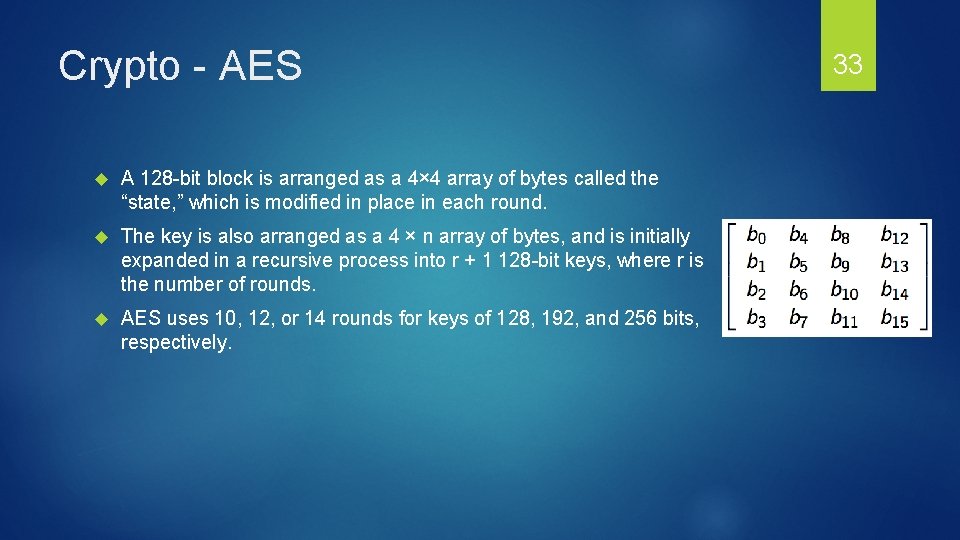
Crypto - AES A 128 -bit block is arranged as a 4× 4 array of bytes called the “state, ” which is modified in place in each round. The key is also arranged as a 4 × n array of bytes, and is initially expanded in a recursive process into r + 1 128 -bit keys, where r is the number of rounds. AES uses 10, 12, or 14 rounds for keys of 128, 192, and 256 bits, respectively. 33
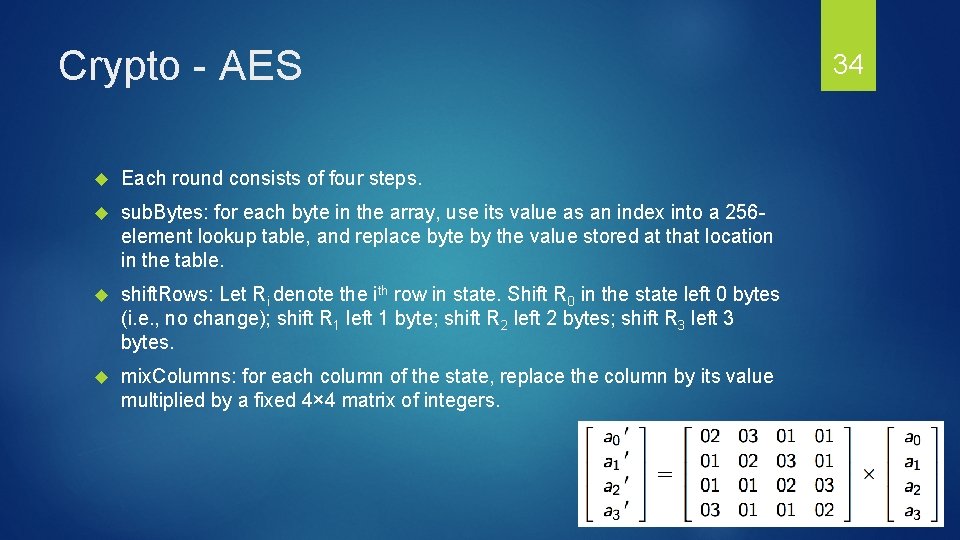
Crypto - AES Each round consists of four steps. sub. Bytes: for each byte in the array, use its value as an index into a 256 element lookup table, and replace byte by the value stored at that location in the table. shift. Rows: Let Ri denote the ith row in state. Shift R 0 in the state left 0 bytes (i. e. , no change); shift R 1 left 1 byte; shift R 2 left 2 bytes; shift R 3 left 3 bytes. mix. Columns: for each column of the state, replace the column by its value multiplied by a fixed 4× 4 matrix of integers. 34
Crypto - AES add. Round. Key: XOR the state with a 128 -bit round key derived from the original key K by a recursive process. 35
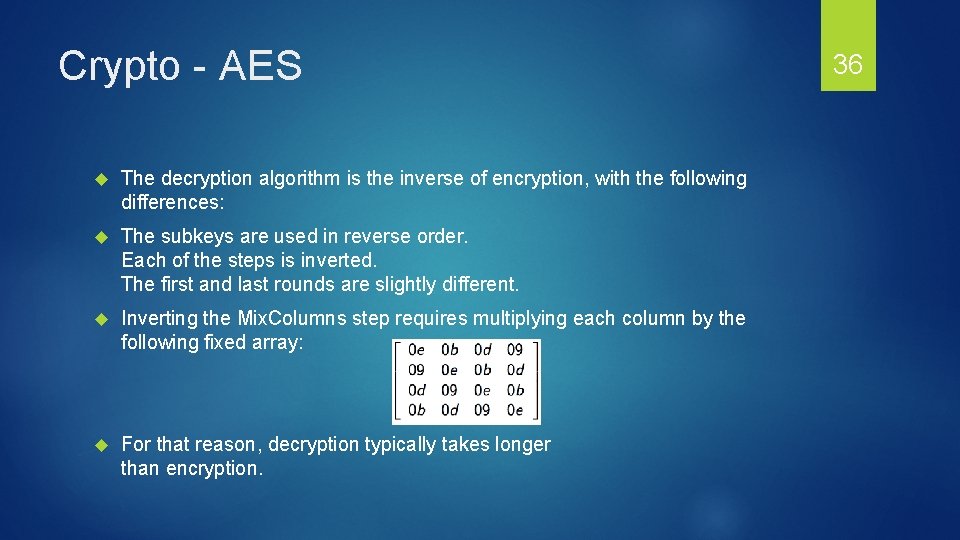
Crypto - AES The decryption algorithm is the inverse of encryption, with the following differences: The subkeys are used in reverse order. Each of the steps is inverted. The first and last rounds are slightly different. Inverting the Mix. Columns step requires multiplying each column by the following fixed array: For that reason, decryption typically takes longer than encryption. 36
Crypto - AES is incorporated in a large number of commercial encryption products. The algorithm is fairly new, but has been subjected to extensive analysis, No flaws have been discovered, but that doesn’t mean that none exist. AES is modular and the key length can be extended if necessary. Similarly, the number of rounds can be increased. AES is a widely-used modern symmetric encryption algorithm. AES uses a block of 128 -bits. AES allows keys of size 128 -bits, 192 -bits, and 256 -bits, with 10, 12, 14 rounds, respectively. 37
Crypto - AES The simplest way of using a block cipher like AES is to encrypt (with the same key) each block in the plaintext. This is a block encryption mode called “Electronic Code Book” (ECB). Identical blocks in the plaintext yield identical blocks in the ciphertext To solve the problem of EBC, do something to “randomize” blocks before they’re encrypted. Cipher Block Chaining (CBC): XOR each successive plaintext block with the previous ciphertext block and then encrypt. An initialization vector IV is used as a “seed” for the process. 38
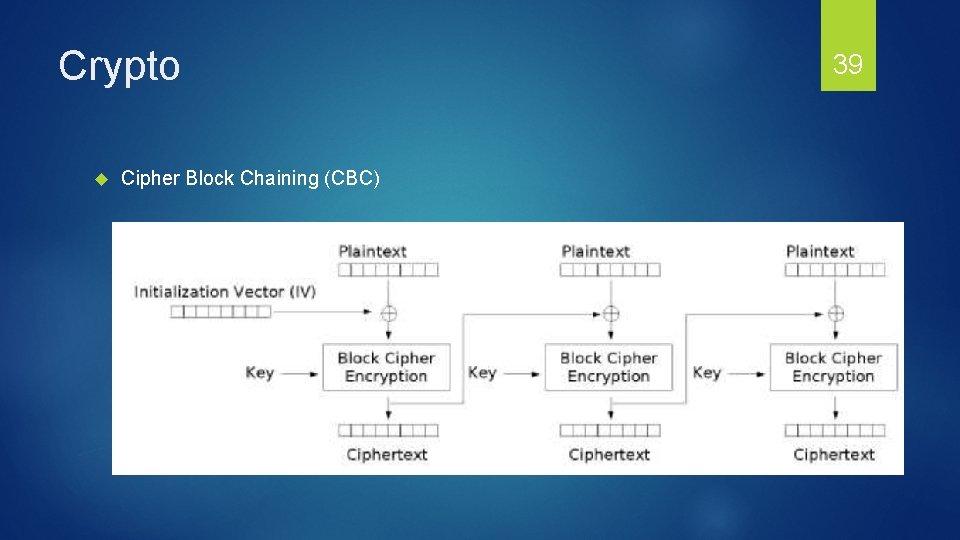
Crypto Cipher Block Chaining (CBC) 39

40 THE END
- Slides: 40