
Web 3 Javas Script API References https web
Web 3 Javas. Script API
References • https: //web 3 js. readthedocs. io/en/1. 0/ • https: //github. com/ethereum/wiki/Java. Script-API
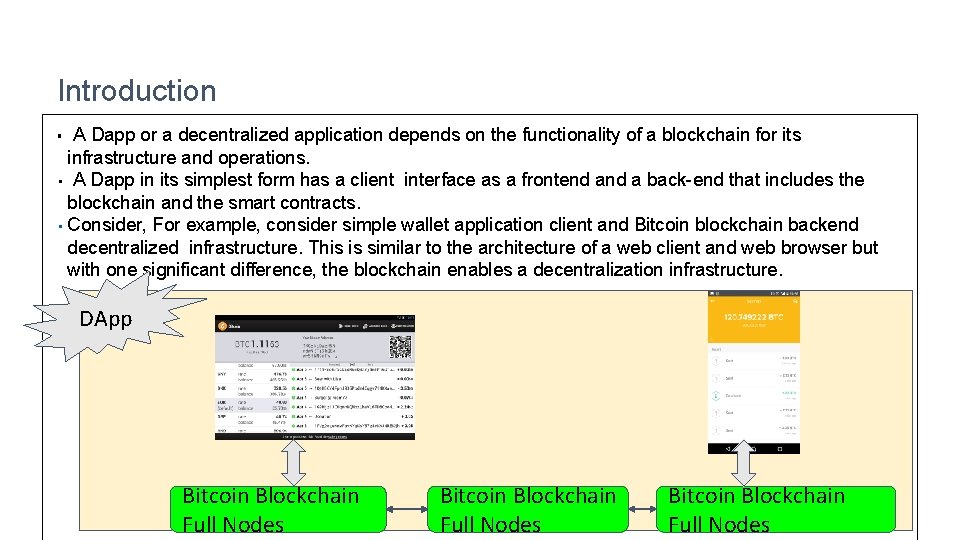
Introduction A Dapp or a decentralized application depends on the functionality of a blockchain for its infrastructure and operations. ▪ A Dapp in its simplest form has a client interface as a frontend a back-end that includes the blockchain and the smart contracts. ▪ Consider, For example, consider simple wallet application client and Bitcoin blockchain backend decentralized infrastructure. This is similar to the architecture of a web client and web browser but with one significant difference, the blockchain enables a decentralization infrastructure. ▪ DApp Bitcoin Blockchain Full Nodes
Hmm. . The client or front-end can be a web app (HTML and JS framework), command-line interface (CLI), desktop application, mobile application or even IOTs. Understand web front-end is outside the blockchain protocol and only link into the blockchain/smart contract using the artifacts generated by the smart contract compile process. Recall we discussed these artifacts generated by Remix IDE in Course 2. ▪ Moreover a decentralized application can be created with non-blockchain back-end. IPFS (Interplanetary file system) is a an example of such an architecture. We will learn about IPFS in the next course. ▪ We are familiar with web server-client, database server-client, how about a Dapp? What is the architecture of a Dapp? How do you develop one? ▪ These are the questions we try to answer in this course. ▪

Recap of DApp Stack
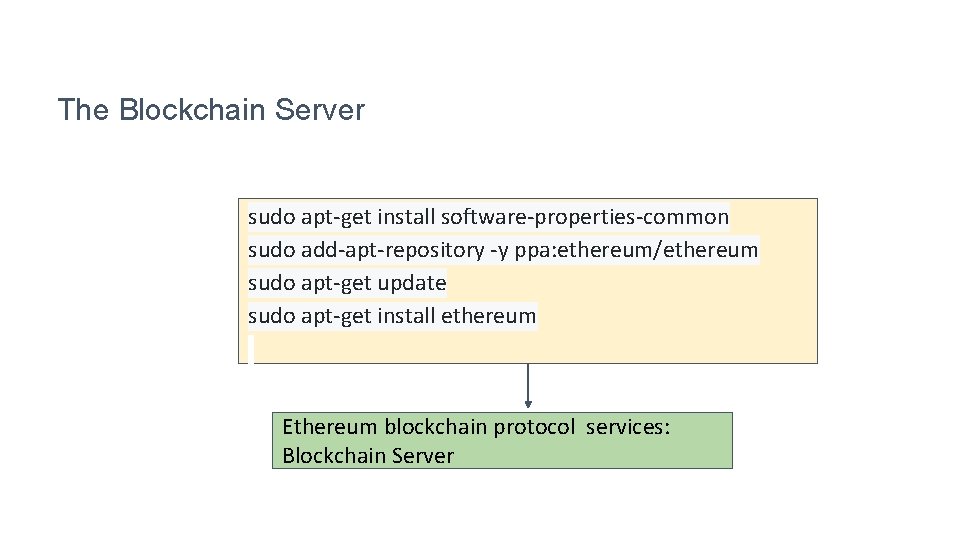
The Blockchain Server sudo apt-get install software-properties-common sudo add-apt-repository -y ppa: ethereum/ethereum sudo apt-get update sudo apt-get install ethereum Ethereum blockchain protocol services: Blockchain Server
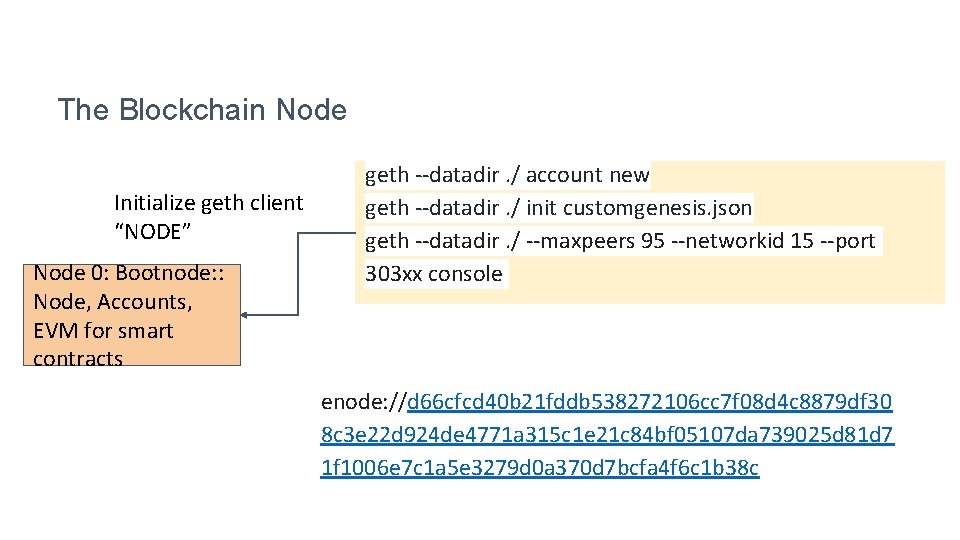
The Blockchain Node Initialize geth client “NODE” Node 0: Bootnode: : Node, Accounts, EVM for smart contracts geth --datadir. / account new geth --datadir. / init customgenesis. json geth --datadir. / --maxpeers 95 --networkid 15 --port 303 xx console enode: //d 66 cfcd 40 b 21 fddb 538272106 cc 7 f 08 d 4 c 8879 df 30 8 c 3 e 22 d 924 de 4771 a 315 c 1 e 21 c 84 bf 05107 da 739025 d 81 d 7 1 f 1006 e 7 c 1 a 5 e 3279 d 0 a 370 d 7 bcfa 4 f 6 c 1 b 38 c
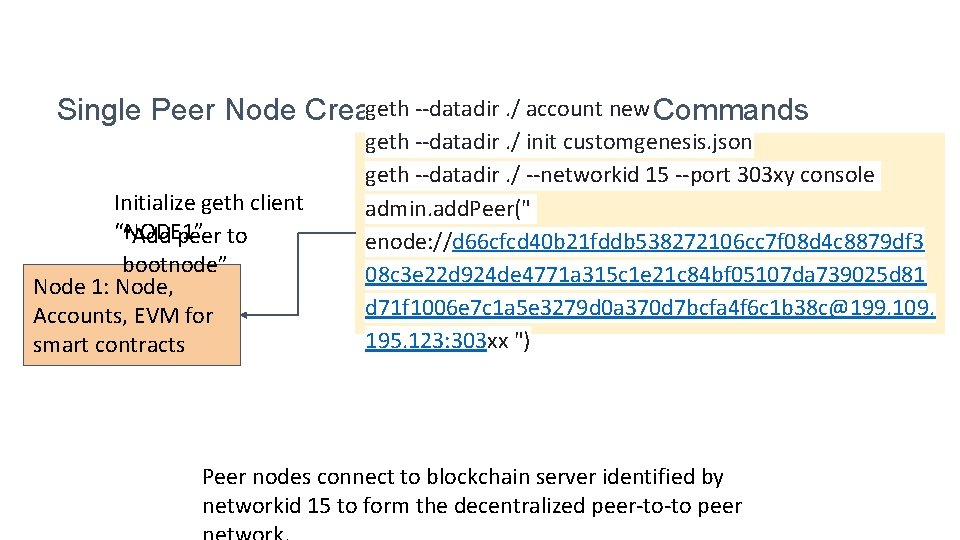
geth --datadir. / account new Commands Single Peer Node Creation and Connection Initialize geth client “NODE 1” “Add peer to bootnode” Node 1: Node, Accounts, EVM for smart contracts geth --datadir. / init customgenesis. json geth --datadir. / --networkid 15 --port 303 xy console admin. add. Peer(" enode: //d 66 cfcd 40 b 21 fddb 538272106 cc 7 f 08 d 4 c 8879 df 3 08 c 3 e 22 d 924 de 4771 a 315 c 1 e 21 c 84 bf 05107 da 739025 d 81 d 71 f 1006 e 7 c 1 a 5 e 3279 d 0 a 370 d 7 bcfa 4 f 6 c 1 b 38 c@199. 109. 195. 123: 303 xx ") Peer nodes connect to blockchain server identified by networkid 15 to form the decentralized peer-to-to peer
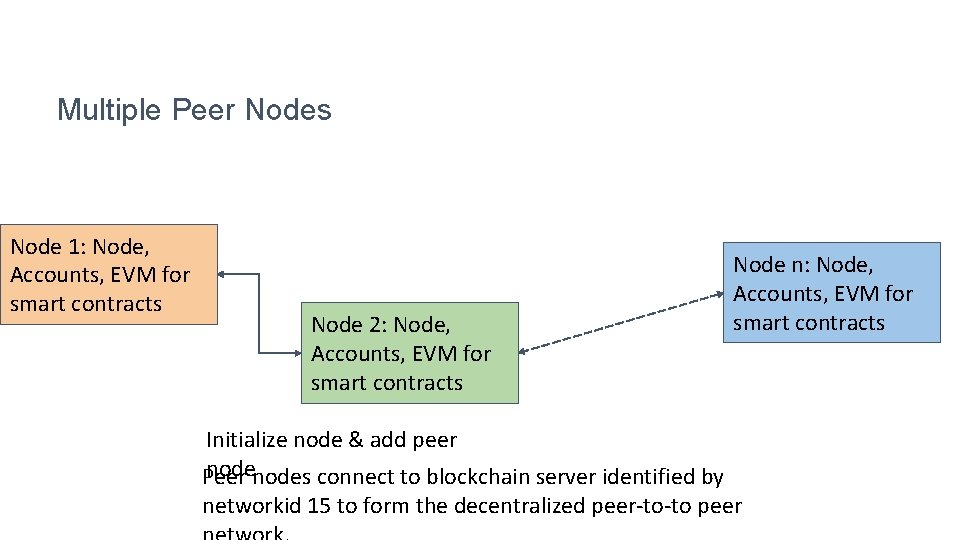
Multiple Peer Nodes Node 1: Node, Accounts, EVM for smart contracts Node 2: Node, Accounts, EVM for smart contracts Initialize node & add peer nodes connect to blockchain server identified by Peer Node n: Node, Accounts, EVM for smart contracts networkid 15 to form the decentralized peer-to-to peer
What is a Dapp? Dapp, a decentralized application, solves a problem that requires blockchain services and blockchain infrastructure for realizing its purpose. Typically design of a Dapp has a front-end, a blockchain back-end and the code connecting the two. In such an architecture, the front-end of the Dapp channels any external stimulus from the users to the blockchain infrastructure and returns any response back to them. --It initiates transactions to invoke functions on the smart contract that in turn records the transactions, state transitions and receipts on the blockchain.
What is a Dapp? ; Front-end Design Front-end of the Dapp can be as simple as a command line interface. It also can be a sophisticated web app or easy to use mobile app. Front-end development may involve web development (html/js/css and web app frameworks such as express) for a web-client, mobile app development for a mobile client and so on. We will use a simple basic web app as frontend for the Dapps we develop in this course.
Blockchain Server-Client Analogy time: You can map the blockchain architecture we discussed here to the client/server architecture we are so familiar with in the context of web applications and database server/client, mobile server/client model. Here blockchain server is the Ethereum “node” (not node. js) and underlying infrastructure, and client or the front-end is a web client with embedded web 3. js script, communicating using JSON over RPC pipeline.
Web 3 deploy script, Contract Address and ABI Recall from Course 2, web 3 Deploy script is an important artifact generated by the remix compile process. • If you are programmatically assembling the Dapp without the help of any development environment • You will copy the web 3 deploy script into your web app, say in html/js file as a script, • deploy the smart contract using the functions in the script • invoke the smart contract function using the functions in the script, ABI and smart contract address • At this time, if you are a programmer, you can review the web 3 deploy script generated in the Remix IDE. • Dont worry, we plan to use an IDE to develop the Dapp later on in Module 2 of this course. •
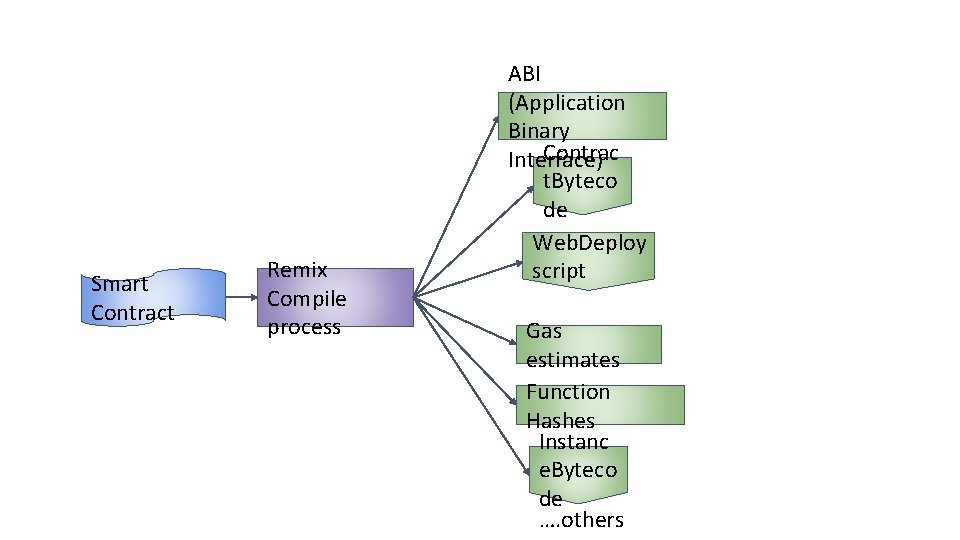
Smart Contract Remix Compile process ABI (Application Binary Contrac Interface) t. Byteco de Web. Deploy script Gas estimates Function Hashes Instanc e. Byteco de …. others
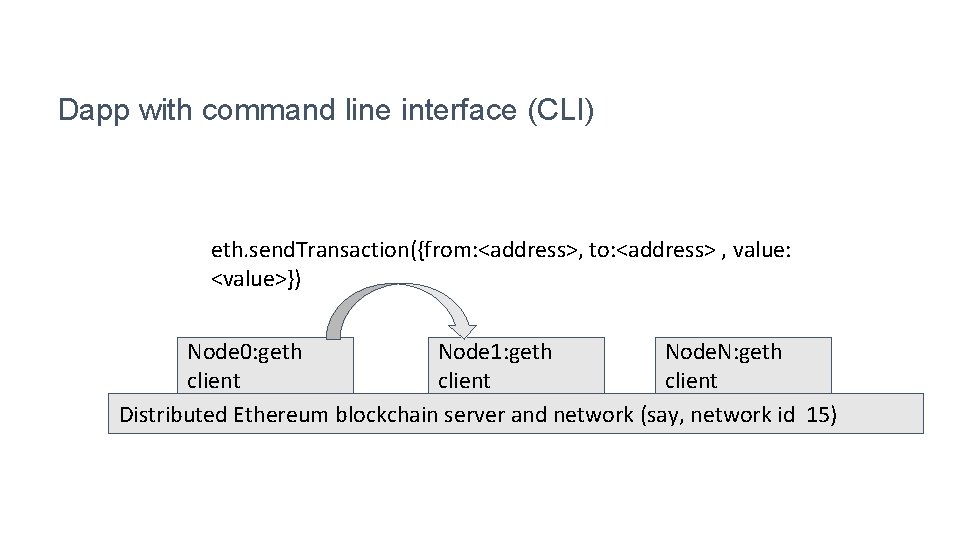
Dapp with command line interface (CLI) eth. send. Transaction({from: <address>, to: <address> , value: <value>}) Node 0: geth Node 1: geth Node. N: geth client Distributed Ethereum blockchain server and network (say, network id 15)
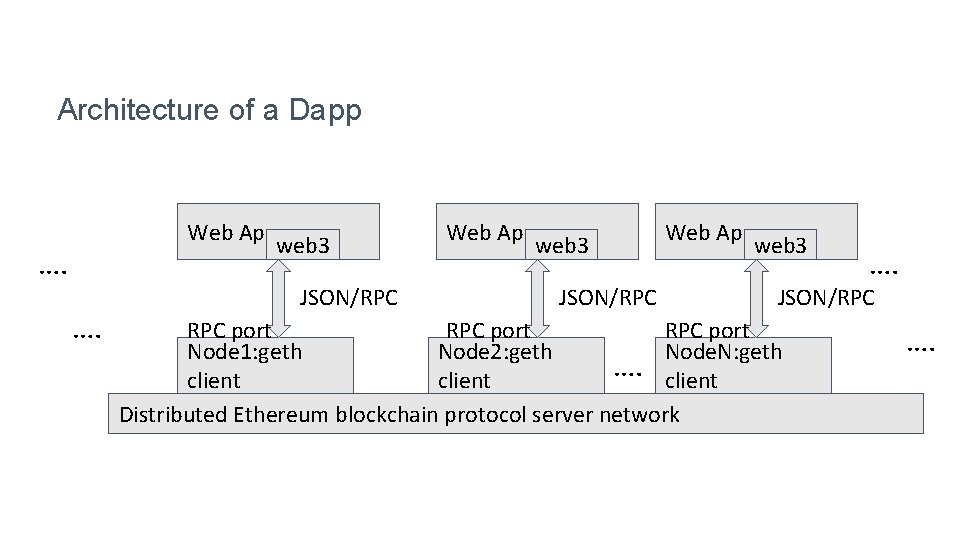
Architecture of a Dapp Web App web 3 …. …. JSON/RPC Web App web 3 …. JSON/RPC port Node 1: geth Node 2: geth Node. N: geth …. client Distributed Ethereum blockchain protocol server network ….
What is an API? API or Application Programming Interface is a convenient and standard way to expose a set of functions related to a specific data set and related services. APIs also lend to reusability of code. An API publishes a set of functions or methods that can be used programmatically invoke operations, access data and store data. Access to an API can be controlled by specific access methods, for example public keys, if so warranted by the application. Here are some well-known examples of API: --Twitter API to access tweets that can be filtered by query terms --Google Maps API that allows for applications “embed” the map features such as geolocation in their own applications, leveraging and reusing the power of google map API.
Why are APIs important? Blockchain server and node provide the blockchain functionality data structures. How do applications “call” them? Invoke them? Use them for accomplishing tasks of an application? We need a well-defined standard approach to get things done for a Dapp. Answer is in the APIs. In our case, specific APIs expose the services of the blockchain server using standard functions. When you develop a Dapp, interaction with a geth node and blockchain server functionality is accomplished by invoking these APIs
Why in the context of Dapp are we learning APIs? Blockchain technology has ushered in a whole new culture in software and systems development and management. Software systems in the beginning were proprietary products. Slowly they moved on to become open source, and freeware. With blockchain technology developers are only contributors to software, many of them help to run the network by standing up nodes, mining etc. More importantly they also propose and vote on the improvements and changes to the blockchain protocol. Thus we want you to be more than developers; you can be contributors and committers to code, you can help in the governance and help shape the protocol. That is the new blockchain technology culture. To enable you to be informed developers in this context, you need a basic knowledge of the APIs and the inner workings.
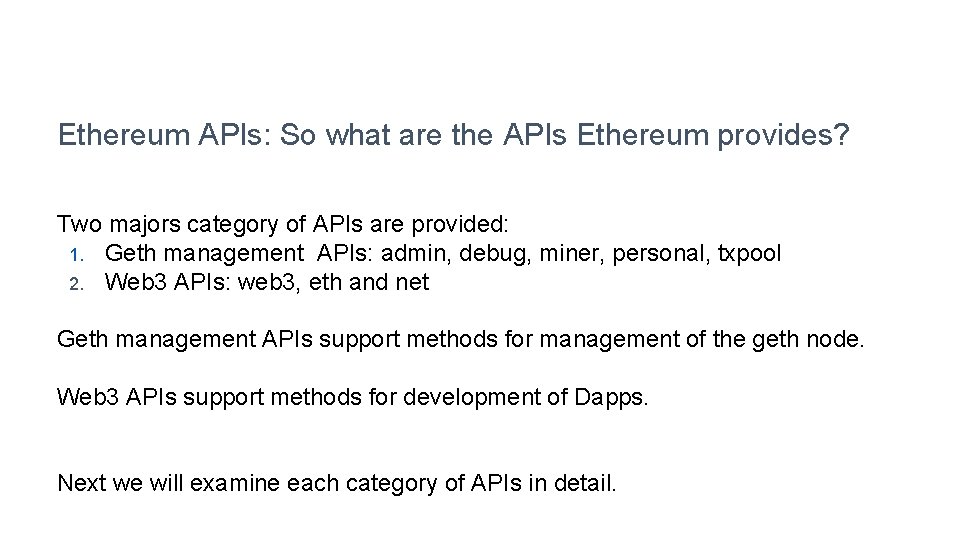
Ethereum APIs: So what are the APIs Ethereum provides? Two majors category of APIs are provided: 1. Geth management APIs: admin, debug, miner, personal, txpool 2. Web 3 APIs: web 3, eth and net Geth management APIs support methods for management of the geth node. Web 3 APIs support methods for development of Dapps. Next we will examine each category of APIs in detail.
Geth Management APIs admin: The admin API allows you to use functions to work with your Geth instance, including network peer and RPC endpoint management. Examples: admin. add. Peer(. . ) admin. node. Info() You can observe that “admin” supports functions for management of the node.
Geth Management APIs debug: Examples: debug. dump. Block(16) Will return the block header details. You can observe that debug object provides you the ability to peek into the blockchain, study and debug any issues.
Geth Management APIs miner: The miner API allows you to control the node's mining operation and set various mining specific settings. Very easy to understand. Example: miner. start() miner. stop() are sample functions that will start and stop the miner. You can also say miner. start(6) where 6 parallel threads assigned to mining operation.
Geth Management APIs personal: Deals with creation and management of accounts within a node. It also manages private keys in the key store. Example: personal. new. Account() will create a new account within a node.
Geth Management APIs txpool: The txpool API gives you access to several non-standard RPC methods to inspect the contents of the transaction pool containing all the currently pending transactions as well as the ones queued for future processing. Example: txpool. inspect() lists you all the pending transactions for you to peruse them to identify any issues.
Web 3 API web 3. js library when included in the Dapp <script type="text/javascript" src=". . /dist/web 3. js"></script> Lets you use the web 3 object provided by the web 3. js library and all its objects. It also lets you communicate with the local node through the RPC port. It also provides access to eth object and its function via: web 3. eth and net object: web 3. net and their respective functions. Additionally to whisper API: web 3. ssh is used for secure “gossiping” and enables the Whisper protocol that is a precursor for next generation Dapps.
Importance of web 3 Web 3 is a javascript library that is specifically designed for use with web client of Ethereum Dapps. It is portal through which all the underlying operations of the Ethereum node and blockchain server can be invoked. For example: smart contract deployment, smart contract function invocation You will use web 3 in the development of the front end of the Dapp and for interacting with the blockchain.
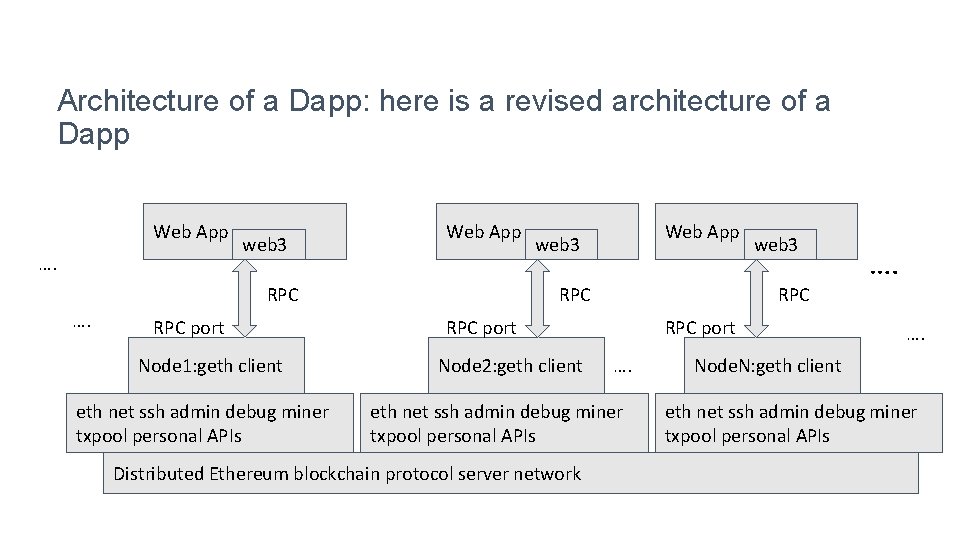
Architecture of a Dapp: here is a revised architecture of a Dapp Web App …. web 3 Web App RPC …. RPC port Node 1: geth client eth net ssh admin debug miner txpool personal APIs Web App web 3 RPC port Node 2: geth client RPC port …. eth net ssh admin debug miner txpool personal APIs Distributed Ethereum blockchain protocol server network web 3 …. …. Node. N: geth client eth net ssh admin debug miner txpool personal APIs
Tracing a call/request from a web front of Dapp (requestresponse. . ) So far we discussed structural and API details. When a web request is initiated by a user, if it is regular web app request, it is directed to the http endpoint (say, port 8080) and to the web server to be executed. For a Dapp: --geth client has to expose a RPC endpoint using the command --rpcport XXXX where XXXX is the RPCport. --A web 3 object instantiated in the web page script (recall that web 3. js is a javascript library) --Requests/Calls on invoked on this web 3 object --Requests are transmitted as JSON over the RPC pipeline between the web client and the geth client --requested call/function is executed using appropriate API and the results returned through the RPC pipeline.
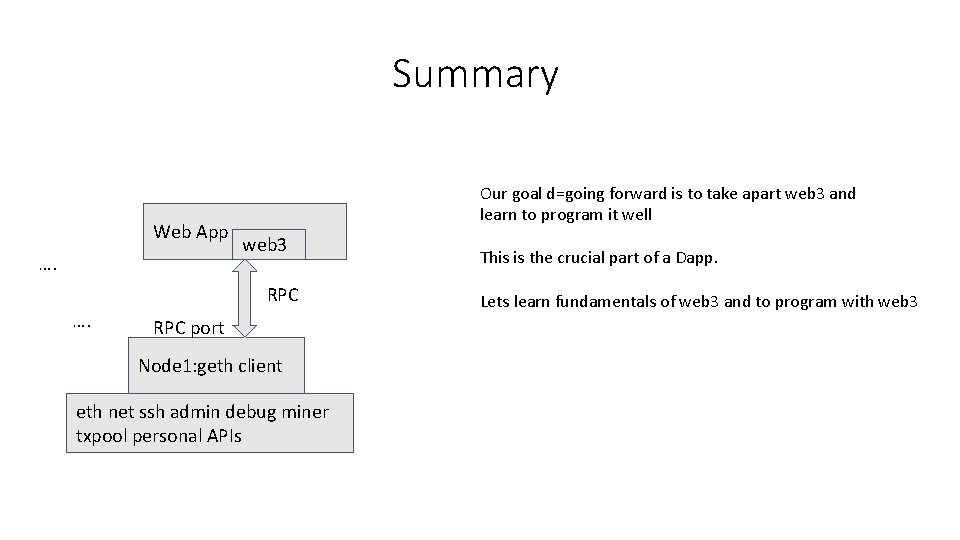
Summary Web App …. Our goal d=going forward is to take apart web 3 and learn to program it well web 3 RPC …. RPC port Node 1: geth client eth net ssh admin debug miner txpool personal APIs This is the crucial part of a Dapp. Lets learn fundamentals of web 3 and to program with web 3
- Slides: 30