
WEAVING CODE EXTENSIONS INTO JAVASCRIPT Benjamin Lerner Herman
WEAVING CODE EXTENSIONS INTO JAVASCRIPT Benjamin Lerner, Herman Venter, and Dan Grossman University of Washington, Microsoft Research
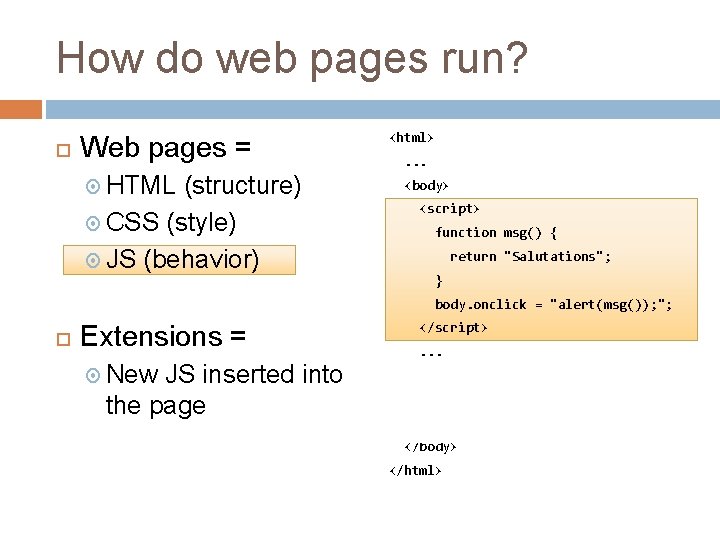
How do web pages run? Web pages = HTML (structure) CSS (style) JS (behavior) <html>. . . <body> <script> function msg() { return "Salutations"; } body. onclick = "alert(msg()); "; Extensions = New JS inserted into the page </script>. . . <script> function msg() { return "hi"; } </script> </body> </html>
Outline Motivation Userscripts Browser extensions Techniques and semantic flaws Wrapping Monkey-patching Language approach: weaving mechanism Functions
Outline Motivation Userscripts Browser extensions Techniques and semantic flaws Wrapping Monkey-patching Language approach: weaving mechanism Functions
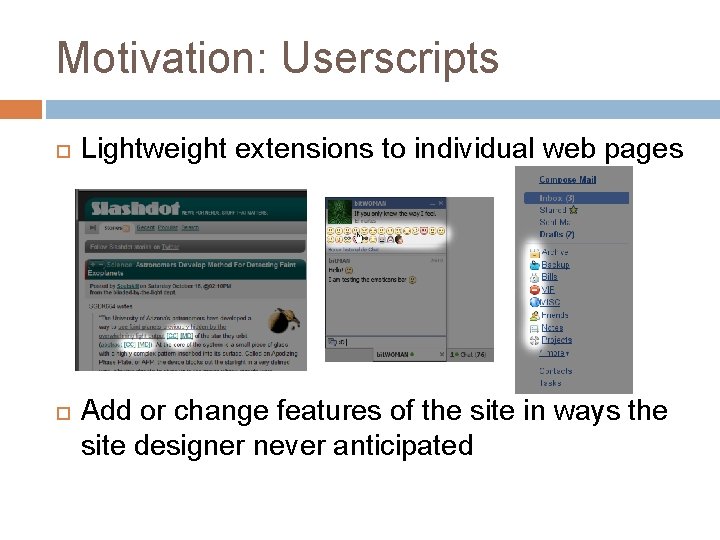
Motivation: Userscripts Lightweight extensions to individual web pages Add or change features of the site in ways the site designer never anticipated

Key features of Userscripts Execution Userscripts are appended to the page Once added, they behave identically to page scripts Popularity 60 K scripts 10 M+ users
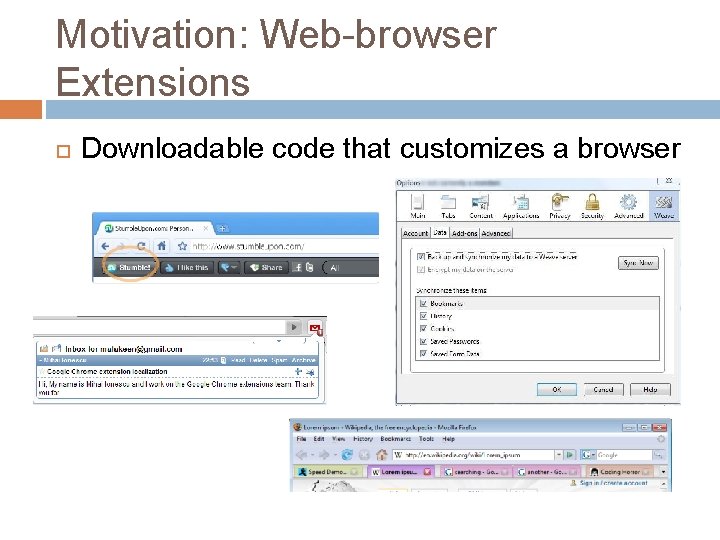
Motivation: Web-browser Extensions Downloadable code that customizes a browser
How do these extensions work? Can’t only append new code to the page It won’t get called Need to replace existing code too Only two techniques available within JS: Wrapping Monkey patching
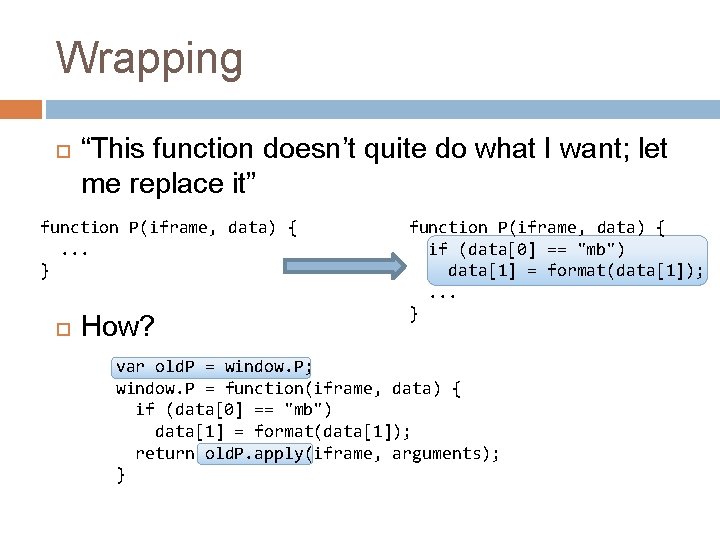
Wrapping “This function doesn’t quite do what I want; let me replace it” function P(iframe, data) {. . . } How? function P(iframe, data) { if (data[0] == "mb") data[1] = format(data[1]); . . . } var old. P = window. P; window. P = function(iframe, data) { if (data[0] == "mb") data[1] = format(data[1]); return old. P. apply(iframe, arguments); }
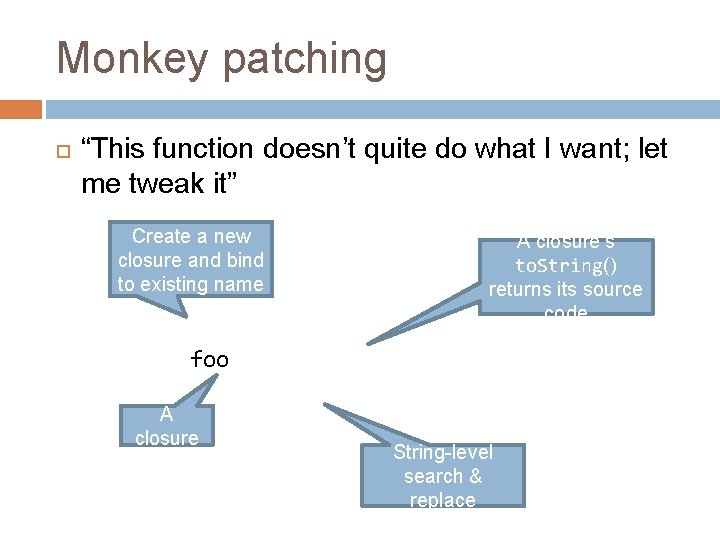
Monkey patching “This function doesn’t quite do what I want; let me tweak it” Create a new closure and bind to existing name A closure’s to. String() returns its source code eval("foo = " + foo. to. String(). replace("some code", A "modified code")); closure String-level search & replace
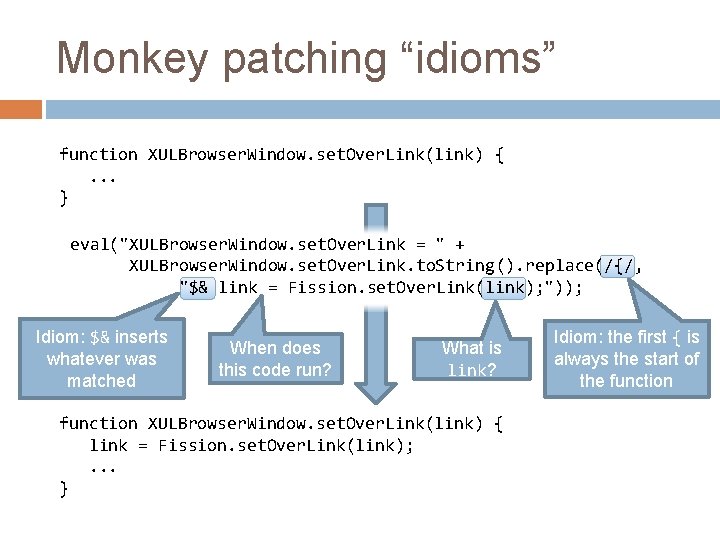
Monkey patching “idioms” function XULBrowser. Window. set. Over. Link(link) {. . . } eval("XULBrowser. Window. set. Over. Link = " + XULBrowser. Window. set. Over. Link. to. String(). replace(/{/, "$& link = Fission. set. Over. Link(link); ")); Idiom: $& inserts whatever was matched When does this code run? What is link? function XULBrowser. Window. set. Over. Link(link) { link = Fission. set. Over. Link(link); . . . } Idiom: the first { is always the start of the function
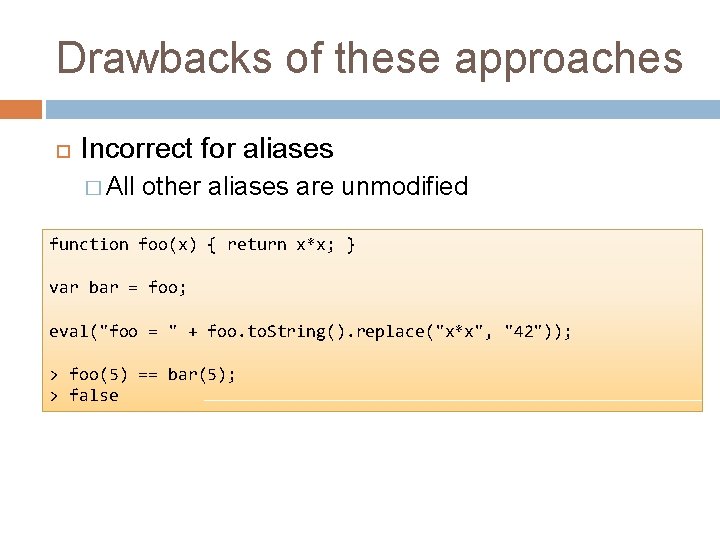
Drawbacks of these approaches Incorrect for aliases � All other aliases are unmodified function foo(x) { return x*x; } var bar = foo; eval("foo = " + foo. to. String(). replace("x*x", "42")); > foo(5) == bar(5); > false
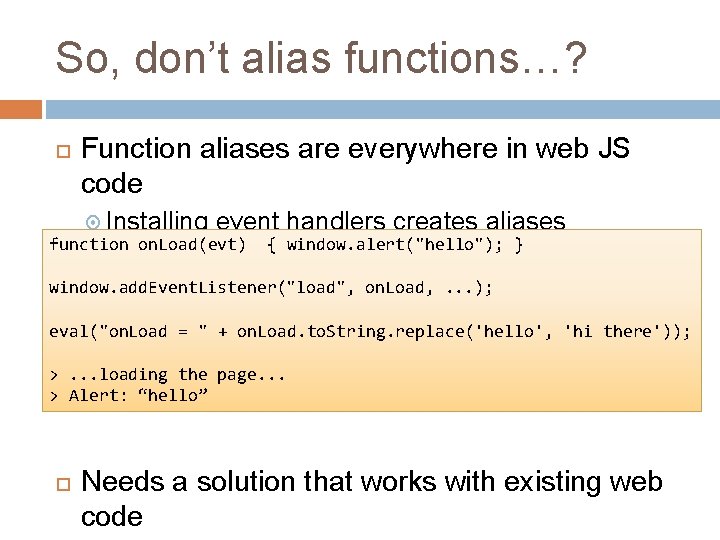
So, don’t alias functions…? Function aliases are everywhere in web JS code Installing event handlers creates aliases function on. Load(evt) { window. alert("hello"); } window. add. Event. Listener("load", on. Load, . . . ); eval("on. Load = " + on. Load. to. String. replace('hello', 'hi there')); >. . . loading the page. . . > Alert: “hello” Needs a solution that works with existing web code
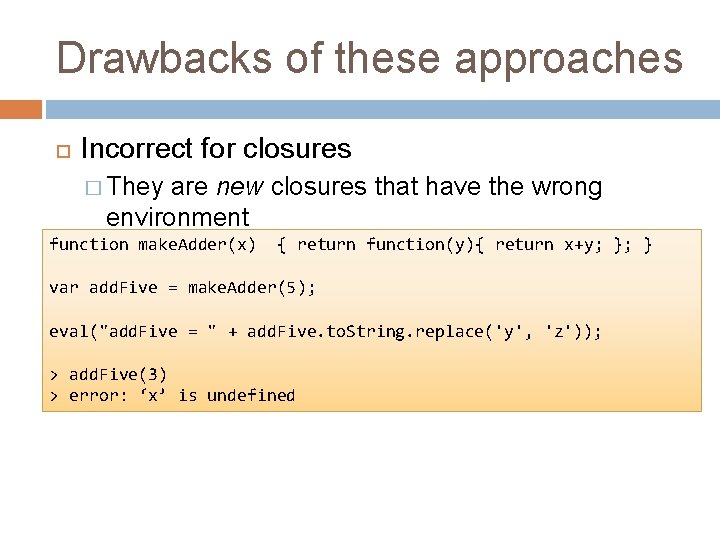
Drawbacks of these approaches Incorrect for closures � They are new closures that have the wrong environment function make. Adder(x) { return function(y){ return x+y; }; } var add. Five = make. Adder(5); eval("add. Five = " + add. Five. to. String. replace('y', 'z')); > add. Five(3) > error: ‘x’ is undefined
Outline Motivation Userscripts Browser extensions Techniques and semantic flaws Wrapping Monkey-patching Language approach: weaving mechanism Functions
Goal: combine extensions & mainline Extensions need to: Define what new code to run When it needs to run How it interacts with existing code Sounds a lot like dynamic aspect weaving! …Unless you’d rather we not call it “aspects” These aren’t traditional “cross-cutting concerns” We use the same mechanism, not the same motivation
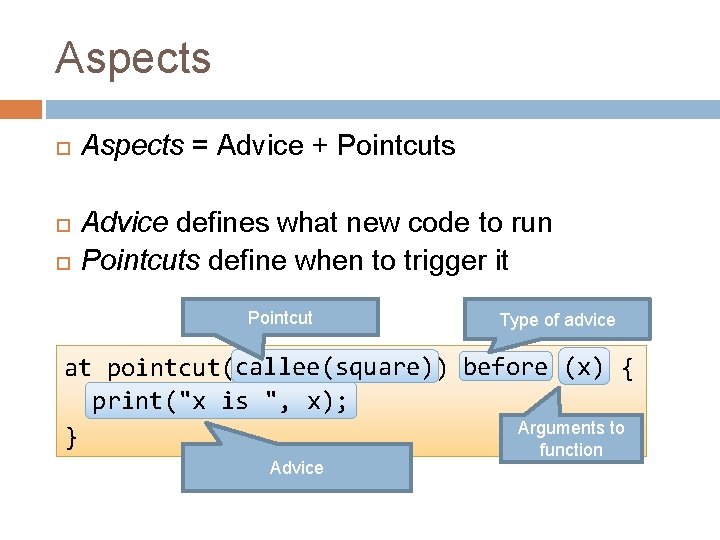
Aspects Aspects = Advice + Pointcuts Advice defines what new code to run Pointcuts define when to trigger it Pointcut Type of advice callee(square) before (x) { at pointcut(callee(square)) print("x is ", x); Arguments to } function Advice
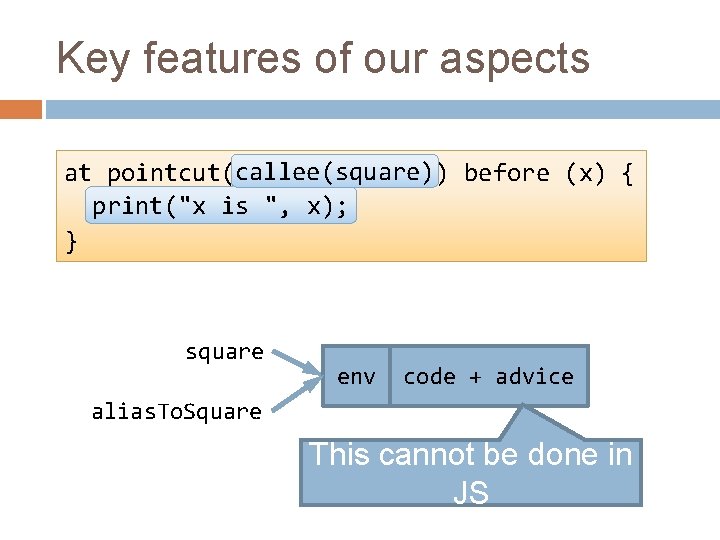
Key features of our aspects callee(square) before (x) { at pointcut(callee(square)) print("x is ", x); } square env code + advice _ alias. To. Square This cannot be done in JS
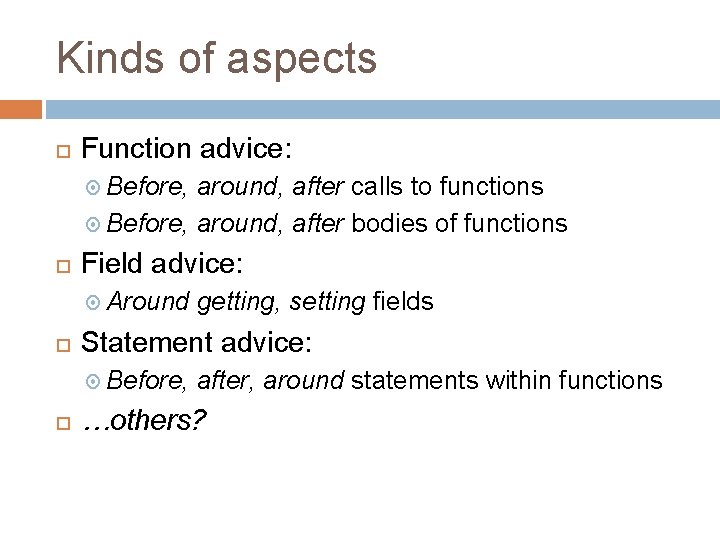
Kinds of aspects Function advice: Before, around, after calls to functions Before, around, after bodies of functions Field advice: Around Statement advice: Before, getting, setting fields after, around statements within functions …others?
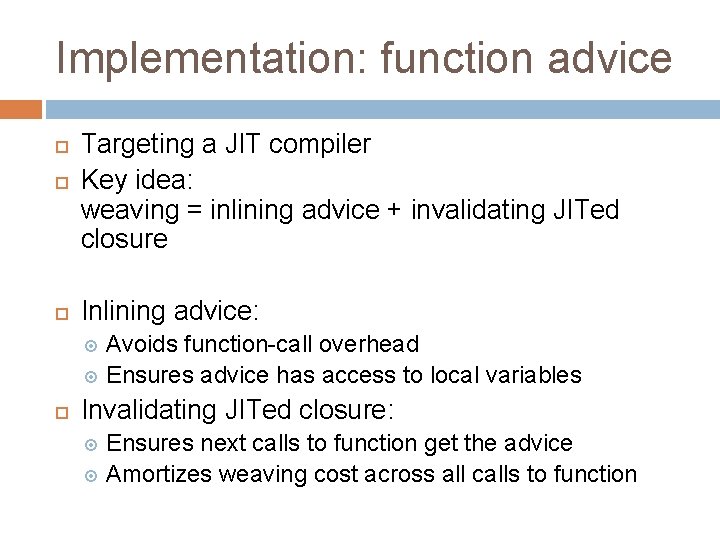
Implementation: function advice Targeting a JIT compiler Key idea: weaving = inlining advice + invalidating JITed closure Inlining advice: Avoids function-call overhead Ensures advice has access to local variables Invalidating JITed closure: Ensures next calls to function get the advice Amortizes weaving cost across all calls to function
Conclusions Extensions have strange behavior Existing techniques within JS are inadequate But we can’t simply outlaw all extensions Introduced dynamic aspect weaving as new JS language feature Provides cleaner semantics Provides better performance Provides sufficient expressive power for real extensions Win-win!
- Slides: 21