
Weathering and Soils GEOLOGY TODAY Chapter 7 Barbara
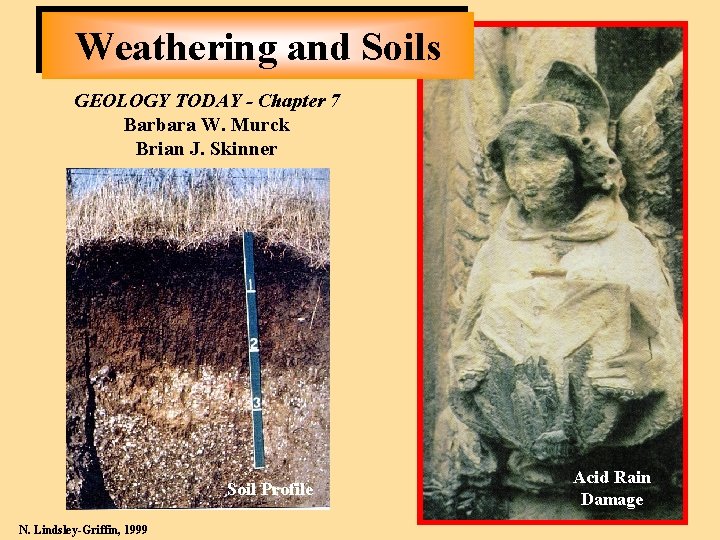
Weathering and Soils GEOLOGY TODAY - Chapter 7 Barbara W. Murck Brian J. Skinner Soil Profile N. Lindsley-Griffin, 1999 Acid Rain Damage
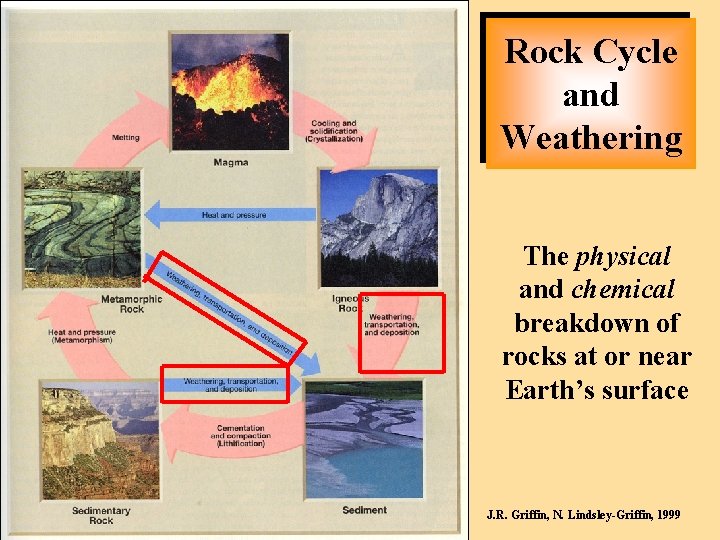
Rock Cycle and Weathering The physical and chemical breakdown of rocks at or near Earth’s surface J. R. Griffin, N. Lindsley-Griffin, 1999
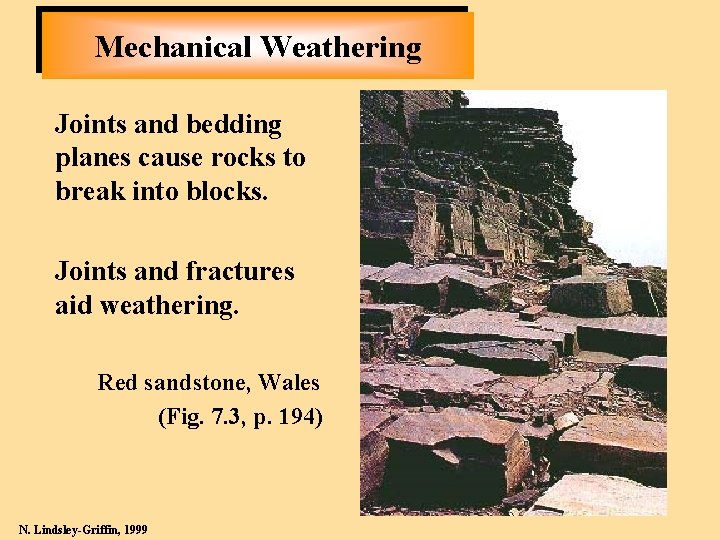
Mechanical Weathering Joints and bedding planes cause rocks to break into blocks. Joints and fractures aid weathering. Red sandstone, Wales (Fig. 7. 3, p. 194) N. Lindsley-Griffin, 1999
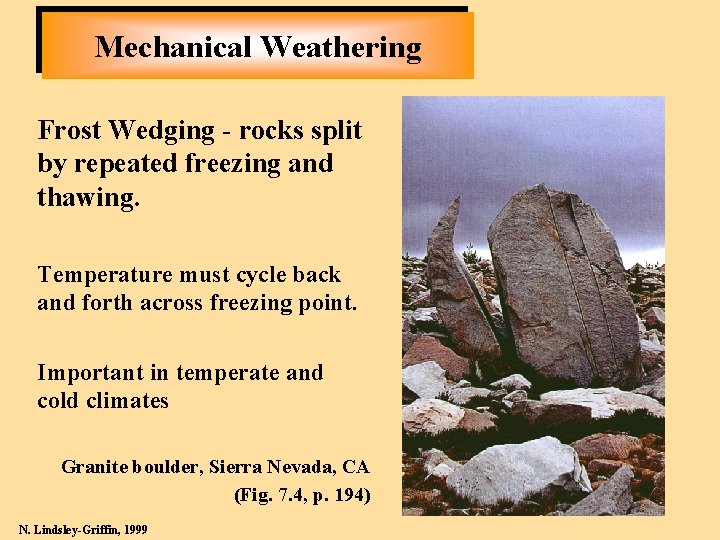
Mechanical Weathering Frost Wedging - rocks split by repeated freezing and thawing. Temperature must cycle back and forth across freezing point. Important in temperate and cold climates Granite boulder, Sierra Nevada, CA (Fig. 7. 4, p. 194) N. Lindsley-Griffin, 1999
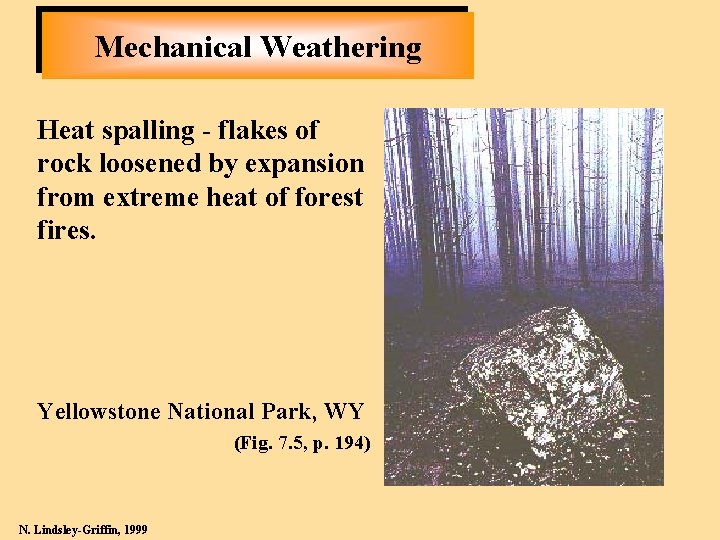
Mechanical Weathering Heat spalling - flakes of rock loosened by expansion from extreme heat of forest fires. Yellowstone National Park, WY (Fig. 7. 5, p. 194) N. Lindsley-Griffin, 1999
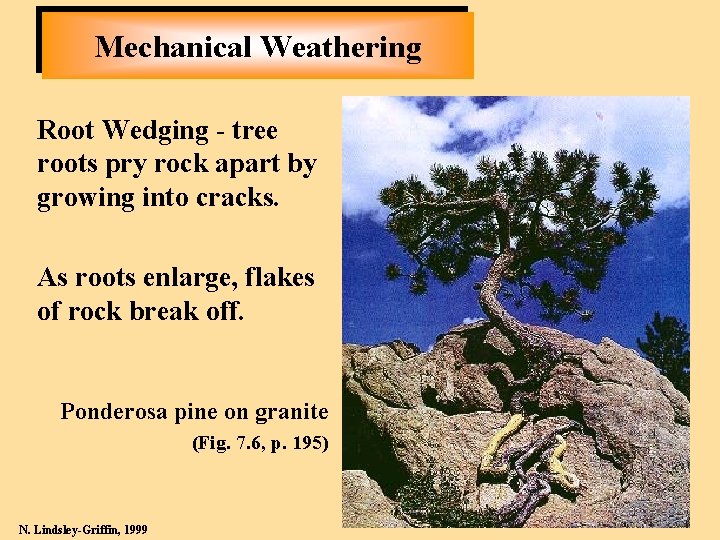
Mechanical Weathering Root Wedging - tree roots pry rock apart by growing into cracks. As roots enlarge, flakes of rock break off. Ponderosa pine on granite (Fig. 7. 6, p. 195) N. Lindsley-Griffin, 1999
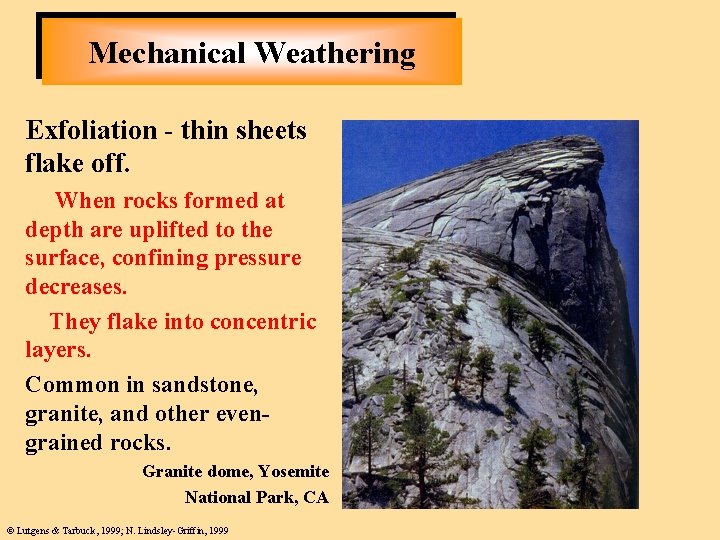
Mechanical Weathering Exfoliation - thin sheets flake off. When rocks formed at depth are uplifted to the surface, confining pressure decreases. They flake into concentric layers. Common in sandstone, granite, and other evengrained rocks. Granite dome, Yosemite National Park, CA © Lutgens & Tarbuck, 1999; N. Lindsley-Griffin, 1999
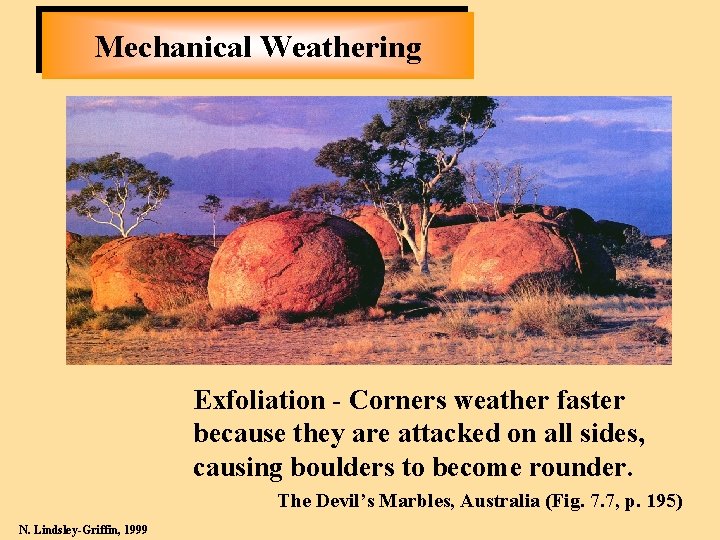
Mechanical Weathering Exfoliation - Corners weather faster because they are attacked on all sides, causing boulders to become rounder. The Devil’s Marbles, Australia (Fig. 7. 7, p. 195) N. Lindsley-Griffin, 1999
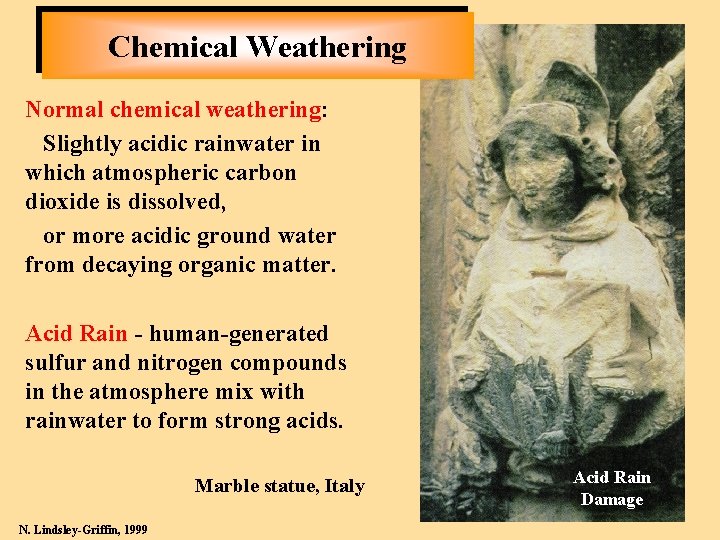
Chemical Weathering Normal chemical weathering: Slightly acidic rainwater in which atmospheric carbon dioxide is dissolved, or more acidic ground water from decaying organic matter. Acid Rain - human-generated sulfur and nitrogen compounds in the atmosphere mix with rainwater to form strong acids. Marble statue, Italy N. Lindsley-Griffin, 1999 Acid Rain Damage
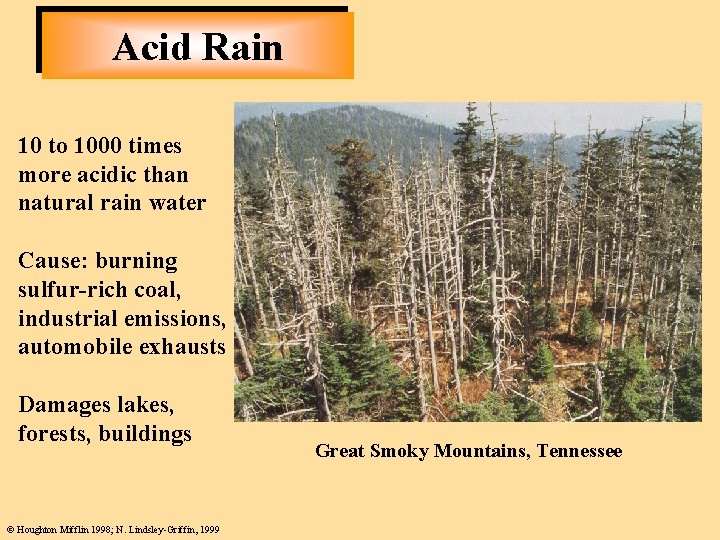
Acid Rain 10 to 1000 times more acidic than natural rain water Cause: burning sulfur-rich coal, industrial emissions, automobile exhausts Damages lakes, forests, buildings © Houghton Mifflin 1998; N. Lindsley-Griffin, 1999 Great Smoky Mountains, Tennessee
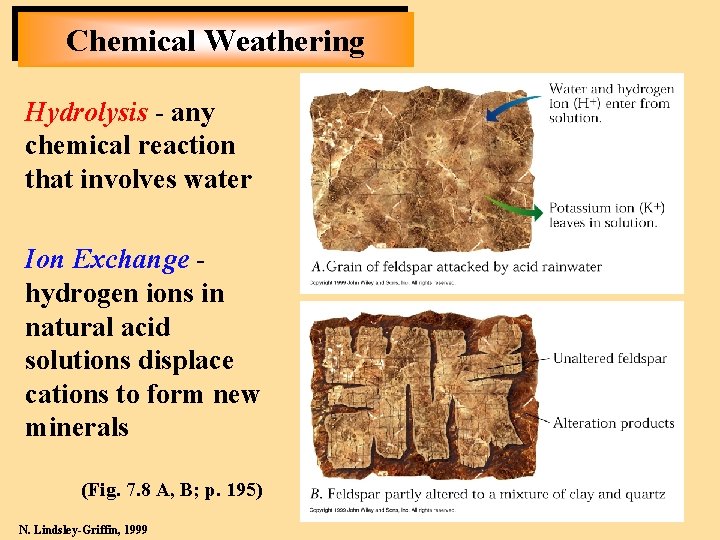
Chemical Weathering Hydrolysis - any chemical reaction that involves water Ion Exchange hydrogen ions in natural acid solutions displace cations to form new minerals (Fig. 7. 8 A, B; p. 195) N. Lindsley-Griffin, 1999
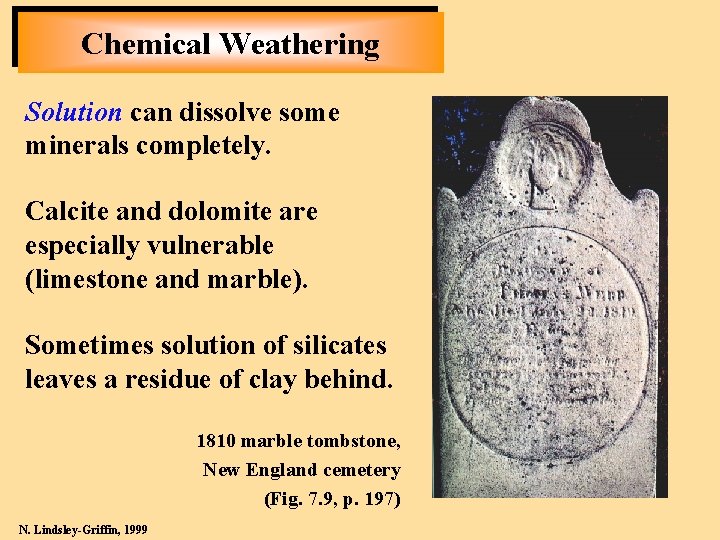
Chemical Weathering Solution can dissolve some minerals completely. Calcite and dolomite are especially vulnerable (limestone and marble). Sometimes solution of silicates leaves a residue of clay behind. 1810 marble tombstone, New England cemetery (Fig. 7. 9, p. 197) N. Lindsley-Griffin, 1999

Chemical Weathering Oxidation adds oxygen to iron in minerals to produce hematite and stain rocks and soil red. Oxidized soil, Hawaii (Fig. 7. 10, p. 197) N. Lindsley-Griffin, 1999
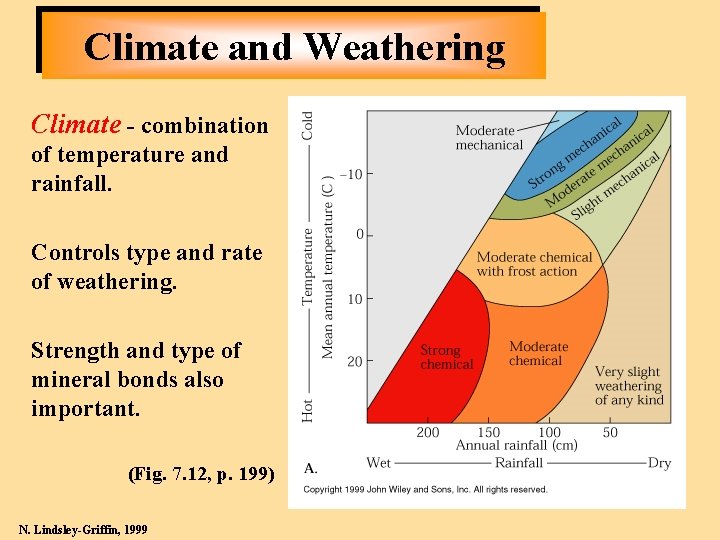
Climate and Weathering Climate - combination of temperature and rainfall. Controls type and rate of weathering. Strength and type of mineral bonds also important. (Fig. 7. 12, p. 199) N. Lindsley-Griffin, 1999
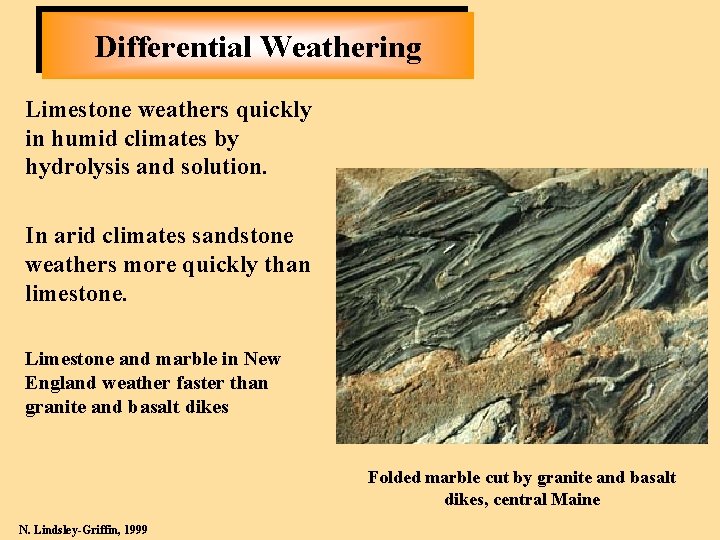
Differential Weathering Limestone weathers quickly in humid climates by hydrolysis and solution. In arid climates sandstone weathers more quickly than limestone. Limestone and marble in New England weather faster than granite and basalt dikes Folded marble cut by granite and basalt dikes, central Maine N. Lindsley-Griffin, 1999
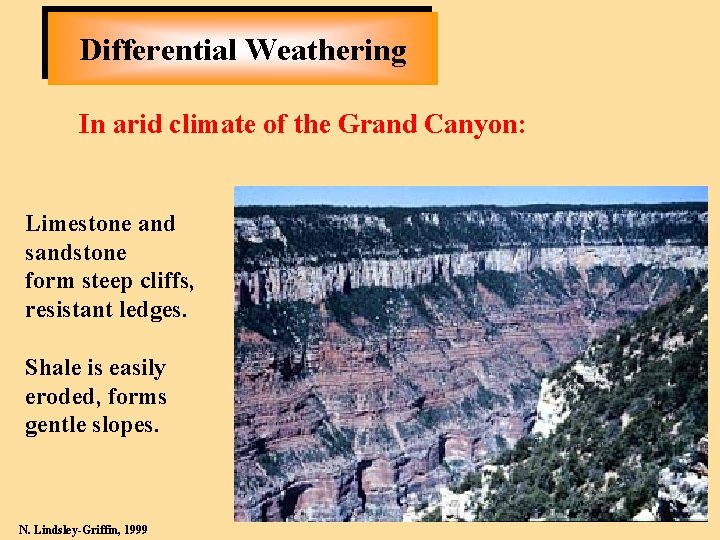
Differential Weathering In arid climate of the Grand Canyon: Limestone and sandstone form steep cliffs, resistant ledges. Shale is easily eroded, forms gentle slopes. N. Lindsley-Griffin, 1999
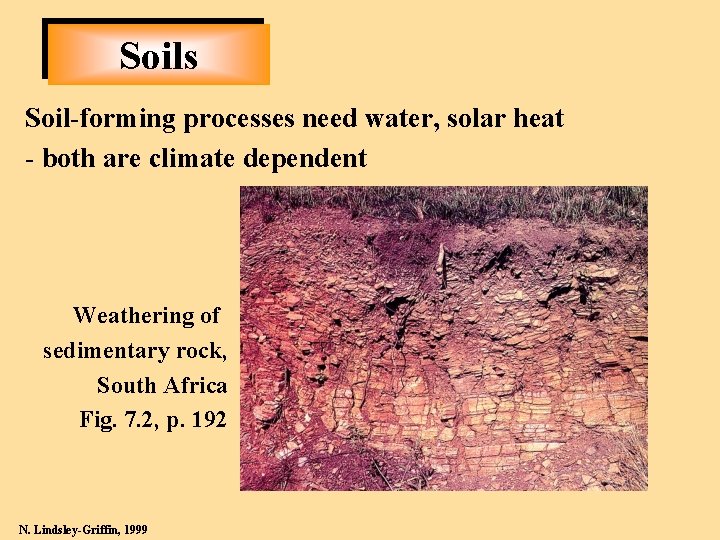
Soils Soil-forming processes need water, solar heat - both are climate dependent Weathering of sedimentary rock, South Africa Fig. 7. 2, p. 192 N. Lindsley-Griffin, 1999
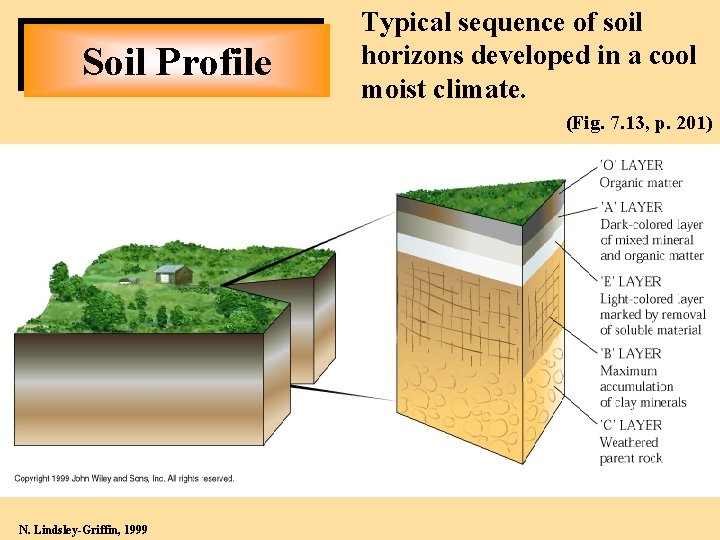
Soil Profile Typical sequence of soil horizons developed in a cool moist climate. (Fig. 7. 13, p. 201) N. Lindsley-Griffin, 1999
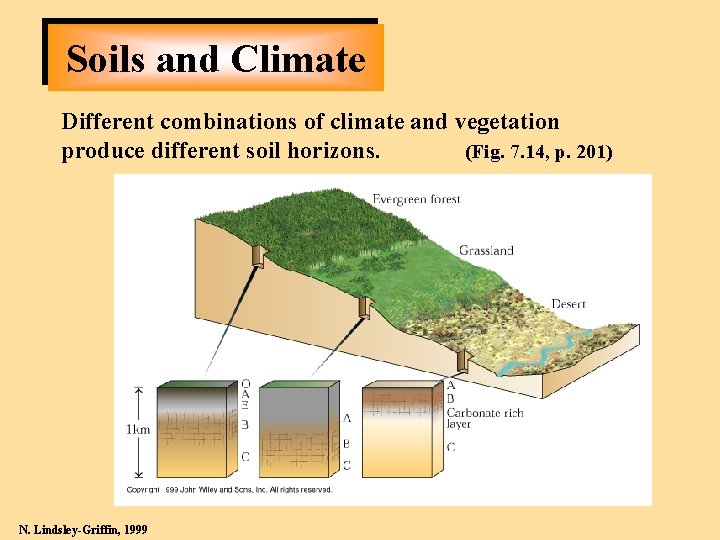
Soils and Climate Different combinations of climate and vegetation produce different soil horizons. (Fig. 7. 14, p. 201) N. Lindsley-Griffin, 1999
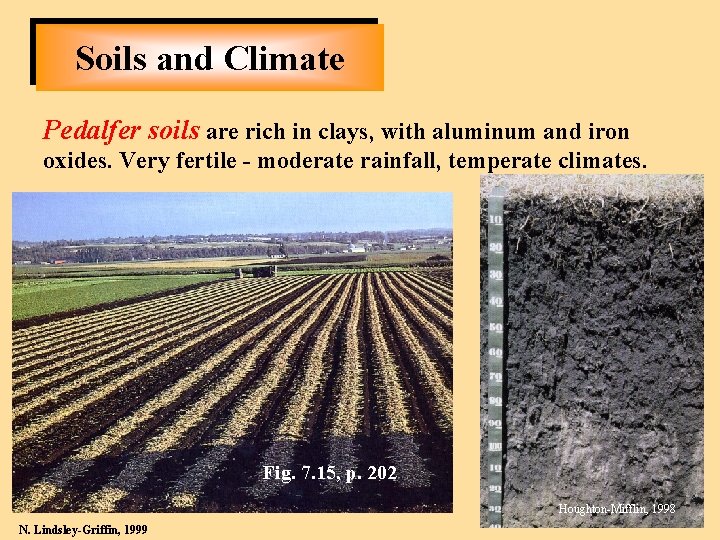
Soils and Climate Pedalfer soils are rich in clays, with aluminum and iron oxides. Very fertile - moderate rainfall, temperate climates. Fig. 7. 15, p. 202 Houghton-Mifflin, 1998 N. Lindsley-Griffin, 1999
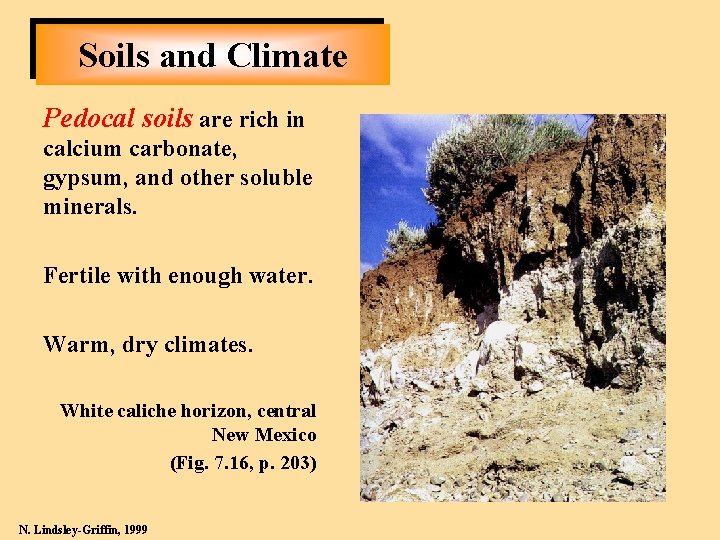
Soils and Climate Pedocal soils are rich in calcium carbonate, gypsum, and other soluble minerals. Fertile with enough water. Warm, dry climates. White caliche horizon, central New Mexico (Fig. 7. 16, p. 203) N. Lindsley-Griffin, 1999
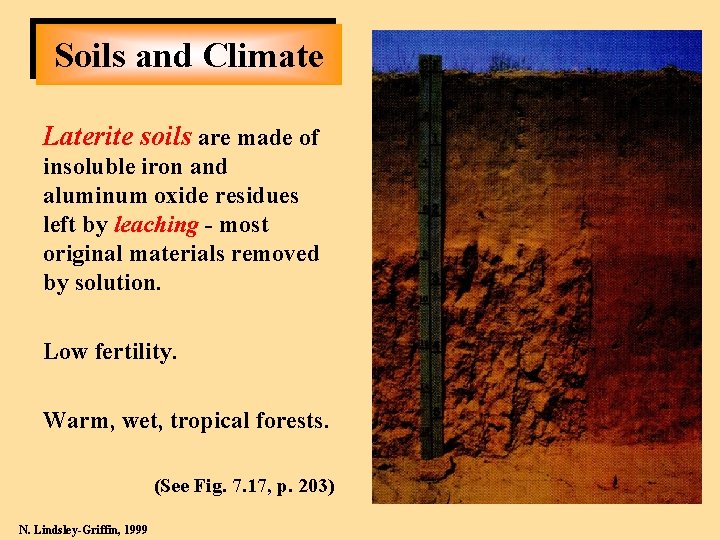
Soils and Climate Laterite soils are made of insoluble iron and aluminum oxide residues left by leaching - most original materials removed by solution. Low fertility. Warm, wet, tropical forests. (See Fig. 7. 17, p. 203) N. Lindsley-Griffin, 1999
- Slides: 22