
Weathering and Erosion Research Project and Stream Table
* Weathering and Erosion Research Project and Stream Table Experiment
* Warm-Up 1/22/15 Learning Target #15: I can differentiate between weathering and erosion, and provide examples of how each process occurs. 1. Describe the difference between weathering and erosion 2. Explain one example of weathering 3. Explain one example of erosion

* * Want to Collaborate? Be aware that if you choose to work with partners, any disagreements/problems that arise that cause the project to be non -proficient or incomplete will be YOUR responsibility.
Please post your project to your correct class: Class Codes * * * Hour Hour * 1 code: bvvcxu 5 code: pmahpa 9 code: 6 xkctm 11 code: 7 gbpe 7 13 code: ixkb 4 f 15 code: ca 6 fp 4 Posting to Edmodo

* Stream Table Lab 5

* Learning Target #16 * I can generate a question that can be investigated using resources and equipment available. (Hypothesis, Research, and Problem) 6

* Learning Target #17 *I can design and safely conduct an investigation that provides reliable quantitative data. (Materials, Procedure, Data) 7

* Learning Target #18 *I can use technology to organize and present experimental data (Analysis, Format) 8
* Learning Target #19 * I can explain what I have learned from an investigation based upon the data that I collected, and apply those findings to real-world scenarios. (Conclusion and Implications) 9
* Mass Movement: Land Slides * https: //www. youtube. com/watch? v=mkn. St. AMia 0 Q * Watch the video * Develop 2 -3 questions or inferences related to what you see about mass movement and erosion 10
* Essential Question: What factors effect the rate of erosion? Rate of Erosion- how much sediment is moved in a certain amount of time 11
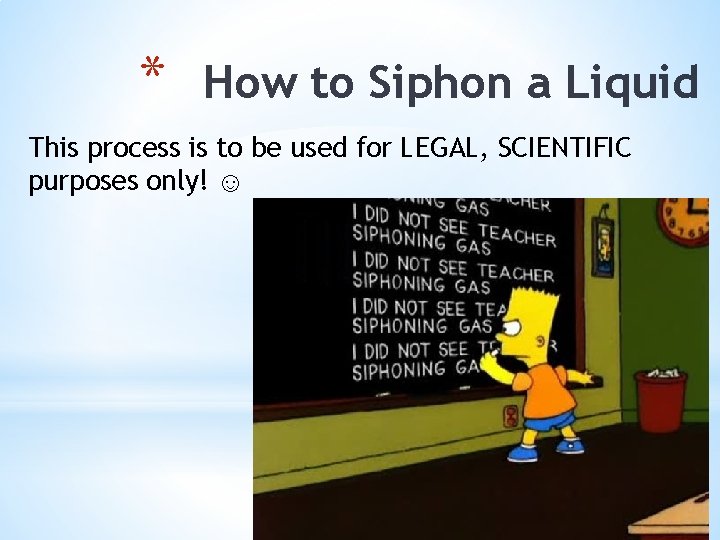
* How to Siphon a Liquid This process is to be used for LEGAL, SCIENTIFIC purposes only! ☺ 12
* * * * Set-Up for Siphoning a Liquid Black bucket filled to line with water 1 plastic bucket filled 1/4 full with water 1 plastic bucket (empty) 1 tubing with glass dropper 1 funnel with long stem Small plastic cup 1 towel 13
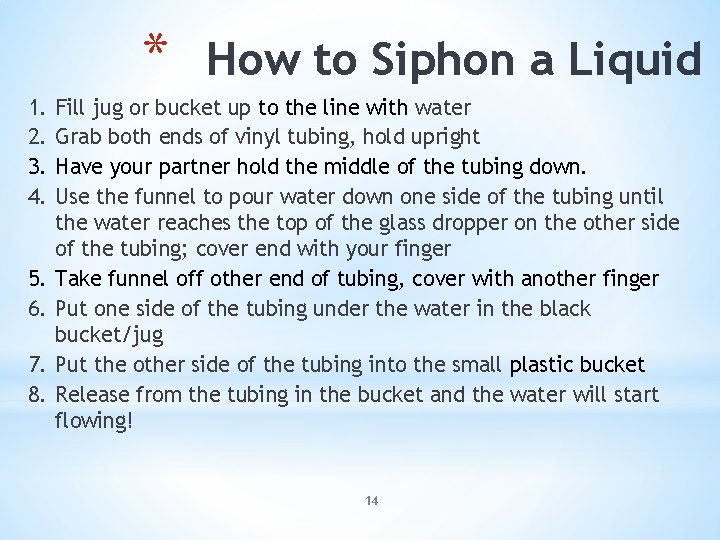
* 1. 2. 3. 4. 5. 6. 7. 8. How to Siphon a Liquid Fill jug or bucket up to the line with water Grab both ends of vinyl tubing, hold upright Have your partner hold the middle of the tubing down. Use the funnel to pour water down one side of the tubing until the water reaches the top of the glass dropper on the other side of the tubing; cover end with your finger Take funnel off other end of tubing, cover with another finger Put one side of the tubing under the water in the black bucket/jug Put the other side of the tubing into the small plastic bucket Release from the tubing in the bucket and the water will start flowing! 14
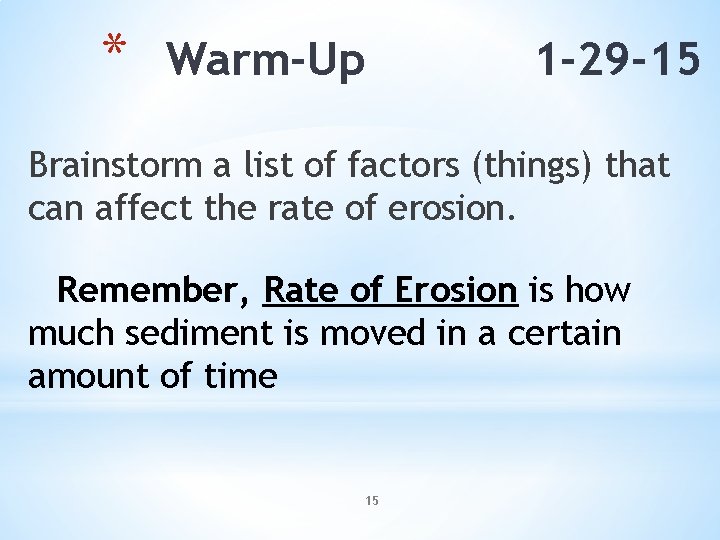
* Warm-Up 1 -29 -15 Brainstorm a list of factors (things) that can affect the rate of erosion. Remember, Rate of Erosion is how much sediment is moved in a certain amount of time 15
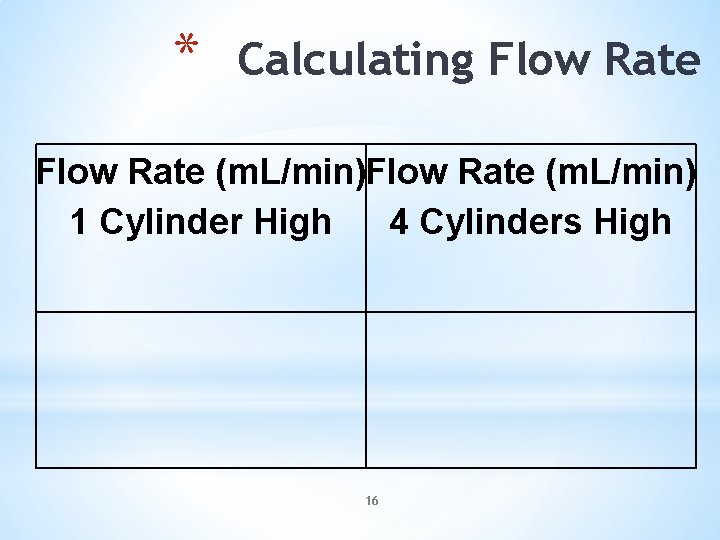
* Calculating Flow Rate (m. L/min)Flow Rate (m. L/min) 1 Cylinder High 4 Cylinders High 16
* 1. 2. 3. Today’s Jobs Water to the line keeper Time keeper Data recorder 17
* Calculating Flow Rate 1. Place the black bucket on top of 1 cylinder (lid on!) 2. Siphon water into small plastic bucket with water until it reaches a steady flow 3. QUICKLY transfer water flow to an EMPTY plastic bucket. Begin timing immediately. Time for 1 minute. *Make sure to keep refilling the water in the black bucket up to the line as it flows out in order to keep the flow rate the same 4. Use funnel to pour water from small bucket into large graduated cylinder. Measure the amount of water to determine flow rate. Units are written as follows: __ m. L per minute 18
* Changing the Flow Rate Keep the top lid on the cylinders at all times! Use all 4 cylinders to make the bucket of water higher. Calculate your flow rate for 1 minute. What can we conclude about the relationship between height of water and flow rate? 19
* Flow Rate Challenge Keep the top lid on the cylinders at all times! Use the black cylinders and the clamp to create a flow rate of EXACTLY 275 m. L per minute. *The clamp should be used to fine-tune the flow. 20
* Determining Slope of Stream Table 1. Use wooden blocks to adjust how the angle of the stream table 2. Line up protractor arrow directly in front of where stream table touches the lab table 3. Measure the space in between the lab table and stream table to determine the angle (slope). 21
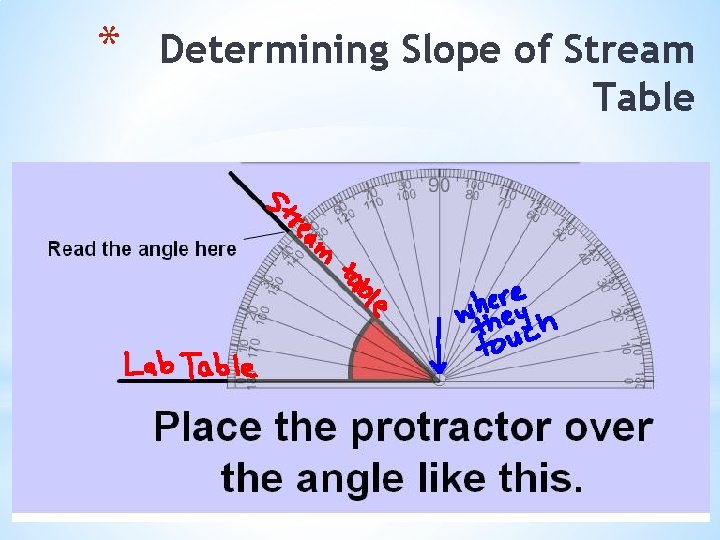
* Determining Slope of Stream Table 22
* 1. 2. 3. Creating a Slope Make your table have a slope of 10° Make your table have a slope of 15° Make your table have a slope of 25° 23
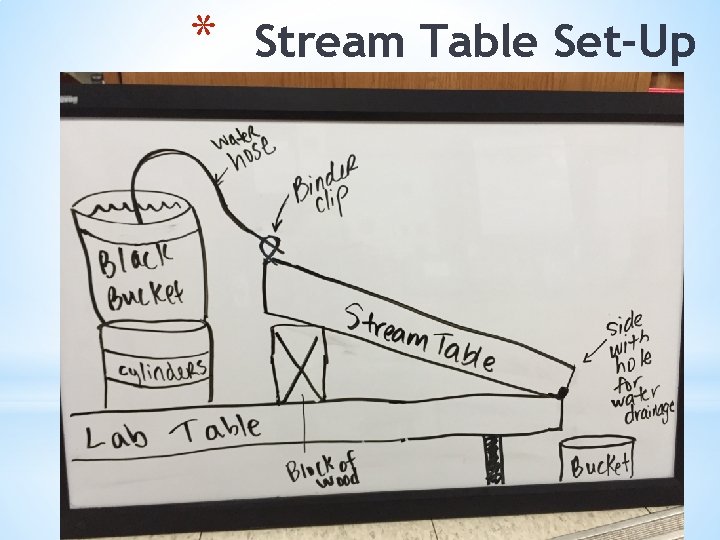
* Stream Table Set-Up 24
* 1. 2. 3. 4. 5. 6. 7. 8. Lab Readiness Check-List Correct slope of stream table set Fl. AT, 21 cm long plateau made Binder clip attached to stream table Tape the string across the table Keep refilling the black bucket Picture taker!!!!! During and end result Timer! Do Last Match your flow rate (time for 1 minute- once you’ve got it, don’t take the tubing out of the water!!! We can adjust it 25 from there. )
* 1. 2. Warm-Up 2 -10 -15 Explain how your experiment could be improved if you repeated it again. Why do you make those recommendations? (Be detailed— 4 to 6 sentences. The more you write now, the less you thinking/reflecting you will have to do for your Lab Write-Up Conclusion) 26
* 1. 2. Warm-Up 2 -10 -15 Explain how your experiment could be improved if you repeated it again. Why do you make those recommendations? (Be detailed— 4 to 6 sentences. The more you write now, the less you thinking/reflecting you will have to do for your Lab Write-Up Conclusion) 27
* Implications (Copy this in your lab report) Discuss how you would deal with: flow rate of river water or rain flowing down the hill, type of sediment, AND slope of land. INCLUDE WHY or HOW YOUR IDEAS WILL CAUSE LESS EROSION!! You just bought a piece of land along the Fox River. The land has a steep slope down to the waters edge (shoreline). How would you develop this land to insure the least amount of erosion? Be specific about: * How or where would you place any buildings on the land? Explain. * What you would want to do to the shoreline? Explain. 28

29
- Slides: 29