
WEATHER What is Weather Weather refers to the
- Slides: 75
WEATHER
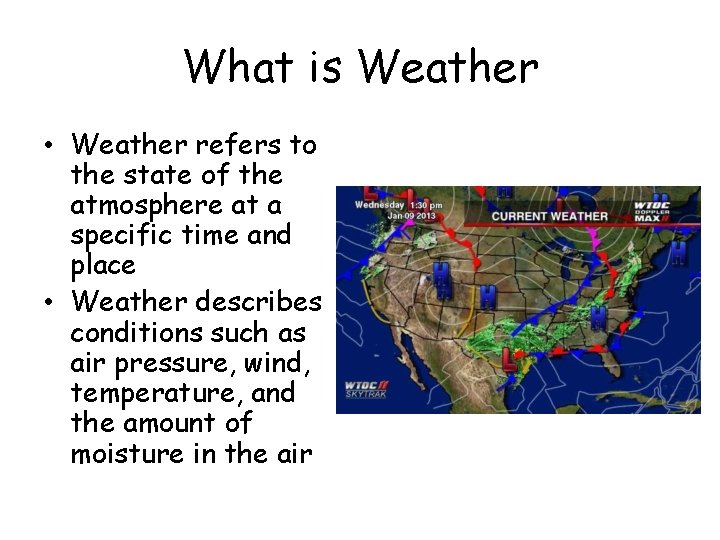
What is Weather • Weather refers to the state of the atmosphere at a specific time and place • Weather describes conditions such as air pressure, wind, temperature, and the amount of moisture in the air
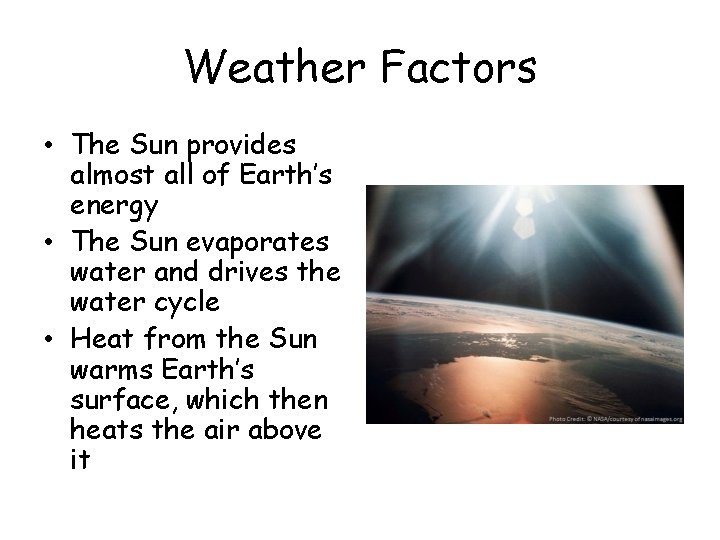
Weather Factors • The Sun provides almost all of Earth’s energy • The Sun evaporates water and drives the water cycle • Heat from the Sun warms Earth’s surface, which then heats the air above it
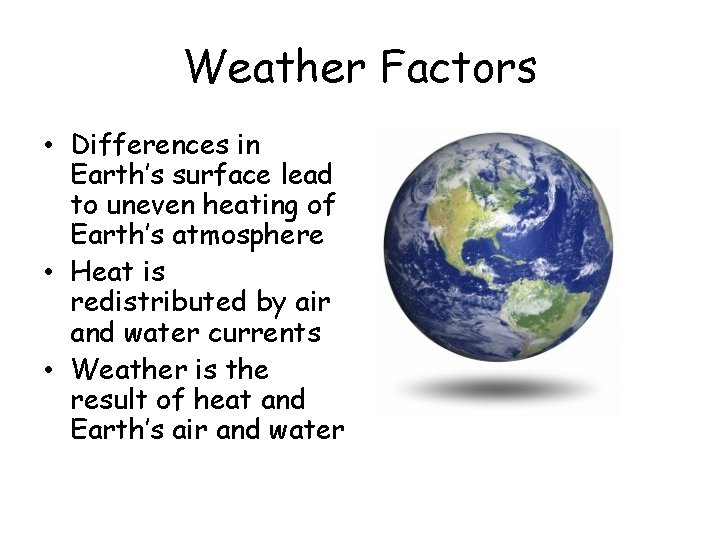
Weather Factors • Differences in Earth’s surface lead to uneven heating of Earth’s atmosphere • Heat is redistributed by air and water currents • Weather is the result of heat and Earth’s air and water
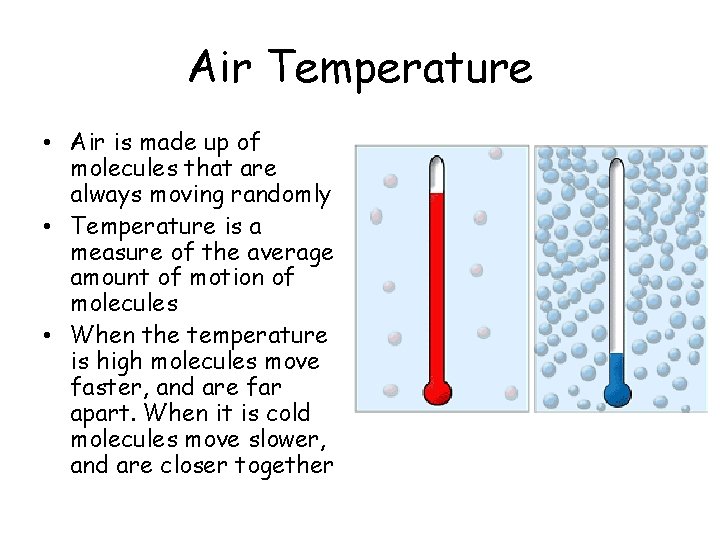
Air Temperature • Air is made up of molecules that are always moving randomly • Temperature is a measure of the average amount of motion of molecules • When the temperature is high molecules move faster, and are far apart. When it is cold molecules move slower, and are closer together
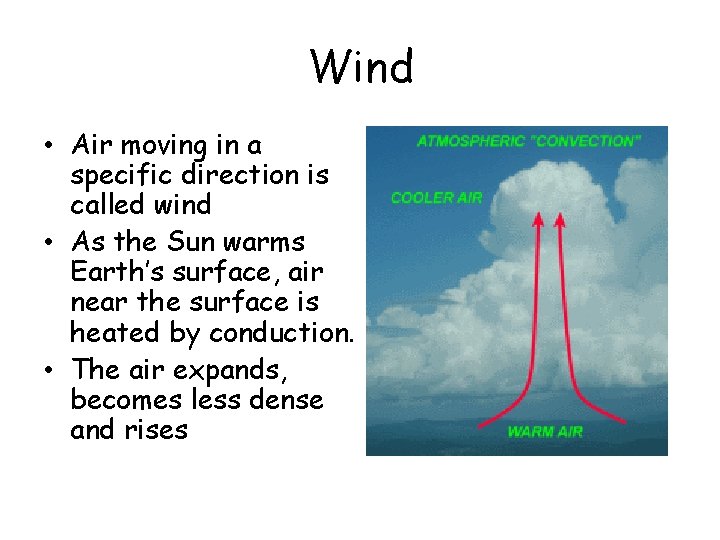
Wind • Air moving in a specific direction is called wind • As the Sun warms Earth’s surface, air near the surface is heated by conduction. • The air expands, becomes less dense and rises
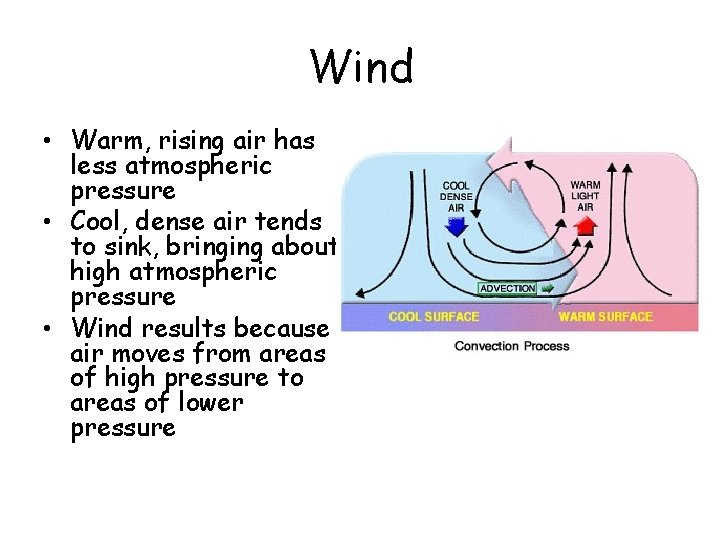
Wind • Warm, rising air has less atmospheric pressure • Cool, dense air tends to sink, bringing about high atmospheric pressure • Wind results because air moves from areas of high pressure to areas of lower pressure
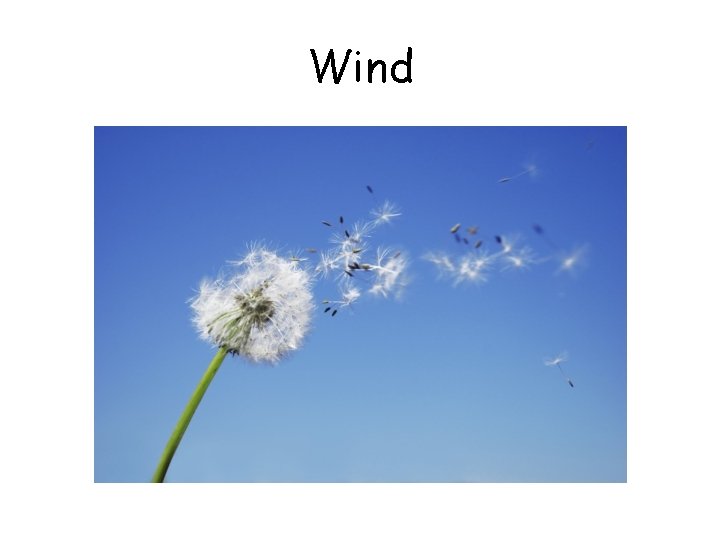
Wind
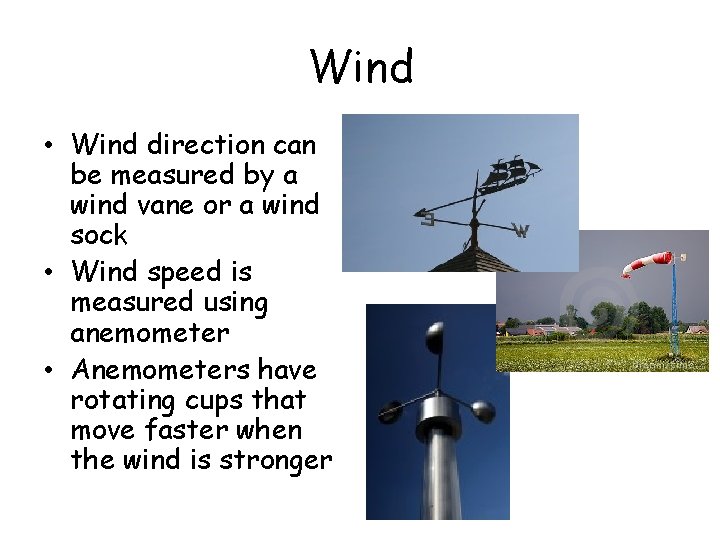
Wind • Wind direction can be measured by a wind vane or a wind sock • Wind speed is measured using anemometer • Anemometers have rotating cups that move faster when the wind is stronger
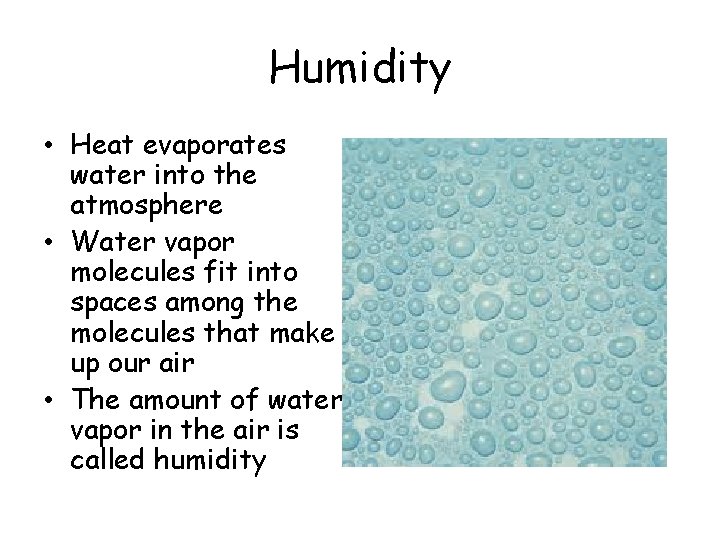
Humidity • Heat evaporates water into the atmosphere • Water vapor molecules fit into spaces among the molecules that make up our air • The amount of water vapor in the air is called humidity
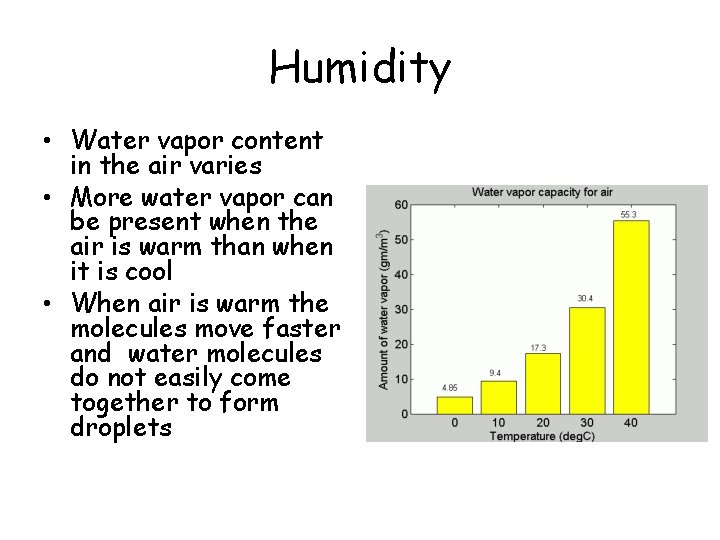
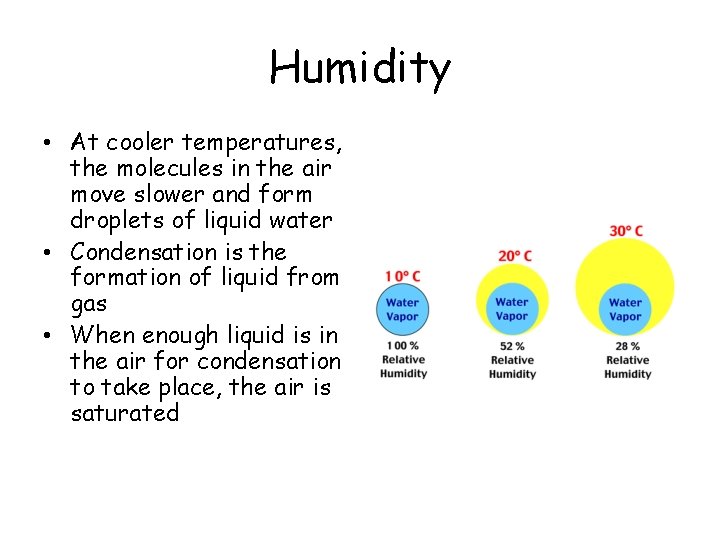
Humidity • Water vapor content in the air varies • More water vapor can be present when the air is warm than when it is cool • When air is warm the molecules move faster and water molecules do not easily come together to form droplets
Humidity • At cooler temperatures, the molecules in the air move slower and form droplets of liquid water • Condensation is the formation of liquid from gas • When enough liquid is in the air for condensation to take place, the air is saturated
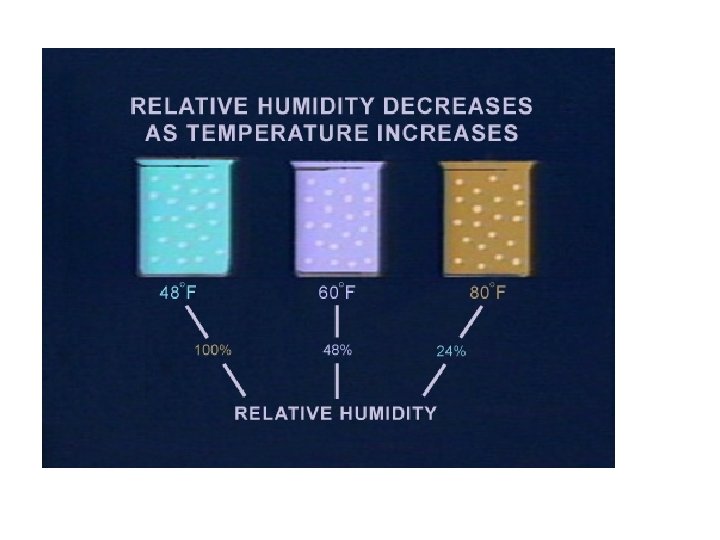
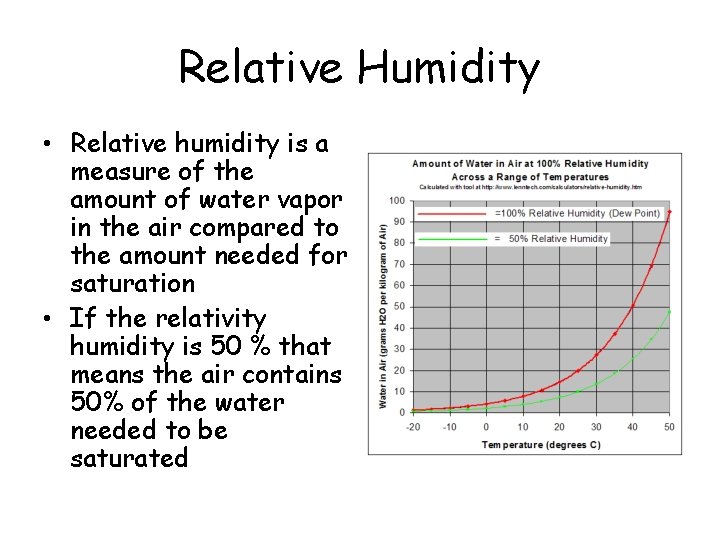
Relative Humidity • Relative humidity is a measure of the amount of water vapor in the air compared to the amount needed for saturation • If the relativity humidity is 50 % that means the air contains 50% of the water needed to be saturated
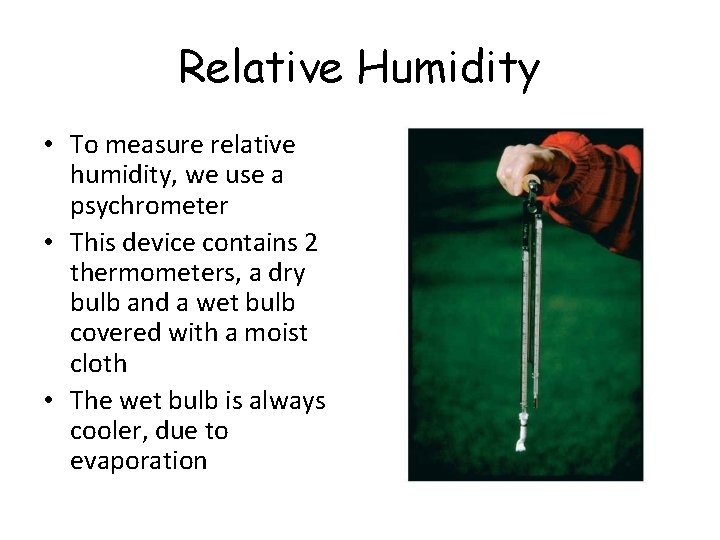
Relative Humidity • To measure relative humidity, we use a psychrometer • This device contains 2 thermometers, a dry bulb and a wet bulb covered with a moist cloth • The wet bulb is always cooler, due to evaporation
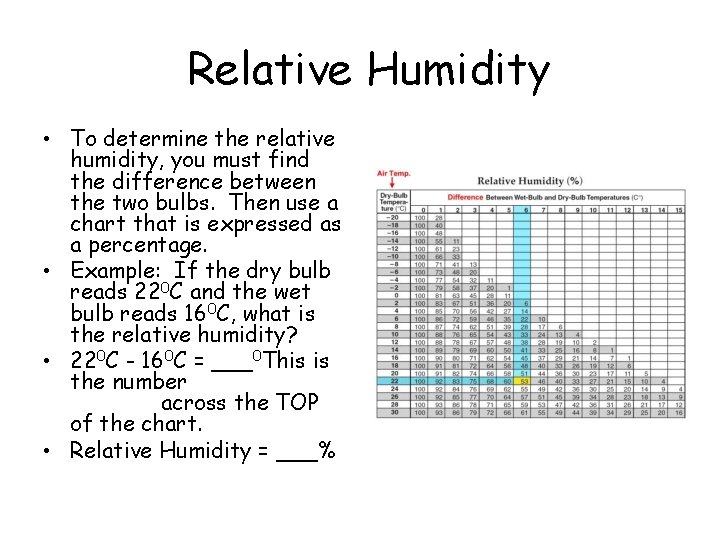
Relative Humidity • To determine the relative humidity, you must find the difference between the two bulbs. Then use a chart that is expressed as a percentage. • Example: If the dry bulb reads 220 C and the wet bulb reads 160 C, what is the relative humidity? • 220 C - 160 C = ___0 This is the number across the TOP of the chart. • Relative Humidity = ___%
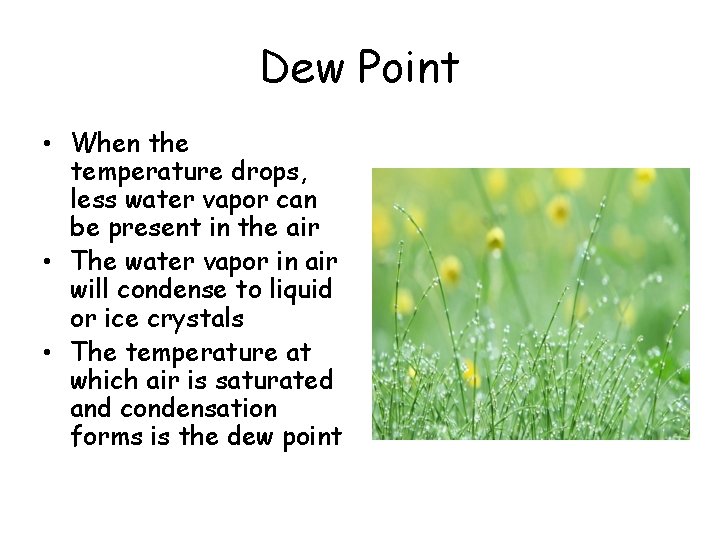
Dew Point • When the temperature drops, less water vapor can be present in the air • The water vapor in air will condense to liquid or ice crystals • The temperature at which air is saturated and condensation forms is the dew point
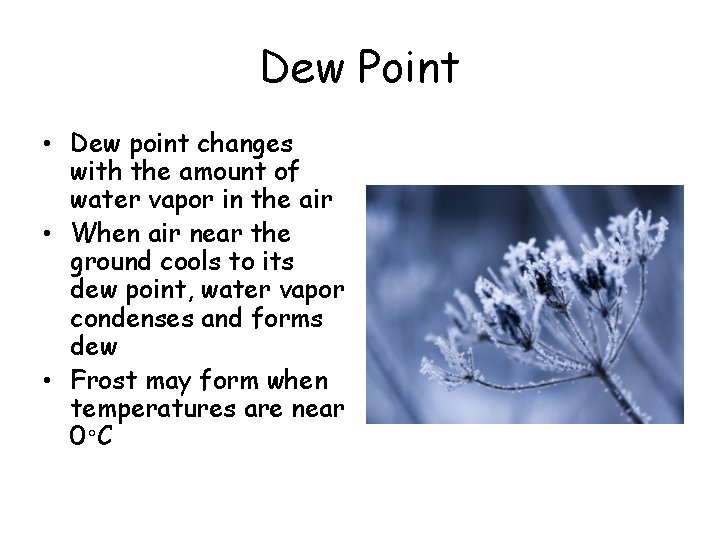
Dew Point • Dew point changes with the amount of water vapor in the air • When air near the ground cools to its dew point, water vapor condenses and forms dew • Frost may form when temperatures are near 0◦C
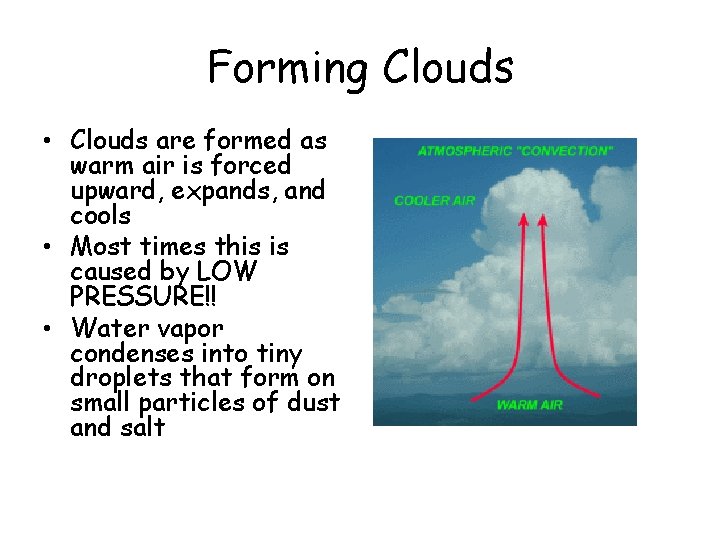
Forming Clouds • Clouds are formed as warm air is forced upward, expands, and cools • Most times this is caused by LOW PRESSURE!! • Water vapor condenses into tiny droplets that form on small particles of dust and salt
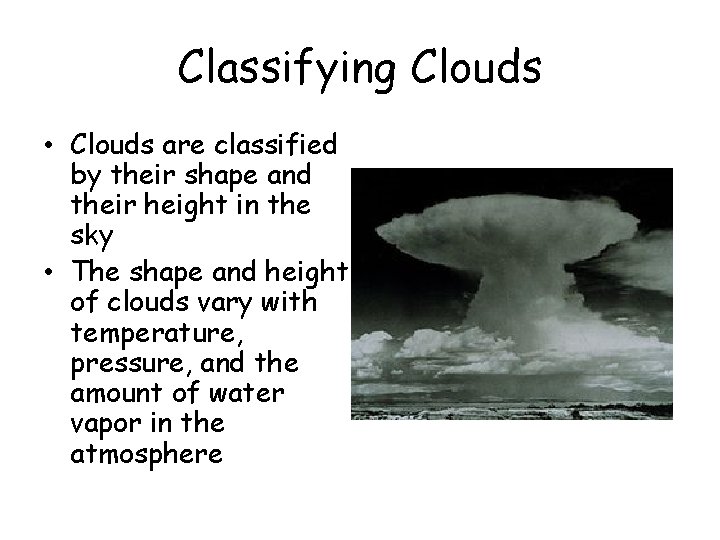
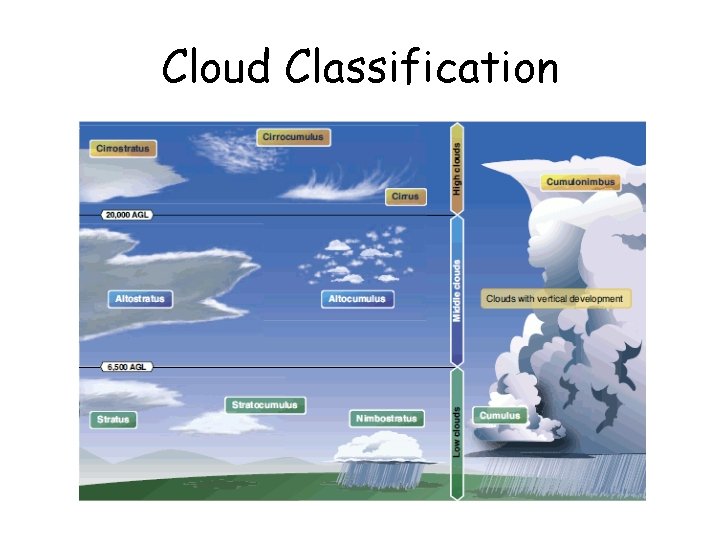
Classifying Clouds • Clouds are classified by their shape and their height in the sky • The shape and height of clouds vary with temperature, pressure, and the amount of water vapor in the atmosphere
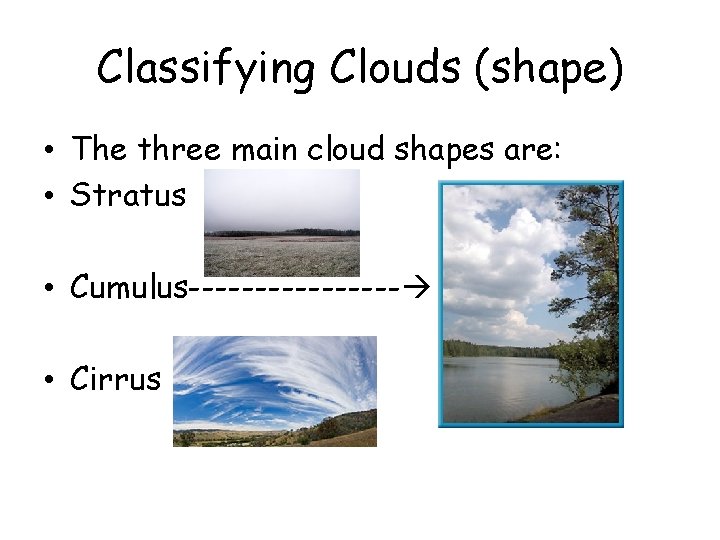
Classifying Clouds (shape) • The three main cloud shapes are: • Stratus • Cumulus-------- • Cirrus
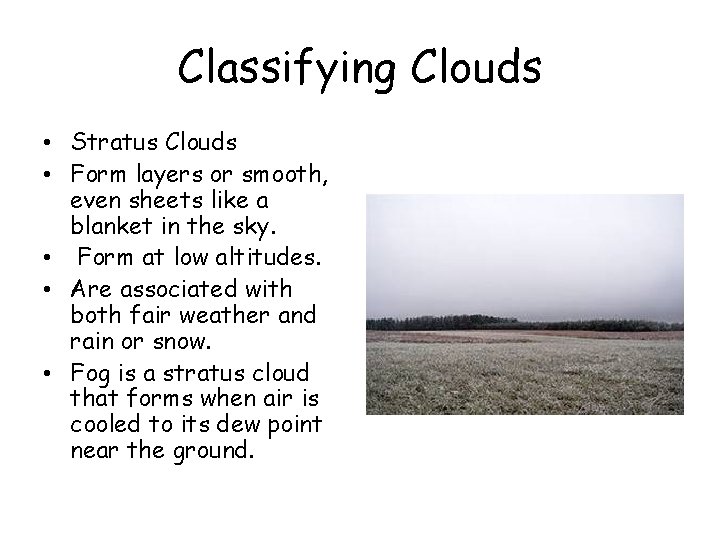
Classifying Clouds • Stratus Clouds • Form layers or smooth, even sheets like a blanket in the sky. • Form at low altitudes. • Are associated with both fair weather and rain or snow. • Fog is a stratus cloud that forms when air is cooled to its dew point near the ground.
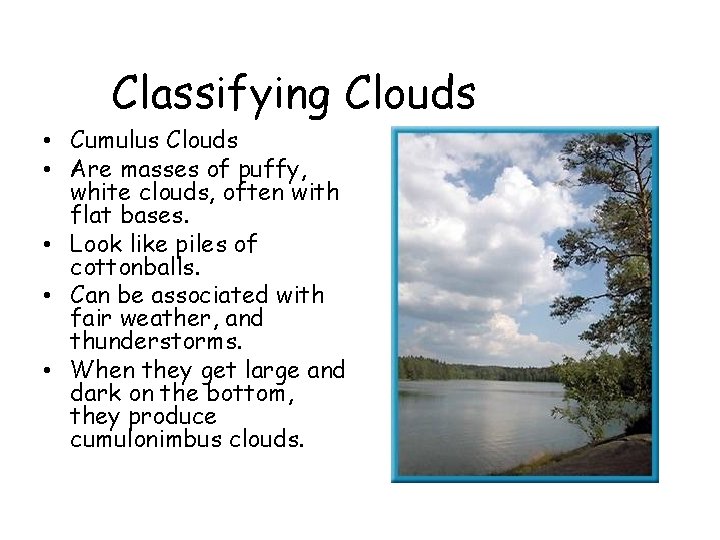
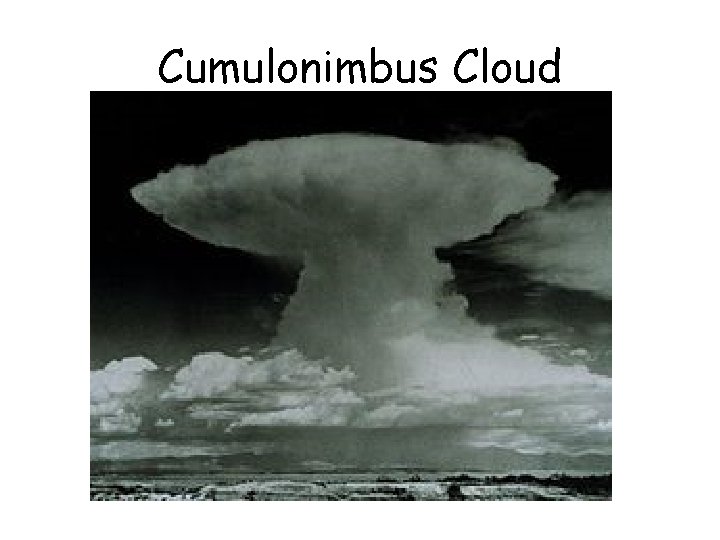
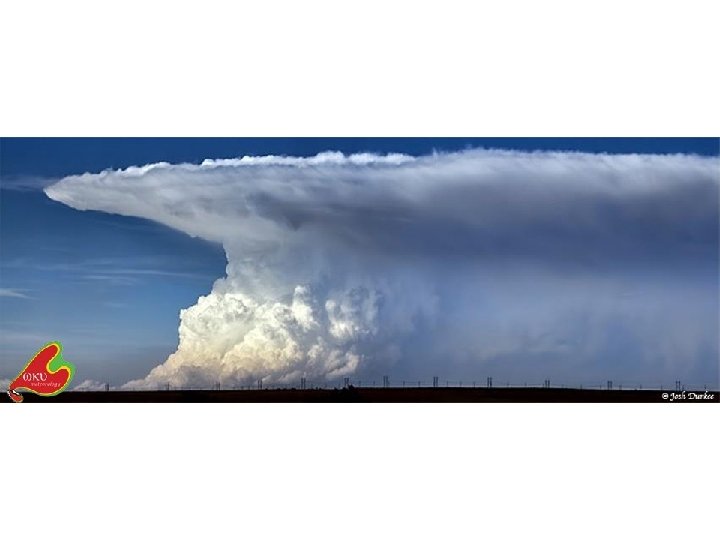
Classifying Clouds • Cumulus Clouds • Are masses of puffy, white clouds, often with flat bases. • Look like piles of cottonballs. • Can be associated with fair weather, and thunderstorms. • When they get large and dark on the bottom, they produce cumulonimbus clouds.
Cumulonimbus Cloud
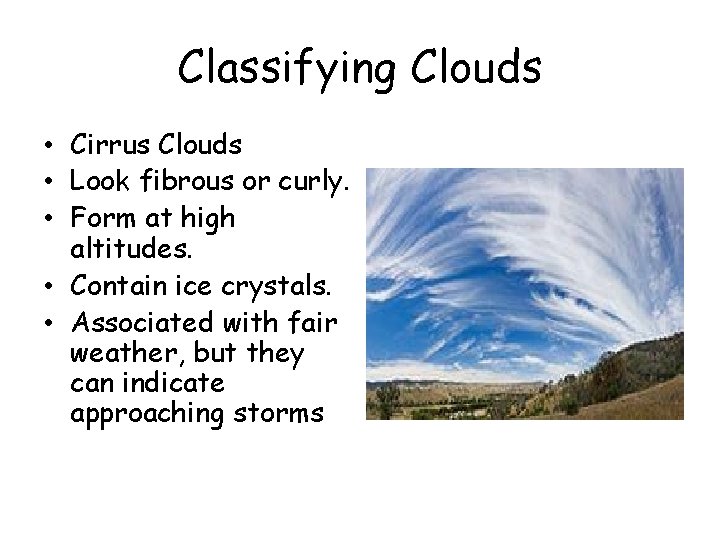
Classifying Clouds • Cirrus Clouds • Look fibrous or curly. • Form at high altitudes. • Contain ice crystals. • Associated with fair weather, but they can indicate approaching storms
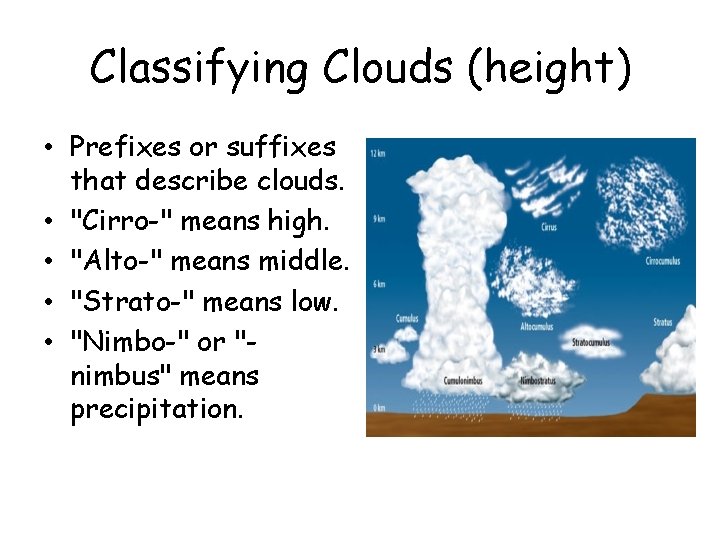
Classifying Clouds (height) • Prefixes or suffixes that describe clouds. • "Cirro-" means high. • "Alto-" means middle. • "Strato-" means low. • "Nimbo-" or "nimbus" means precipitation.
Cloud Classification
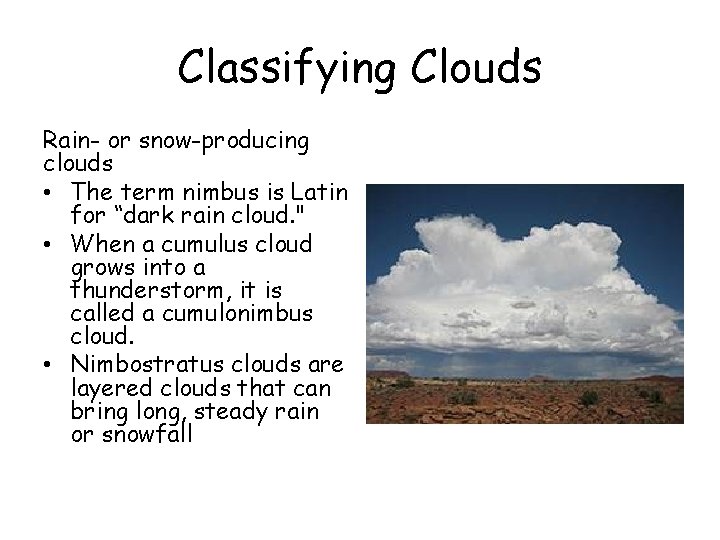
Classifying Clouds Rain- or snow-producing clouds • The term nimbus is Latin for “dark rain cloud. " • When a cumulus cloud grows into a thunderstorm, it is called a cumulonimbus cloud. • Nimbostratus clouds are layered clouds that can bring long, steady rain or snowfall
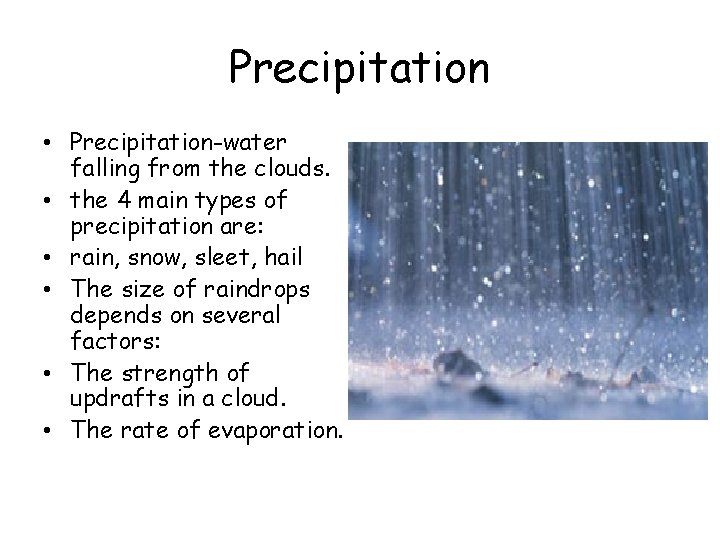
Precipitation • Precipitation-water falling from the clouds. • the 4 main types of precipitation are: • rain, snow, sleet, hail • The size of raindrops depends on several factors: • The strength of updrafts in a cloud. • The rate of evaporation.
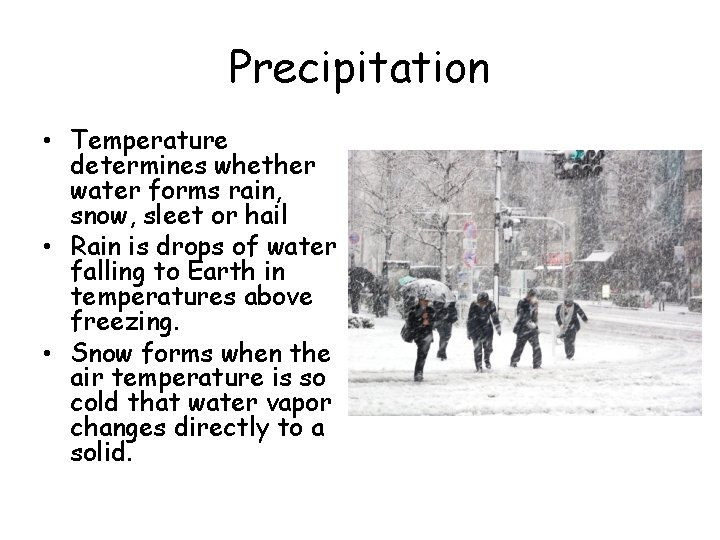
Precipitation • Temperature determines whether water forms rain, snow, sleet or hail • Rain is drops of water falling to Earth in temperatures above freezing. • Snow forms when the air temperature is so cold that water vapor changes directly to a solid.
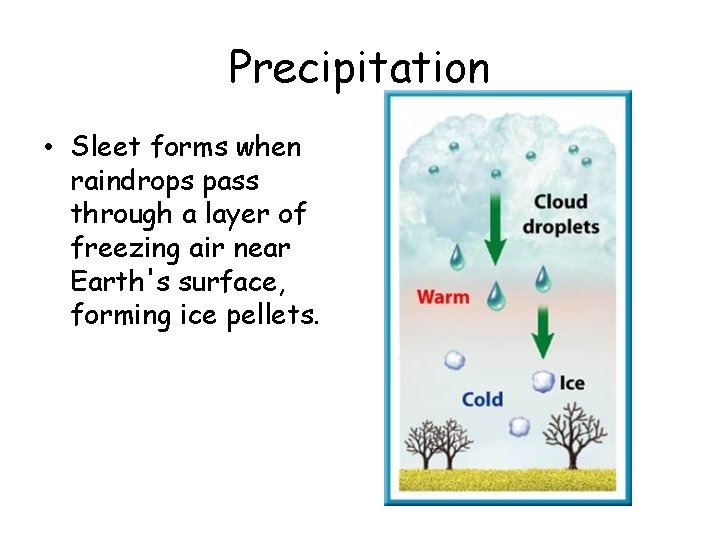
Precipitation • Sleet forms when raindrops pass through a layer of freezing air near Earth's surface, forming ice pellets.
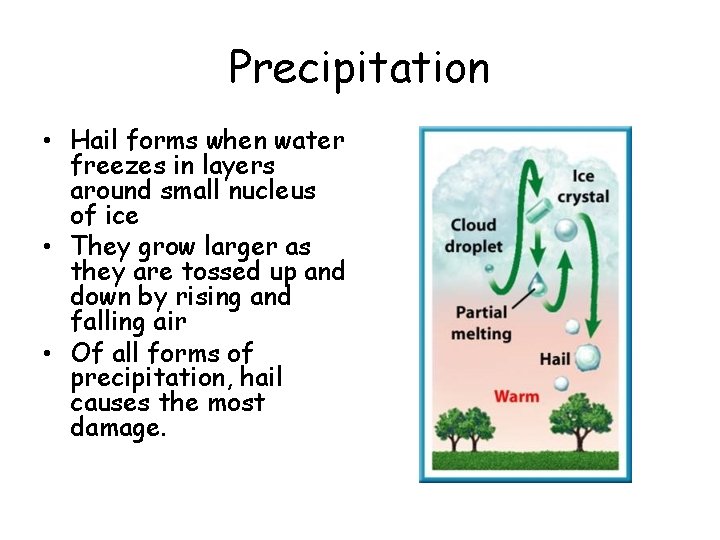
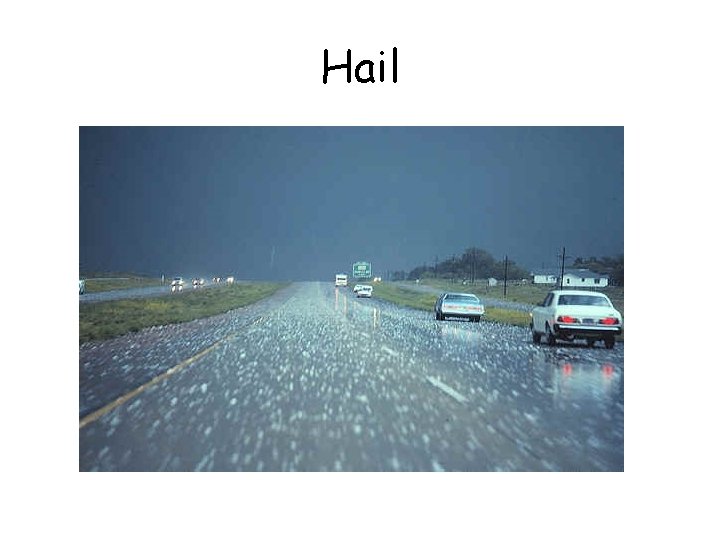
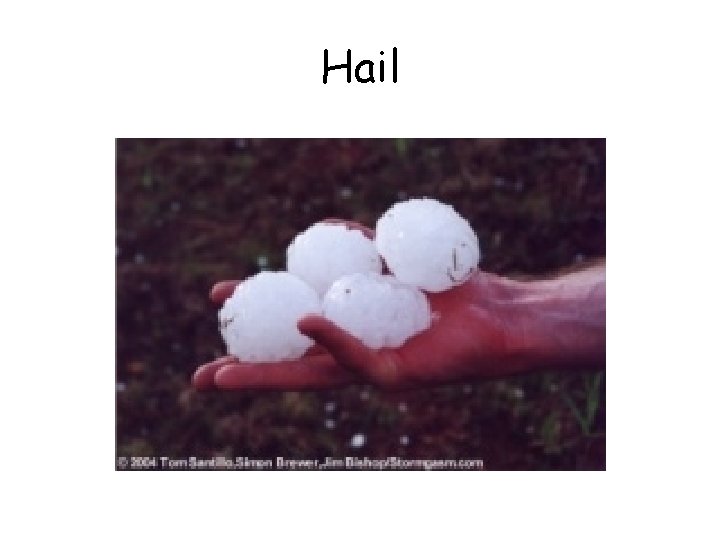
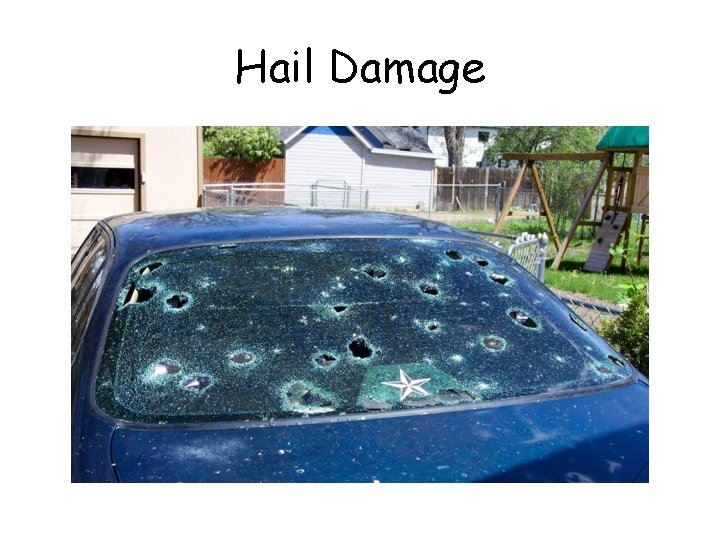
Precipitation • Hail forms when water freezes in layers around small nucleus of ice • They grow larger as they are tossed up and down by rising and falling air • Of all forms of precipitation, hail causes the most damage.
Hail
Hail
Hail Damage
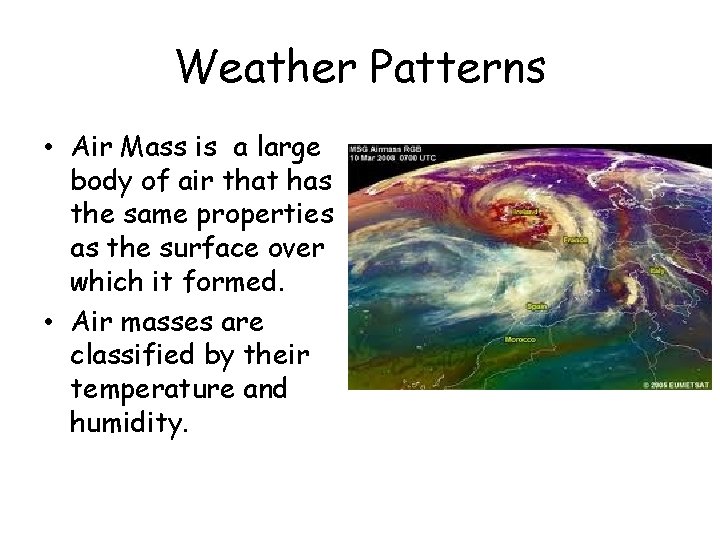
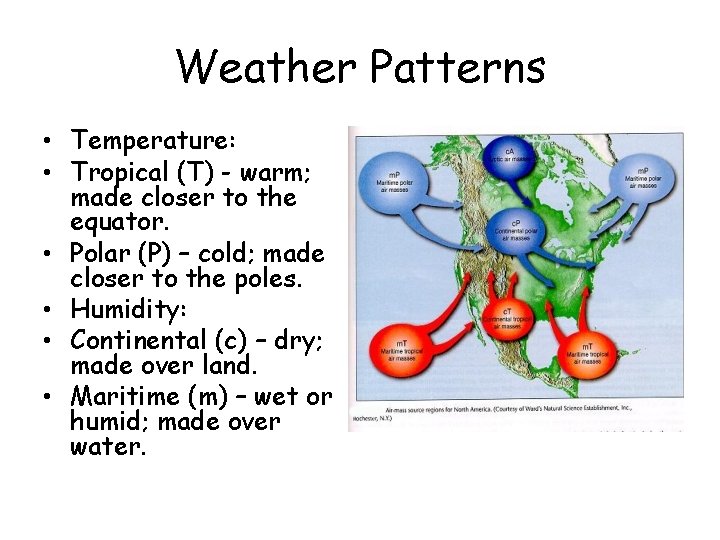
Weather Patterns • Air Mass is a large body of air that has the same properties as the surface over which it formed. • Air masses are classified by their temperature and humidity.
Weather Patterns • Temperature: • Tropical (T) - warm; made closer to the equator. • Polar (P) – cold; made closer to the poles. • Humidity: • Continental (c) – dry; made over land. • Maritime (m) – wet or humid; made over water.
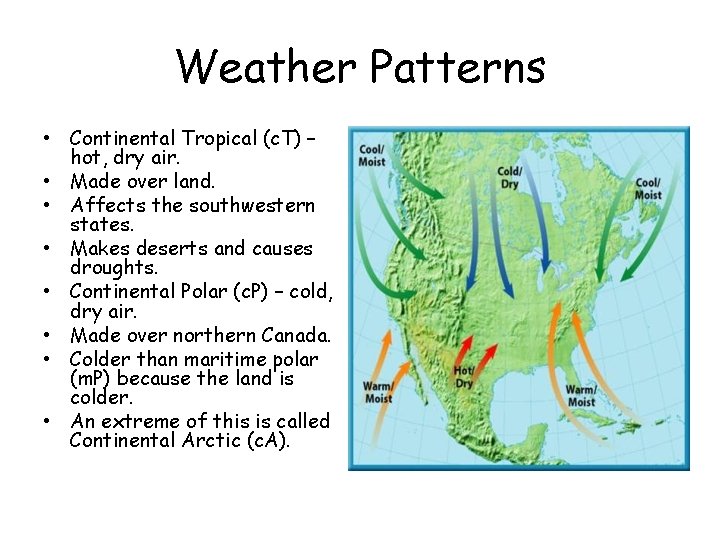
Weather Patterns • Continental Tropical (c. T) – hot, dry air. • Made over land. • Affects the southwestern states. • Makes deserts and causes droughts. • Continental Polar (c. P) – cold, dry air. • Made over northern Canada. • Colder than maritime polar (m. P) because the land is colder. • An extreme of this is called Continental Arctic (c. A).
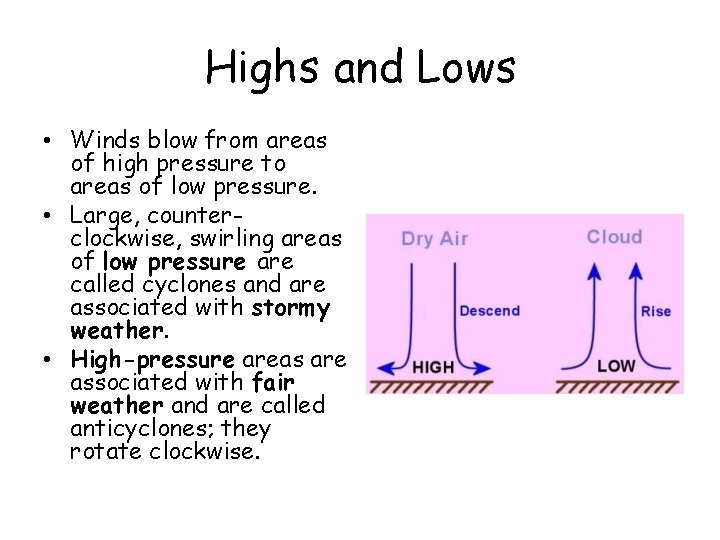
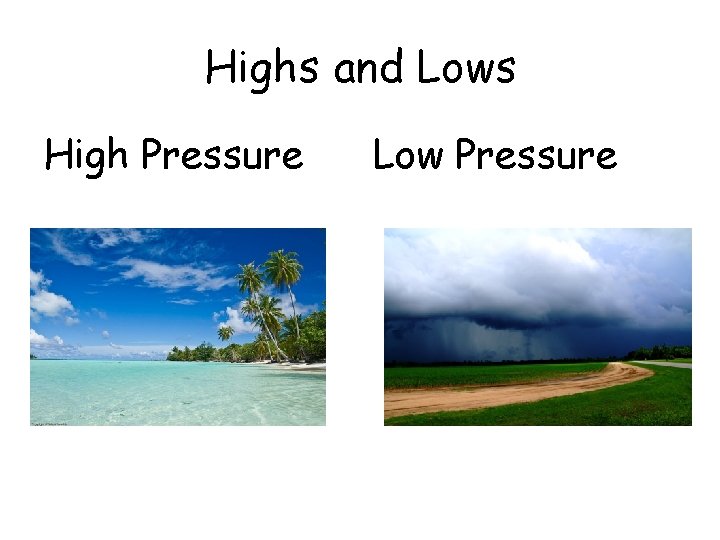
Highs and Lows • Winds blow from areas of high pressure to areas of low pressure. • Large, counterclockwise, swirling areas of low pressure are called cyclones and are associated with stormy weather. • High-pressure areas are associated with fair weather and are called anticyclones; they rotate clockwise.
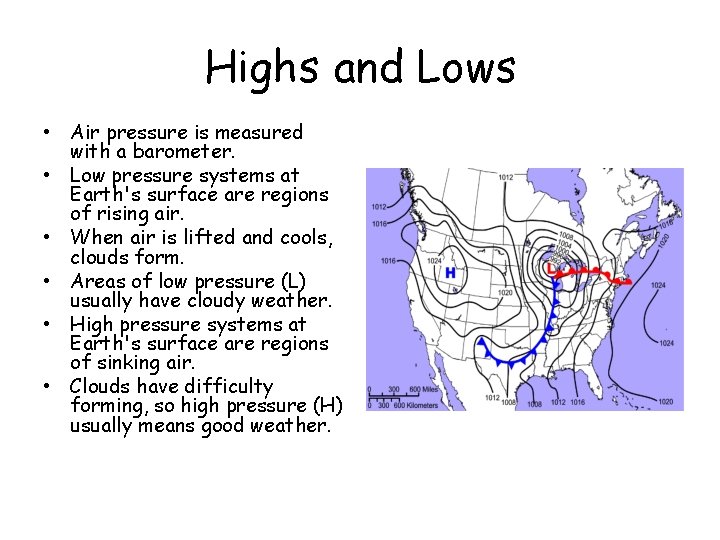
Highs and Lows • Air pressure is measured with a barometer. • Low pressure systems at Earth's surface are regions of rising air. • When air is lifted and cools, clouds form. • Areas of low pressure (L) usually have cloudy weather. • High pressure systems at Earth's surface are regions of sinking air. • Clouds have difficulty forming, so high pressure (H) usually means good weather.
Highs and Lows High Pressure Low Pressure
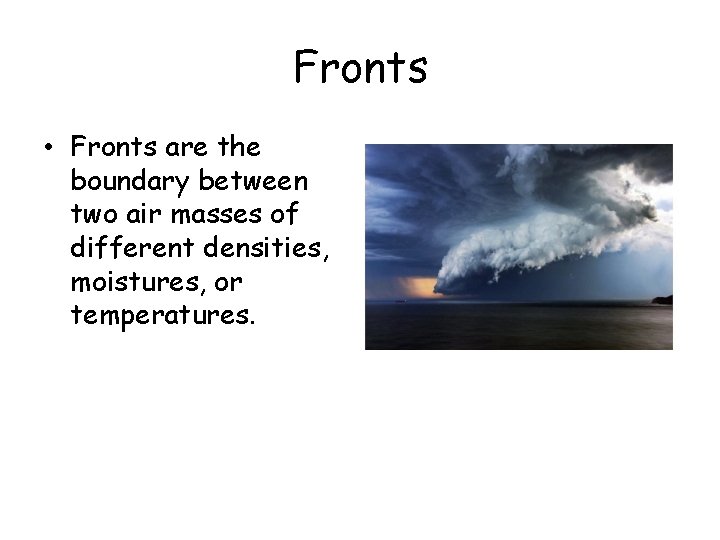
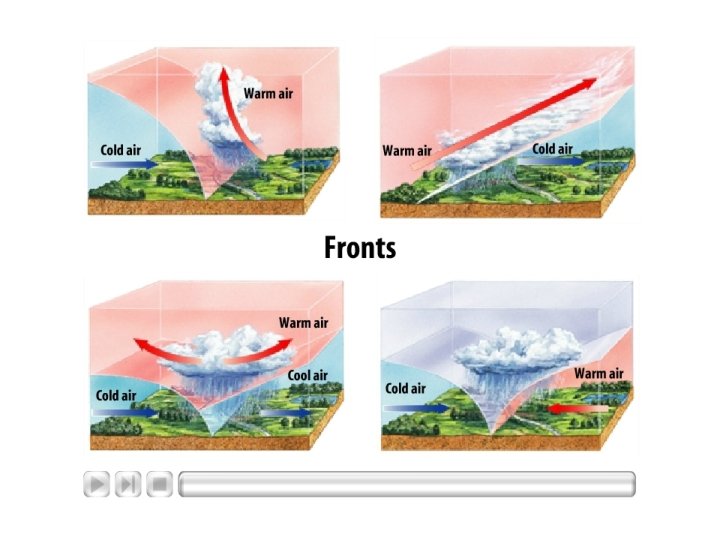
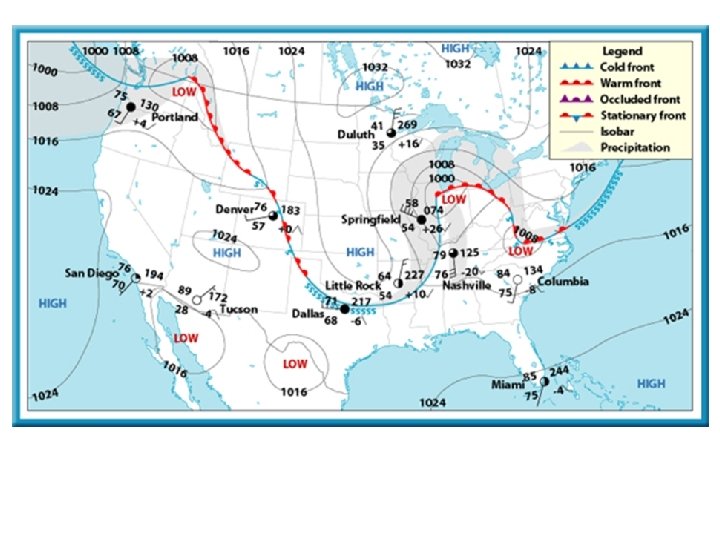
Fronts • Fronts are the boundary between two air masses of different densities, moistures, or temperatures.
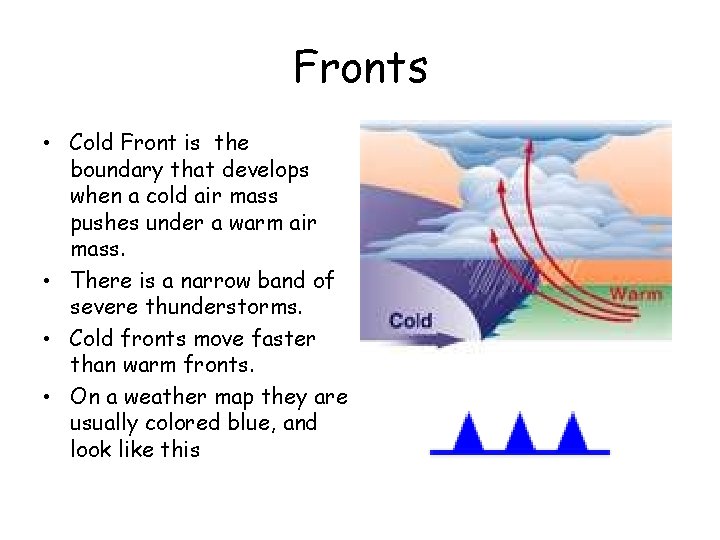
Fronts • Cold Front is the boundary that develops when a cold air mass pushes under a warm air mass. • There is a narrow band of severe thunderstorms. • Cold fronts move faster than warm fronts. • On a weather map they are usually colored blue, and look like this
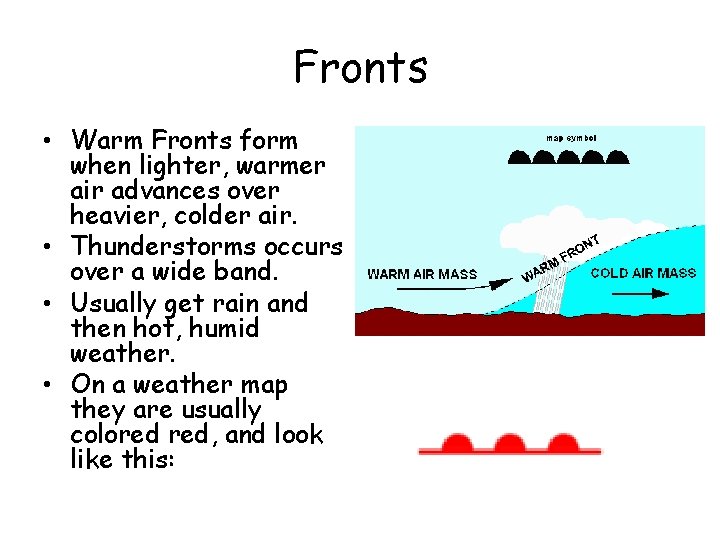
Fronts • Warm Fronts form when lighter, warmer air advances over heavier, colder air. • Thunderstorms occurs over a wide band. • Usually get rain and then hot, humid weather. • On a weather map they are usually colored red, and look like this:
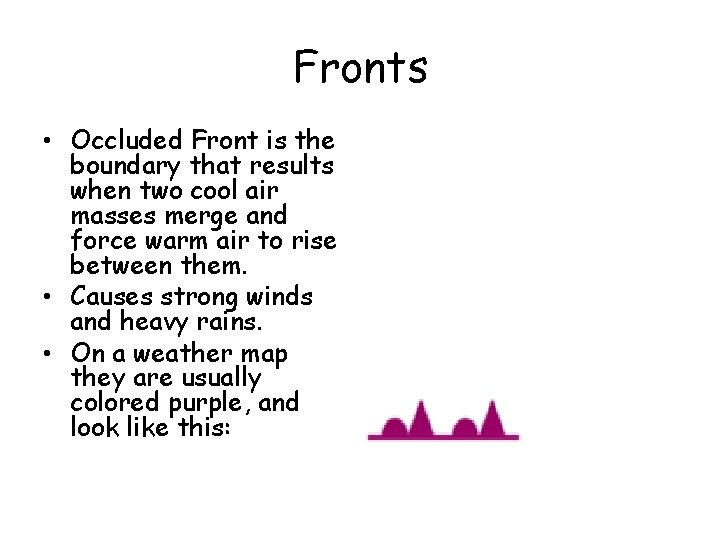
Fronts • Occluded Front is the boundary that results when two cool air masses merge and force warm air to rise between them. • Causes strong winds and heavy rains. • On a weather map they are usually colored purple, and look like this:
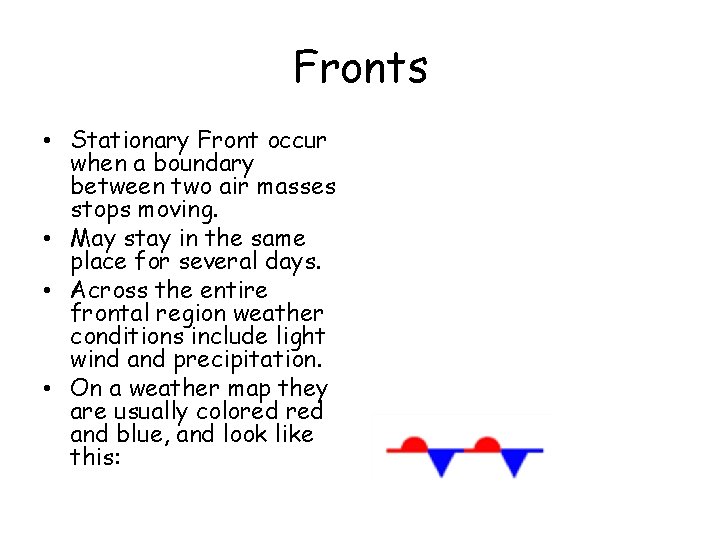
Fronts • Stationary Front occur when a boundary between two air masses stops moving. • May stay in the same place for several days. • Across the entire frontal region weather conditions include light wind and precipitation. • On a weather map they are usually colored and blue, and look like this:
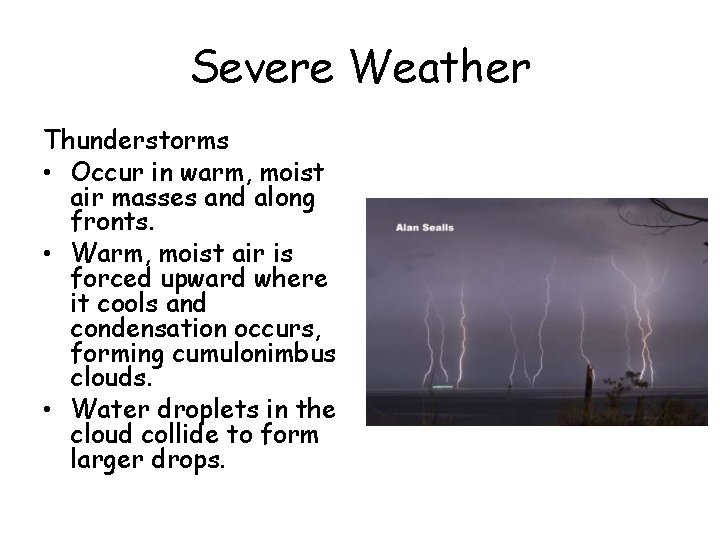
Severe Weather Thunderstorms • Occur in warm, moist air masses and along fronts. • Warm, moist air is forced upward where it cools and condensation occurs, forming cumulonimbus clouds. • Water droplets in the cloud collide to form larger drops.
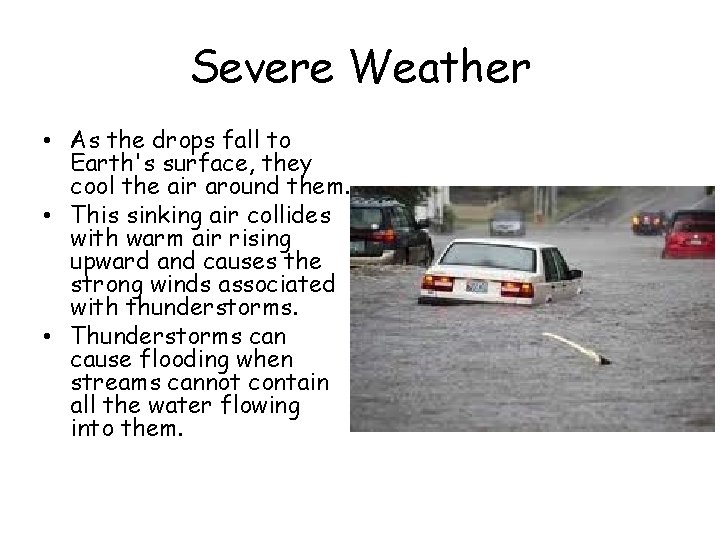
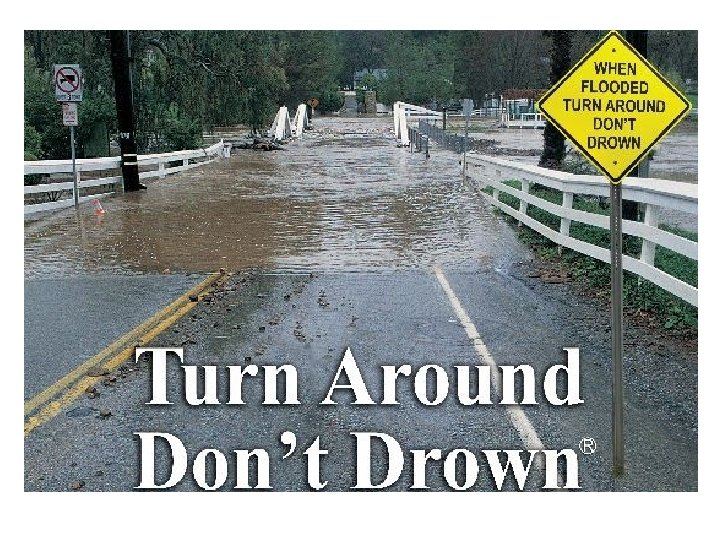
Severe Weather • As the drops fall to Earth's surface, they cool the air around them. • This sinking air collides with warm air rising upward and causes the strong winds associated with thunderstorms. • Thunderstorms can cause flooding when streams cannot contain all the water flowing into them.
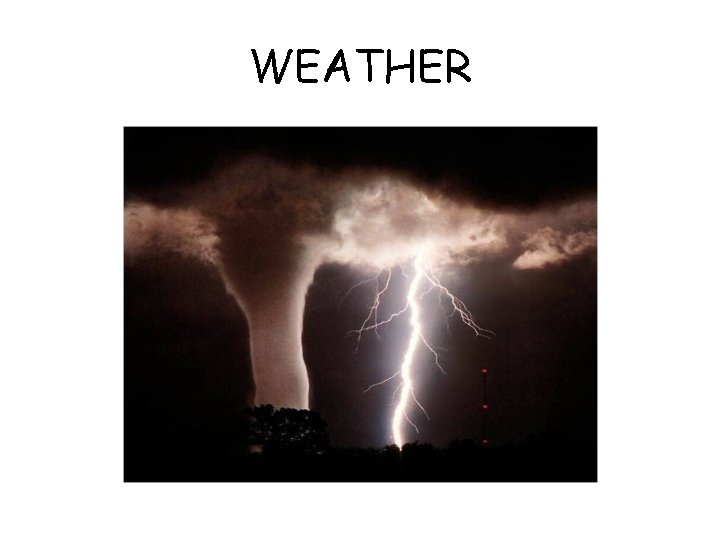
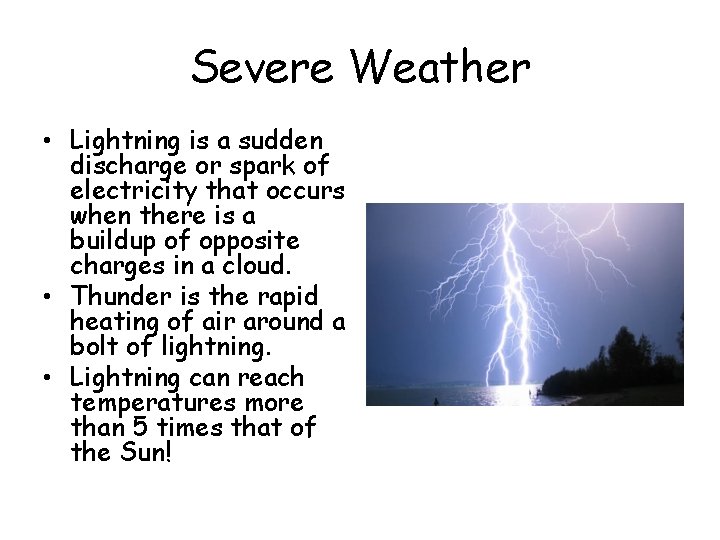
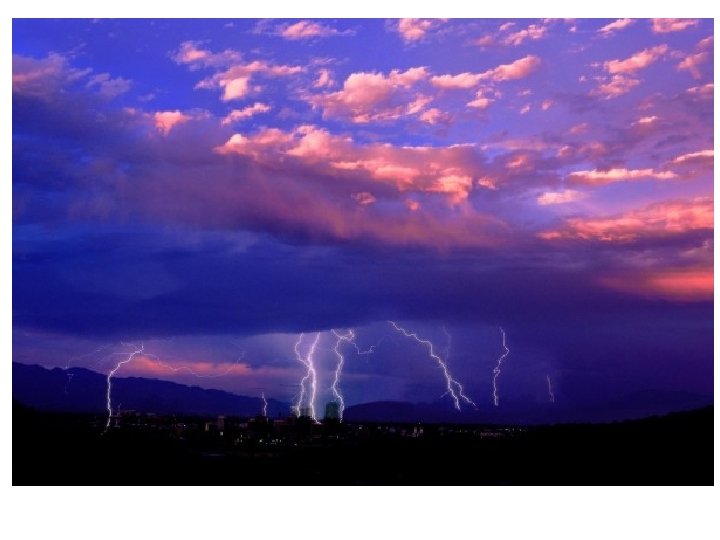
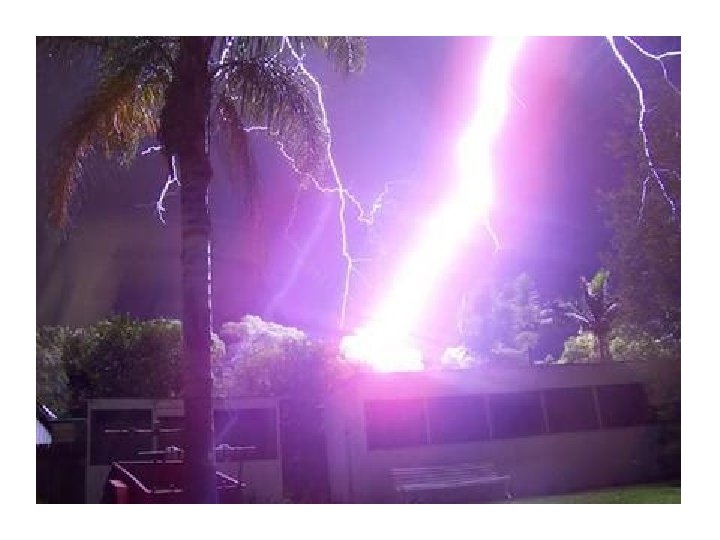
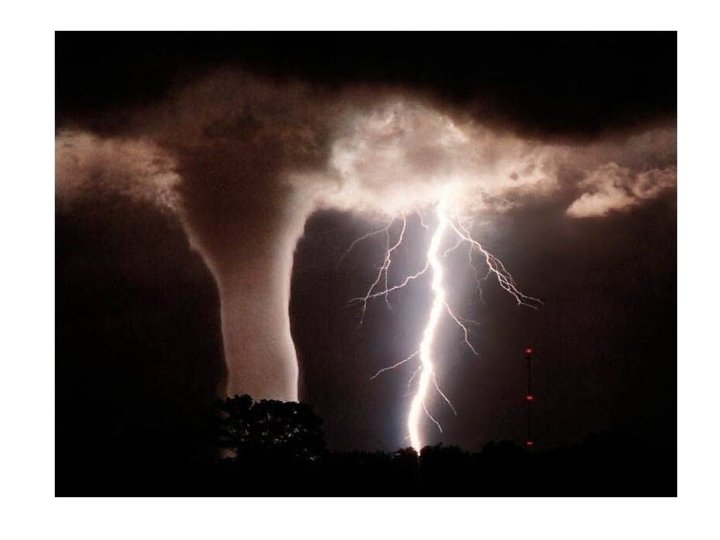
Severe Weather • Lightning is a sudden discharge or spark of electricity that occurs when there is a buildup of opposite charges in a cloud. • Thunder is the rapid heating of air around a bolt of lightning. • Lightning can reach temperatures more than 5 times that of the Sun!
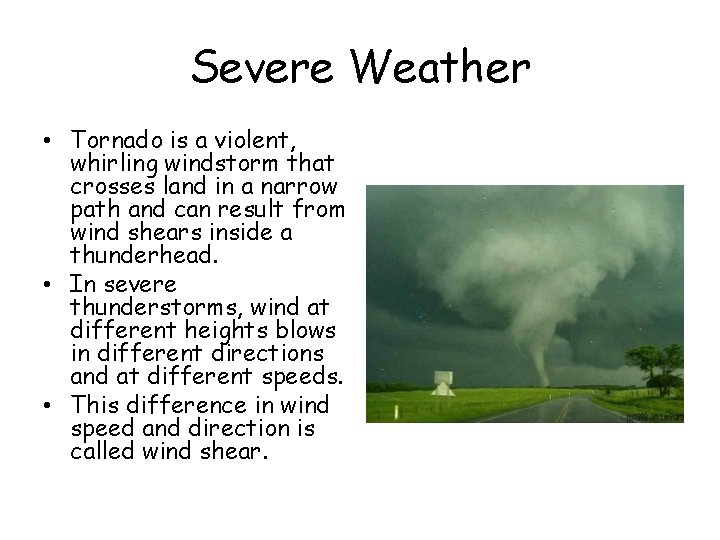
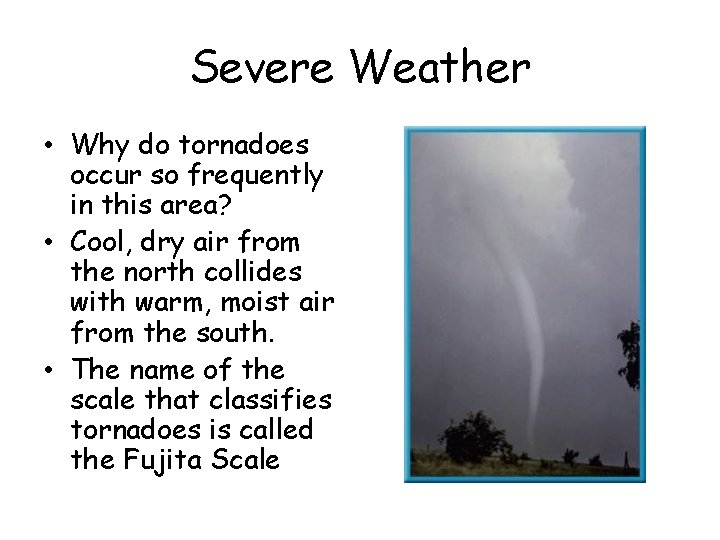
Severe Weather • Tornado is a violent, whirling windstorm that crosses land in a narrow path and can result from wind shears inside a thunderhead. • In severe thunderstorms, wind at different heights blows in different directions and at different speeds. • This difference in wind speed and direction is called wind shear.
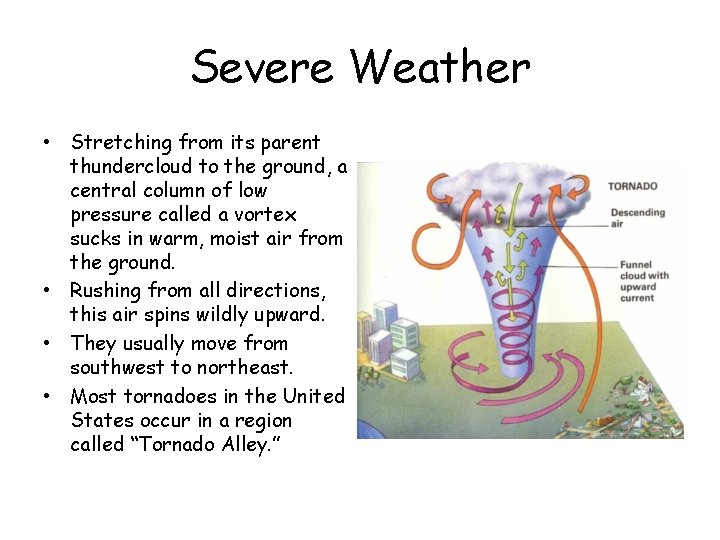
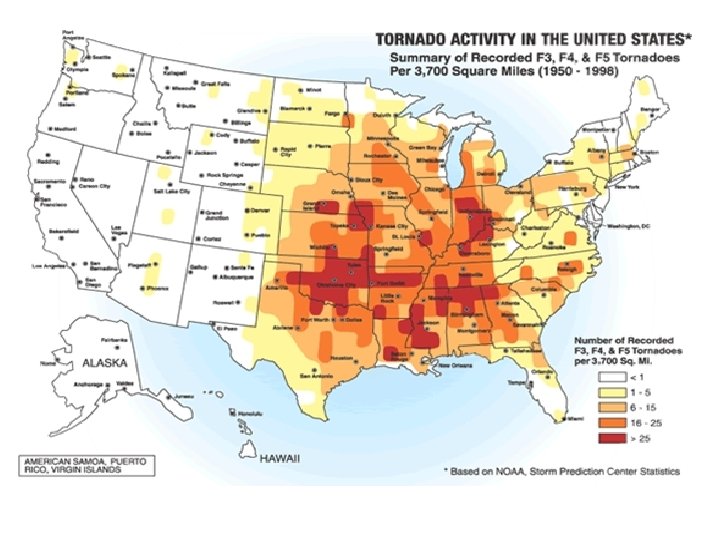
Severe Weather • Stretching from its parent thundercloud to the ground, a central column of low pressure called a vortex sucks in warm, moist air from the ground. • Rushing from all directions, this air spins wildly upward. • They usually move from southwest to northeast. • Most tornadoes in the United States occur in a region called “Tornado Alley. ”
Severe Weather • Why do tornadoes occur so frequently in this area? • Cool, dry air from the north collides with warm, moist air from the south. • The name of the scale that classifies tornadoes is called the Fujita Scale
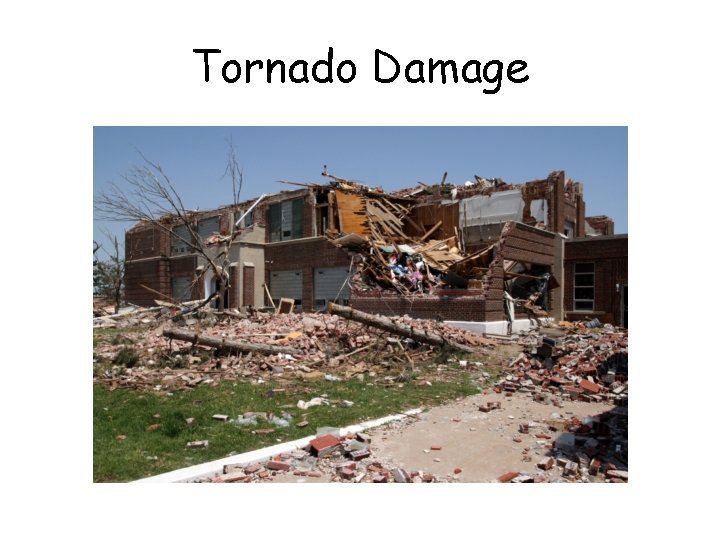
Tornado Damage
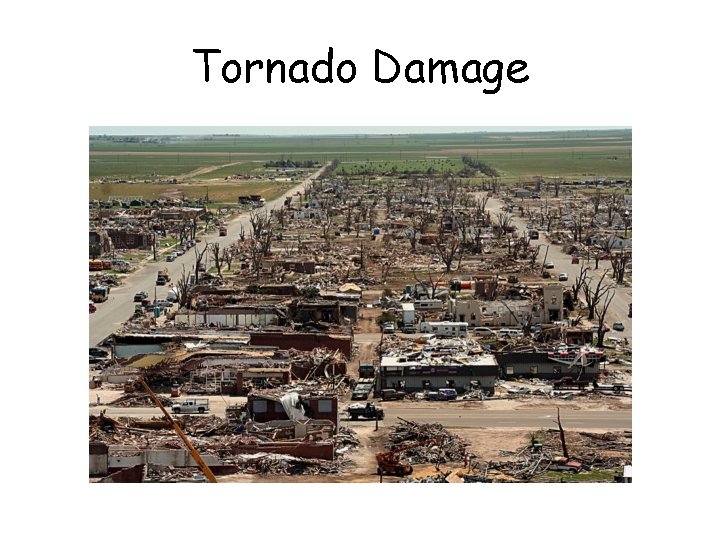
Tornado Damage
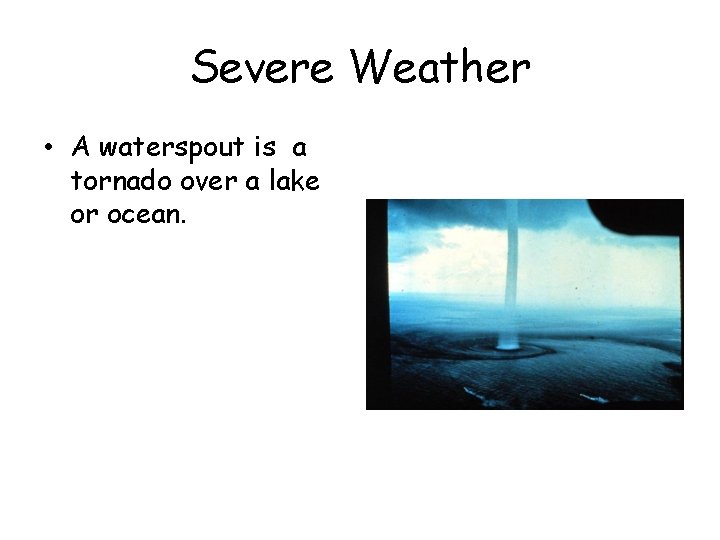
Severe Weather • A waterspout is a tornado over a lake or ocean.
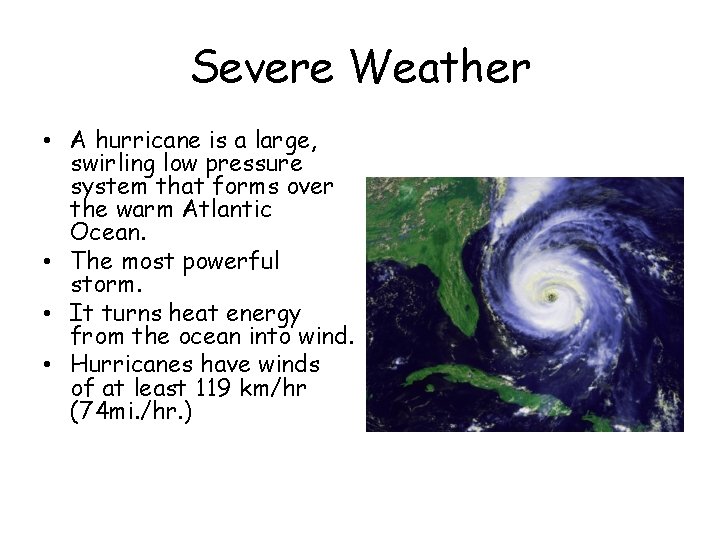
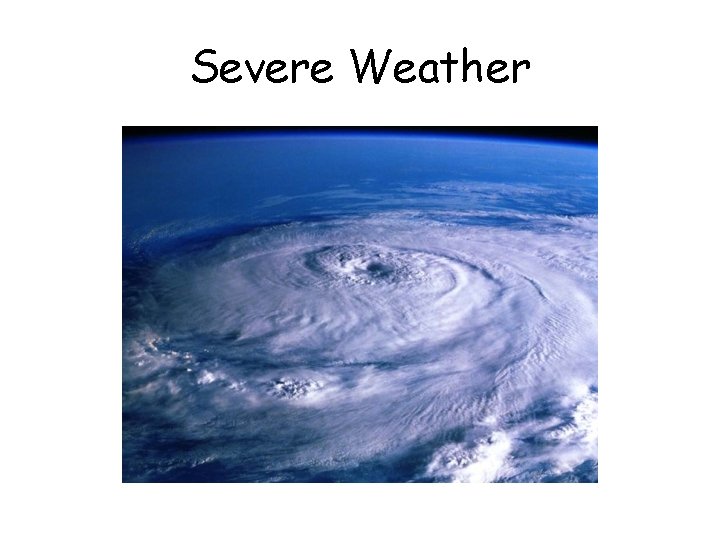
Severe Weather • A hurricane is a large, swirling low pressure system that forms over the warm Atlantic Ocean. • The most powerful storm. • It turns heat energy from the ocean into wind. • Hurricanes have winds of at least 119 km/hr (74 mi. /hr. )
Severe Weather
Severe Weather
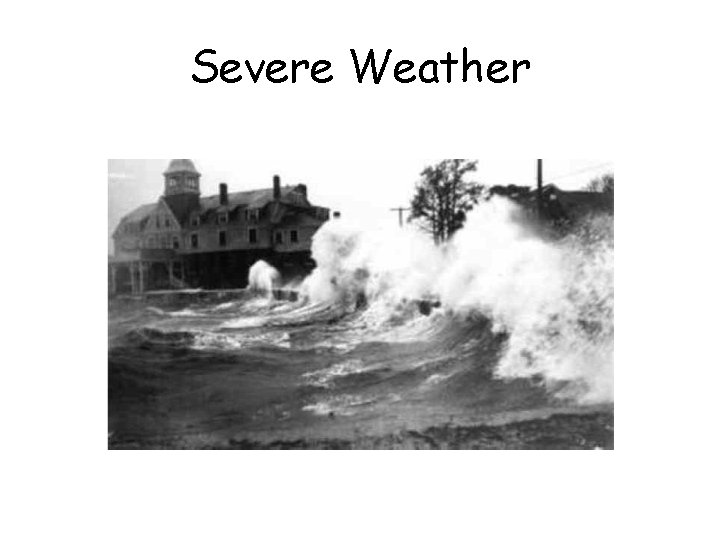
Severe Weather • Typhoons are hurricanes in the Pacific Ocean. • Cyclones are hurricanes in the Indian Ocean. • When a hurricane strikes land, high winds, tornadoes, heavy rains, and high waves can cause a lot of damage. • Floods from the heavy rains and tidal surges can cause additional damage. • As they move inland they lose strength because the supply of warm, moist air is now gone.
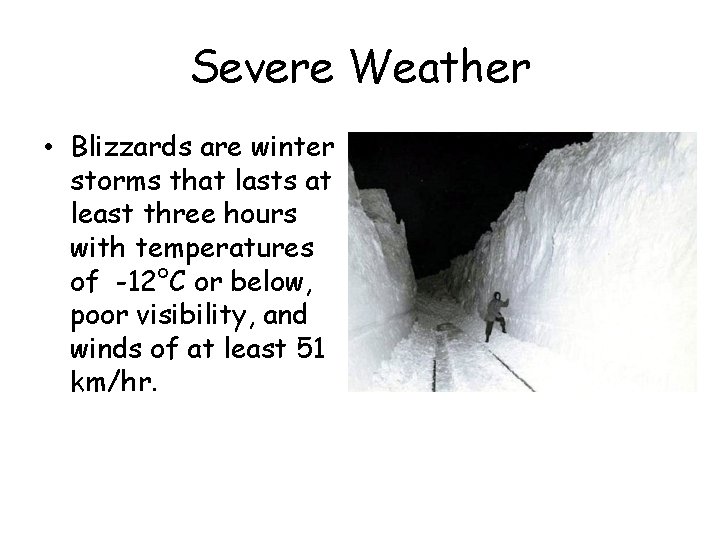
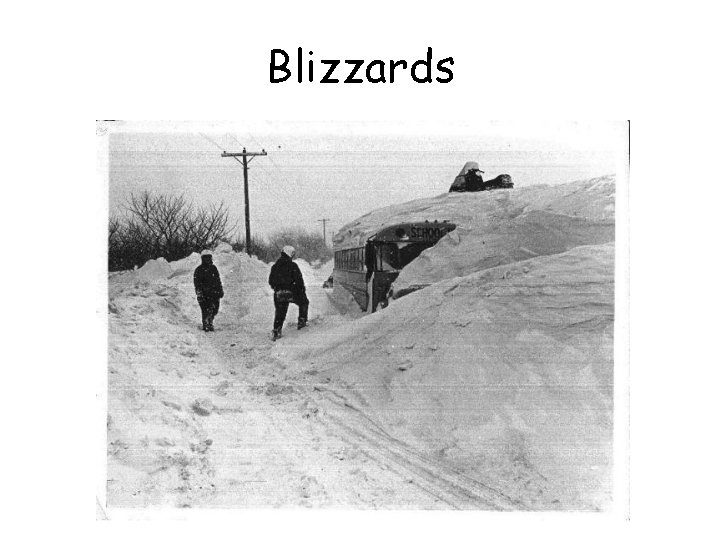
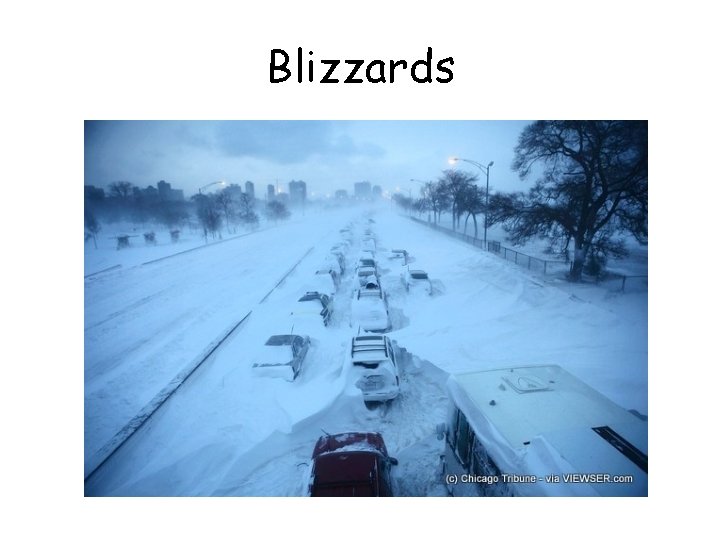
Severe Weather • Blizzards are winter storms that lasts at least three hours with temperatures of -12°C or below, poor visibility, and winds of at least 51 km/hr.
Blizzards
Blizzards
Severe Weather • When severe weather threatens The National Weather Service issues a watch or warning. • A Weather Watch is issued if conditions are favorable for severe thunderstorms, tornadoes, floods, blizzards, and hurricanes; stay tuned to a radio or TV station for weather reports. • Weather Warnings are issued when severe weather conditions already exist; you should take action immediately.
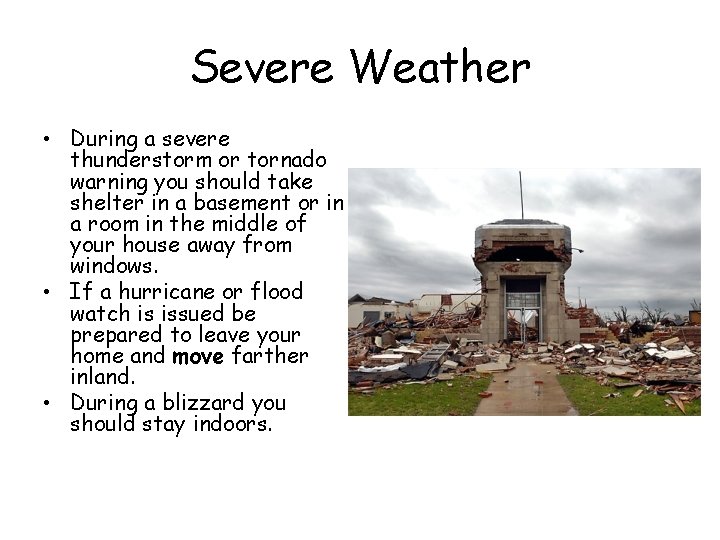
Severe Weather • During a severe thunderstorm or tornado warning you should take shelter in a basement or in a room in the middle of your house away from windows. • If a hurricane or flood watch is issued be prepared to leave your home and move farther inland. • During a blizzard you should stay indoors.
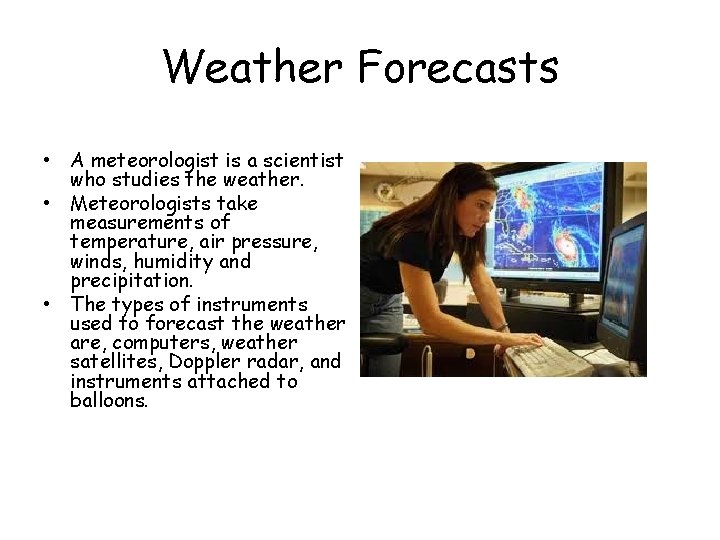
Weather Forecasts • A meteorologist is a scientist who studies the weather. • Meteorologists take measurements of temperature, air pressure, winds, humidity and precipitation. • The types of instruments used to forecast the weather are, computers, weather satellites, Doppler radar, and instruments attached to balloons.
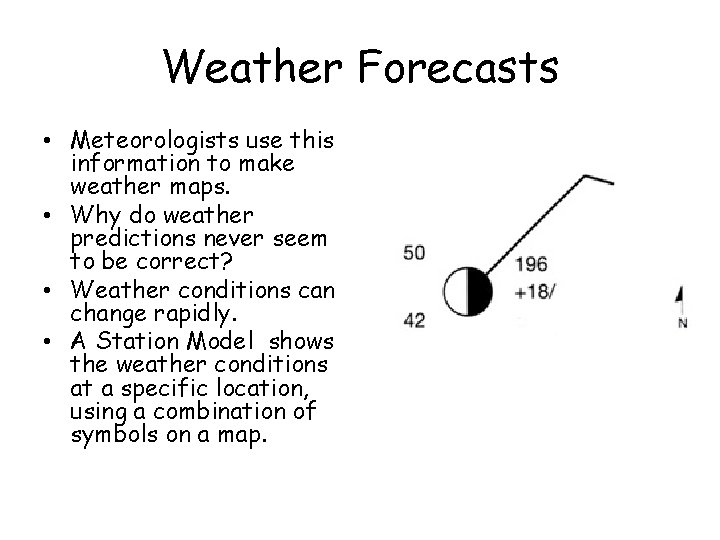
Weather Forecasts • Meteorologists use this information to make weather maps. • Why do weather predictions never seem to be correct? • Weather conditions can change rapidly. • A Station Model shows the weather conditions at a specific location, using a combination of symbols on a map.
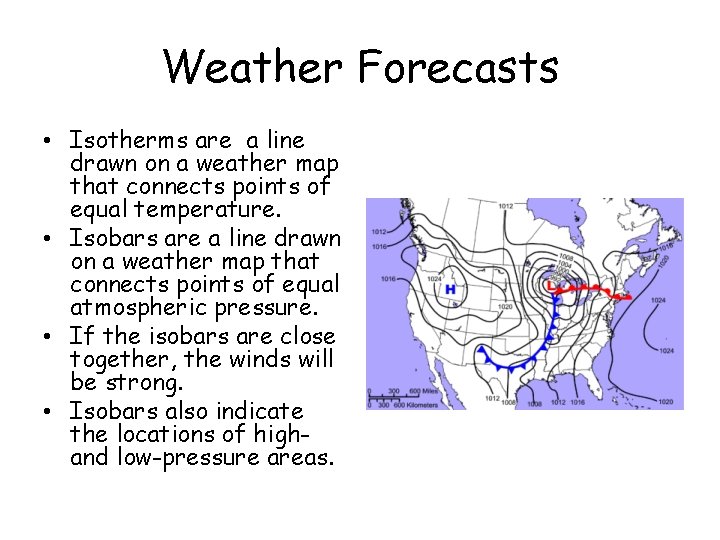
Weather Forecasts • Isotherms are a line drawn on a weather map that connects points of equal temperature. • Isobars are a line drawn on a weather map that connects points of equal atmospheric pressure. • If the isobars are close together, the winds will be strong. • Isobars also indicate the locations of highand low-pressure areas.