
Weather vs Climate Weather conditions of atmosphere at
- Slides: 47
Weather vs. Climate • Weather – conditions of atmosphere at particular time and place • Climate – long-term average of weather • Ocean influences Earth’s weather and climate patterns. © 2011 Pearson Education, Inc.
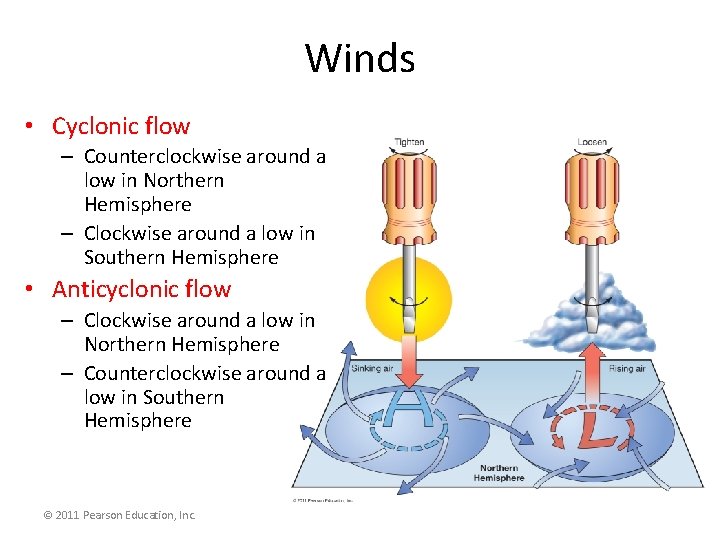
Winds • Cyclonic flow – Counterclockwise around a low in Northern Hemisphere – Clockwise around a low in Southern Hemisphere • Anticyclonic flow – Clockwise around a low in Northern Hemisphere – Counterclockwise around a low in Southern Hemisphere © 2011 Pearson Education, Inc.
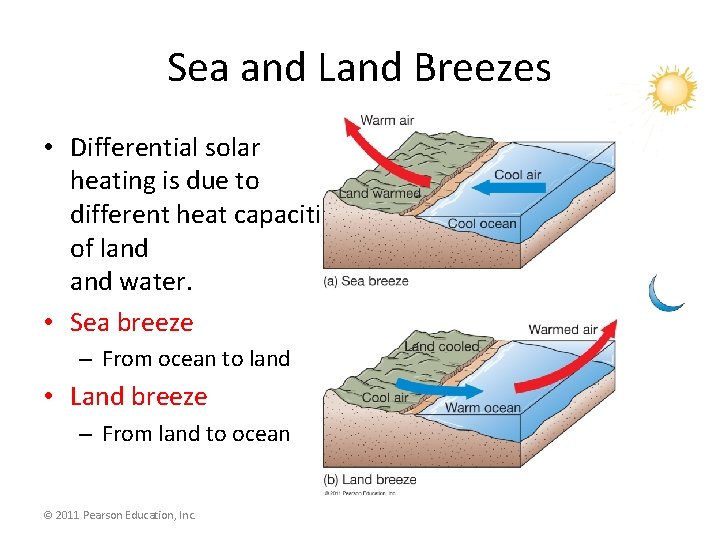
Sea and Land Breezes • Differential solar heating is due to different heat capacities of land water. • Sea breeze – From ocean to land • Land breeze – From land to ocean © 2011 Pearson Education, Inc.
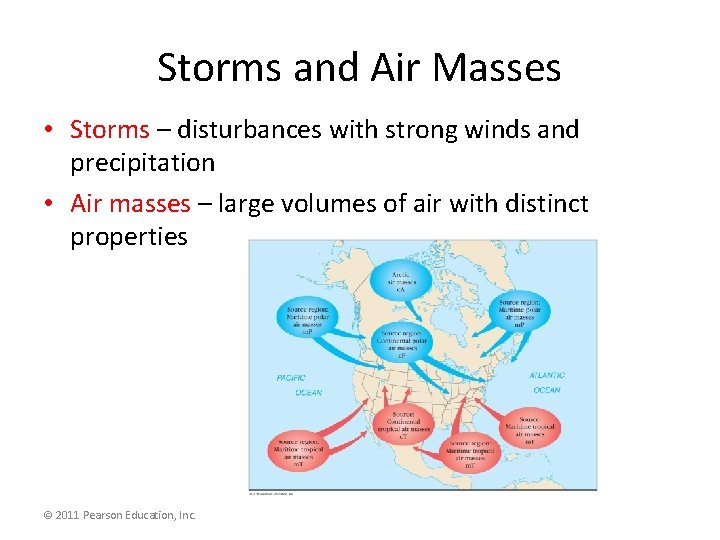
Storms and Air Masses • Storms – disturbances with strong winds and precipitation • Air masses – large volumes of air with distinct properties © 2011 Pearson Education, Inc.
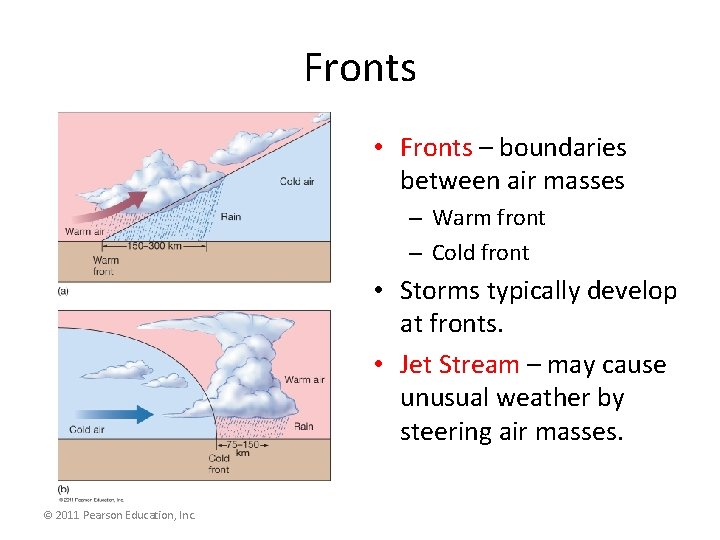
Fronts • Fronts – boundaries between air masses – Warm front – Cold front • Storms typically develop at fronts. • Jet Stream – may cause unusual weather by steering air masses. © 2011 Pearson Education, Inc.
Tropical Cyclones (Hurricanes) • • • Large rotating masses of low pressure Strong winds, torrential rain Classified by maximum sustained wind speed Typhoons Cyclones © 2011 Pearson Education, Inc.
Hurricane Origins • Low pressure cell • Winds feed water vapor – latent heat of condensation • Air rises, low pressure deepens • Storm develops – Winds less than 61 km/hour (38 miles/hour) – tropical depression – Winds 61– 120 km/hour (38– 74 miles/hour) – tropical storm – Winds above 120 km/hour (74 miles/hour) – tropical cyclone or hurricane © 2011 Pearson Education, Inc.
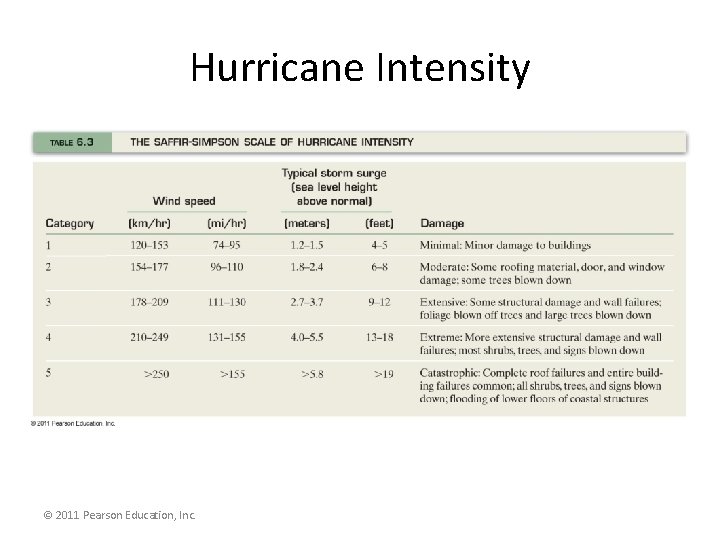
Hurricane Intensity © 2011 Pearson Education, Inc.
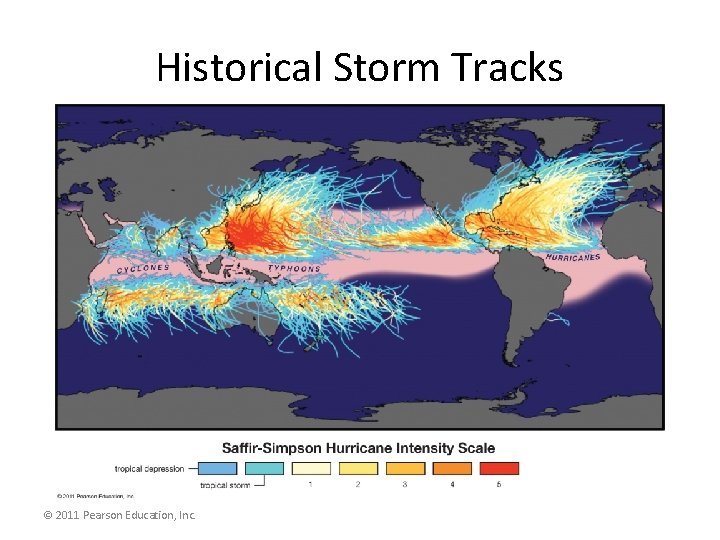
Hurricanes • About 100 worldwide per year • Require – Ocean water warmer than° 25°C (77°F) – Warm, moist air – The Coriolis Effect • Hurricane season is June 1 – November 30 © 2011 Pearson Education, Inc.
Historical Storm Tracks © 2011 Pearson Education, Inc.
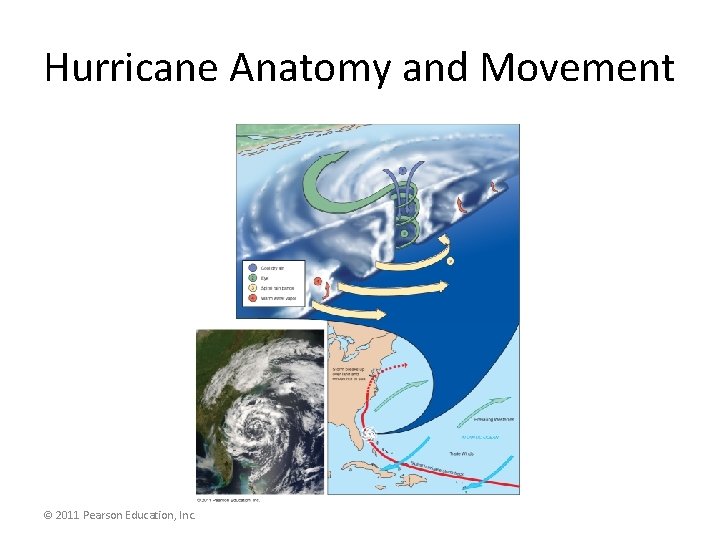
Hurricane Anatomy and Movement © 2011 Pearson Education, Inc.
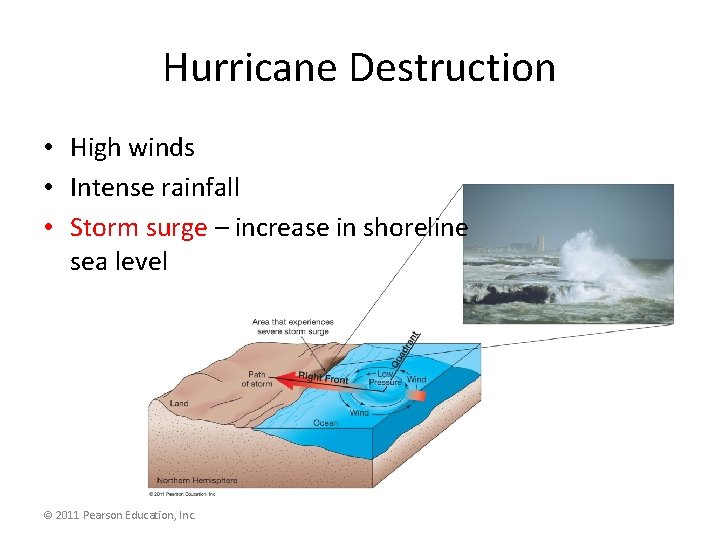
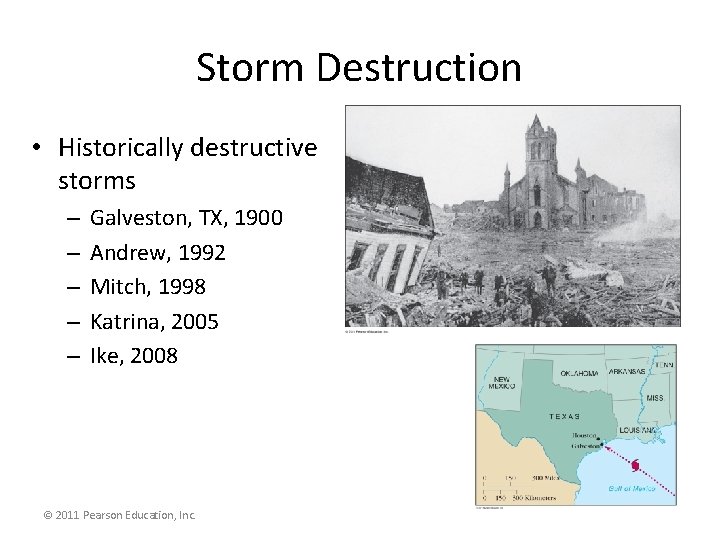
Hurricane Destruction • High winds • Intense rainfall • Storm surge – increase in shoreline sea level © 2011 Pearson Education, Inc.
Storm Destruction • Historically destructive storms – – – Galveston, TX, 1900 Andrew, 1992 Mitch, 1998 Katrina, 2005 Ike, 2008 © 2011 Pearson Education, Inc.
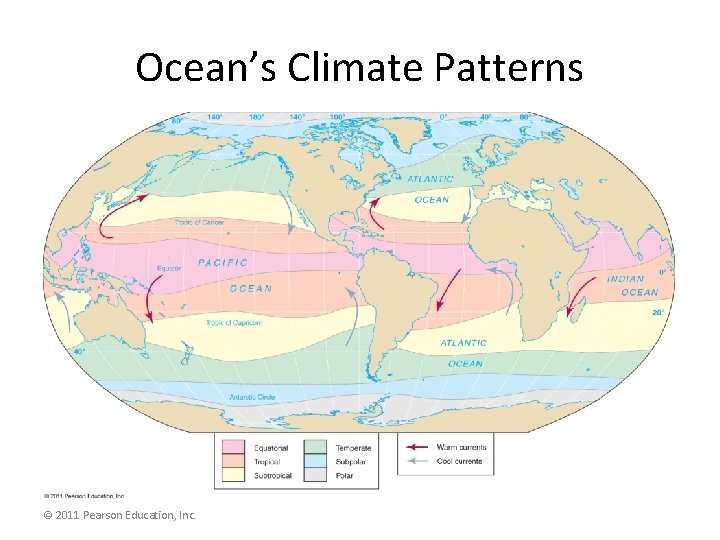
Ocean’s Climate Patterns • Open ocean’s climate regions are parallel to latitude lines. • These regions may be modified by surface ocean currents. © 2011 Pearson Education, Inc.
Ocean’s Climate Patterns © 2011 Pearson Education, Inc.
Ocean’s Climate Zones • Equatorial – Rising air – Weak winds – Doldrums • Tropical – North and south of equatorial zone – Extend to Tropics of Cancer and Capricorn – Strong winds, little precipitation, rough seas • Subtropical – High pressure, descending air – Weak winds, sluggish currents © 2011 Pearson Education, Inc.
Ocean’s Climate Zones • Temperate – Strong westerly winds – Severe storms common • Subpolar – Extensive precipitation – Summer sea ice • Polar – High pressure – Sea ice most of the year © 2011 Pearson Education, Inc.
Chapter 7, pages 215 -223
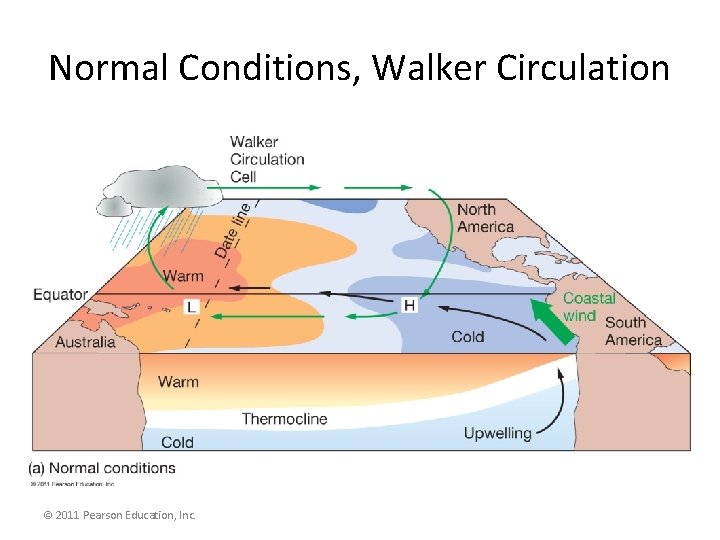
Atmospheric-Ocean Connections in the Pacific Ocean • Walker Circulation Cell – normal conditions – Air pressure across equatorial Pacific is higher in eastern Pacific – Strong southeast trade winds – Pacific warm pool on western side of ocean – Thermocline deeper on western side – Upwelling off the coast of Peru © 2011 Pearson Education, Inc.
Normal Conditions, Walker Circulation © 2011 Pearson Education, Inc.
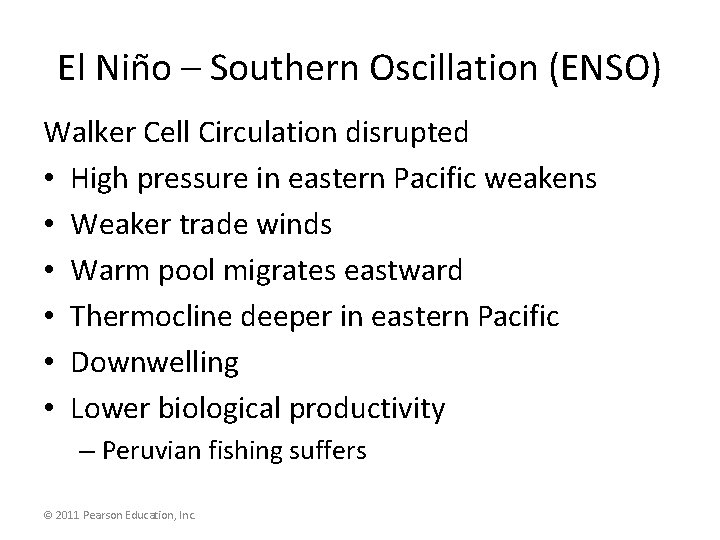
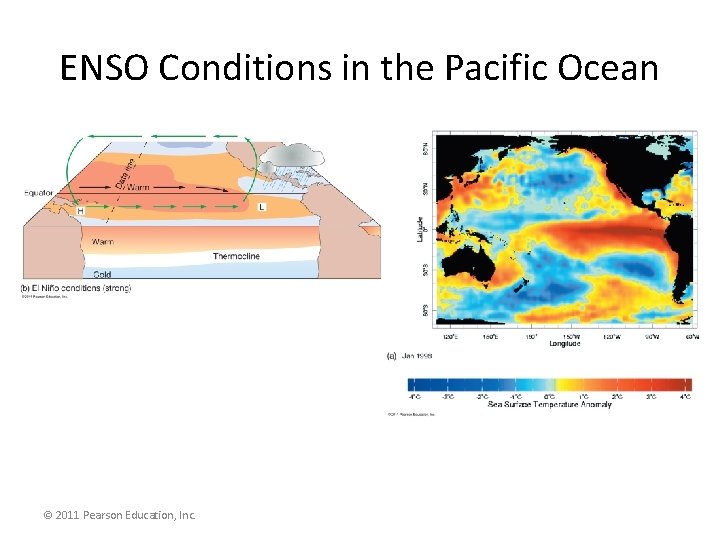
El Nin o – Southern Oscillation (ENSO) Walker Cell Circulation disrupted • High pressure in eastern Pacific weakens • Weaker trade winds • Warm pool migrates eastward • Thermocline deeper in eastern Pacific • Downwelling • Lower biological productivity – Peruvian fishing suffers © 2011 Pearson Education, Inc.
ENSO Conditions in the Pacific Ocean © 2011 Pearson Education, Inc.
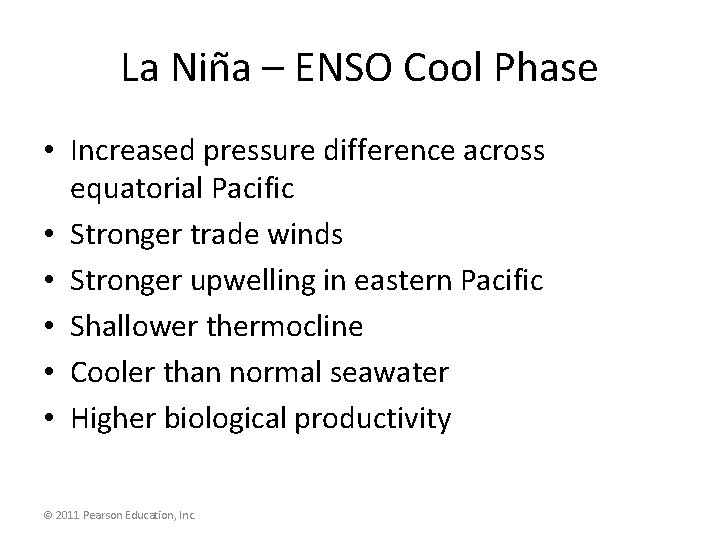
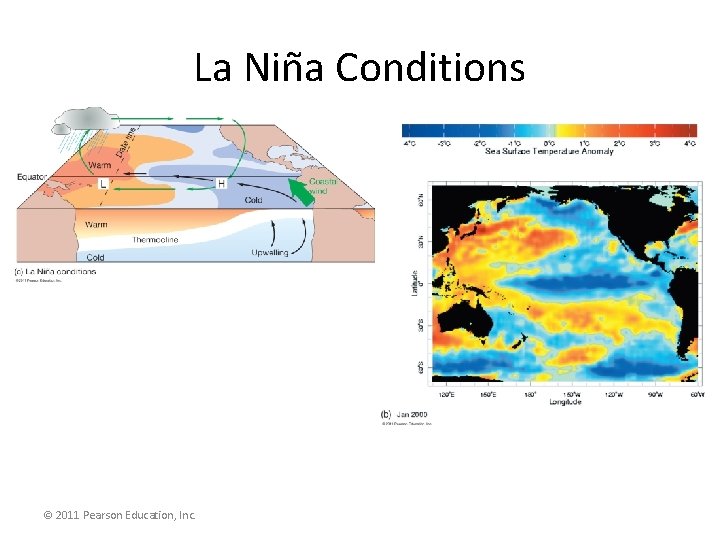
La Nin a – ENSO Cool Phase • Increased pressure difference across equatorial Pacific • Stronger trade winds • Stronger upwelling in eastern Pacific • Shallower thermocline • Cooler than normal seawater • Higher biological productivity © 2011 Pearson Education, Inc.
La Nin a Conditions © 2011 Pearson Education, Inc.
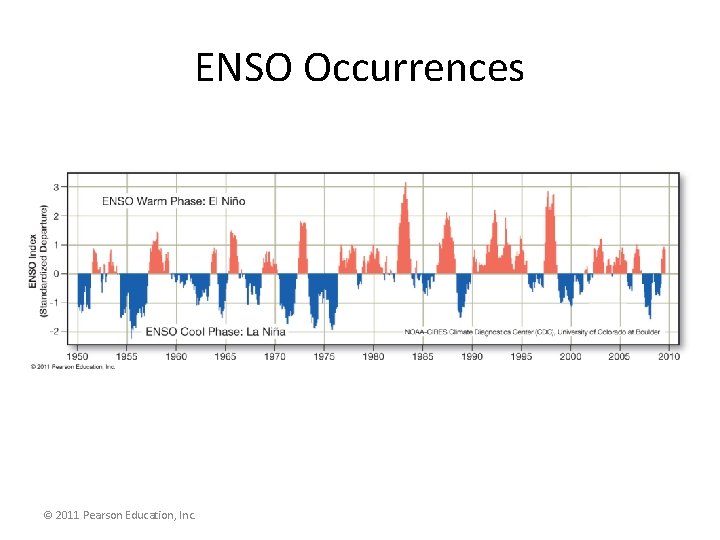
Occurrence of ENSO Events • El Niño warm phase about every 2– 10 years • Highly irregular • Phases usually last 12– 18 months • 10, 000 -year sediment record of events • ENSO may be part of Pacific Decadal Oscillation (PDO) – Long-term natural climate cycle – Lasts 20– 30 years © 2011 Pearson Education, Inc.
ENSO Occurrences © 2011 Pearson Education, Inc.
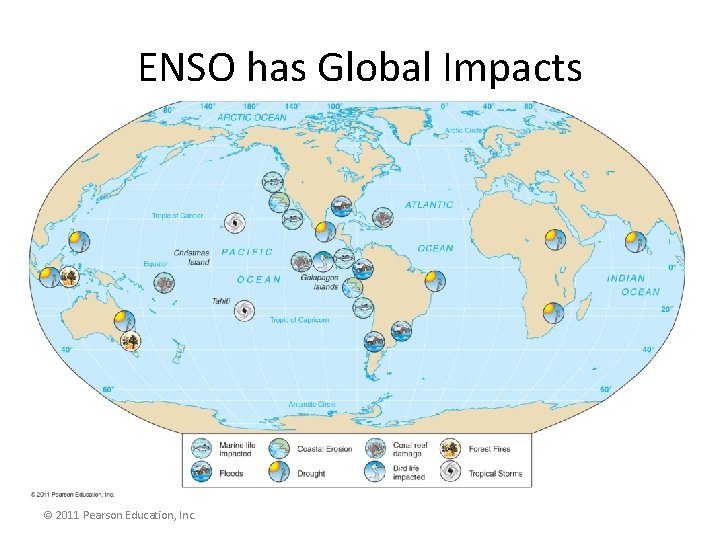
ENSO has Global Impacts © 2011 Pearson Education, Inc.
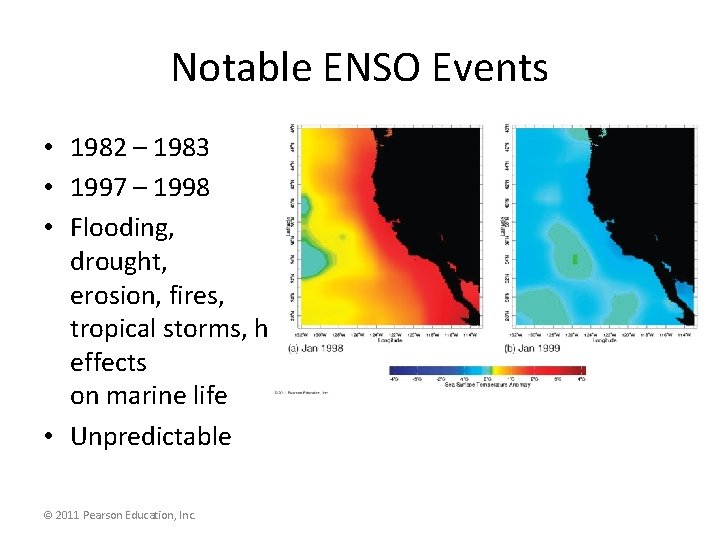
Notable ENSO Events • 1982 – 1983 • 1997 – 1998 • Flooding, drought, erosion, fires, tropical storms, harmful effects on marine life • Unpredictable © 2011 Pearson Education, Inc.
Predicting El Nin o Events • Tropical Ocean−Global Atmosphere (TOGA) program – 1985 – Monitors equatorial South Pacific – System of buoys • Tropical Atmosphere and Ocean (TOA) project – Continues monitoring • ENSO still not fully understood © 2011 Pearson Education, Inc.
Chapter 16, Sections 16. 1 -16. 3
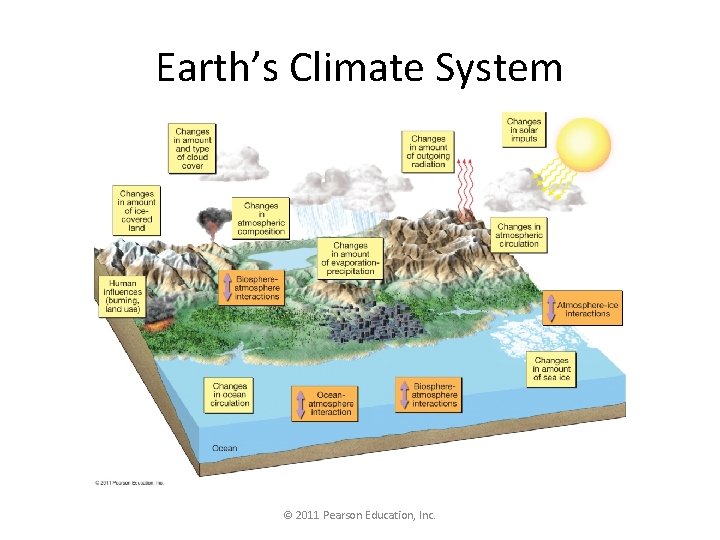
Earth’s Climate System • Climate – long term atmospheric conditions in a region • Earth’s climate includes interactions of: – Atmosphere – Hydrosphere – Geosphere – Biosphere – Cryosphere • Climate system – exchanges of energy and moisture between these spheres © 2011 Pearson Education, Inc.
Earth’s Climate System © 2011 Pearson Education, Inc.
Earth’s Climate System • Feedback loops – modify atmospheric processes – Positive feedback loops – enhance initial change – Negative feedback loops – counteract initial change © 2011 Pearson Education, Inc.
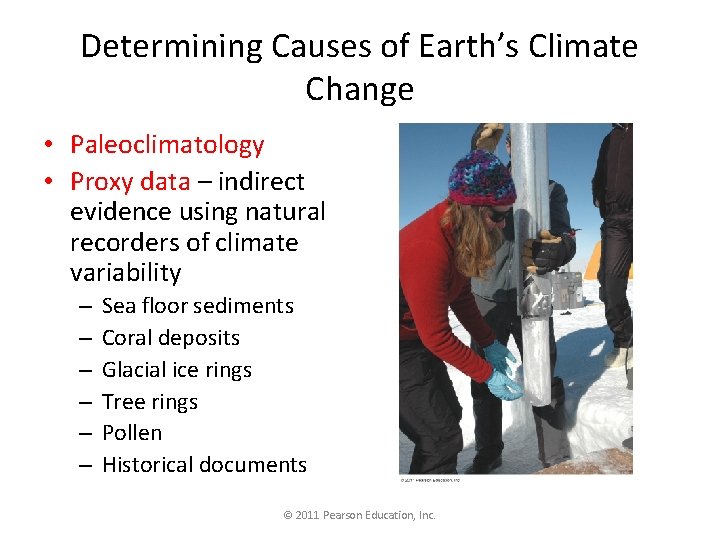
Determining Causes of Earth’s Climate Change • Paleoclimatology • Proxy data – indirect evidence using natural recorders of climate variability – – – Sea floor sediments Coral deposits Glacial ice rings Tree rings Pollen Historical documents © 2011 Pearson Education, Inc.
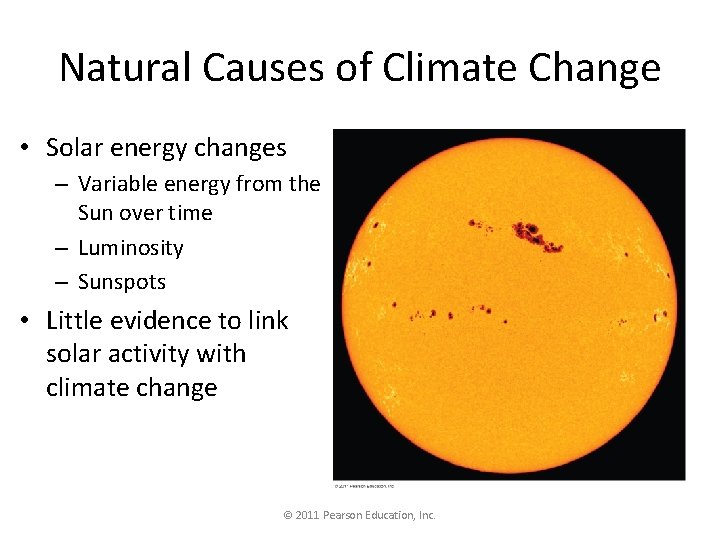
Natural Causes of Climate Change • Solar energy changes – Variable energy from the Sun over time – Luminosity – Sunspots • Little evidence to link solar activity with climate change © 2011 Pearson Education, Inc.
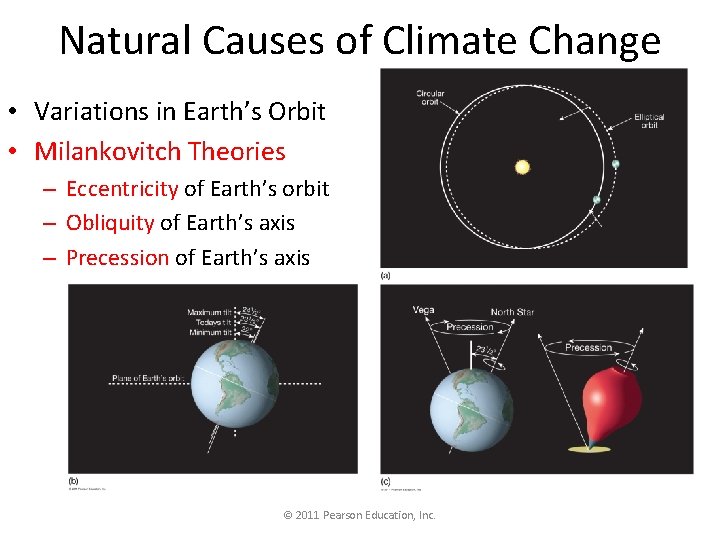
Natural Causes of Climate Change • Variations in Earth’s Orbit • Milankovitch Theories – Eccentricity of Earth’s orbit – Obliquity of Earth’s axis – Precession of Earth’s axis © 2011 Pearson Education, Inc.
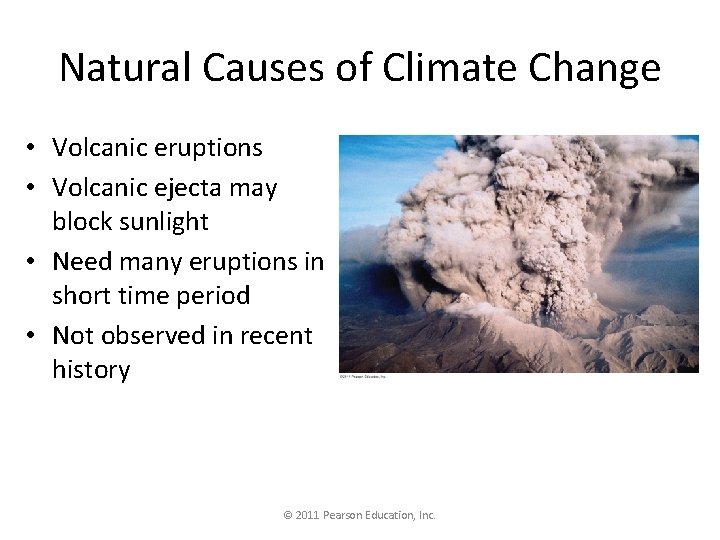
Natural Causes of Climate Change • Volcanic eruptions • Volcanic ejecta may block sunlight • Need many eruptions in short time period • Not observed in recent history © 2011 Pearson Education, Inc.
Natural Causes of Climate Change • Movement of Earth’s Plates – Change ocean circulation – Extremely slow process – Climate change would be very gradual over millions of years © 2011 Pearson Education, Inc.
Natural Causes of Climate Change • Linked to Pleistocene Ice Age, Little Ice Age, Medieval Warm Period • Recent change unprecedented – More likely result of human activity than natural causes © 2011 Pearson Education, Inc.
Documenting Human-Caused Climate Change • Intergovernmental Panel on Climate Change (IPCC) – Global group of scientists – Published assessments since 1990 – Predict global temperature changes of 1. 4– 5. 8°C (2. 5– 10. 4°F) • Climate change models can mimic modern conditions only if human emissions are taken into account. © 2011 Pearson Education, Inc.
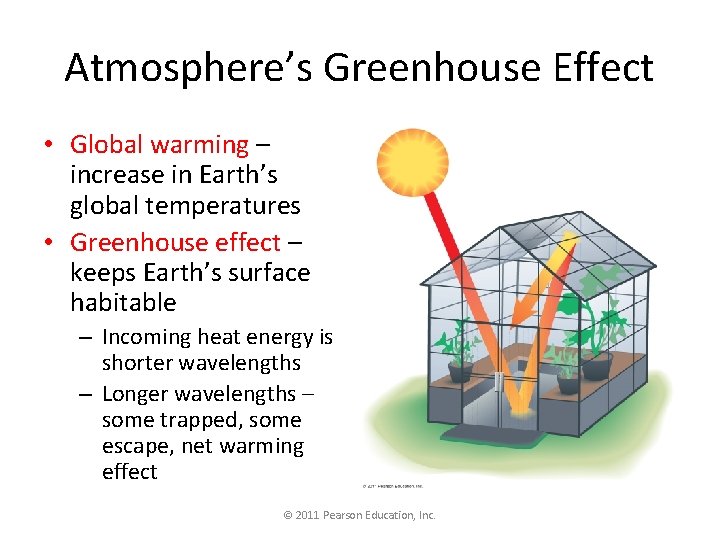
Atmosphere’s Greenhouse Effect • Global warming – increase in Earth’s global temperatures • Greenhouse effect – keeps Earth’s surface habitable – Incoming heat energy is shorter wavelengths – Longer wavelengths – some trapped, some escape, net warming effect © 2011 Pearson Education, Inc.
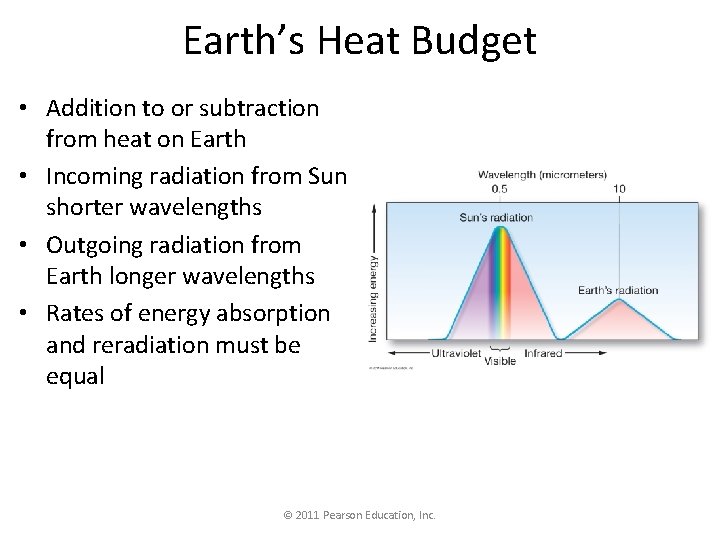
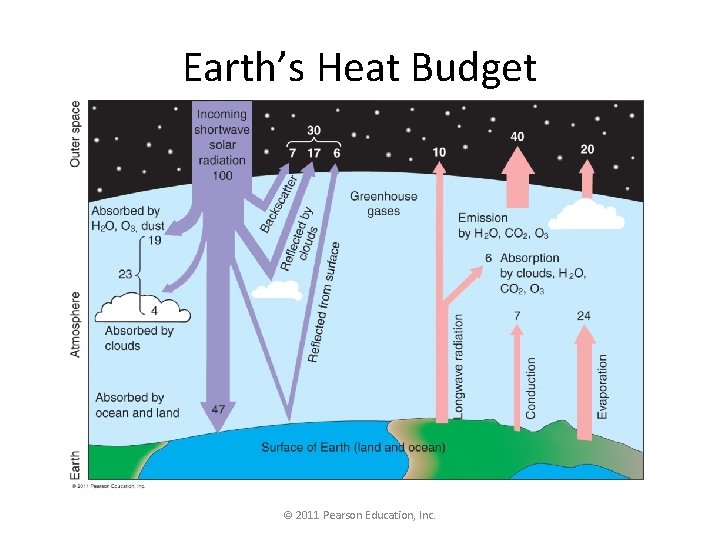
Earth’s Heat Budget • Addition to or subtraction from heat on Earth • Incoming radiation from Sun shorter wavelengths • Outgoing radiation from Earth longer wavelengths • Rates of energy absorption and reradiation must be equal © 2011 Pearson Education, Inc.
Earth’s Heat Budget © 2011 Pearson Education, Inc.
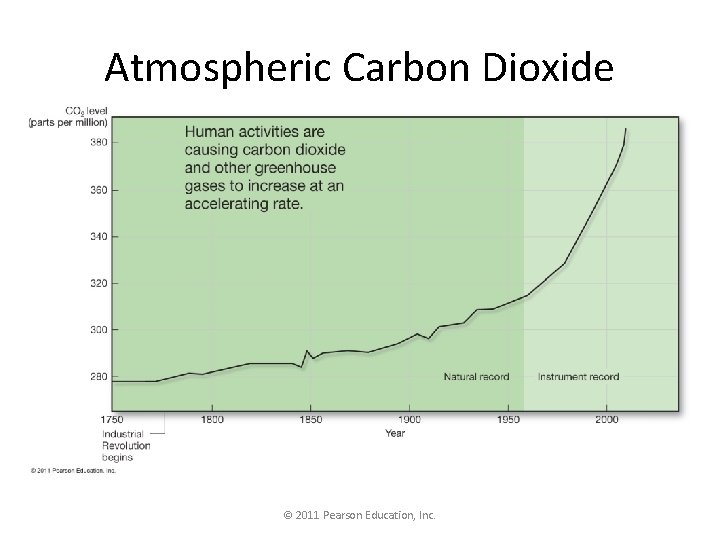
Greenhouse Gases • Water vapor – Most important – 66– 85% of greenhouse effect • Carbon dioxide – Natural part of atmosphere – Greatest relative contribution from human activities – Burning of fossil fuels © 2011 Pearson Education, Inc.
Atmospheric Carbon Dioxide © 2011 Pearson Education, Inc.
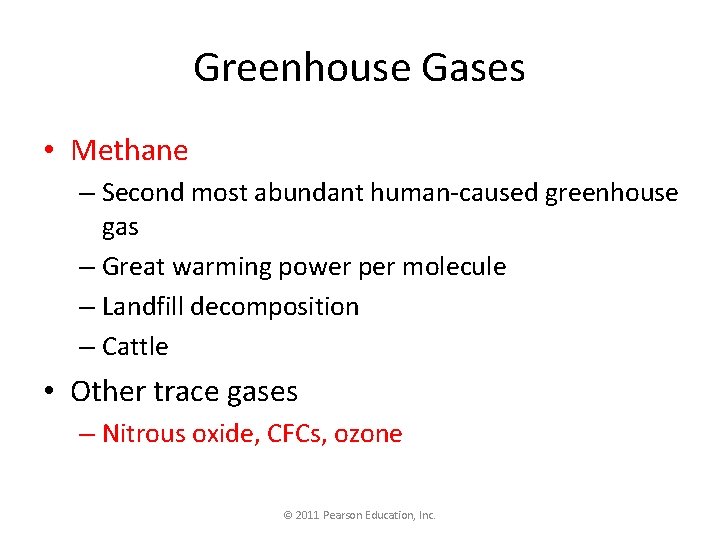
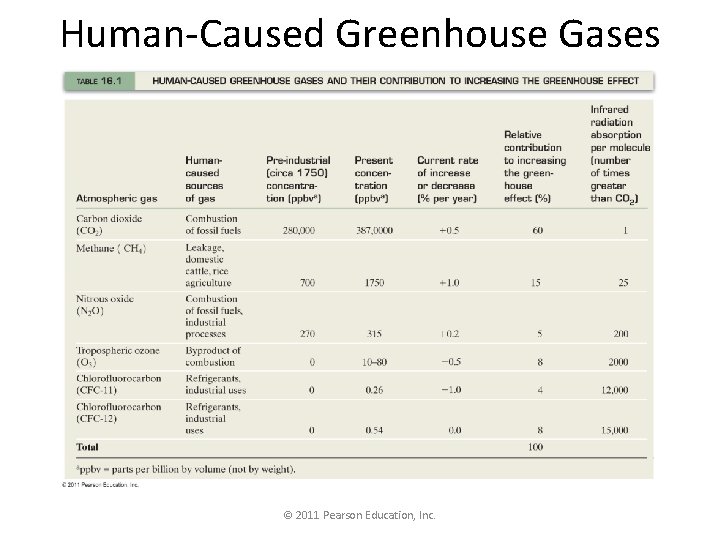
Greenhouse Gases • Methane – Second most abundant human-caused greenhouse gas – Great warming power per molecule – Landfill decomposition – Cattle • Other trace gases – Nitrous oxide, CFCs, ozone © 2011 Pearson Education, Inc.
Human-Caused Greenhouse Gases © 2011 Pearson Education, Inc.