
Weather Studies Introduction to Atmospheric Science American Meteorological

- Slides: 39
Weather Studies Introduction to Atmospheric Science American Meteorological Society Chapter 6 Humidity, Saturation, and Stability Credit: This presentation was prepared for AMS by Michael Leach, Professor of Geography at New Mexico State University - Grants
Case-in-Point § Cloud forests are forests that are perpetually shrouded in clouds or mist – They are found from 2000 -3000 m (6500 -9800 ft) in elevation in the tropics and subtropics § Onshore and upslope winds that are warm and humid supply the moisture – Warm air blowing upslope cools through expansion – Expansional cooling raises the relative humidity to saturation and water vapor condenses into low clouds and fog – The tree canopy strips moisture from the clouds and this water drips to the forest floor § Deforestation reduces available moisture and raises air temperature → clouds form less readily and at higher elevations 2
Case-in-Point § If global warming translates into higher sea surface temperatures (SSTs) in the tropics, cloud forests could be affected – Air flowing onshore would be warmer – Greater ascents would be required to produce clouds – Clouds would be at higher elevations § Perhaps even lift off the mountains – Cloud forests are extremely sensitive to climate variations § They may prove to be early indicators of effects of global-scale climate change 3
Driving Question § How does the cycling of water in the Earthatmosphere system help maintain a habitable planet? – This chapter will tell us: § How the global water cycle functions – Especially as it relates to transference between the Earth’s surface and the atmosphere § How to quantify the water content of air § How air becomes saturated through uplift and expansional cooling § How atmospheric stability affects the ascent of air 4
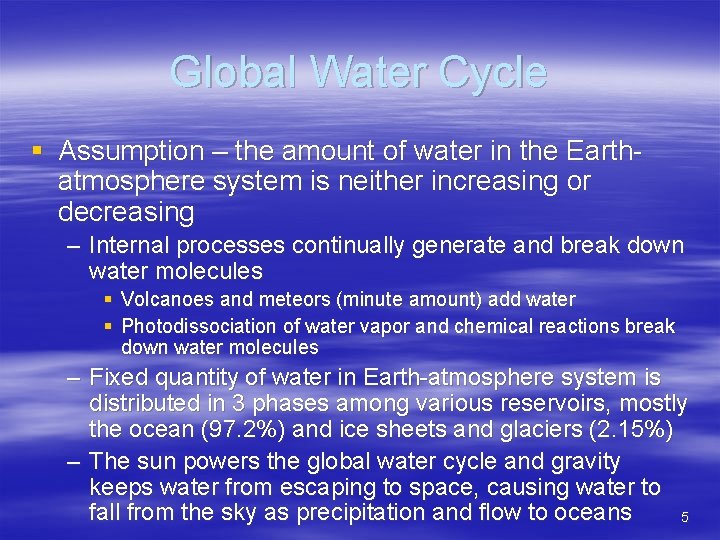
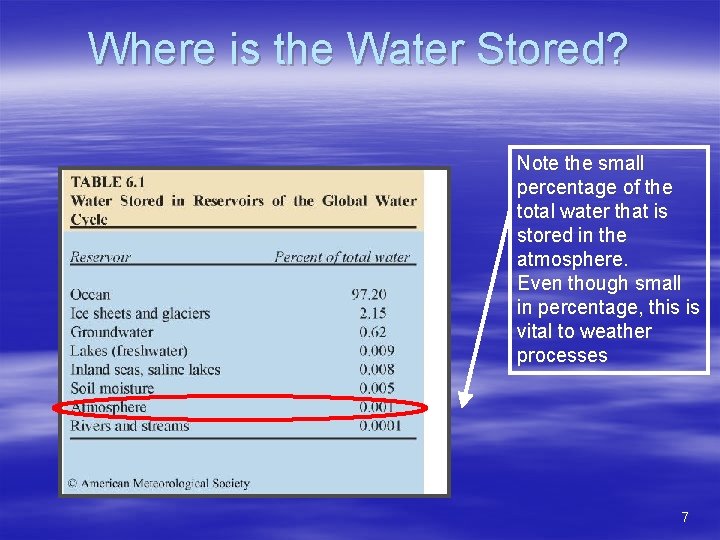
Global Water Cycle § Assumption – the amount of water in the Earthatmosphere system is neither increasing or decreasing – Internal processes continually generate and break down water molecules § Volcanoes and meteors (minute amount) add water § Photodissociation of water vapor and chemical reactions break down water molecules – Fixed quantity of water in Earth-atmosphere system is distributed in 3 phases among various reservoirs, mostly the ocean (97. 2%) and ice sheets and glaciers (2. 15%) – The sun powers the global water cycle and gravity keeps water from escaping to space, causing water to fall from the sky as precipitation and flow to oceans 5
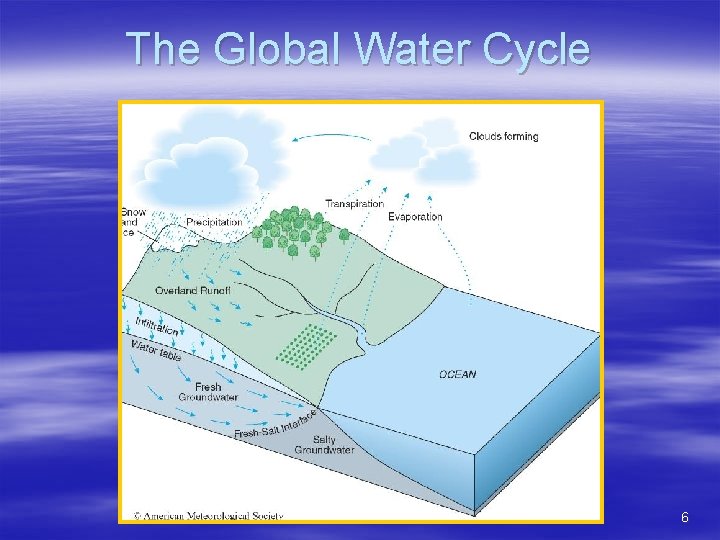
The Global Water Cycle 6
Where is the Water Stored? Note the small percentage of the total water that is stored in the atmosphere. Even though small in percentage, this is vital to weather processes 7
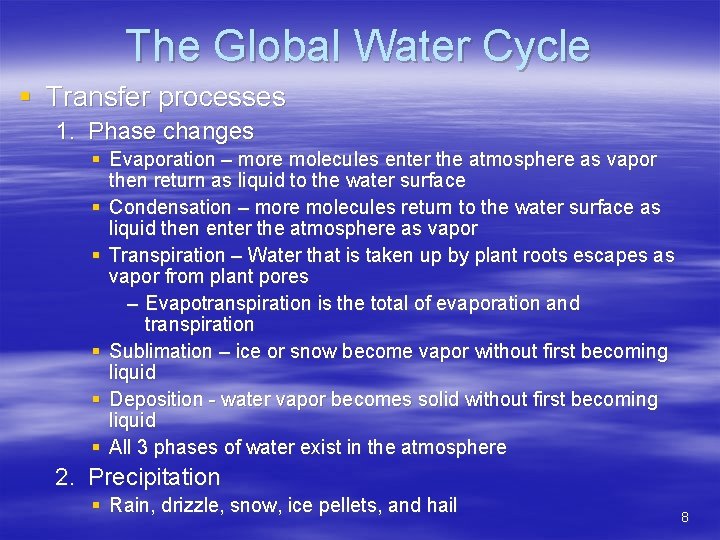
The Global Water Cycle § Transfer processes 1. Phase changes § Evaporation – more molecules enter the atmosphere as vapor then return as liquid to the water surface § Condensation – more molecules return to the water surface as liquid then enter the atmosphere as vapor § Transpiration – Water that is taken up by plant roots escapes as vapor from plant pores – Evapotranspiration is the total of evaporation and transpiration § Sublimation – ice or snow become vapor without first becoming liquid § Deposition - water vapor becomes solid without first becoming liquid § All 3 phases of water exist in the atmosphere 2. Precipitation § Rain, drizzle, snow, ice pellets, and hail 8
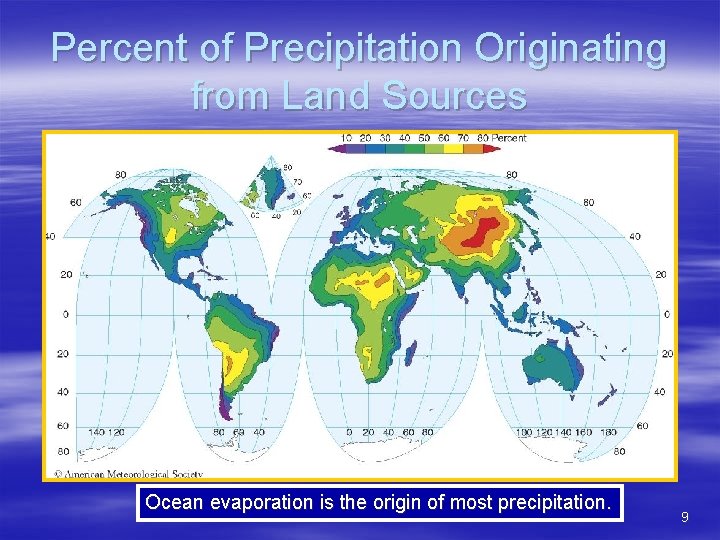
Percent of Precipitation Originating from Land Sources Ocean evaporation is the origin of most precipitation. 9
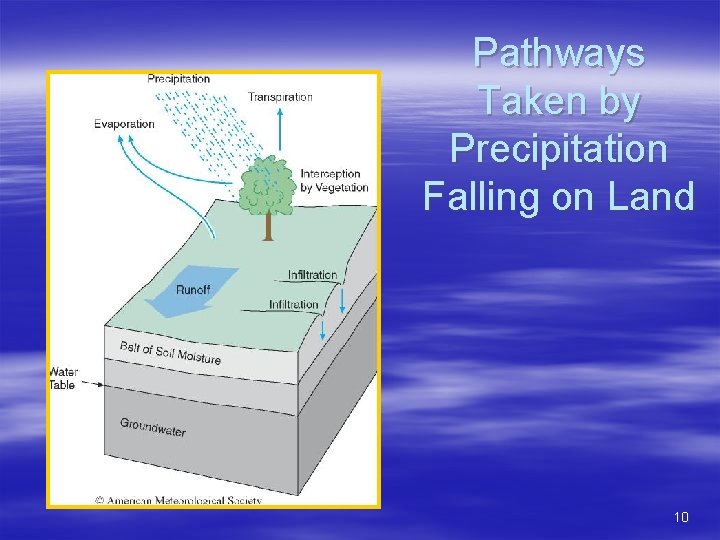
Pathways Taken by Precipitation Falling on Land 10
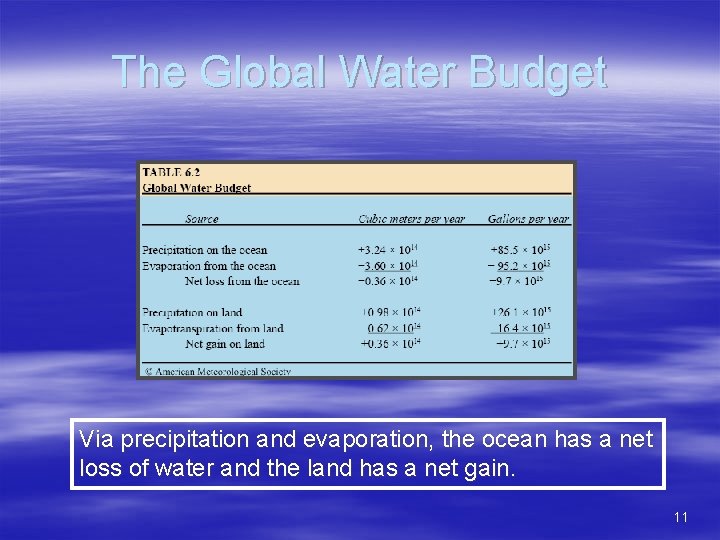
The Global Water Budget Via precipitation and evaporation, the ocean has a net loss of water and the land has a net gain. 11
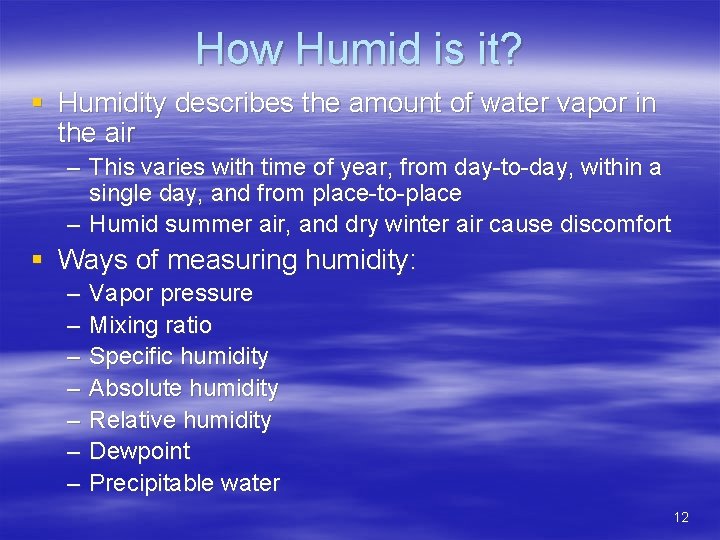
How Humid is it? § Humidity describes the amount of water vapor in the air – This varies with time of year, from day-to-day, within a single day, and from place-to-place – Humid summer air, and dry winter air cause discomfort § Ways of measuring humidity: – – – – Vapor pressure Mixing ratio Specific humidity Absolute humidity Relative humidity Dewpoint Precipitable water 12
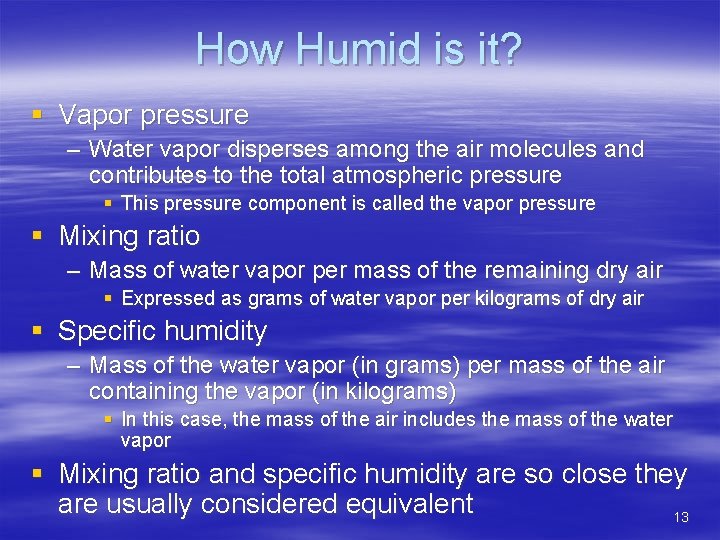
How Humid is it? § Vapor pressure – Water vapor disperses among the air molecules and contributes to the total atmospheric pressure § This pressure component is called the vapor pressure § Mixing ratio – Mass of water vapor per mass of the remaining dry air § Expressed as grams of water vapor per kilograms of dry air § Specific humidity – Mass of the water vapor (in grams) per mass of the air containing the vapor (in kilograms) § In this case, the mass of the air includes the mass of the water vapor § Mixing ratio and specific humidity are so close they are usually considered equivalent 13
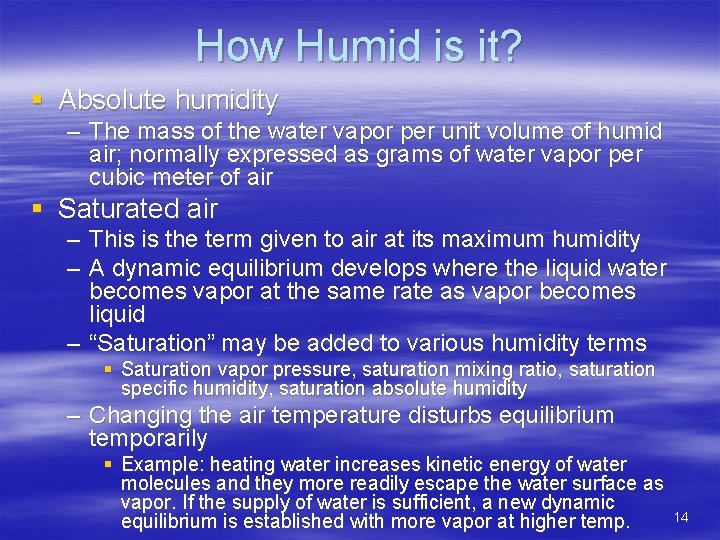
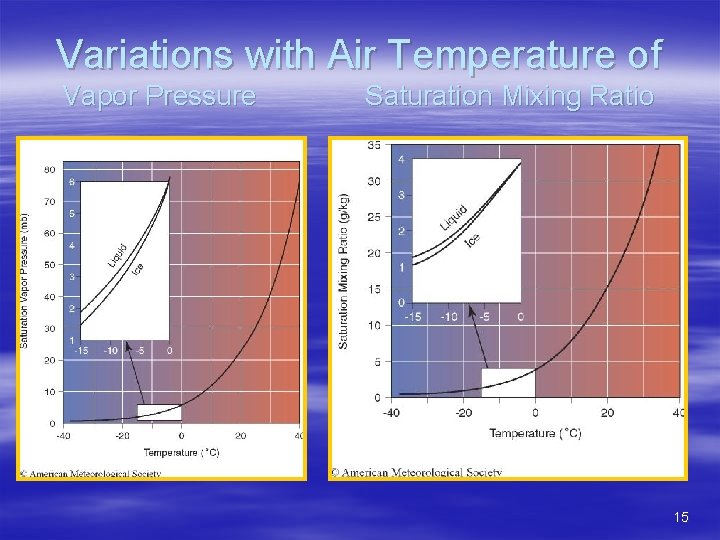
How Humid is it? § Absolute humidity – The mass of the water vapor per unit volume of humid air; normally expressed as grams of water vapor per cubic meter of air § Saturated air – This is the term given to air at its maximum humidity – A dynamic equilibrium develops where the liquid water becomes vapor at the same rate as vapor becomes liquid – “Saturation” may be added to various humidity terms § Saturation vapor pressure, saturation mixing ratio, saturation specific humidity, saturation absolute humidity – Changing the air temperature disturbs equilibrium temporarily § Example: heating water increases kinetic energy of water molecules and they more readily escape the water surface as vapor. If the supply of water is sufficient, a new dynamic equilibrium is established with more vapor at higher temp. 14
Variations with Air Temperature of Vapor Pressure Saturation Mixing Ratio 15
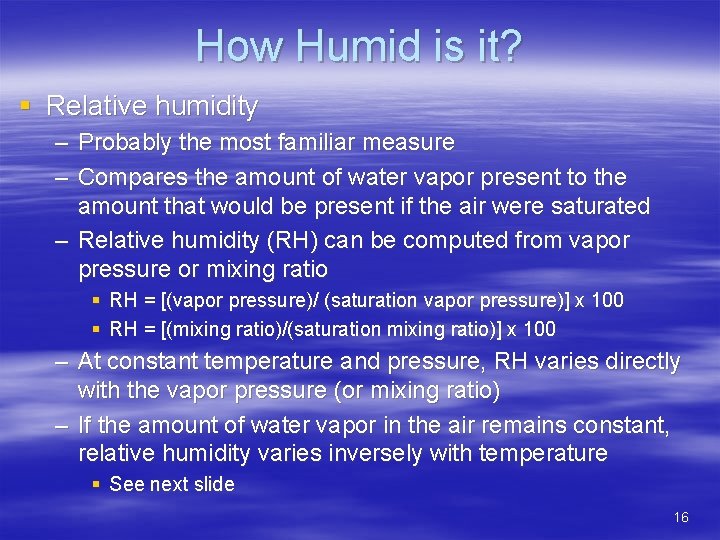
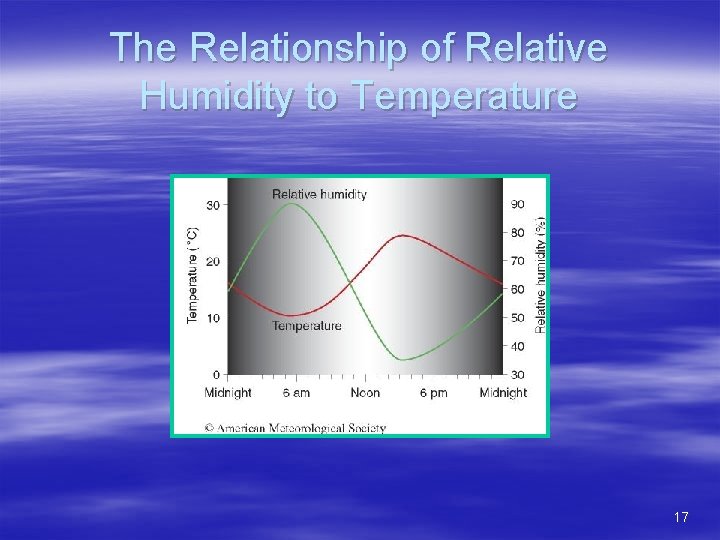
How Humid is it? § Relative humidity – Probably the most familiar measure – Compares the amount of water vapor present to the amount that would be present if the air were saturated – Relative humidity (RH) can be computed from vapor pressure or mixing ratio § RH = [(vapor pressure)/ (saturation vapor pressure)] x 100 § RH = [(mixing ratio)/(saturation mixing ratio)] x 100 – At constant temperature and pressure, RH varies directly with the vapor pressure (or mixing ratio) – If the amount of water vapor in the air remains constant, relative humidity varies inversely with temperature § See next slide 16
The Relationship of Relative Humidity to Temperature 17
How Humid is it? § Dewpoint – The temperature to which the air must be cooled at constant pressure to reach saturation § At the dewpoint, air reaches 100% relative humidity § Higher with greater concentration of water vapor in air § With high relative humidity, the dewpoint is closer to the current temperature than with low relative humidity – Dew is small drops of water that form on surfaces by condensation of water vapor – If the dewpoint is below freezing, frost may form on the colder surfaces through deposition § Dewpoints below freezing are sometimes referred to as frostpoints 18
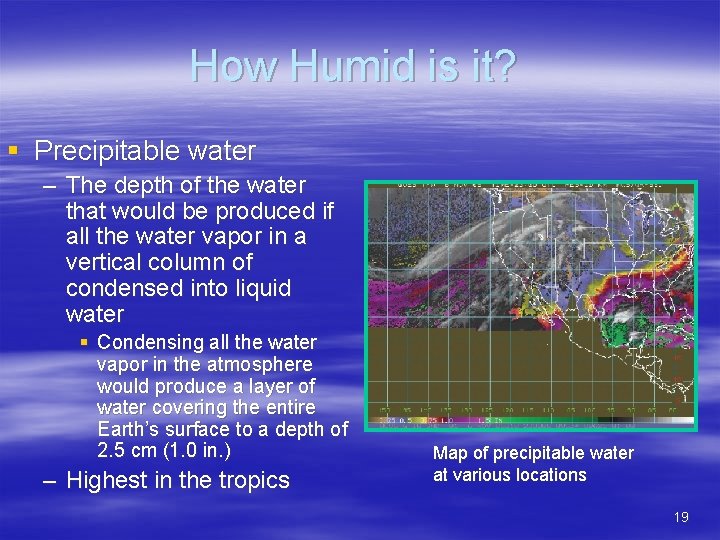
How Humid is it? § Precipitable water – The depth of the water that would be produced if all the water vapor in a vertical column of condensed into liquid water § Condensing all the water vapor in the atmosphere would produce a layer of water covering the entire Earth’s surface to a depth of 2. 5 cm (1. 0 in. ) – Highest in the tropics Map of precipitable water at various locations 19
Monitoring Water Vapor § Humidity instruments – Hygrometer § Measures the water vapor concentration of air – Dewpoint hygrometer § Uses a temperature-controlled mirror and an infrared beam – When the mirror temperature reaches a point that condensation forms, the reflectivity of the mirror is changed, altering the reflection of the beam. The temperature is recorded as the dewpoint. § These are common at NWS forecast stations – Hair hygrometer § Relates changes in length of a humid hair to humidity – hair lengthens as relative humidity increases – Hygrograph § Provides a record of humidity variations over time – Electronic hygrometer § Based on changes in resistance of certain chemicals as they absorb or release water vapor to the air 20
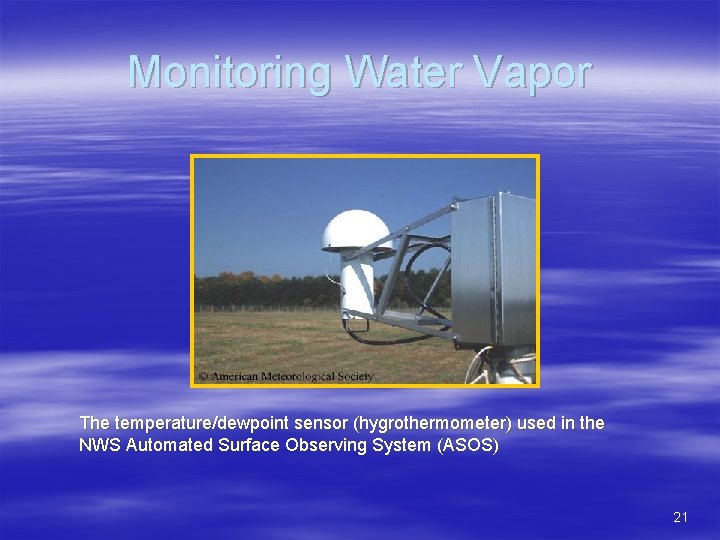
Monitoring Water Vapor The temperature/dewpoint sensor (hygrothermometer) used in the NWS Automated Surface Observing System (ASOS) 21
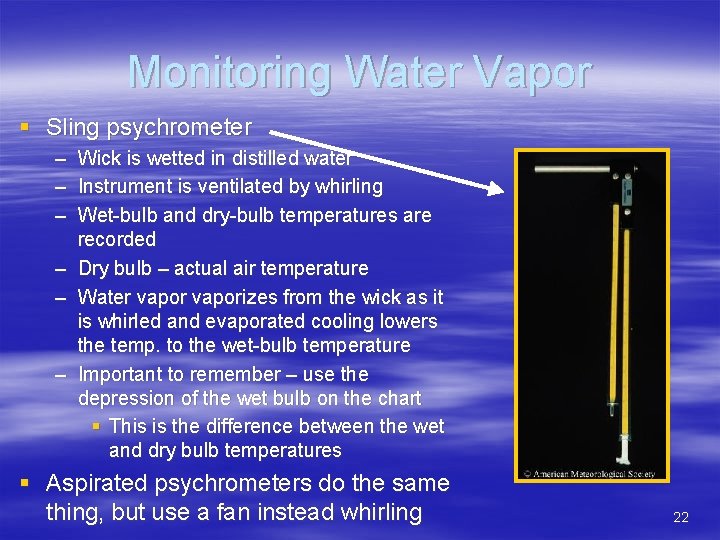
Monitoring Water Vapor § Sling psychrometer – Wick is wetted in distilled water – Instrument is ventilated by whirling – Wet-bulb and dry-bulb temperatures are recorded – Dry bulb – actual air temperature – Water vaporizes from the wick as it is whirled and evaporated cooling lowers the temp. to the wet-bulb temperature – Important to remember – use the depression of the wet bulb on the chart § This is the difference between the wet and dry bulb temperatures § Aspirated psychrometers do the same thing, but use a fan instead whirling 22
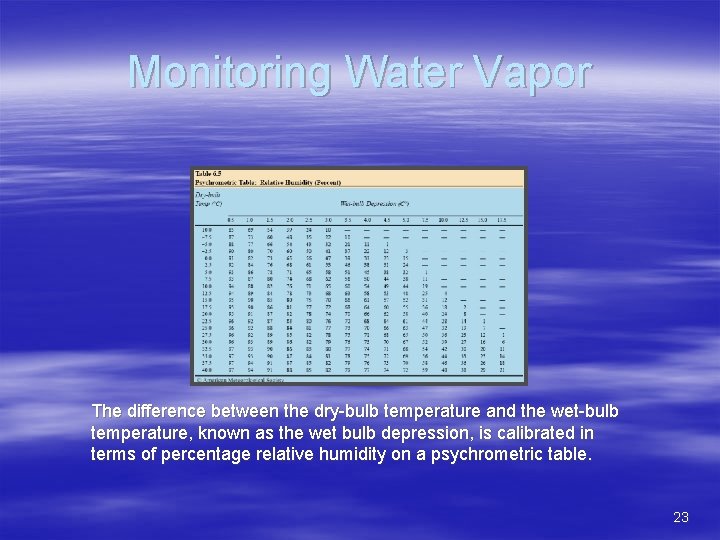
Monitoring Water Vapor The difference between the dry-bulb temperature and the wet-bulb temperature, known as the wet bulb depression, is calibrated in terms of percentage relative humidity on a psychrometric table. 23
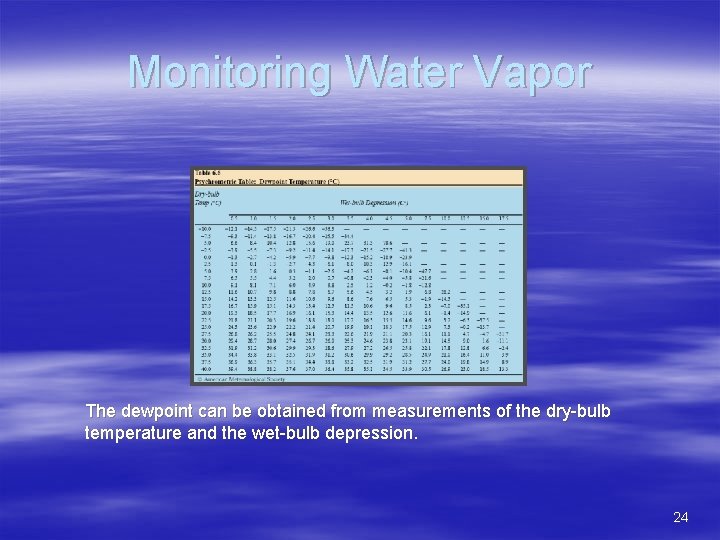
Monitoring Water Vapor The dewpoint can be obtained from measurements of the dry-bulb temperature and the wet-bulb depression. 24
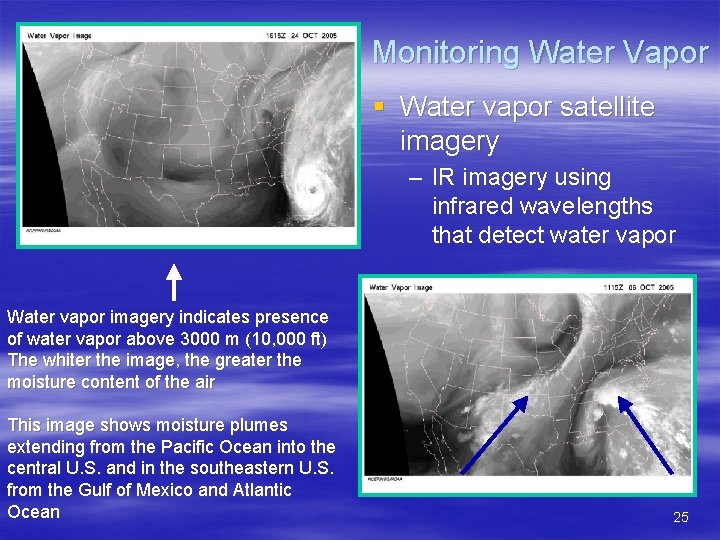
Monitoring Water Vapor § Water vapor satellite imagery – IR imagery using infrared wavelengths that detect water vapor Water vapor imagery indicates presence of water vapor above 3000 m (10, 000 ft) The whiter the image, the greater the moisture content of the air This image shows moisture plumes extending from the Pacific Ocean into the central U. S. and in the southeastern U. S. from the Gulf of Mexico and Atlantic Ocean 25
How Air Becomes Saturated § As relative humidity nears 100%, condensation or deposition becomes more likely § Condensation or deposition will form clouds – Clouds are liquid and/or ice particles § Humidity increases when: – Air is cooled; saturation vapor pressure decreases while actual vapor pressure remains constant – Water vapor is added at a constant temperature; vapor pressure increases while saturation vapor pressure remains constant § As ascending saturated air (RH about 100%) expands and cools, saturation mixing ratio and actual mixing ratio decline and some water vapor is converted to water droplets or ice crystals 26
How Air Becomes Saturated § Adiabatic process and lapse rates (review from Chapter 5) – During an adiabatic process, no heat is exchanged between the air parcel and its environment – Expansional cooling and compressional heating of unsaturated air are referred to as adiabatic processes if no heat is exchanged with surroundings – Air cools adiabatically as it rises § § Lower pressure with altitude allows the air to expand Unsaturated ascending air cools at 9. 8° C/1000 m (5. 5° F/1000 ft) and it warms at the same rate upon descent. – This is called the dry adiabatic lapse rate – Upon saturation, air continues to cool, but at the moist adiabatic lapse rate of 6° C/1000 m (3. 3° F/1000 ft) → rate is lower because latent heat released upon condensation partially offsets cooling as parcel rises 27
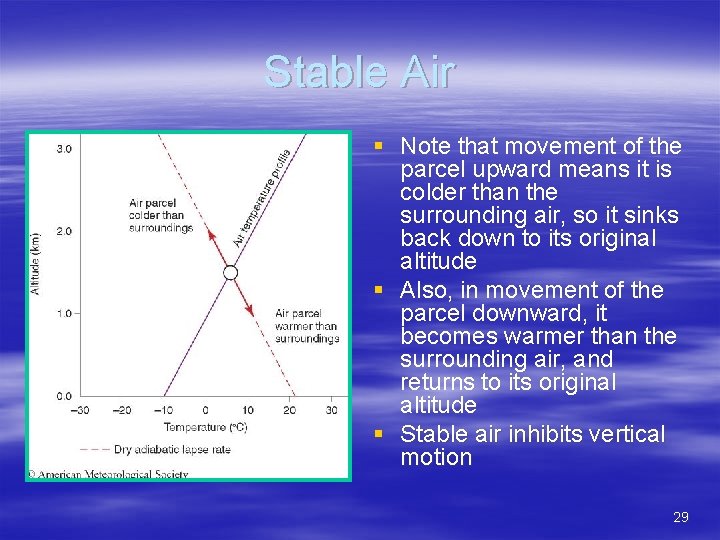
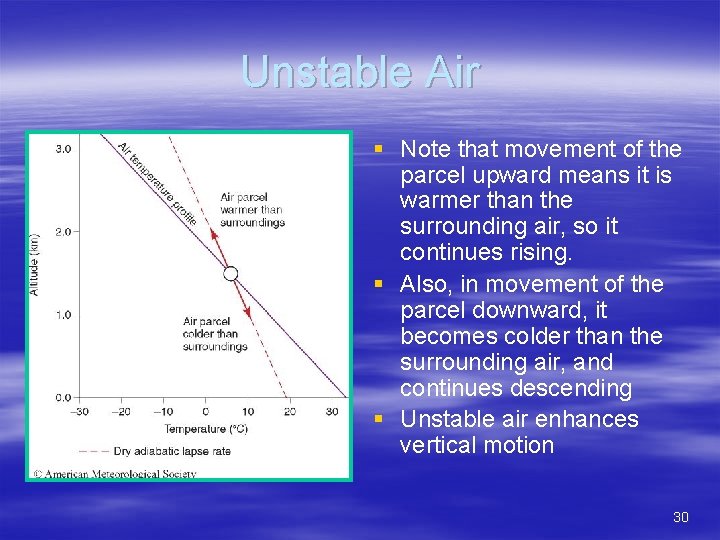
Atmospheric Stability § Air parcels are subject to buoyant forces caused by density differences between the surrounding air and the parcel itself § Atmospheric stability is the property of ambient air that either enhances (unstable) or suppresses (stable) vertical motion of air parcels – In stable air, an ascending parcel becomes cooler and more dense than the surrounding air § This causes the parcel to sink back to its original altitude – In unstable air, an ascending parcel becomes warmer and less dense than the surrounding air § This causes the parcel to continue rising 28
Stable Air § Note that movement of the parcel upward means it is colder than the surrounding air, so it sinks back down to its original altitude § Also, in movement of the parcel downward, it becomes warmer than the surrounding air, and returns to its original altitude § Stable air inhibits vertical motion 29
Unstable Air § Note that movement of the parcel upward means it is warmer than the surrounding air, so it continues rising. § Also, in movement of the parcel downward, it becomes colder than the surrounding air, and continues descending § Unstable air enhances vertical motion 30
Atmospheric Stability § Soundings – These are the temperature profiles of the ambient air through which air parcels are moving – Soundings (and hence stability) can change due to: § Local radiational heating and cooling – At night, cold ground cools and stabilizes the overlying air – During day, warm ground warms and destabilizes the overlying air § Air mass advection – Air mass is stabilized as it moves over a colder surface – Air mass is destabilized as it moves over a warmer surface § Large-scale ascent or descent of air – Subsiding air generally becomes more stable – Rising air generally becomes less stable 31
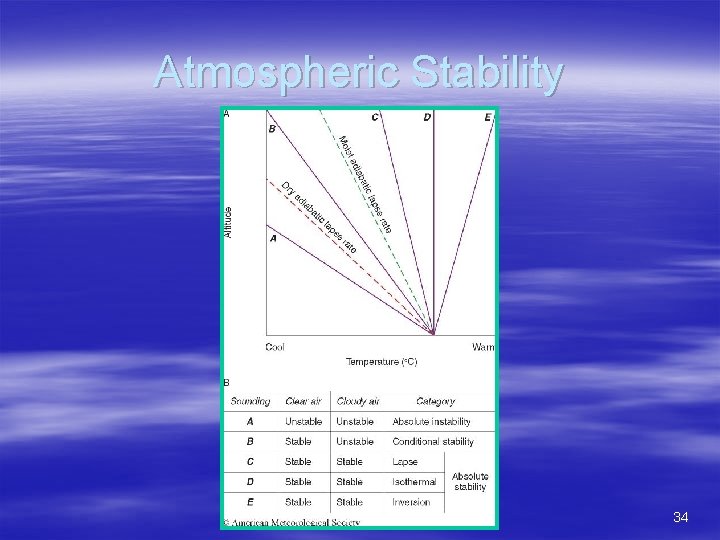
Atmospheric Stability § Absolute instability – Occurs when the air temperature is dropping more rapidly with altitude than the dry adiabatic lapse rate (9. 8° C/1000 m) § Conditional instability – Occurs when the air temperature is dropping with altitude more rapidly than the moist adiabatic lapse rate (6° C/1000 m), but less rapidly than the dry adiabatic lapse rate – Air layer is stable for unsaturated air parcels and unstable for saturated air parcels – Implies that unsaturated air must be forced upwards in order to reach saturation 32
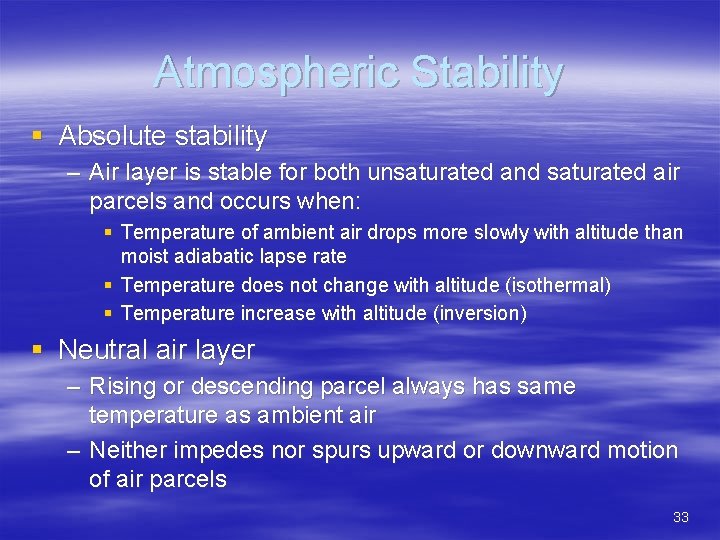
Atmospheric Stability § Absolute stability – Air layer is stable for both unsaturated and saturated air parcels and occurs when: § Temperature of ambient air drops more slowly with altitude than moist adiabatic lapse rate § Temperature does not change with altitude (isothermal) § Temperature increase with altitude (inversion) § Neutral air layer – Rising or descending parcel always has same temperature as ambient air – Neither impedes nor spurs upward or downward motion of air parcels 33
Atmospheric Stability 34
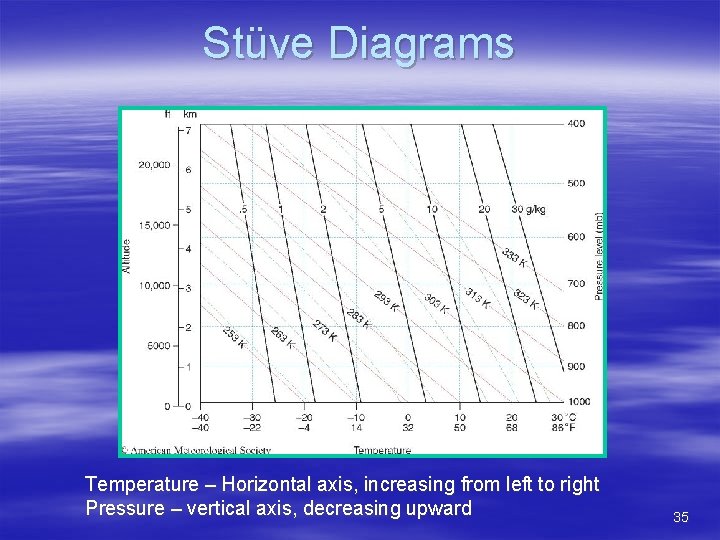
Stüve Diagrams Temperature – Horizontal axis, increasing from left to right Pressure – vertical axis, decreasing upward 35
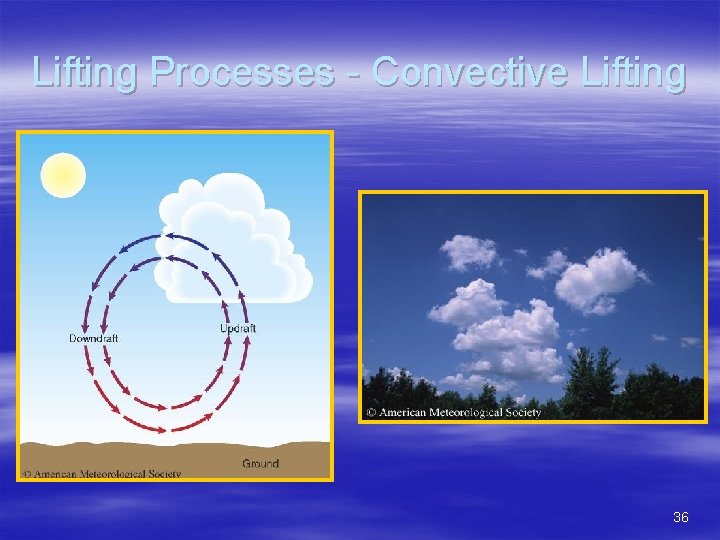
Lifting Processes - Convective Lifting 36
Lifting Processes - Frontal Lifting § Frontal uplift occurs where contrasting air masses meet – leads to expansional cooling of rising air, and possible cloud and precipitation development § Warm front – as a cold and dry air mass retreats, the warm air advances by riding up and over the cold air – The leading edge of advancing warm air at the Earth’s surface is the warm front § Cold front – cold and dry air displaces warm and humid air by sliding under it and forcing the warm air upwards – The leading edge of advancing cold air at the Earth’s surface is the cold front 37
Lifting Processes – Orographic Lifting 38
Lifting Processes – Convergent Lifting § When surface winds converge, associated upward motion leads to expansional cooling, increasing relative humidity, and possible cloud and precipitation formation § For example, converging winds are largely responsible for cloudiness and precipitation in a low-pressure system § In another example, converging sea breezes contribute to high frequency of thunderstorms in central Florida 39