
Weather Radar Network in Turkey Frat BETEPE DMI

Weather Radar Network in Turkey Fırat BEŞTEPE DMI Expert Electrical and Electronics Engineer, MSc Remote Sensing Division Turkish State Meteorological Service
Outline q Definition and Basic Principle of RADAR q Weather Radars q History of Weather Radars in Turkey q Weather Radar Network in Turkey q General Overview of Operational Radar Sites q Sample Radar Images 2
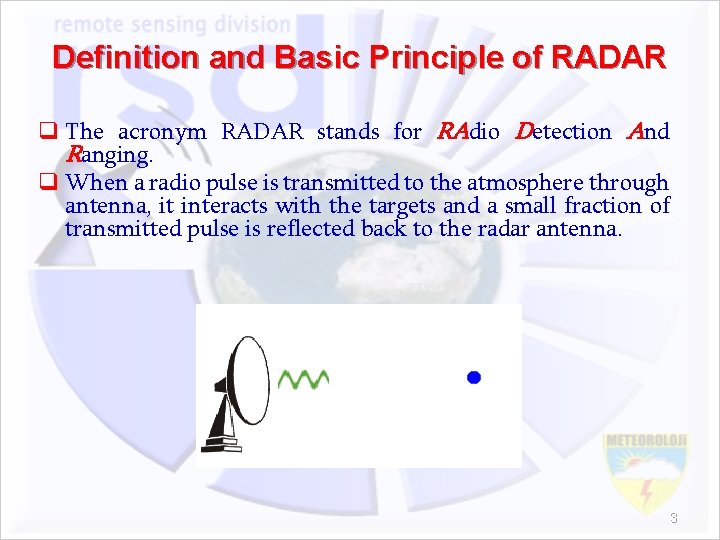
Definition and Basic Principle of RADAR q The acronym RADAR stands for RAdio Detection And Ranging. q When a radio pulse is transmitted to the atmosphere through antenna, it interacts with the targets and a small fraction of transmitted pulse is reflected back to the radar antenna. 3

Block Diagram of RADAR 4
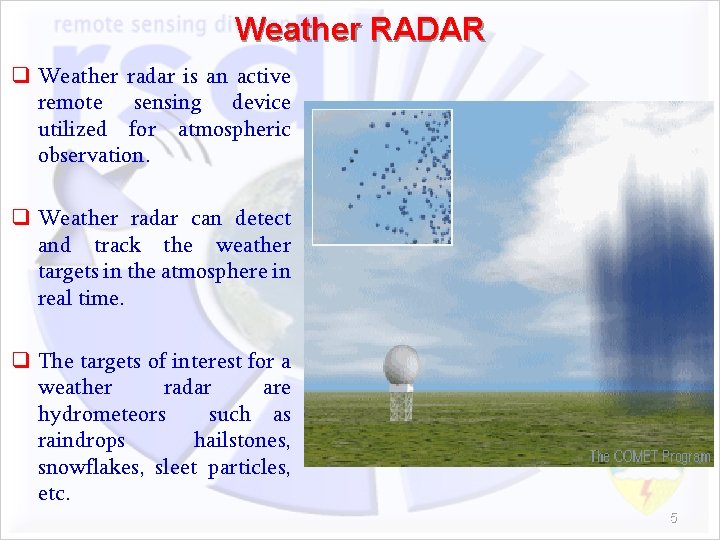
Weather RADAR q Weather radar is an active remote sensing device utilized for atmospheric observation. q Weather radar can detect and track the weather targets in the atmosphere in real time. q The targets of interest for a weather radar are hydrometeors such as raindrops hailstones, snowflakes, sleet particles, etc. 5
Weather RADAR q The most important questions required to be answered related with weather forecasting and monitoring are; § How much? (quantity or intensity) § Where? (location) § What period of time? (temporal information) q Conventional observation equipments can answer these questions as well, however they provide only spot measurements in the spatial and temporal course of an event. However, a radar allows fullcoverage weather monitoring with the highest temporal and spatial resolution. q Weather radars are very important devices for meteorology and hydrology in measuring areal precipitation and observing its development and direction of motion. 6

Weather RADAR q To detect precipitation quantitatively, locate it and track its motion. q To detect severe weather activities and forecast their future position and intensity. q To estimate the types of precipitation (rain, snow, hail, etc. ). q To analyze storm structure and its potential. q To perform short-term (up to 6 hours) weather forecasting, namely Nowcasting. q To provide data for hydrological models. 7
q In History of Weather RADARs in Turkey, Turkish State. Turkey Meteorological Service (TSMS) is legally responsible for installing and operating the weather radars and archiving their data. q In 1970 s and 1980 s, TSMS was using analog meteorological radars which are exhibited in TSMS museum in Ankara now. q However, the modern weather radar era in Turkey started in late 1990 s. With the tender in 1997, Gematronik Company installed a Doppler Radar in Ankara in 2000. This C-Band Doppler Radar is a quite early sample of a fast switch type polarimetric radars in the world. q Afterwards with the Project of TEFER (Turkey Emergency Flood and Earthquake Recovery), three more C-Band Doppler Weather Radar systems were installed by Mitsubishi – Hazama Consortium in Istanbul, Zonguldak and Balikesir provinces in 2003. 8
q In 2006, TSMS decided to extend the weather radar network with new C-band doppler radars and established a feasibility commision composed of experts from relavant diciplines in TSMS. This commision fulfilled a long-term study and presented a very comprehensive report in June 2007 forming the developement process of TSMS radar network. q According to the feasibility report, in addition to existing 4 radars, 16 more C-Band Doppler Weather Radars in total were planned in order to cover all parts of the country. q As a first step after feasibility study, TSMS went out to a tender for six C-band Doppler Weather Radars in 2008 and Vaisala Company got this tender. q Within the scope of the contract signed between TSMS and Vaisala in December 2008, the installation of two out of six C-band Doppler Weather Radars were completed and set into operation recently. 9
Turkish Weather RADAR Network q As of today, the operational radars are; § § § Ankara (June, 2000) İstanbul (March, 2003) Balıkesir (March, 2003) Zonguldak (March, 2003) İzmir (May, 2010) Muğla (July, 2010) : C-Band Polarimetric Doppler : C-Band Polarimetric Doppler : C-Band Polarimetric Doppler 10

RADAR Locations in Turkey İstanbul Zonguldak Samsun Trabzon Ankara Balıkesir İzmir Muğla Hatay Antalya Represents the operational radars. Represents the scheduled radars to be installed until mid-2012 by Vaisala 11

Doppler Mode RADAR Coverages 12
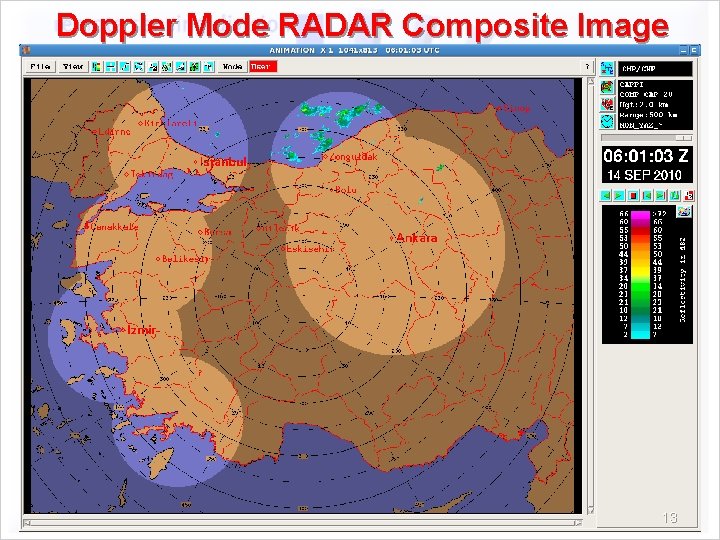
Doppler Mode RADAR Composite Image 13
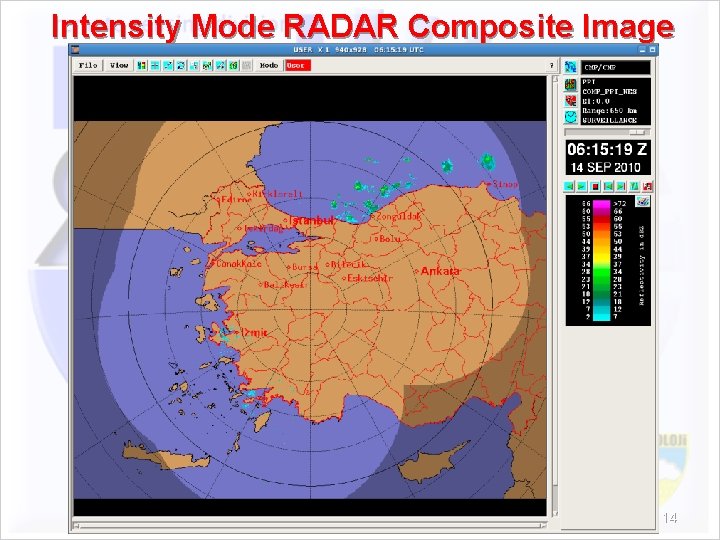
Intensity Mode RADAR Composite Image 14
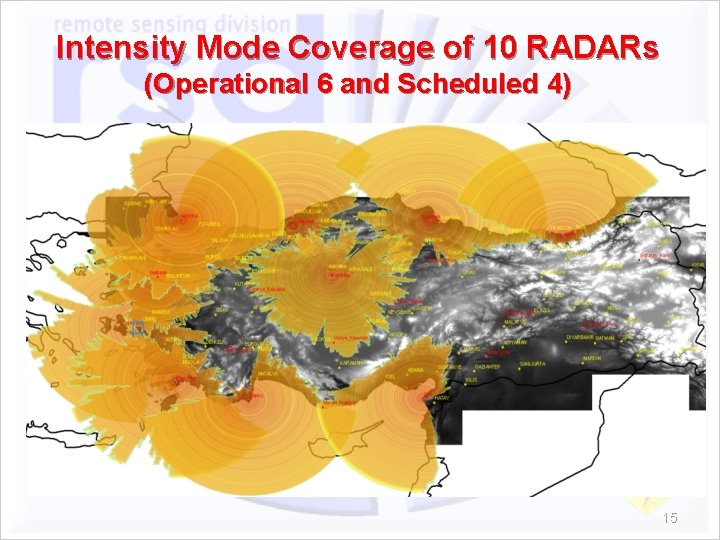
Intensity Mode Coverage of 10 RADARs (Operational 6 and Scheduled 4) 15
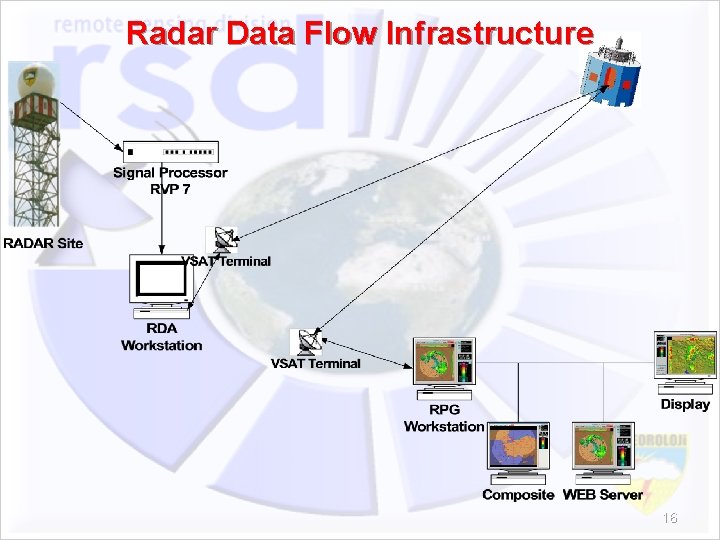
Radar Data Flow Infrastructure 16
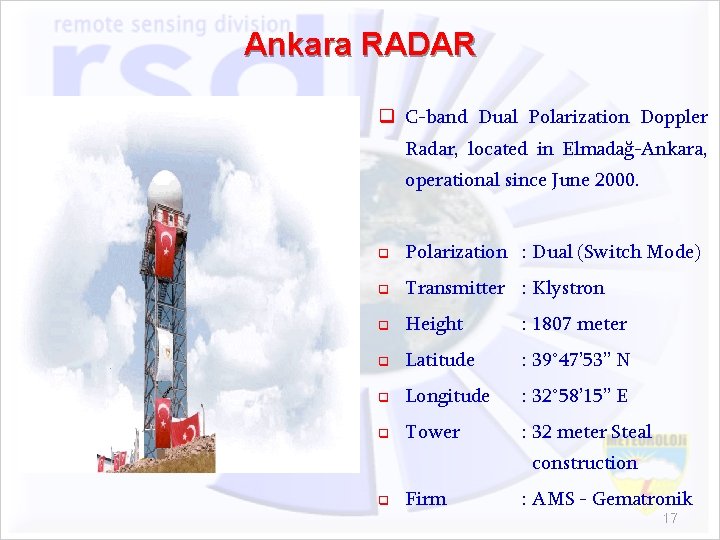
Ankara RADAR q C-band Dual Polarization Doppler Radar, located in Elmadağ-Ankara, operational since June 2000. q Polarization : Dual (Switch Mode) q Transmitter : Klystron q Height : 1807 meter q Latitude : 39° 47’ 53” N q Longitude : 32° 58’ 15” E q Tower : 32 meter Steal construction q Firm : AMS - Gematronik 17
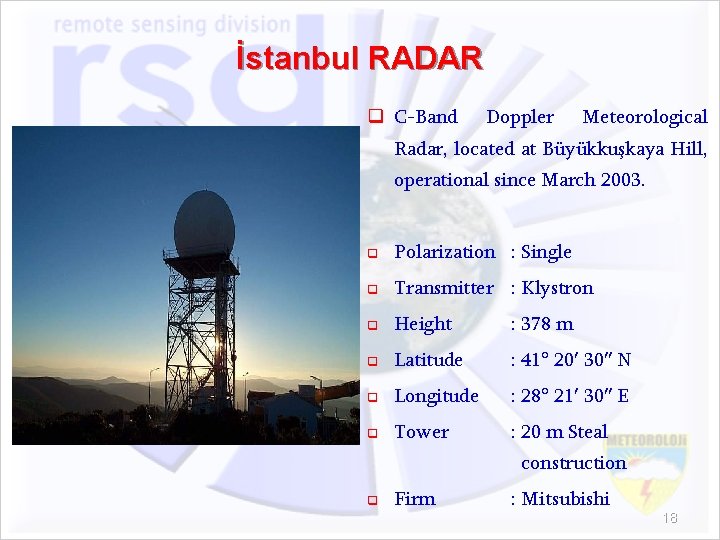
İstanbul RADAR q C-Band Doppler Meteorological Radar, located at Büyükkuşkaya Hill, operational since March 2003. q Polarization : Single q Transmitter : Klystron q Height : 378 m q Latitude : 41 20 30 N q Longitude : 28 21 30 E q Tower : 20 m Steal construction q Firm : Mitsubishi 18
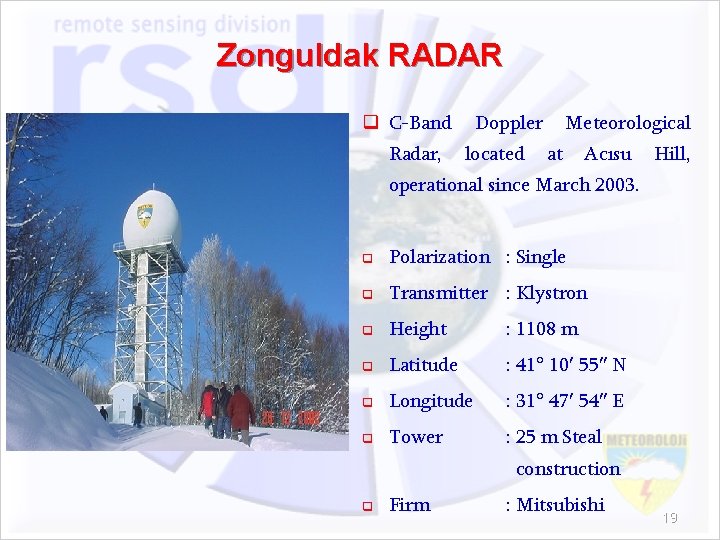
Zonguldak RADAR q C-Band Radar, Doppler located Meteorological at Acısu Hill, operational since March 2003. q Polarization : Single q Transmitter : Klystron q Height : 1108 m q Latitude : 41 10 55 N q Longitude : 31 47 54 E q Tower : 25 m Steal construction q Firm : Mitsubishi 19

Balıkesir RADAR q C-Band Doppler Meteorological Radar, located at Akcaldedesi Hill, operational since March 2003. q Polarization : Single q Transmitter : Klystron q Height : 642 m q Latitude : 39 44 26 N q Longitude : 27 37 10 E q Tower : 25 m Steal construction q Firm : Mitsubishi 20
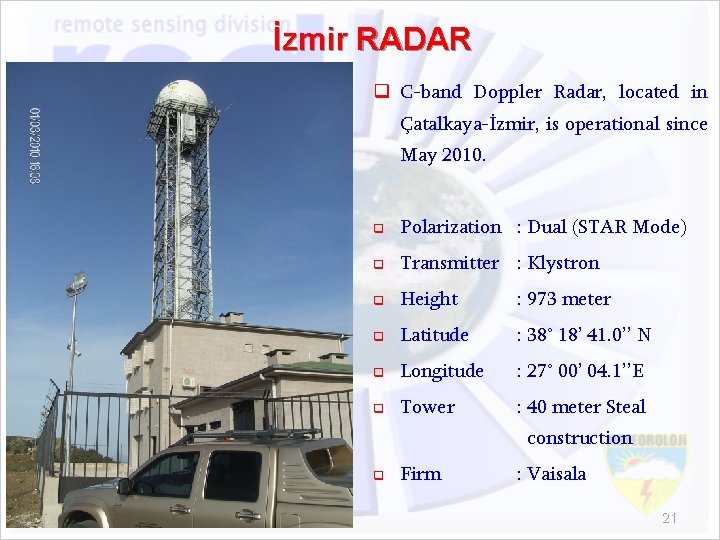
İzmir RADAR q C-band Doppler Radar, located in Çatalkaya-İzmir, is operational since May 2010. q Polarization : Dual (STAR Mode) q Transmitter : Klystron q Height : 973 meter q Latitude : 38° 18’ 41. 0’’ N q Longitude : 27° 00’ 04. 1’’E q Tower : 40 meter Steal construction q Firm : Vaisala 21
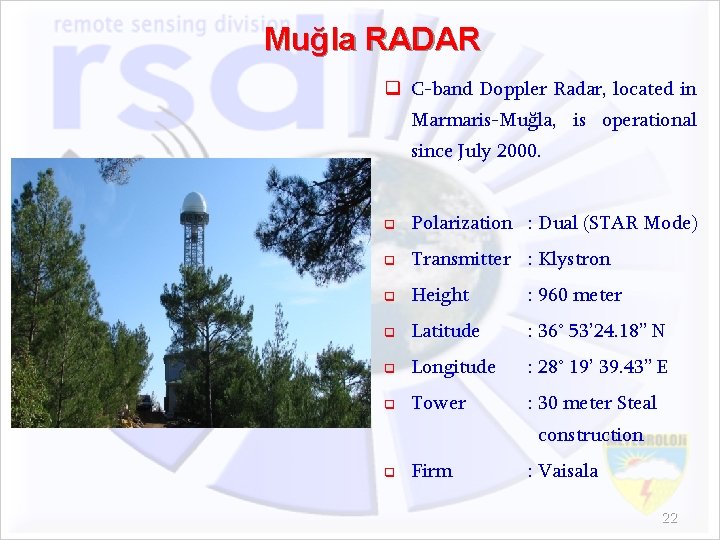
Muğla RADAR q C-band Doppler Radar, located in Marmaris-Muğla, is operational since July 2000. q Polarization : Dual (STAR Mode) q Transmitter : Klystron q Height : 960 meter q Latitude : 36° 53’ 24. 18” N q Longitude : 28° 19’ 39. 43” E q Tower : 30 meter Steal construction q Firm : Vaisala 22
Future Plans q The Turkish State Meteorological Service (TSMS) primarily aims to cover all country with 20 in total C-Band Doppler Radars as soon as possible. q Within the scope of contract signed with Vaisala in December 2008, two of six C-Band Polarimetric Doppler Weather Radars were already installed and set into operation recently. q Within the scope of same contract the remaining four C-Band Doppler Radars will be installed until mid-2012 according to the schedule below: § § Antalya (2011) Adana (2011) Trabzon (2012) Samsun (2012) : C-Band Polarimetric Doppler : C-Band Doppler q The biggest difficulty in Turkey for weather radar operations is the complicated and irregular topography and accordingly the beam blockage. In this sense, TSMS plans to fill the gaps in the C-Band Radar Network with short range X-Band Radars. 23
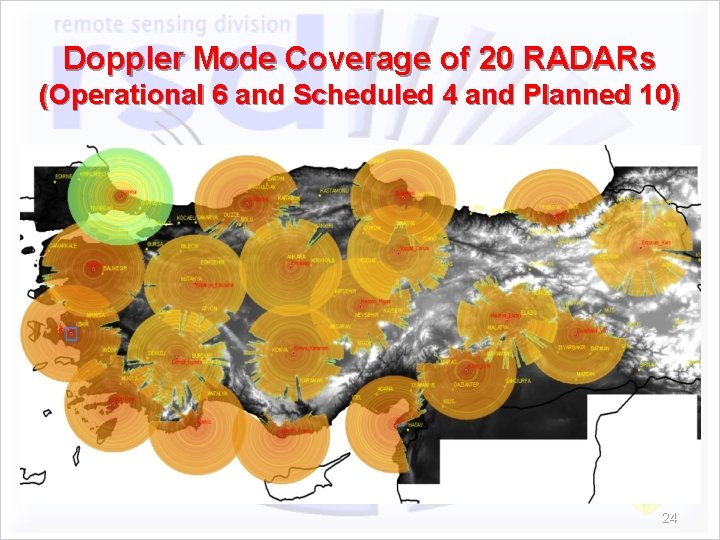
Doppler Mode Coverage of 20 RADARs (Operational 6 and Scheduled 4 and Planned 10) 24
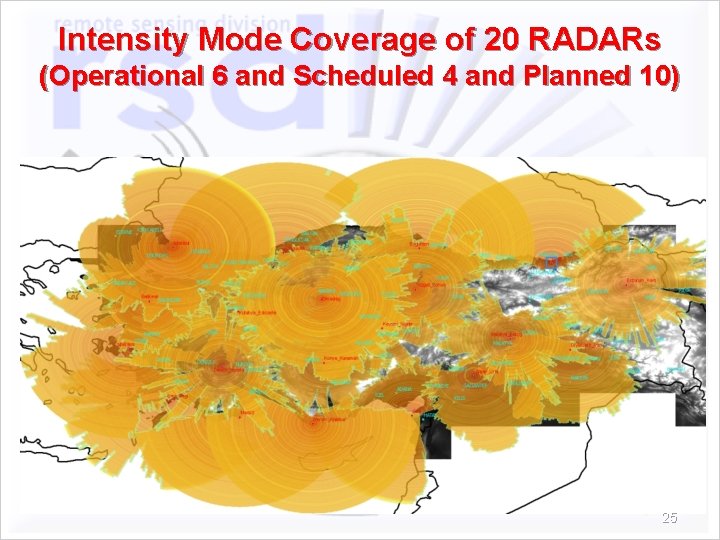
Intensity Mode Coverage of 20 RADARs (Operational 6 and Scheduled 4 and Planned 10) 25

MAX (Maximum Display) 26
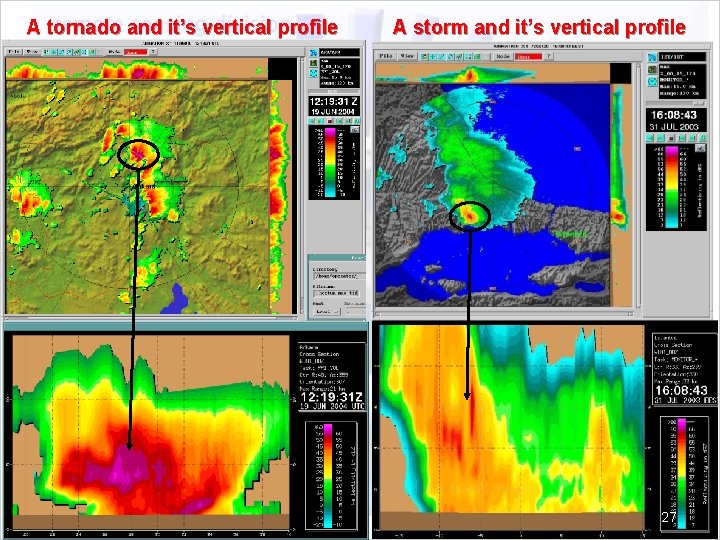
A tornado and it’s vertical profile A storm and it’s vertical profile 27
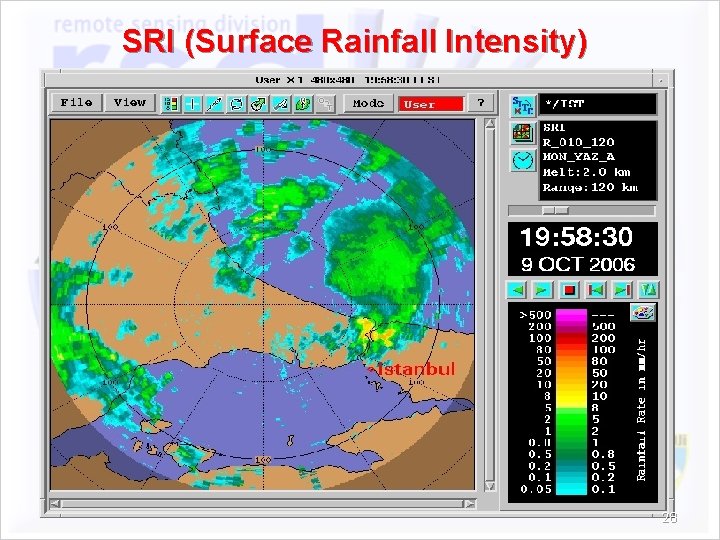
SRI (Surface Rainfall Intensity) 28
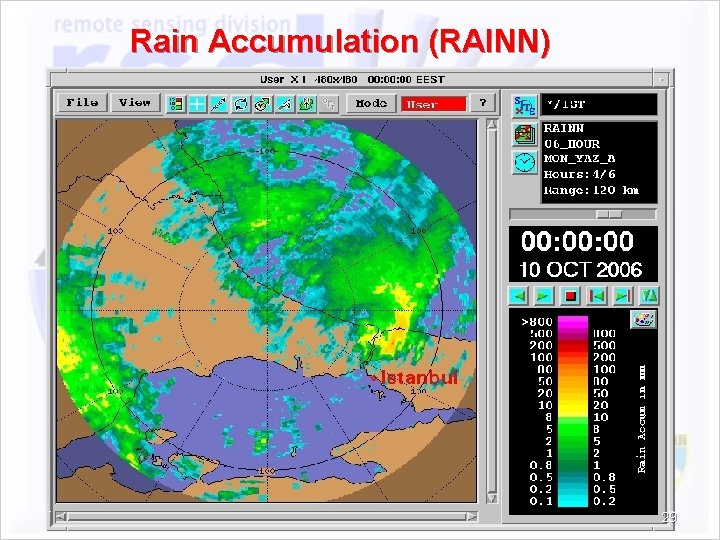
Rain Accumulation (RAINN) 29
Thank you! 30
- Slides: 30