
Weather and Climate Lecture 6 Microclimates Introduction Microclimatology

- Slides: 20
Weather and Climate Lecture 6: Microclimates
Introduction Microclimatology: – Study of climate over a small area – Urban – Forest – Mountains and valleys l Changes can be seen in: - Temperatures - Wind speeds, humidity and precipitation l
Introduction l l l Microclimates are of importance to: Planners Architects Farmers Geography Students
Bare Soil l Temperatures can vary due to the nature of soils: – Humus rich (dark) – Absorb more heat than light coloured soils, hence higher temperatures – Moist soils vs dry soils – Specific heat capacity differences – Moist soils will warm up more slowly, lower temperatures than dry soils – Ridge vs furrow in ploughed soils
Bare soil l Air as a poor conductor of heat – Soil with a high proportion of air (sand) – Hot at surface, cool rapidly with depth – Excess moisture in the soil will take it a longer time to heat up than fairly moist soil
Rainforest Microclimates Trees and Forests have a marked effect on climate l Due to trees which act as wind-breaks: l – Air movement in a forest ecosystem is much less l As a result of shade provided by the canopy: – More humid than open land – Vapour pressure higher
Rainforest Microclimates l Incoming radiation – Absorbed by canopy layer – In a rainforest, up to 5 layers – Trees with large, waxy leaves also have higher albedo, reflect incoming insolation l At night: – Vegetation traps and retains outgoing radiation – Aided by the high humidity (high number of water vapour molecules
Deciduous Forest l Deciduous Forests: – Will tend to have their own microclimate in Summer when vegetation is full – During winter, leaves are lost – May take the climate of the surrounding area as canopy is absent to affect temperatures, humidity and winds
Deciduous Forest Areas with large leaved trees as opposed to areas with small leaved trees: l Sycamore vs birch or oak l Sycamore absorbs more energy, hence lower temperatures in areas associated under these trees l Oak trees have higher density of leaves than birch, hence more light reaches the ground under birch, warmer temperatures l
Urban Microclimates l Large cities and conurbations: – Climatic conditions differ from countryside – Atmospheric composition – Temperature – Sunlight – Wind – Humidity – Cloud Cover – Precipitation
Urban Microclimates l Atmospheric Composition – 3 to 7 times more dust particles – Absorb radiation to give off heat – 200 times more sulphur dioxide – 10 times more nitrogen oxide – 10 times more hydrocarbons – 2 times more carbon dioxide l These aid in increases in cloud cover and precipitation, smog, higher temperatures and reduced sunlight
Urban Microclimates l Temperature – Tower blocks: low albedo and non reflective, absorb heat during the day time; higher temperatures than in a rural area – during the night; due to high thermal capacity of concrete structures and buildings, heat is slowly released; warmer temperatures – Further heat is obtained from car fumes, factories, power stations, central heating units, people
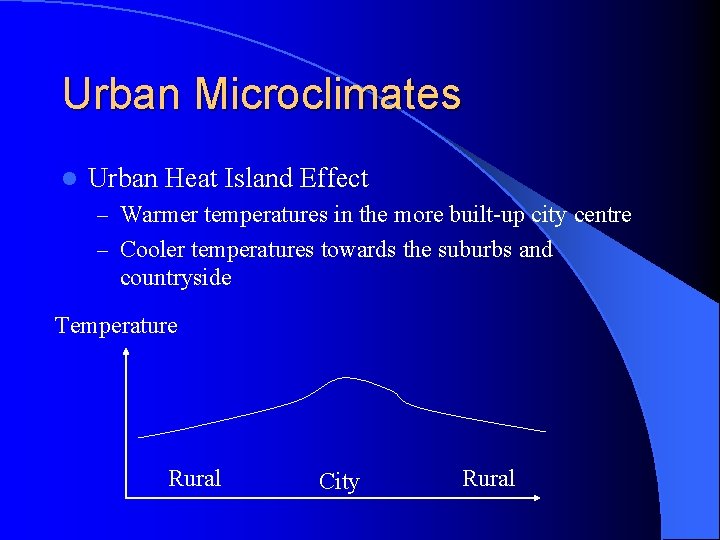
Urban Microclimates l Urban Heat Island Effect – Warmer temperatures in the more built-up city centre – Cooler temperatures towards the suburbs and countryside Temperature Rural City Rural
Urban Microclimates l In urban areas: – Day temperatures on average 0. 6 deg C warmer – night: 3 to 4 deg C warmer – Dust and cloud act as a blanket – Mean winter temp 1 to 2 deg C warmer – Mean summer temp 5 deg C warmer
Urban Microclimates l Sunlight – Less insolation and more cloud cover than rural areas – Dust and other particles absorb and reflect insolation – High rise buildings block out sunlight l Wind – Wind velocity is reduced; buildings act as windbreaks – Urban mean annual velocities may be up to 30 percent lower in rural areas – Calm periods 10 to 20 percent more than rural area
Urban Microclimates l On the other hand: – Skyscrapers which are very closely spaced and without ‘void decks’ – Form canyons – Wind eddies and currents are channeled along these narrow canyons – Strong enough to cause tall buildings to sway and pedestrians to be blown over
Urban Microclimates l Relative Humidity – Lower in urban areas than in rural areas – Warmer air in urban areas (increasing saturation specific humidity) – Lack of vegetation and surface storage to contribute to evapotranspiration – Therefore relative humidity lower
Urban Microclimates l Cloud Cover – Thicker and more frequent cloud cover – More condensation nuclei – warm, unstable air – clouds therefore form easily
Urban Microclimates l Precipitation – Mean anuual precipitation total, number of days with less than 5 mm of rainfall are 10 percent higher in major urban areas – turns snow into sleet, limits the number of days with snow on the ground – high frequency and intensity of smog due to concentration of condensation nuclei and pollutants
Mountain and Valley Microclimates l Mountains and valleys can be said to create their own climates: – Foehn/Chinnok – Anabatic winds – Katabatic Winds – Associated Fog – Rainfall