
Wearing the hair shirt A retrospective on Haskell

![“Declaration style” Define a function as a series of independent equations map f []](https://slidetodoc.com/presentation_image/186871cbf1c9772aafc44fd00a91d63f/image-12.jpg "“Declaration style” Define a function as a series of independent equations map f []")
![Quickcheck prop. Rev : : [Int] -> Bool prop. Rev xs = reverse (reverse](https://slidetodoc.com/presentation_image/186871cbf1c9772aafc44fd00a91d63f/image-46.jpg "Quickcheck prop. Rev : : [Int] -> Bool prop. Rev xs = reverse (reverse")
![Qualified types § Type classes are an example of qualified types [Jones thesis]. Main](https://slidetodoc.com/presentation_image/186871cbf1c9772aafc44fd00a91d63f/image-53.jpg "Qualified types § Type classes are an example of qualified types [Jones thesis]. Main")
- Slides: 65
Wearing the hair shirt A retrospective on Haskell Simon Peyton Jones Microsoft Research, Cambridge
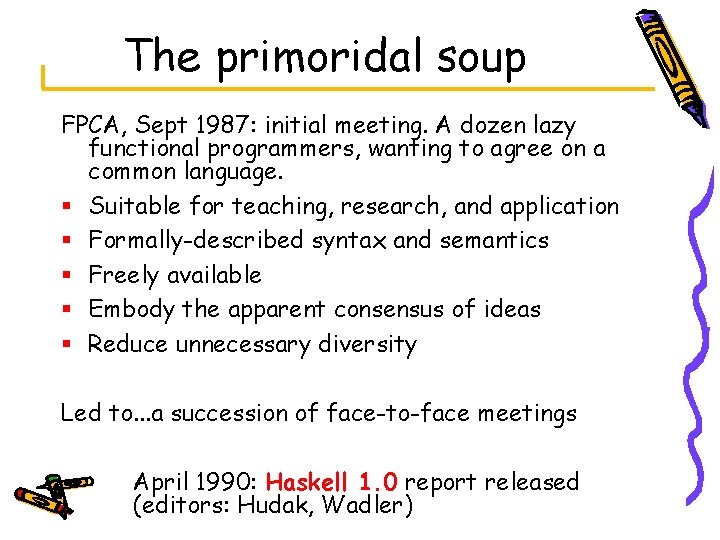
The primoridal soup FPCA, Sept 1987: initial meeting. A dozen lazy functional programmers, wanting to agree on a common language. § Suitable for teaching, research, and application § Formally-described syntax and semantics § Freely available § Embody the apparent consensus of ideas § Reduce unnecessary diversity Led to. . . a succession of face-to-face meetings April 1990: Haskell 1. 0 report released (editors: Hudak, Wadler)
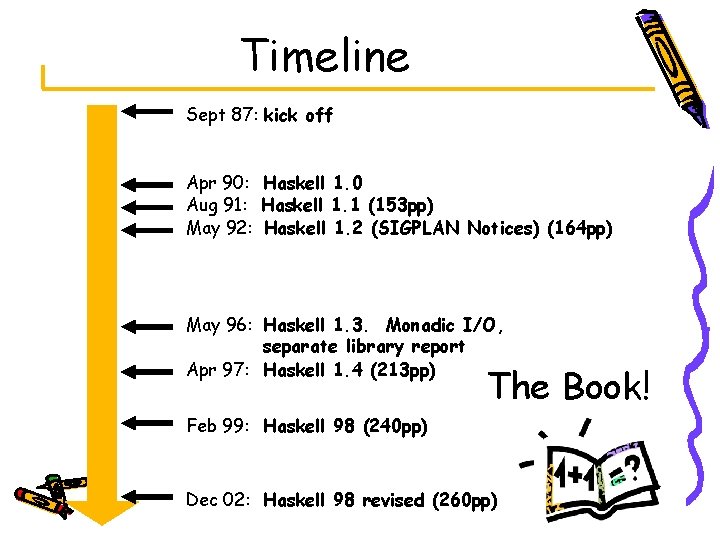
Timeline Sept 87: kick off Apr 90: Haskell 1. 0 Aug 91: Haskell 1. 1 (153 pp) May 92: Haskell 1. 2 (SIGPLAN Notices) (164 pp) May 96: Haskell 1. 3. Monadic I/O, separate library report Apr 97: Haskell 1. 4 (213 pp) The Book! Feb 99: Haskell 98 (240 pp) Dec 02: Haskell 98 revised (260 pp)
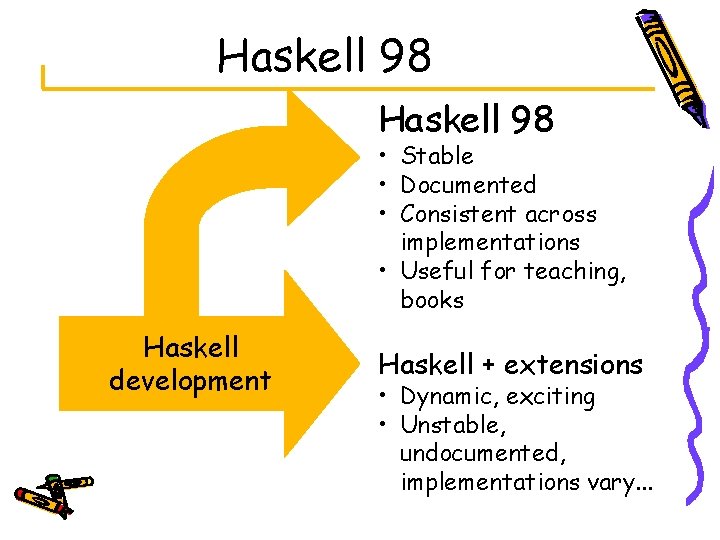
Haskell 98 • Stable • Documented • Consistent across implementations • Useful for teaching, books Haskell development Haskell + extensions • Dynamic, exciting • Unstable, undocumented, implementations vary. . .
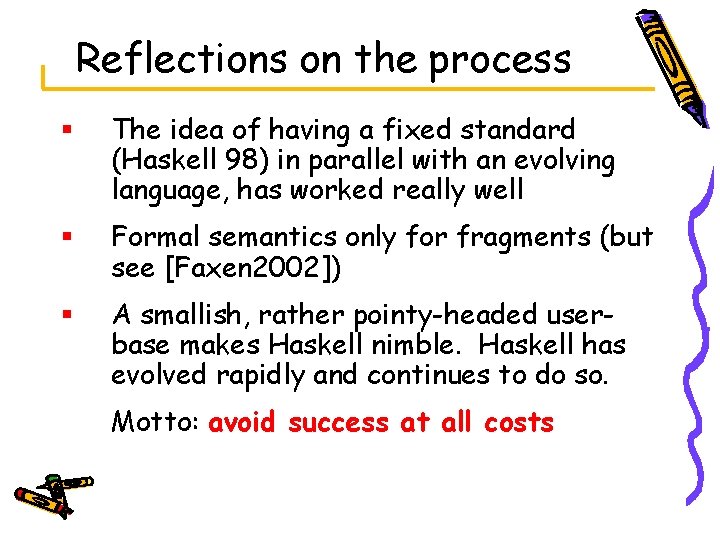
Reflections on the process § The idea of having a fixed standard (Haskell 98) in parallel with an evolving language, has worked really well § Formal semantics only for fragments (but see [Faxen 2002]) § A smallish, rather pointy-headed userbase makes Haskell nimble. Haskell has evolved rapidly and continues to do so. Motto: avoid success at all costs
The price of usefulness § Libraries increasingly important: – 1996: Separate libraries Report – 2001: Hierarchical library naming structure, increasingly populated § Foreign-function interface increasingly important – 1993 onwards: a variety of experiments – 2001: successful effort to standardise a FFI across implementations § Any language large enough to be useful is dauntingly complex
Syntax
Syntax is not important Parsing is the easy bit of a compiler
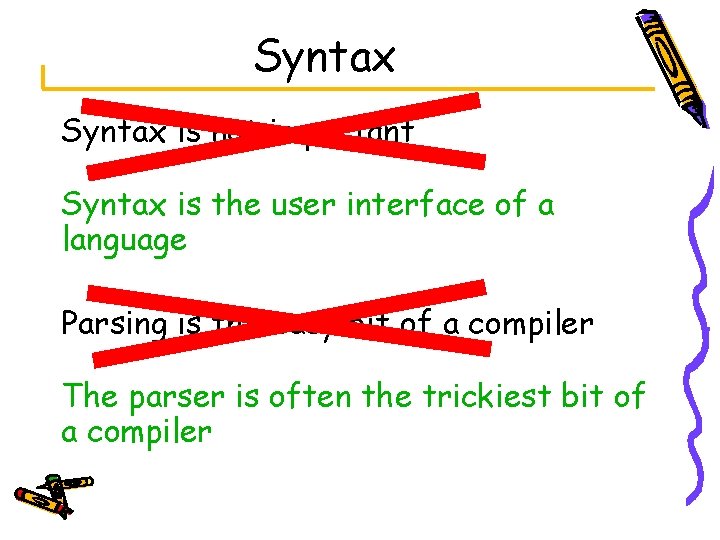
Syntax is not important Syntax is the user interface of a language Parsing is the easy bit of a compiler The parser is often the trickiest bit of a compiler
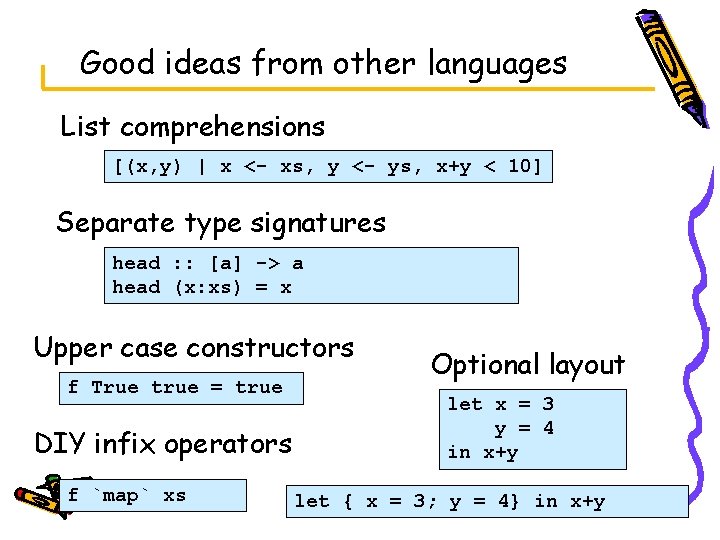
Good ideas from other languages List comprehensions [(x, y) | x <- xs, y <- ys, x+y < 10] Separate type signatures head : : [a] -> a head (x: xs) = x Upper case constructors f True true = true DIY infix operators f `map` xs Optional layout let x = 3 y = 4 in x+y let { x = 3; y = 4} in x+y
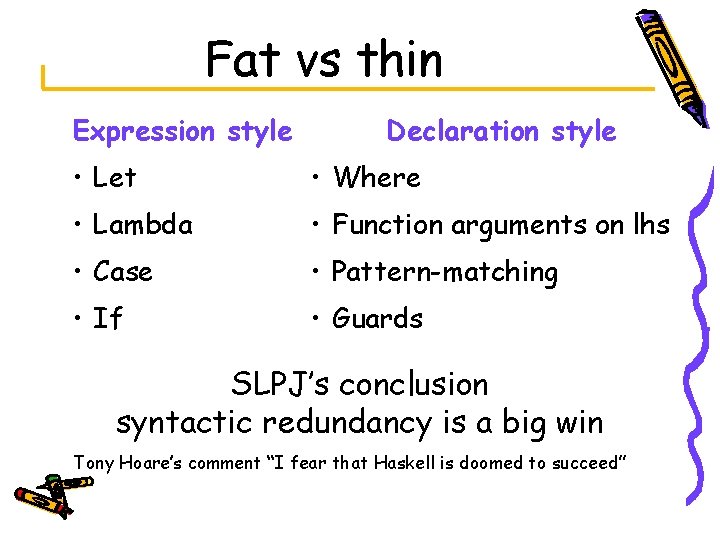
Fat vs thin Expression style Declaration style • Let • Where • Lambda • Function arguments on lhs • Case • Pattern-matching • If • Guards SLPJ’s conclusion syntactic redundancy is a big win Tony Hoare’s comment “I fear that Haskell is doomed to succeed”
“Declaration style” Define a function as a series of independent equations map f [] = [] map f (x: xs) = f x : map f xs sign x | x>0 | x==0 | x<0 = 1 = 0 = -1
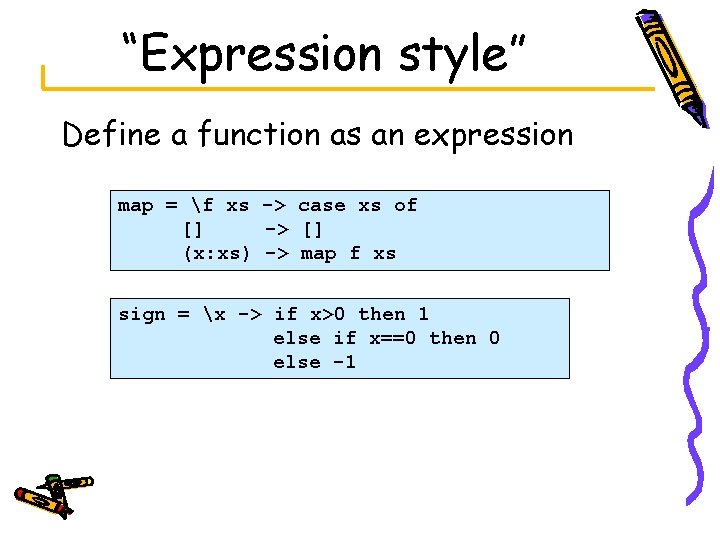
“Expression style” Define a function as an expression map = f xs -> case xs of [] -> [] (x: xs) -> map f xs sign = x -> if x>0 then 1 else if x==0 then 0 else -1
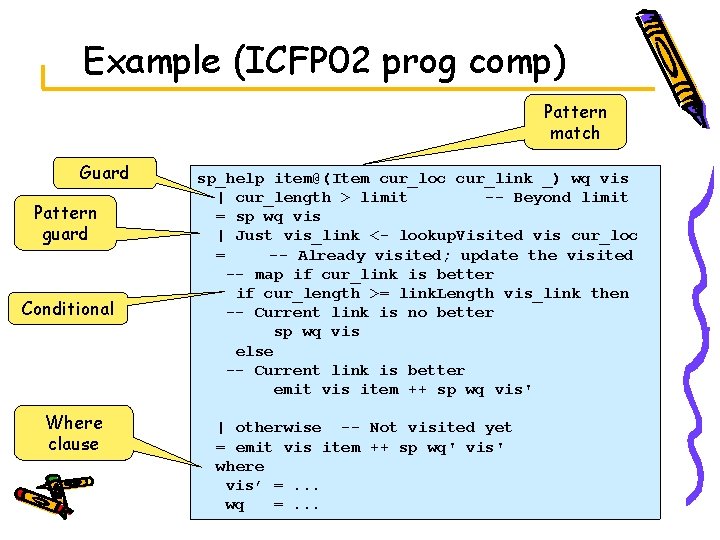
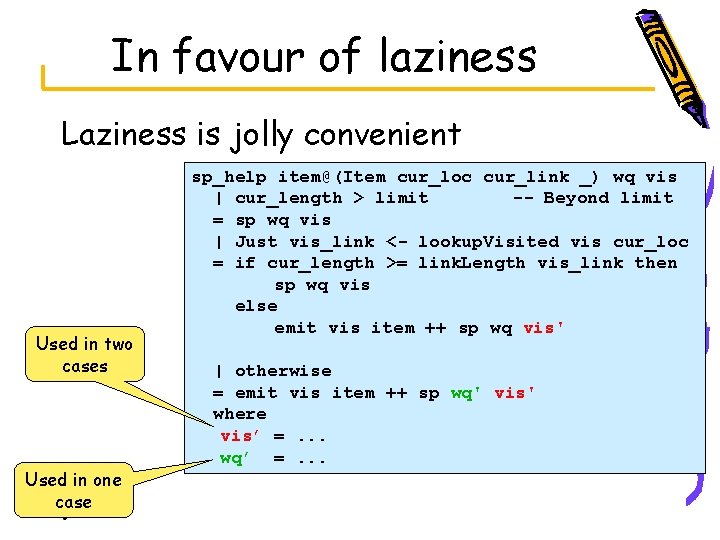
Example (ICFP 02 prog comp) Pattern match Guard Pattern guard Conditional Where clause sp_help item@(Item cur_loc cur_link _) wq vis | cur_length > limit -- Beyond limit = sp wq vis | Just vis_link <- lookup. Visited vis cur_loc = -- Already visited; update the visited -- map if cur_link is better if cur_length >= link. Length vis_link then -- Current link is no better sp wq vis else -- Current link is better emit vis item ++ sp wq vis' | otherwise -- Not visited yet = emit vis item ++ sp wq' vis' where vis’ =. . . wq =. . .
So much for syntax. . . What is important or interesting about Haskell?
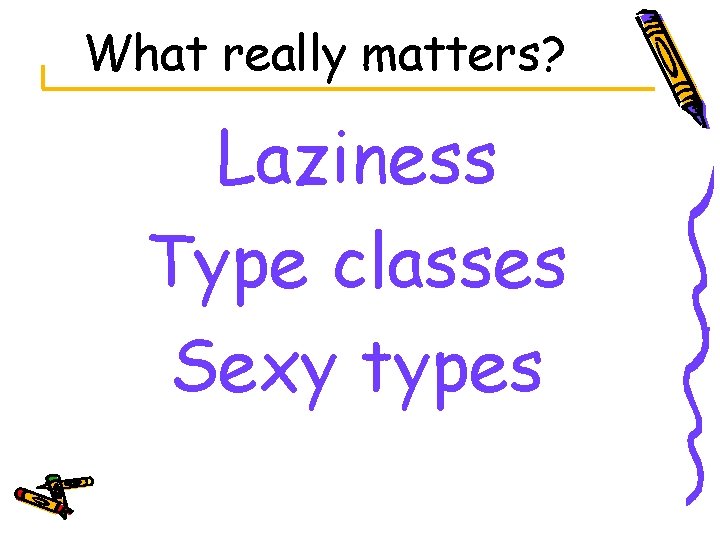
What really matters? Laziness Type classes Sexy types
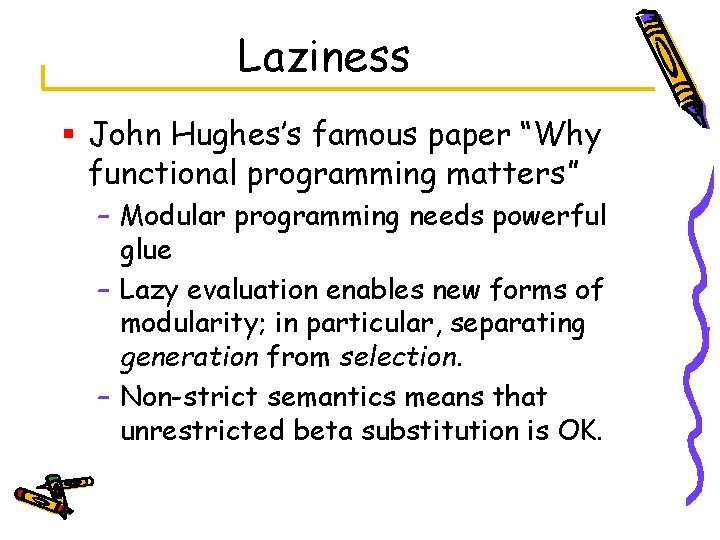
Laziness § John Hughes’s famous paper “Why functional programming matters” – Modular programming needs powerful glue – Lazy evaluation enables new forms of modularity; in particular, separating generation from selection. – Non-strict semantics means that unrestricted beta substitution is OK.
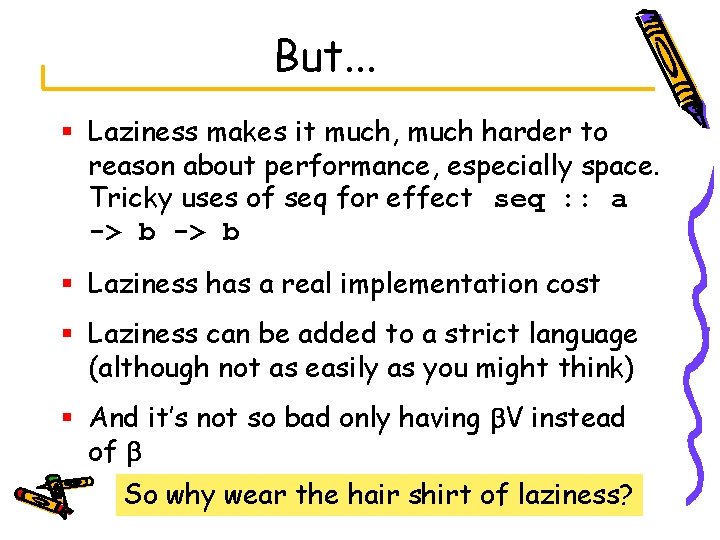
But. . . § Laziness makes it much, much harder to reason about performance, especially space. Tricky uses of seq for effect seq : : a -> b § Laziness has a real implementation cost § Laziness can be added to a strict language (although not as easily as you might think) § And it’s not so bad only having b. V instead of b So why wear the hair shirt of laziness?
In favour of laziness Laziness is jolly convenient Used in two cases Used in one case sp_help item@(Item cur_loc cur_link _) wq vis | cur_length > limit -- Beyond limit = sp wq vis | Just vis_link <- lookup. Visited vis cur_loc = if cur_length >= link. Length vis_link then sp wq vis else emit vis item ++ sp wq vis' | otherwise = emit vis item ++ sp wq' vis' where vis’ =. . . wq’ =. . .
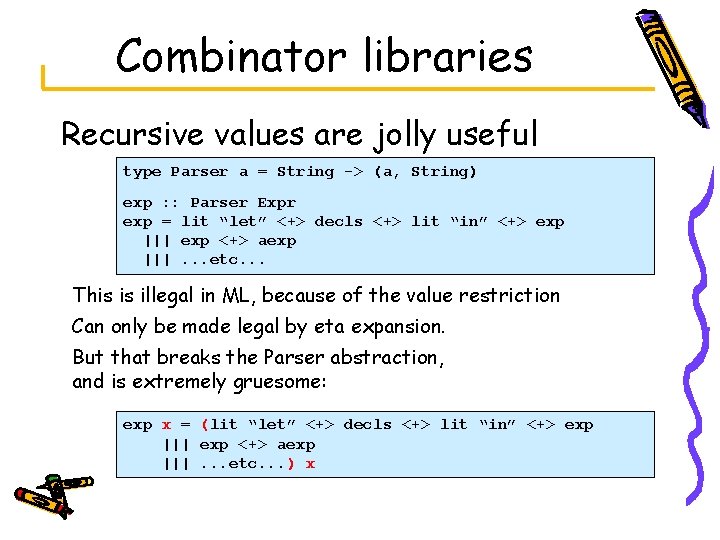
Combinator libraries Recursive values are jolly useful type Parser a = String -> (a, String) exp : : Parser Expr exp = lit “let” <+> decls <+> lit “in” <+> exp ||| exp <+> aexp |||. . . etc. . . This is illegal in ML, because of the value restriction Can only be made legal by eta expansion. But that breaks the Parser abstraction, and is extremely gruesome: exp x = (lit “let” <+> decls <+> lit “in” <+> exp ||| exp <+> aexp |||. . . etc. . . ) x
The big one. .
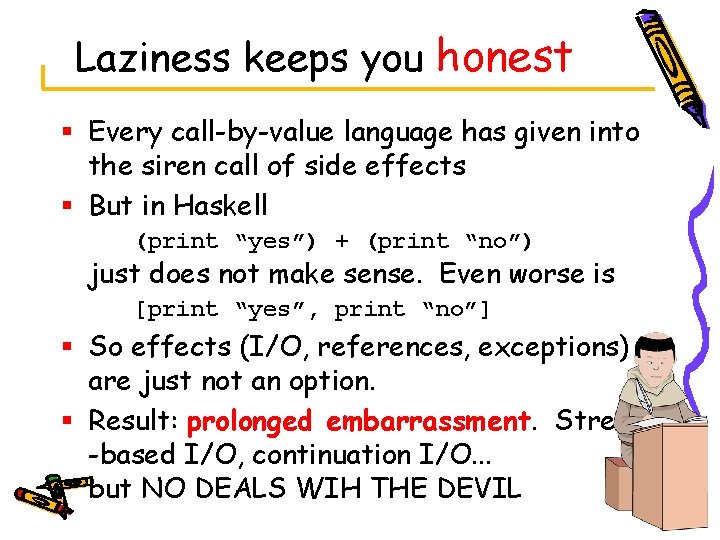
Laziness keeps you honest § Every call-by-value language has given into the siren call of side effects § But in Haskell (print “yes”) + (print “no”) just does not make sense. Even worse is [print “yes”, print “no”] § So effects (I/O, references, exceptions) are just not an option. § Result: prolonged embarrassment. Stream -based I/O, continuation I/O. . . but NO DEALS WIH THE DEVIL
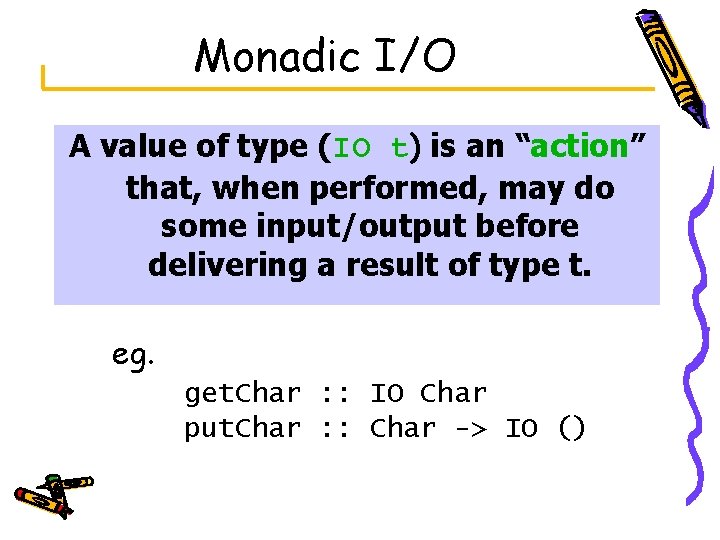
Monadic I/O A value of type (IO t) is an “action” that, when performed, may do some input/output before delivering a result of type t. eg. get. Char : : IO Char put. Char : : Char -> IO ()
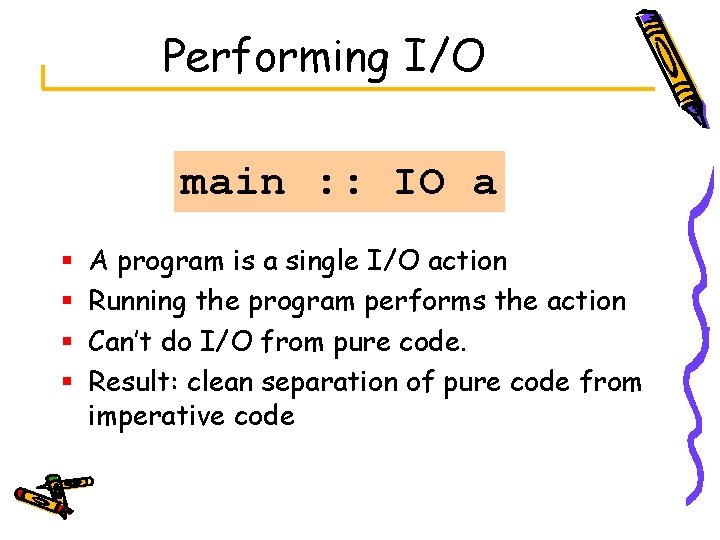
Performing I/O main : : IO a § § A program is a single I/O action Running the program performs the action Can’t do I/O from pure code. Result: clean separation of pure code from imperative code
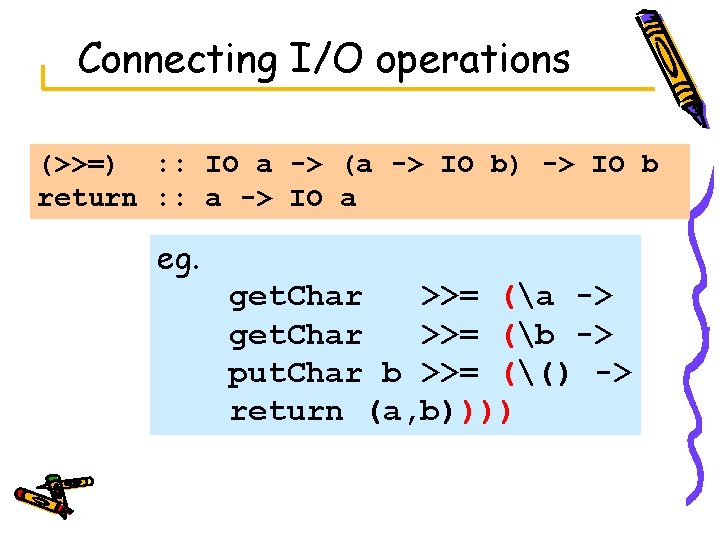
Connecting I/O operations (>>=) : : IO a -> (a -> IO b) -> IO b return : : a -> IO a eg. get. Char >>= (a -> get. Char >>= (b -> put. Char b >>= (() -> return (a, b))))
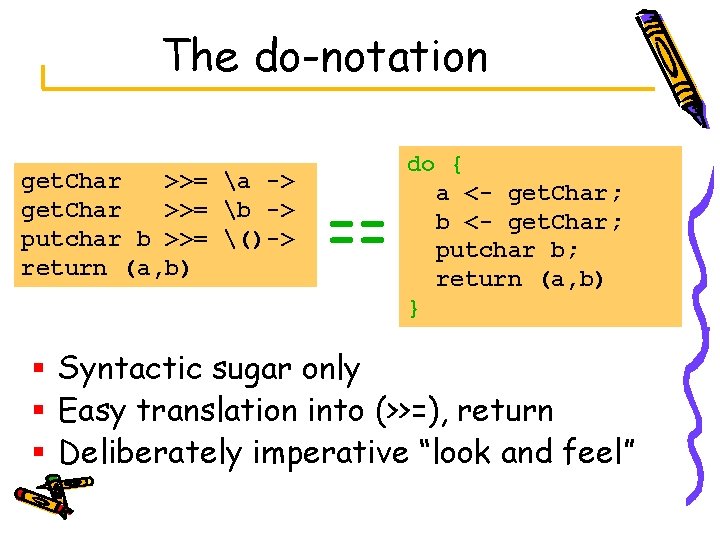
The do-notation get. Char >>= a -> get. Char >>= b -> putchar b >>= ()-> return (a, b) == do { a <- get. Char; b <- get. Char; putchar b; return (a, b) } § Syntactic sugar only § Easy translation into (>>=), return § Deliberately imperative “look and feel”
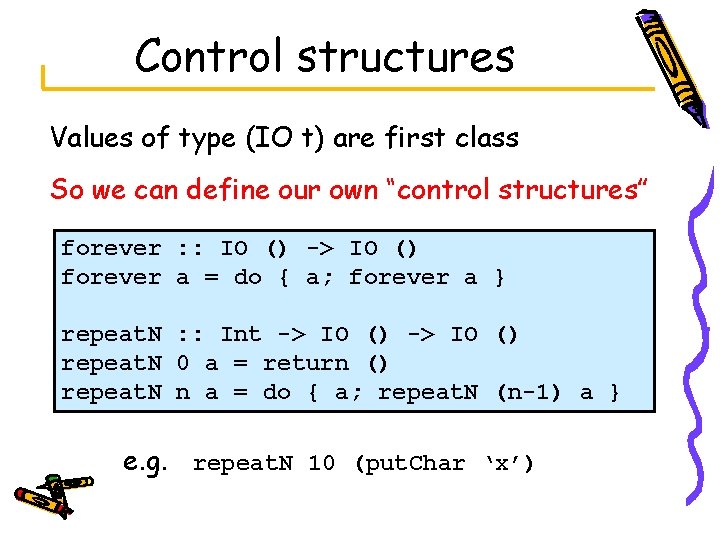
Control structures Values of type (IO t) are first class So we can define our own “control structures” forever : : IO () -> IO () forever a = do { a; forever a } repeat. N : : Int -> IO () repeat. N 0 a = return () repeat. N n a = do { a; repeat. N (n-1) a } e. g. repeat. N 10 (put. Char ‘x’)
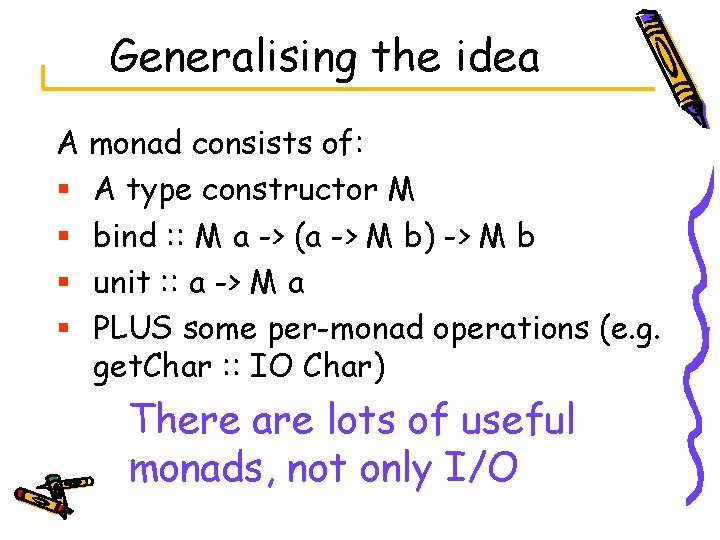
Generalising the idea A monad consists of: § A type constructor M § bind : : M a -> (a -> M b) -> M b § unit : : a -> M a § PLUS some per-monad operations (e. g. get. Char : : IO Char) There are lots of useful monads, not only I/O
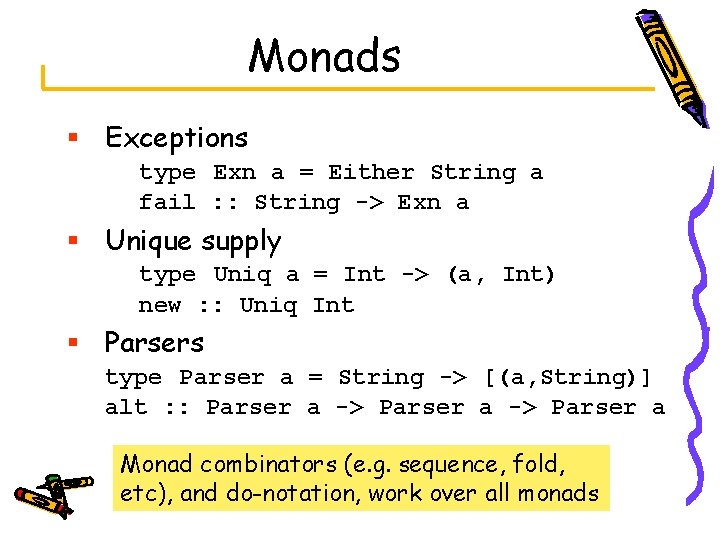
Monads § Exceptions type Exn a = Either String a fail : : String -> Exn a § Unique supply type Uniq a = Int -> (a, Int) new : : Uniq Int § Parsers type Parser a = String -> [(a, String)] alt : : Parser a -> Parser a Monad combinators (e. g. sequence, fold, etc), and do-notation, work over all monads
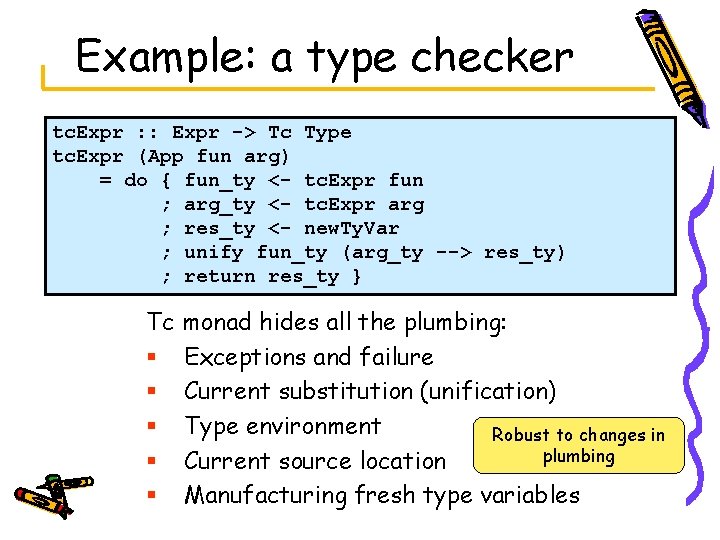
Example: a type checker tc. Expr : : Expr -> Tc Type tc. Expr (App fun arg) = do { fun_ty <- tc. Expr fun ; arg_ty <- tc. Expr arg ; res_ty <- new. Ty. Var ; unify fun_ty (arg_ty --> res_ty) ; return res_ty } Tc monad hides all the plumbing: § Exceptions and failure § Current substitution (unification) § Type environment Robust to changes in plumbing § Current source location § Manufacturing fresh type variables
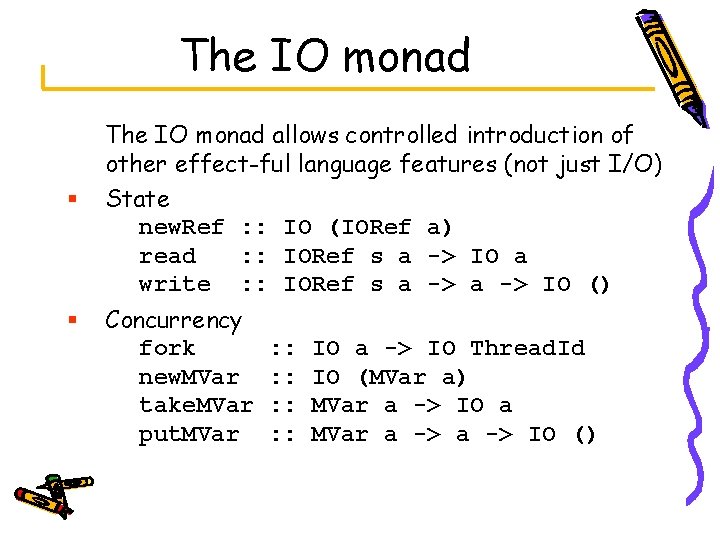
The IO monad § § The IO monad allows controlled introduction of other effect-ful language features (not just I/O) State new. Ref : : IO (IORef a) read : : IORef s a -> IO a write : : IORef s a -> IO () Concurrency fork new. MVar take. MVar put. MVar : : : : IO a -> IO Thread. Id IO (MVar a) MVar a -> IO a MVar a -> IO ()
What have we achieved? § The ability to mix imperative and purelyfunctional programming Imperative “skin” Purely-functional core
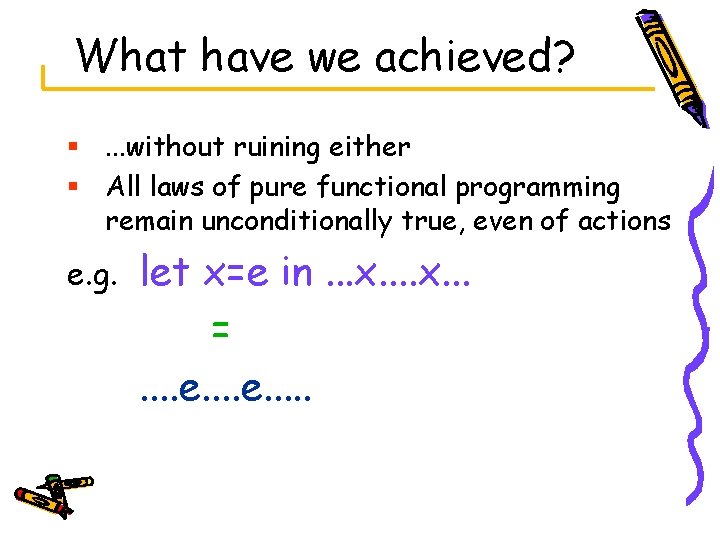
What have we achieved? §. . . without ruining either § All laws of pure functional programming remain unconditionally true, even of actions e. g. let x=e in. . . x. . . =. . . . e. . .
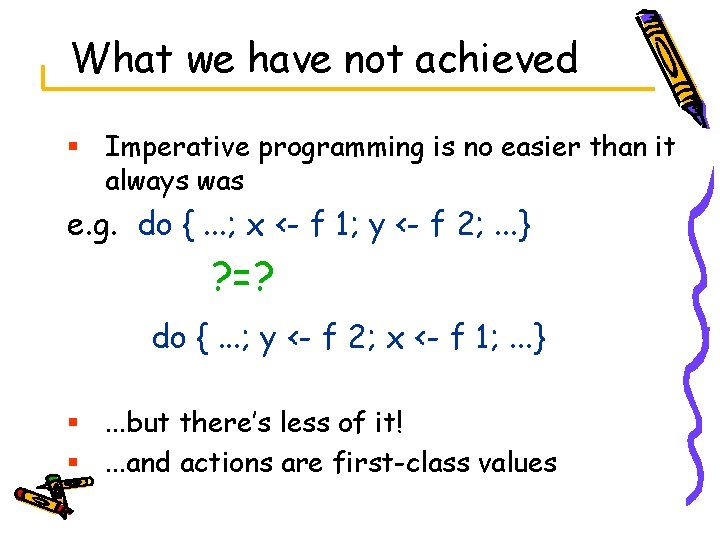
What we have not achieved § Imperative programming is no easier than it always was e. g. do {. . . ; x <- f 1; y <- f 2; . . . } ? =? do {. . . ; y <- f 2; x <- f 1; . . . } §. . . but there’s less of it! §. . . and actions are first-class values
Open challenge 1 Open problem: the IO monad has become Haskell’s sinbin. (Whenever we don’t understand something, we toss it in the IO monad. ) Festering sore: unsafe. Perform. IO : : IO a -> a Dangerous, indeed type-unsafe, but occasionally indispensable. Wanted: finer-grain effect partitioning e. g. IO {read x, write y} Int
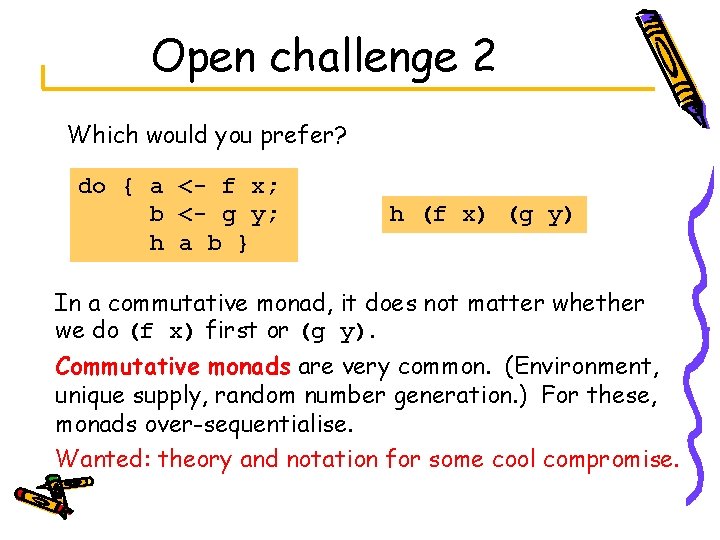
Open challenge 2 Which would you prefer? do { a <- f x; b <- g y; h a b } h (f x) (g y) In a commutative monad, it does not matter whether we do (f x) first or (g y). Commutative monads are very common. (Environment, unique supply, random number generation. ) For these, monads over-sequentialise. Wanted: theory and notation for some cool compromise.
Monad summary § Monads are a beautiful example of a theory-into-practice (more thought pattern than actual theorems) § Hidden effects are like hire-purchase: pay nothing now, but it catches up with you in the end § Enforced purity is like paying up front: painful on Day 1, but usually worth it § But we made one big mistake. . .
Our biggest mistake Using the scary term “monad” rather than “warm fuzzy thing”
What really matters? Laziness Purity and monads Type classes Sexy types
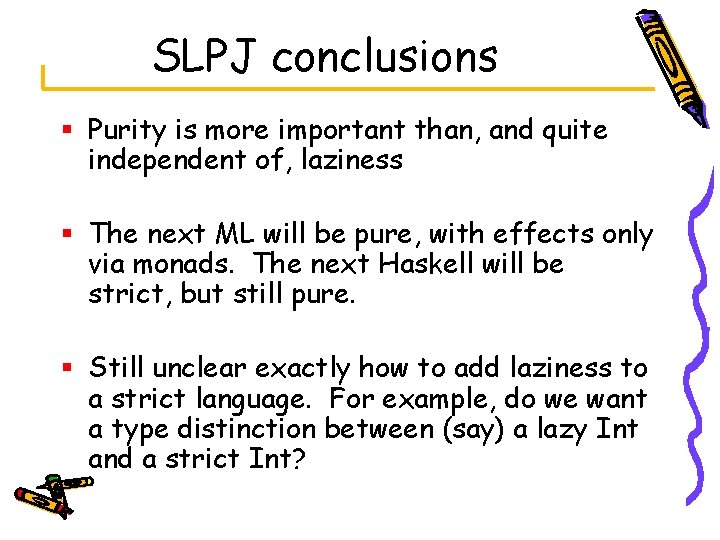
SLPJ conclusions § Purity is more important than, and quite independent of, laziness § The next ML will be pure, with effects only via monads. The next Haskell will be strict, but still pure. § Still unclear exactly how to add laziness to a strict language. For example, do we want a type distinction between (say) a lazy Int and a strict Int?
Type classes
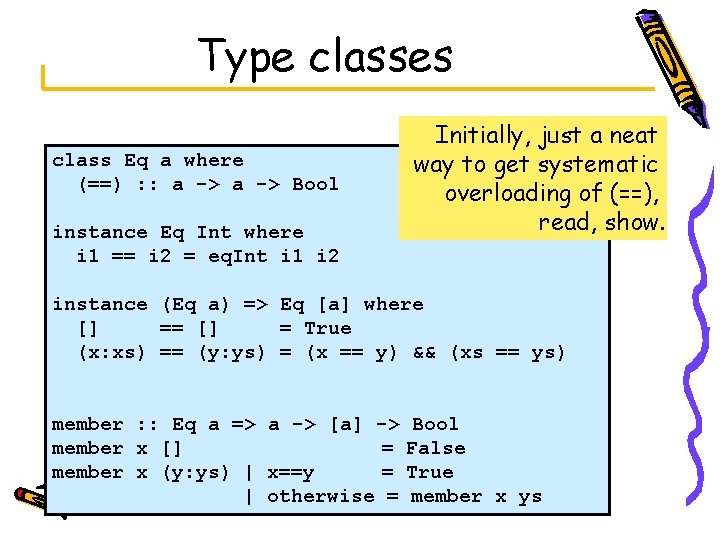
Type classes class Eq a where (==) : : a -> Bool instance Eq Int where i 1 == i 2 = eq. Int i 1 i 2 Initially, just a neat way to get systematic overloading of (==), read, show. instance (Eq a) => Eq [a] where [] == [] = True (x: xs) == (y: ys) = (x == y) && (xs == ys) member : : Eq a => a -> [a] -> Bool member x [] = False member x (y: ys) | x==y = True | otherwise = member x ys
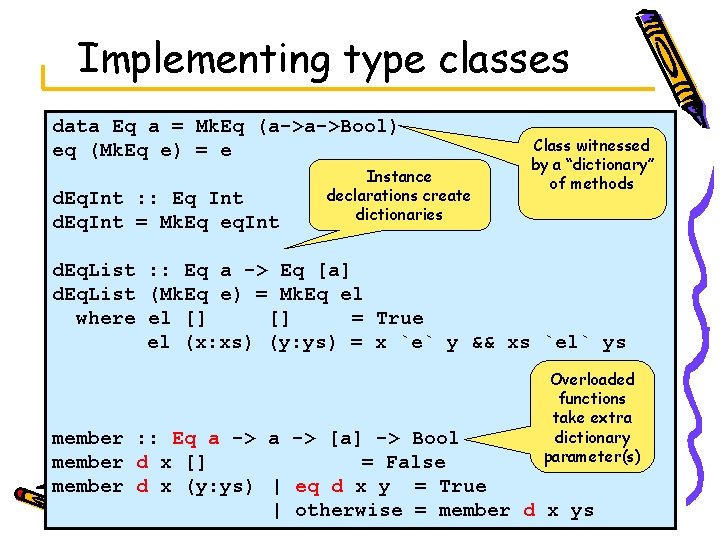
Implementing type classes data Eq a = Mk. Eq (a->a->Bool) eq (Mk. Eq e) = e d. Eq. Int : : Eq Int d. Eq. Int = Mk. Eq eq. Int Instance declarations create dictionaries Class witnessed by a “dictionary” of methods d. Eq. List : : Eq a -> Eq [a] d. Eq. List (Mk. Eq e) = Mk. Eq el where el [] [] = True el (x: xs) (y: ys) = x `e` y && xs `el` ys Overloaded functions take extra dictionary parameter(s) member : : Eq a -> [a] -> Bool member d x [] = False member d x (y: ys) | eq d x y = True | otherwise = member d x ys
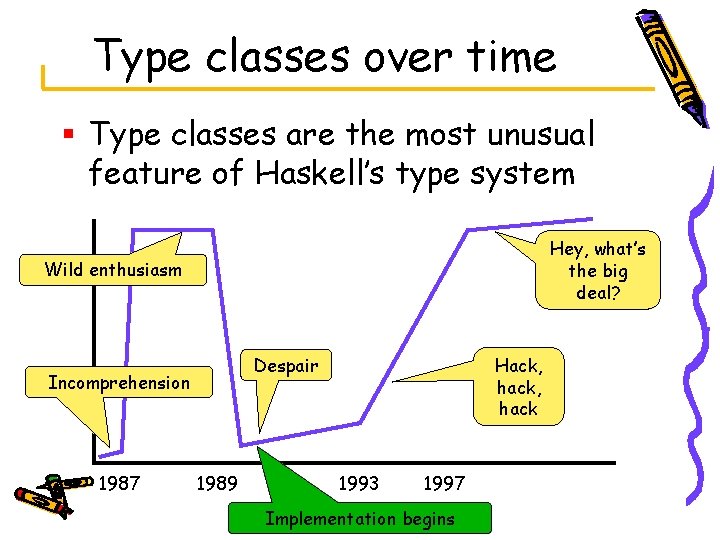
Type classes over time § Type classes are the most unusual feature of Haskell’s type system Hey, what’s the big deal? Wild enthusiasm Despair Incomprehension 1987 1989 Hack, hack 1993 1997 Implementation begins
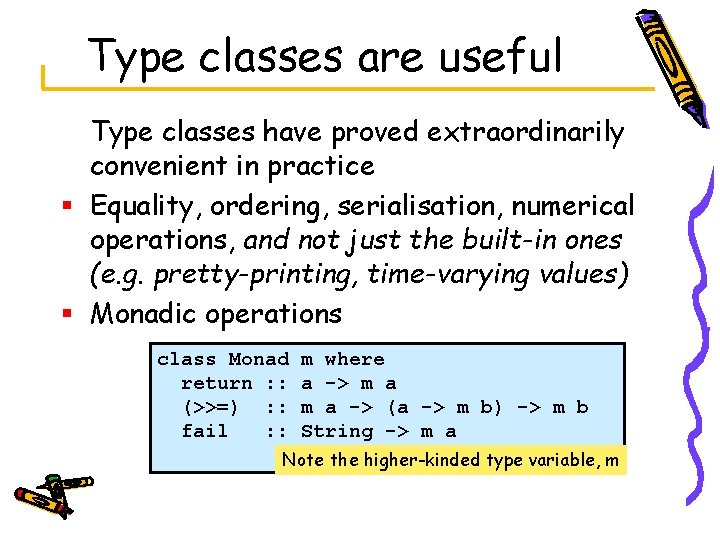
Type classes are useful Type classes have proved extraordinarily convenient in practice § Equality, ordering, serialisation, numerical operations, and not just the built-in ones (e. g. pretty-printing, time-varying values) § Monadic operations class Monad return : : (>>=) : : fail : : m where a -> m a -> (a -> m b) -> m b String -> m a Note the higher-kinded type variable, m
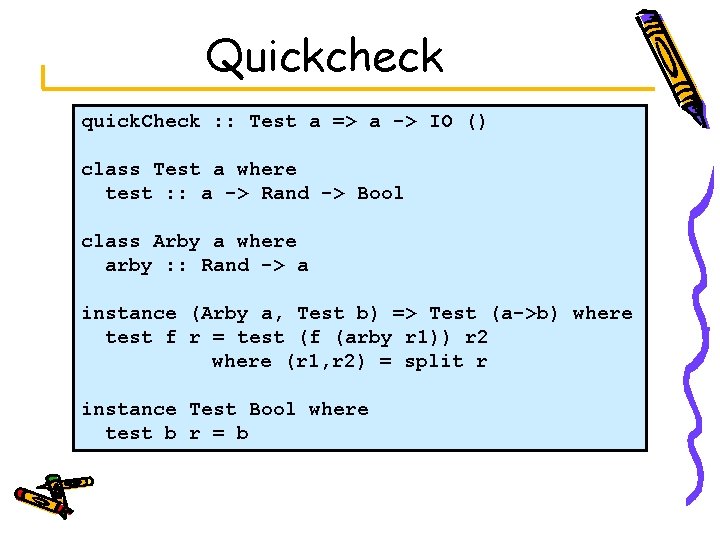
Quickcheck prop. Rev : : [Int] -> Bool prop. Rev xs = reverse (reverse xs) == xs prop. Rev. App : : [Int] -> Bool prop. Rev. App xs ys = reverse (xs++ys) == reverse ys ++ reverse xs ghci> quick. Check prop. Rev OK: passed 100 tests ghci> quick. Check prop. Rev. App OK: passed 100 tests Quickcheck (which is just a Haskell 98 library) § Works out how many arguments § Generates suitable test data § Runs tests
Quickcheck quick. Check : : Test a => a -> IO () class Test a where test : : a -> Rand -> Bool class Arby a where arby : : Rand -> a instance (Arby a, Test b) => Test (a->b) where test f r = test (f (arby r 1)) r 2 where (r 1, r 2) = split r instance Test Bool where test b r = b
Extensiblity § Like OOP, one can add new data types “later”. E. g. Quick. Check works for your new data types (provided you make them instances of Arby) §. . . but also not like OOP
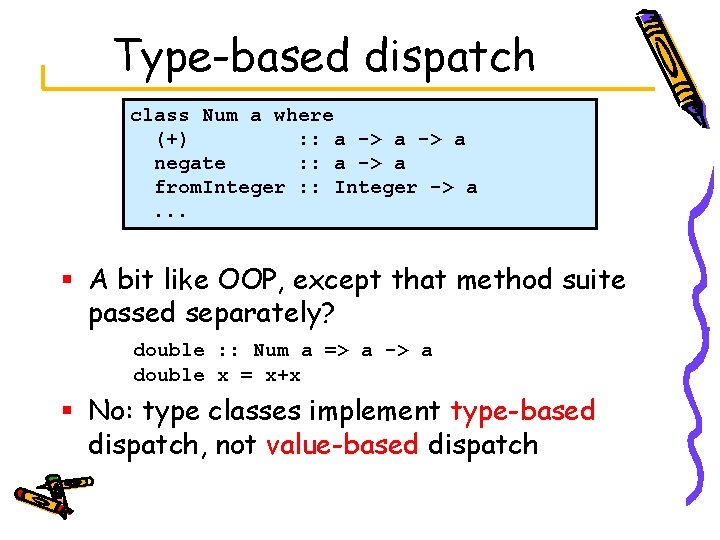
Type-based dispatch class Num a where (+) : : a -> a negate : : a -> a from. Integer : : Integer -> a. . . § A bit like OOP, except that method suite passed separately? double : : Num a => a -> a double x = x+x § No: type classes implement type-based dispatch, not value-based dispatch
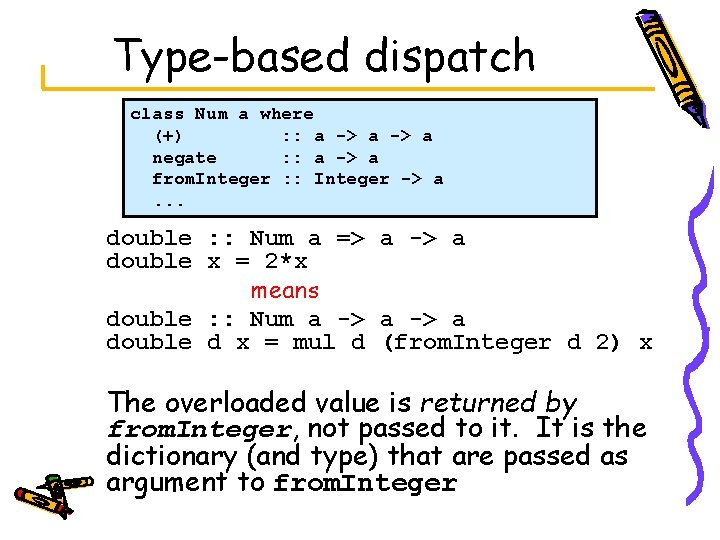
Type-based dispatch class Num a where (+) : : a -> a negate : : a -> a from. Integer : : Integer -> a. . . double : : Num a => a -> a double x = 2*x means double : : Num a -> a double d x = mul d (from. Integer d 2) x The overloaded value is returned by from. Integer, not passed to it. It is the dictionary (and type) that are passed as argument to from. Integer
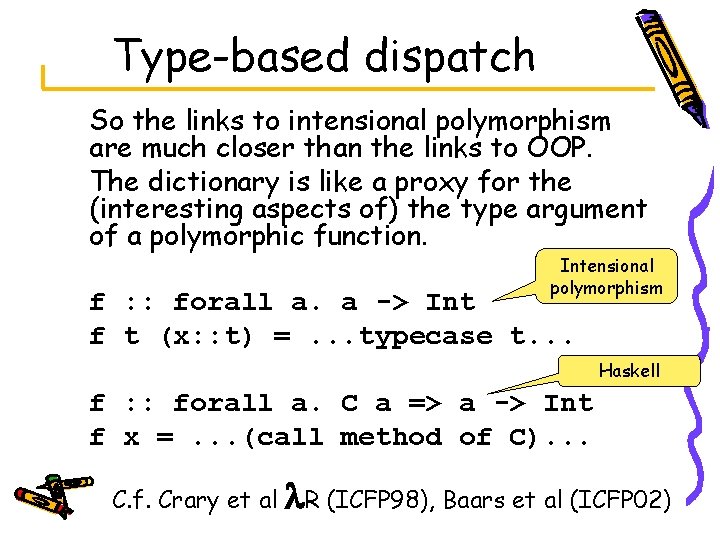
Type-based dispatch So the links to intensional polymorphism are much closer than the links to OOP. The dictionary is like a proxy for the (interesting aspects of) the type argument of a polymorphic function. Intensional polymorphism f : : forall a. a -> Int f t (x: : t) =. . . typecase t. . . Haskell f : : forall a. C a => a -> Int f x =. . . (call method of C). . . C. f. Crary et al l. R (ICFP 98), Baars et al (ICFP 02)
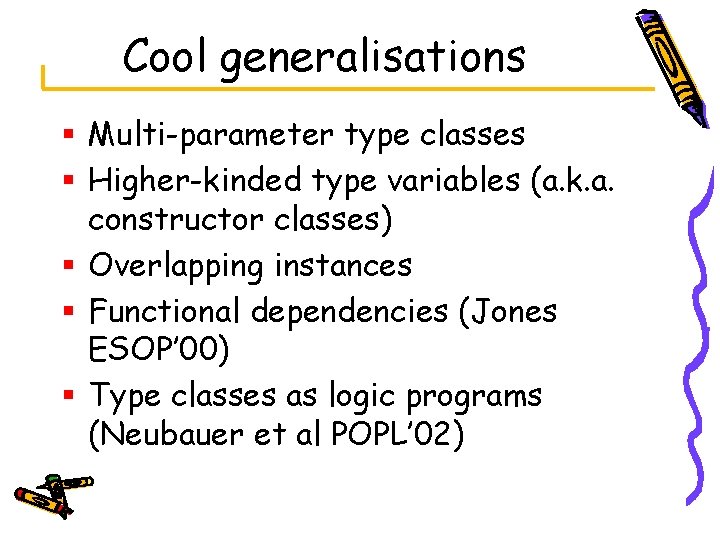
Cool generalisations § Multi-parameter type classes § Higher-kinded type variables (a. k. a. constructor classes) § Overlapping instances § Functional dependencies (Jones ESOP’ 00) § Type classes as logic programs (Neubauer et al POPL’ 02)
Qualified types § Type classes are an example of qualified types [Jones thesis]. Main features – types of form a. Q => – qualifiers Q are witnessed by run-time evidence § Known examples – type classes (evidence = tuple of methods) – implicit parameters (evidence = value of implicit param) – extensible records (evidence = offset of field in record) § Another unifying idea: Constraint Handling Rules (Stucky/Sulzmann ICFP’ 02)
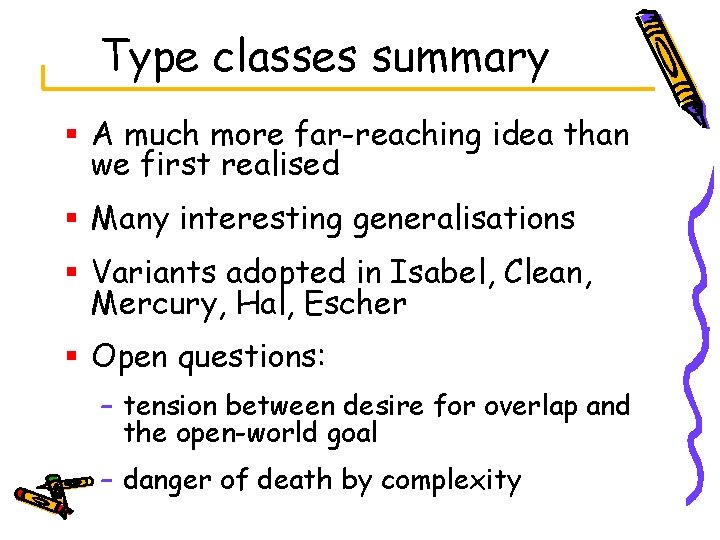
Type classes summary § A much more far-reaching idea than we first realised § Many interesting generalisations § Variants adopted in Isabel, Clean, Mercury, Hal, Escher § Open questions: – tension between desire for overlap and the open-world goal – danger of death by complexity
Sexy types
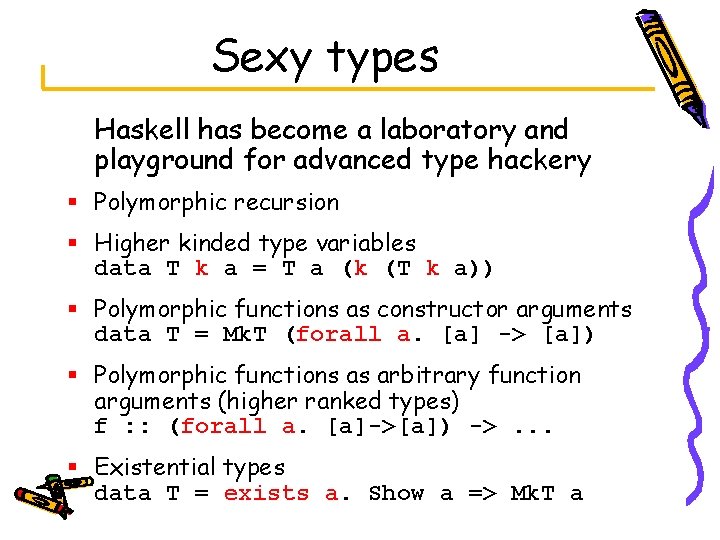
Sexy types Haskell has become a laboratory and playground for advanced type hackery § Polymorphic recursion § Higher kinded type variables data T k a = T a (k (T k a)) § Polymorphic functions as constructor arguments data T = Mk. T (forall a. [a] -> [a]) § Polymorphic functions as arbitrary function arguments (higher ranked types) f : : (forall a. [a]->[a]) ->. . . § Existential types data T = exists a. Show a => Mk. T a
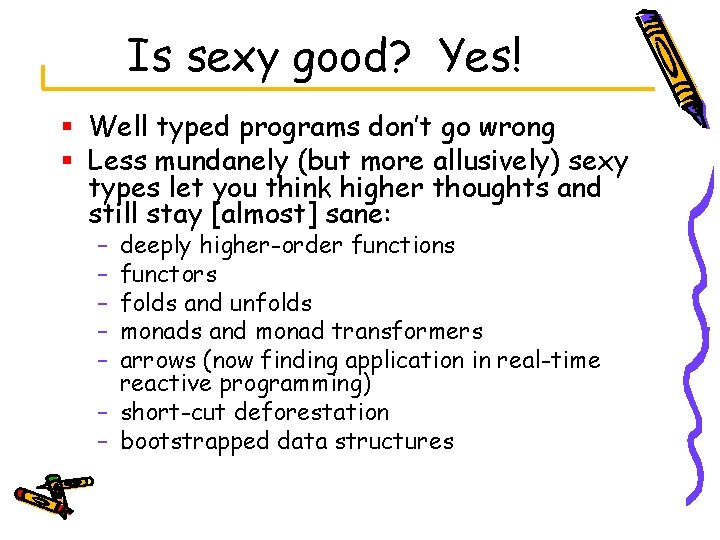
Is sexy good? Yes! § Well typed programs don’t go wrong § Less mundanely (but more allusively) sexy types let you think higher thoughts and still stay [almost] sane: – – – deeply higher-order functions functors folds and unfolds monads and monad transformers arrows (now finding application in real-time reactive programming) – short-cut deforestation – bootstrapped data structures
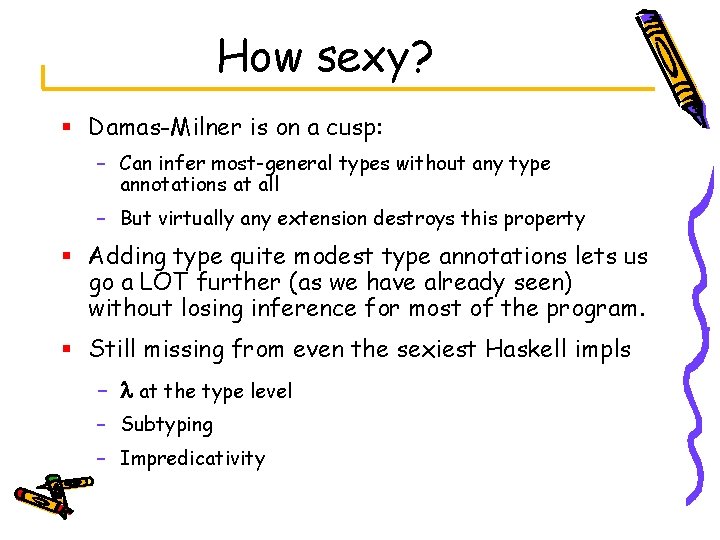
How sexy? § Damas-Milner is on a cusp: – Can infer most-general types without any type annotations at all – But virtually any extension destroys this property § Adding type quite modest type annotations lets us go a LOT further (as we have already seen) without losing inference for most of the program. § Still missing from even the sexiest Haskell impls – l at the type level – Subtyping – Impredicativity
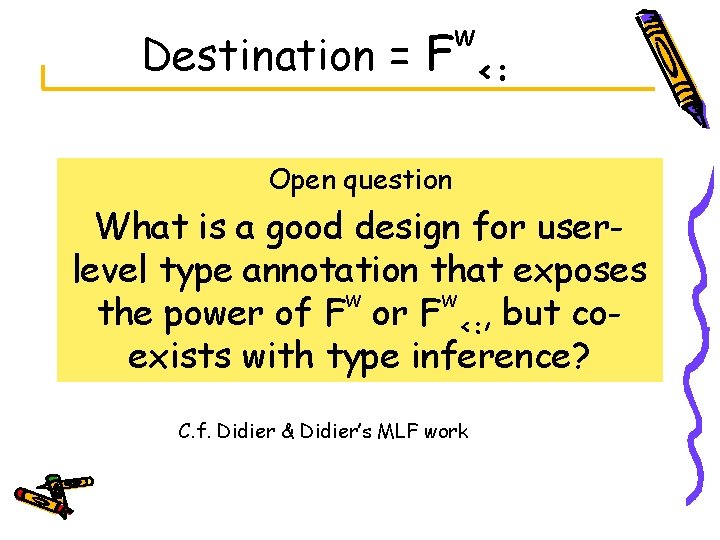
Destination = F w <: Open question What is a good design for userlevel type annotation that exposes w w the power of F or F <: , but coexists with type inference? C. f. Didier & Didier’s MLF work
Difficulty Modules Haskell 98 Haskell + sexy types Power ML functors
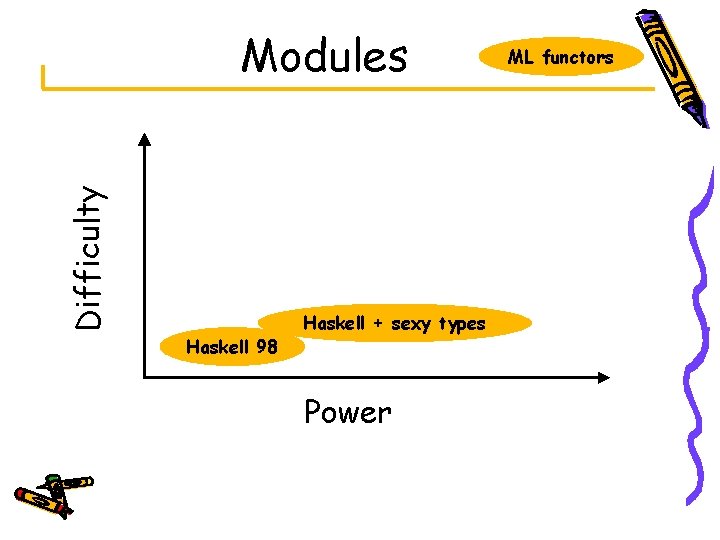
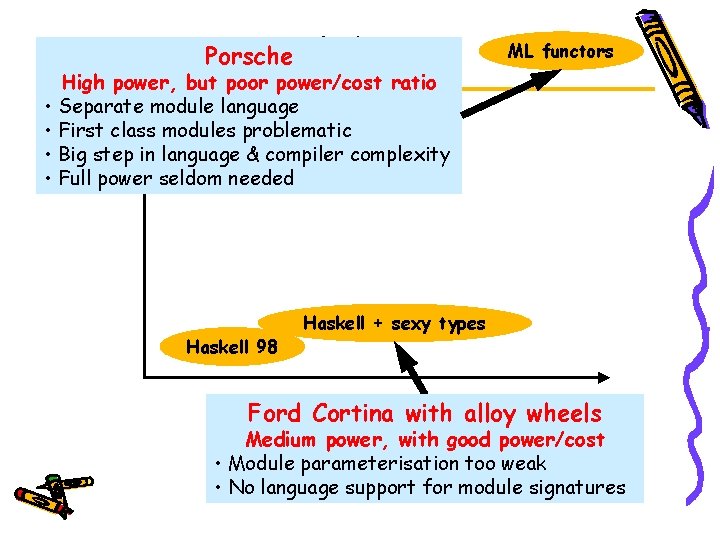
Modules High power, but poor power/cost ratio Porsche ML functors • Separate module language • First class modules problematic • Big step in language & compiler complexity • Full power seldom needed Haskell 98 Haskell + sexy types Ford Power Cortina with alloy wheels Medium power, with good power/cost • Module parameterisation too weak • No language support for module signatures
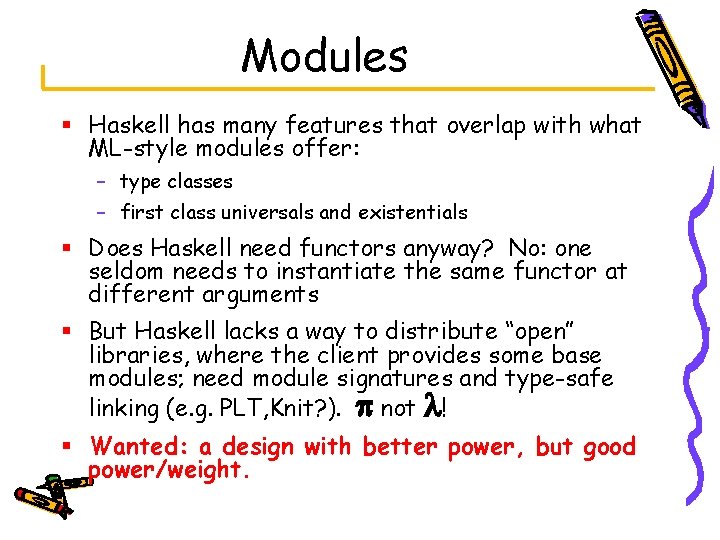
Modules § Haskell has many features that overlap with what ML-style modules offer: – type classes – first class universals and existentials § Does Haskell need functors anyway? No: one seldom needs to instantiate the same functor at different arguments § But Haskell lacks a way to distribute “open” libraries, where the client provides some base modules; need module signatures and type-safe linking (e. g. PLT, Knit? ). p not l! § Wanted: a design with better power, but good power/weight.
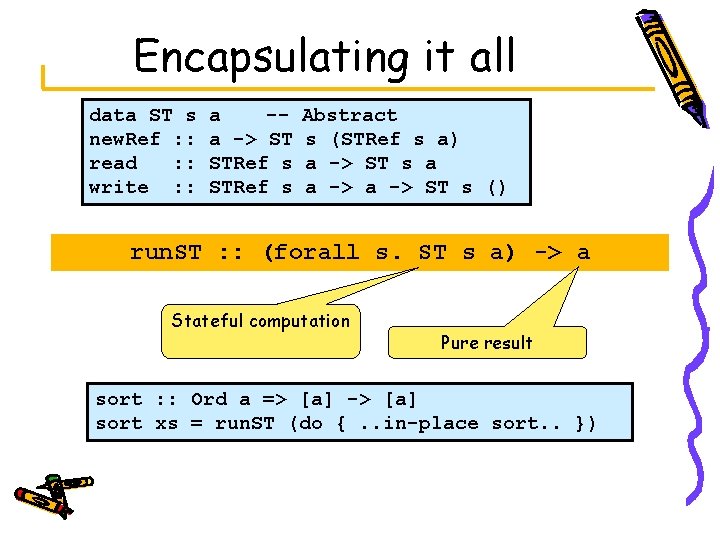
Encapsulating it all data ST s new. Ref : : read : : write : : a -a -> ST STRef s Abstract s (STRef s a) a -> ST s a a -> ST s () run. ST : : (forall s. ST s a) -> a Stateful computation Pure result sort : : Ord a => [a] -> [a] sort xs = run. ST (do {. . in-place sort. . })
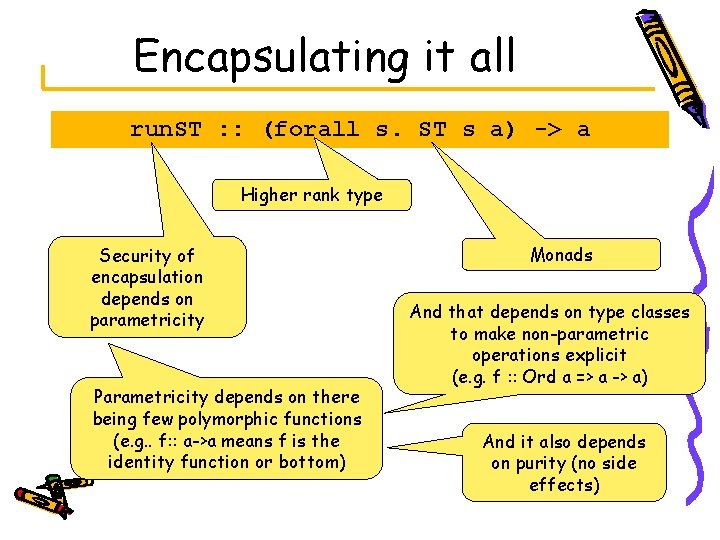
Encapsulating it all run. ST : : (forall s. ST s a) -> a Higher rank type Security of encapsulation depends on parametricity Parametricity depends on there being few polymorphic functions (e. g. . f: : a->a means f is the identity function or bottom) Monads And that depends on type classes to make non-parametric operations explicit (e. g. f : : Ord a => a -> a) And it also depends on purity (no side effects)
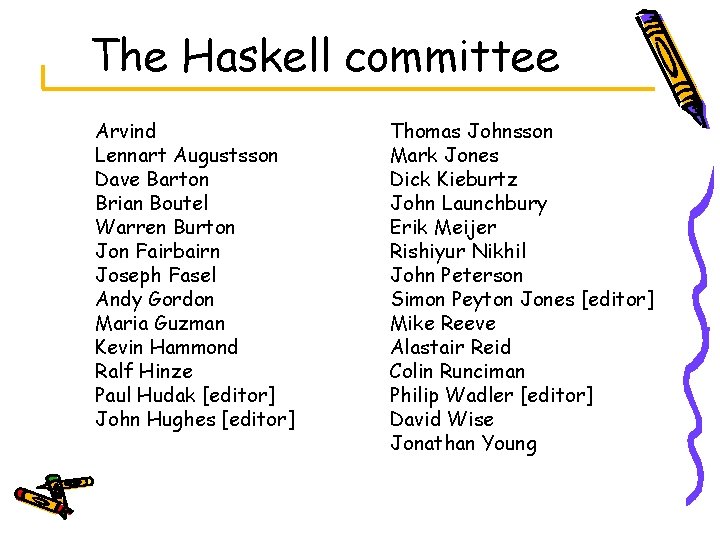
The Haskell committee Arvind Lennart Augustsson Dave Barton Brian Boutel Warren Burton Jon Fairbairn Joseph Fasel Andy Gordon Maria Guzman Kevin Hammond Ralf Hinze Paul Hudak [editor] John Hughes [editor] Thomas Johnsson Mark Jones Dick Kieburtz John Launchbury Erik Meijer Rishiyur Nikhil John Peterson Simon Peyton Jones [editor] Mike Reeve Alastair Reid Colin Runciman Philip Wadler [editor] David Wise Jonathan Young