
Wearable TMS System for Ambulatory Use Zach Beller
Wearable TMS System for Ambulatory Use Zach Beller, Lindsey Kahan, Ben Sass Group 19 September 24, 2014 1
Problem Neuropathic pain affects up to 6 -7% of the general population with limited efficacy in treatment (30 -40%) Depression affects around 5 -15% of the population with a third of patients unresponsive to traditional treatments 75% of stroke survivors suffer disability that decreases their employability Lefaucher 2014 2

What is TMS? Transcranial Magnetic Stimulation Non-invasive magnetic modulation of neuronal activity Shown to benefit patients with depression, neuropathic pain, and motor chronic stroke Ongoing research on further applicability of TMS therapy 3

How TMS works Utilizes the Biot-Savart Law Induces eddy currents at focus of magnetic stimulation Focus and orientation of magnetic field preferentially modulates neurons Rossi 2009 4

How TMS works: Waveform Monophasic and biphasic pulses produce differing effects Magnitude of effects directly depends on magnetic field strength Sommer 2006 5

How TMS works: Frequency Various pulse protocols exist with differences in efficacy Rossi 2009 6
Clinical Effects Effective against Depression Effective against neuropathic pain Probable effectiveness against motor chronic stroke Possible effectiveness against Parkinson’s Disease Lefaucher 2014 7
Clinical Effects Schizophrenia symptoms PTSD Tinnitus Cigarette consumption Auditory hallucinations Broca’s nonfluent aphasia Post-acute stroke CRPS type 1 Hemispatial neglect Epilepsy 8
Need for a portable system Current TMS systems require a stationary patient At best this is an inconvenience At worst this may limit the clinical usefulness of TMS Integration into home environment and into applicable activities 9
Scope Producing a TMS system that enables patient mobility. 10
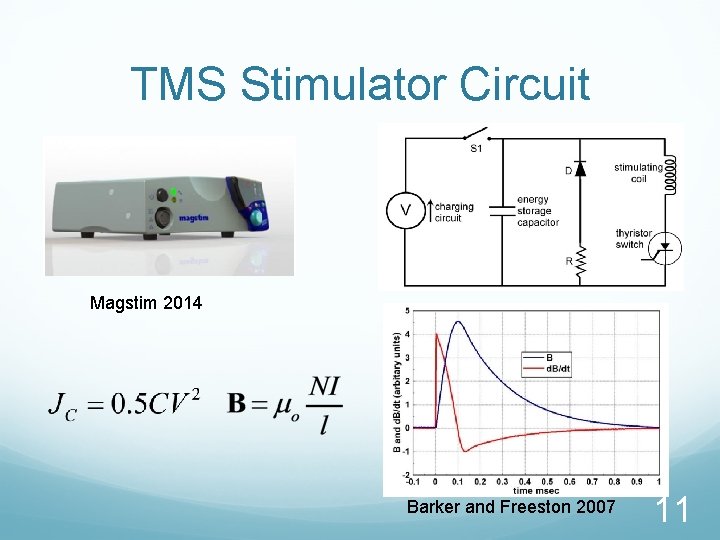
TMS Stimulator Circuit Magstim 2014 Barker and Freeston 2007 11
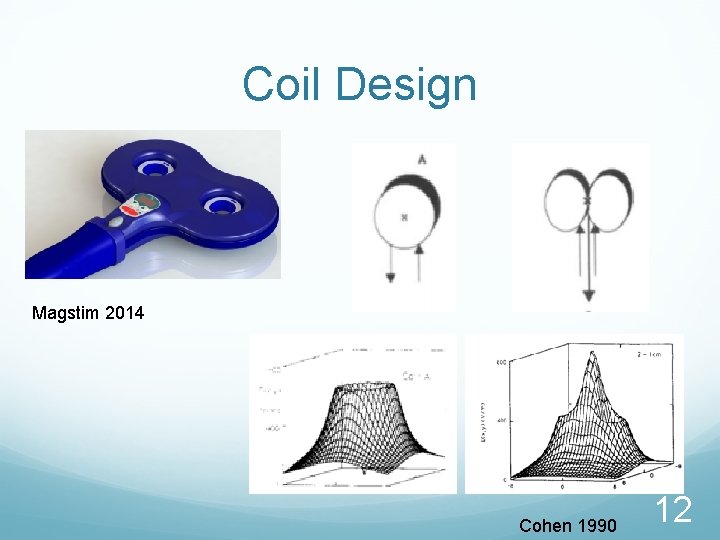
Coil Design Magstim 2014 Cohen 1990 12
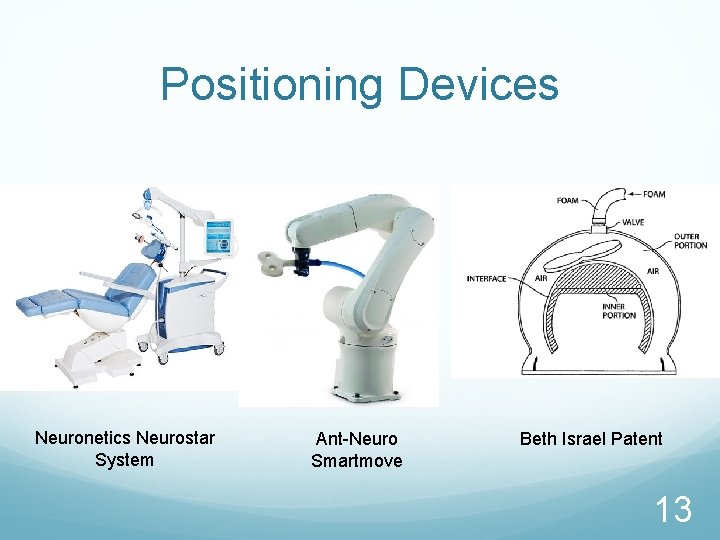
Positioning Devices Neuronetics Neurostar System Ant-Neuro Smartmove Beth Israel Patent 13
Targeting Systems Most basic simply uses a distance metric across the scalp from the motor cortex to target the DLPFC EEG and f. MRI have been used to target focal areas Several products are on the market offering stereotactic cameras and other tracking mechanisms 14
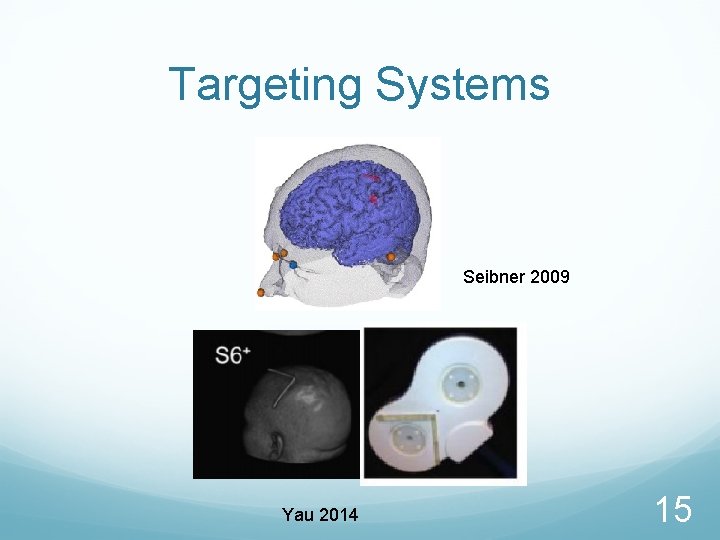
Targeting Systems Seibner 2009 Yau 2014 15
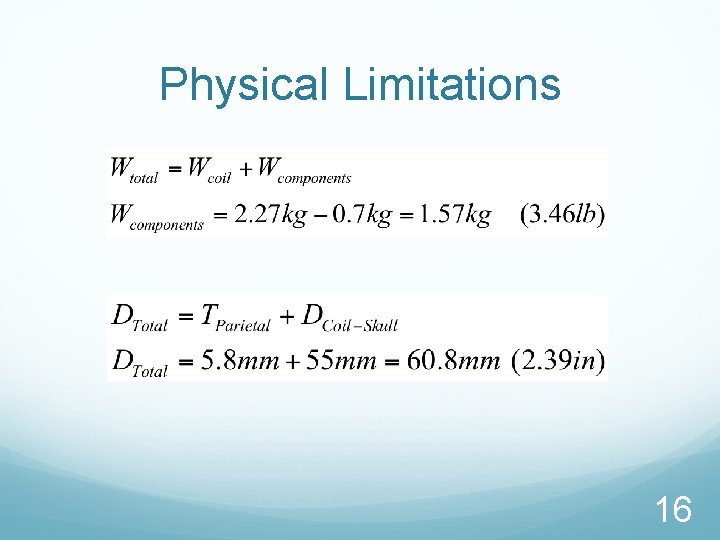
Physical Limitations 16
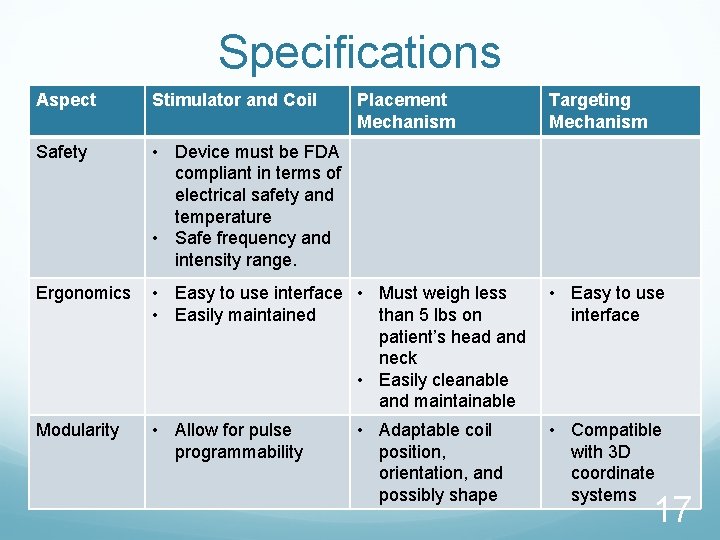
Specifications Aspect Stimulator and Coil Placement Mechanism Safety • Device must be FDA compliant in terms of electrical safety and temperature • Safe frequency and intensity range. Ergonomics • Easy to use interface • Must weigh less • Easily maintained than 5 lbs on patient’s head and neck • Easily cleanable and maintainable • Easy to use interface Modularity • Allow for pulse programmability • Compatible with 3 D coordinate systems • Adaptable coil position, orientation, and possibly shape Targeting Mechanism 17
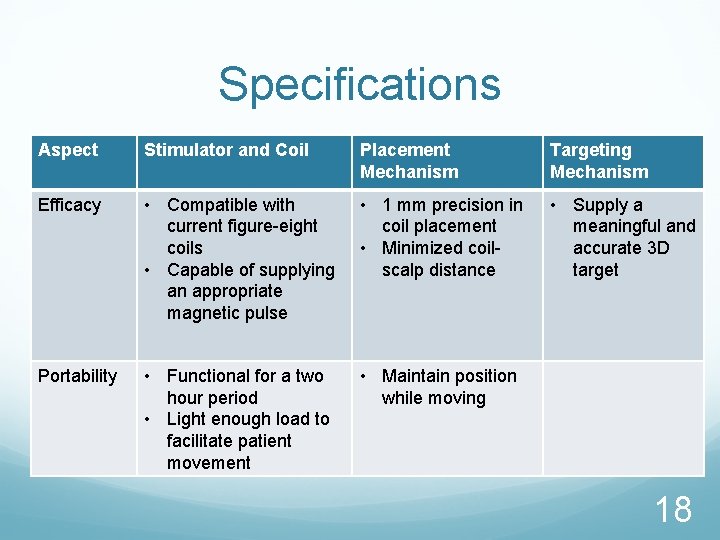
Specifications Aspect Stimulator and Coil Placement Mechanism Targeting Mechanism Efficacy • Compatible with current figure-eight coils • Capable of supplying an appropriate magnetic pulse • 1 mm precision in coil placement • Minimized coilscalp distance • Supply a meaningful and accurate 3 D target Portability • Functional for a two hour period • Light enough load to facilitate patient movement • Maintain position while moving 18
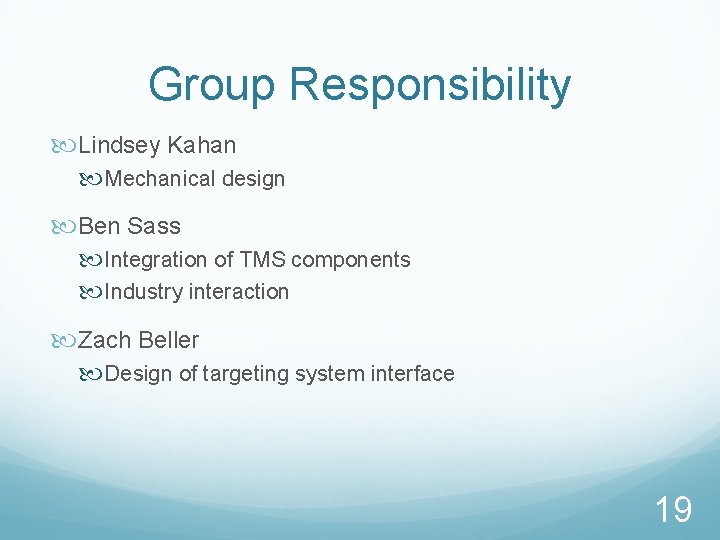
Group Responsibility Lindsey Kahan Mechanical design Ben Sass Integration of TMS components Industry interaction Zach Beller Design of targeting system interface 19
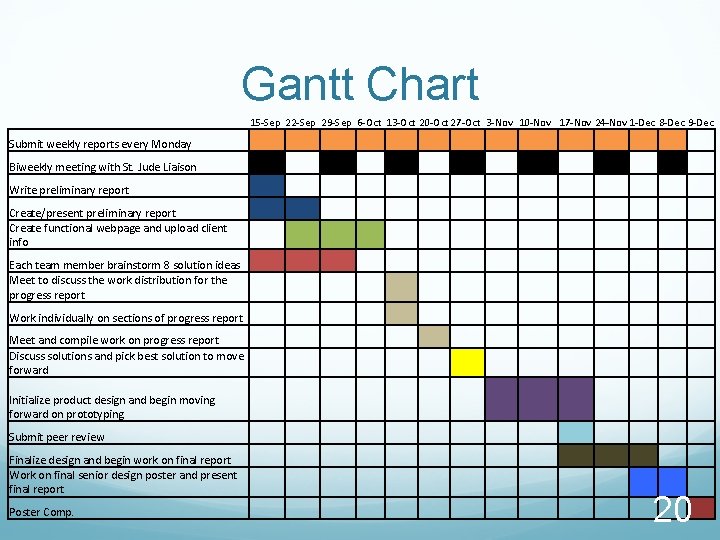
Gantt Chart 15 -Sep 22 -Sep 29 -Sep 6 -Oct 13 -Oct 20 -Oct 27 -Oct 3 -Nov 10 -Nov 17 -Nov 24 -Nov 1 -Dec 8 -Dec 9 -Dec Submit weekly reports every Monday Biweekly meeting with St. Jude Liaison Write preliminary report Create/present preliminary report Create functional webpage and upload client info Each team member brainstorm 8 solution ideas Meet to discuss the work distribution for the progress report Work individually on sections of progress report Meet and compile work on progress report Discuss solutions and pick best solution to move forward Initialize product design and begin moving forward on prototyping Submit peer review Finalize design and begin work on final report Work on final senior design poster and present final report Poster Comp. 20
References Lefaucheur, Jean-Pascal, et al. "Evidence-based guidelines on therapeutic use of repetitive transcranial magnetic stimulation (r. TMS). " Clinical Neurophysiology (2014). O'Shea, Jacinta, and Vincent Walsh. "Transcranial magnetic stimulation. " Current Biology 17. 6 (2007): R 196 -R 199. Rossi, Simone, et al. "Safety, ethical considerations, and application guidelines for the use of transcranial magnetic stimulation in clinical practice and research. " Clinical neurophysiology 120. 12 (2009): 2008 -2039. Barker, Anthony T. , Reza Jalinous, and Ian L. Freeston. "Non-invasive magnetic stimulation of human motor cortex. " The Lancet 325. 8437 (1985): 1106 -1107. Kobayashi, Masahito, and Alvaro Pascual-Leone. "Transcranial magnetic stimulation in neurology. " The Lancet Neurology 2. 3 (2003): 145 -156. Holtzheimer 3 rd, P. E. , J. Russo, and D. H. Avery. "A meta-analysis of repetitive transcranial magnetic stimulation in the treatment of depression. " Psychopharmacology bulletin 35. 4 (2000): 149 -169. KOZEL, F. ANDREW, and MARK S. GEORGE. "Meta-analysis of left prefrontal repetitive transcranial magnetic stimulation (r. TMS) to treat depression. " Journal of Psychiatric Practice® 8. 5 (2002): 270 -275. Mansur, C. G. , et al. "A sham stimulation-controlled trial of r. TMS of the unaffected hemisphere in stroke patients. " Neurology 64. 10 (2005): 1802 -1804. Taylor, A. E. , and J. A. Saintcyr. "The neuropsychology of Parkinsons-disease. " Brain and cognition 28. 3 (1995): 281 -296. 21
References Contd. Sommer, Martin, et al. "Half sine, monophasic and biphasic transcranial magnetic stimulation of the human motor cortex. " Clinical Neurophysiology 117. 4 (2006): 838 -844. US 20090018384 A 1 Kozel, F. Andrew, et al. "How coil–cortex distance relates to age, motor threshold, and antidepressant response to repetitive transcranial magnetic stimulation. " The Journal of neuropsychiatry and clinical neurosciences 12. 3 (2000): 376 -384. Zangen, Abraham, et al. "Transcranial magnetic stimulation of deep brain regions: evidence for efficacy of the H-coil. " Clinical neurophysiology 116. 4 (2005): 775 -779. "About Brainsway DTMS. " Brainsway, 2014. Web. 18 Sept. 2014. Vanneste, Sven, et al. "TMS by double-cone coil prefrontal stimulation for medication resistant chronic depression: A case report. " Neurocase 20. 1 (2014): 61 -68. Yau, Jeffrey M. , et al. "Efficient and robust identification of cortical targets in concurrent TMS–f. MRI experiments. " Neuro. Image 76 (2013): 134 -144. Johnson, Kevin A. , et al. "Prefrontal r. TMS for treating depression: location and intensity results from the OPT-TMS multi-site clinical trial. " Brain stimulation 6. 2 (2013): 108 -117. 22
References Contd. Neggers, S. F. W. , et al. "A stereotactic method for image-guided transcranial magnetic stimulation validated with f. MRI and motor-evoked potentials. " Neuroimage 21. 4 (2004): 1805 -1817. Siebner, Hartwig R. , et al. "Consensus paper: combining transcranial stimulation with neuroimaging. " Brain stimulation 2. 2 (2009): 58 -80. Schönfeldt-Lecuona, Carlos, et al. "Accuracy of stereotaxic positioning of transcranial magnetic stimulation. " Brain topography 17. 4 (2005): 253 -259. Galperin, Henry. "Pricing for Mag. Stim TMS. " Message to Benjamin Sass. 15 Sept. 2014. E-mail. "Cervel Neurotech, Inc. " Cervel Neurotech Inc, 2014. Web. 18 Sept. 2014. Wassermann, Eric, Charles Epstein, and Ulf Ziemann, eds. "Oxford handbook of transcranial stimulation. " (2008). Phillips, Chandler A. , and Jerrold S. Petrofsky. "A Computer Model of Neck Muscle Endurance and Fatigue as a Function of Helmet Loading. " Computers in Biology and Medicine 16. 2 (1986): 103 -30. Pub. Med. Web. "C-B 60 Butterfly Coil. " Mag. Venture. N. p. , n. d. Web. 19 Sept. 2014. <http: //www. magventure. com/engb/products/coils/butterflycoils/c-b 60 butterfly. aspx>. 23
References Contd. Mahinda, H. , and O. Murty. "VARIABILITY IN THICKNESS OF HUMAN SKULL BONES AND STERNUM – AN AUTOPSY EXPERIENCE. " Journal of Forensic Medicine and Toxicology 26. 2 (2009): n. pag. JFMT Online. Web. Kimura, Hideki, et al. "A Comprehensive Study of Repetitive Transcranial Magnetic Stimulation in Parkinson's Disease. " International Scholarly Research Notices 2011 (2011). Torrance, Nicola, et al. "The epidemiology of chronic pain of predominantly neuropathic origin. Results from a general population survey. " The Journal of Pain 7. 4 (2006): 281 -289. "A Privately Held Medical Device Company and Developers of the Neuro. Star TMS Therapy System®. " Neuronetics. com. Neuronetics, 2014. Web. 18 Sept. 2014. ANT "Leading a Revolution in Brain and Nerve Treatment. " Magstim, 2014. Web. 18 Sept. 2014. "Mag. Venture. " Mag. Venture, 2014. Web. 18 Sept. 2014. 24
Specifications: Safety Frequency Modulation Range Magnetic Field Intensity 25
Specifications: Ergonomics Easily useable System-User and System-Patient interfaces 30 minute turnaround time Easily cleanable and maintainable Must be comfortably supported by patient’s head and neck 26
Specifications: Modularity Must facilitate modular coil positioning Must include TMS protocol programmability Possible modularity in coil type 27
Specifications: Efficacy 1 mm precision for coil placement Compatibility with 3 -space coordinate systems Compatibility with figure-eight coil Reasonable coil-head spacing Appropriate magnetic field intensity 28
Specifications: Portability Must be functional for two hours Must be light enough to facilitate movement Must be easily maintained in non-specialized environment 29
- Slides: 29