
WEARABLE TEXTILE ELECTRONICS Characteristics and applications Elina Iln
WEARABLE TEXTILE ELECTRONICS Characteristics and applications Elina Ilén, Post Doc Researcher in Fashion Textile Futures research group 19. 1. 2016 elina. ilen@aalto. fi
MY BACKGROUND � Master of Science (Fiber, Textile and Clothing)1999 from TUT (Tampere Univ. Of Tech. ) � Master Thesis of Clothing Physiology of Children (Reima –Group) � 16 year experience of Textile Electronics R&D and mass production In China in Clothing Plus (2000 -2008)> customers: Polar Electro, Suunto, Philips, Nokia. . � 2 years in Textile Högskolan i Borås as visiting researcher in Smart textiles reasearch group (2009 -2010) � 5 years in international children’s clothing business in reima (www. reima. com), first as R&D project manager and later as business development director, responsible for innovations, material R&D, quality management, and business compliance in supply chain. (2010 -2015) � CEO of Planno Oy, providing R&D, sourcing, and quality management consultancy in the area of textile electronics (www. planno. fi) (2013 -> ) � Doctor of Science (Material Tech. ) 2015 from (Tampere Univ. Of Tech) � Thesis: Decontamination of wearable textile electrodes for medical and health care applications � Post Doc Researcher in Fashion and Textile Futures –team. The coordinator of Trash 2 cash –EU project. (2016 – 2018)
STRUCTURE OF THE LECTURE • • Characteristics Terminology System architecture Internet of Things Application areas with examples Capabilities of textiles Doctoral study • • Theory about textiles electronics in health care Research objectives Study performing Main findings
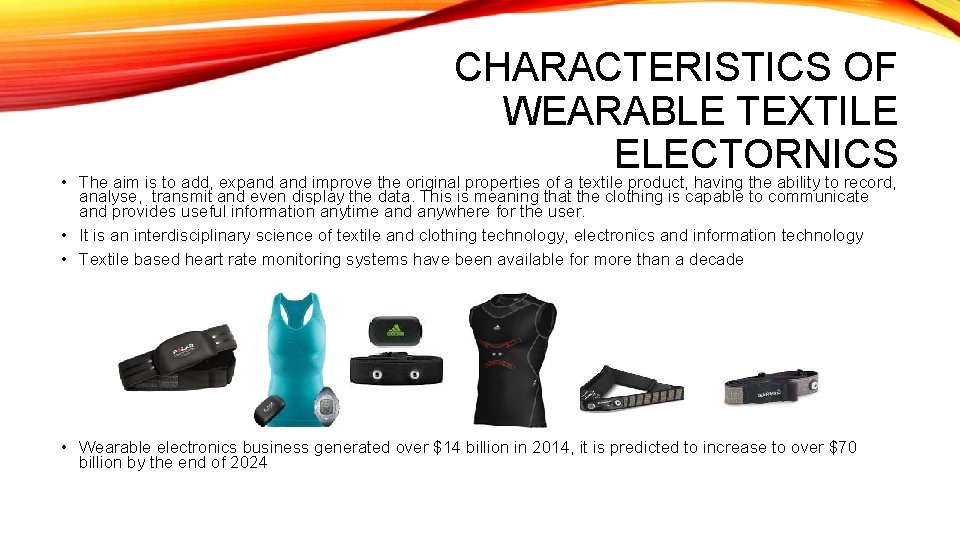
CHARACTERISTICS OF WEARABLE TEXTILE ELECTORNICS • The aim is to add, expand improve the original properties of a textile product, having the ability to record, analyse, transmit and even display the data. This is meaning that the clothing is capable to communicate and provides useful information anytime and anywhere for the user. • It is an interdisciplinary science of textile and clothing technology, electronics and information technology • Textile based heart rate monitoring systems have been available for more than a decade • Wearable electronics business generated over $14 billion in 2014, it is predicted to increase to over $70 billion by the end of 2024
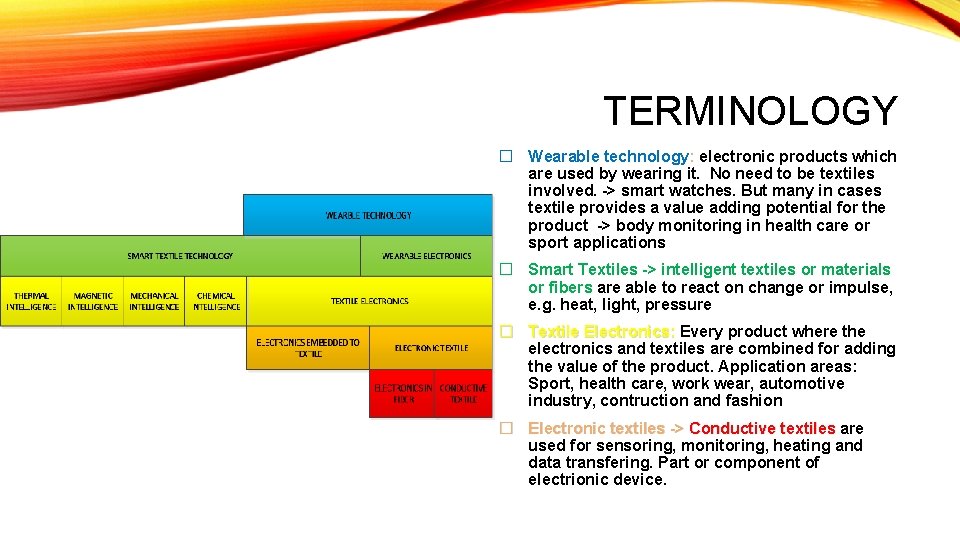
TERMINOLOGY � Wearable technology: electronic products which are used by wearing it. No need to be textiles involved. -> smart watches. But many in cases textile provides a value adding potential for the product -> body monitoring in health care or sport applications � Smart Textiles -> intelligent textiles or materials or fibers are able to react on change or impulse, e. g. heat, light, pressure � Textile Electronics: Every product where the electronics and textiles are combined for adding the value of the product. Application areas: Sport, health care, work wear, automotive industry, contruction and fashion � Electronic textiles -> Conductive textiles are used for sensoring, monitoring, heating and data transfering. Part or component of electrionic device.

SYSTEM ARCHITECTURE
TEXTILES AND INTERNET OF THINGS (IOT) • Wearable technology is a part of digitalization and Internet of Things which open incredible possibilities for the new innovations in products and services • Main drivers for textile/clothing and electronic integration are: • Miniature size of electronics • More efficient and faster networks for wireless communication • Improvements in low energy technologies • Exponential growth of smart phones and tablets • Wearable textile technology inc. textile electrodes is obviuosly one application area of Io. T as it combines people and devices
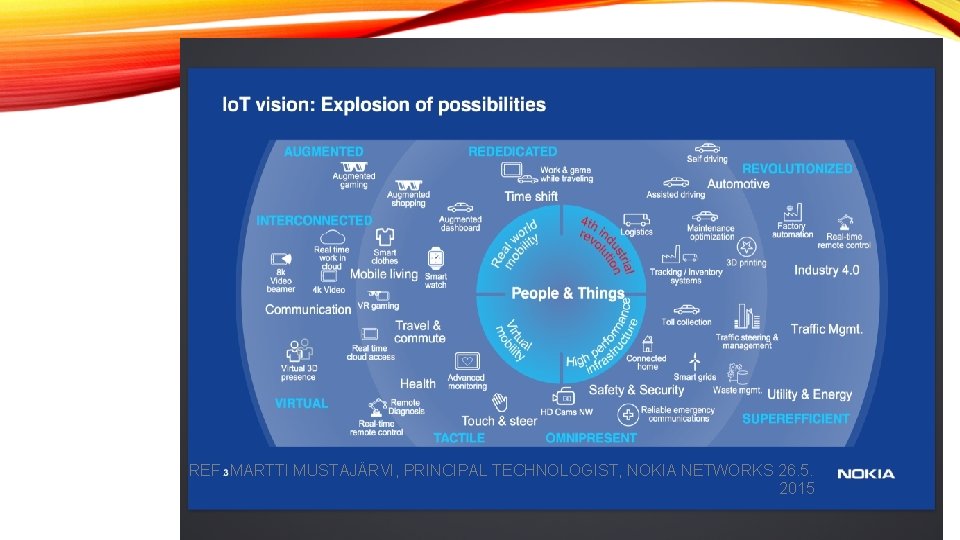
REF. MARTTI MUSTAJÄRVI, PRINCIPAL TECHNOLOGIST, NOKIA NETWORKS 26. 5. 2015
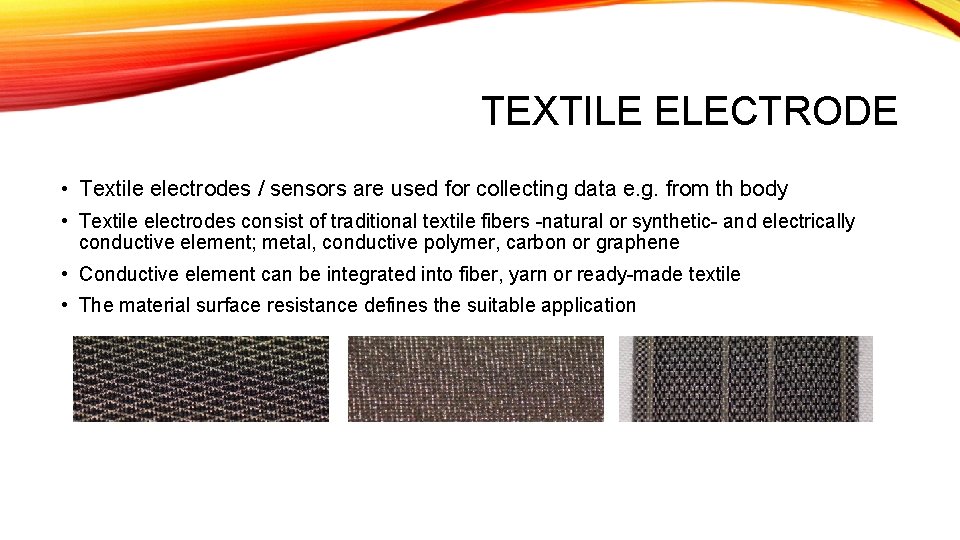
TEXTILE ELECTRODE • Textile electrodes / sensors are used for collecting data e. g. from th body • Textile electrodes consist of traditional textile fibers -natural or synthetic- and electrically conductive element; metal, conductive polymer, carbon or graphene • Conductive element can be integrated into fiber, yarn or ready-made textile • The material surface resistance defines the suitable application
APPLICATION AREAS OF CONDUCTIVE TEXTILES � � � � Body monitoring Signal and power transfer Heating Antennas Detectors and actuators EMI – shielding Static dissipation control (ESD)

ADVANTAGES OF TEXTILE ELECTRODES / CONDUCTIVE TEXTILES • Clothing embedded electrodes enable perfect electrode placement and shape • The flexibility of electrodes guarantees a proper skin contact • Cables and wires can be integrated into textile invisibly • System invisibility makes it acceptable for the user • Comfortability and softness of electrodes enable long time measurement
BODY MEASURING WITH TEXTILE ELECTRODES • • • Heart rate, heart rate variability, heart activity (ECG) Stress level and sleep quality (ECG) Brain function and vitality level (EEG) Muscle rate and balance (EMG) Body motions and postures (EMG) Body composition; fat content and fluid balance (EBI) Lung function (EIT) Respiration rate and frequency Skin conductivity Skin temperature

BUSINESS AREAS FOR TEXTILE ELECTRONICS • Professional and protective wear • Fashion • Sport and well-being • Home interiors • Automotive • Construction • Gaming Industries • Medical and health care
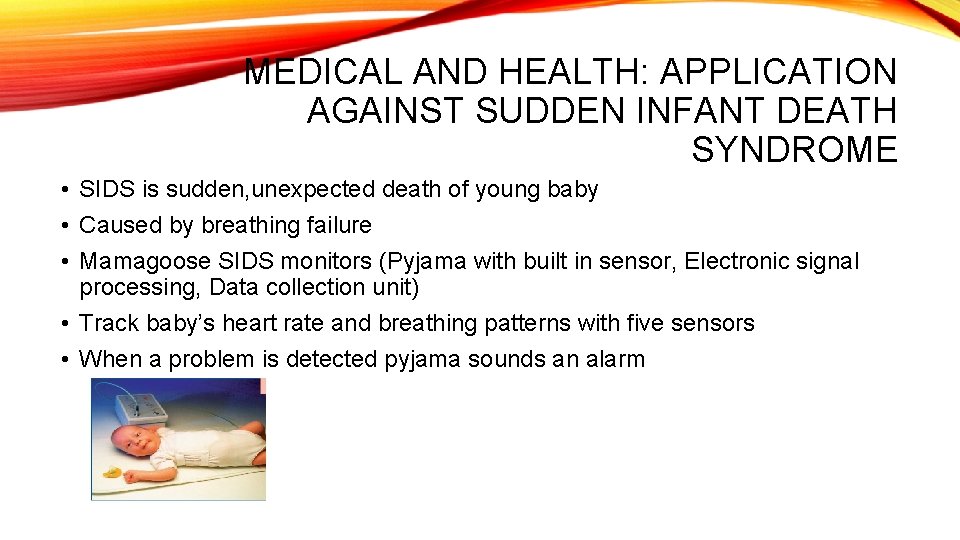
MEDICAL AND HEALTH: APPLICATION AGAINST SUDDEN INFANT DEATH SYNDROME • SIDS is sudden, unexpected death of young baby • Caused by breathing failure • Mamagoose SIDS monitors (Pyjama with built in sensor, Electronic signal processing, Data collection unit) • Track baby’s heart rate and breathing patterns with five sensors • When a problem is detected pyjama sounds an alarm
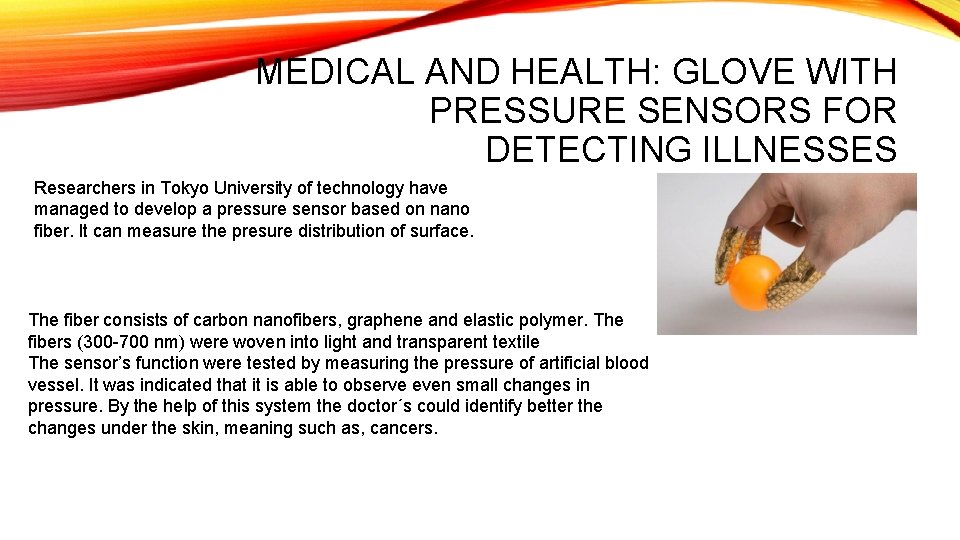
MEDICAL AND HEALTH: GLOVE WITH PRESSURE SENSORS FOR DETECTING ILLNESSES Researchers in Tokyo University of technology have managed to develop a pressure sensor based on nano fiber. It can measure the presure distribution of surface. The fiber consists of carbon nanofibers, graphene and elastic polymer. The fibers (300 -700 nm) were woven into light and transparent textile The sensor’s function were tested by measuring the pressure of artificial blood vessel. It was indicated that it is able to observe even small changes in pressure. By the help of this system the doctor´s could identify better the changes under the skin, meaning such as, cancers.
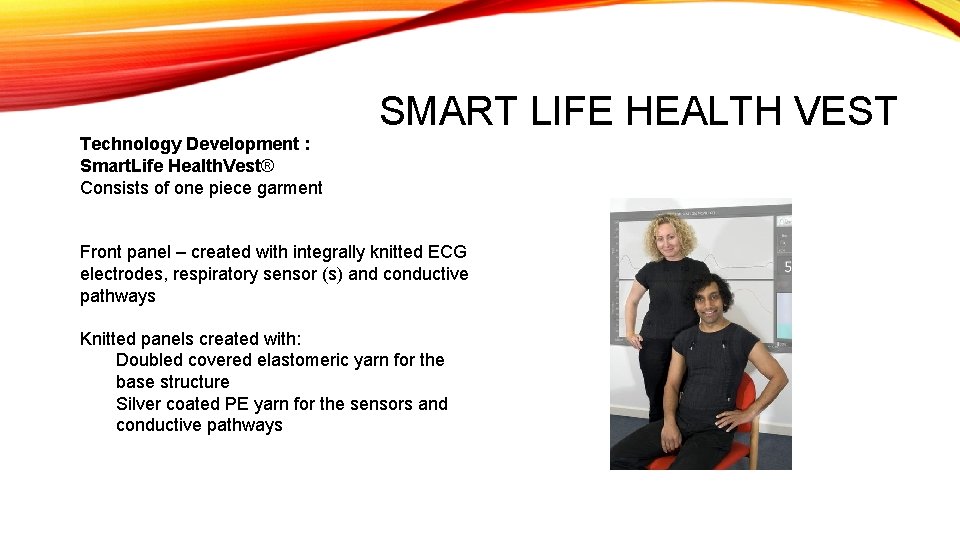
SMART LIFE HEALTH VEST Technology Development : Smart. Life Health. Vest® Consists of one piece garment Front panel – created with integrally knitted ECG electrodes, respiratory sensor (s) and conductive pathways Knitted panels created with: Doubled covered elastomeric yarn for the base structure Silver coated PE yarn for the sensors and conductive pathways
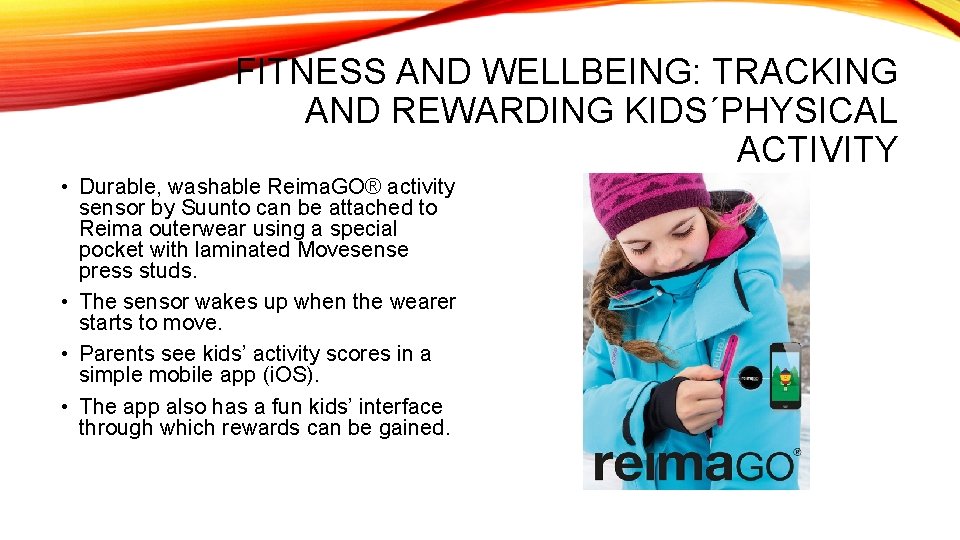
FITNESS AND WELLBEING: TRACKING AND REWARDING KIDS´PHYSICAL ACTIVITY • Durable, washable Reima. GO® activity sensor by Suunto can be attached to Reima outerwear using a special pocket with laminated Movesense press studs. • The sensor wakes up when the wearer starts to move. • Parents see kids’ activity scores in a simple mobile app (i. OS). • The app also has a fun kids’ interface through which rewards can be gained.
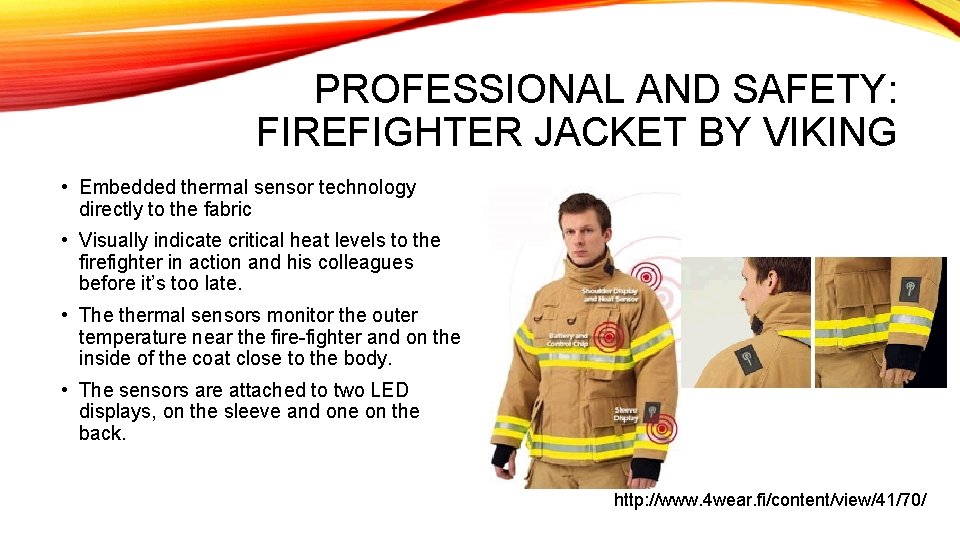
PROFESSIONAL AND SAFETY: FIREFIGHTER JACKET BY VIKING • Embedded thermal sensor technology directly to the fabric • Visually indicate critical heat levels to the firefighter in action and his colleagues before it’s too late. • The thermal sensors monitor the outer temperature near the fire-fighter and on the inside of the coat close to the body. • The sensors are attached to two LED displays, on the sleeve and one on the back. http: //www. 4 wear. fi/content/view/41/70/
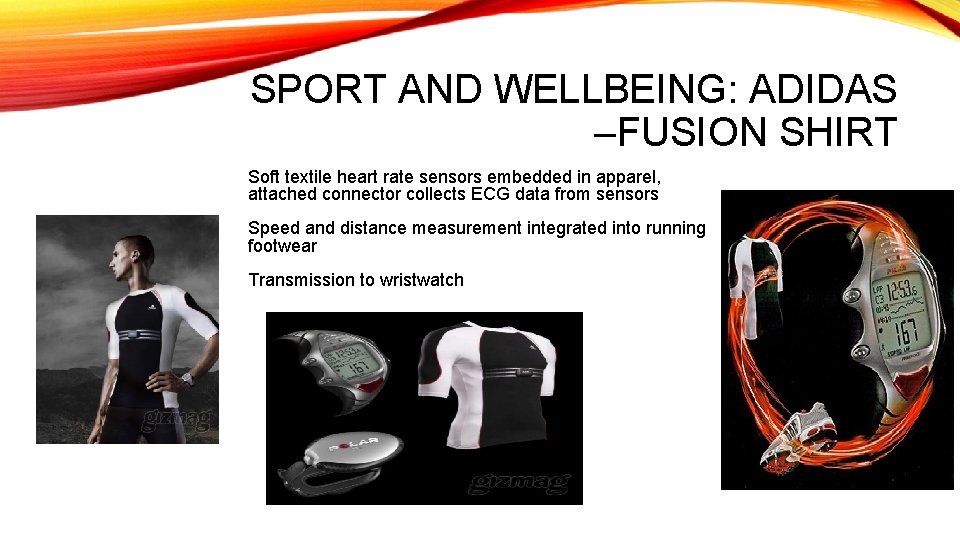
SPORT AND WELLBEING: ADIDAS –FUSION SHIRT Soft textile heart rate sensors embedded in apparel, attached connector collects ECG data from sensors Speed and distance measurement integrated into running footwear Transmission to wristwatch
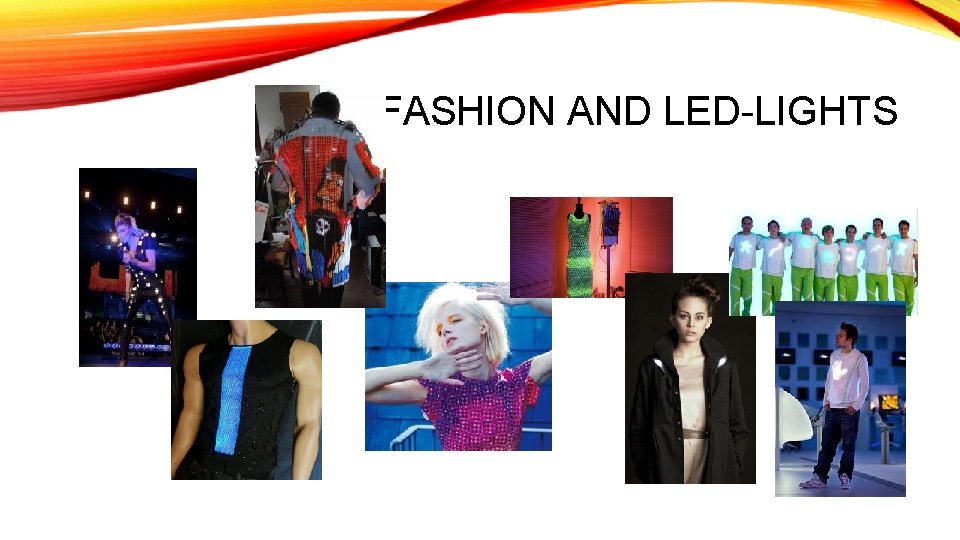
FASHION AND LED-LIGHTS
DOCTOR´S THESIS 2015 Decontamination of wearable textile electrodes for medical and health care applications
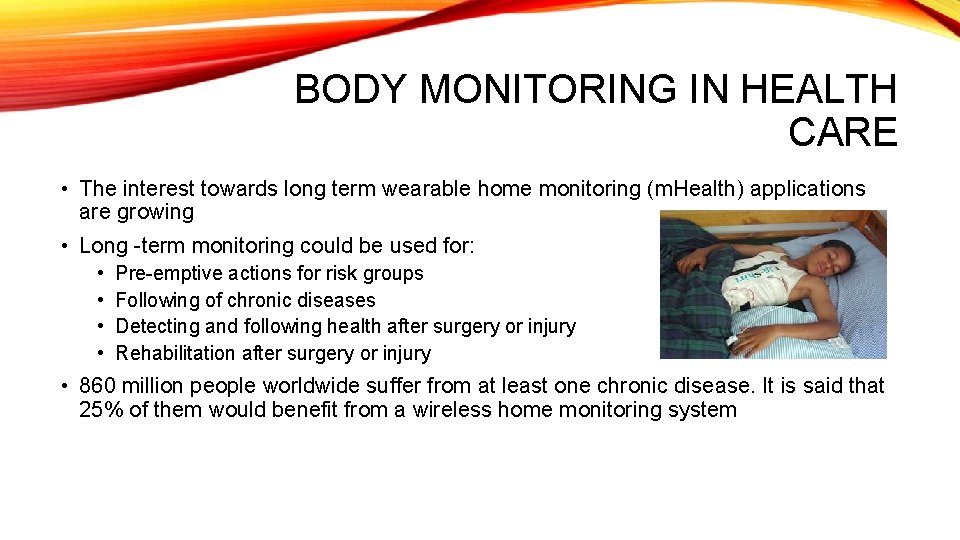
BODY MONITORING IN HEALTH CARE • The interest towards long term wearable home monitoring (m. Health) applications are growing • Long -term monitoring could be used for: • • Pre-emptive actions for risk groups Following of chronic diseases Detecting and following health after surgery or injury Rehabilitation after surgery or injury • 860 million people worldwide suffer from at least one chronic disease. It is said that 25% of them would benefit from a wireless home monitoring system

REQUIREMENTS OF TEXTILE ELECTRONICS IN HEALTH CARE • A wearable system must be reusable, because of its complexity and expensiveness • Recycling from user to user must be made safely, thus it must be sterilized or disinfected before every exchange • It must be washable and visibly clean before sterilization
RESEARCH OBJECTIVES OF MY DOCTOR´S THESIS • To determine the most efficient sterilization method for elastic knitted electrodes and woven fabric electrodes • To investigate how textile electrodes endure the disinfection process • To identify a safe fluid-repellent treatment for elastic and inelastic conductive textiles in order to make the textiles easy-to-clean

DECONTAMINATION IN HOSPITALS • Decontamination is a removal or inactivation of infection-causing organisms from a material • Sterilization kills all living organisms; used in hospital inpatient departments, intensive care units and operating theatres • Disinfection is used for semi-critical and low risk devices, because it is not effective for the most resistant bacterial spores • Cleaning is the lowest level of decontamination • Decontamination level is chosen according to the object’s purpose of use in a certain environment or condition

DECONTAMINATION OF TEXTILES • Textiles are absorbing and spreading infections effectively in hospitals • Cleaning is a prerequisite process for textile sterilization and disinfection • Sterilization of textiles can be made by • Auto claving (steam) • Ethylene oxide • Irradiation • Autoclaving is a simple and widely used, inexpensive and safe method

OIL AND STAIN REPELLENT FINISHING • The principle is coming from lotus plant leaf. A small contact of droplet to surface is essential. • The stain release property is based on rolling effect of droplet • Advantages of the repellent finish are: • Improved cleaning effect even in a lower temperature • Faster drying speed after washing • Decreased need for machine washing
TESTING OF TEXTILE PROPERTIES AFTER TREATMENTS • Process conditions are stressful; heat, chemical and mechanical stress might damage the textile electrically and/or mechanically • The functioning of textile electrodes after treatments was examined: • • • Surface electrical resistance Surface abrasion resistance Elasticity Dimensional change Repellency

MAIN FINDINGS • Textile electrodes tolerates the decontamination treatments in hospitals • The cleaning effect of textile electrodes can be improved by stain and water repellent finishes • This study gives useful information for researchers, designers and producers how the electronic textiles for medical applications should be defined, fabricated and verified • http: //dspace. cc. tut. fi/dpub/handle/123456789/23170
TOPIC RELATED LINKS • • • http: //www. smarttextiles. se http: //www. smarttextiles. net http: // www. wearable-technologies. com http: //www. innovationintextiles. com http: //www. plusplasticelectronics. com/Smar t. Fabrics. Textiles. aspx http: //www. gizmag. com http: //www. engadget. com/ http: //www. inteletex. com http: //www. technical-textiles. net • • • http: //interactive-wear. de http: // www. polar. fi http: // www. crunchwear. com http: //www. clothingplus. fi http: //www. gzespace. com http: //www. textronicsinc. com http: //www. research. philips. com http: //www. fibretronic. com http: //www. nike. com http: //www. adidas. com http: //www. smartlifetech. com

KEYWORDS FOR SEARCH • • Intelligent/smart/interactive fabrics/textiles/materials/clothing/garment Wearable technology/computers/computing/electronics Textile electronics Electronic(s) Textile/E-textile Textile electrode/sensor Mobile health E-health
FAIR AND CONFERENCES • • Techtextil and Avantex 2017, Frankfurt, German Smart Fabrics, 2016, USA or Europe ISWC- International Symposium of wearable computers 2016 Wearable Technologies 2016, Munich, German

KIITOS! elina. ilen@aalto. fi

• Anturi on noin kahdeksan mikrometriä paksu ja voi mitata paineen 144 paikasta yhdellä kertaa. • Laitteen prototyyppi koostuu orgaanisista transistoreista, sähköisistä kytkimistä, jotka on tehty hiili- ja happipohjaisista orgaanisista materiaaleista, sekä paineherkästä nanokuiturakenteesta. Hiilinanoputkia ja grafeenia lisättiin elastiseen polymeeriin, mistä syntyi halkaisijaltaan 300– 700 nanometriä paksuja kuituja, joista kudottiin läpinäkyvä, ohut ja kevyt huokoinen rakenne. • Koekappaleella mitattiin keinotekoisen verisuonen painetta, ja todettiin, että mittari havaitsi pienetkin muutokset. Tämän ansiosta lääkärit voivat havaita ihonalaisia muutoksia herkemmin käsineillä kuin omilla sormillaan. Näin he voisivat tulevaisuudessa tunnistaa sairauksia, kuten syöpiä. • Tutkimusjohtaja tohtori Sungwon Lee ja professori Takao Someya Tokion teknillisestä yliopistosta kehittivät tiedotteen mukaan nanokuiduista paineanturin, joka pystyy mittaamaan paineen jakautumisen pyöreällä alustalla
- Slides: 34