
WEALTH MANAGEMENT Wealth Management Means Wealth Management as








- Slides: 21
WEALTH MANAGEMENT
Wealth Management Means • Wealth Management as a concept originated in year 1990’s in the US. Essentially it is the investment advisory covering financial planning that provides individuals with private banking/ asset management/ taxation advisory & portfolio management. • Wealth management combines both financial planning and specialized financial services, including personal retail banking services, estate planning, legal and tax advice, and investment management services. The goal of wealth management is to sustain and grow longterm wealth.
• Wealth management is a high-level professional service that combines financial/investment advice, accounting/tax services, retirement planning and legal/estate planning for one fee. • Investors work with a single wealth manager who coordinates input from financial experts and can include coordinating advice from the investors own attorney, accountants and insurance agent. Some wealth managers also provide banking services or advice.
Role of Wealth Manager • Preparing a financial blue print for the investors future • Advice on investment in share market • Advice on investment in small savings schemes and other debt instruments • Advice on investment in mutual funds and other investment products • Suggesting a suitable asset allocation based on risk profile of the investors • Management of loans and other liabilities • Insurance planning and risk management • Tax planning • Planning for smooth inheritance of wealth to the next generation.
Wealth Management in India • India’s wealth management services sector is largely fragmented, which isn’t surprising given the industry is still in its early days. Hence, it is recommended that firms take a long-term view while evaluating potential return on investment. • Though wealth management is a new concept for India, some companies are started working in this direction. Here is list of some companies:
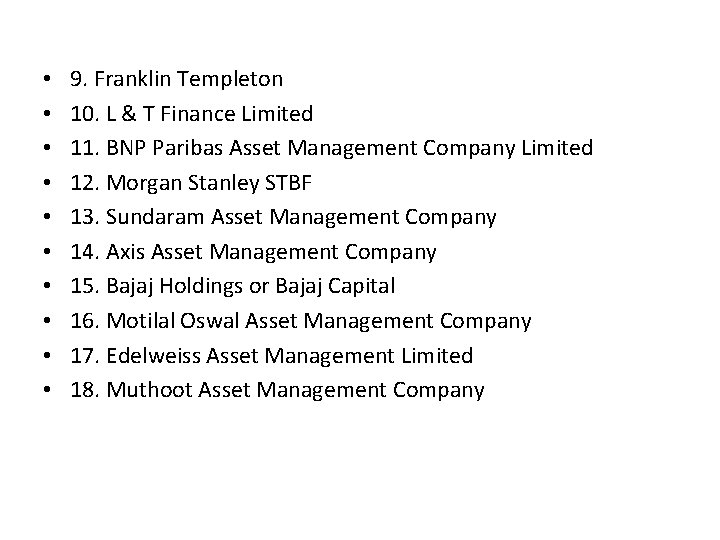
Wealth Management Companies in India • • 1. ICICI Asset Management Company 2. HDFC Asset Management Company 3. Reliance Asset Management Company 4. UTI Asset Management Company 5. Birla Sun Life Asset Management Company 6. Kotak Mahindra Asset Management 7. Religare Asset Management Company 8. Tata Asset Management Company
• • • 9. Franklin Templeton 10. L & T Finance Limited 11. BNP Paribas Asset Management Company Limited 12. Morgan Stanley STBF 13. Sundaram Asset Management Company 14. Axis Asset Management Company 15. Bajaj Holdings or Bajaj Capital 16. Motilal Oswal Asset Management Company 17. Edelweiss Asset Management Limited 18. Muthoot Asset Management Company
Investment Avenues • Investment Avenues are different ways that you can invest your money. • Following investment avenues that are considered in this report are as follows: • 1. Saving Account • 2. Bank Fixed Deposit • 3. Public Provident Fund • 4. National Saving Certificate • 5. Post Office Saving • 6. Government Securities • 7. Mutual Funds • 8. Life Insurance • 9. Debentures • 10. Bonds • 11. Equity Share Market • 12. Commodity Share Market • 13. FOREX Market • 14. Real Estate (Property) • 15. Gold
Some important Investments option offer by the wealth management companies Mutual Funds 1 • A mutual fund is an investment vehicle that is made up of a pool of funds collected from many investors for the purpose of investing in securities such as stocks, bonds, money market instruments and similar assets. Mutual funds are operated by money managers, who invest the fund's capital and attempt to produce capital gains and income for the fund's investors. • A mutual fund's portfolio is structured and maintained to match the investment objectives stated in its prospectus.
Life Insurance 2 • Life insurance is a protection against the loss of income that would result if the insured passed away. The named beneficiary receives the proceeds and is thereby safeguarded from the financial impact of the death of the insured. • The goal of life insurance is to provide a measure of financial security for your family after you die. So, before purchasing a life insurance policy, you should consider your financial situation and the standard of living you want to maintain for your dependents or survivors.
Debentures & Bonds • A debenture is a type of debt instrument that is not secured by physical assets or collateral. Debentures are backed only by the general creditworthiness and reputation of the issuer. Both corporations and governments frequently issue this type of bond to secure capital. Like other types of bonds, debentures are documented in an indenture. There are 2 types of debentures: Convertible and nonconvertible.
Commodity Market • A physical or virtual marketplace for buying, selling and trading raw or primary products. For investors' purposes there are currently about 50 major commodity markets worldwide that facilitate investment trade in nearly 100 primary commodities.
FOREX Market • FOREX is the market in which currencies are traded. The FOREX market is the largest, most liquid market in the world, with average traded values that can be trillions of dollars per day.
On June 28, 2013 RBI releases Draft Guidelines on Wealth Management/ Marketing/Distribution Services offered by Banks. Background The Monetary Policy Statement for 2013 -14 had indicated that banks offering Wealth Management Services (WMS) which include referral services, Investment Advisory Services (IAS) and Portfolio Management Services (PMS) are exposed to reputational risks on account of mis-selling of products, conflicts of interest, lack of knowledge and clarity about products and frauds.
RBI Circular The Monetary Policy Statement had also indicated that detailed guidelines on marketing and distribution of third-party financial products would be issued in the wake of the irregularities observed in banks offering such services. It was, therefore, proposed to issue comprehensive guidelines on wealth management and marketing/distribution services offered by banks.
Introduction to Indian Bank Wealth Management Services • Wealth management services form part of Treasury operations and personnel involved have expertise in investments, benefitting from the experience and expertise of Bank’s integrated Treasury operations.
• KEY FEATURES OF WEALTH MANAGEMENT· Offers independent, unbiased investment advisory service. · Qualified and experienced Advisory desk to recommend the products that are best suited for you. · Product performance based and not commission driven recommendations. · Investor counseling where not to invest your hard earned money. · Customer oriented approach. Both holistic financial planning and Goal based financial planning undertaken. . · Dedicated Wealth Manager to cater to your needs. · Market information bulletins in the form of Daily News letters and SMS alerts. .
• Advantages of WM · Analyze and evaluate cash flows and financial status. · Define investors goals. · Determine risk tolerance level. · Ascertain Tax situation. · Determine Insurance needs. · Finalize appropriate asset allocation for investors · Prepare a financial plan best suited for your goals, Implement and review the same periodically.
Private banking vs. wealth management • Private banking does not always deal with investing. • Private bank staff may offer clients guidance on certain investment options, but not all banks will be involved in the actual process of investing assets for their clients. • Most clients utilizing private banking services open deposit accounts of one kind or another. • Wealth management employees, including financial advisors, provide advice to clients to help them improve their financial standing and assist clients in investing assets with the goal of generating high returns. • In general, private banking can extend to encompass wealth management, but wealth management firms cannot provide clients with private banking facility services. •
• wealth management banks generally involves advice and execution of investments on behalf of affluent clients. • Firms that specialize in these practices are the primary sources for clients looking to invest in a variety of funds and stocks. • Wealth management advisors also help with financial planning, manage client portfolios and perform a variety of other financial services. • Private wealth management services are provided by larger financial institutions but they may also be provided by independent financial advisors or portfolio managers multilicensed to offer multiple services and who focus on high-networth clients. •
• A wealth management advisor sits down one-on-one with each client and discusses goals, comfort levels with risk, and any other stipulations or restrictions the client may have in regard to the investment of his assets. • The wealth management advisor then composes an investment strategy that incorporates all information gained from the client to help the client achieve his goals. The advisor continues to manage the client’s money and utilizes investment products that coincide with the client's stipulations.