
We will determine how to calculate the Theoretical
- Slides: 4
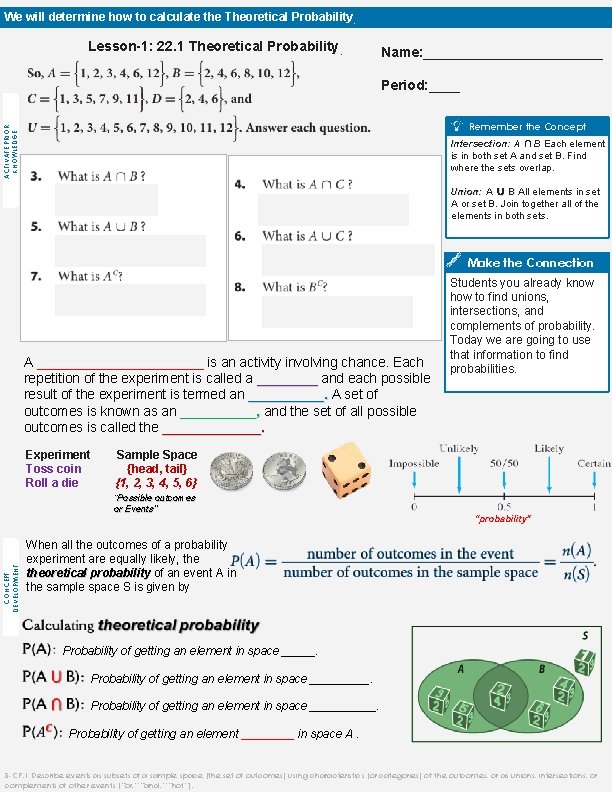
We will determine how to calculate the Theoretical Probability. Lesson-1: 22. 1 Theoretical Probability. Name: ____________ Period: ____ ACTIVATE PRIOR KNOWLEDGE Remember the Concept Intersection: A ∩ B Each element is in both set A and set B. Find where the sets overlap. Union: A ∪ B All elements in set A or set B. Join together all of the elements in both sets. Make the Connection A ___________ is an activity involving chance. Each repetition of the experiment is called a ____ and each possible result of the experiment is termed an _____. A set of outcomes is known as an _____, and the set of all possible outcomes is called the _______. Experiment Toss coin Roll a die Sample Space {head, tail} {1, 2, 3, 4, 5, 6} “Possible outcomes or Events” CONCEPT DEVELOPMENT Students you already know how to find unions, intersections, and complements of probability. Today we are going to use that information to find probabilities. “probability” When all the outcomes of a probability experiment are equally likely, theoretical probability of an event A in the sample space S is given by Probability of getting an element in space __________. Probability of getting an element ____ in space A. S-CP. 1 Describe events as subsets of a sample space (the set of outcomes) using characteristics (or categories) of the outcomes, or as unions, intersections, or complements of other events (“or, ” “and, ” “not”).
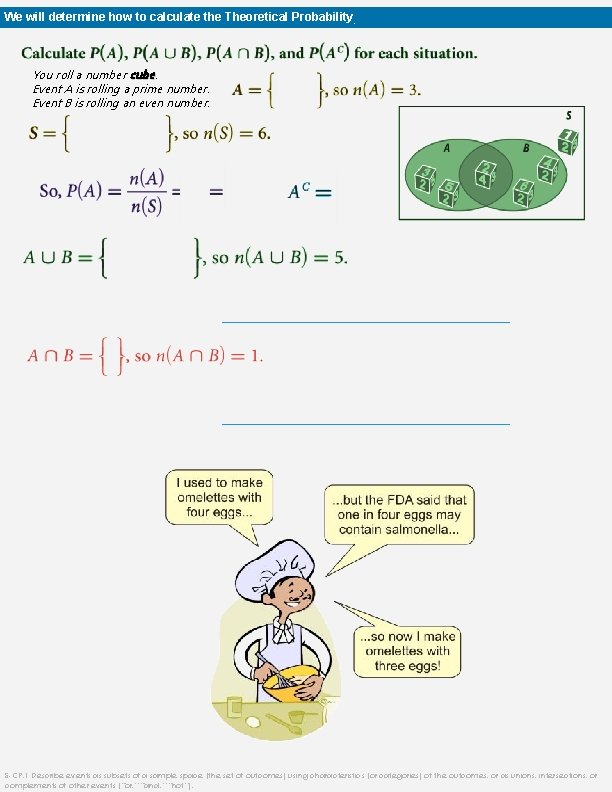
We will determine how to calculate the Theoretical Probability. You roll a number cube Event A is rolling a prime number. Event B is rolling an even number. S-CP. 1 Describe events as subsets of a sample space (the set of outcomes) using characteristics (or categories) of the outcomes, or as unions, intersections, or complements of other events (“or, ” “and, ” “not”).
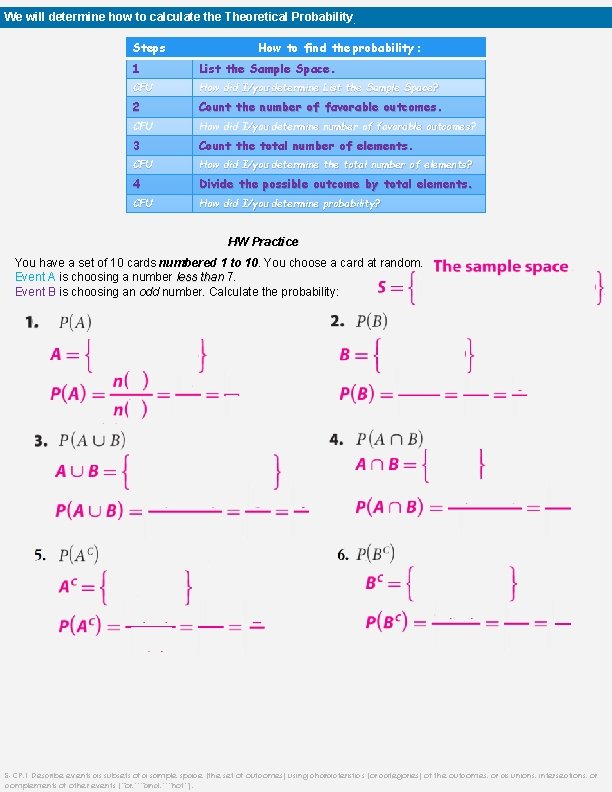
We will determine how to calculate the Theoretical Probability. Steps How to find the probability : 1 List the Sample Space. CFU How did I/you determine List the Sample Space? 2 Count the number of favorable outcomes. CFU How did I/you determine number of favorable outcomes? 3 Count the total number of elements. CFU How did I/you determine the total number of elements? 4 Divide the possible outcome by total elements. CFU How did I/you determine probability? HW Practice You have a set of 10 cards numbered 1 to 10. You choose a card at random. Event A is choosing a number less than 7. Event B is choosing an odd number. Calculate the probability: S-CP. 1 Describe events as subsets of a sample space (the set of outcomes) using characteristics (or categories) of the outcomes, or as unions, intersections, or complements of other events (“or, ” “and, ” “not”).
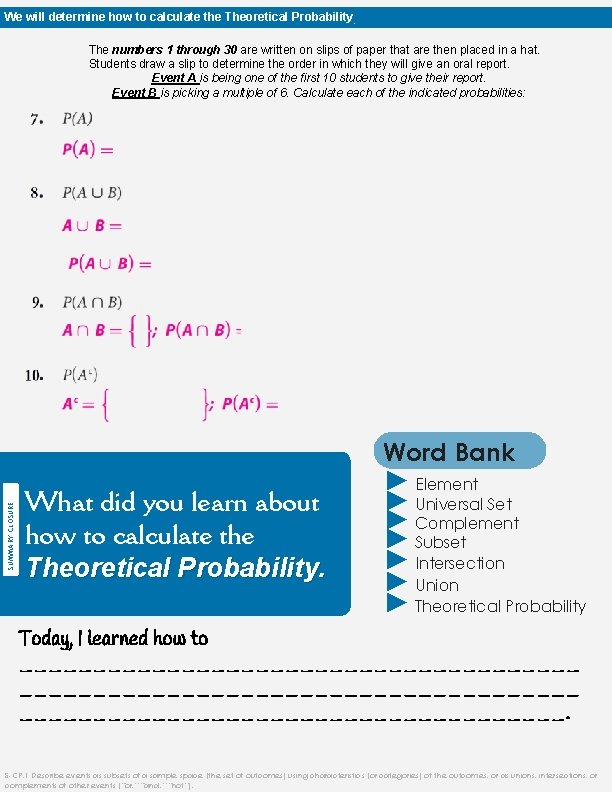
We will determine how to calculate the Theoretical Probability. The numbers 1 through 30 are written on slips of paper that are then placed in a hat. Students draw a slip to determine the order in which they will give an oral report. Event A is being one of the first 10 students to give their report. Event B is picking a multiple of 6. Calculate each of the indicated probabilities: SUMMARY CLOSURE Word Bank What did you learn about how to calculate the Theoretical Probability. ► Element ► Universal Set ► Complement ► Subset ► Intersection ► Union ► Theoretical Probability Today, I learned how to ______________________________________. S-CP. 1 Describe events as subsets of a sample space (the set of outcomes) using characteristics (or categories) of the outcomes, or as unions, intersections, or complements of other events (“or, ” “and, ” “not”).