
We use the toinfinitiveFI full infinitive To express



- Slides: 18
We use the to-infinitive/FI (full infinitive): - To express purpose: She went to the supermarket to buy apples. - After certain verbs that refer to the future (agree, appear, decide, expect, hope, plan, promise, refuse, want) I want you to go there. I hope to see her. - After would like/prefer/love to express a specific preference: I would love to come to your party. INFINITIVE
- After adjectives which describe feelings/emotions (happy, glad, sad), express willingness/unwillingness (eager, reluctant, willing), or refer to a person’s character, and the adjectives lucky and fortunate (clever, kind): I am glad to see you. It was very nice of you to drop me a line. - After too/enough: You are too young to watch this programme.
- With it+be+adjective/noun: It is important to do it now. - after be+first/second/next/last etc. He was the last person to call me on my birthday. - after verbs and expressions such as ask, decide, explain, find out, learn, want to know, when they followed by a question word: She asked me when to get the tickets.
In the expressions to tell you the truth, to be honest, to sum up, to begin with, etc. : To sum up, the headmaster needs to take measures to deal with this situation. With so+adjective+as: Would you be so kind as to help me with my homework. With only expressing an unsatisfactory result: She drove all the way to the mall only to find it closed. in the expessions for+noun/pronoun+FI It was very rude for him to behave like that.
We use the Infinitive without to/BI (bare infinitive): After modal verbs: She can play the piano. After the verbs let, make, see, hear, feel: My mum doesn’t let me stay up late. BUT We use FI after be made, be seen, be heard: She was seen to cross the road. - after had better and would rather: You’d better put your coat on.
We use –ing form: As a noun in the function of a subject: Reading is important. - after the verbs: admit, appreciate, avoid, consider, continue, deny, fancy, go (for activities), imagine, mind, practise, prevent, quit, save, suggest: I don’t mind going there. - After the verbs love, like, enjoy, prefer, hate, dislike to express general preference: I like reading -ING FORM
After the following expressions: be busy, it’s no use, it’s good, it’s worth, can’t help, can’t stand, have difficulty in, have trouble etc. : I’m busy preparing for my exams. After the verbs spend, waste, lose (time, money): He wastes time playing computer every day. After the preposition to in the following expressions: look forward to, be used to, in addition to, object to: I’m used to getting up early.
After other prepositions: I’m thinking of going there. After the verbs hear, listen to, notice, see, watch, feel to describe an incomplete action: I saw Paul crossing the street.
Infinitive Remember/forget to do smth. – планируемое действие e. g. I’m glad I remembered to do my homework. e. g. I forgot to turn off the light. -ing form Remember/forget doing smth. действие относящееся к прошлому e. g. I remember going to Spain last summer. e. g. I’ll never forget taking my driving licence.
Try to do smth. – стараться делать все возможное e. g. I’ve been trying to open the door for the last two hours. Try doing smth. – попытаться сделать в качестве эксперимента e. g. I tried opening the door, but I couldn’t.
Be sorry /regret to do smth. -сожалеть о том, что придется сделать(сообщить что-либо неприятное) e. g. I’m sorry/regret to inform you that you have failed your exams. Be sorry for/regret doing smth. сожалеть о том, что сделано в прошлом e. g. I’m sorry for/regret telling her the truth.
Stop to do smth. – остановиться, чтобы что-то сделать e. g. I stopped to talk with Jane, when I met her in the street yesterday. Stop doing smth. – перестать делать что -то E. g. I stopped talking to Jane a month ago.
Go on to do smth. – закончить действие и приступить к новому e. g. I washed the dishes and went on to clean the kitchen. Go on doing smth. продолжить делать что-либо e. g. Jane, go on reading, please.
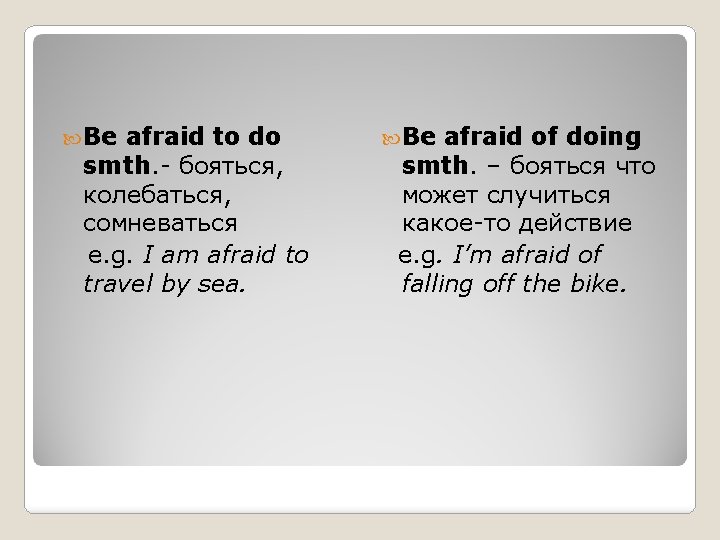
Be afraid to do smth. - бояться, колебаться, сомневаться e. g. I am afraid to travel by sea. Be afraid of doing smth. – бояться что может случиться какое-то действие e. g. I’m afraid of falling off the bike.
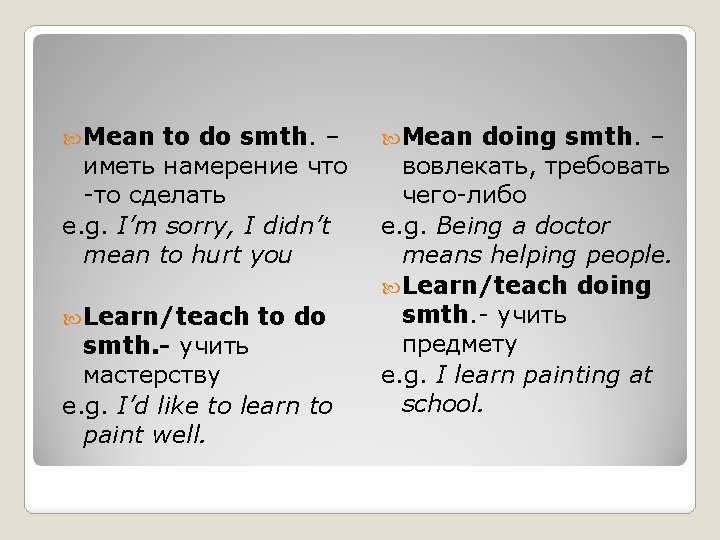
Mean to do smth. – иметь намерение что -то сделать e. g. I’m sorry, I didn’t mean to hurt you Learn/teach to do smth. - учить мастерству e. g. I’d like to learn to paint well. Mean doing smth. – вовлекать, требовать чего-либо e. g. Being a doctor means helping people. Learn/teach doing smth. - учить предмету e. g. I learn painting at school.
Thank you for attention