
We now know BR characterized by fault blocks
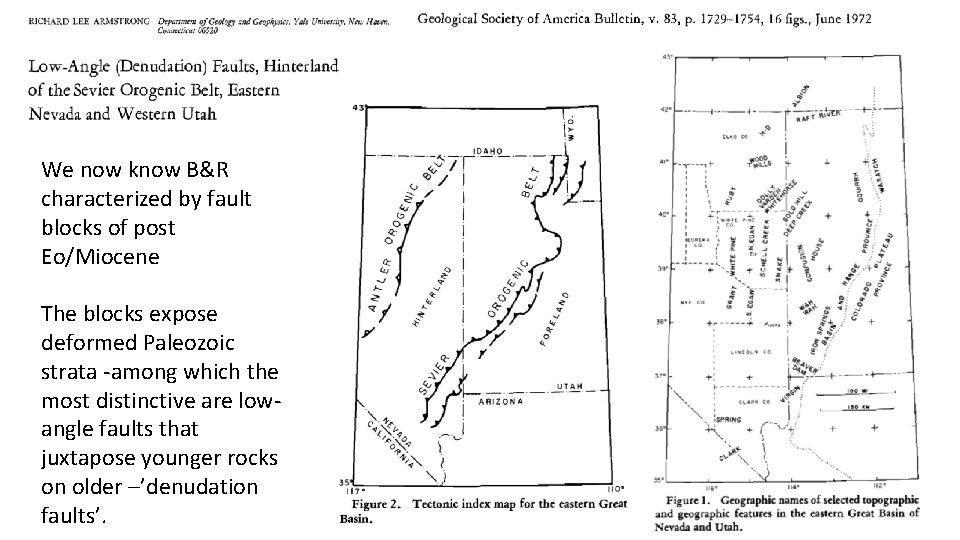
We now know B&R characterized by fault blocks of post Eo/Miocene The blocks expose deformed Paleozoic strata -among which the most distinctive are lowangle faults that juxtapose younger rocks on older –’denudation faults’.
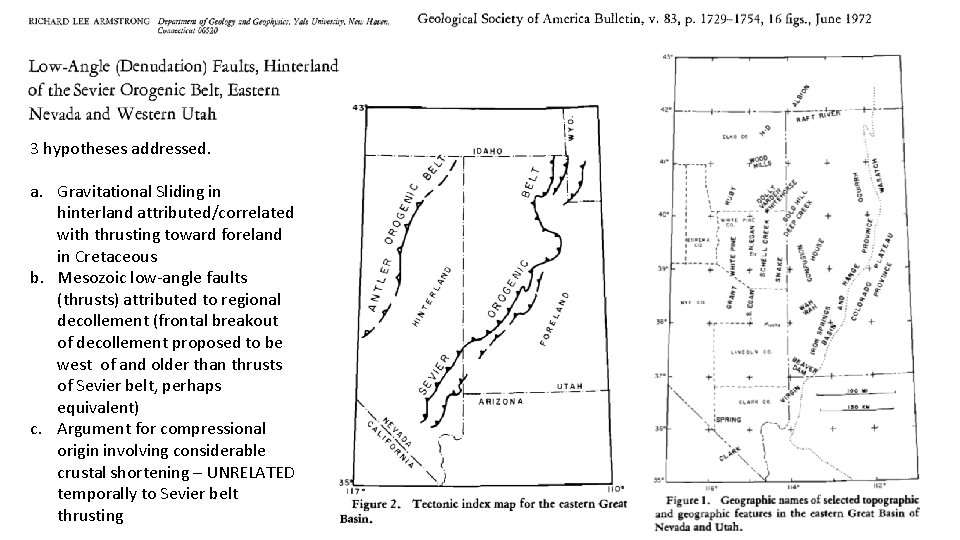
3 hypotheses addressed. a. Gravitational Sliding in hinterland attributed/correlated with thrusting toward foreland in Cretaceous b. Mesozoic low-angle faults (thrusts) attributed to regional decollement (frontal breakout of decollement proposed to be west of and older than thrusts of Sevier belt, perhaps equivalent) c. Argument for compressional origin involving considerable crustal shortening – UNRELATED temporally to Sevier belt thrusting
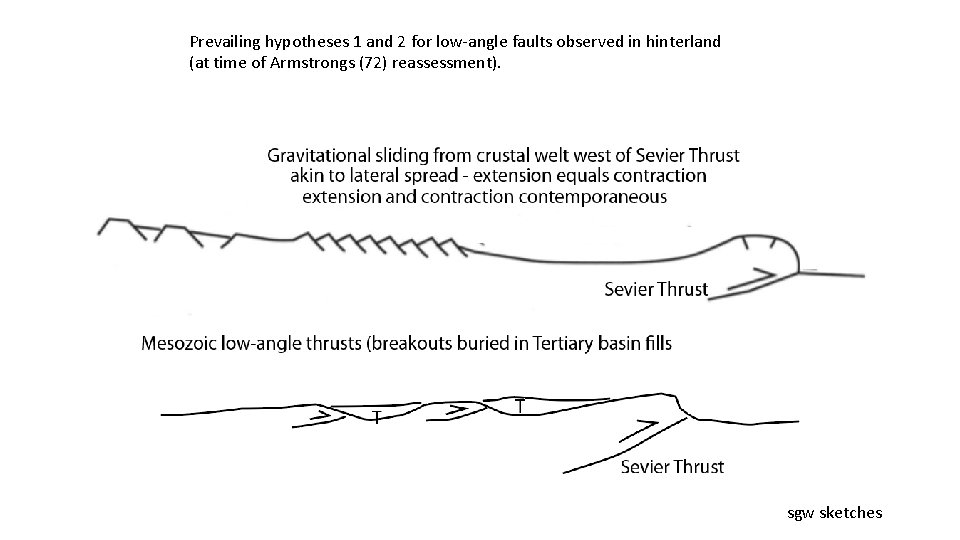
Prevailing hypotheses 1 and 2 for low-angle faults observed in hinterland (at time of Armstrongs (72) reassessment). sgw sketches
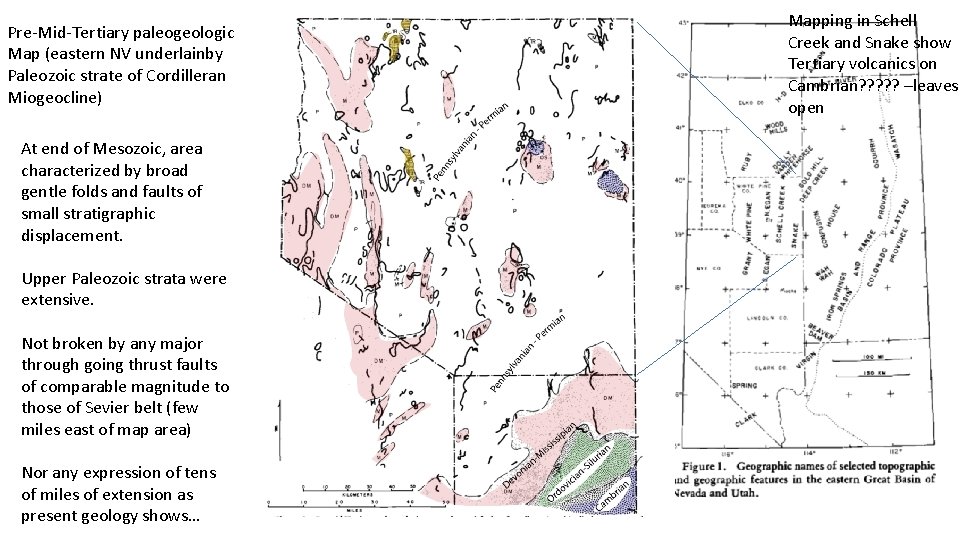
Pre-Mid-Tertiary paleogeologic Map (eastern NV underlainby Paleozoic strate of Cordilleran Miogeocline) At end of Mesozoic, area characterized by broad gentle folds and faults of small stratigraphic displacement. Upper Paleozoic strata were extensive. Not broken by any major through going thrust faults of comparable magnitude to those of Sevier belt (few miles east of map area) Nor any expression of tens of miles of extension as present geology shows… Mapping in Schell Creek and Snake show Tertiary volcanics on Cambrian? ? ? –leaves open
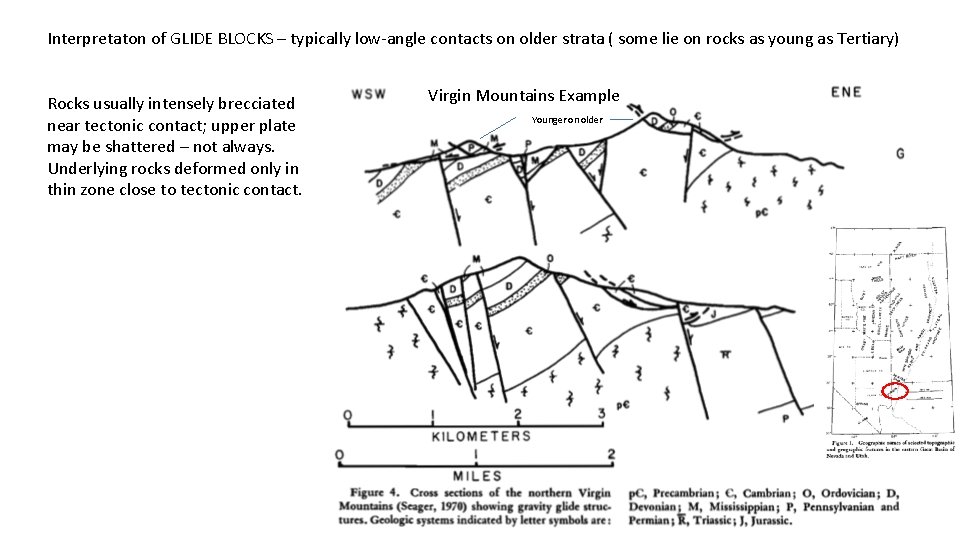
Interpretaton of GLIDE BLOCKS – typically low-angle contacts on older strata ( some lie on rocks as young as Tertiary) Rocks usually intensely brecciated near tectonic contact; upper plate may be shattered – not always. Underlying rocks deformed only in thin zone close to tectonic contact. Virgin Mountains Example Younger on older
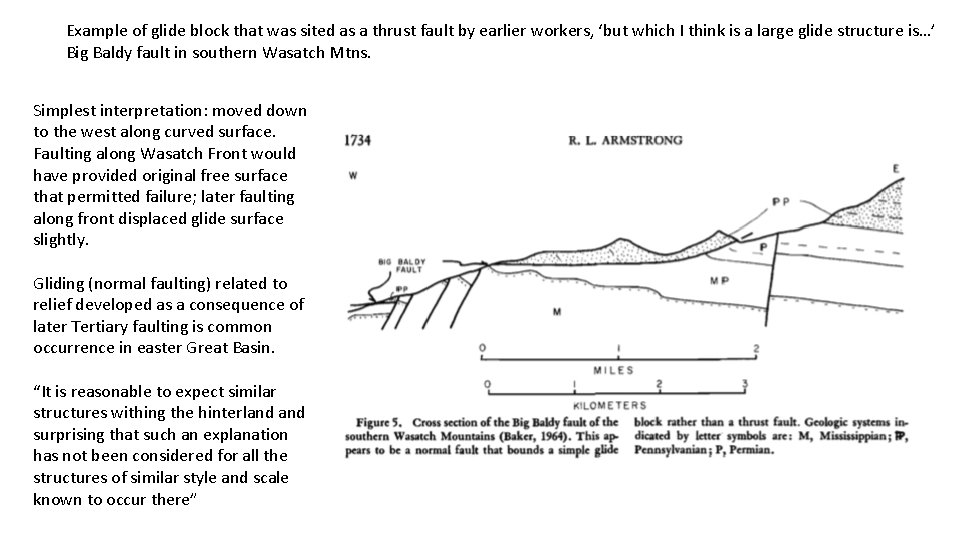
Example of glide block that was sited as a thrust fault by earlier workers, ‘but which I think is a large glide structure is…’ Big Baldy fault in southern Wasatch Mtns. Simplest interpretation: moved down to the west along curved surface. Faulting along Wasatch Front would have provided original free surface that permitted failure; later faulting along front displaced glide surface slightly. Gliding (normal faulting) related to relief developed as a consequence of later Tertiary faulting is common occurrence in easter Great Basin. “It is reasonable to expect similar structures withing the hinterland surprising that such an explanation has not been considered for all the structures of similar style and scale known to occur there”
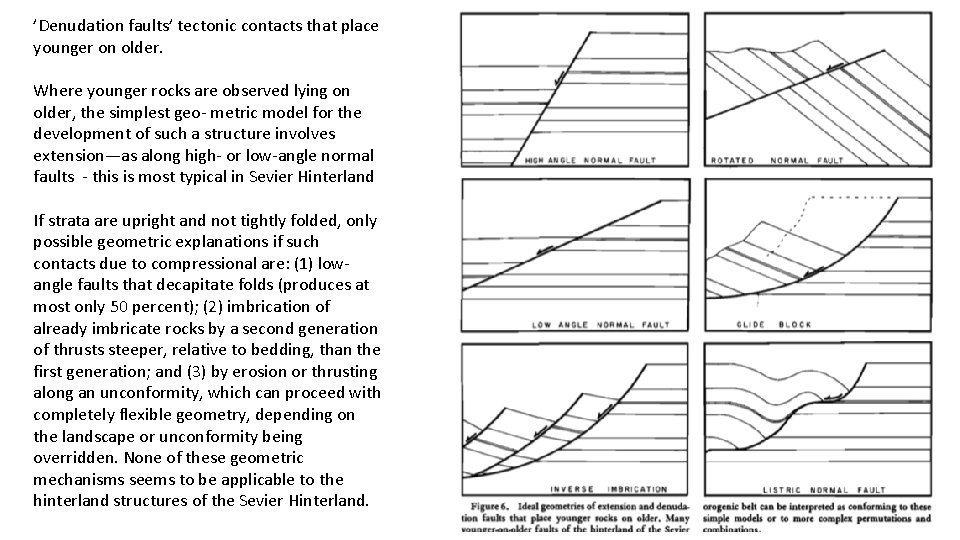
’Denudation faults’ tectonic contacts that place younger on older. Where younger rocks are observed lying on older, the simplest geo- metric model for the development of such a structure involves extension—as along high- or low-angle normal faults - this is most typical in Sevier Hinterland If strata are upright and not tightly folded, only possible geometric explanations if such contacts due to compressional are: (1) lowangle faults that decapitate folds (produces at most only 50 percent); (2) imbrication of already imbricate rocks by a second generation of thrusts steeper, relative to bedding, than the first generation; and (3) by erosion or thrusting along an unconformity, which can proceed with completely flexible geometry, depending on the landscape or unconformity being overridden. None of these geometric mechanisms seems to be applicable to the hinterland structures of the Sevier Hinterland.
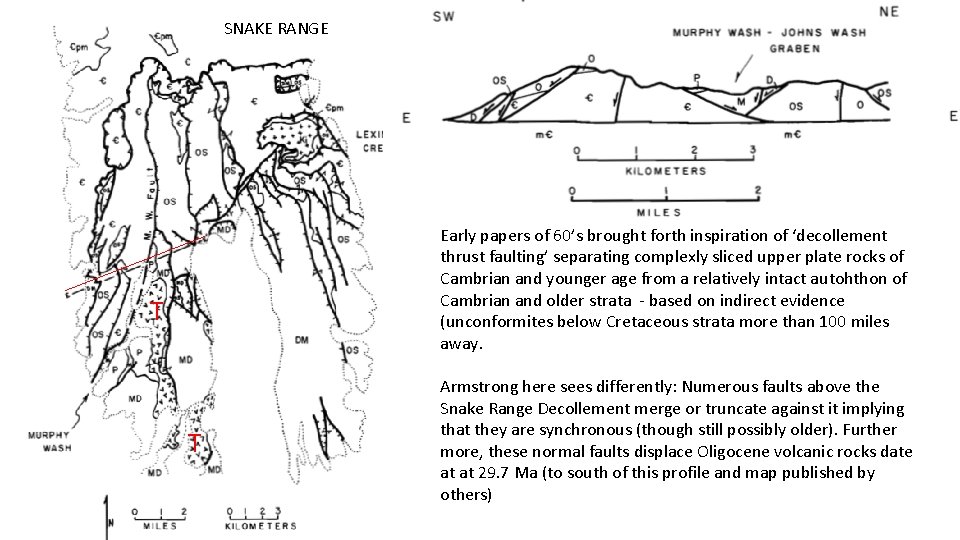
SNAKE RANGE Early papers of 60’s brought forth inspiration of ‘decollement thrust faulting’ separating complexly sliced upper plate rocks of Cambrian and younger age from a relatively intact autohthon of Cambrian and older strata - based on indirect evidence (unconformites below Cretaceous strata more than 100 miles away. T T Armstrong here sees differently: Numerous faults above the Snake Range Decollement merge or truncate against it implying that they are synchronous (though still possibly older). Further more, these normal faults displace Oligocene volcanic rocks date at at 29. 7 Ma (to south of this profile and map published by others)
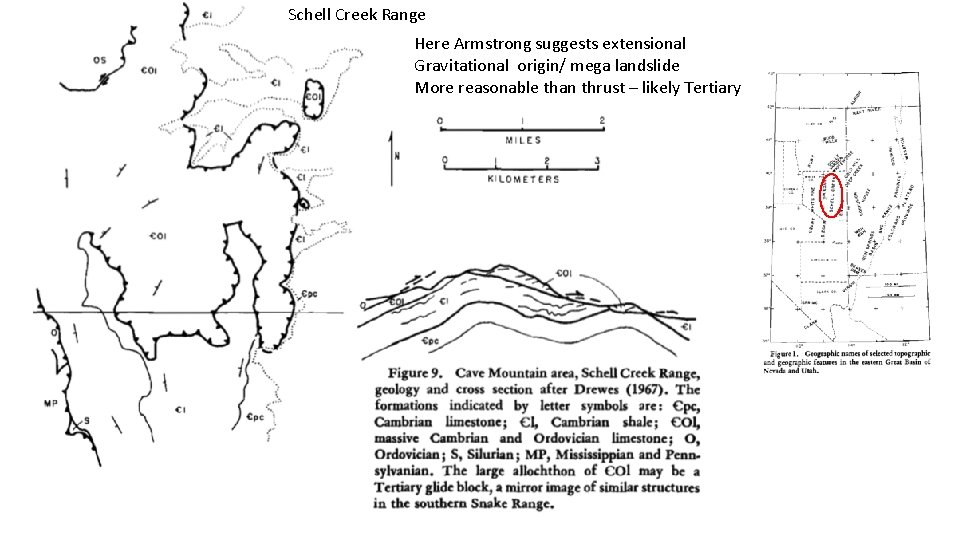
Schell Creek Range Here Armstrong suggests extensional Gravitational origin/ mega landslide More reasonable than thrust – likely Tertiary
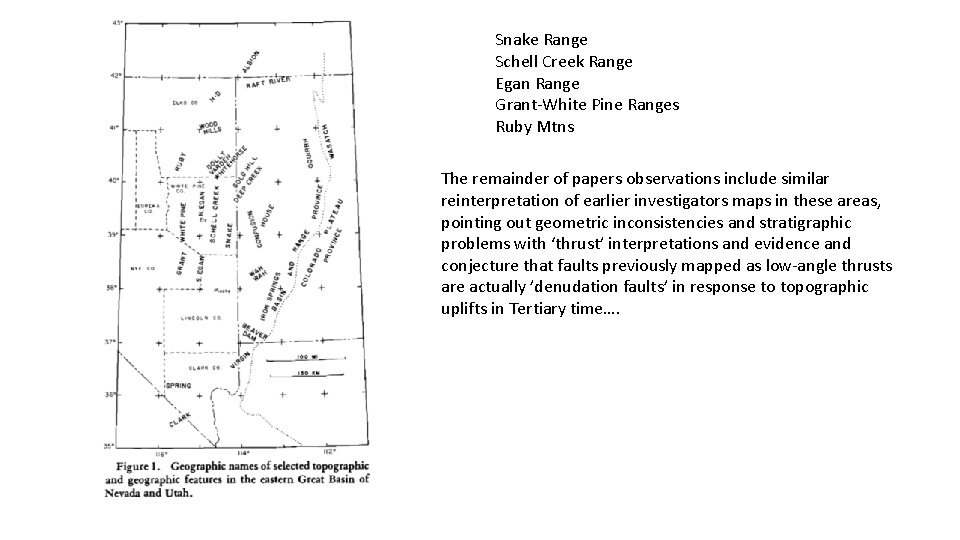
Snake Range Schell Creek Range Egan Range Grant-White Pine Ranges Ruby Mtns The remainder of papers observations include similar reinterpretation of earlier investigators maps in these areas, pointing out geometric inconsistencies and stratigraphic problems with ‘thrust’ interpretations and evidence and conjecture that faults previously mapped as low-angle thrusts are actually ’denudation faults’ in response to topographic uplifts in Tertiary time….
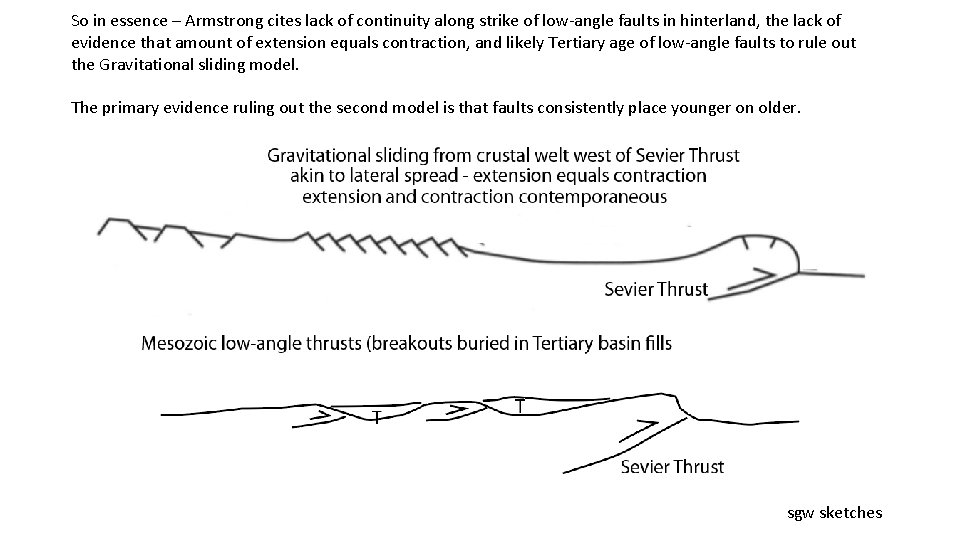
So in essence – Armstrong cites lack of continuity along strike of low-angle faults in hinterland, the lack of evidence that amount of extension equals contraction, and likely Tertiary age of low-angle faults to rule out the Gravitational sliding model. The primary evidence ruling out the second model is that faults consistently place younger on older. sgw sketches
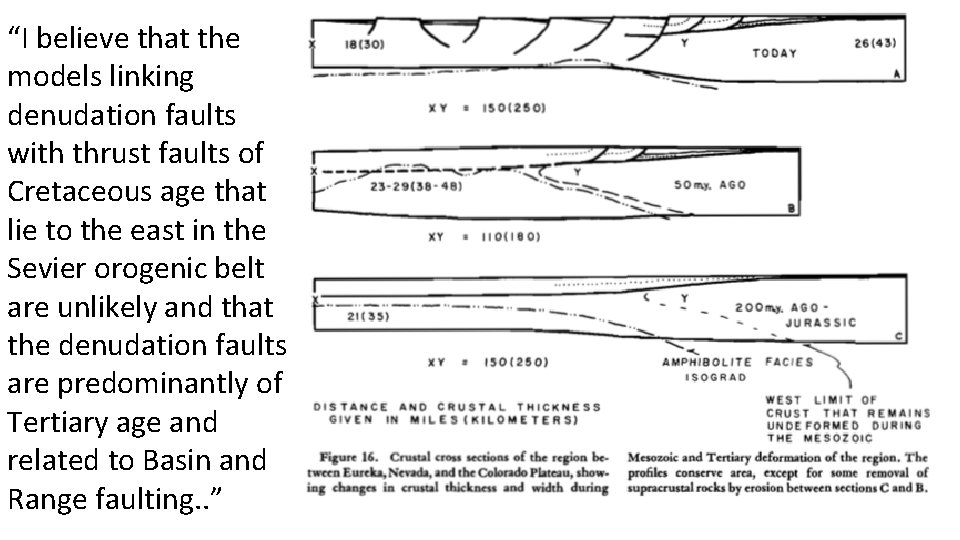
“I believe that the models linking denudation faults with thrust faults of Cretaceous age that lie to the east in the Sevier orogenic belt are unlikely and that the denudation faults are predominantly of Tertiary age and related to Basin and Range faulting. . ”

- Slides: 13