
We need a constant supply of energy even
- Slides: 36
We need a constant supply of energy, even at rest. During exercise more energy will be required. The energy needed will vary with the demands of the activity.
Three Forms of Energy Light from the sun is converted by plants into stored chemical energy. Humans consume the plants or animals who eat the plants, this is then stored as potential energy (ATP). Muscles use this energy for movement this is Kinetic Energy.
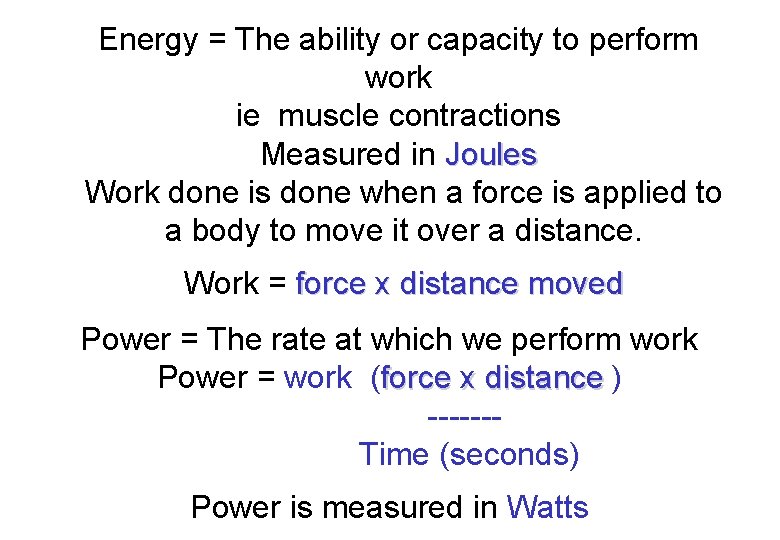
Energy = The ability or capacity to perform work ie muscle contractions Measured in Joules Work done is done when a force is applied to a body to move it over a distance. Work = force x distance moved Power = The rate at which we perform work Power = work (force x distance ) ------Time (seconds) Power is measured in Watts
Only 1 usable form of energy: All food needs to be converted into ATP before potential energy can be used. = High-energy simple phosphate compound = 1 molecule of Adenosine and 3 phosphates
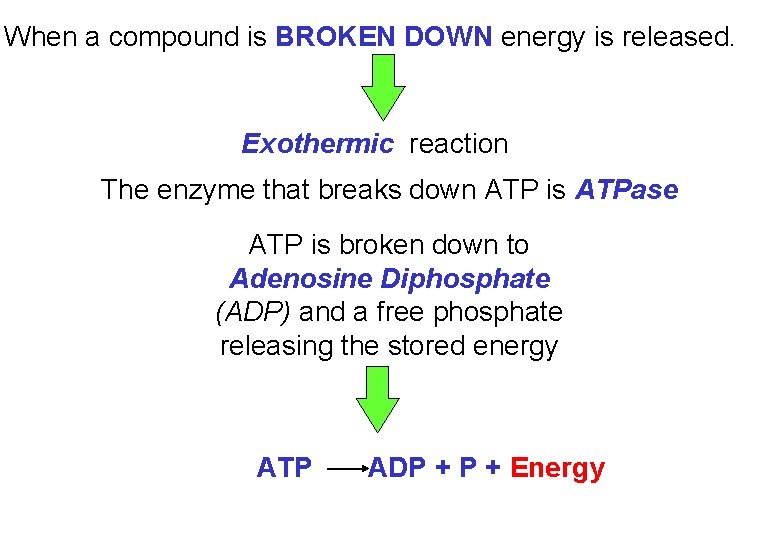
When a compound is BROKEN DOWN energy is released. Exothermic reaction The enzyme that breaks down ATP is ATPase ATP is broken down to Adenosine Diphosphate (ADP) and a free phosphate releasing the stored energy ATP ADP + Energy
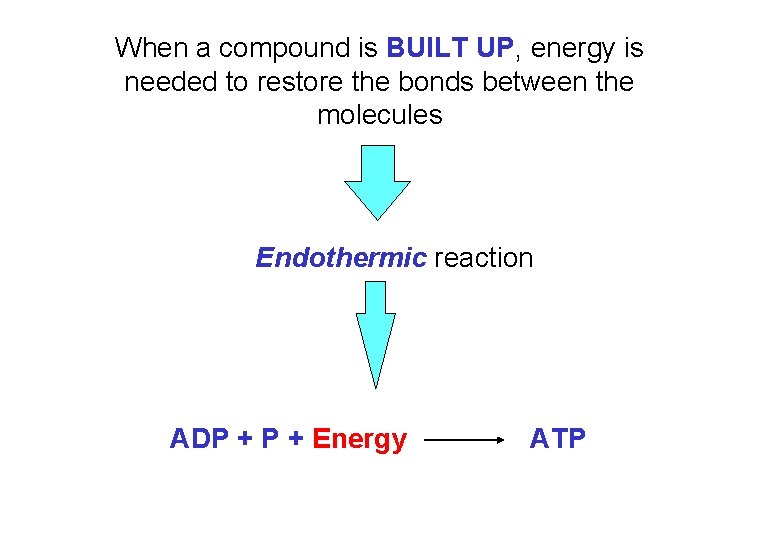
When a compound is BUILT UP, energy is needed to restore the bonds between the molecules Endothermic reaction ADP + Energy ATP
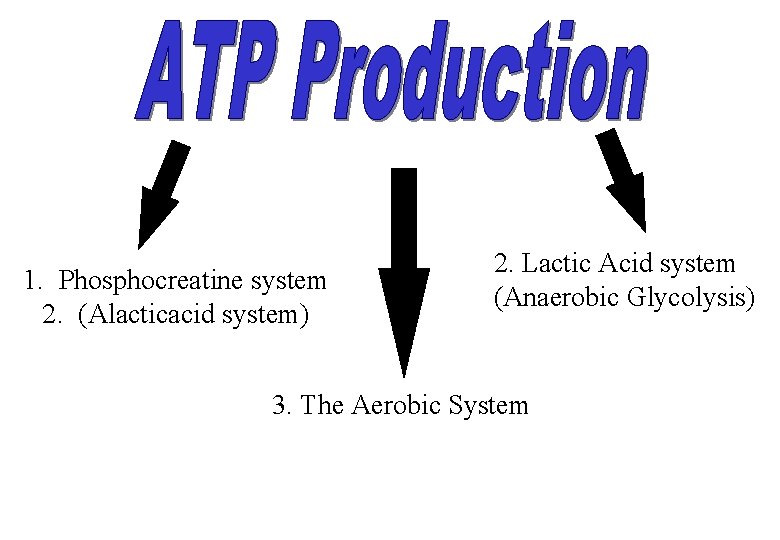
1. Phosphocreatine system 2. (Alacticacid system) 2. Lactic Acid system (Anaerobic Glycolysis) 3. The Aerobic System
We don’t want to run out of ATP! Therefore all three systems work quickly. They are good at supplying energy for different intensities and for different durations of activity. Systems 1 & 2 = Anaerobic System 3 = Aerobic
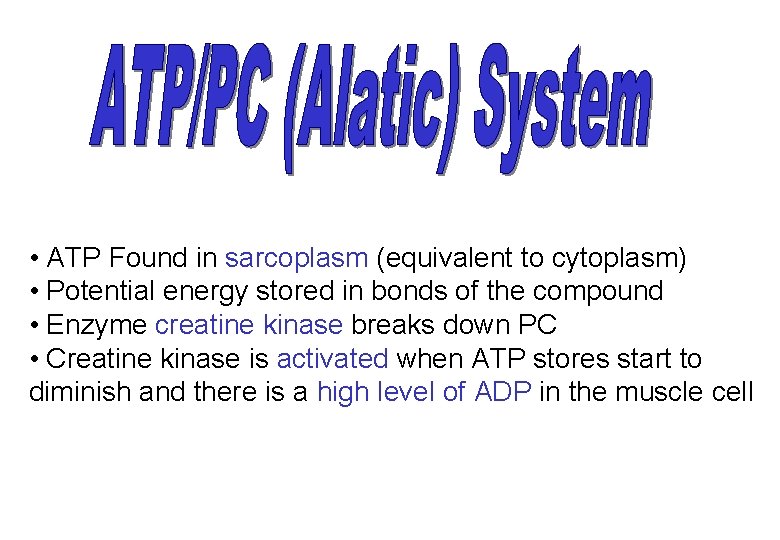
• ATP Found in sarcoplasm (equivalent to cytoplasm) • Potential energy stored in bonds of the compound • Enzyme creatine kinase breaks down PC • Creatine kinase is activated when ATP stores start to diminish and there is a high level of ADP in the muscle cell
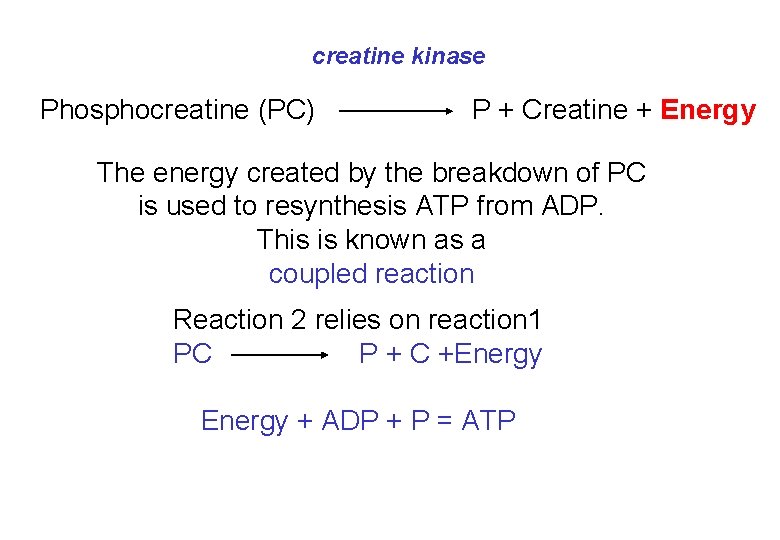
creatine kinase Phosphocreatine (PC) P + Creatine + Energy The energy created by the breakdown of PC is used to resynthesis ATP from ADP. This is known as a coupled reaction Reaction 2 relies on reaction 1 PC P + C +Energy + ADP + P = ATP
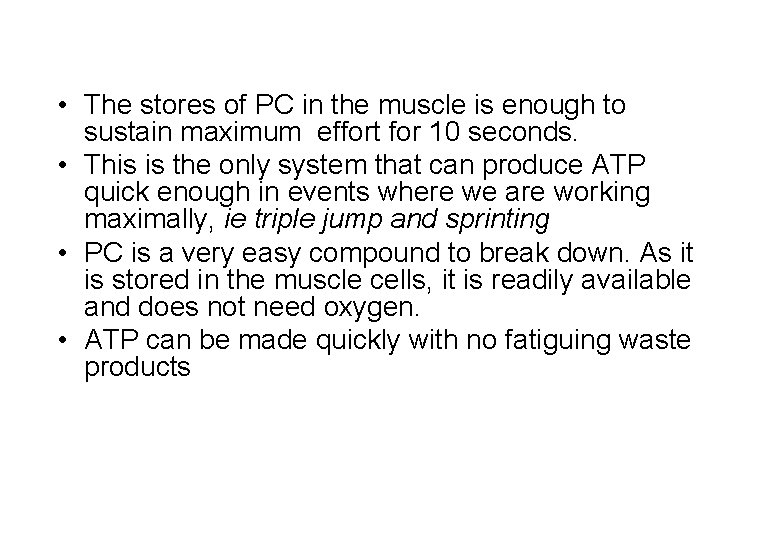
• The stores of PC in the muscle is enough to sustain maximum effort for 10 seconds. • This is the only system that can produce ATP quick enough in events where we are working maximally, ie triple jump and sprinting • PC is a very easy compound to break down. As it is stored in the muscle cells, it is readily available and does not need oxygen. • ATP can be made quickly with no fatiguing waste products
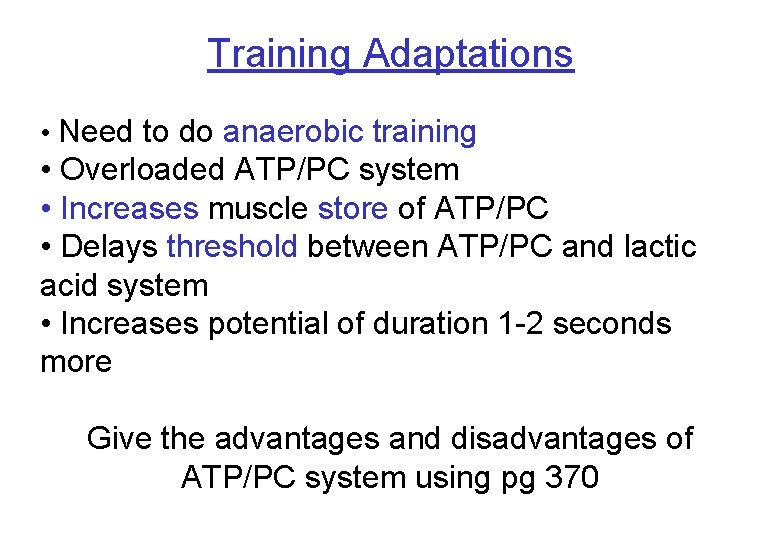
Training Adaptations • Need to do anaerobic training • Overloaded ATP/PC system • Increases muscle store of ATP/PC • Delays threshold between ATP/PC and lactic acid system • Increases potential of duration 1 -2 seconds more Give the advantages and disadvantages of ATP/PC system using pg 370
Aim to provide energy to allow ADP to resynthesise into ATP Coupled reaction Also takes place in the Sarcoplasm Partial breakdown of glucose (need oxygen for full breakdown) Glycolysis = breakdown of glucose/glycogen into pyruvic acid Carbohydrate stored as glycogen in the liver and muscle
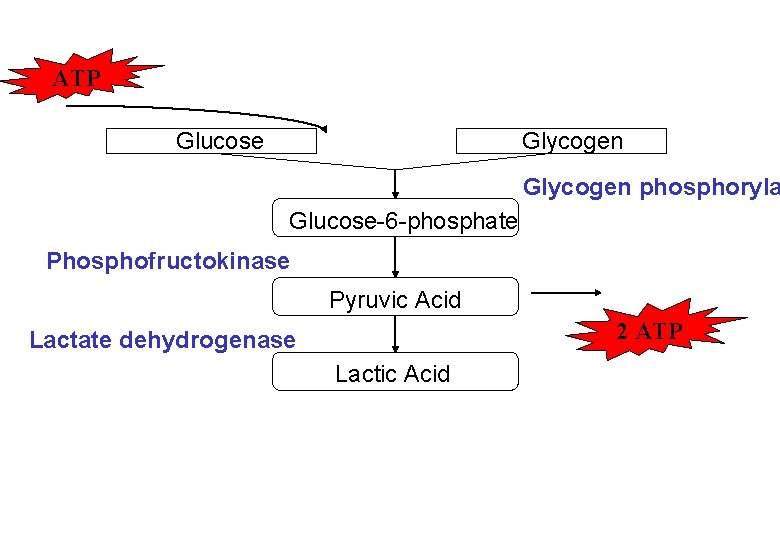
ATP Glucose Glycogen phosphoryla Glucose-6 -phosphate Phosphofructokinase Pyruvic Acid 2 ATP Lactate dehydrogenase Lactic Acid
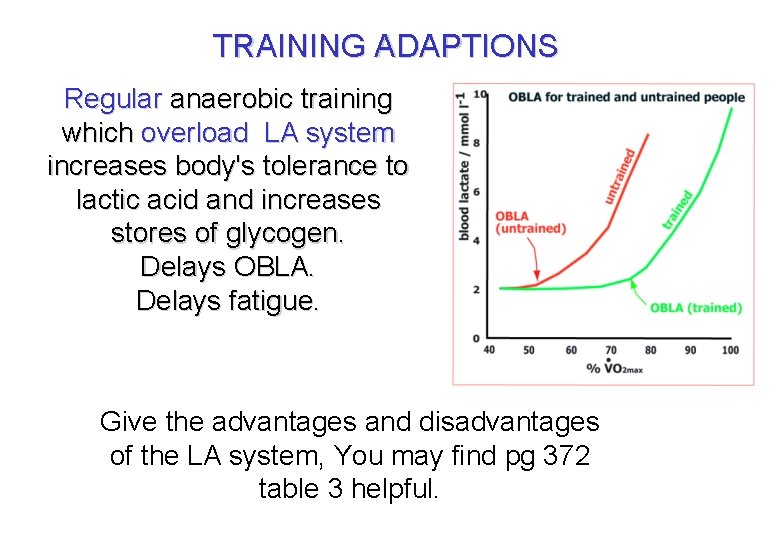
• Provides energy to resynthesise ATP for first 2 -3 minutes of high intensity short duration anaerobic activity. • Flat out intensity it may only last for 30 seconds. • Its limitation is due to onest of blood lactate accumulation (OBLA). • Build up of lactic acid decreases ph of muscle which then inhibits enzymes needed for glycolysis • Muscle fatigue occuirs.
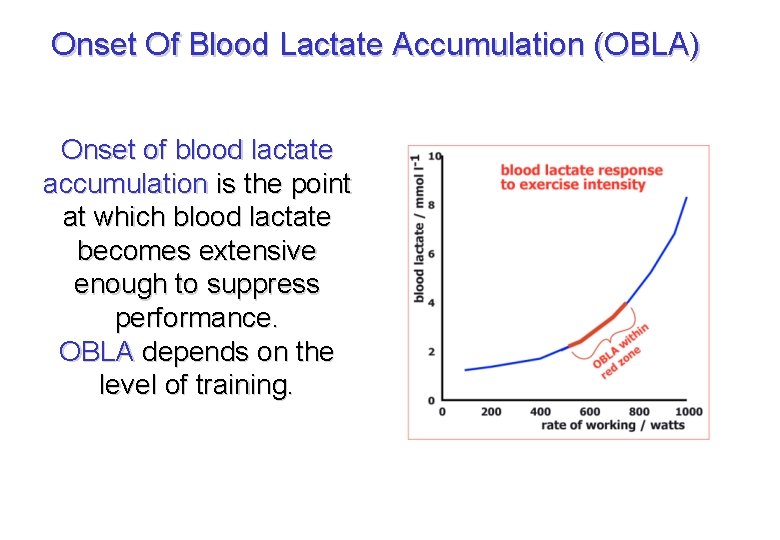
Onset Of Blood Lactate Accumulation (OBLA) Onset of blood lactate accumulation is the point at which blood lactate becomes extensive enough to suppress performance. OBLA depends on the level of training.
TRAINING ADAPTIONS Regular anaerobic training which overload LA system increases body's tolerance to lactic acid and increases stores of glycogen. Delays OBLA. Delays fatigue. Give the advantages and disadvantages of the LA system, You may find pg 372 table 3 helpful.
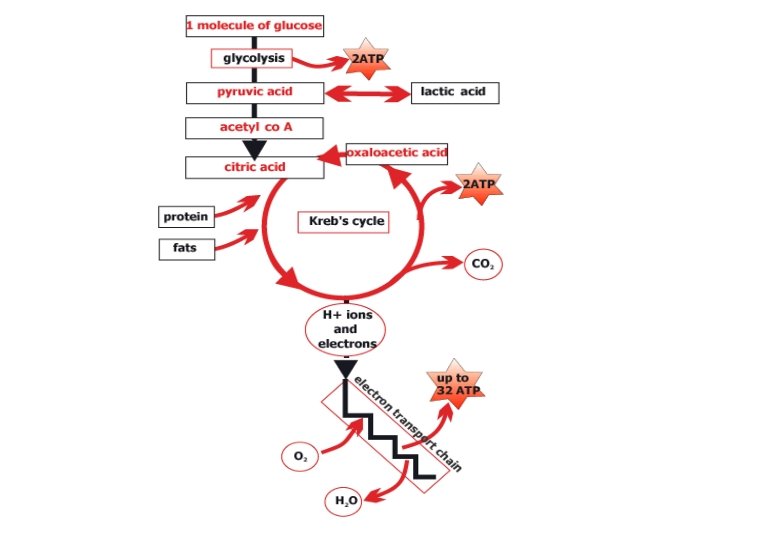
Break down of glycogen, glucose and fats to provide energy, via coupled reactions to resynthersies ADP into ATP. 3 stages: a)Aerobic Glycolysis b) Krebs’ Cycle c) Electron Transport Chain
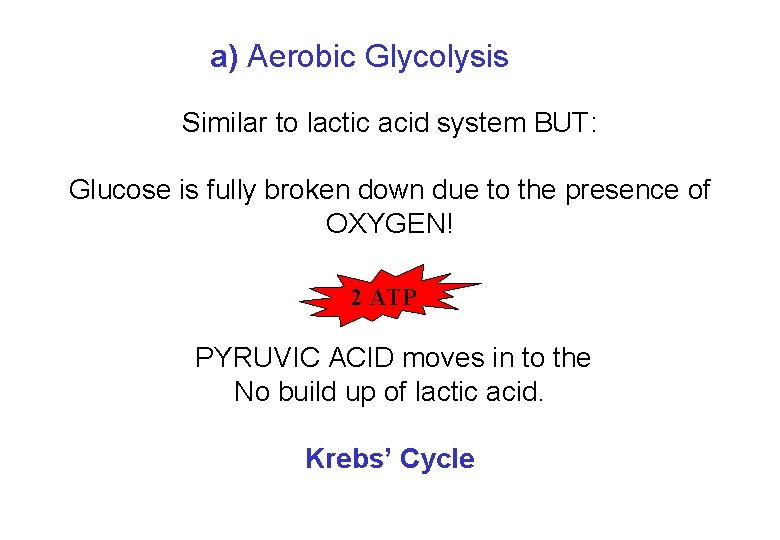
a) Aerobic Glycolysis Similar to lactic acid system BUT: Glucose is fully broken down due to the presence of OXYGEN! 2 ATP PYRUVIC ACID moves in to the No build up of lactic acid. Krebs’ Cycle
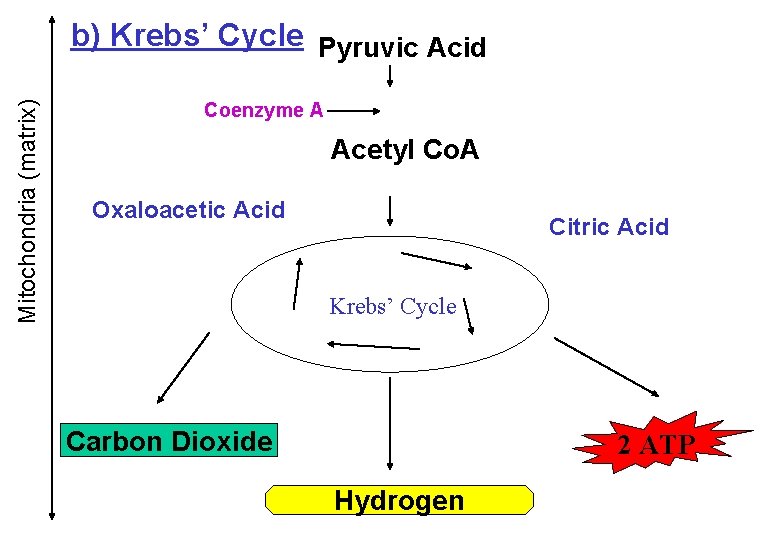
Mitochondria (matrix) b) Krebs’ Cycle Pyruvic Acid Coenzyme A Acetyl Co. A Oxaloacetic Acid Citric Acid Krebs’ Cycle Carbon Dioxide 2 ATP Hydrogen
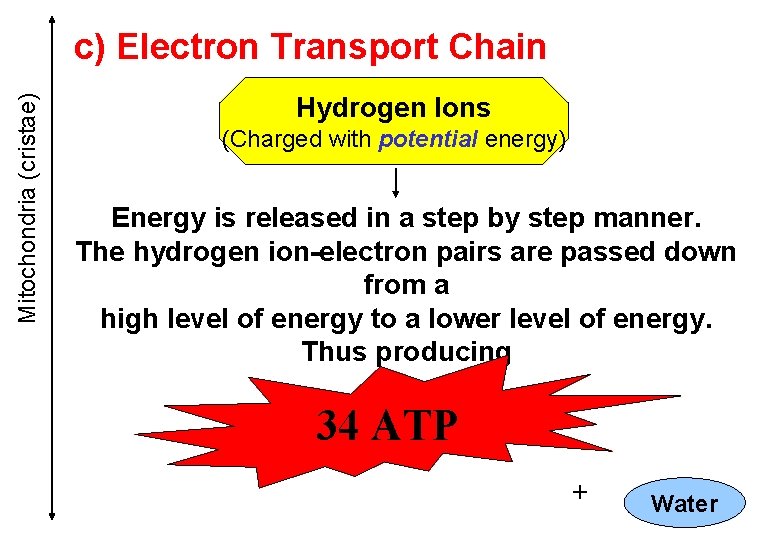
Mitochondria (cristae) c) Electron Transport Chain Hydrogen Ions (Charged with potential energy) Energy is released in a step by step manner. The hydrogen ion-electron pairs are passed down from a high level of energy to a lower level of energy. Thus producing 34 ATP + Water
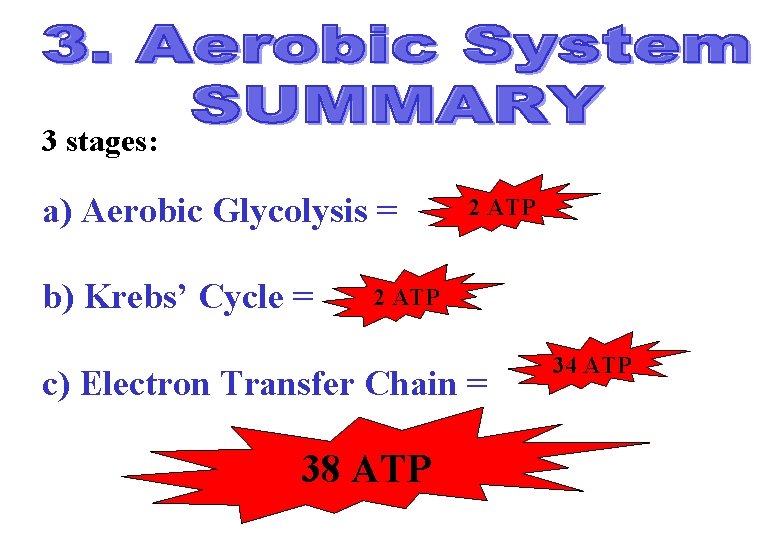
3 stages: a) Aerobic Glycolysis = b) Krebs’ Cycle = 2 ATP c) Electron Transfer Chain = 38 ATP 34 ATP
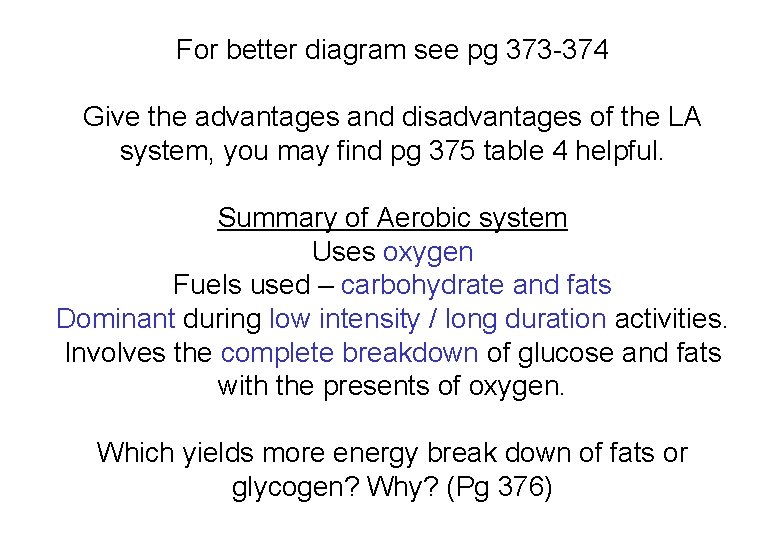
For better diagram see pg 373 -374 Give the advantages and disadvantages of the LA system, you may find pg 375 table 4 helpful. Summary of Aerobic system Uses oxygen Fuels used – carbohydrate and fats Dominant during low intensity / long duration activities. Involves the complete breakdown of glucose and fats with the presents of oxygen. Which yields more energy break down of fats or glycogen? Why? (Pg 376)
Training Adaptations Aerobic training causes adoptions to be made which help to improve the efficiency of the aerobic system. • Increases storage of muscle and liver glycogen • Increases mobilisation of aerobic enzymes • Is able to use free fatty acids (broken down triglycerides by lipases) earlier, this conserves glycogen stores.
Look at the following activities, what is the difference in the rate of energy needed to complete these athletics events? 100 m 400 m 1500 m 10, 000 m Two keywords can be used to describe the difference an activity needs: Intensity Duration
Anaerobic or Aerobic? Anaerobic activities: High intensity Short duration Aerobic activities: Low intensity Long duration
Anaerobic Systems PC or alactic system Dominant during flat out activities lasting 10 seconds Lactic acid or anaerobic glycolysis Dominant during high intensity activities lasting 30 seconds -3 minutes
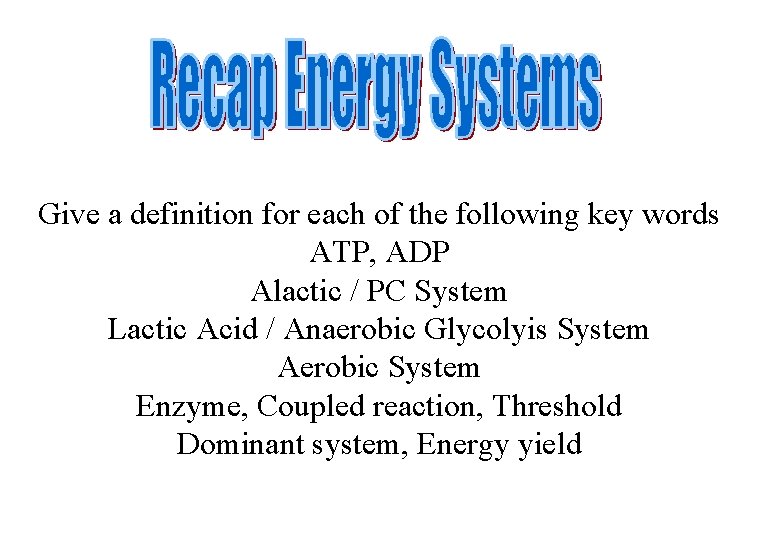
Give a definition for each of the following key words ATP, ADP Alactic / PC System Lactic Acid / Anaerobic Glycolyis System Aerobic System Enzyme, Coupled reaction, Threshold Dominant system, Energy yield
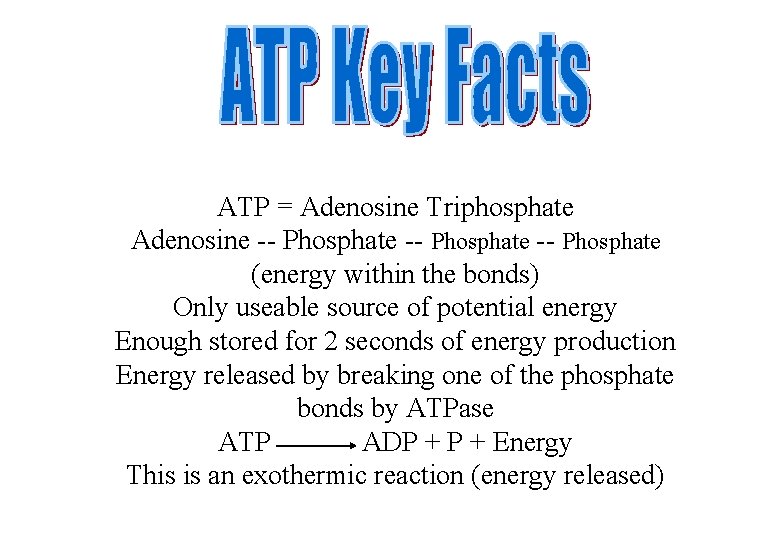
ATP = Adenosine Triphosphate Adenosine -- Phosphate (energy within the bonds) Only useable source of potential energy Enough stored for 2 seconds of energy production Energy released by breaking one of the phosphate bonds by ATPase ATP ADP + Energy This is an exothermic reaction (energy released)
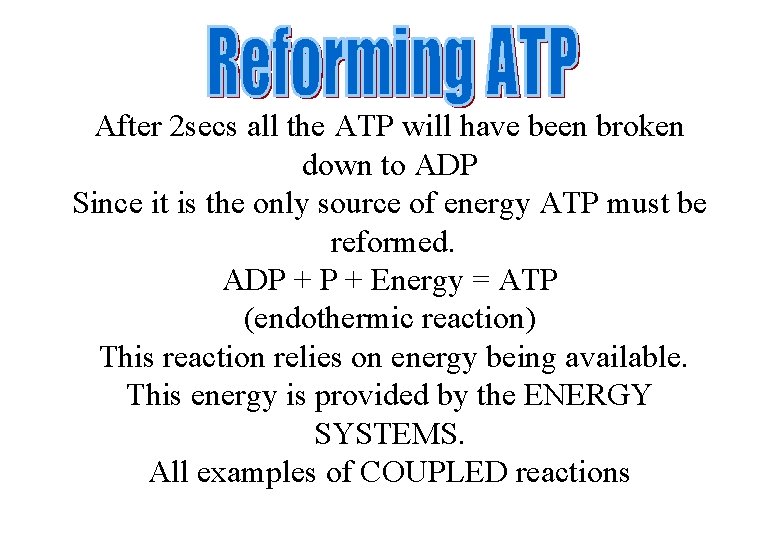
After 2 secs all the ATP will have been broken down to ADP Since it is the only source of energy ATP must be reformed. ADP + Energy = ATP (endothermic reaction) This reaction relies on energy being available. This energy is provided by the ENERGY SYSTEMS. All examples of COUPLED reactions
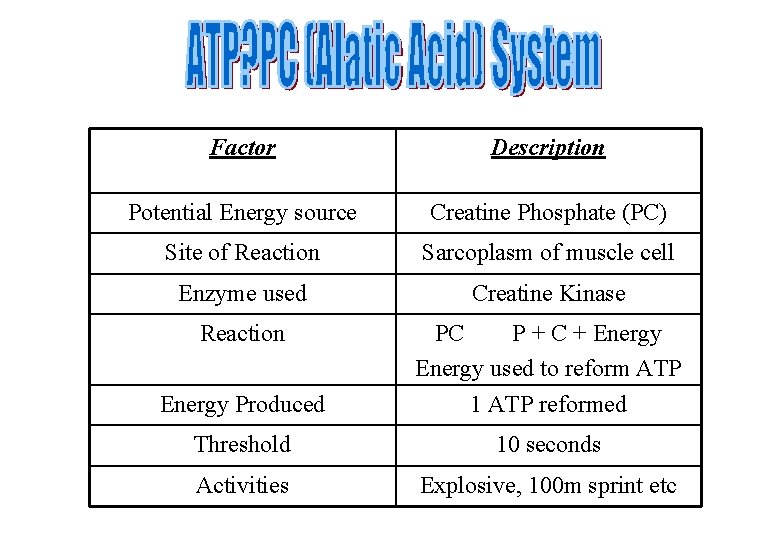
Factor Description Potential Energy source Creatine Phosphate (PC) Site of Reaction Sarcoplasm of muscle cell Enzyme used Creatine Kinase Reaction Energy Produced PC P + C + Energy used to reform ATP 1 ATP reformed Threshold 10 seconds Activities Explosive, 100 m sprint etc
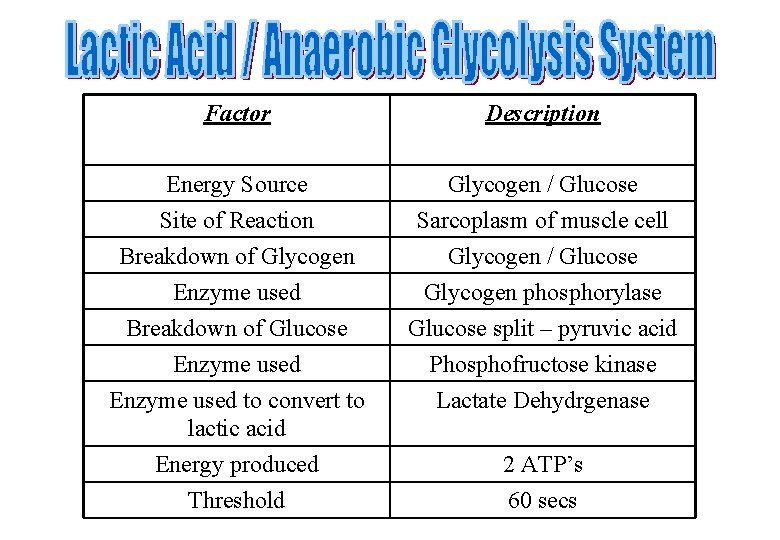
Factor Description Energy Source Glycogen / Glucose Site of Reaction Breakdown of Glycogen Enzyme used Breakdown of Glucose Sarcoplasm of muscle cell Glycogen / Glucose Glycogen phosphorylase Glucose split – pyruvic acid Enzyme used to convert to lactic acid Phosphofructose kinase Lactate Dehydrgenase Energy produced Threshold 2 ATP’s 60 secs
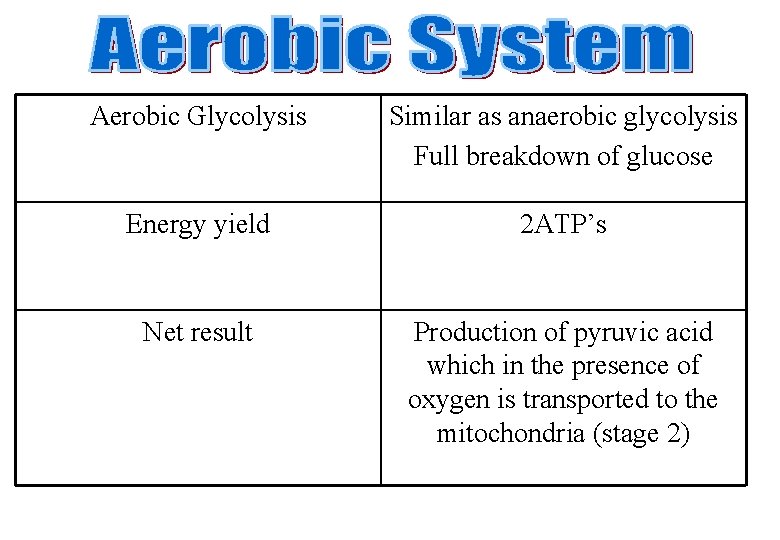
Aerobic Glycolysis Similar as anaerobic glycolysis Full breakdown of glucose Energy yield 2 ATP’s Net result Production of pyruvic acid which in the presence of oxygen is transported to the mitochondria (stage 2)
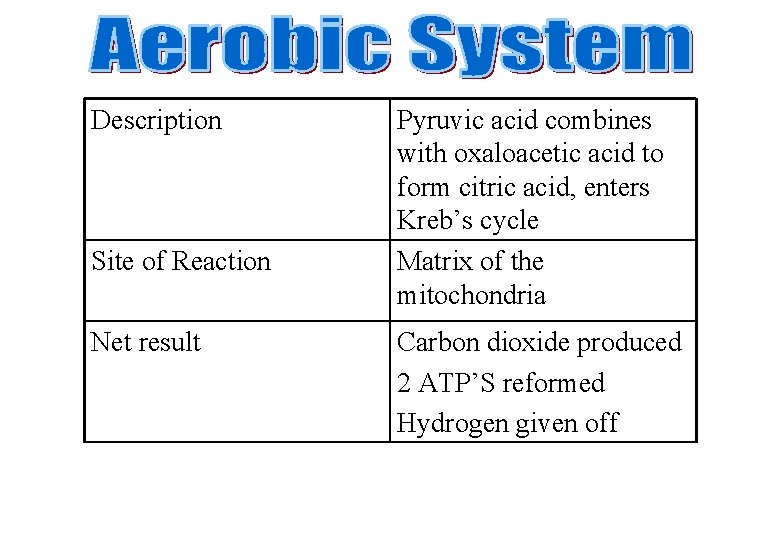
Description Site of Reaction Net result Pyruvic acid combines with oxaloacetic acid to form citric acid, enters Kreb’s cycle Matrix of the mitochondria Carbon dioxide produced 2 ATP’S reformed Hydrogen given off
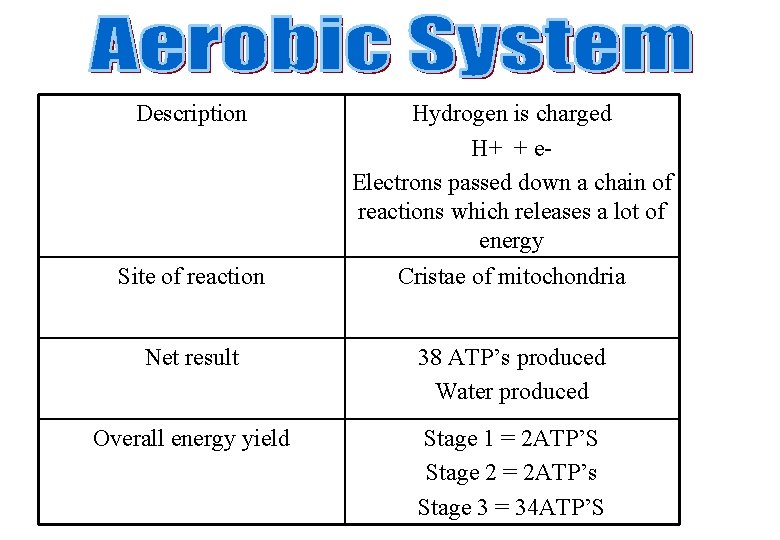
Description Site of reaction Hydrogen is charged H+ + e. Electrons passed down a chain of reactions which releases a lot of energy Cristae of mitochondria Net result 38 ATP’s produced Water produced Overall energy yield Stage 1 = 2 ATP’S Stage 2 = 2 ATP’s Stage 3 = 34 ATP’S