
We learned earlier that a segment bisector is
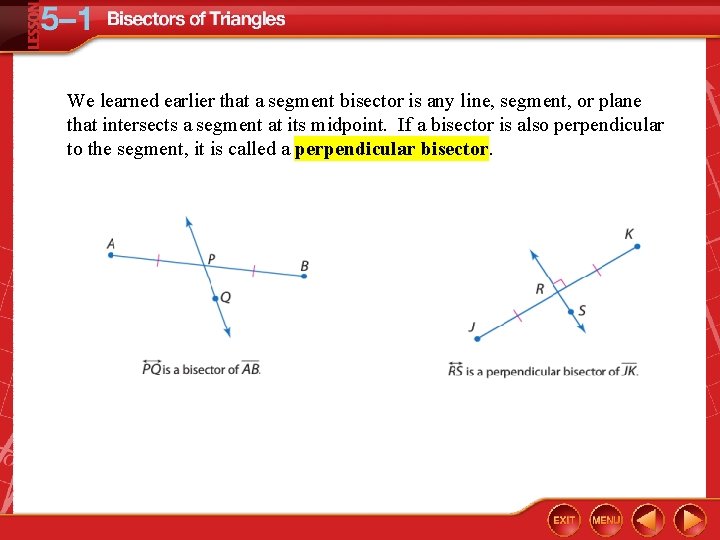
We learned earlier that a segment bisector is any line, segment, or plane that intersects a segment at its midpoint. If a bisector is also perpendicular to the segment, it is called a perpendicular bisector.
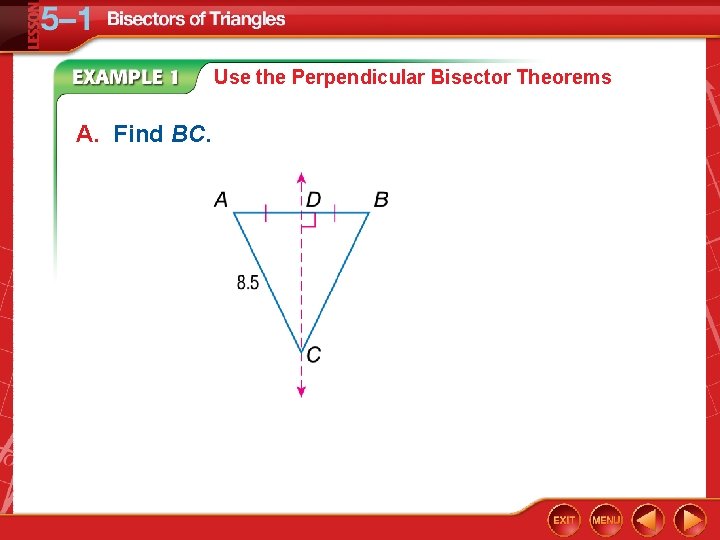
Use the Perpendicular Bisector Theorems A. Find BC.
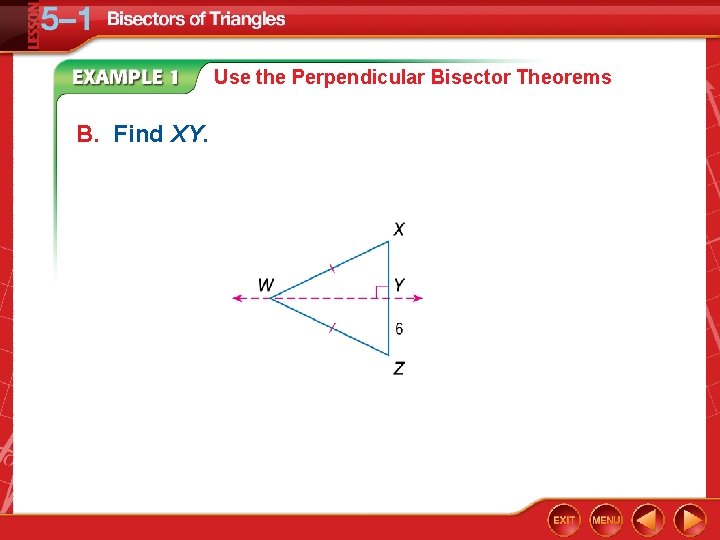
Use the Perpendicular Bisector Theorems B. Find XY.
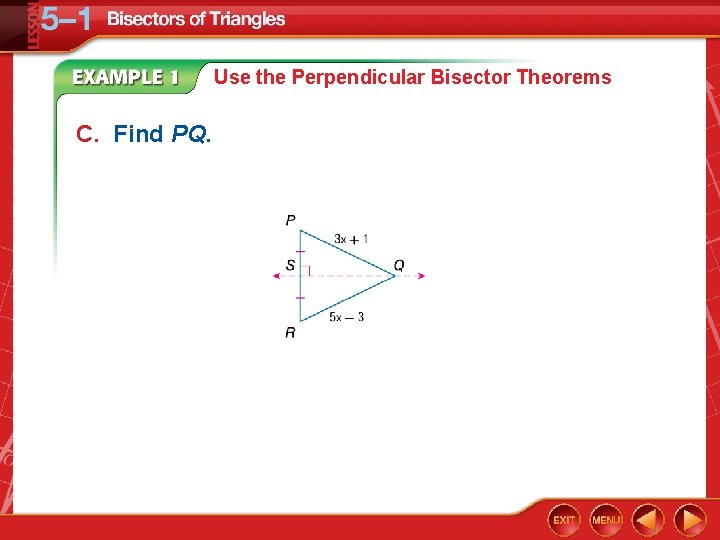
Use the Perpendicular Bisector Theorems C. Find PQ.
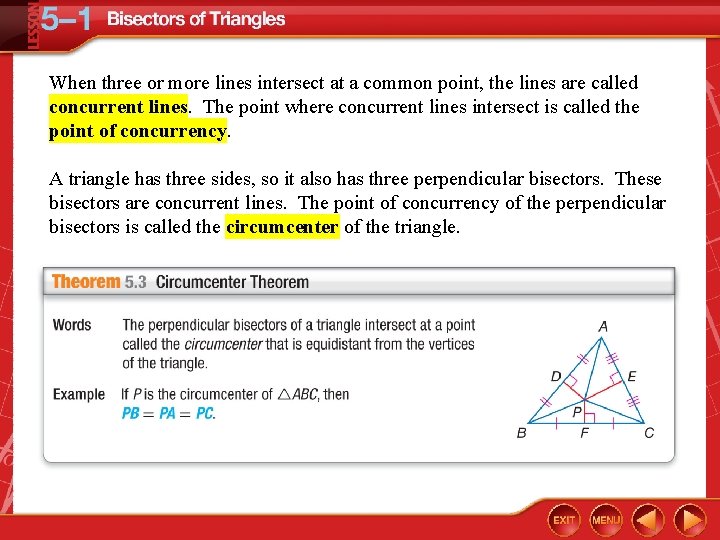
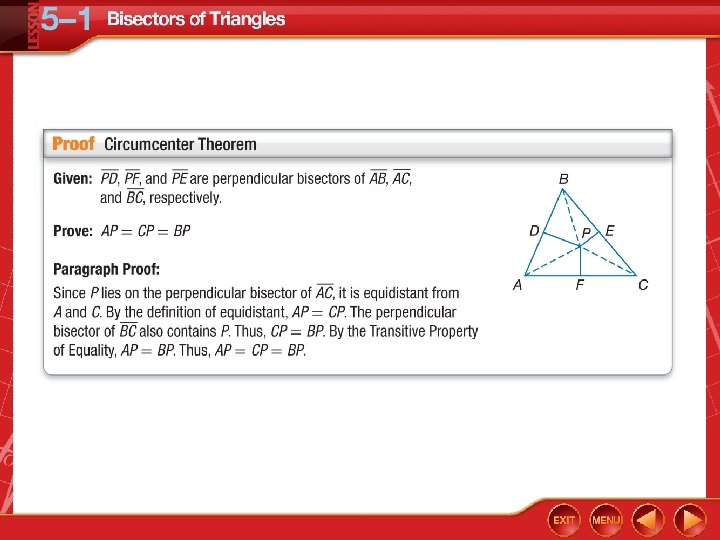
When three or more lines intersect at a common point, the lines are called concurrent lines. The point where concurrent lines intersect is called the point of concurrency. A triangle has three sides, so it also has three perpendicular bisectors. These bisectors are concurrent lines. The point of concurrency of the perpendicular bisectors is called the circumcenter of the triangle.
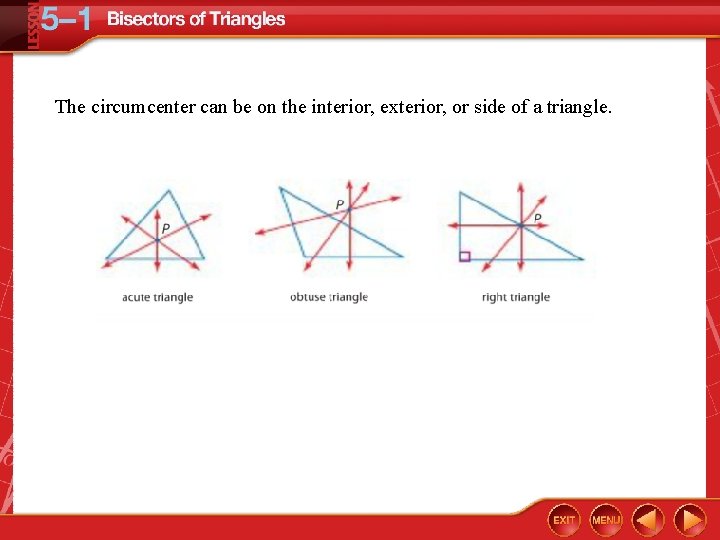
The circumcenter can be on the interior, exterior, or side of a triangle.
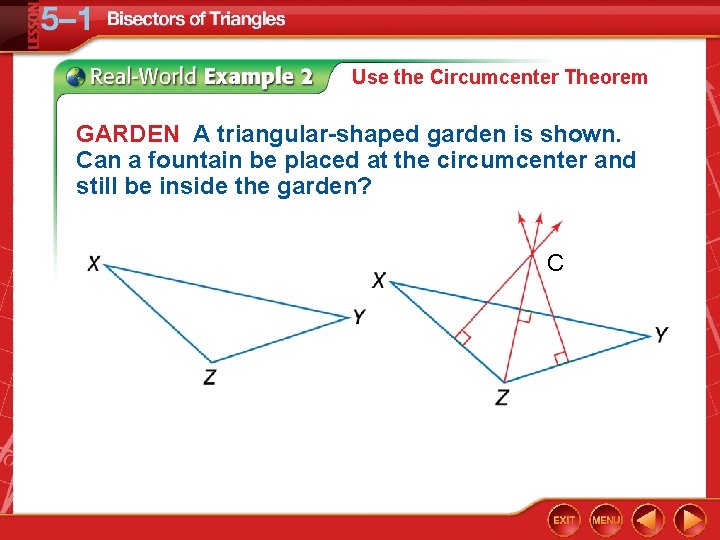
Use the Circumcenter Theorem GARDEN A triangular-shaped garden is shown. Can a fountain be placed at the circumcenter and still be inside the garden? C
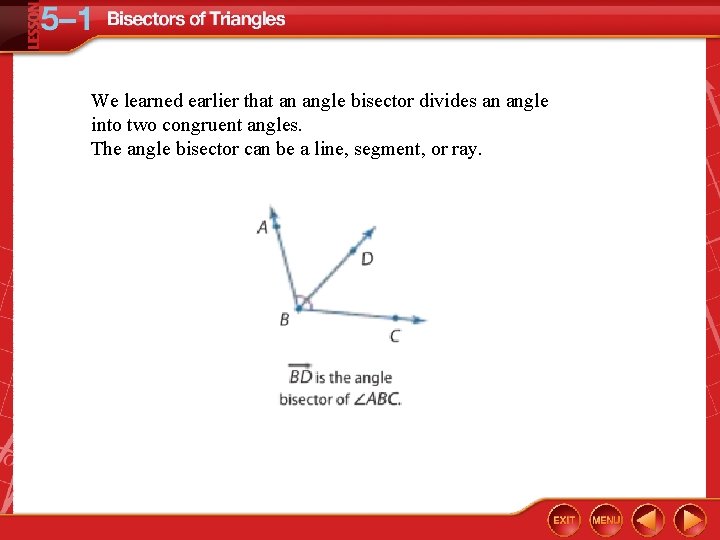
We learned earlier that an angle bisector divides an angle into two congruent angles. The angle bisector can be a line, segment, or ray.
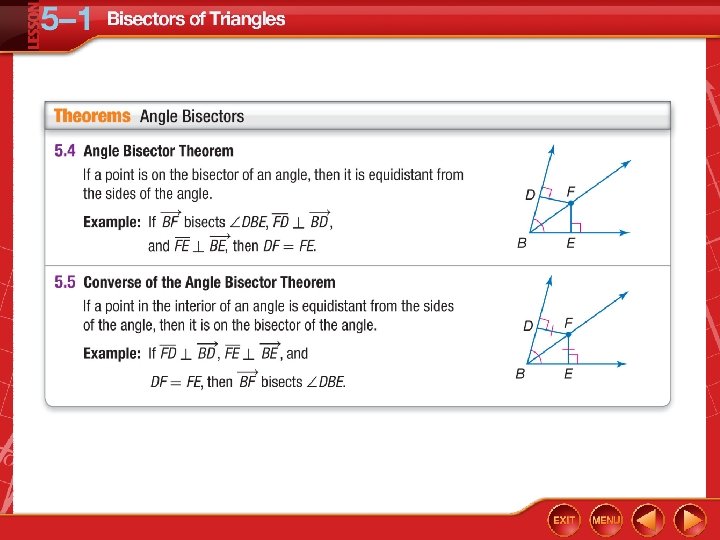
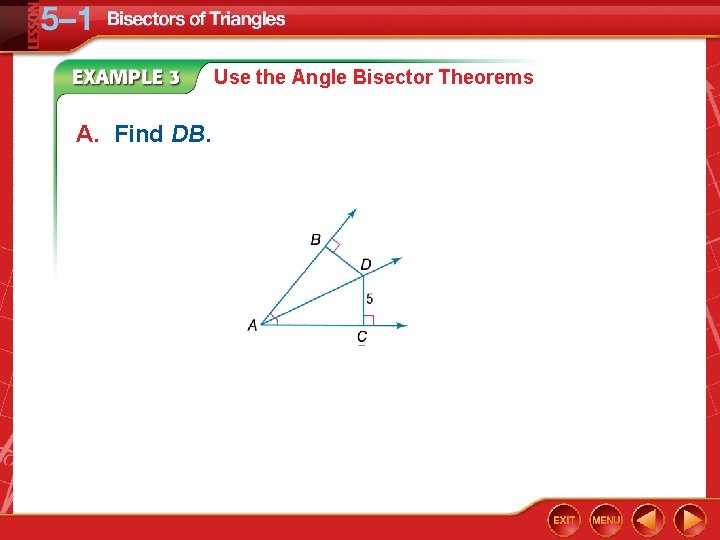
Use the Angle Bisector Theorems A. Find DB.
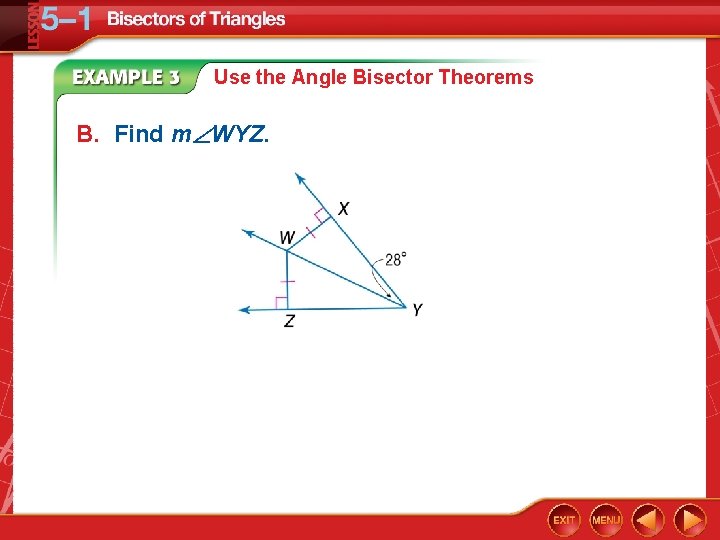
Use the Angle Bisector Theorems B. Find m WYZ.
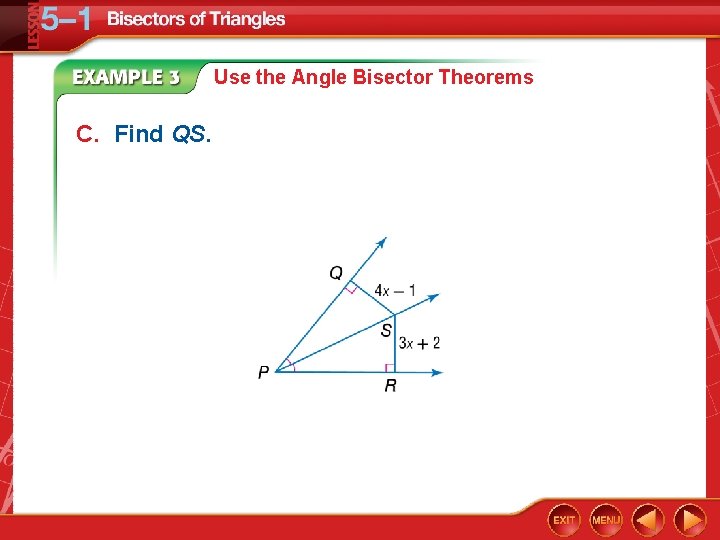
Use the Angle Bisector Theorems C. Find QS.
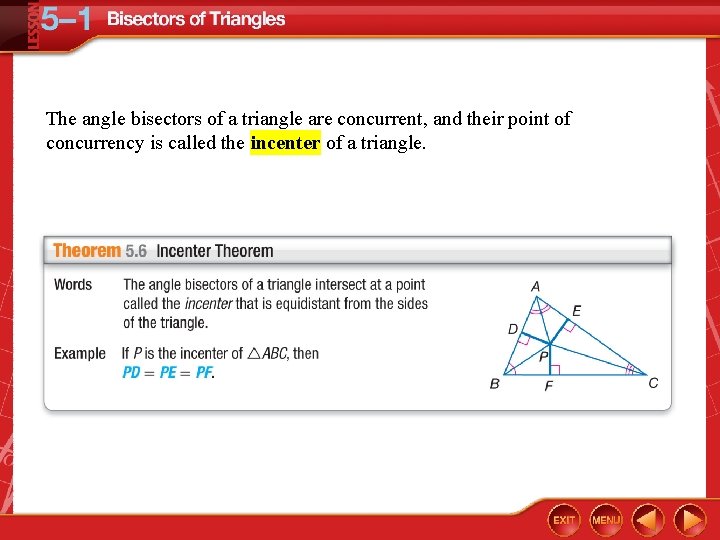
The angle bisectors of a triangle are concurrent, and their point of concurrency is called the incenter of a triangle.
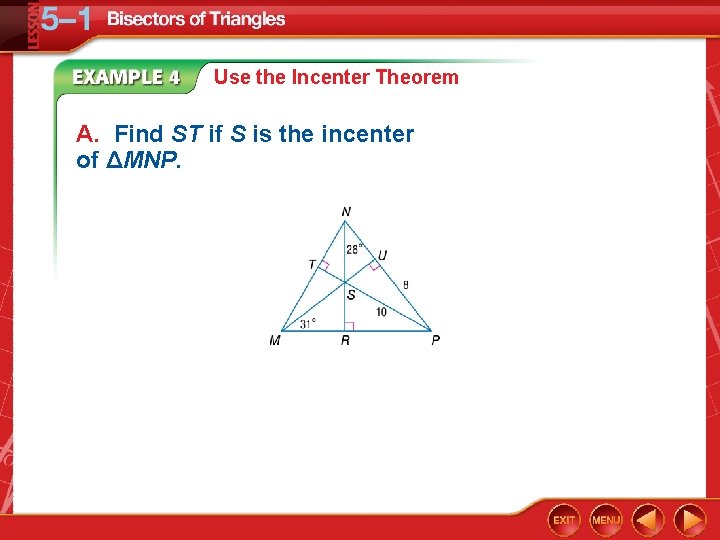
Use the Incenter Theorem A. Find ST if S is the incenter of ΔMNP.
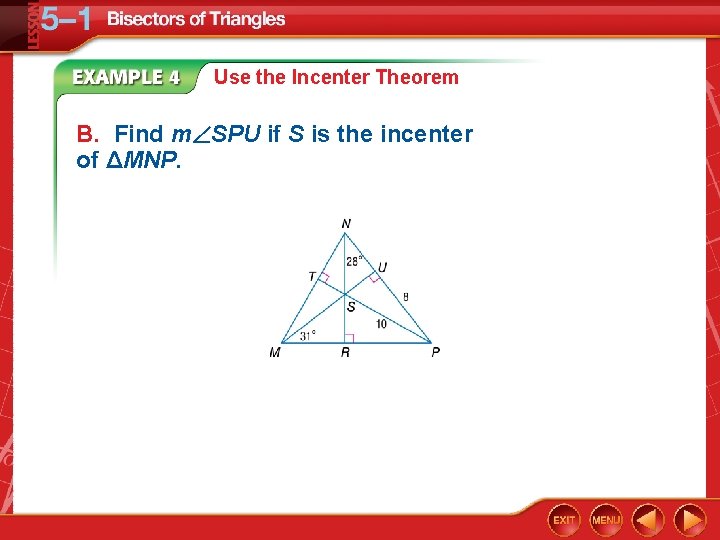
Use the Incenter Theorem B. Find m SPU if S is the incenter of ΔMNP.
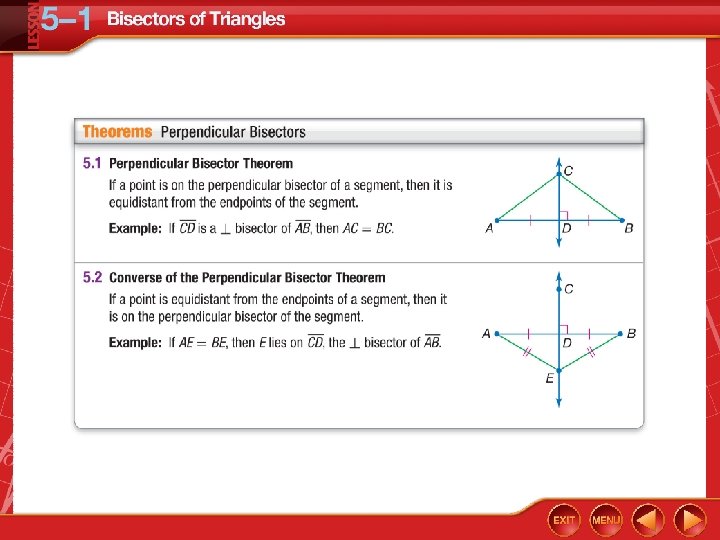
Five-Minute Check (over Chapter 4) CCSS Then/Now New Vocabulary Theorems: Perpendicular Bisectors Example 1: Use the Perpendicular Bisector Theorems Theorem 5. 3: Circumcenter Theorem Proof: Circumcenter Theorem Example 2: Real-World Example: Use the Circumcenter Theorems: Angle Bisectors Example 3: Use the Angle Bisector Theorems Theorem 5. 6: Incenter Theorem Example 4: Use the Incenter Theorem
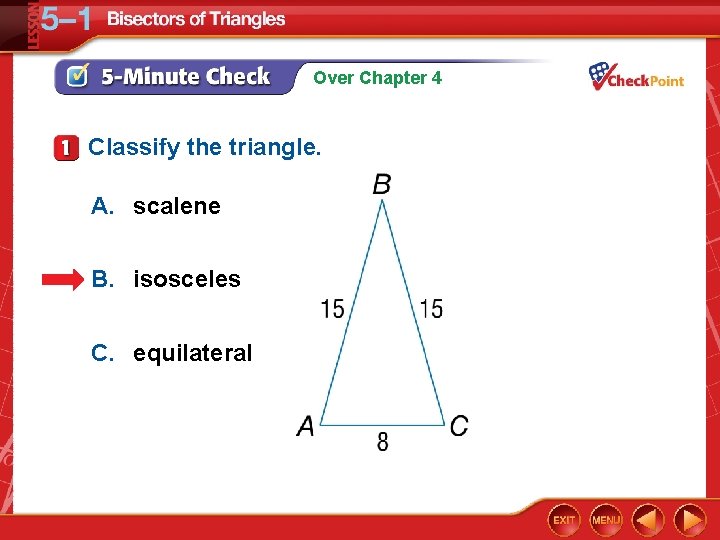
Over Chapter 4 Classify the triangle. A. scalene B. isosceles C. equilateral
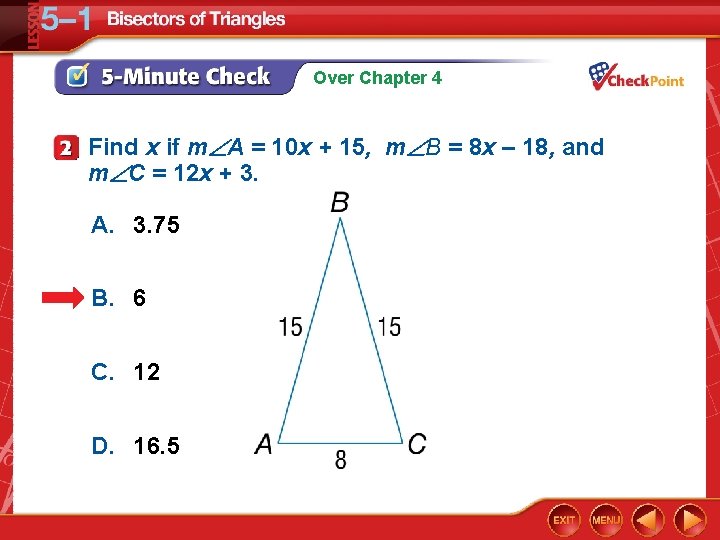
Over Chapter 4 Find x if m A = 10 x + 15, m B = 8 x – 18, and m C = 12 x + 3. A. 3. 75 B. 6 C. 12 D. 16. 5
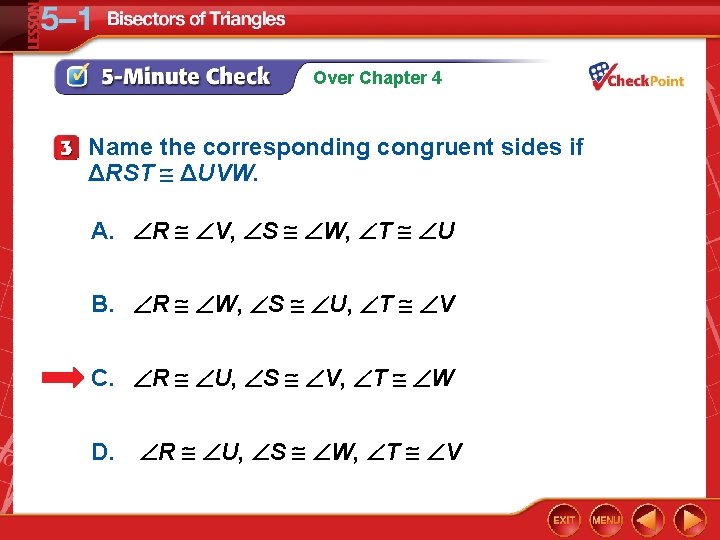
Over Chapter 4 Name the corresponding congruent sides if ΔRST ΔUVW. A. R V, S W, T U B. R W, S U, T V C. R U, S V, T W D. R U, S W, T V
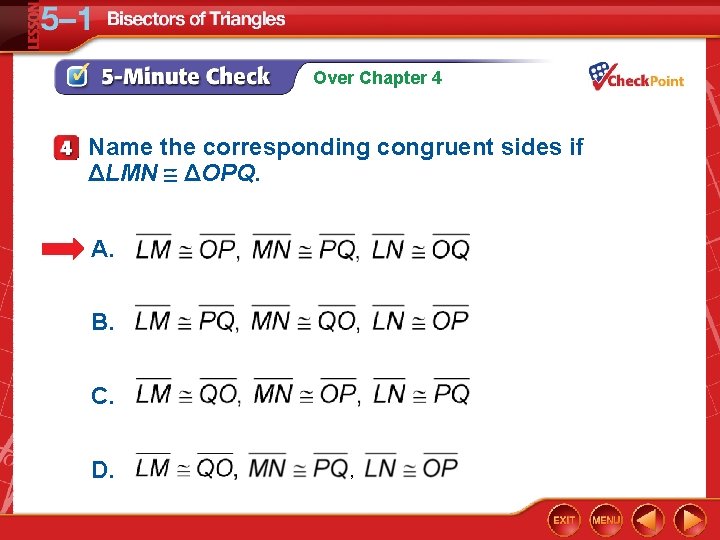
Over Chapter 4 Name the corresponding congruent sides if ΔLMN ΔOPQ. A. B. C. D. ,
Over Chapter 4 Find y if ΔDEF is an equilateral triangle and m F = 8 y + 4. A. 22 B. 10. 75 C. 7 D. 4. 5
Over Chapter 4 ΔABC has vertices A(– 5, 3) and B(4, 6). What are the coordinates for point C if ΔABC is an isosceles triangle with vertex angle A? A. (– 3, – 6) B. (4, 0) C. (– 2, 11) D. (4, – 3)
Content Standards G. CO. 10 Prove theorems about triangles. G. MG. 3 Apply geometric methods to solve problems (e. g. , designing an object or structure to satisfy physical constraints or minimize cost; working with typographic grid systems based on ratios). Mathematical Practices 1 Make sense of problems and persevere in solving them. 3 Construct viable arguments and critique the reasoning of others.
You used segment and angle bisectors. • Identify and use perpendicular bisectors in triangles. • Identify and use angle bisectors in triangles.
- Slides: 28