
we know about learning more than one language
we) know about learning more than one language at the same time Dr. Thor Sawin Middlebury Institute of International Studies ICLL 2019 Https: //www. tinyurl. com/icll 2019 tho r
“Hardly anyone speaks a "pure" form of any language here. In conversations with foreigners, I think the locals try to stick to just one language (if the foreigner only knows one language), but in conversations with each other they will switch back and forth to whatever language is best for communicating. I've noticed, actually, that the subject matter greatly influences what language they will use. With that in mind, I want to echo the question that others have written about-- what about heart language? And does it even exist? ”
“what about heart language? And does it even exist? My husband I are just beginning work with Meskhetian Turks, and we have yet to figure out what language will be most helpful. We've already been learning Russian, but the Turks here know. Language as Russian, discrete separable Our plan is to solidify our objects Kazakh, Russian, Turkish, and even Ottoman Turkish. and then focus on Kazakh, with perhaps some Ottoman Turkish thrown in. as to how effective that will At this point, though, we can only guess be. ” Policies for “acquiring a second language” not a complex repertoire of language resources. Without all Outsider
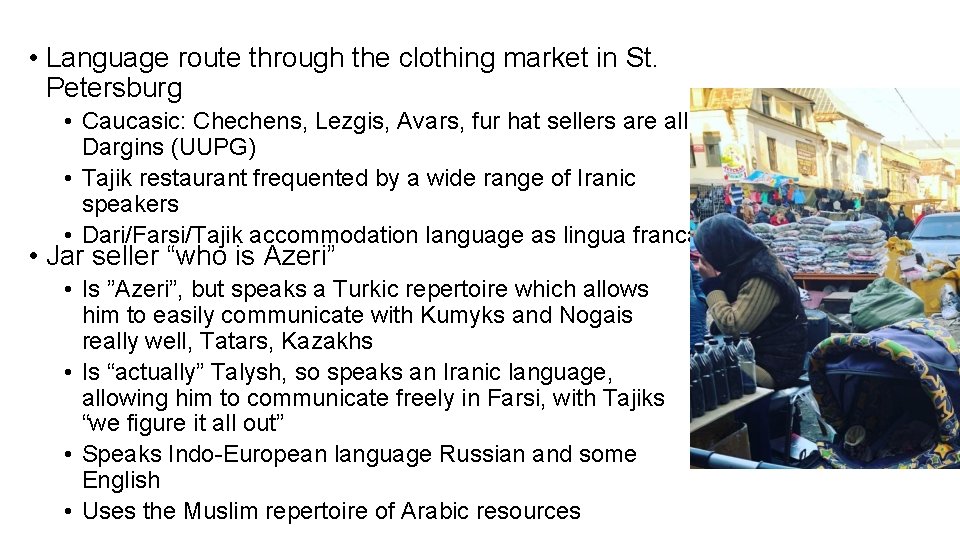
• Language route through the clothing market in St. Petersburg • Caucasic: Chechens, Lezgis, Avars, fur hat sellers are all Dargins (UUPG) • Tajik restaurant frequented by a wide range of Iranic speakers • Dari/Farsi/Tajik accommodation language as lingua franca • Jar seller “who is Azeri” • Is ”Azeri”, but speaks a Turkic repertoire which allows him to easily communicate with Kumyks and Nogais really well, Tatars, Kazakhs • Is “actually” Talysh, so speaks an Iranic language, allowing him to communicate freely in Farsi, with Tajiks “we figure it all out” • Speaks Indo-European language Russian and some English • Uses the Muslim repertoire of Arabic resources
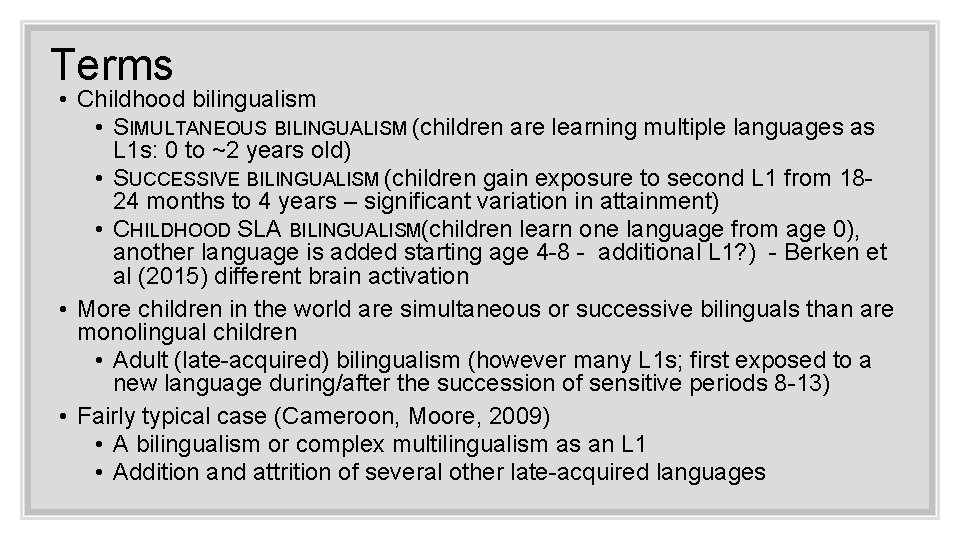
Terms • Childhood bilingualism • SIMULTANEOUS BILINGUALISM (children are learning multiple languages as L 1 s: 0 to ~2 years old) • SUCCESSIVE BILINGUALISM (children gain exposure to second L 1 from 1824 months to 4 years – significant variation in attainment) • CHILDHOOD SLA BILINGUALISM(children learn one language from age 0), another language is added starting age 4 -8 - additional L 1? ) - Berken et al (2015) different brain activation • More children in the world are simultaneous or successive bilinguals than are monolingual children • Adult (late-acquired) bilingualism (however many L 1 s; first exposed to a new language during/after the succession of sensitive periods 8 -13) • Fairly typical case (Cameroon, Moore, 2009) • A bilingualism or complex multilingualism as an L 1 • Addition and attrition of several other late-acquired languages

Serial monogamy ~ Serial monolingualism H “national” language: 20 th century language policy assumes: • functionally monolingual English speakers L “minority” language • start learning a single language overseas Learning time • first live in large city • learn the official national language • until Advanced Low proficiency • then move to a regional center H language: L language: • “freed” to learn a regional language • learn the national and regional languages separately in time and (often) space • mirror assumed use in the community
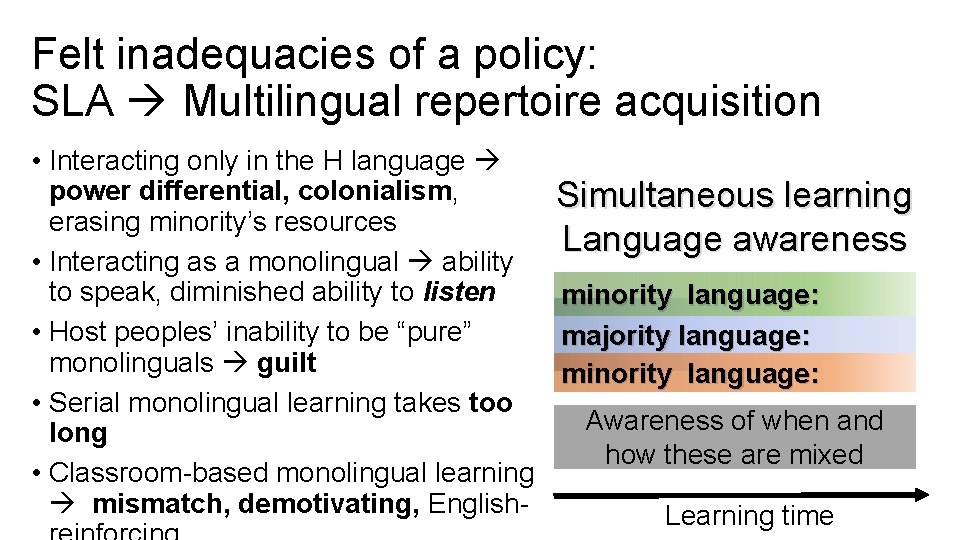
Felt inadequacies of a policy: SLA Multilingual repertoire acquisition • Interacting only in the H language power differential, colonialism, Simultaneous learning erasing minority’s resources Language awareness • Interacting as a monolingual ability to speak, diminished ability to listen minority language: • Host peoples’ inability to be “pure” majority language: monolinguals guilt minority language: • Serial monolingual learning takes too Awareness of when and long how these are mixed • Classroom-based monolingual learning mismatch, demotivating, English. Learning time
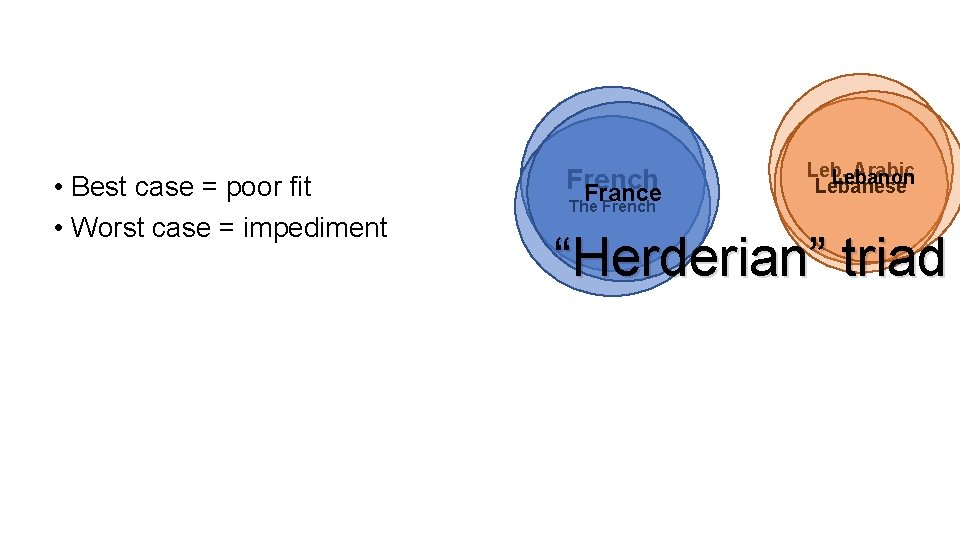
• Best case = poor fit • Worst case = impediment French France Leb. Arabic Lebanon Lebanese The French “Herderian” triad
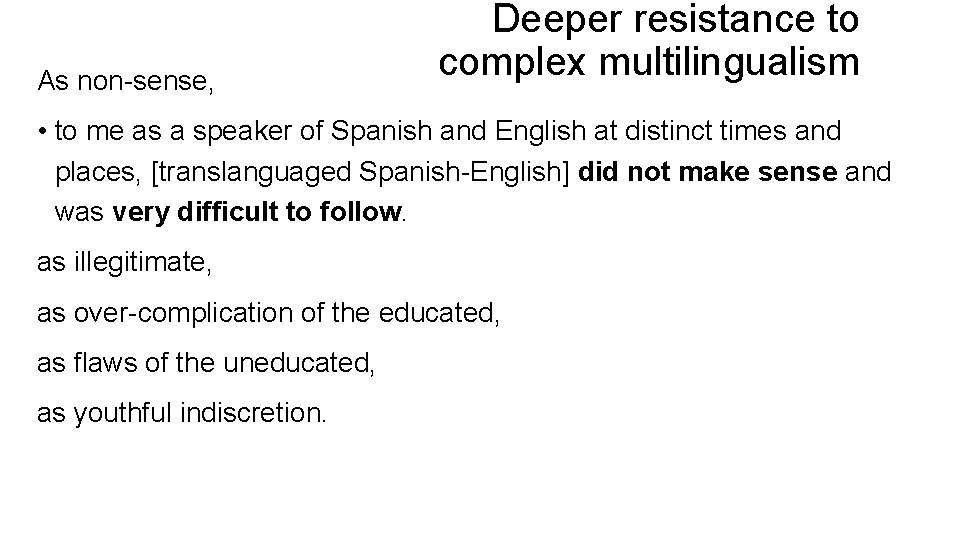
As non-sense, Deeper resistance to complex multilingualism • to me as a speaker of Spanish and English at distinct times and places, [translanguaged Spanish-English] did not make sense and was very difficult to follow. as illegitimate, as over-complication of the educated, as flaws of the uneducated, as youthful indiscretion.
As non-sense, Deeper resistance to complex multilingualism as illegitimate, • I can't always tell when [it is mixing] (…) has borrowed the Persian word and it is now a legitimate Turkish word (…) it can be difficult to differentiate what is language mixing and what are legitimate shared words as over-complication of the educated, as flaws of the uneducated, as youthful indiscretion,
As non-sense, Deeper resistance to complex multilingualism as illegitimate, as over-complication of the educated, • the more educated and well-read a person is, the more complicated we can make things, such as mixing languages. . . However, all over the world there are simple people who function without so many words as flaws of the uneducated, as youthful indiscretion,
As non-sense, Deeper resistance to complex multilingualism as illegitimate, as over-complication of the educated, as flaws of the uneducated, • Only the seriously educated know how to express themselves in writing correctly and fluently (don't even ask about texting-spelling can be atrocious!). as youthful indiscretion.
As non-sense, Deeper resistance to complex multilingualism as illegitimate, as over-complication of the educated, as flaws of the uneducated, as youthful indiscretion, • [mixing] is the laxness of the younger generation (…) not as impacted by social medias [sic]
Deep resistance: Multiplication of vocabulary • We pretty much have to learn a minimum of 2 -3 words for everything. • I have described Kurdish as “slippery. ” It just seems to be exceptionally hard to really “get down. ” Learning 3 possible ways of saying a word or phrase is rather daunting to even the most dedicated of language learners! Ignores that even monolinguals always learn 3 -4 ways of communicating the same idea.
What neurolinguistics and psycholinguistic research has shown • Proficient bilinguals are often not capable of isolating an L 1 a in tasks where an L 1 b or L 2 is not required (Kroll, 2006) • All childhood-acquired languages are simultaneously activated whenever any of them are spoken • For late-acquired, there can be some specialization, but significant overlap • L 2 activates during an L 3, but that activation is often helpful • L 1 forms converge towards L 2, with L 3, convergence happens in all directions underspecification, “grammar of acceptance” • Multilinguals formulate wider grammars, the more languages known the more accurate in phonology, inflection (conjugation). “those who have will be given more” • Multiple languages simultaneous give more affordances for learning the others, facilitate better strategy use (Kordt, 2018; Dmitrenko, 2017) • Late bilinguals have advantages in learning novel words than early bilinguals (Nair et al, 2015) • Order of acquisition is not a neurolinguistics reality – rather different cognitive and social roles of ways of speaking (Hammarberg, 2010) • Robustness of use is what determines the self-sufficiency of the neural networks, not “amount of languages” • learning attitude, culture/community interest, learning experience, ideal self and instrumentality
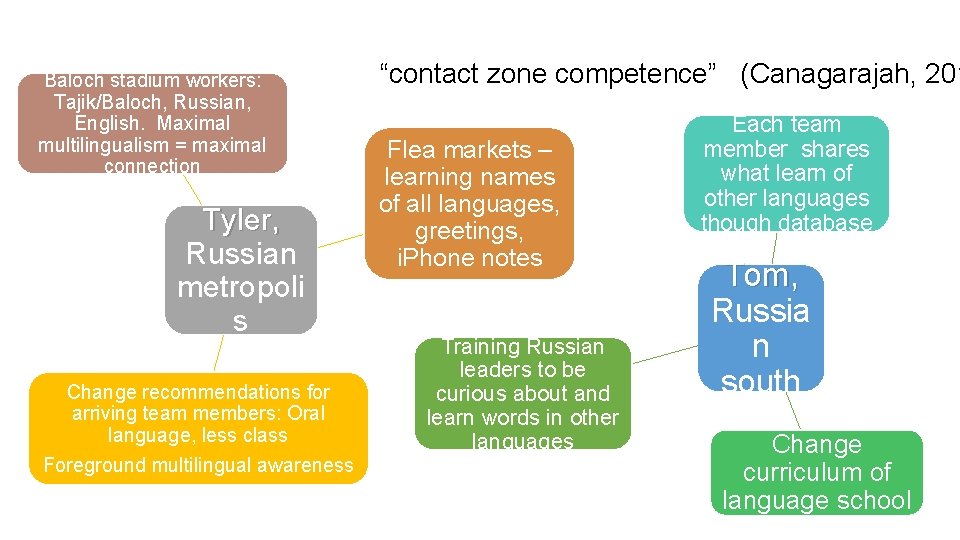
Baloch stadium workers: Tajik/Baloch, Russian, English. Maximal multilingualism = maximal connection Tyler, Russian metropoli s Change recommendations for arriving team members: Oral language, less class Foreground multilingual awareness “contact zone competence” (Canagarajah, 201 Flea markets – learning names of all languages, greetings, i. Phone notes Training Russian leaders to be curious about and learn words in other languages Each team member shares what learn of other languages though database Tom, Russia n south Change curriculum of language school
Changes that seem promising 1. “The wrong Russian” is often better than “the right Russian” meeting in the shared space of being 2 nd language speakers (oral Central Asian over literary) 2. Turn “duplicating words” on its head -- Maybe learning 50 highcurrency lexical items (words, phrases) in Dargin, 50 Avar ones, means having a 100 -phrase smaller Russian vocabulary at time X, but the rewards are great 3. Equip with awareness of and language for talking about contact zone multilingualism from very beginning (counteract long internship in parallel monolingualism) 4. “Double major” in language from the beginning, with sharing of high-currency phrases in others among team 5. Speak to you in my good language listening to y’all in your preferred mix
Reflections • Developing minority-language-fronted multilingual repertoires rather than “Learn Russian first, then learn Chechen” • Powerful step towards changing the stance and footing of fieldworkers • Speaking from a position of weakness, appreciating the funds of knowledge among “target” population • Contact Zone orientation (Canagarajah, 2017) • “Pick a language” “Maximum multilingualism” • Humans oriented to using all of the resources at their disposal when in contact with another • Direct and indirect probes to see the expanse of the field on which we are meeting • Using as broad a multilingualism as possible increases chances for maximum specificity, maximum overlap of identity (maximal solidarity), maximum likelihood of understanding
- Slides: 18