
WCN 2017 Satellite Symposium 2017 4 26 Mexico
- Slides: 32
WCN 2017 Satellite Symposium 2017. 4. 26. Mexico City Significance of hyperuricemia among community-based screening participants, focusing in longevity Kunitoshi Iseki Clinical Research Support Center, Tomishiro Central Hospital, Okinawa, Japan
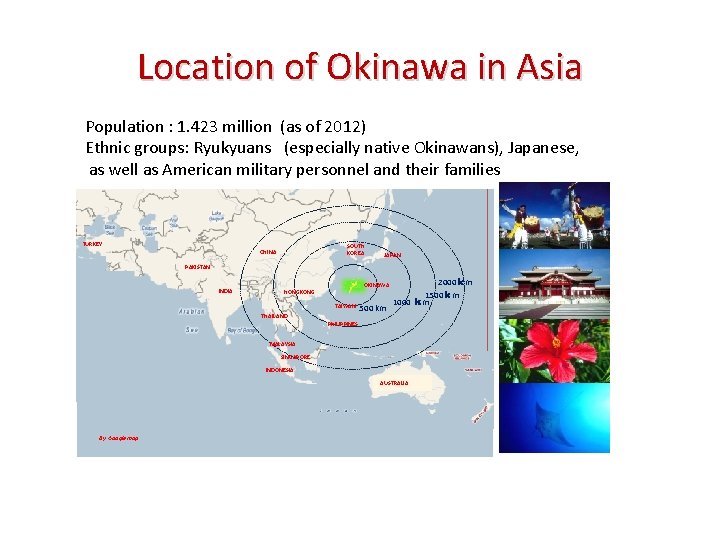
Location of Okinawa in Asia Population : 1. 423 million (as of 2012) Ethnic groups: Ryukyuans (especially native Okinawans), Japanese, as well as American military personnel and their families TURKEY SOUTH KOREA CHINA JAPAN PAKISTAN INDIA OKINAWA HONGKONG TAIWAN THAILAND 500 km 2000km 1500km 1000 km PHILIPPINES MALAYSIA SINGAPORE INDONESIA AUSTRALIA By Google map
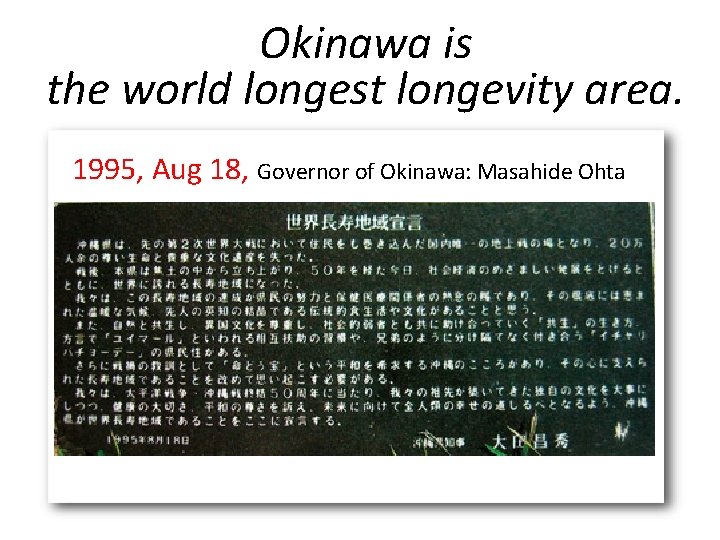
Okinawa is the world longest longevity area. 1995, Aug 18, Governor of Okinawa: Masahide Ohta
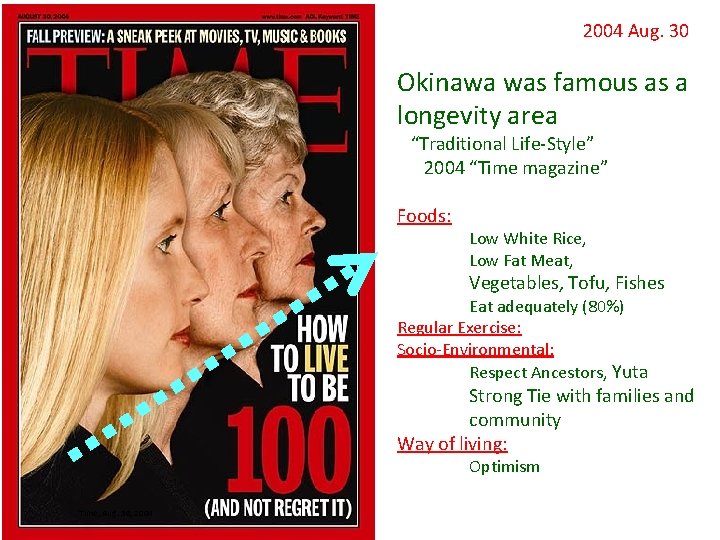
2004 Aug. 30 Okinawa was famous as a longevity area “Traditional Life-Style” 2004 “Time magazine” Foods: Low White Rice, Low Fat Meat, Vegetables, Tofu, Fishes Eat adequately (80%) Regular Exercise: Socio-Environmental: Respect Ancestors, Yuta Strong Tie with families and community Way of living: Optimism Time, Aug. 30, 2004
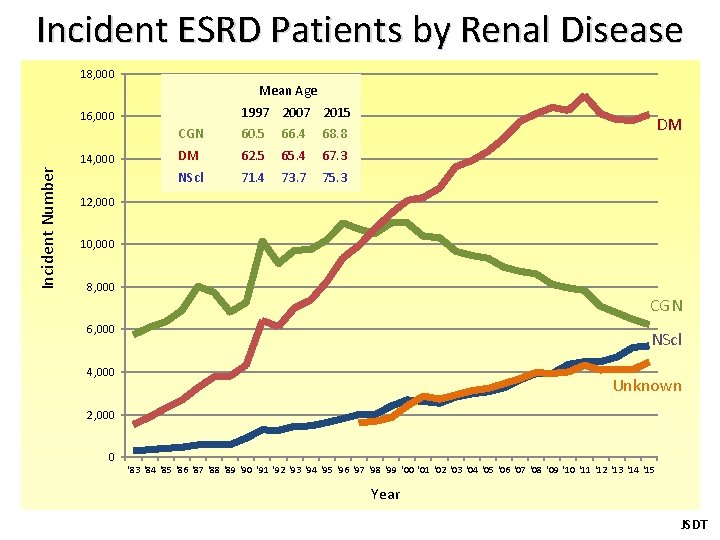
Incident ESRD Patients by Renal Disease 18, 000 Mean Age 1997 2007 2015 16, 000 Incident Number 14, 000 CGN 60. 5 66. 4 68. 8 DM 62. 5 65. 4 67. 3 NScl 71. 4 73. 7 75. 3 DM 12, 000 10, 000 8, 000 CGN 6, 000 NScl 4, 000 Unknown 2, 000 0 '83 '84 '85 '86 '87 '88 '89 '90 '91 '92 '93 '94 '95 '96 '97 '98 '99 '00 '01 '02 '03 '04 '05 '06 '07 '08 '09 '10 '11 '12 '13 '14 '15 Year JSDT
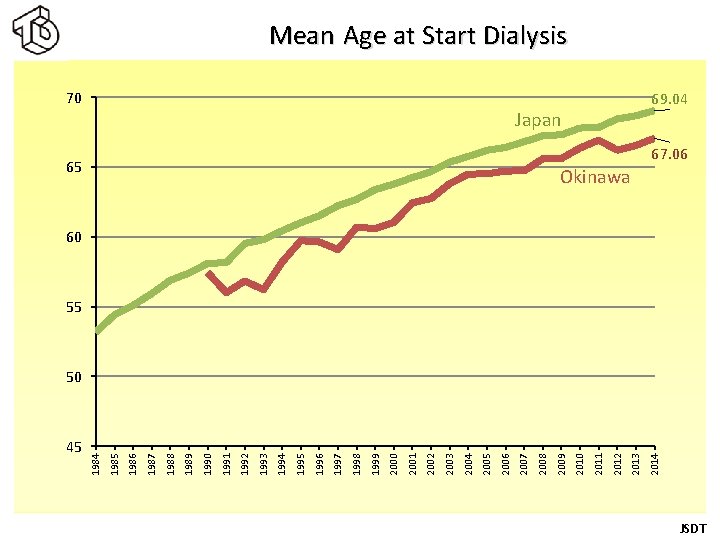
45 Japan 2014 2013 2012 2011 2010 65 2009 2008 70 2007 2006 2005 2004 2003 2002 2001 2000 1999 1998 1997 1996 1995 1994 1993 1992 1991 1990 1989 1988 1987 1986 1985 1984 Mean Age at Start Dialysis 69. 04 67. 06 Okinawa 60 55 50 JSDT
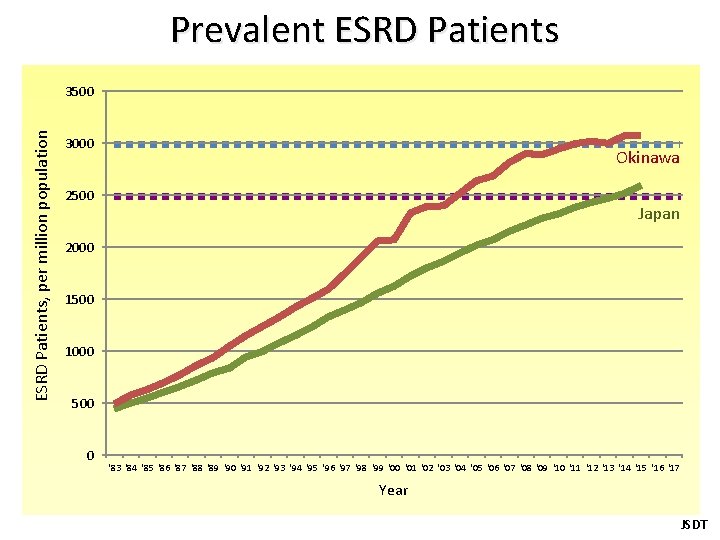
Prevalent ESRD Patients, per million population 3500 3000 Okinawa 2500 Japan 2000 1500 1000 500 0 '83 '84 '85 '86 '87 '88 '89 '90 '91 '92 '93 '94 '95 '96 '97 '98 '99 '00 '01 '02 '03 '04 '05 '06 '07 '08 '09 '10 '11 '12 '13 '14 '15 '16 '17 Year JSDT
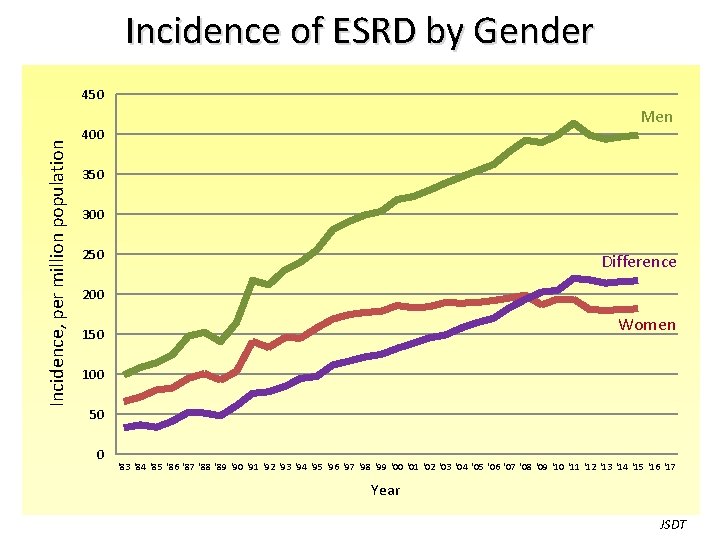
Incidence of ESRD by Gender Incidence, per million population 450 Men 400 350 300 250 Difference 200 Women 150 100 50 0 '83 '84 '85 '86 '87 '88 '89 '90 '91 '92 '93 '94 '95 '96 '97 '98 '99 '00 '01 '02 '03 '04 '05 '06 '07 '08 '09 '10 '11 '12 '13 '14 '15 '16 '17 Year JSDT
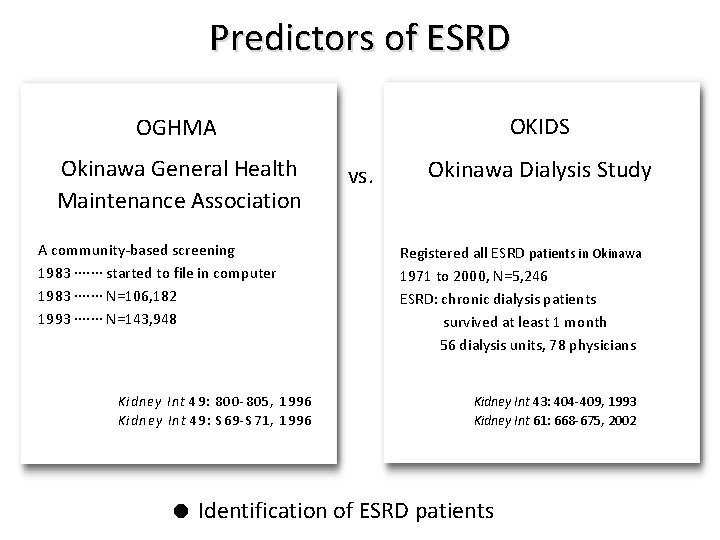
Predictors of ESRD OKIDS OGHMA Okinawa General Health Maintenance Association A community-based screening 1983 ······· started to file in computer 1983 ······· N=106, 182 1993 ······· N=143, 948 Kidney Int 49: 800 -805, 1996 Kidney Int 49: S 69 -S 71, 1996 vs. Okinawa Dialysis Study Registered all ESRD patients in Okinawa 1971 to 2000, N=5, 246 ESRD: chronic dialysis patients survived at least 1 month 56 dialysis units, 78 physicians Kidney Int 43: 404 -409, 1993 Kidney Int 61: 668 -675, 2002 Identification of ESRD patients
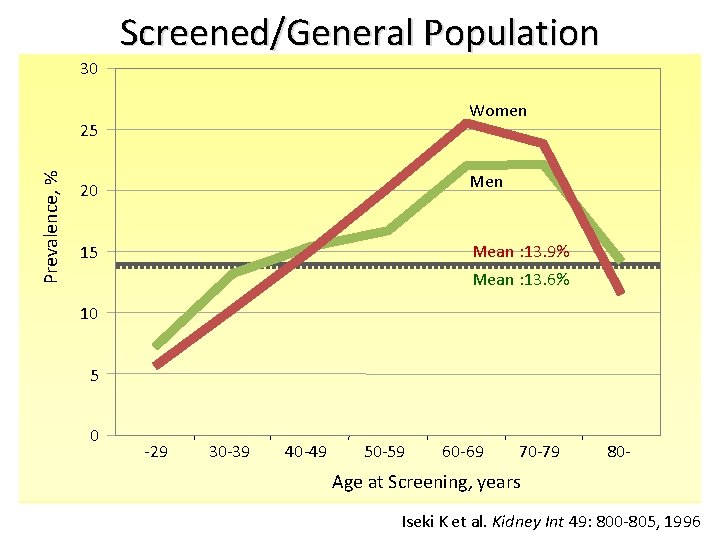
30 Screened/General Population Women Prevalence, % 25 Men 20 Mean : 13. 9% 15 Mean : 13. 6% 10 5 0 -29 30 -39 40 -49 50 -59 60 -69 70 -79 80 - Age at Screening, years Iseki K et al. Kidney Int 49: 800 -805, 1996
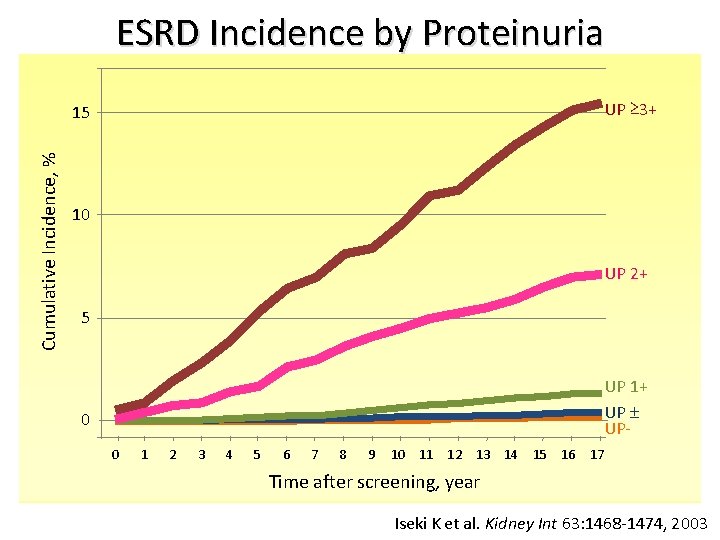
ESRD Incidence by Proteinuria UP ≥ 3+ Cumulative Incidence, % 15 10 UP 2+ 5 UP 1+ UP UP- 0 0 1 2 3 4 5 6 7 8 9 10 11 12 13 14 15 16 17 Time after screening, year Iseki K et al. Kidney Int 63: 1468 -1474, 2003
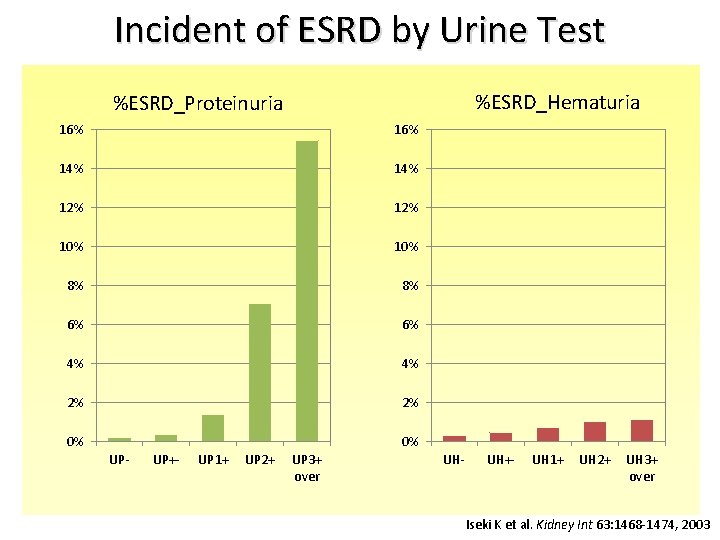
Incident of ESRD by Urine Test %ESRD_Hematuria %ESRD_Proteinuria 16% 14% 12% 10% 8% 8% 6% 6% 4% 4% 2% 2% 0% 0% UP- UP+- UP 1+ UP 2+ UP 3+ over UH- UH+- UH 1+ UH 2+ UH 3+ over Iseki K et al. Kidney Int 63: 1468 -1474, 2003
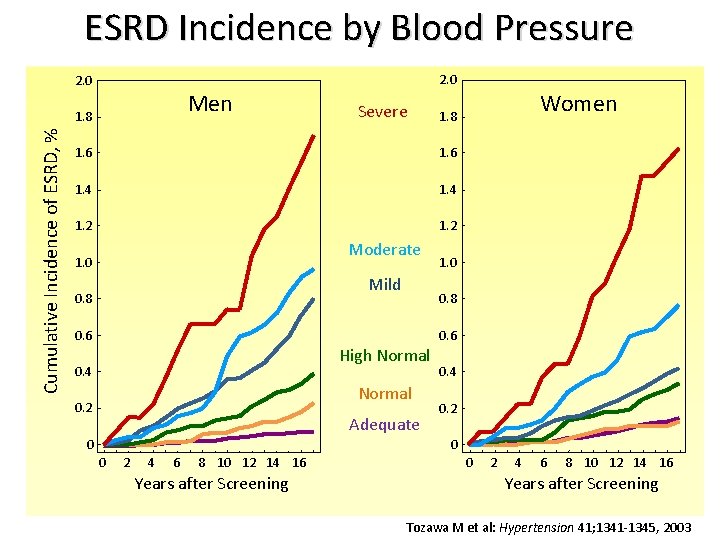
ESRD Incidence by Blood Pressure 2. 0 Men Cumulative Incidence of ESRD, % 1. 8 Severe 1. 6 1. 4 1. 2 Moderate 1. 0 Mild 0. 8 Women 1. 8 1. 0 0. 8 0. 6 High Normal 0. 4 Normal 0. 2 Adequate 0 0. 4 0. 2 0 0 2 4 6 8 10 12 14 16 Years after Screening Tozawa M et al: Hypertension 41; 1341 -1345, 2003
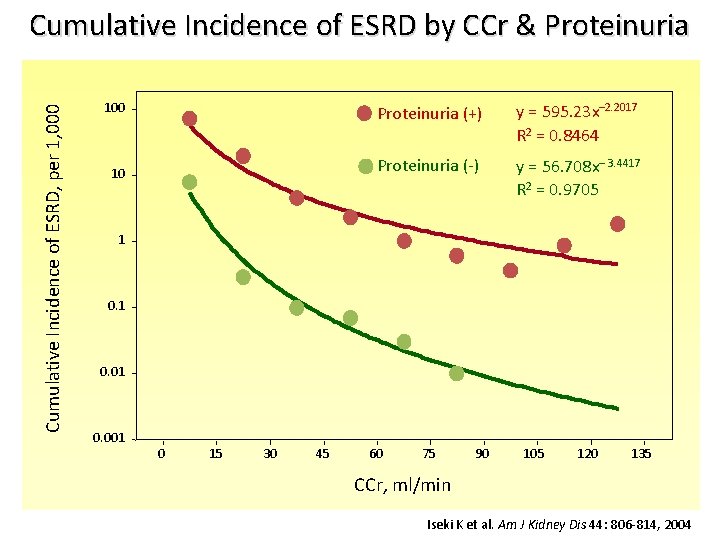
Cumulative Incidence of ESRD, per 1, 000 Cumulative Incidence of ESRD by CCr & Proteinuria 100 10 Proteinuria (+) y = 595. 23 x– 2. 2017 R 2 = 0. 8464 Proteinuria (-) y = 56. 708 x– 3. 4417 R 2 = 0. 9705 1 0. 01 0. 001 0 15 30 45 60 75 90 105 120 135 CCr, ml/min Iseki K et al. Am J Kidney Dis 44: 806 -814, 2004
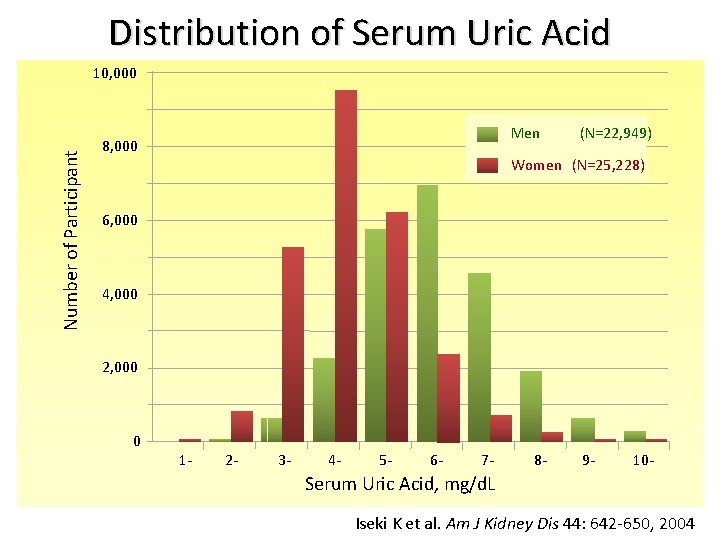
Distribution of Serum Uric Acid Number of Participant 10, 000 Men 8, 000 (N=22, 949) Women (N=25, 228) 6, 000 4, 000 2, 000 0 1 - 2 - 3 - 4 - 5 - 6 - 7 - 8 - 9 - 10 - Serum Uric Acid, mg/d. L Iseki K et al. Am J Kidney Dis 44: 642 -650, 2004
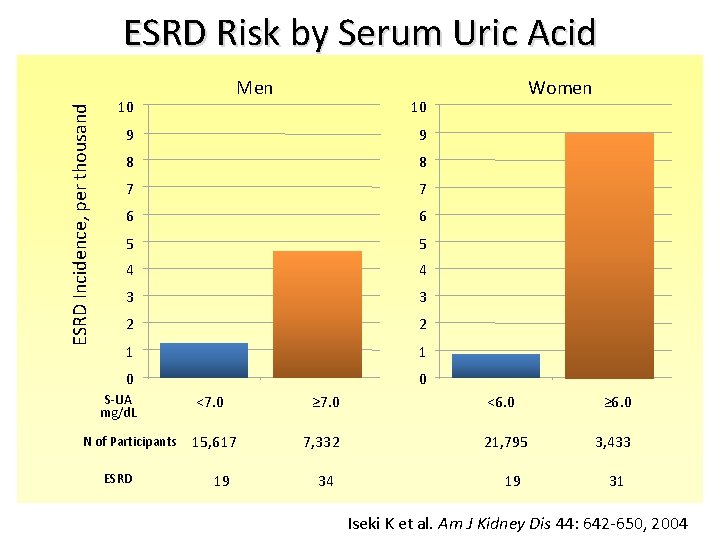
ESRD Incidence, per thousand ESRD Risk by Serum Uric Acid Men 10 10 9 9 8 8 7 7 6 6 5 5 4 4 3 3 2 2 1 1 0 0 S-UA mg/d. L N of Participants ESRD <7. 0 15, 617 19 Women ≥ 7. 0 7, 332 34 <6. 0 21, 795 19 ≥ 6. 0 3, 433 31 Iseki K et al. Am J Kidney Dis 44: 642 -650, 2004
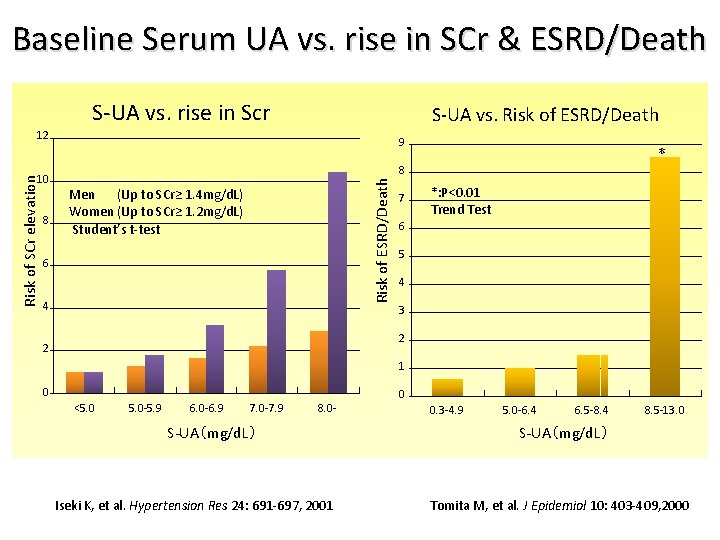
Baseline Serum UA vs. rise in SCr & ESRD/Death S-UA vs. rise in Scr S-UA vs. Risk of ESRD/Death 12 8 * 8 Risk of ESRD/Death Risk of SCr elevation 10 9 Men (Up to SCr≥ 1. 4 mg/d. L) Women (Up to SCr≥ 1. 2 mg/d. L) Student’s t-test 6 4 7 *: P<0. 01 Trend Test 6 5 4 3 2 2 1 0 <5. 0 -5. 9 6. 0 -6. 9 7. 0 -7. 9 8. 0 - S-UA(mg/d. L) Iseki K, et al. Hypertension Res 24: 691 -697, 2001 0 0. 3 -4. 9 5. 0 -6. 4 6. 5 -8. 4 8. 5 -13. 0 S-UA(mg/d. L) Tomita M, et al. J Epidemiol 10: 403 -409, 2000
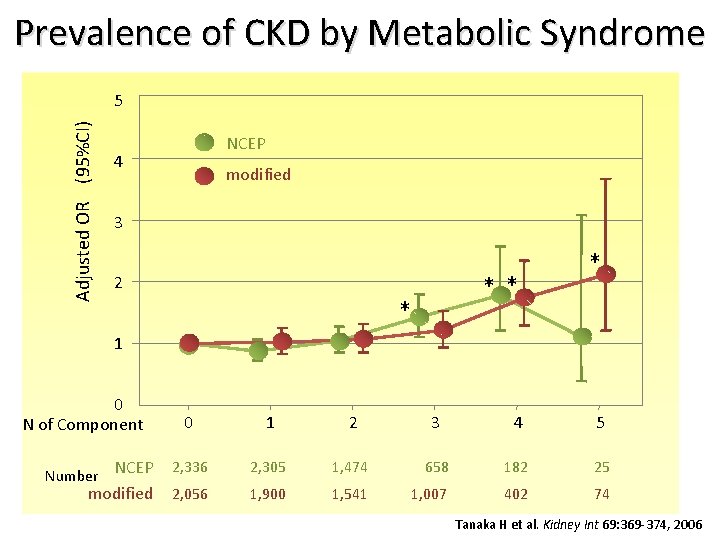
Prevalence of CKD by Metabolic Syndrome Adjusted OR (95%CI) 5 NCEP 4 modified 3 * 2 * * * 1 0 N of Component NCEP modified Number 0 1 2 3 4 5 2, 336 2, 305 1, 474 658 182 25 2, 056 1, 900 1, 541 1, 007 402 74 Tanaka H et al. Kidney Int 69: 369 -374, 2006
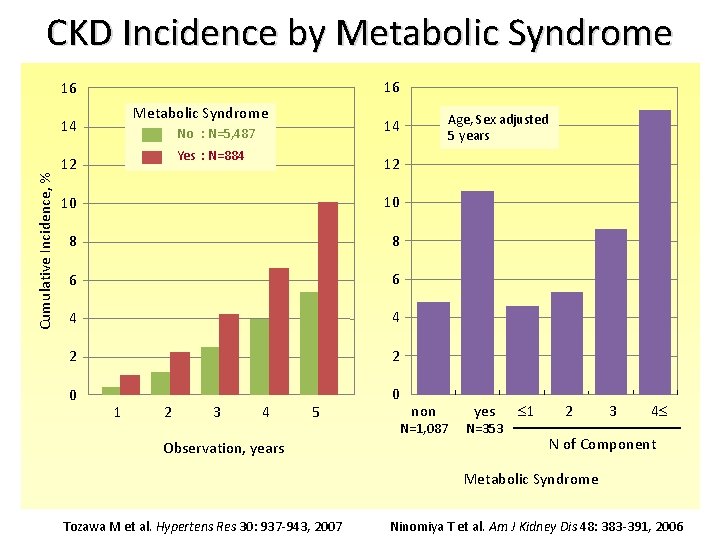
CKD Incidence by Metabolic Syndrome 16 16 Metabolic Syndrome Cumulative Incidence, % 14 No : N=5, 487 Yes : N=884 12 12 10 10 8 8 6 6 4 4 2 2 0 0 1 2 3 Age, Sex adjusted 5 years 14 4 5 Observation, years non N=1, 087 yes N=353 1 2 3 4 N of Component Metabolic Syndrome Tozawa M et al. Hypertens Res 30: 937 -943, 2007 Ninomiya T et al. Am J Kidney Dis 48: 383 -391, 2006
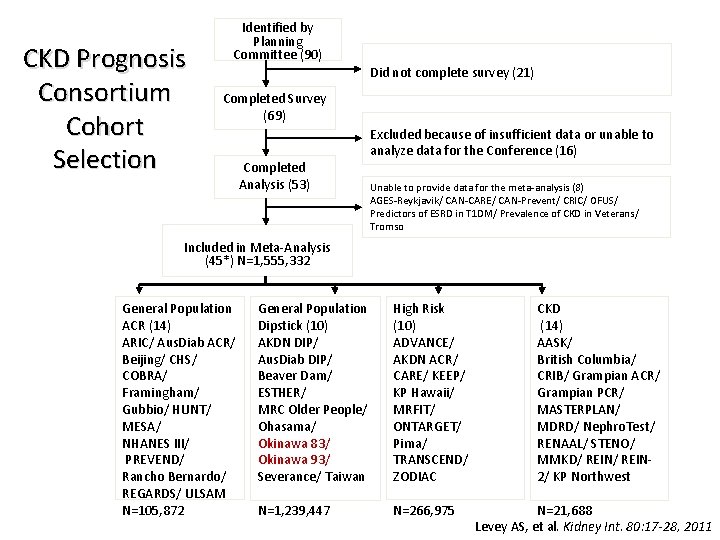
CKD Prognosis Consortium Cohort Selection Identified by Planning Committee (90) Did not complete survey (21) Completed Survey (69) Completed Analysis (53) Excluded because of insufficient data or unable to analyze data for the Conference (16) Unable to provide data for the meta-analysis (8) AGES-Reykjavik/ CAN-CARE/ CAN-Prevent/ CRIC/ OFUS/ Predictors of ESRD in T 1 DM/ Prevalence of CKD in Veterans/ Tromso Included in Meta-Analysis (45*) N=1, 555, 332 General Population ACR (14) ARIC/ Aus. Diab ACR/ Beijing/ CHS/ COBRA/ Framingham/ Gubbio/ HUNT/ MESA/ NHANES III/ PREVEND/ Rancho Bernardo/ REGARDS/ ULSAM N=105, 872 General Population Dipstick (10) AKDN DIP/ Aus. Diab DIP/ Beaver Dam/ ESTHER/ MRC Older People/ Ohasama/ Okinawa 83/ Okinawa 93/ Severance/ Taiwan High Risk (10) ADVANCE/ AKDN ACR/ CARE/ KEEP/ KP Hawaii/ MRFIT/ ONTARGET/ Pima/ TRANSCEND/ ZODIAC N=1, 239, 447 N=266, 975 CKD (14) AASK/ British Columbia/ CRIB/ Grampian ACR/ Grampian PCR/ MASTERPLAN/ MDRD/ Nephro. Test/ RENAAL/ STENO/ MMKD/ REIN 2/ KP Northwest N=21, 688 Levey AS, et al. Kidney Int. 80: 17 -28, 2011
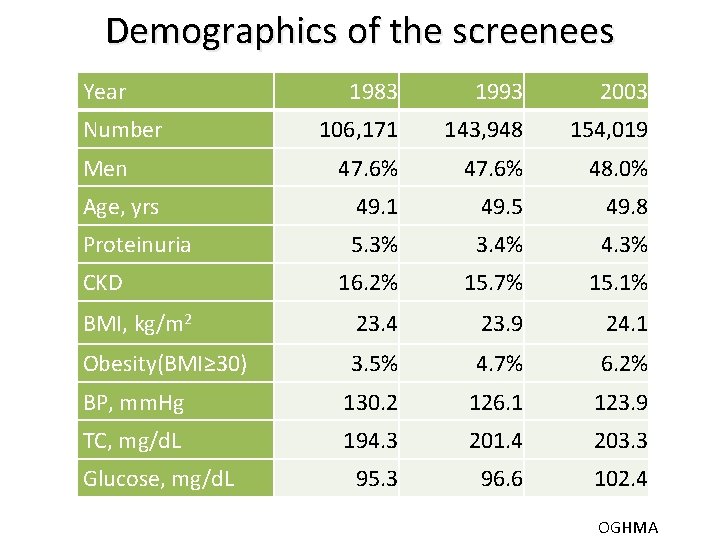
Demographics of the screenees Year 1983 1993 2003 106, 171 143, 948 154, 019 47. 6% 48. 0% Age, yrs 49. 1 49. 5 49. 8 Proteinuria 5. 3% 3. 4% 4. 3% 16. 2% 15. 7% 15. 1% BMI, kg/m 2 23. 4 23. 9 24. 1 Obesity(BMI≥ 30) 3. 5% 4. 7% 6. 2% BP, mm. Hg 130. 2 126. 1 123. 9 TC, mg/d. L 194. 3 201. 4 203. 3 95. 3 96. 6 102. 4 Number Men CKD Glucose, mg/d. L OGHMA
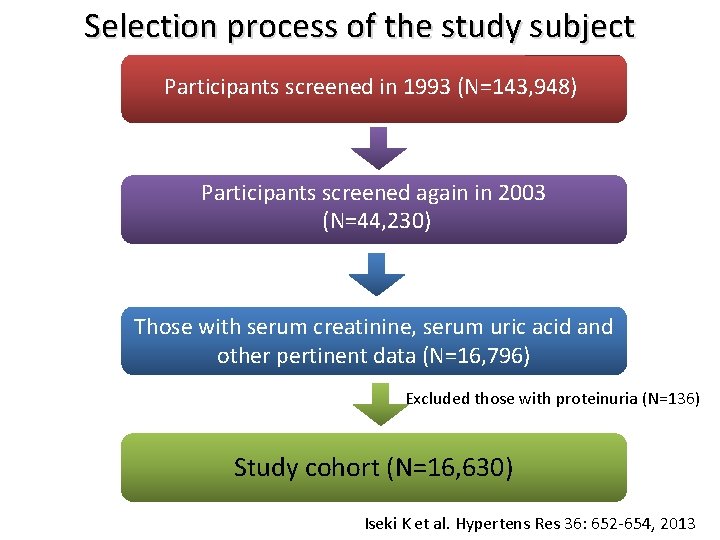
Selection process of the study subject Participants screened in 1993 (N=143, 948) Participants screened again in 2003 (N=44, 230) Those with serum creatinine, serum uric acid and other pertinent data (N=16, 796) Excluded those with proteinuria (N=136) Study cohort (N=16, 630) Iseki K et al. Hypertens Res 36: 652 -654, 2013
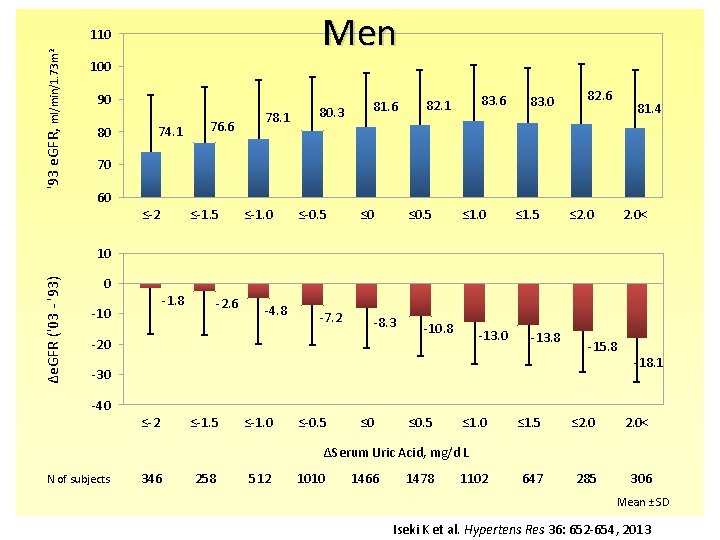
Men '93 e. GFR, ml/min/1. 73 m 2 110 100 90 80 74. 1 76. 6 78. 1 80. 3 81. 6 83. 6 82. 1 83. 0 82. 6 81. 4 70 60 ≤-2 ≤-1. 5 ≤-1. 0 ≤-0. 5 ≤ 1. 0 ≤ 1. 5 ≤ 2. 0< Δe. GFR ('03 - '93) 10 0 -1. 8 -10 -2. 6 -4. 8 -7. 2 -8. 3 -20 -10. 8 -13. 0 -13. 8 -15. 8 -30 -18. 1 -40 ≤-2 ≤-1. 5 ≤-1. 0 ≤-0. 5 ≤ 1. 0 ≤ 1. 5 ≤ 2. 0< 647 285 306 ΔSerum Uric Acid, mg/d L N of subjects 346 258 512 1010 1466 1478 1102 Mean ± SD Iseki K et al. Hypertens Res 36: 652 -654, 2013
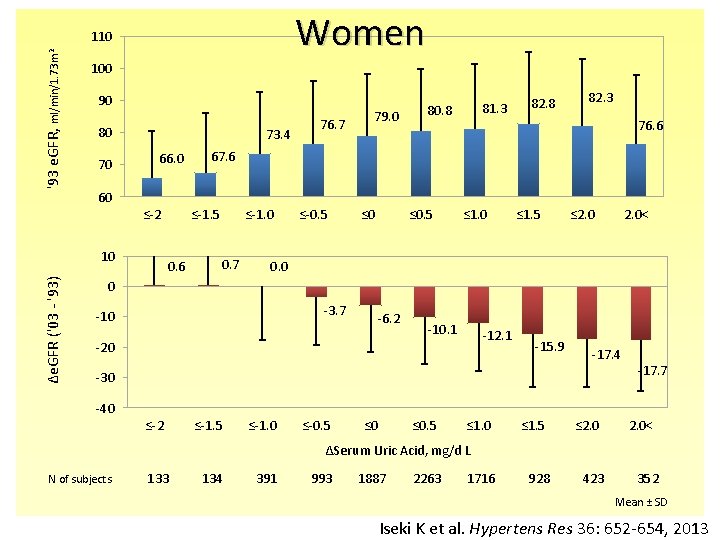
Women '93 e. GFR, ml/min/1. 73 m 2 110 100 90 80 70 73. 4 66. 0 79. 0 82. 8 82. 3 76. 6 67. 6 60 ≤-2 10 Δe. GFR ('03 - '93) 76. 7 81. 3 80. 8 ≤-1. 5 0. 6 ≤-1. 0 0. 7 ≤-0. 5 ≤ 1. 0 ≤ 1. 5 ≤ 2. 0< 0. 0 0 -3. 7 -10 -6. 2 -10. 1 -12. 1 -20 -15. 9 -17. 4 -30 -17. 7 -40 ≤-2 ≤-1. 5 ≤-1. 0 ≤-0. 5 ≤ 1. 0 ≤ 1. 5 ≤ 2. 0< ΔSerum Uric Acid, mg/d L N of subjects 133 134 391 993 1887 2263 1716 928 423 352 Mean ± SD Iseki K et al. Hypertens Res 36: 652 -654, 2013
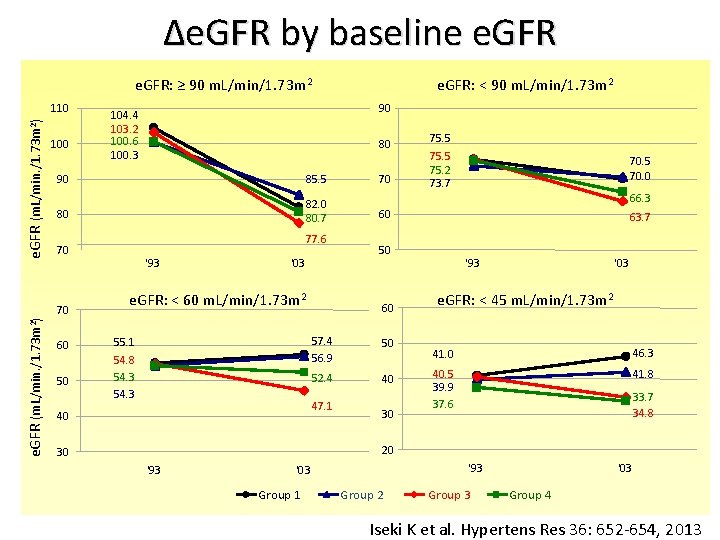
Δe. GFR by baseline e. GFR: ≥ 90 m. L/min/1. 73 m 2 e. GFR (m. L/min. /1. 73 m 2) 110 100 80 90 85. 5 80 82. 0 80. 7 70 e. GFR (m. L/min. /1. 73 m 2) 90 104. 4 103. 2 100. 6 100. 3 77. 6 70 '93 '03 e. GFR: < 60 m. L/min/1. 73 m 2 60 55. 1 50 54. 8 54. 3 e. GFR: < 90 m. L/min/1. 73 m 2 70. 5 70. 0 66. 3 60 63. 7 50 60 57. 4 56. 9 50 52. 4 40 47. 1 40 70 75. 5 75. 2 73. 7 30 '93 '03 e. GFR: < 45 m. L/min/1. 73 m 2 41. 0 46. 3 40. 5 39. 9 37. 6 41. 8 33. 7 34. 8 20 30 '93 '03 Group 1 Group 2 Group 3 '03 Group 4 Iseki K et al. Hypertens Res 36: 652 -654, 2013
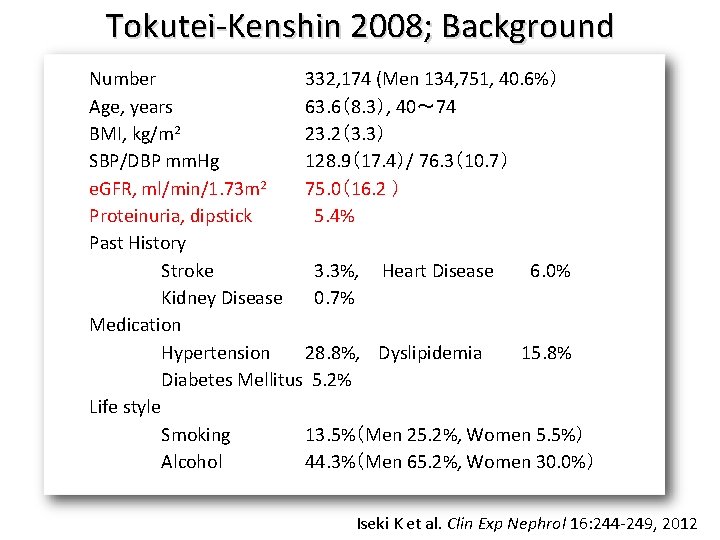
Tokutei-Kenshin 2008; Background Number 332, 174 (Men 134, 751, 40. 6%) Age, years 63. 6(8. 3), 40~ 74 BMI, kg/m 2 23. 2(3. 3) SBP/DBP mm. Hg 128. 9(17. 4)/ 76. 3(10. 7) e. GFR, ml/min/1. 73 m 2 75. 0(16. 2 ) Proteinuria, dipstick 5. 4% Past History Stroke 3. 3%, Heart Disease 6. 0% Kidney Disease 0. 7% Medication Hypertension 28. 8%, Dyslipidemia 15. 8% Diabetes Mellitus 5. 2% Life style Smoking 13. 5%(Men 25. 2%, Women 5. 5%) Alcohol 44. 3%(Men 65. 2%, Women 30. 0%) Iseki K et al. Clin Exp Nephrol 16: 244 -249, 2012
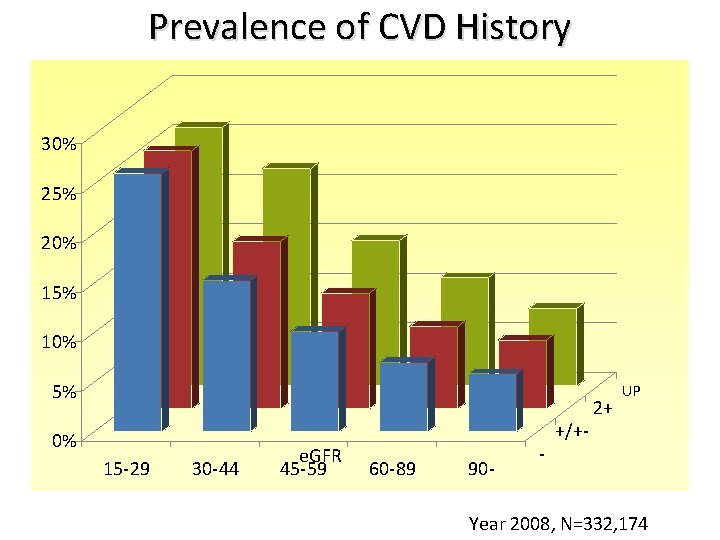
Prevalence of CVD History 30% 25% 20% 15% 10% 5% 0% 15 -29 30 -44 e. GFR 45 -59 60 -89 90 - - +/+- 2+ UP Year 2008, N=332, 174
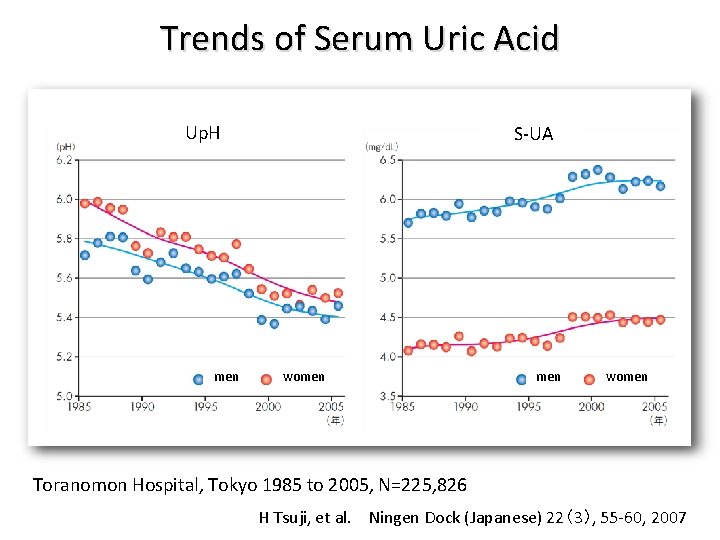
Trends of Serum Uric Acid Up. H men S-UA women Toranomon Hospital, Tokyo 1985 to 2005, N=225, 826 H Tsuji, et al. Ningen Dock (Japanese) 22(3), 55 -60, 2007
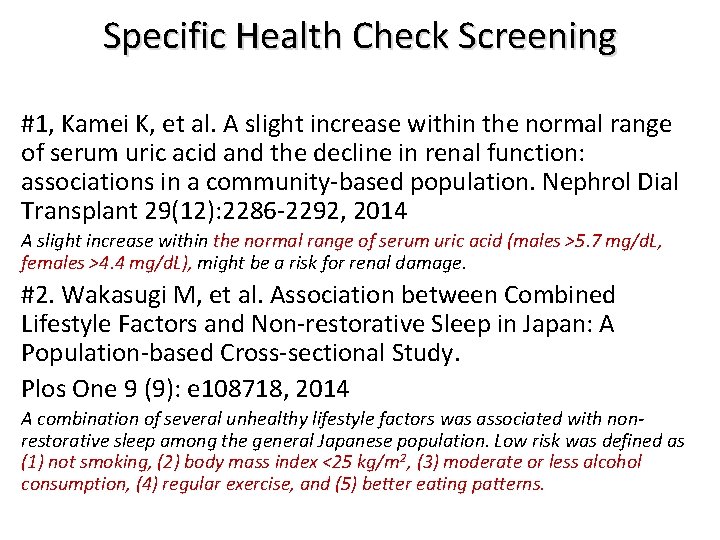
Specific Health Check Screening #1, Kamei K, et al. A slight increase within the normal range of serum uric acid and the decline in renal function: associations in a community-based population. Nephrol Dial Transplant 29(12): 2286 -2292, 2014 A slight increase within the normal range of serum uric acid (males >5. 7 mg/d. L, females >4. 4 mg/d. L), might be a risk for renal damage. #2. Wakasugi M, et al. Association between Combined Lifestyle Factors and Non-restorative Sleep in Japan: A Population-based Cross-sectional Study. Plos One 9 (9): e 108718, 2014 A combination of several unhealthy lifestyle factors was associated with nonrestorative sleep among the general Japanese population. Low risk was defined as (1) not smoking, (2) body mass index <25 kg/m 2, (3) moderate or less alcohol consumption, (4) regular exercise, and (5) better eating patterns.
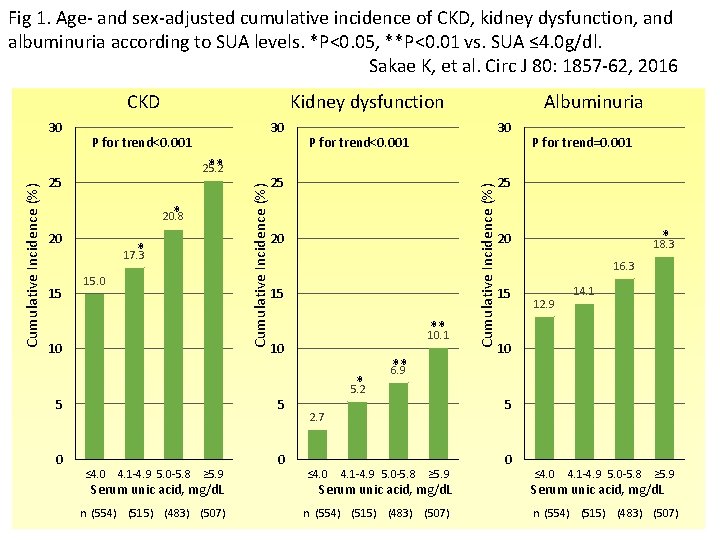
Fig 1. Age- and sex-adjusted cumulative incidence of CKD, kidney dysfunction, and albuminuria according to SUA levels. *P<0. 05, **P<0. 01 vs. SUA ≤ 4. 0 g/dl. Sakae K, et al. Circ J 80: 1857 -62, 2016 30 P for trend<0. 001 ** 25. 2 25 * 20. 8 20 15 * 17. 3 15. 0 10 Cumulative Incidence (%) 30 Kidney dysfunction 20 15 ** 10. 1 10 * 5 0 0 ≤ 4. 0 4. 1 -4. 9 5. 0 -5. 8 ≥ 5. 9 Serum unic acid, mg/d. L n (554) (515) (483) (507) 30 P for trend<0. 001 25 5 Albuminuria ** 6. 9 5. 2 4. 1 -4. 9 5. 0 -5. 8 P for trend=0. 001 25 * 20 18. 3 16. 3 15 12. 9 14. 1 10 5 2. 7 ≤ 4. 0 Cumulative Incidence (%) CKD ≥ 5. 9 Serum unic acid, mg/d. L n (554) (515) (483) (507) 0 ≤ 4. 0 4. 1 -4. 9 5. 0 -5. 8 ≥ 5. 9 Serum unic acid, mg/d. L n (554) (515) (483) (507)
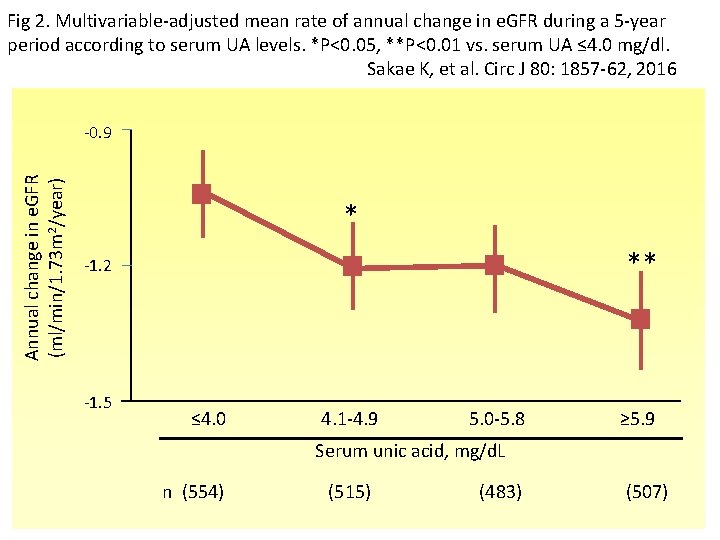
Fig 2. Multivariable-adjusted mean rate of annual change in e. GFR during a 5 -year period according to serum UA levels. *P<0. 05, **P<0. 01 vs. serum UA ≤ 4. 0 mg/dl. Sakae K, et al. Circ J 80: 1857 -62, 2016 Annual change in e. GFR (ml/min/1. 73 m 2/year) -0. 9 * ** -1. 2 -1. 5 ≤ 4. 0 4. 1 -4. 9 5. 0 -5. 8 ≥ 5. 9 Serum unic acid, mg/d. L n (554) (515) (483) (507)
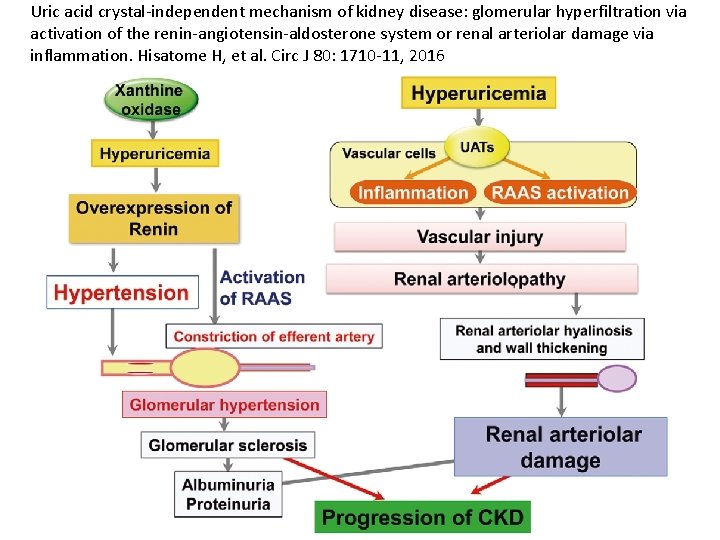
Uric acid crystal-independent mechanism of kidney disease: glomerular hyperfiltration via activation of the renin-angiotensin-aldosterone system or renal arteriolar damage via inflammation. Hisatome H, et al. Circ J 80: 1710 -11, 2016