
WCDMAHSPA Aida Botonji Tieto 1 Background 1 st
WCDMA/HSPA Aida Botonjić Tieto 1
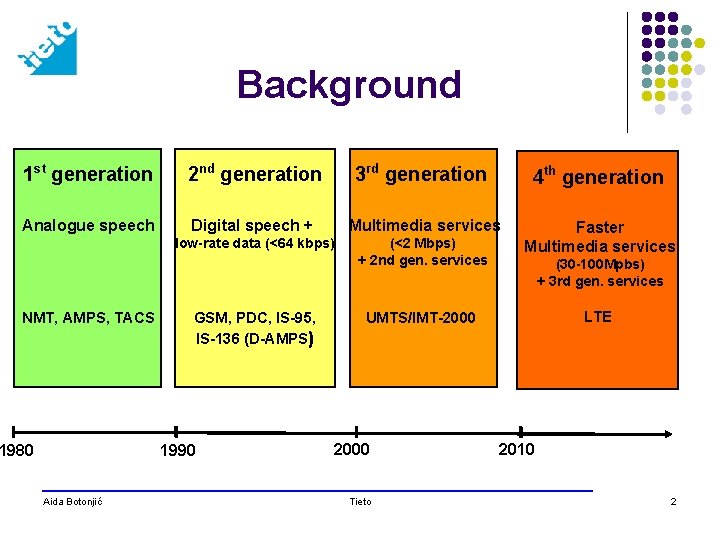
Background 1 st generation 2 nd generation 3 rd generation 4 th generation Analogue speech Digital speech + Multimedia services low-rate data (<64 kbps) (<2 Mbps) + 2 nd gen. services Faster Multimedia services NMT, AMPS, TACS 1980 GSM, PDC, IS-95, IS-136 (D-AMPS) 1990 Aida Botonjić (30 -100 Mpbs) LTE + 3 rd gen. services LTE UMTS/IMT-2000 Tieto 2010 2
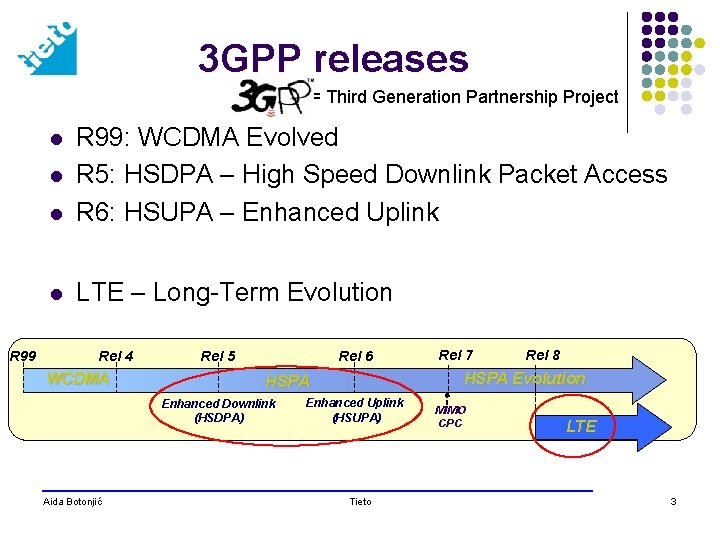
3 GPP releases = Third Generation Partnership Project l R 99: WCDMA Evolved R 5: HSDPA – High Speed Downlink Packet Access R 6: HSUPA – Enhanced Uplink l LTE – Long-Term Evolution l l R 99 Rel 4 WCDMA Rel 5 Rel 6 Aida Botonjić Rel 8 HSPA Evolution HSPA Enhanced Downlink (HSDPA) Rel 7 Enhanced Uplink (HSUPA) Tieto MIMO CPC LTE 3
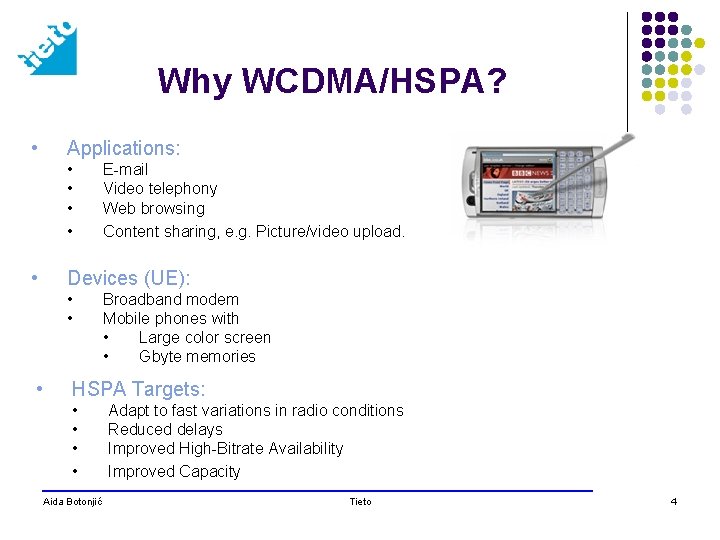
Why WCDMA/HSPA? • Applications: • • • E-mail Video telephony Web browsing Content sharing, e. g. Picture/video upload. Devices (UE): • • • Broadband modem Mobile phones with • Large color screen • Gbyte memories HSPA Targets: • • Aida Botonjić Adapt to fast variations in radio conditions Reduced delays Improved High-Bitrate Availability Improved Capacity Tieto 4
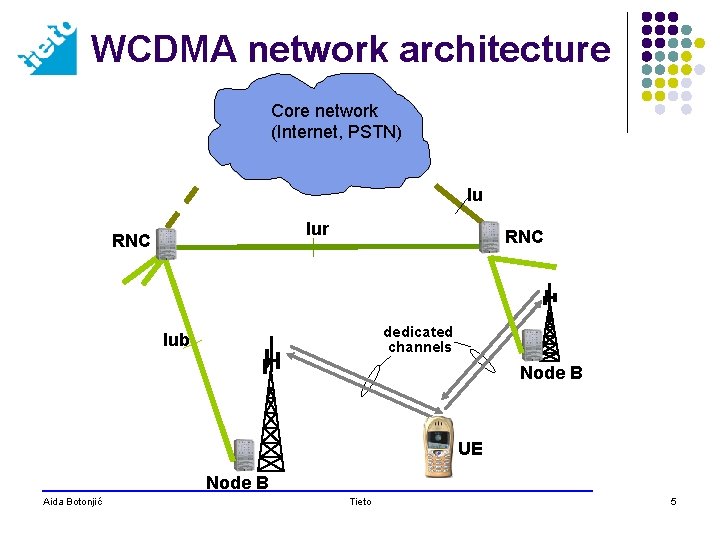
WCDMA network architecture Core network (Internet, PSTN) Iu Iur RNC dedicated channels Iub Node B UE Node B Aida Botonjić Tieto 5
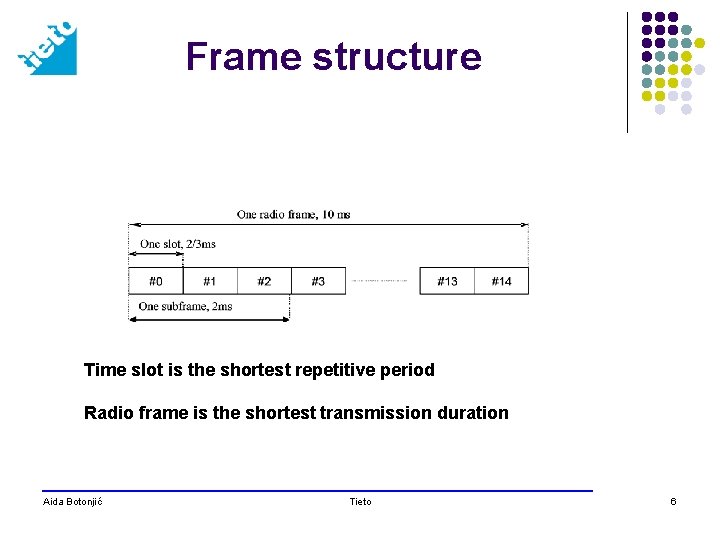
Frame structure Time slot is the shortest repetitive period Radio frame is the shortest transmission duration Aida Botonjić Tieto 6
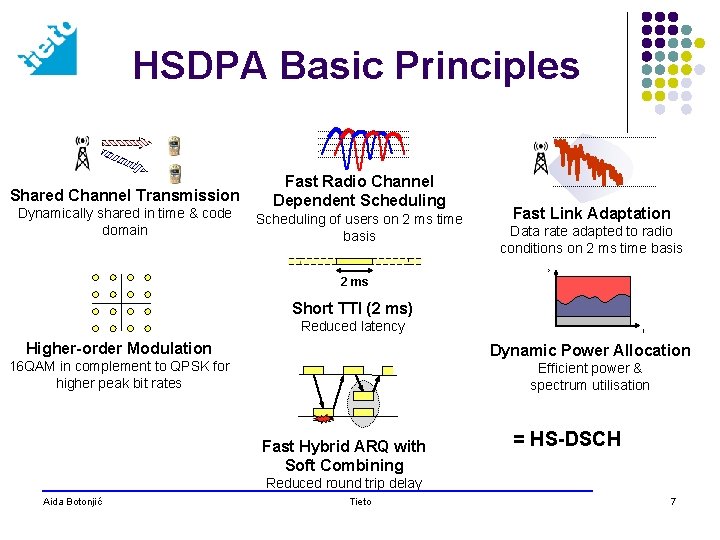
HSDPA Basic Principles Shared Channel Transmission Dynamically shared in time & code domain Fast Radio Channel Dependent Scheduling of users on 2 ms time basis Fast Link Adaptation Data rate adapted to radio conditions on 2 ms time basis P 2 ms Short TTI (2 ms) Reduced latency Higher-order Modulation t Dynamic Power Allocation 16 QAM in complement to QPSK for higher peak bit rates Efficient power & spectrum utilisation Fast Hybrid ARQ with Soft Combining = HS-DSCH Reduced round trip delay Aida Botonjić Tieto 7
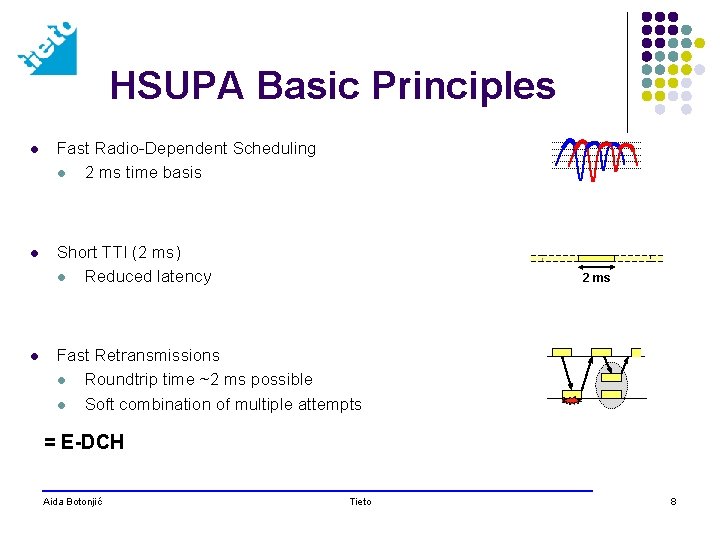
HSUPA Basic Principles l Fast Radio-Dependent Scheduling l 2 ms time basis l Short TTI (2 ms) l Reduced latency l 2 ms Fast Retransmissions l Roundtrip time ~2 ms possible l Soft combination of multiple attempts = E-DCH Aida Botonjić Tieto 8
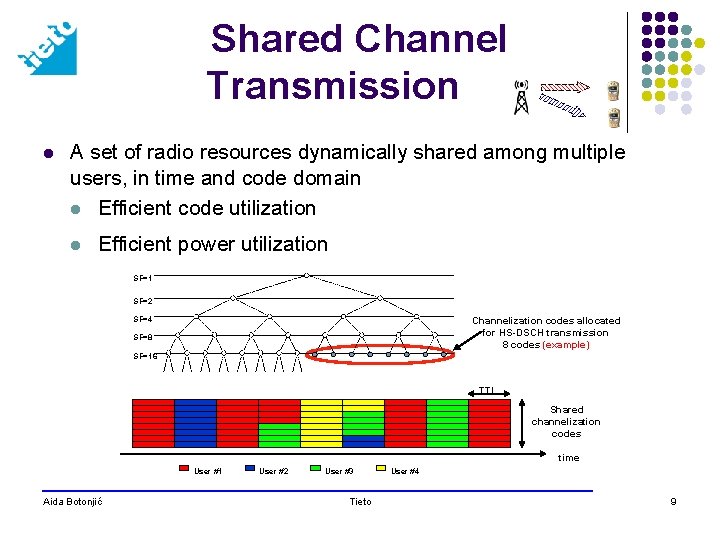
Shared Channel Transmission l A set of radio resources dynamically shared among multiple users, in time and code domain l Efficient code utilization l Efficient power utilization SF=1 SF=2 SF=4 Channelization codes allocated for HS-DSCH transmission 8 codes (example) SF=8 SF=16 TTI Shared channelization codes time User #1 Aida Botonjić User #2 User #3 Tieto User #4 9
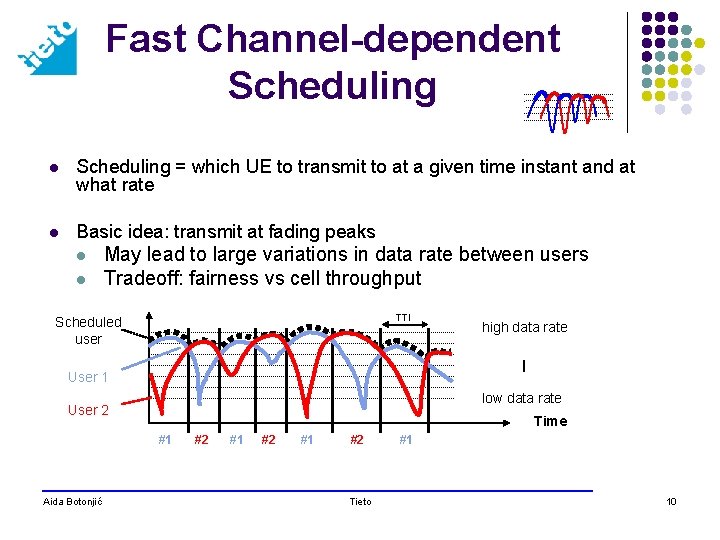
Fast Channel-dependent Scheduling l Scheduling = which UE to transmit to at a given time instant and at what rate l Basic idea: transmit at fading peaks l l May lead to large variations in data rate between users Tradeoff: fairness vs cell throughput TTI Scheduled user high data rate User 1 low data rate User 2 Time #1 Aida Botonjić #2 #1 #2 Tieto #1 10
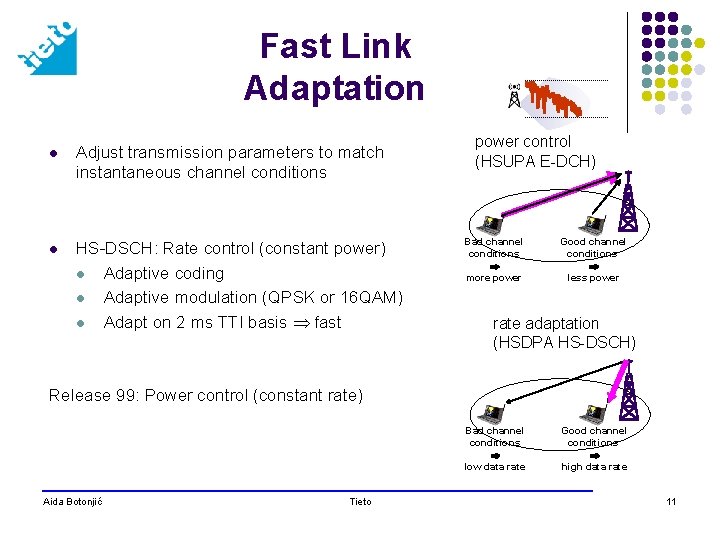
Fast Link Adaptation l Adjust transmission parameters to match instantaneous channel conditions l HS-DSCH: Rate control (constant power) l Adaptive coding l Adaptive modulation (QPSK or 16 QAM) l Adapt on 2 ms TTI basis fast power control (HSUPA E-DCH) Bad channel conditions more power Good channel conditions less power rate adaptation (HSDPA HS-DSCH) Release 99: Power control (constant rate) Bad channel conditions low data rate Aida Botonjić Tieto Good channel conditions high data rate 11
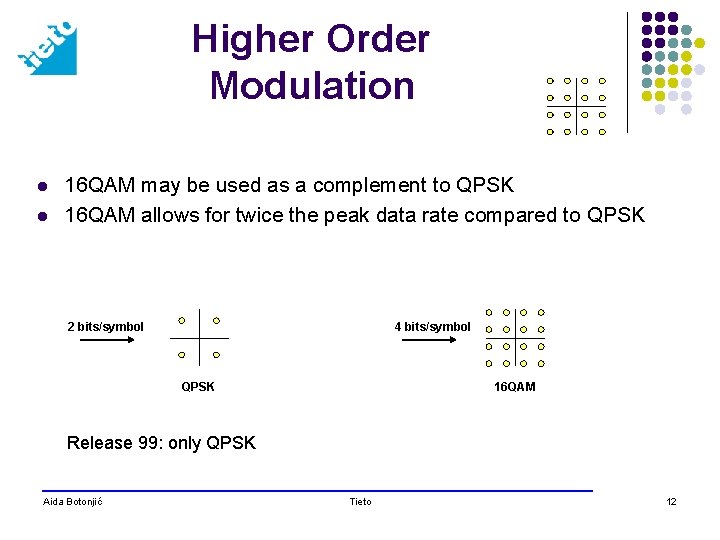
Higher Order Modulation l l 16 QAM may be used as a complement to QPSK 16 QAM allows for twice the peak data rate compared to QPSK 2 bits/symbol 4 bits/symbol QPSK 16 QAM Release 99: only QPSK Aida Botonjić Tieto 12
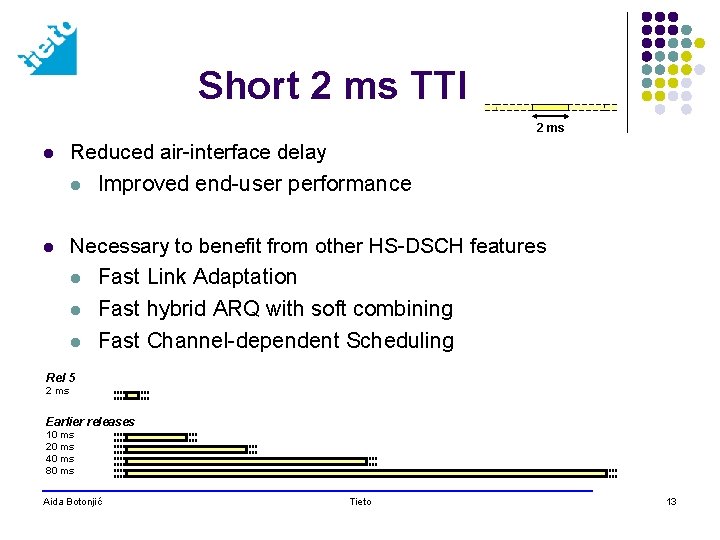
Short 2 ms TTI 2 ms l Reduced air-interface delay l Improved end-user performance l Necessary to benefit from other HS-DSCH features l Fast Link Adaptation l l Fast hybrid ARQ with soft combining Fast Channel-dependent Scheduling Rel 5 2 ms Earlier releases 10 ms 20 ms 40 ms 80 ms Aida Botonjić Tieto 13
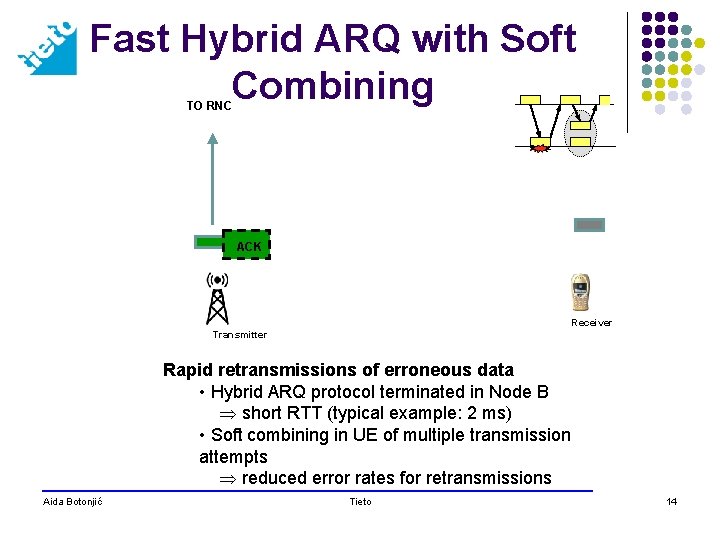
Fast Hybrid ARQ with Soft Combining TO RNC ACK Receiver Transmitter Rapid retransmissions of erroneous data • Hybrid ARQ protocol terminated in Node B short RTT (typical example: 2 ms) • Soft combining in UE of multiple transmission attempts reduced error rates for retransmissions Aida Botonjić Tieto 14
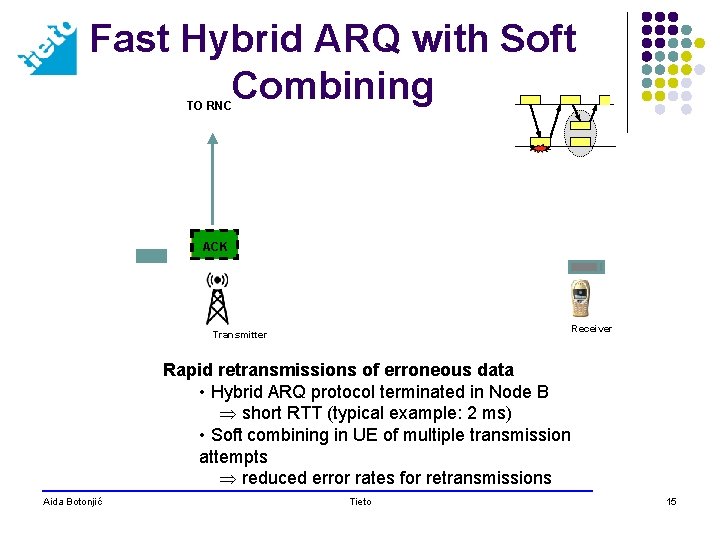
Fast Hybrid ARQ with Soft Combining TO RNC NACK Receiver Transmitter Rapid retransmissions of erroneous data • Hybrid ARQ protocol terminated in Node B short RTT (typical example: 2 ms) • Soft combining in UE of multiple transmission attempts reduced error rates for retransmissions Aida Botonjić Tieto 15
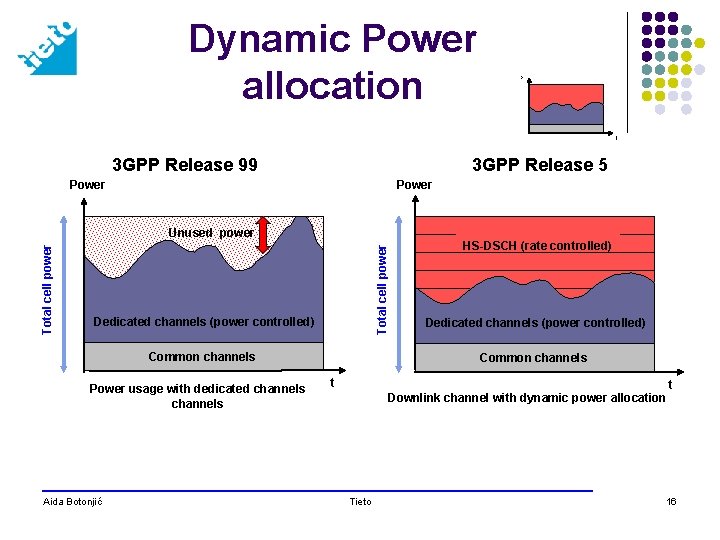
Dynamic Power allocation P t 3 GPP Release 99 3 GPP Release 5 Power Total cell power Unused power Dedicated channels (power controlled) Common channels Power usage with dedicated channels Aida Botonjić HS-DSCH (rate controlled) Dedicated channels (power controlled) Common channels t Downlink channel with dynamic power allocation Tieto t 16
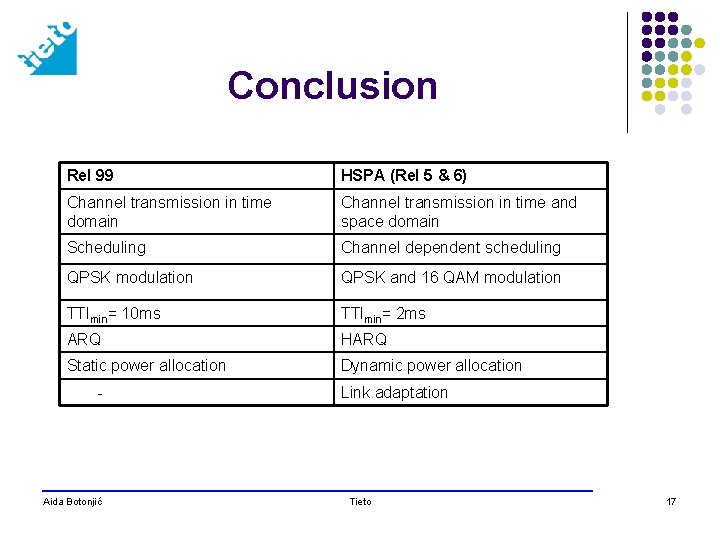
Conclusion Rel 99 HSPA (Rel 5 & 6) Channel transmission in time domain Channel transmission in time and space domain Scheduling Channel dependent scheduling QPSK modulation QPSK and 16 QAM modulation TTImin= 10 ms TTImin= 2 ms ARQ HARQ Static power allocation Dynamic power allocation - Aida Botonjić Link adaptation Tieto 17
- Slides: 17