
WBS Work Breakdown Structure Unitec New Zealand Learning
WBS Work Breakdown Structure © Unitec New Zealand
Learning outcome To understand WBS Work breakdown Structure and its application to Construction Planning >>FACULTY OF TECHNOLOGY AND BUILT ENVIRONMENT
What is a WBS ? Work Breakdown Structure is a deliverable orientated hierarchical decomposition of work to be executed by project team to accomplish the project objectives ( PIMBOK)
Lets consider this bit by bit! deliverable oriented – WBS focuses on work to be delivered rather than tasks needed to accomplish the work • Deliverable = Concrete slab • Tasks = formwork, reinforcing, concrete pour… hierarchical – WBS is representing bigger chunk of work at hierarchical manner starting with a node the top and then nodes representing smaller chunk as we move down
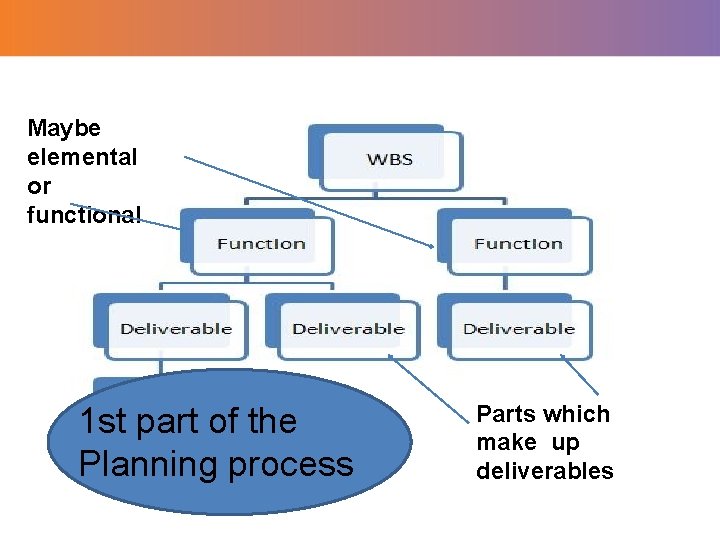
Maybe elemental or functional “Build before we Build !” 1 st(BIM) part of the Planning process Parts which make up deliverables
WBS Decomposition!!! Key Rule: (a) 100% Rule: WBS includes 100% of the work defined by the project scope and captures ALL deliverables – internal, external, interim – in terms of the work to be completed, including project management. (Project Management Institute) (b) Anything that is not defined in the WBS is outside the scope of the project. (Haugan 2002)

Multi - functional
As Construction Professionals what are we trying to achieve by this WBS process? Part 1: Confirm and understand scope of works in this project Part 2: Arrive at a list of tasks, which we can then use to work out durations It is important to appreciate at which level of detail this transition occurs!
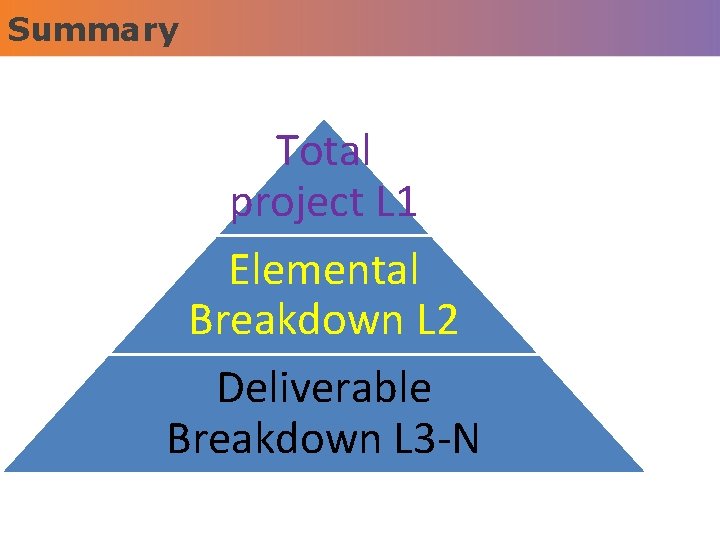
Summary Total project L 1 Elemental Breakdown L 2 Deliverable Breakdown L 3 -N

Part two - WBS for construction planners --the HOW bit! The level of decomposition required and subsequent level of details will be dictated either by the number of tasks and parameters of the task durations (or possibly both) As progress is made down decomposition path always consider the overall requirement of the programming requirement.
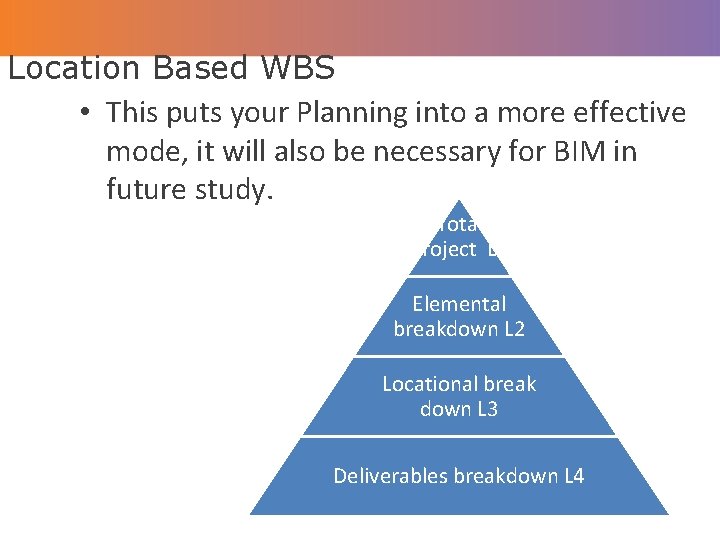
Location Based WBS • This puts your Planning into a more effective mode, it will also be necessary for BIM in future study. Total project L 1 Elemental breakdown L 2 Locational break down L 3 Deliverables breakdown L 4

WBS / Programme Distinction WBS • Comprehensive classification of project scope • Contains no activity duration • No resource assignments • No dependencies Programme • Actual work to be done • Contains activity durations • Contains assignment of resources to tasks • Contains dependencies
Part 2: Determining work activities -Factors to be considered 1. 2. 3. 4. 5. 6. 7. Nature of the work/homogeneity Location/floor Size/duration Timing/chronology Responsibility Others At the level that baton passes to the programmer some form of staging or phasing will be introduced. (Mubarak 2010)
Work package - Or task/Activity = measurable piece of work and a single responsibility • Single discrete scope of work • Definite start and end • “mini projects” (Hinze 2012)
Tasks An individual item or sub project of work by a single person, trade or organisation, which when combined with other tasks in the correct sequence and relationship will result in an event occurring Components of Task - Description - Duration - Relationship with other tasks Note - a task achieves nothing in isolation it is only when it is combined with other tasks its purpose becomes clear
Determining of work activities Unique identity (ID) • • • Logical pattern According to company’s policy National coding systems, (for QS CBI , Co-ordinated Building Information, www. masterspec. co. nz • • Name of the project Location Type of activity …for assignment purposes when using MS project it is advisable to ignore coding and let MSP WBS coding system prevail.
The end point after Part 2 • Clearly defined deliverables and project scope such that: – Cost/time is easily estimated – Outputs can be measured (clear and quantifiable) – Progress tracking (monitor & control) is facilitated • Well defined tasks (no less than one day)
References • Haugan, G. T. (2002). Effective Work Breakdown Structures (The Project Management Essential Ibrary Series). USA: Management Concepts Inc. • Hinze, J. W. (2012). Construction Planning and Scheduling. New Jersey: Pearson Education. • Mubarak, S. (2010). Construction project scheduling and control (2 nd edition). Hoboken, New Jersey: John Wiley & Sons. • Project management Institute (Practice Standard for Work Breakdown Structures (Second Edition), Project Management Institute. • Wysocki R. K. , Mc. Gary R. (2003). Effective Project Management (Third edition) Hoboken, New Jersey: Wiley Publishing.
- Slides: 18