
Wayside Acoustic Detection Device For Vehicle Condition Monitoring
- Slides: 19
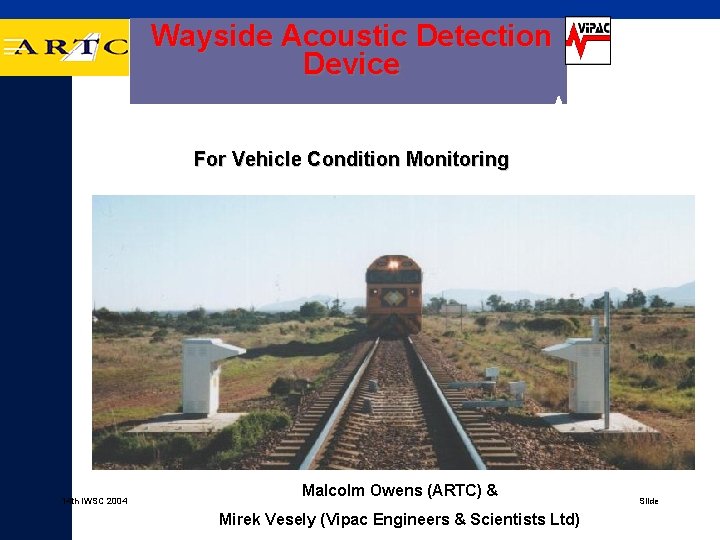
Wayside Acoustic Detection Device For Vehicle Condition Monitoring 14 th IWSC 2004 Malcolm Owens (ARTC) & Mirek Vesely (Vipac Engineers & Scientists Ltd) Slide
Wayside Acoustic Detection Devices Objectives: Ø To improve operational safety by reducing maintenance costs & derailments Fundamental Principle: To reliably identify developing bearing faults of rolling stock Ø So the developing faults can be monitored and bearing removal planned with minimal impact on train scheduling Ø To spot prematurely failing bearings Ø Improved maintenance strategies through SAFELY maximizing bearing life Ø 14 th IWSC 2004 2
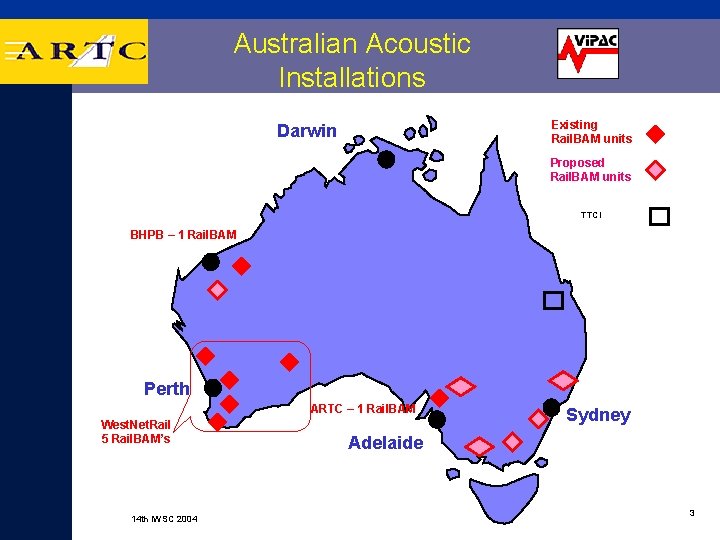
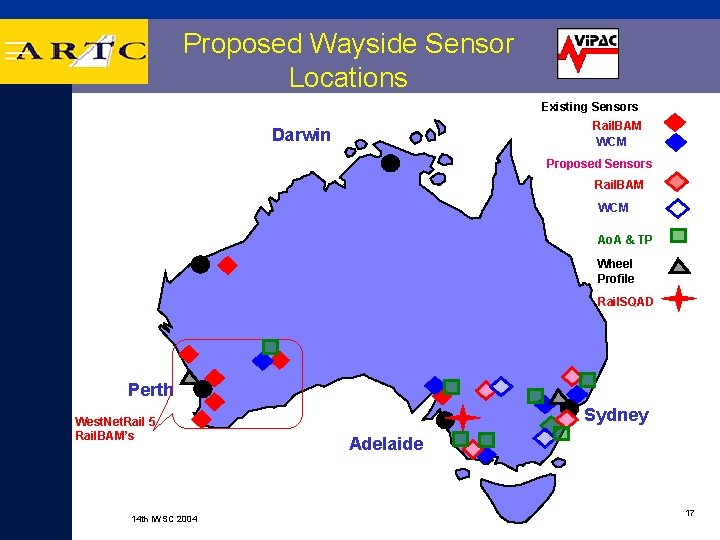
Australian Acoustic Installations Existing Rail. BAM units Darwin Proposed Rail. BAM units TTCI BHPB – 1 Rail. BAM Perth ARTC – 1 Rail. BAM West. Net. Rail 5 Rail. BAM’s 14 th IWSC 2004 Sydney Adelaide 3
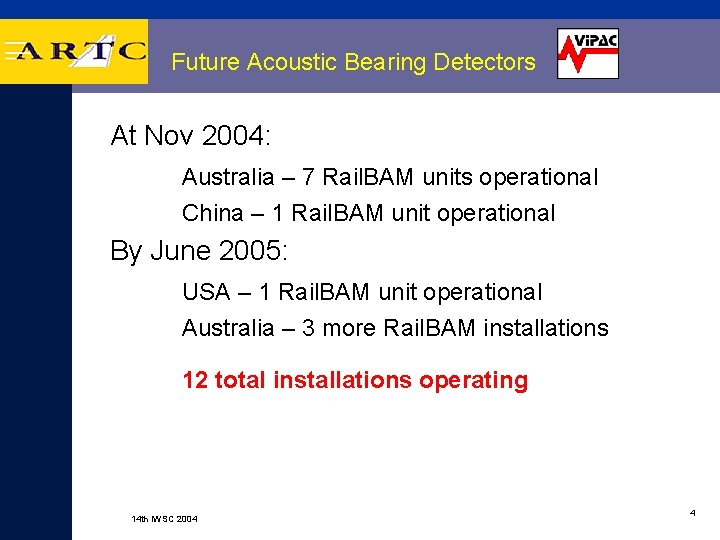
Future Acoustic Bearing Detectors At Nov 2004: Australia – 7 Rail. BAM units operational China – 1 Rail. BAM unit operational By June 2005: USA – 1 Rail. BAM unit operational Australia – 3 more Rail. BAM installations 12 total installations operating 14 th IWSC 2004 4
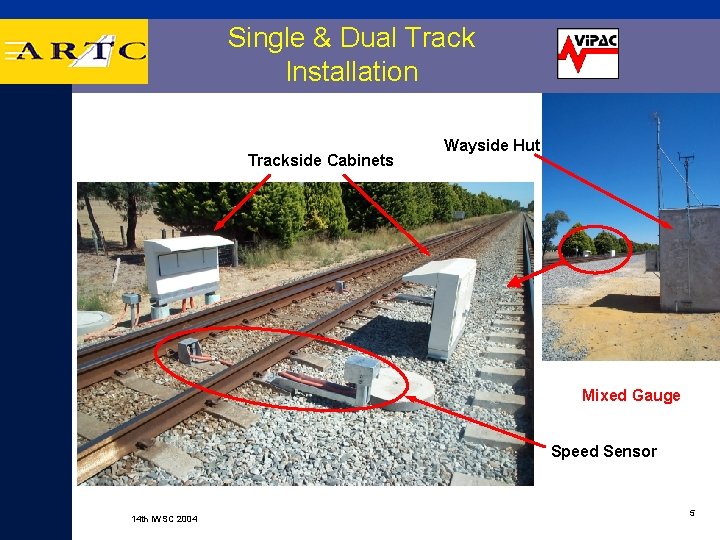
Single & Dual Track Installation Trackside Cabinets Wayside Hut Mixed Gauge Speed Sensor 14 th IWSC 2004 5
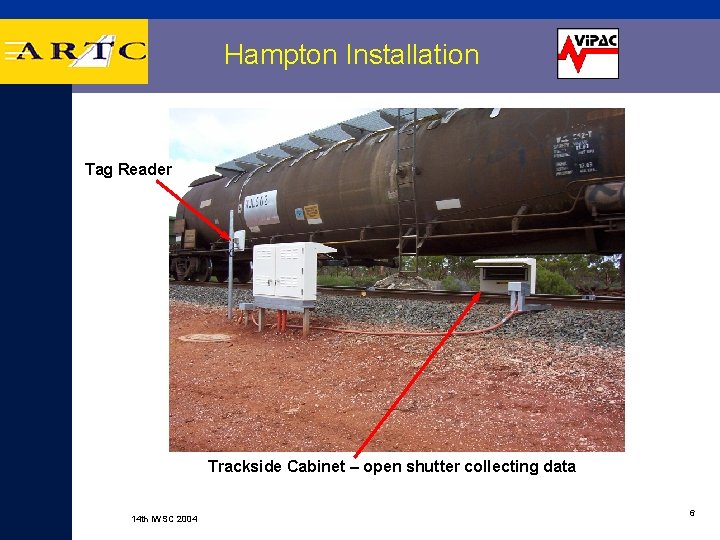
Hampton Installation Tag Reader Trackside Cabinet – open shutter collecting data 14 th IWSC 2004 6
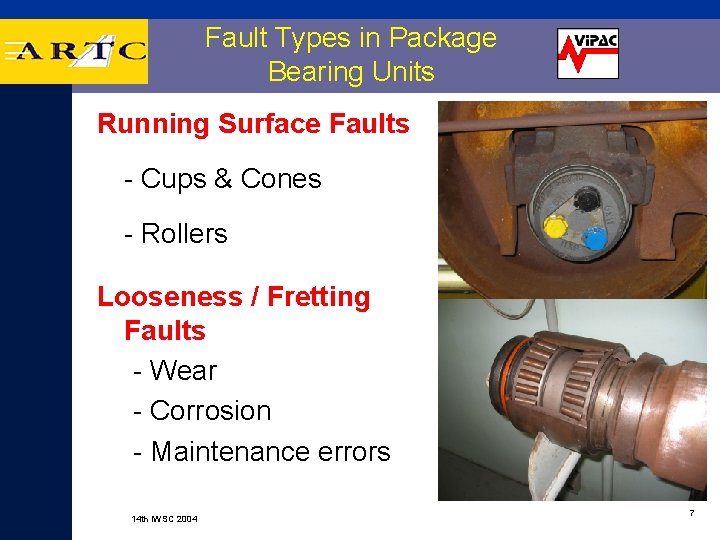
Fault Types in Package Bearing Units Running Surface Faults - Cups & Cones - Rollers Looseness / Fretting Faults - Wear - Corrosion - Maintenance errors 14 th IWSC 2004 7
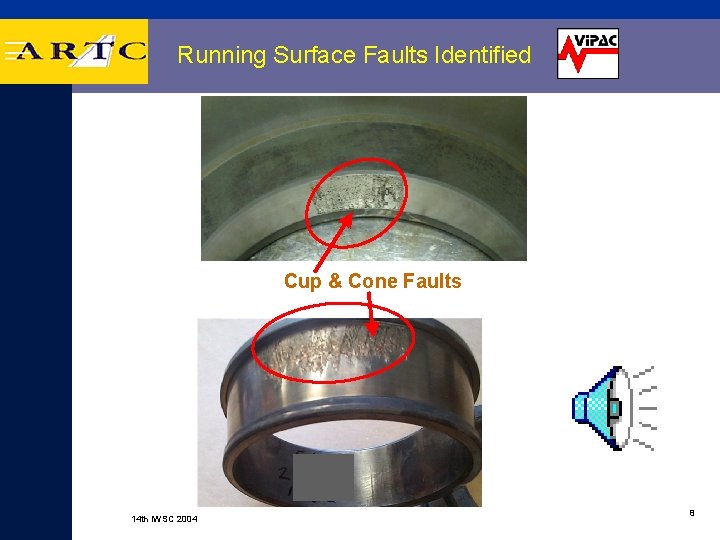
Running Surface Faults Identified Cup & Cone Faults 14 th IWSC 2004 8
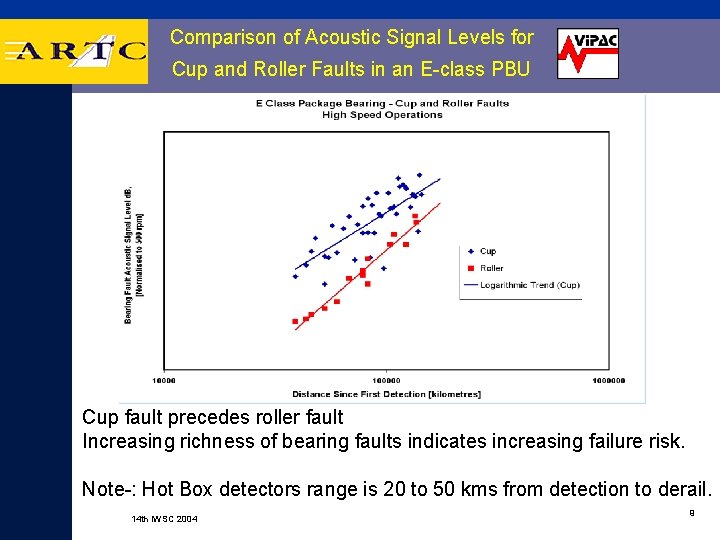
Comparison of Acoustic Signal Levels for Cup and Roller Faults in an E-class PBU Cup fault precedes roller fault Increasing richness of bearing faults indicates increasing failure risk. Note-: Hot Box detectors range is 20 to 50 kms from detection to derail. 14 th IWSC 2004 9
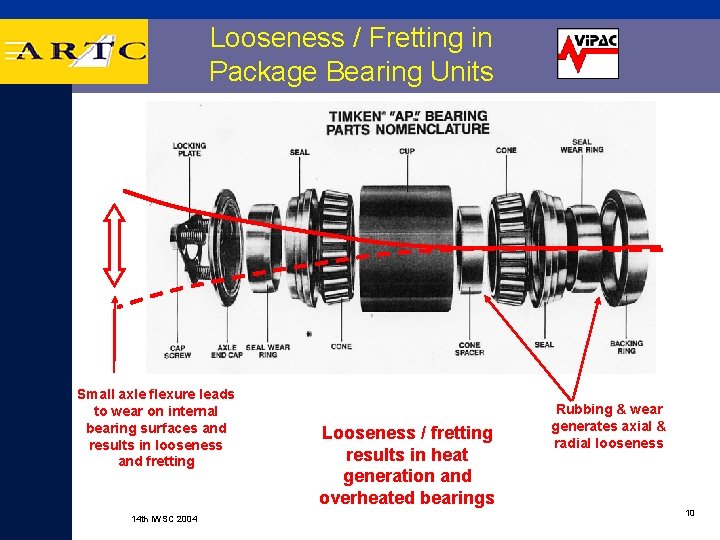
Looseness / Fretting in Package Bearing Units Small axle flexure leads to wear on internal bearing surfaces and results in looseness and fretting 14 th IWSC 2004 Looseness / fretting results in heat generation and overheated bearings Rubbing & wear generates axial & radial looseness 10
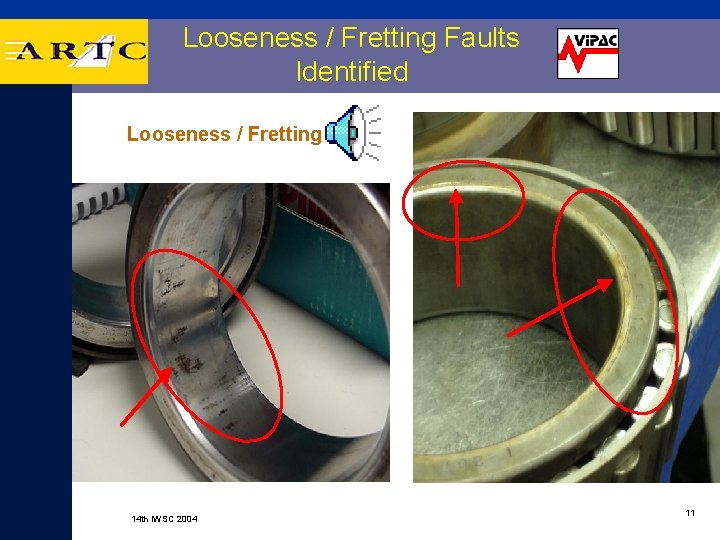
Looseness / Fretting Faults Identified Looseness / Fretting 14 th IWSC 2004 11
Bearing Fault Statistics Tapered Roller Package Bearings - mostly removed due to: Spalling on raceways Ø Fretting wear on the cone back face, backing ring or seal wear ring. Ø Axle Box Bearings - mostly removed due to: Ø Excessive wear or looseness. Algorithm enhancements an on-going process and may be bearing type specific. Note Hot Box detectors can only alert after there is a total failure within the bearing and thermal run away has escalated the external bearing temp 60 degree above normal temps. 14 th IWSC 2004 12
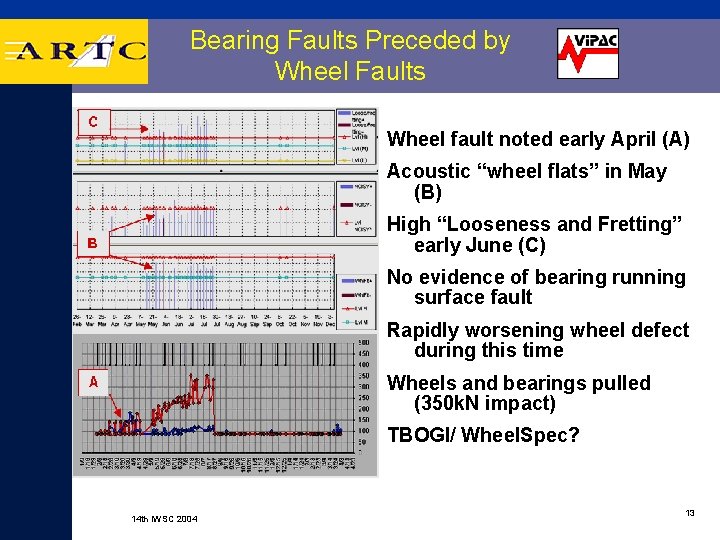
Bearing Faults Preceded by Wheel Faults Wheel fault noted early April (A) Acoustic “wheel flats” in May (B) High “Looseness and Fretting” early June (C) No evidence of bearing running surface fault Rapidly worsening wheel defect during this time Wheels and bearings pulled (350 k. N impact) TBOGI/ Wheel. Spec? 14 th IWSC 2004 13
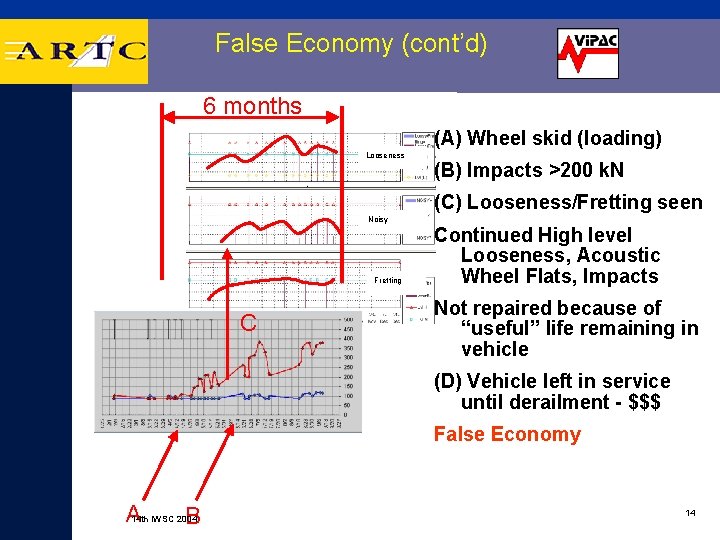
False Economy (cont’d) 6 months (A) Wheel skid (loading) Looseness (B) Impacts >200 k. N (C) Looseness/Fretting seen Noisy Fretting C Continued High level Looseness, Acoustic Wheel Flats, Impacts Not repaired because of “useful” life remaining in vehicle (D) Vehicle left in service until derailment - $$$ False Economy A B 14 th IWSC 2004 14
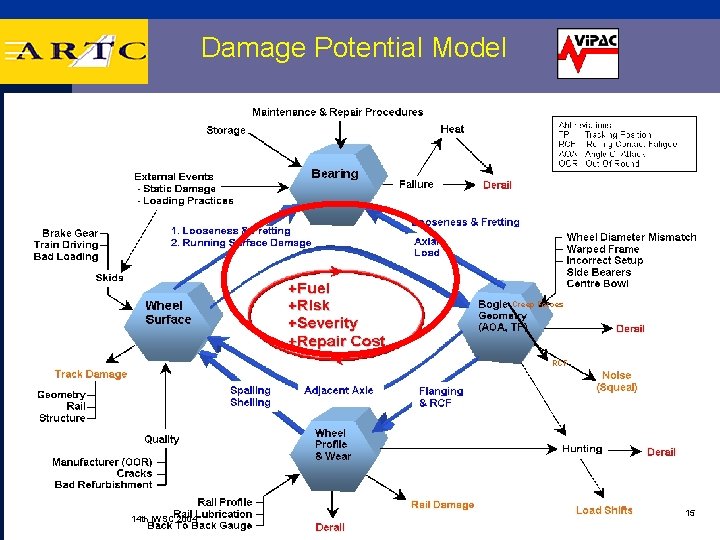
Damage Potential Model Creep Forces RCF 14 th IWSC 2004 15
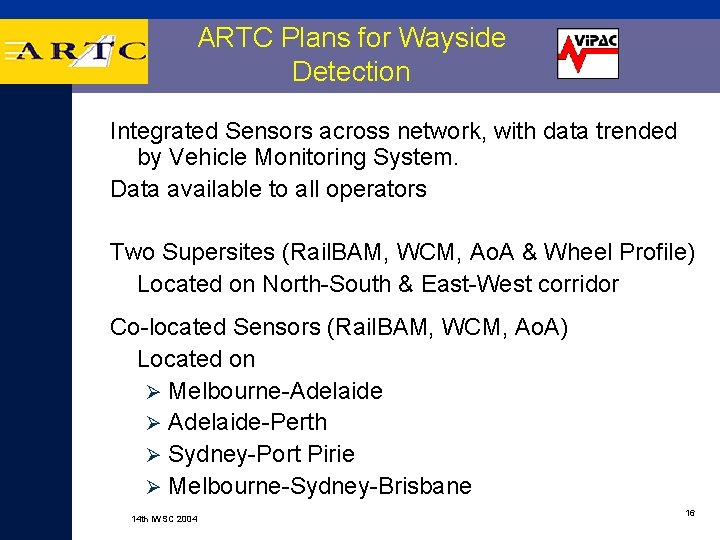
ARTC Plans for Wayside Detection Integrated Sensors across network, with data trended by Vehicle Monitoring System. Data available to all operators Two Supersites (Rail. BAM, WCM, Ao. A & Wheel Profile) Located on North-South & East-West corridor Co-located Sensors (Rail. BAM, WCM, Ao. A) Located on Ø Melbourne-Adelaide Ø Adelaide-Perth Ø Sydney-Port Pirie Ø Melbourne-Sydney-Brisbane 14 th IWSC 2004 16
Proposed Wayside Sensor Locations Existing Sensors Rail. BAM WCM Darwin Proposed Sensors Rail. BAM WCM Ao. A & TP Wheel Profile Rail. SQAD Perth West. Net. Rail 5 Rail. BAM’s 14 th IWSC 2004 Sydney Adelaide 17
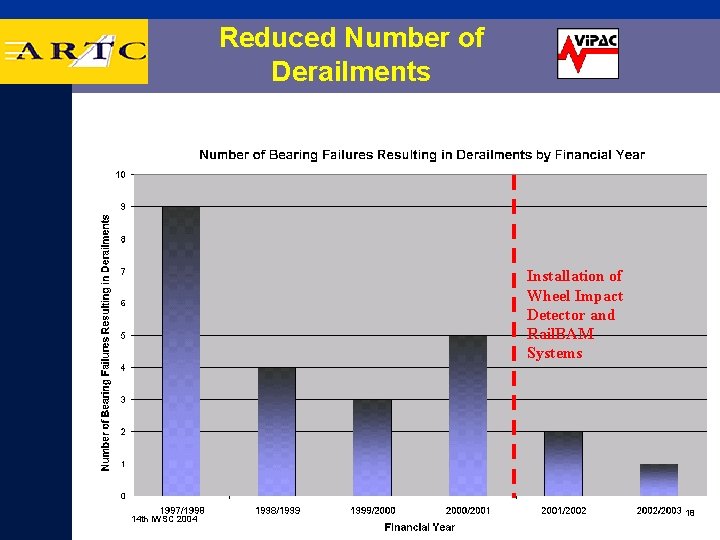
Reduced Number of Derailments Installation of Wheel Impact Detector and Rail. BAM Systems 14 th IWSC 2004 18
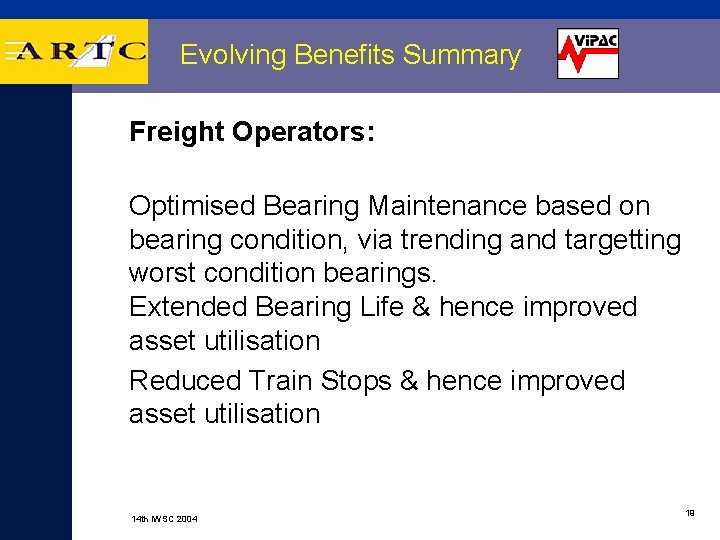
Evolving Benefits Summary Freight Operators: Optimised Bearing Maintenance based on bearing condition, via trending and targetting worst condition bearings. Extended Bearing Life & hence improved asset utilisation Reduced Train Stops & hence improved asset utilisation 14 th IWSC 2004 19