
Ways to investigate the brain Methodology POST MORTEM
Ways to investigate the brain Methodology POST MORTEM & SCANNING TECHNIQUES PET and MRI scanning
How can we study the brain? With a partner Identify at least 3 methods used to study the brain. List the types of scanning techniques you have heard of. Come up with one reason why brain scanning could be a useful research method for psychologists?
Psychologists have devised several ways of studying the brain to try to discover which brain areas are Structure associated with which specific abilities and to Function ascertain how the brain works.

Lesson Outcome All Students will be able to describe a variety of methods used to study the brain using appropriate terminology
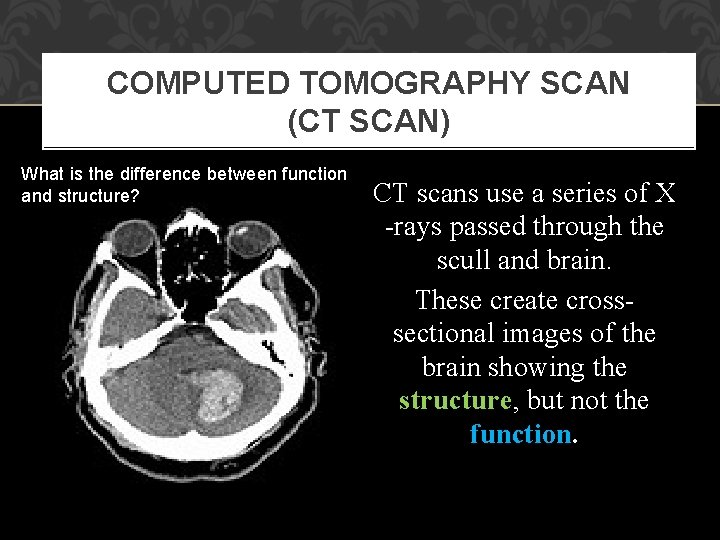
COMPUTED TOMOGRAPHY SCAN (CT SCAN) What is the difference between function and structure? CT scans use a series of X -rays passed through the scull and brain. These create crosssectional images of the brain showing the structure, but not the function.
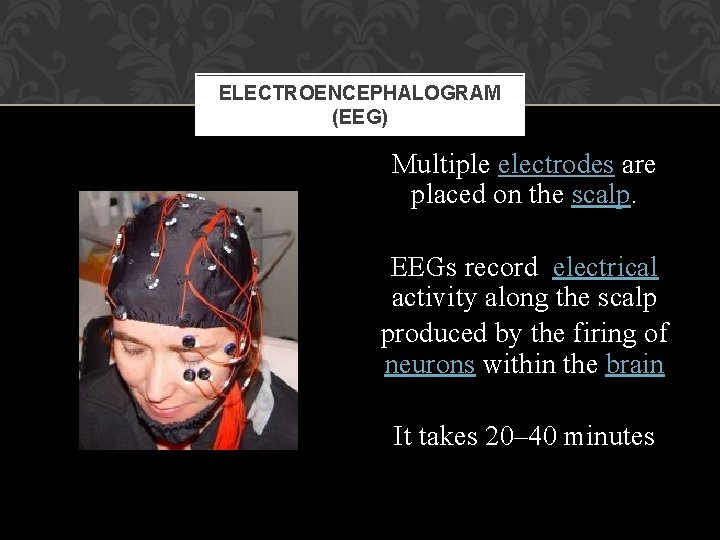
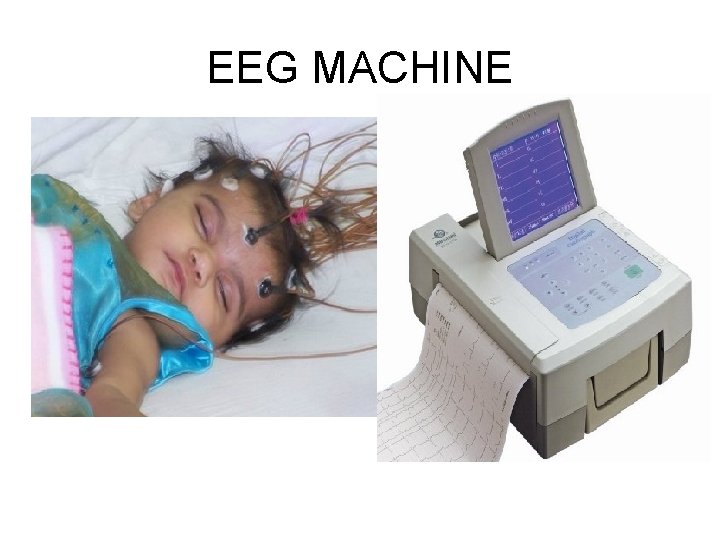
ELECTROENCEPHALOGRAM (EEG) Multiple electrodes are placed on the scalp. EEGs record electrical activity along the scalp produced by the firing of neurons within the brain It takes 20– 40 minutes
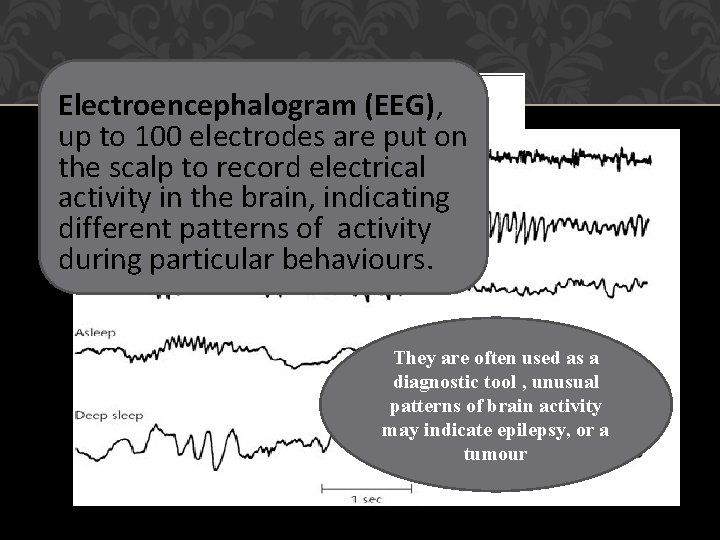
EEG READ OUT Electroencephalogram (EEG), up to 100 electrodes are put on the scalp to record electrical activity in the brain, indicating different patterns of activity during particular behaviours. They are often used as a diagnostic tool , unusual patterns of brain activity may indicate epilepsy, or a tumour
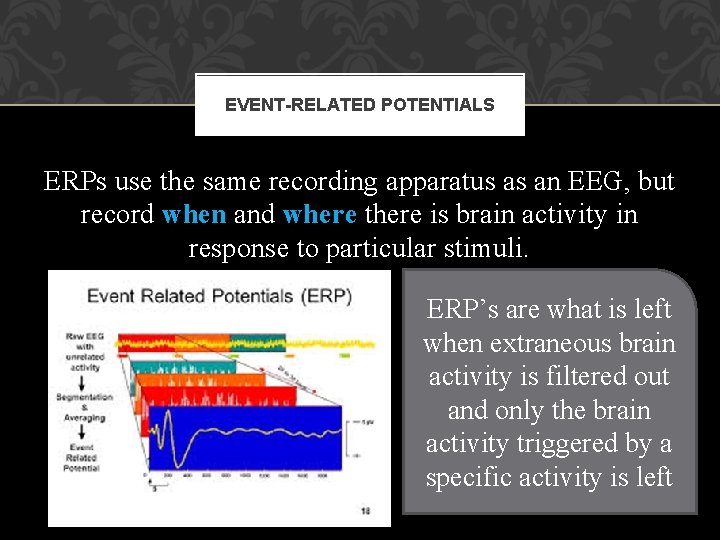
EVENT-RELATED POTENTIALS ERPs use the same recording apparatus as an EEG, but record when and where there is brain activity in response to particular stimuli. ERP’s are what is left when extraneous brain activity is filtered out and only the brain activity triggered by a specific activity is left
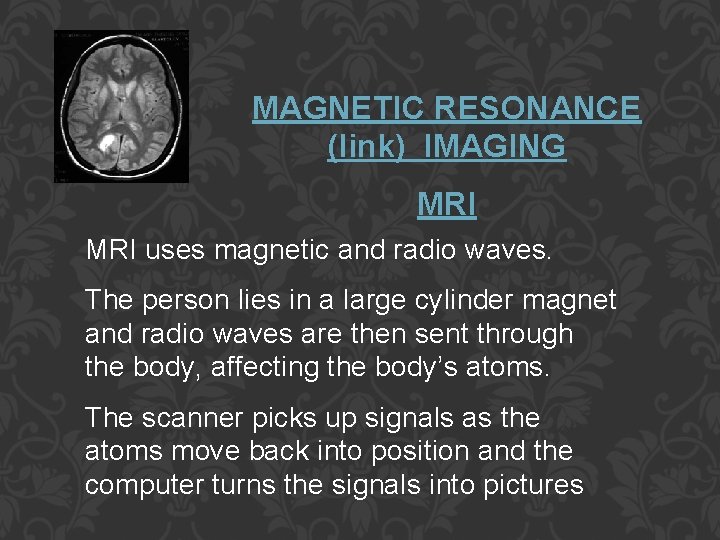
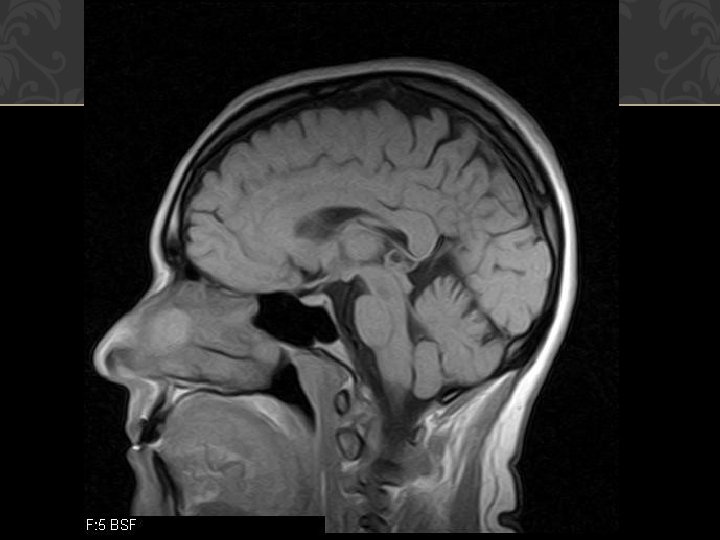
MAGNETIC RESONANCE (link) IMAGING MRI uses magnetic and radio waves. The person lies in a large cylinder magnet and radio waves are then sent through the body, affecting the body’s atoms. The scanner picks up signals as the atoms move back into position and the computer turns the signals into pictures
(LINK) MAGNETIC RESONANCE IMAGING (MRI) Put which another way MRI scanning uses a strong magnetic field affects some atoms. Protons (positively charged particles) in hydrogen atoms in water behave like compass needles. MRI detects signals produced by displaced radio waves insame a The scanner’s electromagnet causes the protons to ‘point’ in the direction. magnetic field. When radio waves are passed through the scull the protons return to their original positions and this detected by scanner. anatomical It isprovides a the detailed view of the brain. Parts of the brain with more hydrogen atoms appear paler; those with fewer hydrogen atoms look darker.
ANOTHER USE Functional Magnetic Resonance Imaging (f. MRI) f. MRI detects changes in blood flow to particular areas of the brain. It provides both an anatomical and a functional view of the brain.
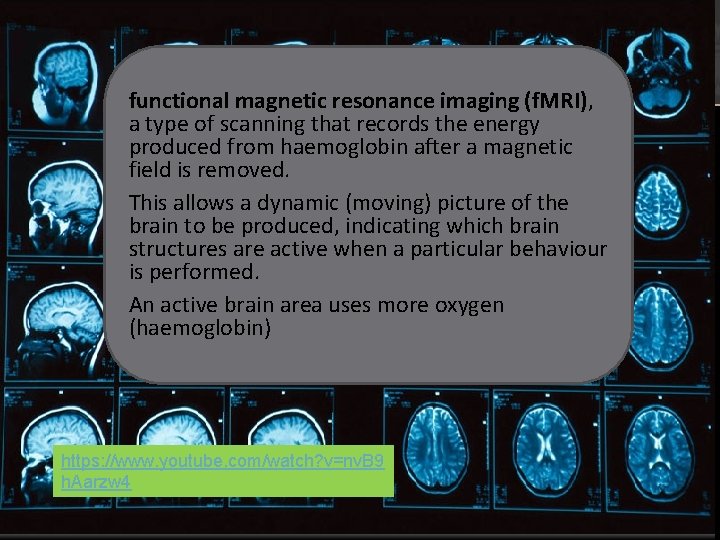
functional magnetic resonance imaging (f. MRI), a type of scanning that records the energy produced from haemoglobin after a magnetic field is removed. This allows a dynamic (moving) picture of the brain to be produced, indicating which brain structures are active when a particular behaviour is performed. An active brain area uses more oxygen (haemoglobin) https: //www. youtube. com/watch? v=nv. B 9 h. Aarzw 4
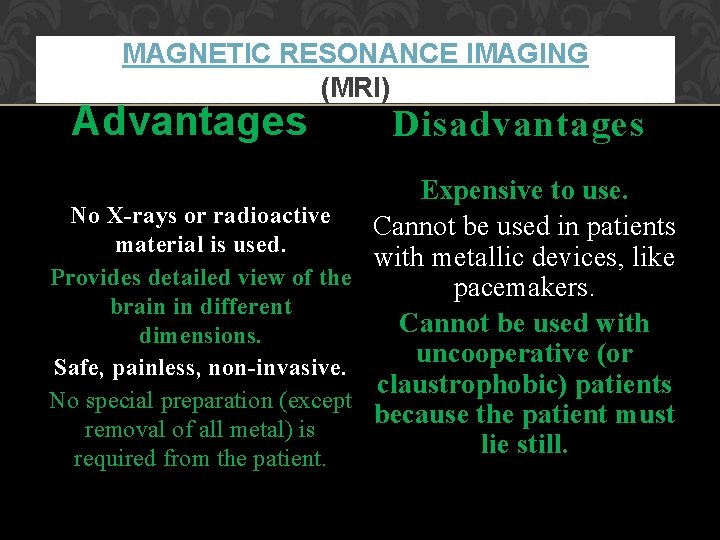
MAGNETIC RESONANCE IMAGING (MRI) Advantages Disadvantages Expensive to use. No X-rays or radioactive Cannot be used in patients material is used. with metallic devices, like Provides detailed view of the pacemakers. brain in different Cannot be used with dimensions. uncooperative (or Safe, painless, non-invasive. claustrophobic) patients No special preparation (except because the patient must removal of all metal) is lie still. required from the patient.
POST-MORTEMS Post-mortems are generally performed on dead individuals who exhibited particular forms of non-typical behaviour before death. This is to identify where in the brain those activities are dealt with – there may be a problem though in generalising from the brains of abnormal individuals to those who don’t exhibit such unusual behaviours.
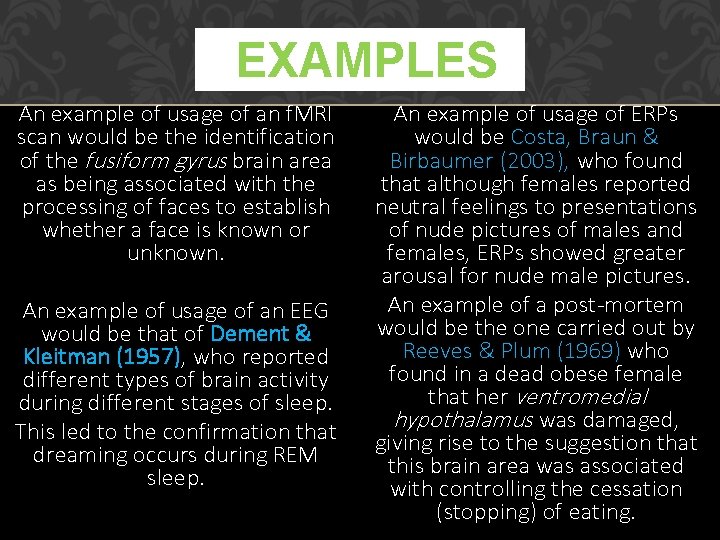
EXAMPLES An example of usage of an f. MRI scan would be the identification of the fusiform gyrus brain area as being associated with the processing of faces to establish whether a face is known or unknown. An example of usage of an EEG would be that of Dement & Kleitman (1957), who reported different types of brain activity during different stages of sleep. This led to the confirmation that dreaming occurs during REM sleep. An example of usage of ERPs would be Costa, Braun & Birbaumer (2003), who found that although females reported neutral feelings to presentations of nude pictures of males and females, ERPs showed greater arousal for nude male pictures. An example of a post-mortem would be the one carried out by Reeves & Plum (1969) who found in a dead obese female that her ventromedial hypothalamus was damaged, giving rise to the suggestion that this brain area was associated with controlling the cessation (stopping) of eating.
ACTIVITY The different methods of studying the brain all have their advantages and disadvantages. In pairs, compile a list of the strengths and weaknesses of the following: 1. f. MRI scans 2. EEGs 3. ERPs 4. Post-mortem examinations. Extension: Is it possible to say that any one particular method is superior to the others? Justify your decision.
EXAM-TYPE QUESTION Explain how an electroencephalogram might be used to investigate the functions of the brain. [3 marks] Question guidance This is an example of a short-answer question. A mark would be gained for providing a relevant, accurate point, with up to two further marks available for elaboration (providing detail) of this point. One method of providing such elaboration might be to provide a relevant example to show your understanding of the technique.
LINK Click the link above to find out about the connectnome project CLICK Extension Activity

PET SCANS Not on the syllabus but interesting
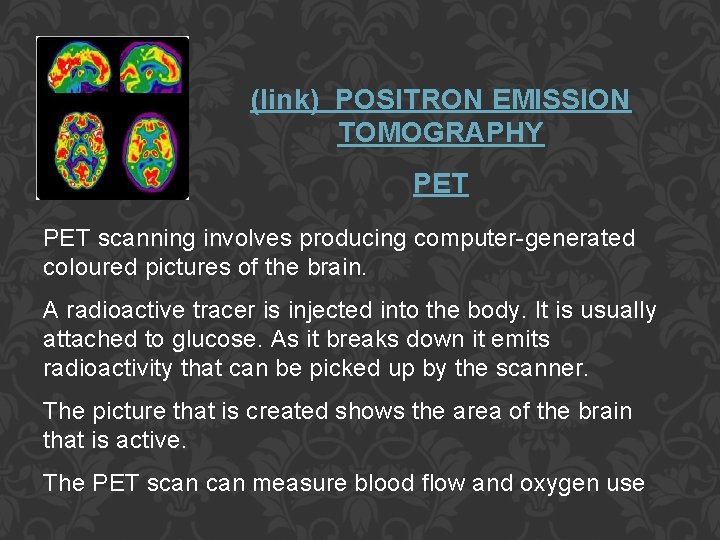
(link) POSITRON EMISSION TOMOGRAPHY PET scanning involves producing computer-generated coloured pictures of the brain. A radioactive tracer is injected into the body. It is usually attached to glucose. As it breaks down it emits radioactivity that can be picked up by the scanner. The picture that is created shows the area of the brain that is active. The PET scan measure blood flow and oxygen use
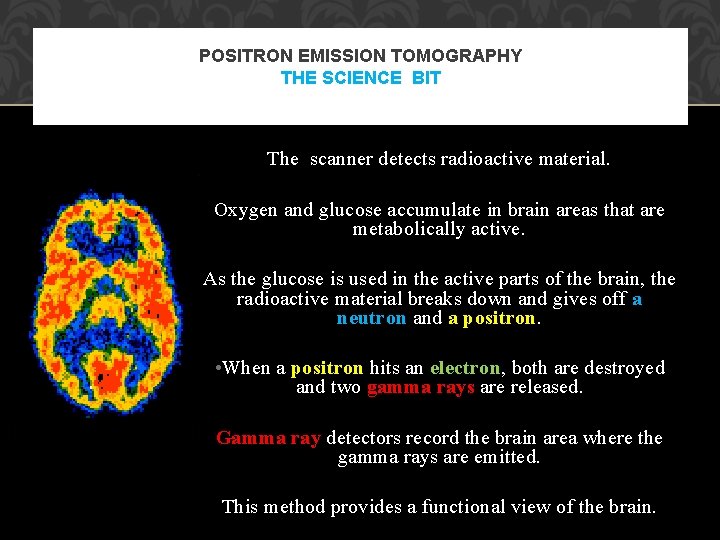
POSITRON EMISSION TOMOGRAPHY THE SCIENCE BIT The scanner detects radioactive material. Oxygen and glucose accumulate in brain areas that are metabolically active. As the glucose is used in the active parts of the brain, the radioactive material breaks down and gives off a neutron and a positron. • When a positron hits an electron, both are destroyed and two gamma rays are released. Gamma ray detectors record the brain area where the gamma rays are emitted. This method provides a functional view of the brain.
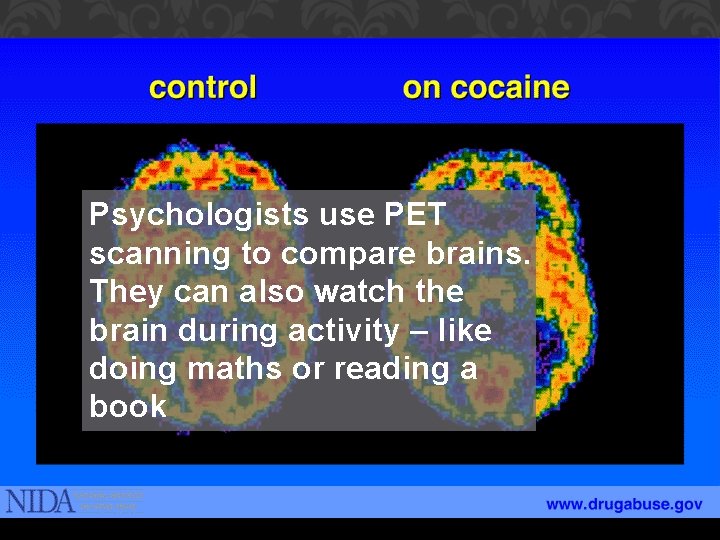
Psychologists use PET scanning to compare brains. They can also watch the brain during activity – like doing maths or reading a book
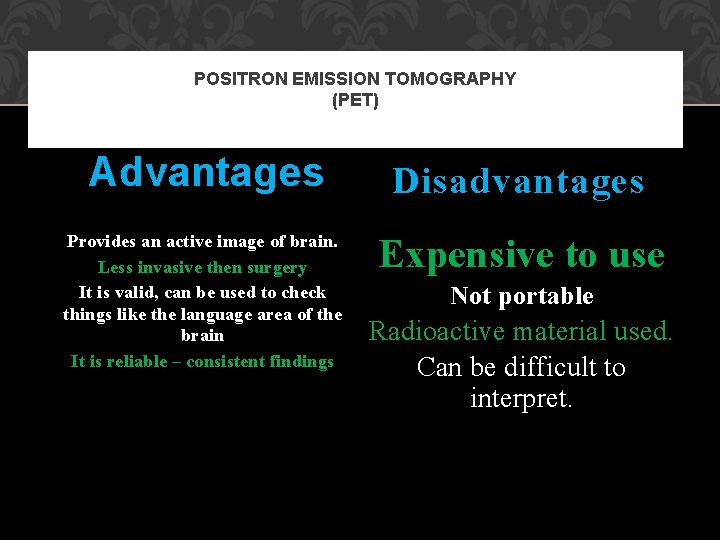
POSITRON EMISSION TOMOGRAPHY (PET) Advantages Provides an active image of brain. Less invasive then surgery It is valid, can be used to check things like the language area of the brain It is reliable – consistent findings Disadvantages Expensive to use Not portable Radioactive material used. Can be difficult to interpret.
STAGES OF SLEEP

HOW MANY HOURS DO YOU USUALLY SLEEP A NIGHT?
What Happens When We Sleep? Sleep occurs in a recurring cycle of 90 to 110 minutes. It is divided into two categories: 1. Non-REM (which is further split into four stages) 2. REM sleep. There are four stages in the non-REM sleep. REM stands for Rapid Eye Movement.
EEG MACHINE
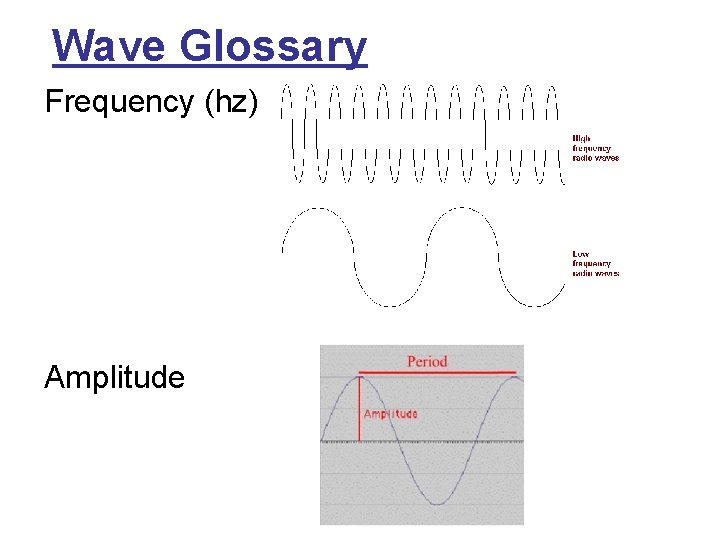
Wave Glossary Frequency (hz) Amplitude
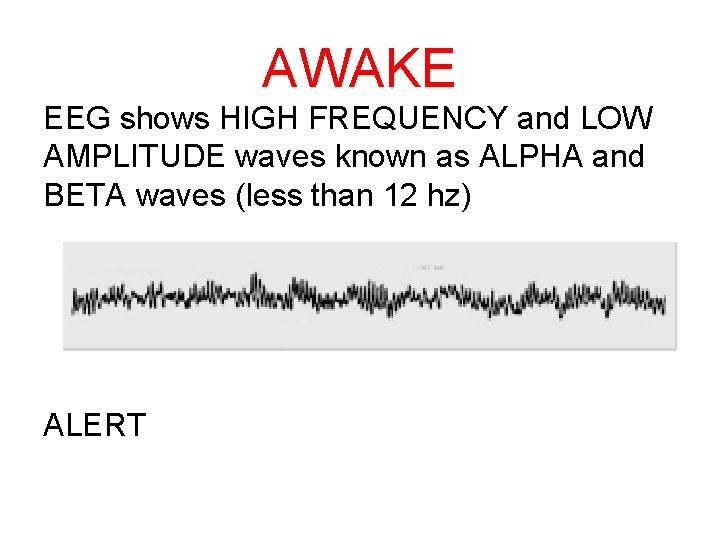
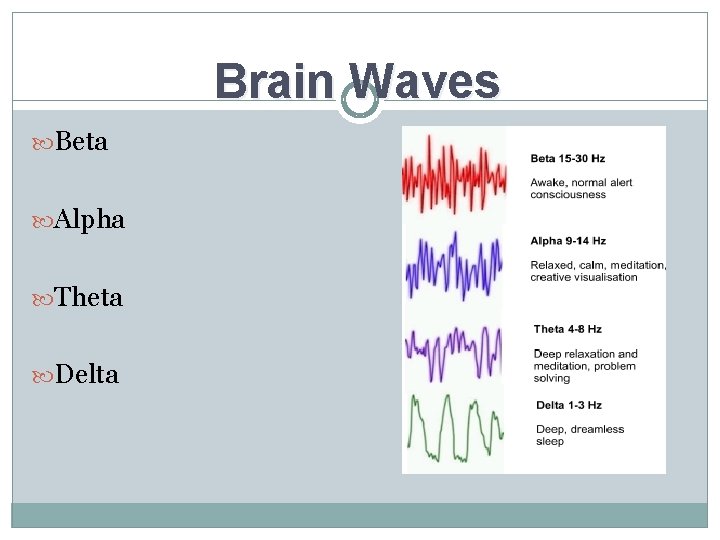
AWAKE EEG shows HIGH FREQUENCY and LOW AMPLITUDE waves known as ALPHA and BETA waves (less than 12 hz) ALERT
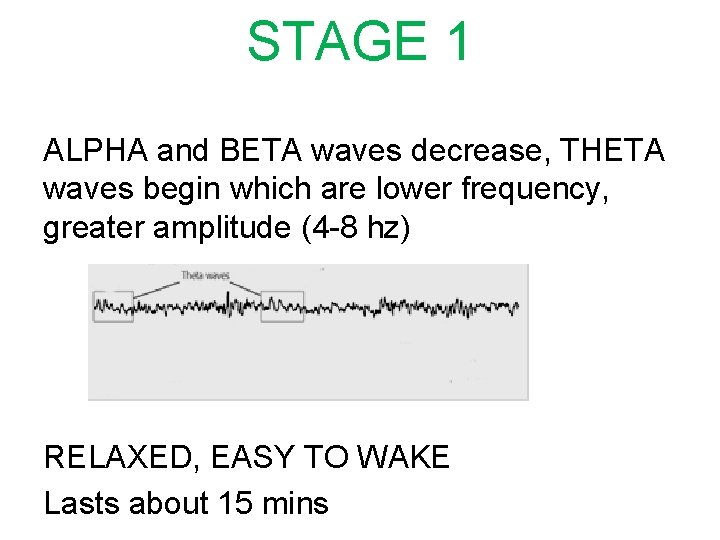
STAGE 1 ALPHA and BETA waves decrease, THETA waves begin which are lower frequency, greater amplitude (4 -8 hz) RELAXED, EASY TO WAKE Lasts about 15 mins
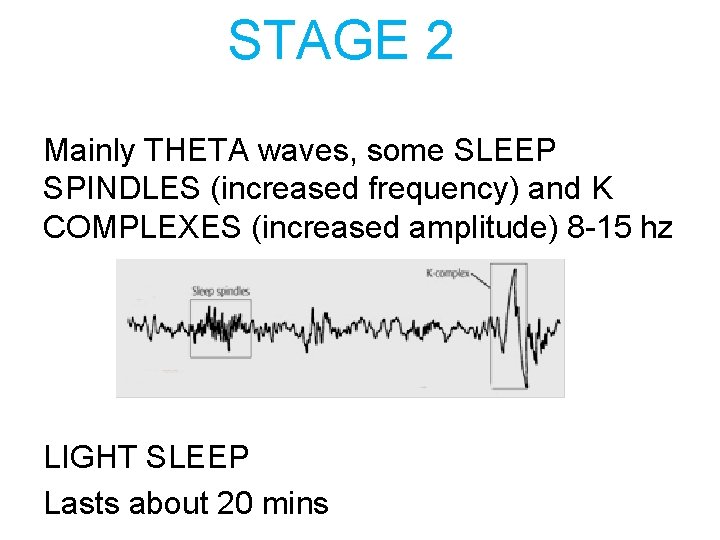
STAGE 2 Mainly THETA waves, some SLEEP SPINDLES (increased frequency) and K COMPLEXES (increased amplitude) 8 -15 hz LIGHT SLEEP Lasts about 20 mins
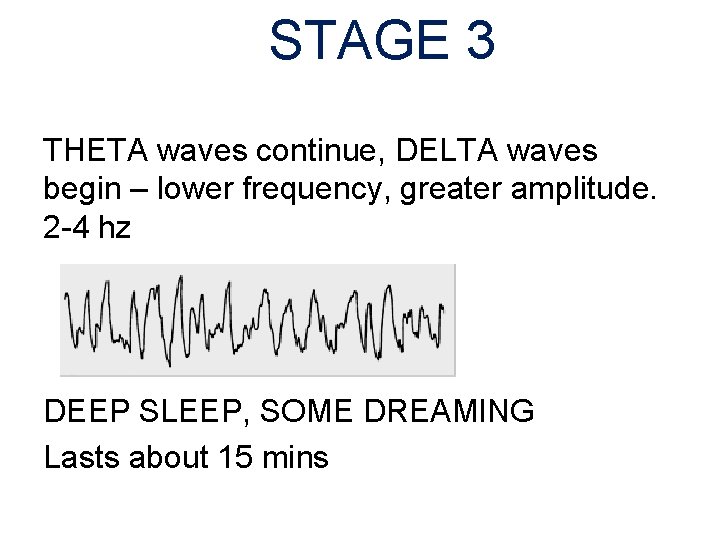
STAGE 3 THETA waves continue, DELTA waves begin – lower frequency, greater amplitude. 2 -4 hz DEEP SLEEP, SOME DREAMING Lasts about 15 mins
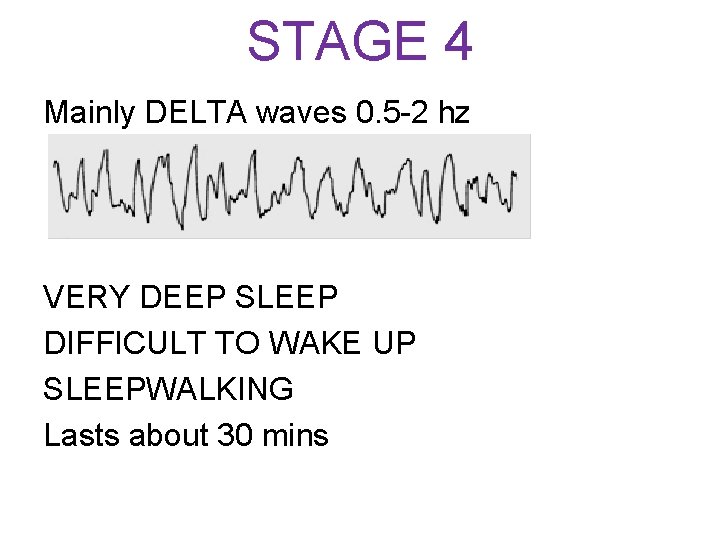
STAGE 4 Mainly DELTA waves 0. 5 -2 hz VERY DEEP SLEEP DIFFICULT TO WAKE UP SLEEPWALKING Lasts about 30 mins
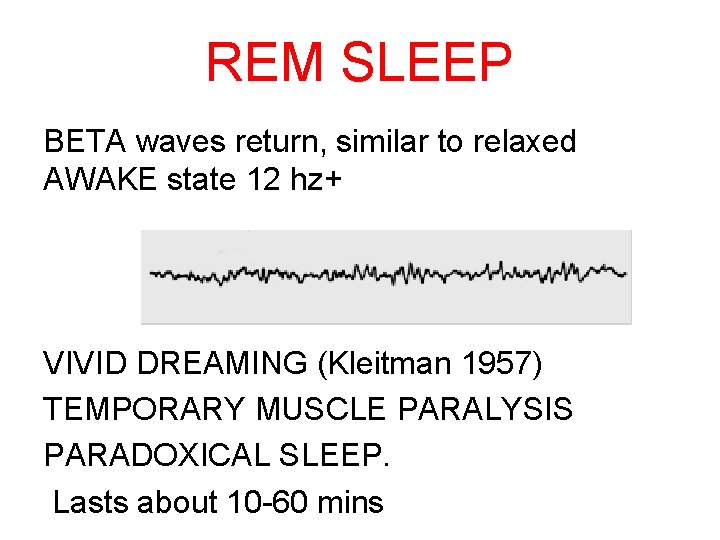
REM SLEEP BETA waves return, similar to relaxed AWAKE state 12 hz+ VIVID DREAMING (Kleitman 1957) TEMPORARY MUSCLE PARALYSIS PARADOXICAL SLEEP. Lasts about 10 -60 mins
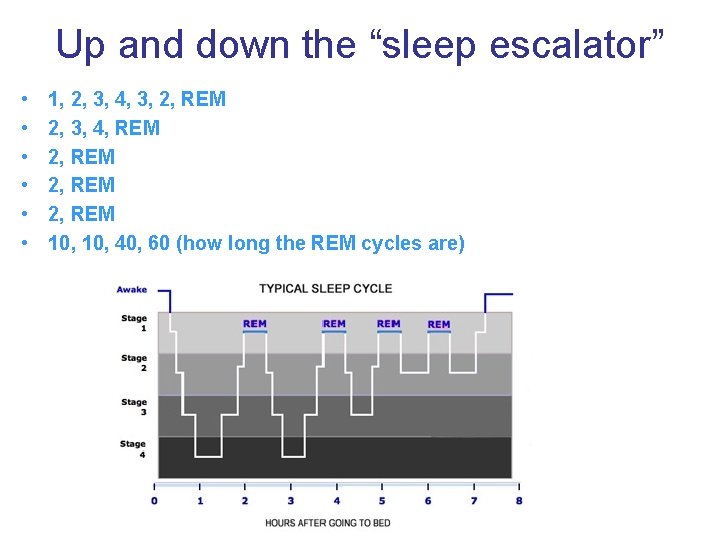
Up and down the “sleep escalator” • • • 1, 2, 3, 4, 3, 2, REM 2, 3, 4, REM 2, REM 10, 40, 60 (how long the REM cycles are)
Brain Waves Beta Alpha Theta Delta
- Slides: 37