
Ways to induce labor Julie Springer Induction n

+ Ways to induce labor Julie Springer
+ Induction n An estimated 22% of all gravid women undergo induction n Done when benefits of expeditious delivery outweigh the risks of continuing pregnancy n Fetal or maternal indications
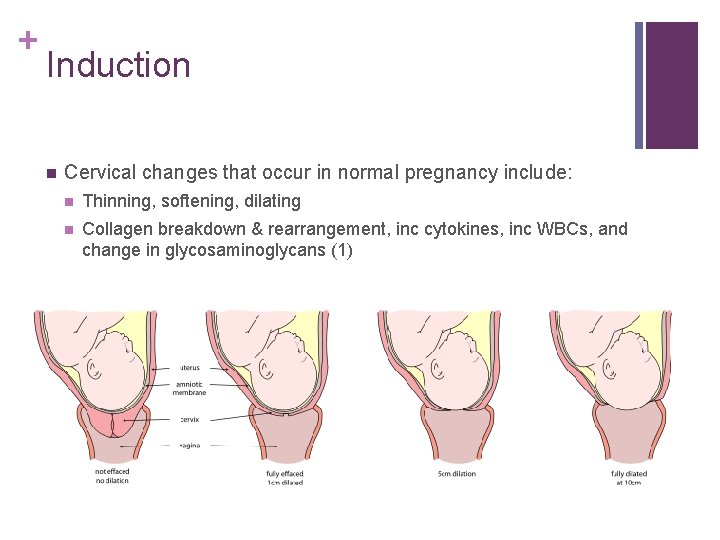
+ Induction n Cervical changes that occur in normal pregnancy include: n Thinning, softening, dilating n Collagen breakdown & rearrangement, inc cytokines, inc WBCs, and change in glycosaminoglycans (1)
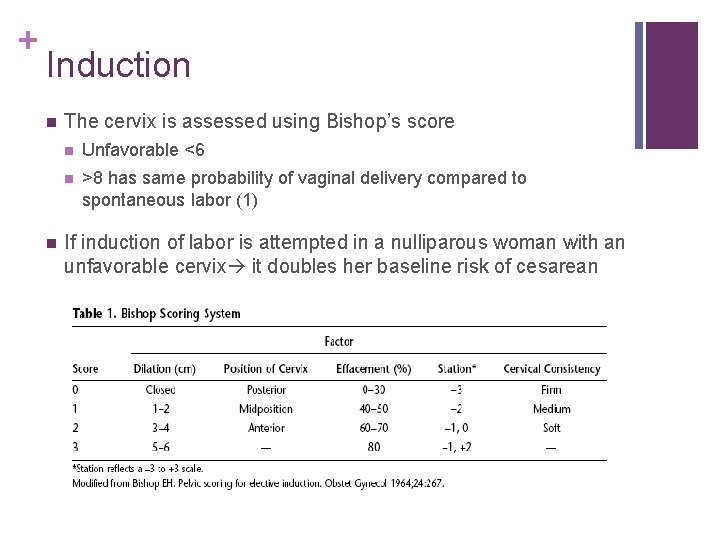
+ Induction n n The cervix is assessed using Bishop’s score n Unfavorable <6 n >8 has same probability of vaginal delivery compared to spontaneous labor (1) If induction of labor is attempted in a nulliparous woman with an unfavorable cervix it doubles her baseline risk of cesarean
+ Methods of induction of labor n Non-pharmacologic methods n n Pharmacologic methods n n Misoprostol, dinosprostone, oxytocin Mechanical methods n n Membranes stripping, nipple stimulation, castor oil Foley, Cook Catheter, EASI Special Populations n Prior Cesarean n PROM
+ Nonpharmacologic methods Induction of labor
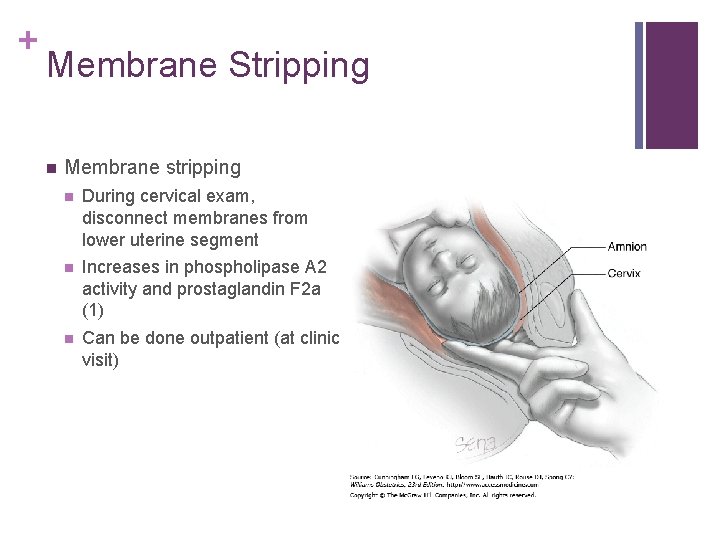
+ Membrane Stripping n Membrane stripping n During cervical exam, disconnect membranes from lower uterine segment n Increases in phospholipase A 2 activity and prostaglandin F 2 a (1) n Can be done outpatient (at clinic visit)
+ Membrane Stripping Cont’d n Cochrane Review in 2009 - 22 trials n Membrane stripping results in spontaneous labor 3 days sooner than if membranes were not stripped n It reduces need for other methods for induction of labor n It causes maternal discomfort, but no major maternal or fetal adverse effects n Results are less predictable(3)
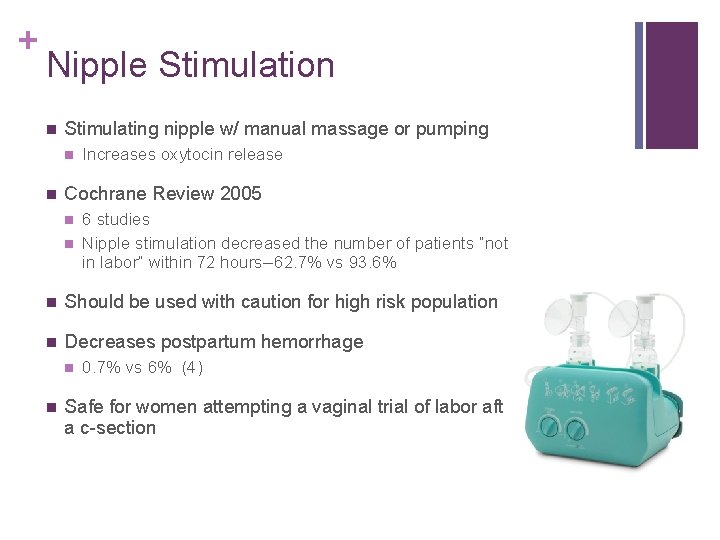
+ Nipple Stimulation n Stimulating nipple w/ manual massage or pumping n n Increases oxytocin release Cochrane Review 2005 n n 6 studies Nipple stimulation decreased the number of patients “not in labor” within 72 hours--62. 7% vs 93. 6% n Should be used with caution for high risk population n Decreases postpartum hemorrhage n n 0. 7% vs 6% (4) Safe for women attempting a vaginal trial of labor after a c-section
+ Castor Oil n Vegetable oil n n n Used as laxative- works on small intestines Cochrane Review n 3 studies all with single dose of castor oil n No difference in cesarean section rates n Maternal side effects were high (6) Castor Oil is NOT generally used for induction
+ Pharmacologic methods Induction of labor
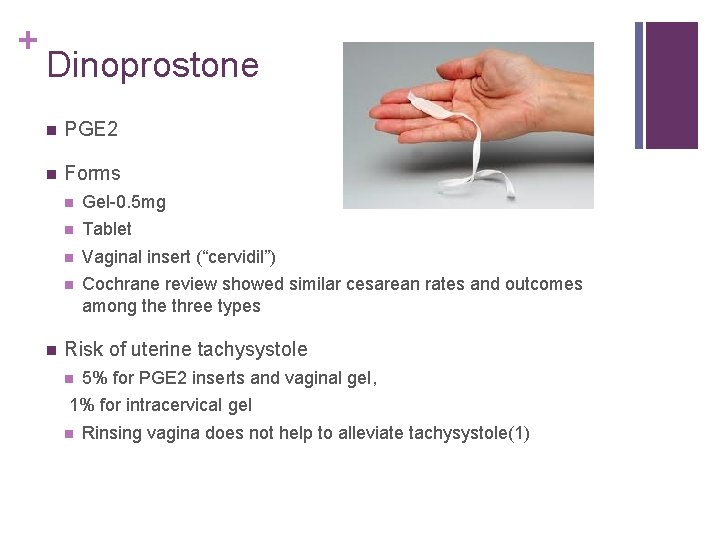
+ Dinoprostone n PGE 2 n Forms n n Gel-0. 5 mg n Tablet n Vaginal insert (“cervidil”) n Cochrane review showed similar cesarean rates and outcomes among the three types Risk of uterine tachysystole n 5% for PGE 2 inserts and vaginal gel, 1% for intracervical gel n Rinsing vagina does not help to alleviate tachysystole(1)
+ Dinoprostone Cont’d n Cochrane Review 2012 n 63 studies reviewed, 10, 441 women n Compared to placebo, dinoprostone increases the rate of cervical favorability and successful vaginal delivery in 24 hours n PGE 2 has no effect on rate of cesarean section n It results in increased rates of hyperstimulation and FHR changes n 4. 4% vs 0. 49% incidence (8)
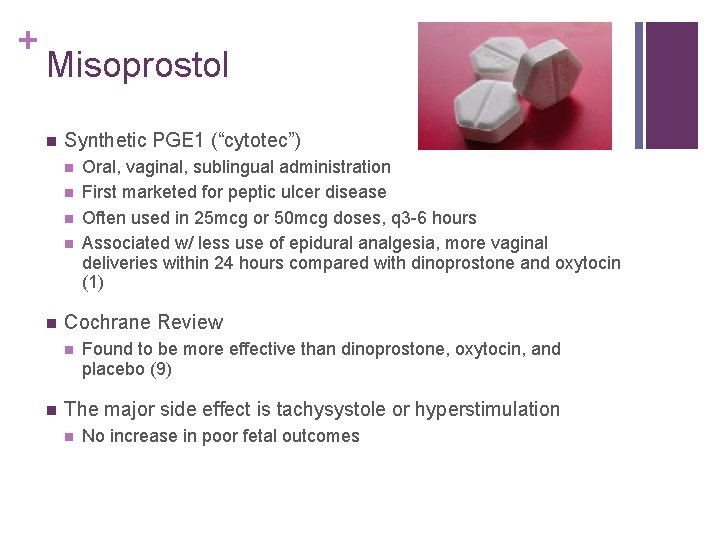
+ Misoprostol n Synthetic PGE 1 (“cytotec”) n n n Cochrane Review n n Oral, vaginal, sublingual administration First marketed for peptic ulcer disease Often used in 25 mcg or 50 mcg doses, q 3 -6 hours Associated w/ less use of epidural analgesia, more vaginal deliveries within 24 hours compared with dinoprostone and oxytocin (1) Found to be more effective than dinoprostone, oxytocin, and placebo (9) The major side effect is tachysystole or hyperstimulation n No increase in poor fetal outcomes
+ Dosage of misoprostol n Cochrane Review n No advantage of higher doses to lower doses n Lower doses result in less hyperstimulation but more need for oxytocin n The majority of studies used 25 mcg vs 50 mcg (9)
+ Oral vs Vaginal Misoprostol n n Cochrane Review n Oral dose has been shown to result in fewer cases of low apgars and hyperstimulation w/ FHR abnormalities n Oral dose can be titrated more n Vaginal shows less need for oxytocin afterwards (9) Jindal et al n Study of 101 women at term n 50 ug oral vs vaginal n Vaginal dose resulted in less time to delivery than oral- 9. 79 hr vs 16. 47 hr n Decrease number of doses were required in vaginal- 2 vs 6 (15)
+ Misoprostol vs Dinoprostone n Cochrane Review n Misoprostol results in: n less need for oxytocin, less analgesia than dinoprostone n more uterine hyperstimulation then dinoprostone(9)
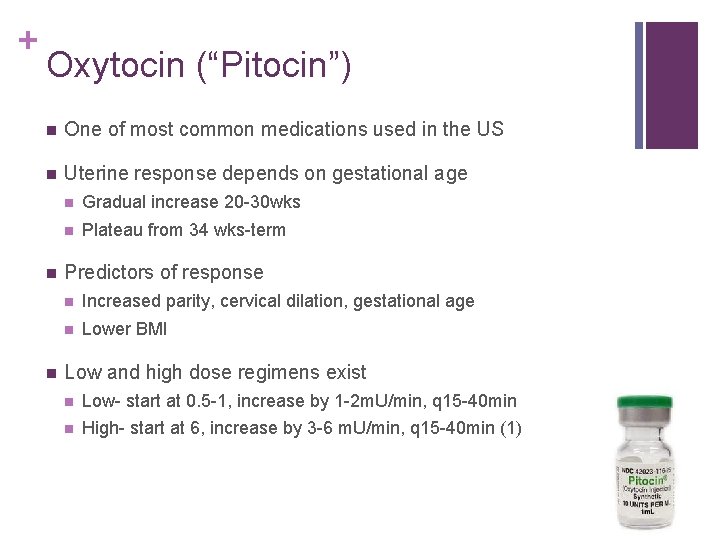
+ Oxytocin (“Pitocin”) n One of most common medications used in the US n Uterine response depends on gestational age n n n Gradual increase 20 -30 wks n Plateau from 34 wks-term Predictors of response n Increased parity, cervical dilation, gestational age n Lower BMI Low and high dose regimens exist n Low- start at 0. 5 -1, increase by 1 -2 m. U/min, q 15 -40 min n High- start at 6, increase by 3 -6 m. U/min, q 15 -40 min (1)

+ Mechanical methods Induction of labor
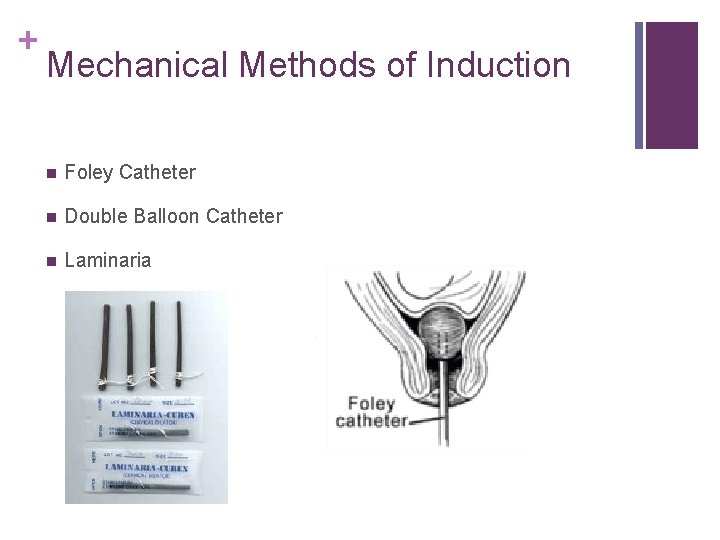
+ Mechanical Methods of Induction n Foley Catheter n Double Balloon Catheter n Laminaria
+ Mechanical vs Pharmacologic n Cochrane Review n n 27 studies reviewed Comparison of any mechanical method vs vaginal prostaglandins n Mechanical methods resulted in fewer deliveries within 24 hrs n n Mechanical methods caused less hyperstimulation w/ FHR changes n n 29% versus 7% 0 vs 5% Comparable cesarean rates- 26 vs 23% (23)
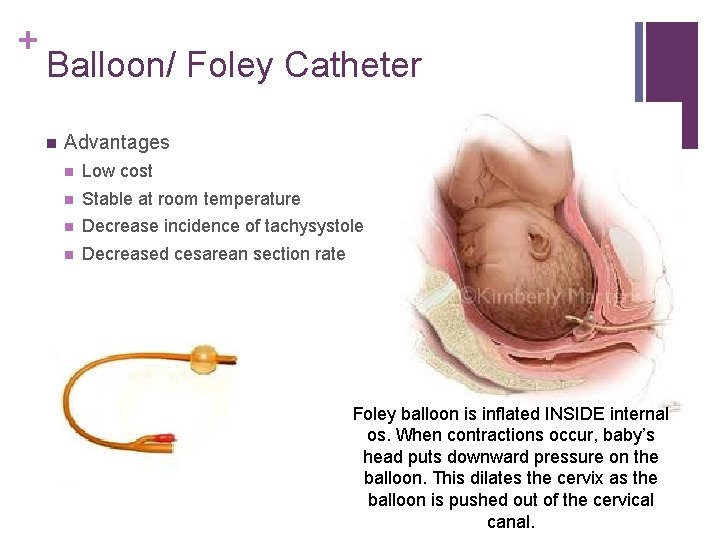
+ Balloon/ Foley Catheter n Advantages n Low cost n Stable at room temperature n Decrease incidence of tachysystole n Decreased cesarean section rate Foley balloon is inflated INSIDE internal os. When contractions occur, baby’s head puts downward pressure on the balloon. This dilates the cervix as the balloon is pushed out of the cervical canal.
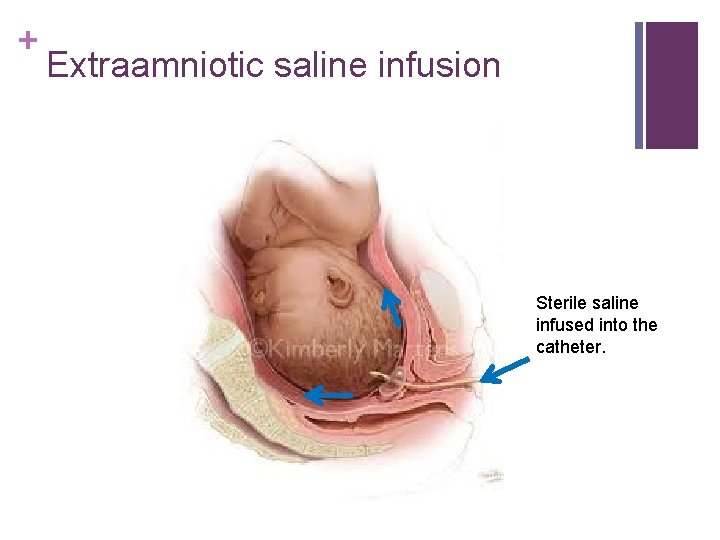
+ Extraamniotic saline infusion Sterile saline infused into the catheter.
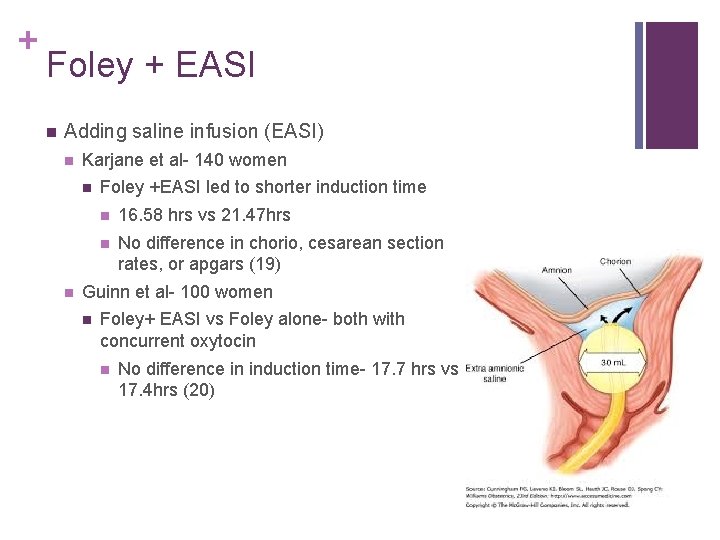
+ Foley + EASI n Adding saline infusion (EASI) n Karjane et al- 140 women n n Foley +EASI led to shorter induction time n 16. 58 hrs vs 21. 47 hrs n No difference in chorio, cesarean section rates, or apgars (19) Guinn et al- 100 women n Foley+ EASI vs Foley alone- both with concurrent oxytocin n No difference in induction time- 17. 7 hrs vs 17. 4 hrs (20)
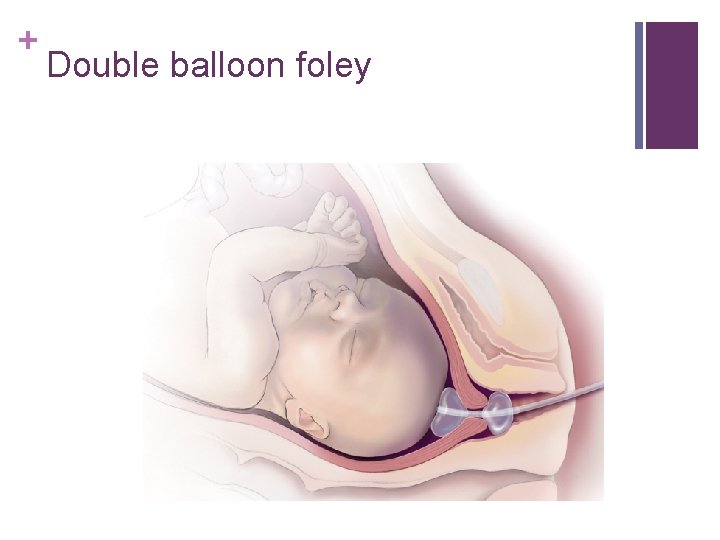
+ Double balloon foley
+ Induction after cesarean section n Cochrane Review n Reviewed 2 studies n Lydon-Rochelle study- compared induction to repeat c-section, evaluated risk for uterine rupture n n Spontaneous labor 3. 3 x risk, induction with non-prostaglandins 5 x risk, and prostaglandins 15. 5 x risk Wing et all- misoprostol vs oxytocin in 38 women n Studied stopped due to 2 uterine ruptures in misoprostol group (10) n Should avoid misoprostol in 3 rd trimester with prior c/s n Use of oxytocin also increases risk of rupture, but only by a small amount (from 36/10, 000 to 87/10, 000) (1)
+ Induction after PROM n Induction of labor on presentation decreases risk of chorioamnionitis and endometritis (26) n Oxytocin n n Decreases risk of chorioamnionitis, postpartum febrile morbidity, and neonatal antibiotic treatments n No increase in cesarean deliveries or neonatal infections Prostaglandins n No evidence that they increase risk of infection n Up to 86% can have successful induction of labor after PROM with misoprostol (24) n Misoprostol is more effective than dinoprostone (25)
+ Citations n 1. Mildred, Ramirez, MD, and Ramin Susan, MD. "ACOG Practice Bulletin No. 107: Induction of Labor. " Obstetrics & Gynecology 114. 2, Part 1 (2009): 386 -97. Print. n 2. Yildirim, Gokhan, Kemal Güngördük, Özge İdem Karadağ, Halİl Aslan, Erdem Turhan, and Yavuz Ceylan. "Membrane Sweeping to Induce Labor in Low-risk Patients at Term Pregnancy: A Randomised Controlled Trial. " Journal of Maternal-Fetal and Neonatal Medicine 23. 7 (2010): 681 -87. Pub. Med. Web. 14 Jan. 2014. n 3. Michel, Boulvain, Stan Catalin, and Irion Olivier. "Membrane Sweeping for Induction of Labor. " Cochrane Database of Systemic Reviews 4 (2009): n. pag. Web. 14 Jan. 2014. <http: //www. ncbi. nlm. nih. gov/pubmed/15674873>. n 4. Josephine, Kavangh, MD, Kelly Anthony, and Thomas Jane. "Breast Stimulation for Cervical Ripening or Induction of Labor. " Cochrane Database of Systemic Reviews 4 (2009): n. pag. Web. 14 Jan. 2014. n 5. EO, Ugwu, Iferikigwe ES, Dim CC, and Ezugwu FO. "Membrane Stripping to Prevent Post-term Pregnancy in Enugu, Nigeria: A Randomized Controlled Trial. " Arch Gynecology Obstetrics 289. 1 (2014): 29 -34. Web. 14 Jan. 2014. n 6. Anthony, Kelly, Kavanagh Josephine, and Thomas Jane. "Castor Oil, Bath And/or Enema for Cervical Priming and Induction of Labor. " Cochrane Database of Systemic Reviews 7 (2013): n. pag. Wolters Kluwer. Web. 14 Jan. 2014 n 7. Boel, Macteld Elisabeth, Sue Jean Lee, Marcus Johannes Rijken, Moo Koo Paw, Mupawjay Pimanpanarak, Saw Oo Tan Singhasivanon, Francois Nosten, and Rose Mc. Gready. "Castor Oil for Induction of Labour: Not Harmful, Not Helpful. " The Australian and New Zealand Journal of Obstetrics and Gynaecology 49. 5 (2009): 499 -503. Wiley. Web. 14 Jan. 2014. n 8. Kelly, Anthony, Sidra Malik, Lee Smith, Josephine Kavanagh, and Jane Thomas. "Vaginal Prostaglandin for Induction of Labour at Term. " Cochrane Database of Systemic Reviews 5 (2012): n. pag. Wolters Kluwer. Web. 14 Jan. 2014. n 9. Hofmeyr, Justus, A. Metin, and Cynthia Pileggi. "Vaginal Misoprostol for Cervical Ripening and Induction of Labour. " Cochrane Database of Systemic Reviews 1 (2013): n. pag. Wolters Kluwer. Web. 14 Jan. 2014.
+ Citations n 10. n 11. Satin, AJ, KJ Leveno, ML Sherman, DS Brewster, and FG Cunningham. "High versus Low Dose Oxytocin for Labor Stimulation. " Obstetrics and Gynecology 80. 1 (1992): 111 -16. Pub. Med. Web. 14 Jan. 2014. n 12. Pettker, CM, SB Pocock, DP Smok, SM Lee, and PC Devine. "Transcervical Foley Catheter with and without Oxytocin for Cervical Ripening: A Randomized Controlled Trial. " Obstetrics and Gynecology 111. 6 (2008): 1320 -1326. Pub. Med. Web. 14 Jan. 2014. n 13 Rahman, H. , A. Pradhan, L. Kharka, S. Kar, and S. Dutta. "Comparative Evaluation of 50 Microgram Oral Misoprostol and 25 Microgram Intravaginal Misoprostol for Induction of Labour at Term: A Randomized Trial. " Journal of Obstetrics and Gynaecology Canada 35. 5 (2013): 408 -16. Web. 14 Jan. 2014. n 14. Loto, OM, AA Ikuomola, II Ayuba, and U. Onwudiegwu. "Comparative Study of the Outcome of Induction of Labor Using 25 µg and 50 µg of Vaginal Misoprostol. " Journal of Maternal Fetal Neonatal Medicine 25. 11 (2012): 2359 -362. Web. 14 Jan. 2014 n 15. Jindal, Promila, Kumkum Avasthi, and Maninder Kaur. "A Comparison of Vaginal vs. Oral Misoprostol for Induction of Labor-Double Blind Randomized Trial. " Journal of Obstetrics and Gynaecology India 61. 5 (2011): 538 -42. Springer Link. Web. 14 Jan. 2014. n 16. Garry D, Figueroa R, Kalish RB, Catalano CJ, Maulik D. Randomized controlled trial of vaginal misoprostol versus dinoprostone vaginal insert for labor induction. J Matern Fetal Neonatal Med 2003; 13: 254– 9. n 17. n 18. Carbone, Jeanine, MD, Methodius G. Tuuli, MD, Patricia Fogertey, RN, Kimberly Roehl, MPH, and George Macones, MD. "Combination of Foley Bulb and Vaginal Misoprostol Compared With Vaginal Misoprostol Alone for Cervical Ripening and Labor Induction: A Randomized Controlled Tria. " Obstetrics and Gynecology 121. 2 (2013): 247 -52. Obstetrics and Gynecology. Web. 20 Jan. 2014. n 19. Karjane NW, Brock EL, Walsh SW. Induction of labor using a Foley balloon, with and without extra-amniotic saline infusion. Obstet Gynecol 2006; 107: 234 – 9. n 20. Labor induction in women with an unfavorable Bishop score: randomize controlled trial of intrauterine Foley catheter with concurrent oxytocin infusion versus Foley catheter with extra-amniotic saline infusion with concurrent oxytocin infusion. Am J Obstet Gynecol 2004; 191: 225– 9. (Level I)
+ Citations n 21. n 22. Suffecool, K. , BM Rosenn, S. Kam, J. Mushi, J. Foroutan, and K. Herrera. "Labor Induction in Nulliparous Women with an Unfavorable Cervix: Double Balloon Catheter versus Dinoprostonea. " Journal Perinatology Medicine (2013): n. pag. Pub. Med. Web n 23. Jozwiak, Marta, WM Kitty Bloemenkamp, Anthony Kelly, Willem Ben Mol, Olivier Irion, and Michel Boulvain. "Mechanical Methods for Induction of Labor. " Cochrane Database of Systemic Reviews 3 (2012): n. pag. Wolters Kluwer. Web. 14 Jan. 2014. n 24. Sanchez-Ramos L, Chen AH, Kaunitz AM, Gaudier FL, Delke I. Labor induction with intravaginal misoprostol in term premature rupture of membranes: a randomized study. Obstet Gynecol 1997; 89: 909– 12 n 25. Am J Perinatol. 2013 Apr 16. [Epub ahead of print] Labor Induction for Premature Rupture of Membranes Using Vaginal Misoprostol versus Dinoprostone Vaginal Insert. Abraham C, Meirowitz N, Kohn N. n 26. Dare MR, Middleton P, Crowther CA, Flenady VJ, Varatharaju B. Planned early birth versus expectant management (waiting) for prelabour rupture of membranes at term (37 weeks or more). Cochrane Database of Systematic Reviews 2006, Issue 1. Art. No. : CD 005302. DOI: 10. 1002/14651858. CD 005302. pub 2. (Level III)
- Slides: 31