
Ways of organizing people to perform work Or

- Slides: 30
Ways of organizing people to perform work Or ways of implementing government policy BUREAUCRACY-BY MUMBRUE, DANIEL, THE NATION BUILDING VARIETY.
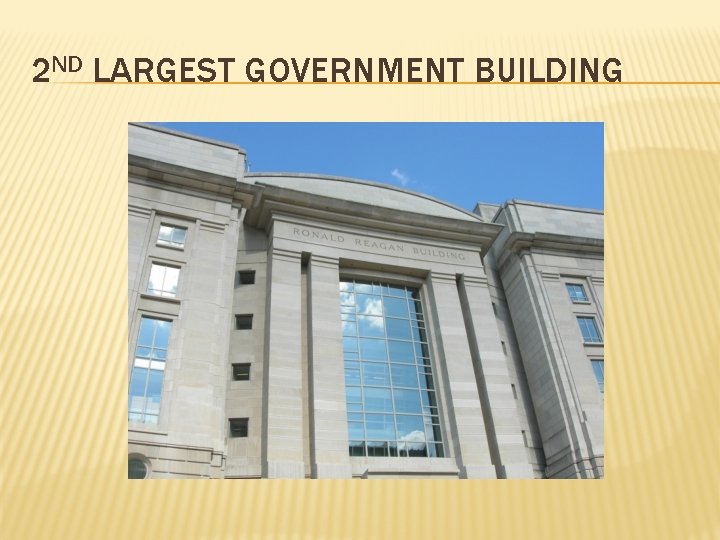
2 ND LARGEST GOVERNMENT BUILDING
QUICK BITS OF INFO � Over 4. 1 million federal government workers � Over 20 million state and local workers � Congress created it � Can be very complex- 12 agencies oversee food inspection in some way. Ex. FDA is part of Health and Human services dept. while USDA is part of Agriculture dept.
MYTHS OF BUREAUCRACY � Americans dislike bureaucrats � Grows bigger every year. (not federal level) � They work in D. C. (only 16 %) � Are inefficient, mired in red tape. (any worse than private companies? )
BRIEF HISTORY � Originally Bureaucrats get hired through patronage (spoils system). Still some limited possibilities for this today � At the federal level there are some posts that are patronage. At the local level, it may be easier. Think of some large city nearby with a convicted but notorious mayor
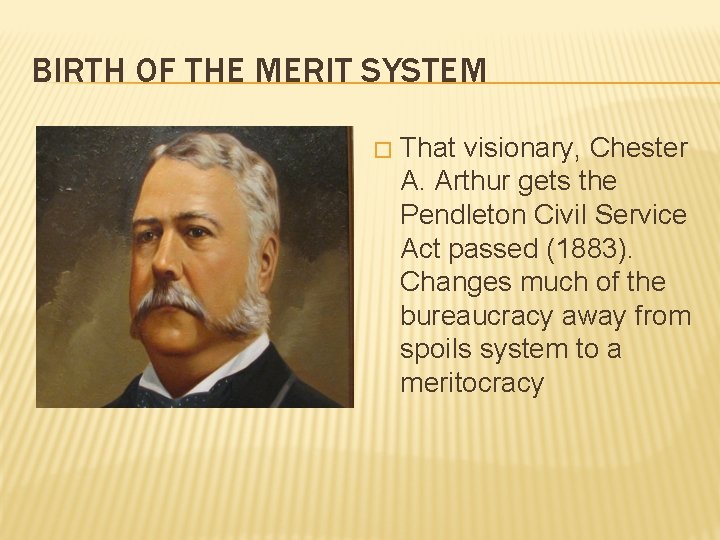
BIRTH OF THE MERIT SYSTEM � That visionary, Chester A. Arthur gets the Pendleton Civil Service Act passed (1883). Changes much of the bureaucracy away from spoils system to a meritocracy
IT CONTINUES (THE BRIEF HISTORY THAT IS) � Munn v. Illinois (1887)-OK for federal gov. to regulate business. Opens door to start of federal gov. regulations (and thus bureaucrats) � The Hatch Act (remember this one? ) government workers cannot participate in partisan politics while on duty � Today, the Office of Personnel Management oversees the hiring of federal government workers
FURTHER CONTINUATION OF WHAT WAS PREVIOUSLY STATED IN A PRIOR SLIDE. � The rule of three- If an agency requests an employee, OPM sends over at least 3 candidates and one has to be selected for grades of GS 1 -GS 18 probationary period, it is difficult to fire many gov. bureaucrats � Senior Executive Services (SES) meant to counter this for upper level bureaucrats. Lose some of the job placement protections, but get cash bonuses and guaranteed transfer if fired � After
PLUM BOOK 400 posts appointed and up to 2500 lesser positions � Usually Quick turnover in these posts � Often hard to exert power from one of these positions as usually outsiders �
THEORIES OF BUREAUCRACY-HOW THEY WORK?
WEBERIAN THEORY OF BUREAUCRACY � Power flows from the top, responsibility flows from the bottom � Use experts, not amateurs � Many rules (red tape) to provide consistency � Very impersonal so as to treat everyone the same � “I can’t help you, your problem falls under someone else’s jurisdiction”
ACQUISITIVE MONOPOLISTIC THEORY � Like corporations in seeking goals. Maximize budget/personnel rather than profits � Administrators are committed to the product � Big agency shows importance, so agencies are responsible for growth of government � “We are an important agency, we have a big budget. ”
GARBAGE CAN THEORY OF BUREAUCRACY Loose collection of ideas waiting to be implemented � Operate by trial and error, not so calculating � May have solutions needing a problem � “Any ideas on what we should do? ” �
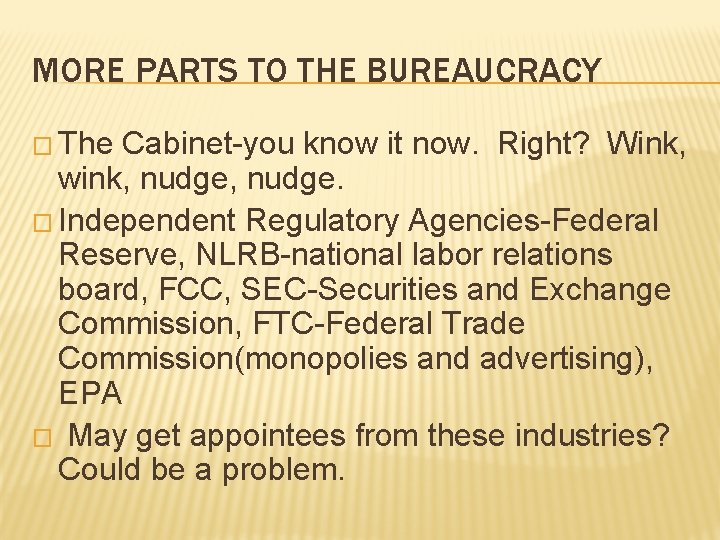
MORE PARTS TO THE BUREAUCRACY � The Cabinet-you know it now. Right? Wink, wink, nudge. � Independent Regulatory Agencies-Federal Reserve, NLRB-national labor relations board, FCC, SEC-Securities and Exchange Commission, FTC-Federal Trade Commission(monopolies and advertising), EPA � May get appointees from these industries? Could be a problem.
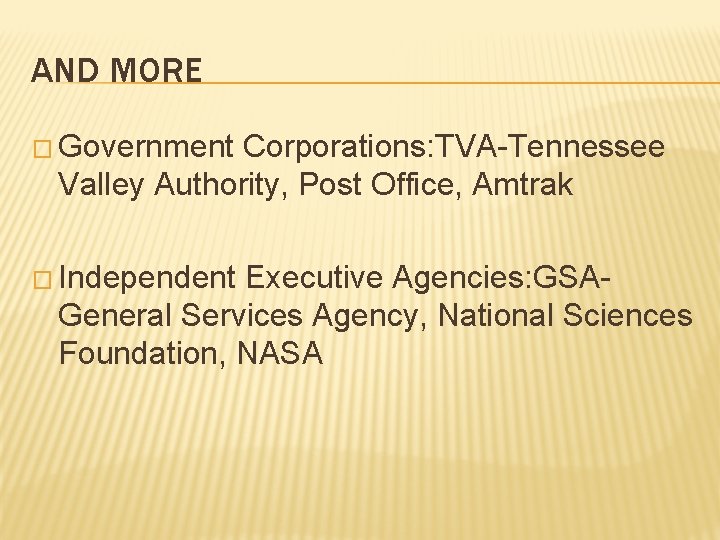
AND MORE � Government Corporations: TVA-Tennessee Valley Authority, Post Office, Amtrak � Independent Executive Agencies: GSAGeneral Services Agency, National Sciences Foundation, NASA
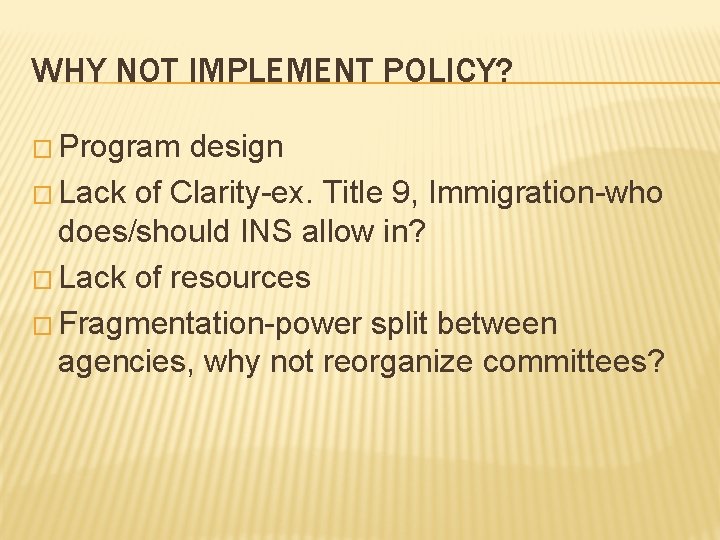
WHY NOT IMPLEMENT POLICY? � Program design � Lack of Clarity-ex. Title 9, Immigration-who does/should INS allow in? � Lack of resources � Fragmentation-power split between agencies, why not reorganize committees?
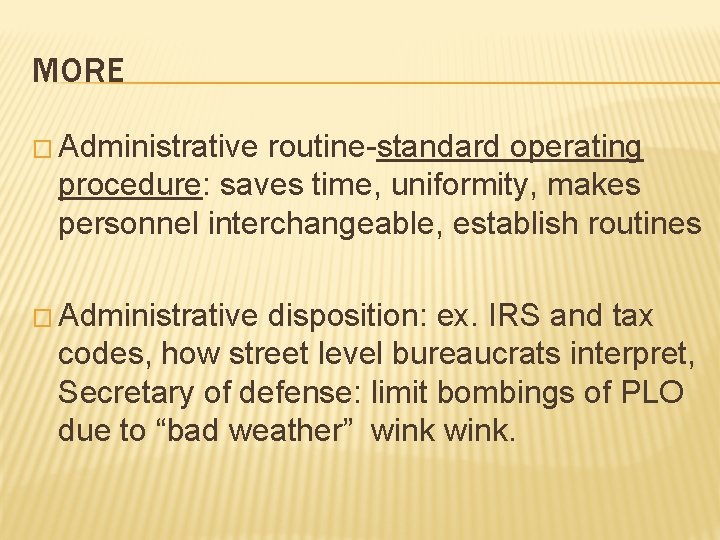
MORE � Administrative routine-standard operating procedure: saves time, uniformity, makes personnel interchangeable, establish routines � Administrative disposition: ex. IRS and tax codes, how street level bureaucrats interpret, Secretary of defense: limit bombings of PLO due to “bad weather” wink.
OVER 200 VOLUMES OF FEDERAL REGULATIONS � Complaints � Raises of prices � Complex � Distorts market forces � Does not work � May cause companies to leave US � Maybe we should deregulate?
BUREAUCRACY AND DEMOCRACY � Bureaucracy and Courts are only unelected public policy makers � Bureaucrats are more representative of the people � Often great knowledge since they are there for long times � However, change may be difficult then
IN GROUPS OF 4 OR LESS �Explain how Congress can control the bureaucracy. �Explain how the President can control the bureaucracy. � 12 points.
PRESIDENTIAL CONTROL OF BUREAUCRACY � Appoint the right people � Issue orders/executive orders � Tinker with the budget � Reorganize the agency
CONGRESSIONAL CONTROL OF BUREAUCRACY (OVERSIGHT) � Influence appointment of bureaucrats (senate) � Tinker with budget � Hold hearings or program evaluations � Rewrite legislation or make more detailed � Reauthorize/jurisdiction of agencies � Set guidelines for new agencies
MORE, IN ADDITION TO WHAT HAS PREVIOUSLY BEEN STATED ON A SLIDE THAT WAS JUST PRIOR TO THIS ONE, WHICH MAKES IT MERELY A CONTINUATION OF THAT SLIDE WAS ALREADY MENTIONED. � Organize/reorganize agencies � Use of “sunset” legislation � Use GAO or CBO � Use Iron triangle for information
BUREAUCRACY AND GROWTH OF POWER � Large � Specialized � Hard to fire bureaucrats � Based on Merit
BUREAUCRATIC POWER-THE SEQUEL � Independent � Specialized agencies/regulatory commissions units/expertise � Delegated authority-Congress and Pres don’t have time to do it all � Discretionary authority-legislation lacks details, so bureaucracy fills in details
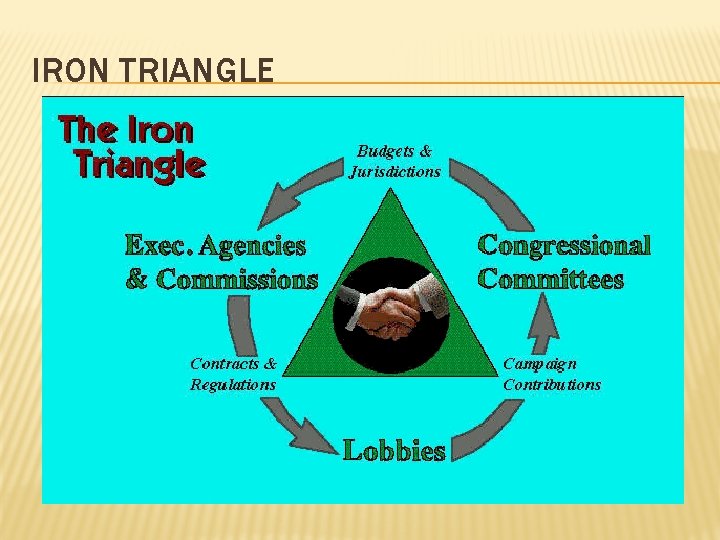
IRON TRIANGLE
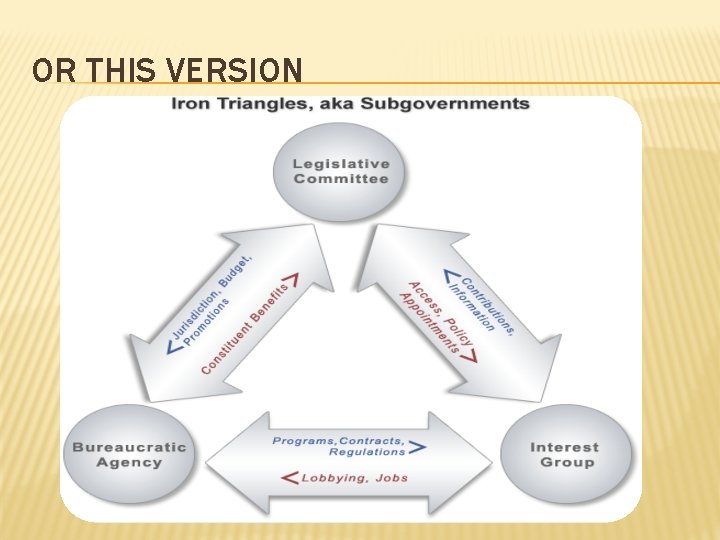
OR THIS VERSION
NOTES FOR IRON TRIANGLES � Is made up of bureaucratic agency, interest group, and Congressional committee � They depend upon each other and need close contact � This is a SUBGOVERNMENT, sometimes hard to control or monitor since it benefits all three groups involved
EXAMPLES OF IRON TRIANGLES � Elderly (AARP) interest group, subcommittee on aging, Social Security Administration � Veterans (American Legion) , committee on Veteran Affairs, Department of Veteran Affairs � Nuclear power had a strong one for awhile, until the 70’s � Agriculture, � Small Business Administration(Reagan tried to abolish it, but the Iron Triangle kept it)
FINAL NOTE � Iron Triangles not as powerful as they used to be, but still relevant. � Federal bureaucracy as a whole has stayed roughly the same size since the 1980’s. But our population and expectations have increased. Is the bureaucracy big enough today? � Now go study!!!!!!!!!!!