
Ways of greetings handshake bow hug kiss on
Ways of greetings: handshake bow hug kiss on the cheek pat on the back ….
1. The conversation of making new T friends consists of 3 parts. 2. When you have a conversation, sometimes you talk about important T things but sometimes do not. 3. “Small talk” is an American slang. T 4. In the third part---the leave-taking, you just need to tell your new friend that you are happy to meet him. F
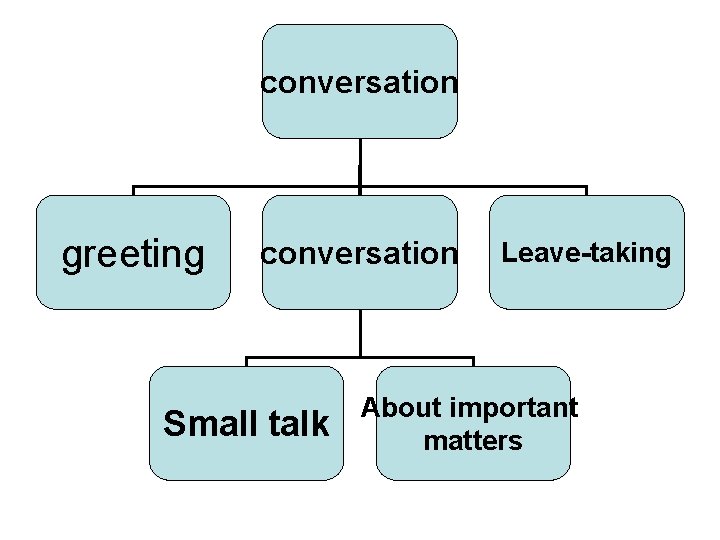
conversation greeting conversation Small talk Leave-taking About important matters
Listen to the following conversation and divide it into three parts.

Greeting Hello------My name is John. Conversation Are you from the same school? -----I major in English. Leave-taking Well, ----Good-bye, John.
Read the text.
Decide which part the following sentences belong to according to the text. A. Greeting B. conversation C. leave-taking 1. How is your English today? 2. Good morning! 3. It was nice to see you here! 4. How do you do? (B) (A ) (C ) ( A)
5. See you later! 6. Goodbye! 7. My English is not very good. 8. What’s your major? ( C ) (B ) ( B )
Fill in the blanks: enerally G____ speaking, a conversation onsists reeting c_______ of three parts: g_______, conversation and leave-taking. The mall talk and conversation consists of s____ something important. When you want to end the conversation, you’d better tell appy your new friend that you are h______ ust to meet him and you m_____ end the conversation.
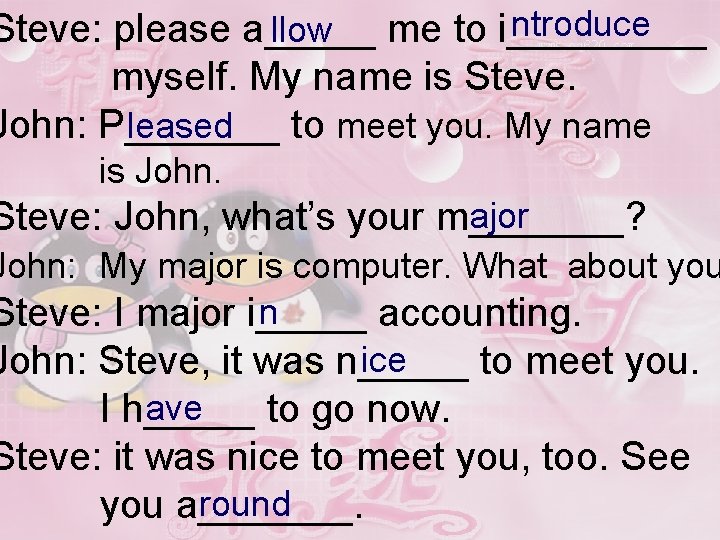
ntroduce llow me to i_____ Steve: please a_____ myself. My name is Steve. leased John: P_______ to meet you. My name is John. ajor Steve: John, what’s your m_______? John: My major is computer. What about you n Steve: I major i_____ accounting. ice John: Steve, it was n_____ to meet you. ave I h_____ to go now. Steve: it was nice to meet you, too. See round you a_______.
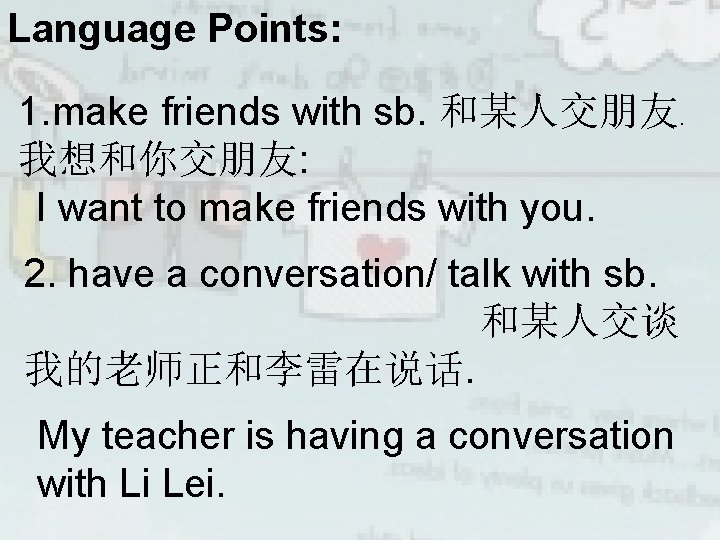
Language Points: 1. make friends with sb. 和某人交朋友. 我想和你交朋友: I want to make friends with you. 2. have a conversation/ talk with sb. 和某人交谈 我的老师正和李雷在说话. My teacher is having a conversation with Li Lei.
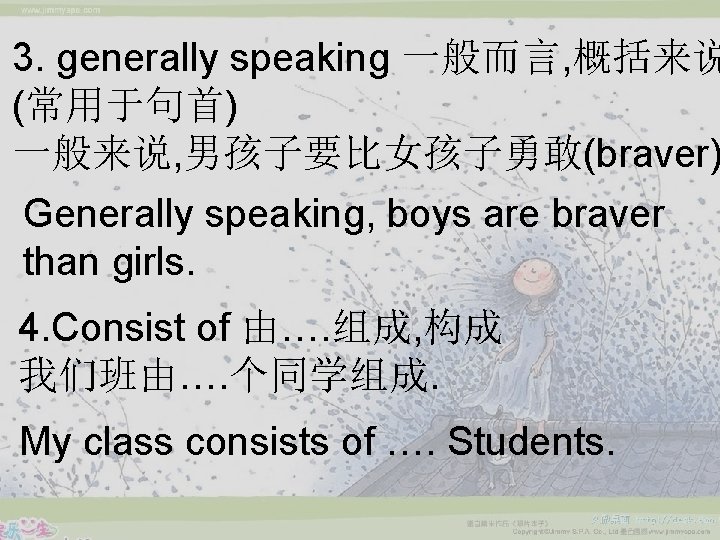
3. generally speaking 一般而言, 概括来说 (常用于句首) 一般来说, 男孩子要比女孩子勇敢(braver) Generally speaking, boys are braver than girls. 4. Consist of 由…. 组成, 构成 我们班由…. 个同学组成. My class consists of …. Students.
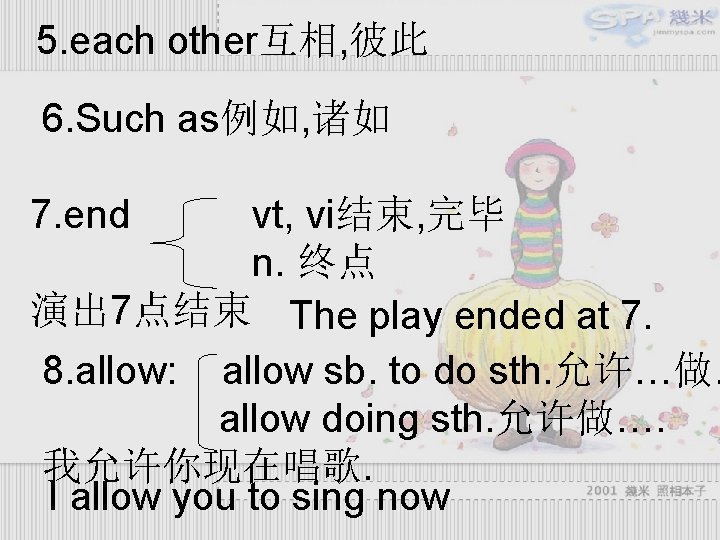
5. each other互相, 彼此 6. Such as例如, 诸如 7. end vt, vi结束, 完毕 n. 终点 演出 7点结束 The play ended at 7. 8. allow: allow sb. to do sth. 允许…做… allow doing sth. 允许做…. 我允许你现在唱歌. I allow you to sing now
9. Introduce介绍 introduce oneself自我介绍 Introduce sb to sb else把某人介绍给另外一个人 10. Major n. 主修课程, 专业 vi. (后跟介词in)主修, 专研 adj. 主要的 我主修计算机专业 I major in computer. / My major is computer 11. Ask sb. (not) to do sth. 叫某人(不要)做某事 老师叫我不要迟到 My teacher asked me not to be late.
12. It is +adj. +(for sb. )+to do sth. 对于某人来说做某事是怎么样的。 对于他来说学电脑是难的。 It is hard for him to learn computer.
Please make a conversation by yourselves: A: My name is…. B: pleased to meet you, I am…. What’s your major? A: I major in…. What about you? B: My major is …. It was nice to meet you. I have to go now. A: See you around.
Homework: 1. Copy the new words 5 times. 2. Copy the 12 phrases 5 times. 3. Finish WB Lesson 2.
- Slides: 17