
Waves that Bend Bounce Twist Squeeze etc 5
Waves that Bend, Bounce, Twist, Squeeze, etc. 5. 1. 6 Diffraction, Reflection, Refraction
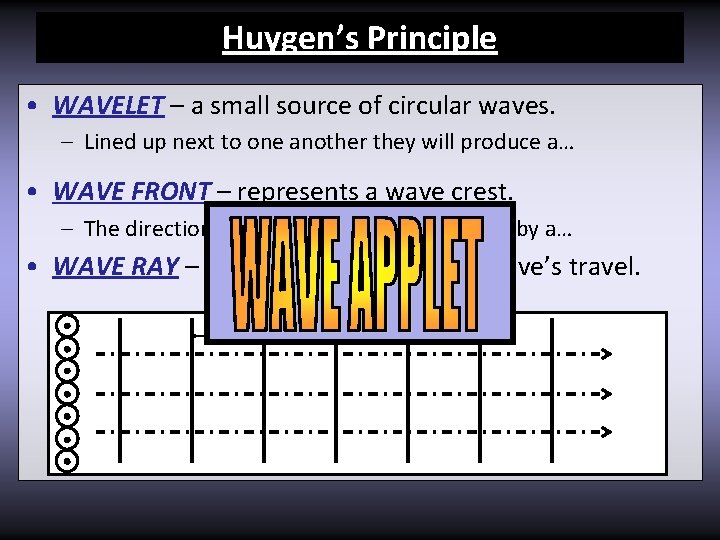
Huygen’s Principle • WAVELET – a small source of circular waves. – Lined up next to one another they will produce a… • WAVE FRONT – represents a wave crest. – The direction in which these travel is shown by a… • WAVE RAY – shows the direction of a wave’s travel. λ
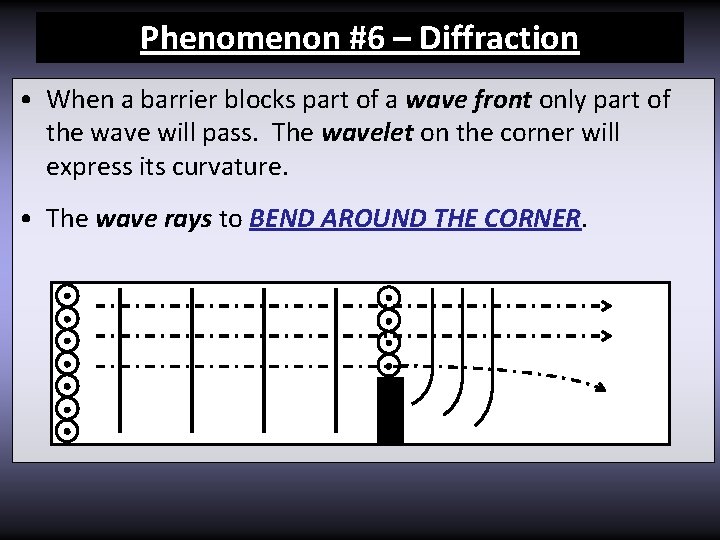
Phenomenon #6 – Diffraction • When a barrier blocks part of a wave front only part of the wave will pass. The wavelet on the corner will express its curvature. • The wave rays to BEND AROUND THE CORNER.
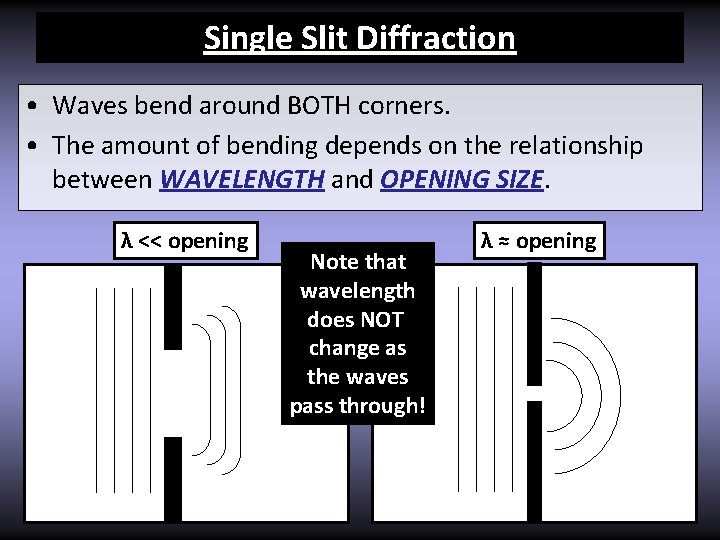
Single Slit Diffraction • Waves bend around BOTH corners. • The amount of bending depends on the relationship between WAVELENGTH and OPENING SIZE. λ << opening Note that wavelength does NOT change as the waves pass through! λ ≈ opening

Double Slit Diffraction • When a wave-front passes through two slits at the same time it bends through both slits and the wave-fronts interfere.

Reflection Revisited Regular (Specular) Flat surfaces Highly reflective (ex. mirror, water) Diffuse Irregular surfaces Most surfaces (ex. paper, wood)
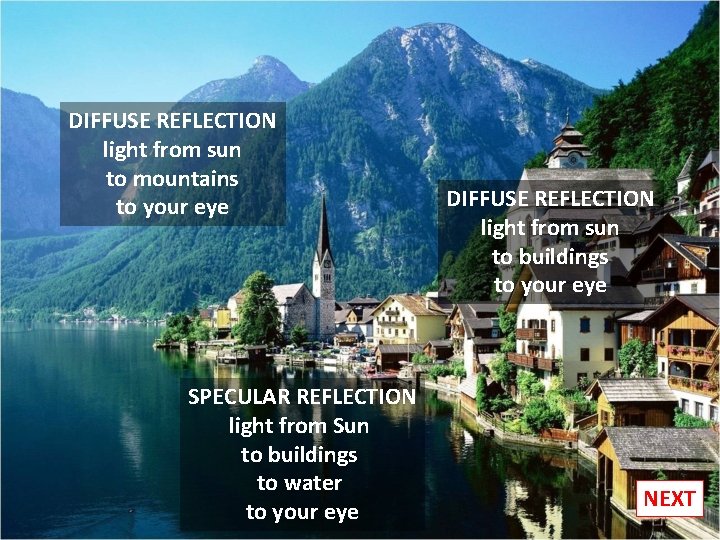
DIFFUSE REFLECTION light from sun to mountains to your eye SPECULAR REFLECTION light from Sun to buildings to water to your eye DIFFUSE REFLECTION light from sun to buildings to your eye NEXT
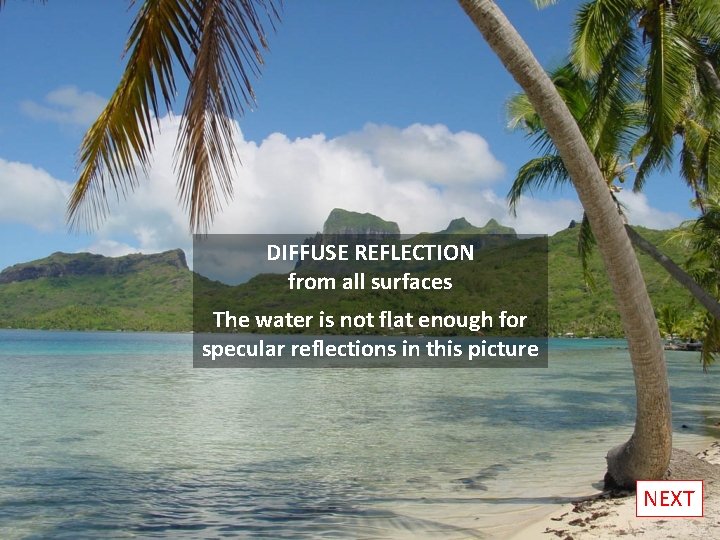
DIFFUSE REFLECTION from all surfaces The water is not flat enough for specular reflections in this picture NEXT
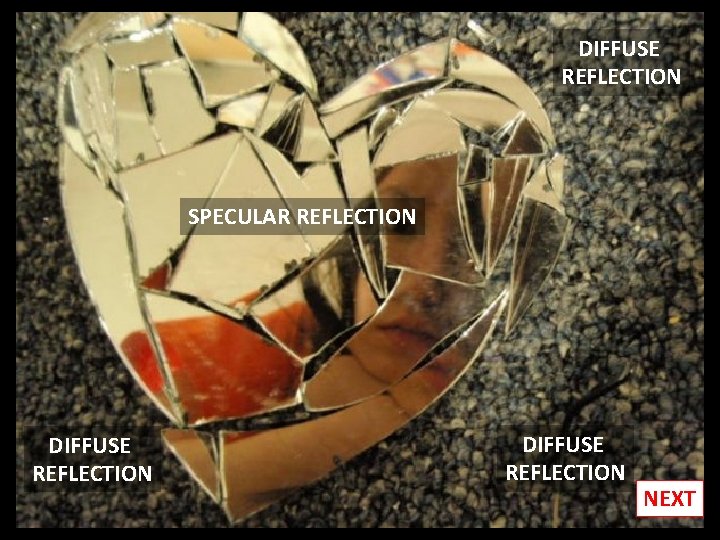
DIFFUSE REFLECTION SPECULAR REFLECTION DIFFUSE REFLECTION NEXT
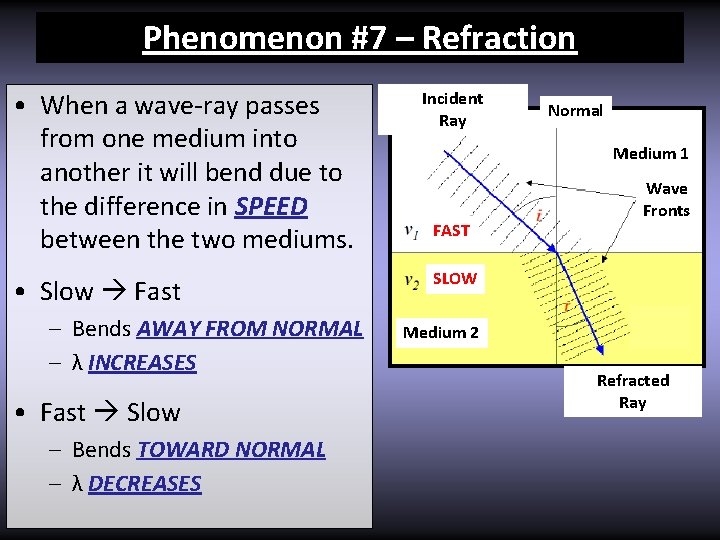
Phenomenon #7 – Refraction • When a wave-ray passes from one medium into another it will bend due to the difference in SPEED between the two mediums. • Slow Fast – Bends AWAY FROM NORMAL – λ INCREASES • Fast Slow – Bends TOWARD NORMAL – λ DECREASES Incident Ray Normal Medium 1 FAST Wave Fronts SLOW Medium 2 Refracted Ray
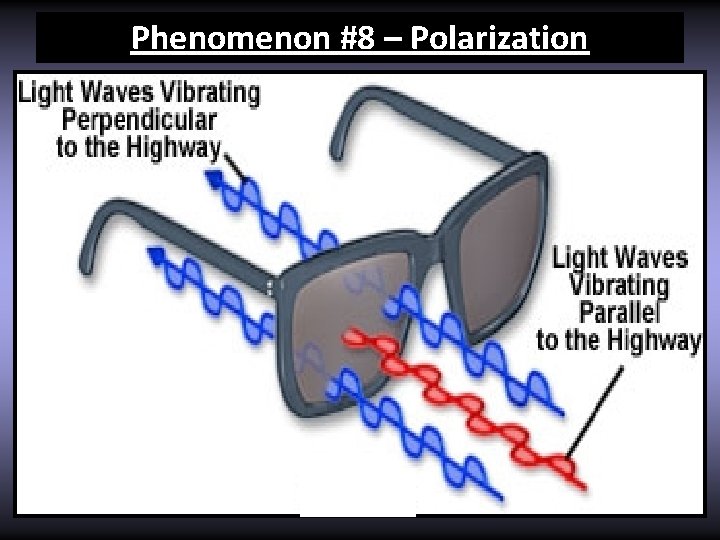
Phenomenon #8 – Polarization • A polarizer only allows waves with particles vibrating in a specific direction to pass. • This only works for TRANSVERSE waves.
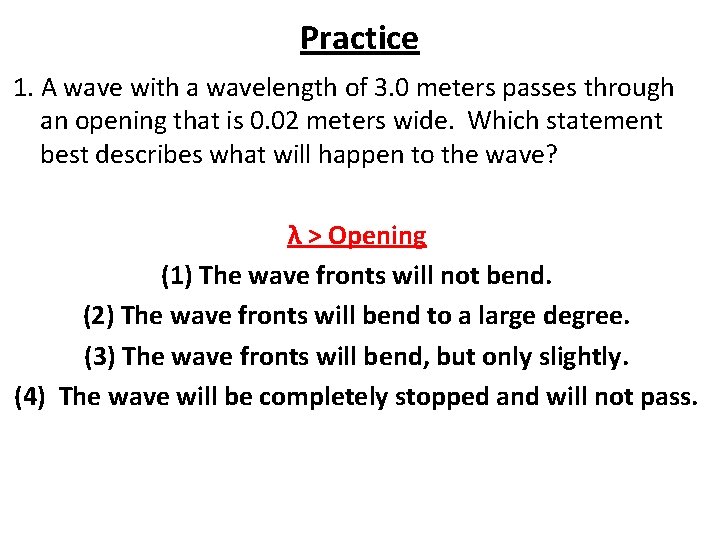
Practice 1. A wave with a wavelength of 3. 0 meters passes through an opening that is 0. 02 meters wide. Which statement best describes what will happen to the wave? λ > Opening (1) The wave fronts will not bend. (2) The wave fronts will bend to a large degree. (3) The wave fronts will bend, but only slightly. (4) The wave will be completely stopped and will not pass.
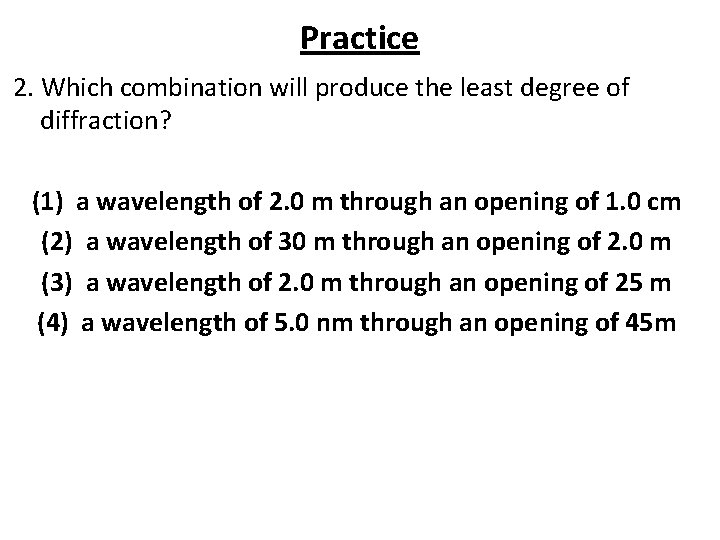
Practice 2. Which combination will produce the least degree of diffraction? (1) a wavelength of 2. 0 m through an opening of 1. 0 cm (2) a wavelength of 30 m through an opening of 2. 0 m (3) a wavelength of 2. 0 m through an opening of 25 m (4) a wavelength of 5. 0 nm through an opening of 45 m
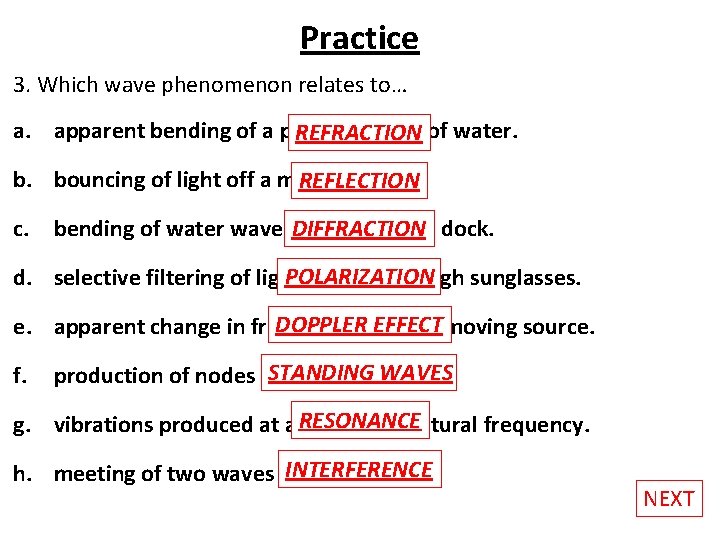
Practice 3. Which wave phenomenon relates to… a. apparent bending of a pencil in a cup of water. REFRACTION b. bouncing of light off a mirror. REFLECTION c. bending of water waves. DIFFRACTION as they pass a dock. POLARIZATION d. selective filtering of light passing through sunglasses. DOPPLERdue EFFECT e. apparent change in frequency to a moving source. f. STANDING WAVES production of nodes and antinodes. g. vibrations produced at a RESONANCE medium’s natural frequency. INTERFERENCE h. meeting of two waves in a medium. NEXT
End of 5. 1. 6
- Slides: 15