
WAVES STUDY GUIDE KEY High School Physical Science
- Slides: 25
WAVES STUDY GUIDE KEY High School Physical Science Lost Mountain Middle School Betsy Sanford
ORGANIZING THE WAVE UNIT FOR STUDYING • Section 1 – What are energy waves? (Comparing and contrasting the types of energy waves. ) Questions #14, 15, 26, 27 • Section 2 – Wave Diagrams (Drawing and labeling the parts of waves. ) Questions #1, 2, 3, 4, 16, 17, 18, 19 • Section 3 – Interactions of Light Waves (What do light waves do when they run into substances? Behaviors of light waves. ) Questions #21, 22, 28, 29, 30, 31 • Section 4 – Interactions of Sound Waves (What do sound waves do when they run into substances? Behaviors of sound waves. ) Questions #5, 6, 7, 8, 9, 10, 11, 12, 13, 20, 23, 24, 32
SECTION 1 – WHAT ARE WAVES? AND COMPARING/CONTRASTING TYPES OF WAVES
QUESTIONS 14 & 15 14. What do waves transfer? 15. What do both electromagnetic waves and mechanical waves have in common? Answer: Waves transfer energy. Both electromagnetic waves and mechanical waves travel in rhythmic disturbances and carry energy.
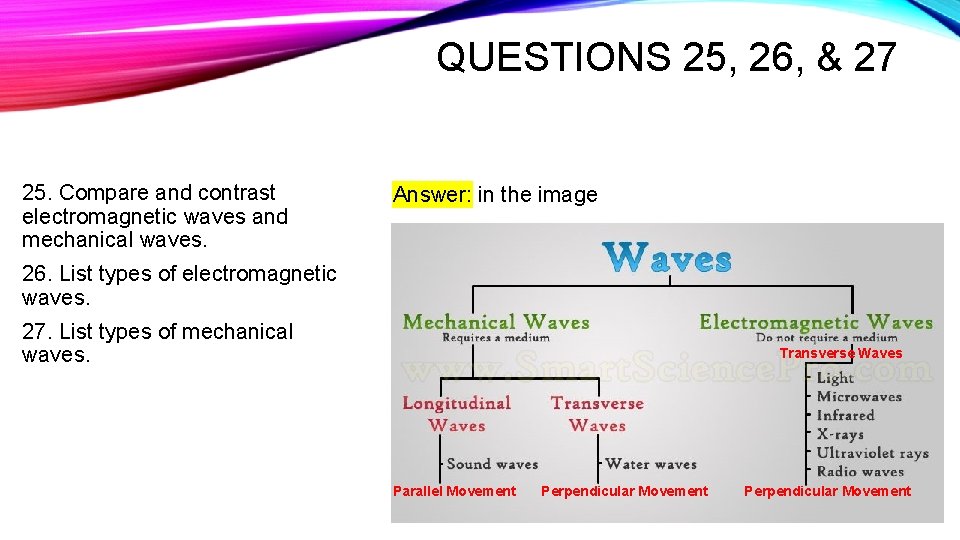
QUESTIONS 25, 26, & 27 25. Compare and contrast electromagnetic waves and mechanical waves. Answer: in the image 26. List types of electromagnetic waves. 27. List types of mechanical waves. Transverse Waves Parallel Movement Perpendicular Movement
SECTION 2 – DIAGRAMS OF WAVES LABELING THE PARTS OF WAVES
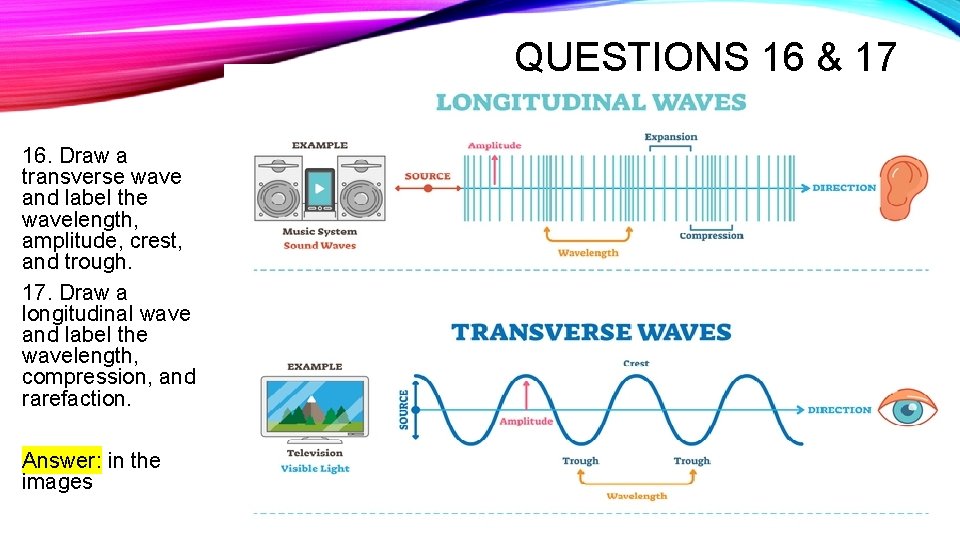
QUESTIONS 16 & 17 16. Draw a transverse wave and label the wavelength, amplitude, crest, and trough. 17. Draw a longitudinal wave and label the wavelength, compression, and rarefaction. Answer: in the images
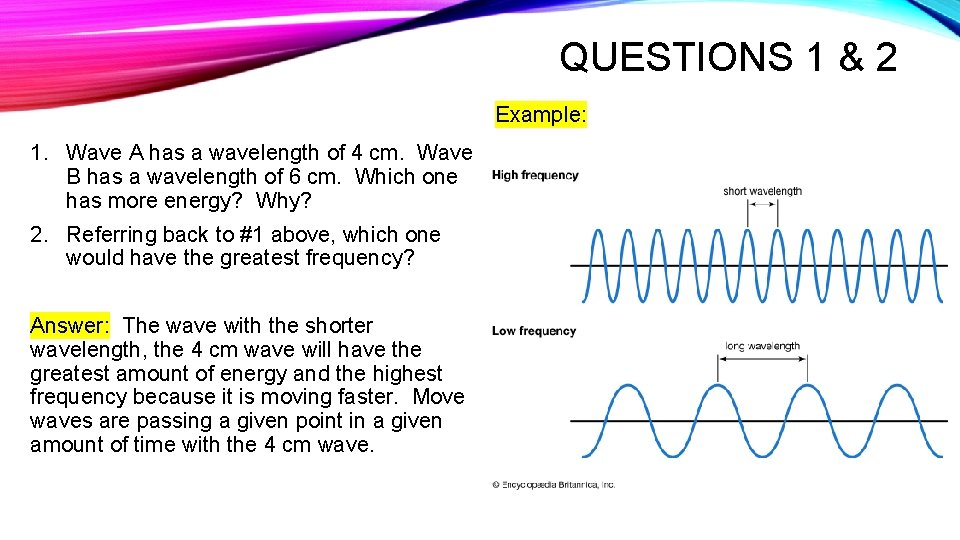
QUESTIONS 1 & 2 Example: 1. Wave A has a wavelength of 4 cm. Wave B has a wavelength of 6 cm. Which one has more energy? Why? 2. Referring back to #1 above, which one would have the greatest frequency? Answer: The wave with the shorter wavelength, the 4 cm wave will have the greatest amount of energy and the highest frequency because it is moving faster. Move waves are passing a given point in a given amount of time with the 4 cm wave.
QUESTIONS 18 & 19 18. What determines the amplitude of a wave? 19. What does the frequency of a wave determine? Answer: Amplitude of a wave is determined by the amount of energy carried in the disturbance. Frequency of wave is determined by the speed of the wave (the number of waves that pass a given point in a given period of time).
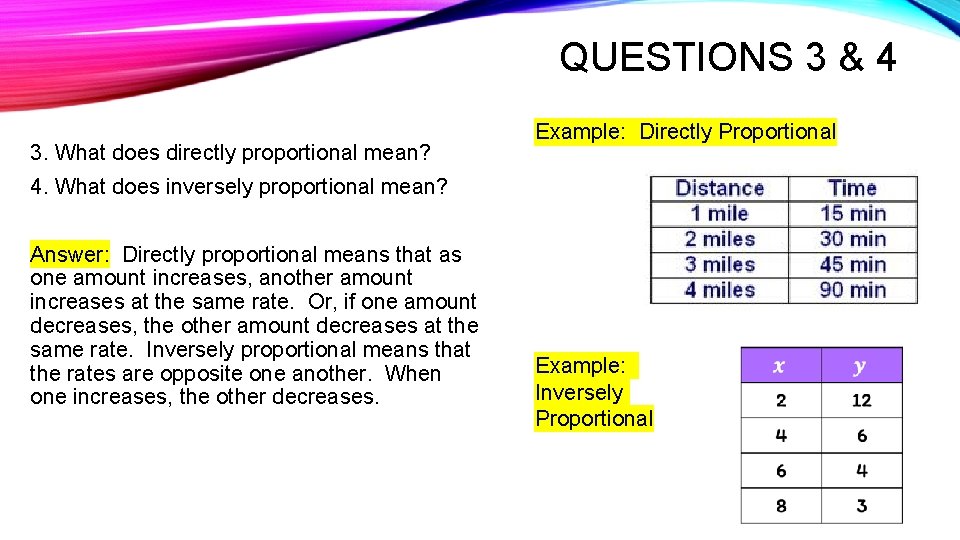
QUESTIONS 3 & 4 3. What does directly proportional mean? Example: Directly Proportional 4. What does inversely proportional mean? Answer: Directly proportional means that as one amount increases, another amount increases at the same rate. Or, if one amount decreases, the other amount decreases at the same rate. Inversely proportional means that the rates are opposite one another. When one increases, the other decreases. Example: Inversely Proportional
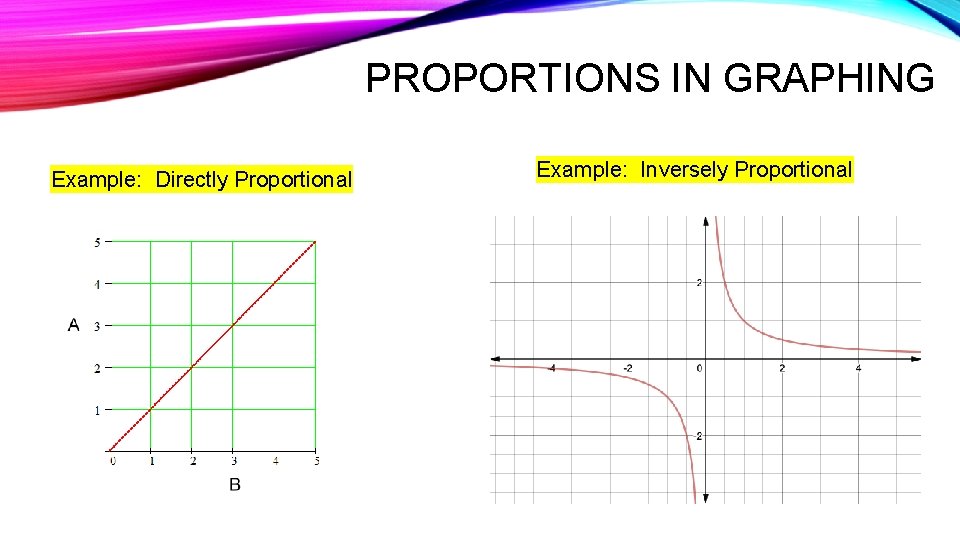
PROPORTIONS IN GRAPHING Example: Directly Proportional Example: Inversely Proportional
SECTION 3 – INTERACTIONS OF LIGHT WAVES
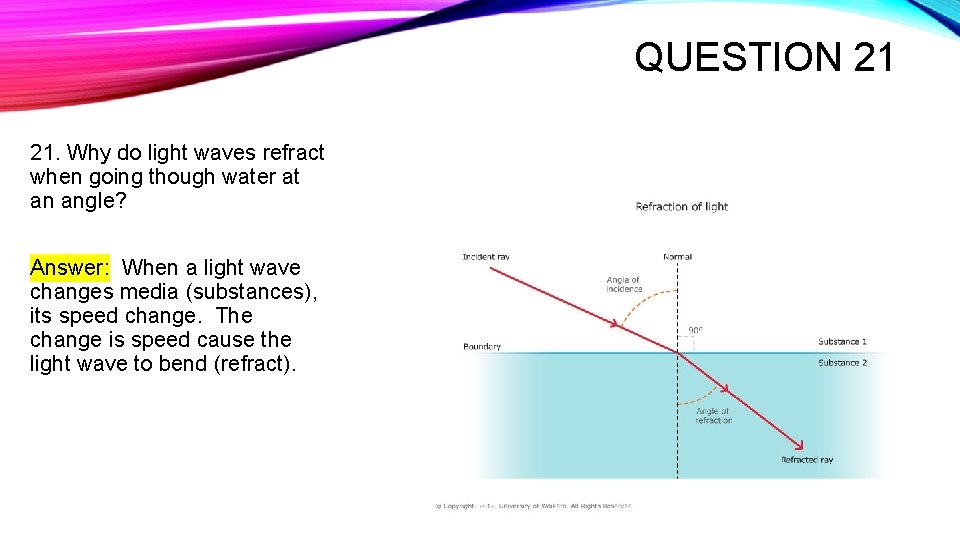
QUESTION 21 21. Why do light waves refract when going though water at an angle? Answer: When a light wave changes media (substances), its speed change. The change is speed cause the light wave to bend (refract).
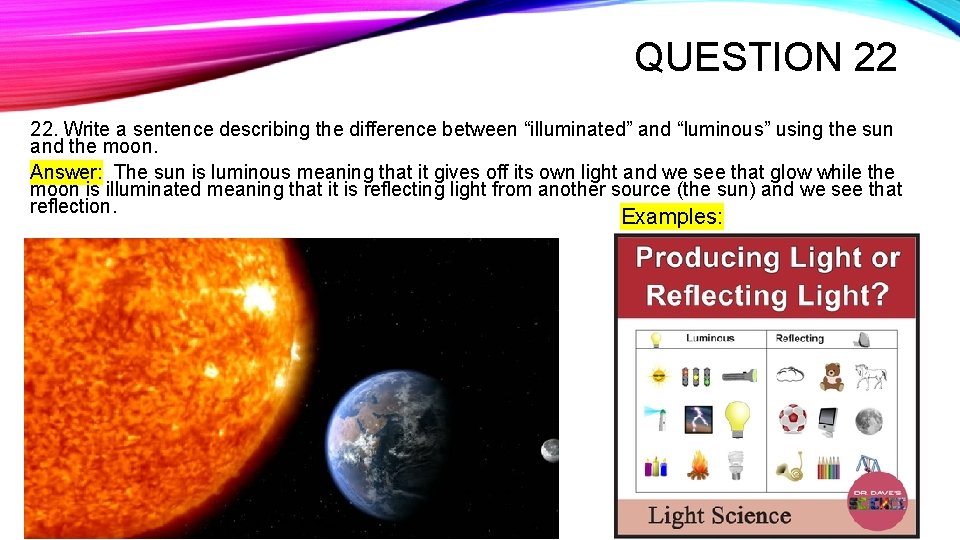
QUESTION 22 22. Write a sentence describing the difference between “illuminated” and “luminous” using the sun and the moon. Answer: The sun is luminous meaning that it gives off its own light and we see that glow while the moon is illuminated meaning that it is reflecting light from another source (the sun) and we see that reflection. Examples:
QUESTIONS 28, 29, & 30 28. Using light wave behaviors, explain why a red color UGA football t-shirt looks red. 29. Which color reflects all colors? _______ Which color absorbs all colors? _______ 30. If you are in a very dark room, can you tell what color shirt another person is wearing? Wy or why not? Answer: Visible light is made up of the different wavelengths of all the colors in the rainbow (R. O. Y. G. B. I. V. ). The different color wavelengths can be absorbed or reflected by fabric. In the case of the red t-shirt, all of the visible light is being absorbed except the red wavelengths which are reflected into your eye. We see the red reflection. A white reflection is a reflection of all color wavelengths together. The absence of reflection (the absorption of all visible light waves) is interpreted by the brain as black. If you are in a room without light, you will not see any colors because there is no light there to be reflected into your eyes.
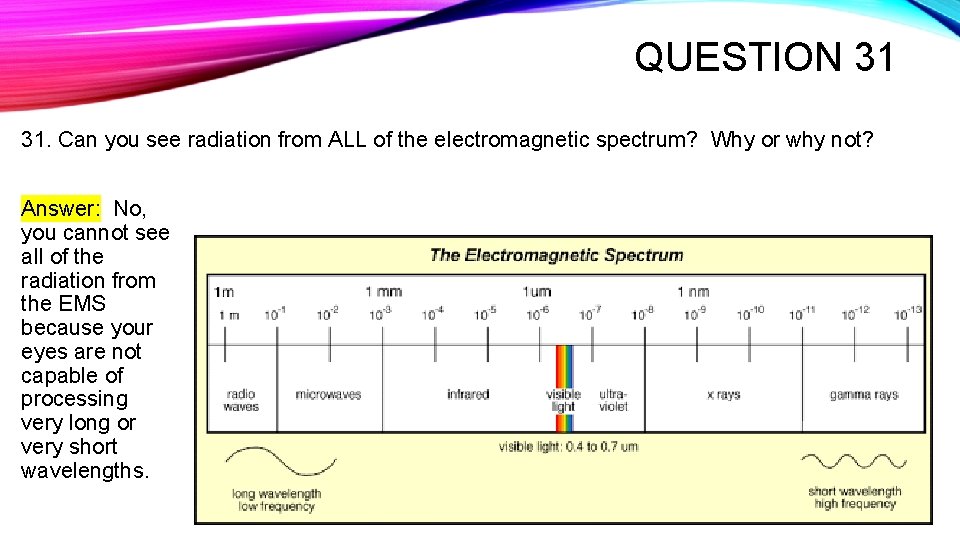
QUESTION 31 31. Can you see radiation from ALL of the electromagnetic spectrum? Why or why not? Answer: No, you cannot see all of the radiation from the EMS because your eyes are not capable of processing very long or very short wavelengths.
SECTION 4 – INTERACTIONS OF SOUND WAVES
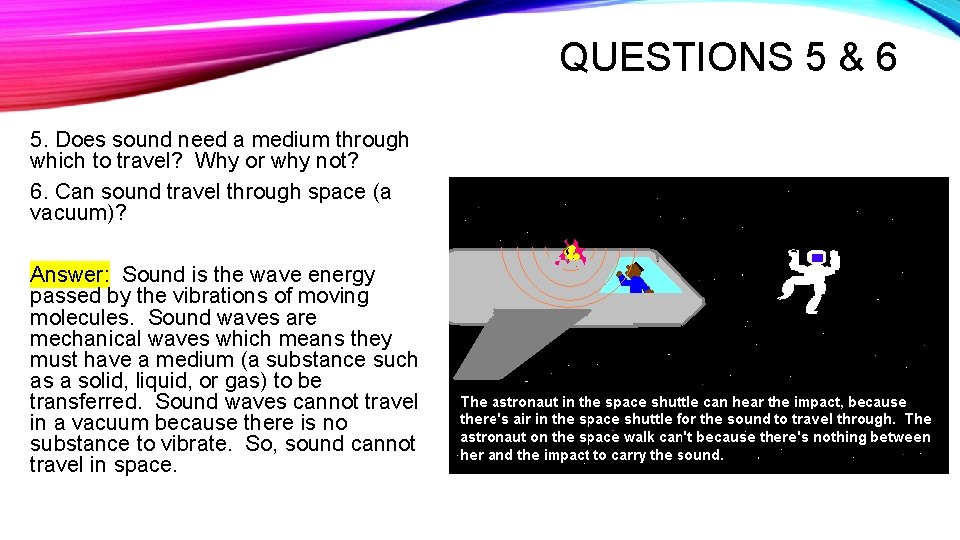
QUESTIONS 5 & 6 5. Does sound need a medium through which to travel? Why or why not? 6. Can sound travel through space (a vacuum)? Answer: Sound is the wave energy passed by the vibrations of moving molecules. Sound waves are mechanical waves which means they must have a medium (a substance such as a solid, liquid, or gas) to be transferred. Sound waves cannot travel in a vacuum because there is no substance to vibrate. So, sound cannot travel in space.
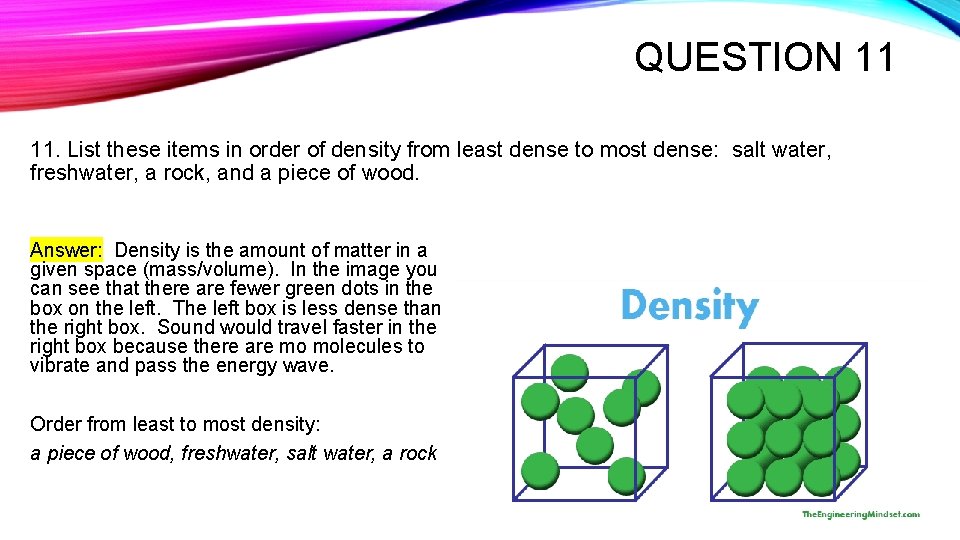
QUESTION 11 11. List these items in order of density from least dense to most dense: salt water, freshwater, a rock, and a piece of wood. Answer: Density is the amount of matter in a given space (mass/volume). In the image you can see that there are fewer green dots in the box on the left. The left box is less dense than the right box. Sound would travel faster in the right box because there are mo molecules to vibrate and pass the energy wave. Order from least to most density: a piece of wood, freshwater, salt water, a rock
QUESTIONS 9, 10, & 32 9. List the items in order in which sound travels from slowest to fastest: gas, solid, and liquid. 10. List the items in order in which light travels from slowest to fastest: gas, solid, and liquid. 32. Sound waves speed up traveling through denser materials. What do light waves do when traveling through denser materials? Answer: Sound will travel slowest in a gas, faster in liquid, and fastest in a solid. Light will travel slowest in solid, faster in a liquid, and fastest in a gas. Light waves slow down in denser materials.
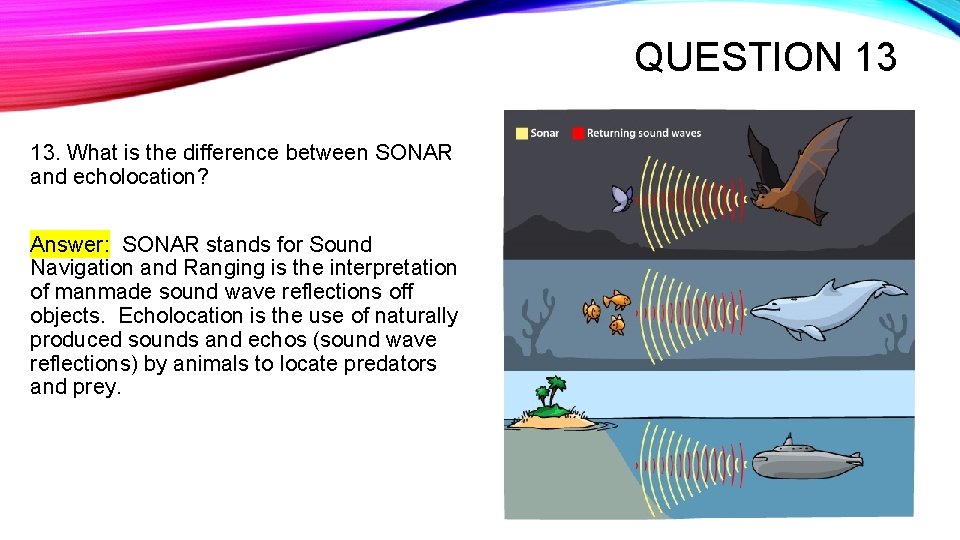
QUESTION 13 13. What is the difference between SONAR and echolocation? Answer: SONAR stands for Sound Navigation and Ranging is the interpretation of manmade sound wave reflections off objects. Echolocation is the use of naturally produced sounds and echos (sound wave reflections) by animals to locate predators and prey.
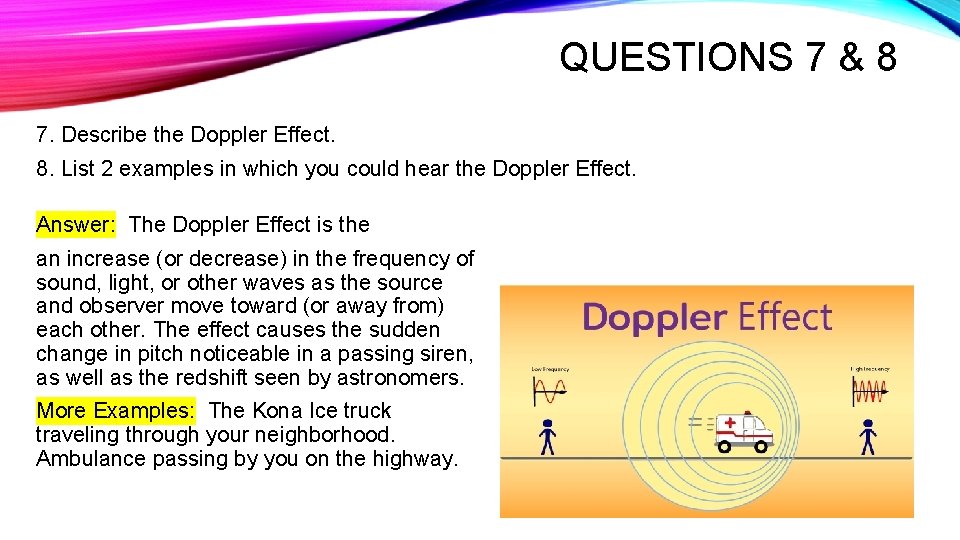
QUESTIONS 7 & 8 7. Describe the Doppler Effect. 8. List 2 examples in which you could hear the Doppler Effect. Answer: The Doppler Effect is the an increase (or decrease) in the frequency of sound, light, or other waves as the source and observer move toward (or away from) each other. The effect causes the sudden change in pitch noticeable in a passing siren, as well as the redshift seen by astronomers. More Examples: The Kona Ice truck traveling through your neighborhood. Ambulance passing by you on the highway.
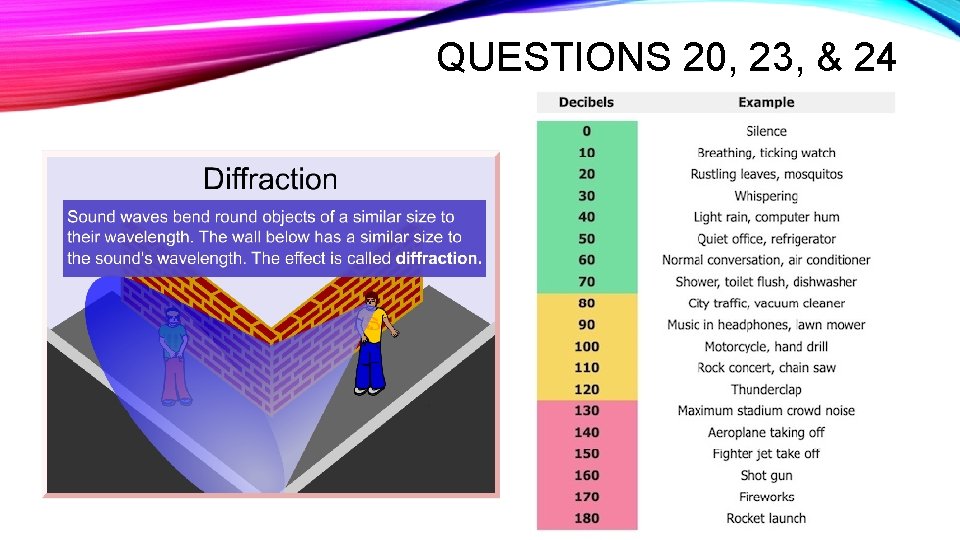
QUESTIONS 20, 23, & 24 20. Write down the decibel reading that will start to cause pain in the ears: _______. 23. Which wave interaction describes why you can hear around the corner of the hallway at school? 24. Striking a drum softer (more lightly) will do what to the amplitude of a sound wave? Answer: 120 decibels are painful to the human ear. The bending of sound waves (diffraction) allows you to hear around the corner in the school hallway. Striking a drum softer (more lightly) which cause less vibration in the drum and thus a softer sound because less energy is being transferred.
QUESTIONS 20, 23, & 24
QUESTION 12 12. Use the following terms to describe music: quality, pitch, rhythm, tone, and overtones. Answer: Sound quality is also called timbre. The auditory sensations caused by the tone of a sound wave. Pitch is the highness or lowness of a sound due to frequency. Higher frequencies are produced by waves with higher speed and have a higher pitch. Lower frequencies are produced by waves with slower speed and have a lower pitch. Rhythm is a strong, regular, repeated pattern of sound wave. Tone is pitch (frequency) + quality (timbre) + strength (energy). An overtone are produced in the human voice and in the sounds of musical instruments. An overtone is the combination of tones made by varied vibrations of sound waves. (Think of all the vibrations of your vocal cords or the string of a guitar. )