
Waves at Boundaries What is a boundary A
Waves at Boundaries
What is a boundary? § A boundary is also known as a medium. § A medium or media is a material that allows a wave to pass through § Examples of mediums: § Air, water, wood, steel § What about a vacuum? Can a sound wave travel through a vacuum?
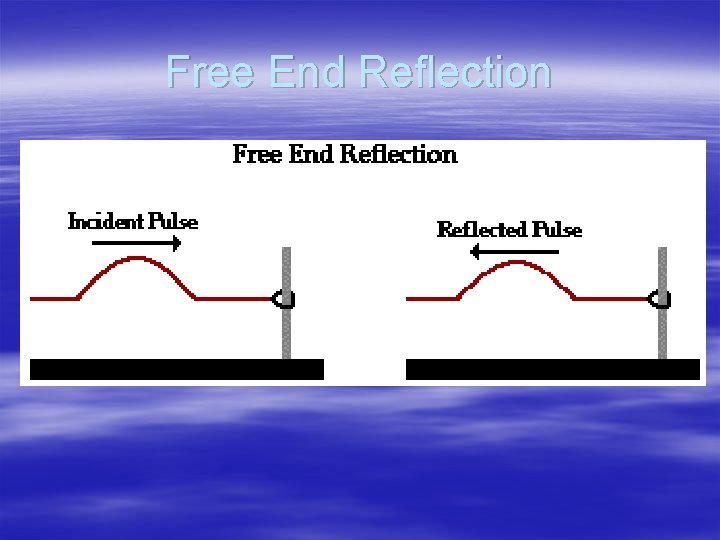
Free End Reflection
Free End Reflection § A reflection that occurs when the medium is not fixed at one end § The amplitude of the incoming pulse is equal to the amplitude of the outgoing pulse
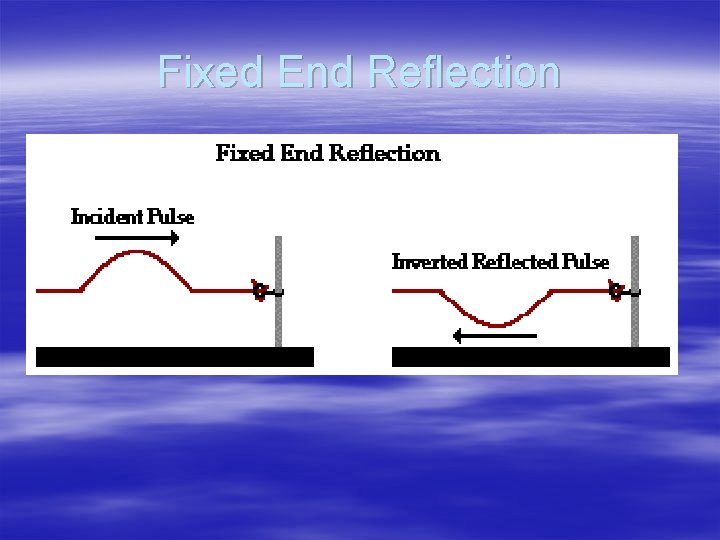
Fixed End Reflection

Fixed End Reflection
Fixed End Reflection § When the medium is fixed at one or both ends, the amplitude of the incoming pulse is equal but opposite of the outgoing pulse
Standing Wave § The incoming and reflecting waves interfere § They create a wave pattern that appears to be stationary
Standing Waves § Standing waves create: NODES and ANITNODES § Nodes: the particles of the medium are at rest § Antinodes: the particles of the medium are moving with greatest speed ; the amplitude is twice the amplitude of the original wave
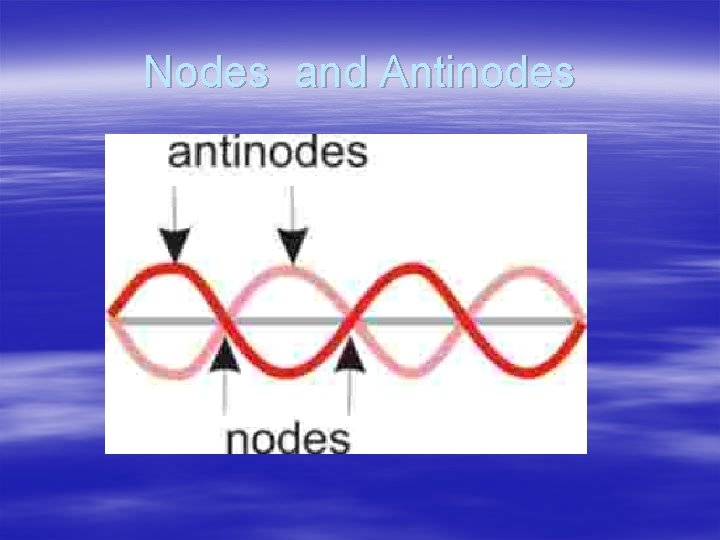
Nodes and Antinodes
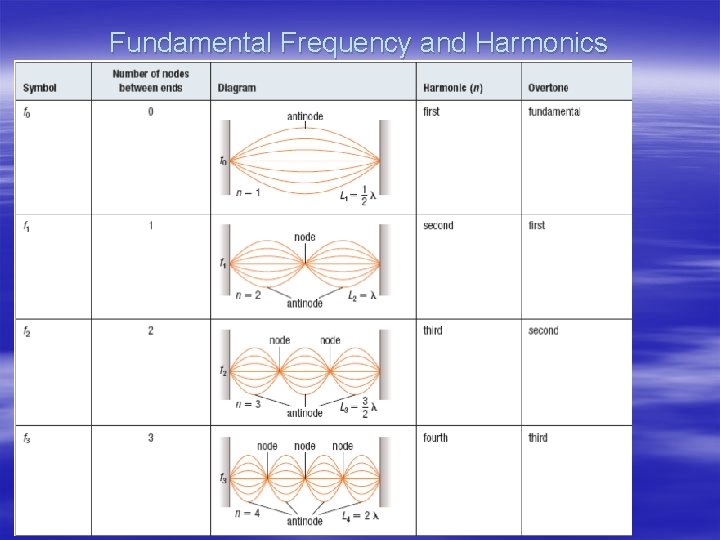
Fundamental Frequency and Harmonics
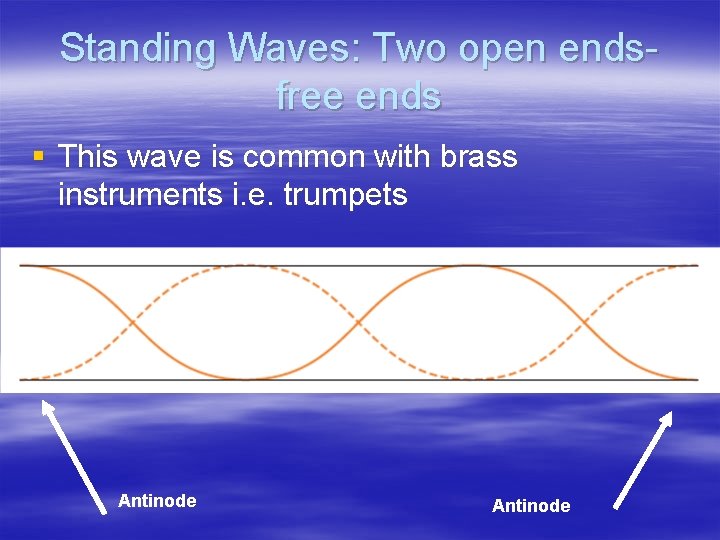
Standing Waves: Two open endsfree ends § This wave is common with brass instruments i. e. trumpets Antinode
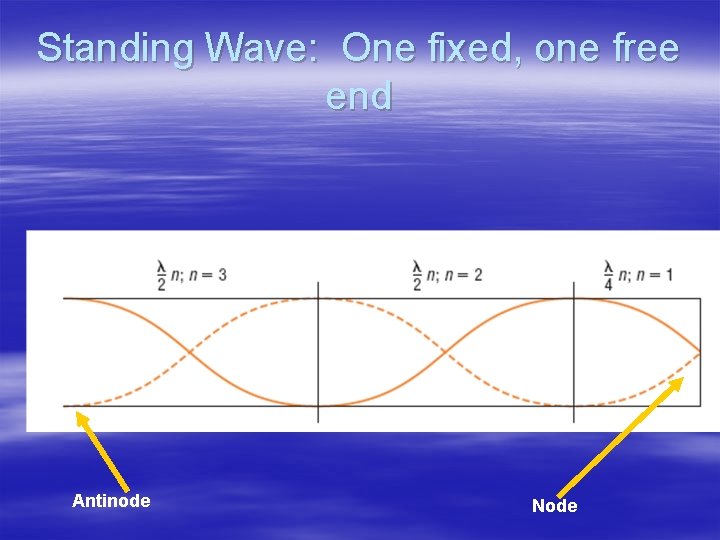
Standing Wave: One fixed, one free end Antinode Node
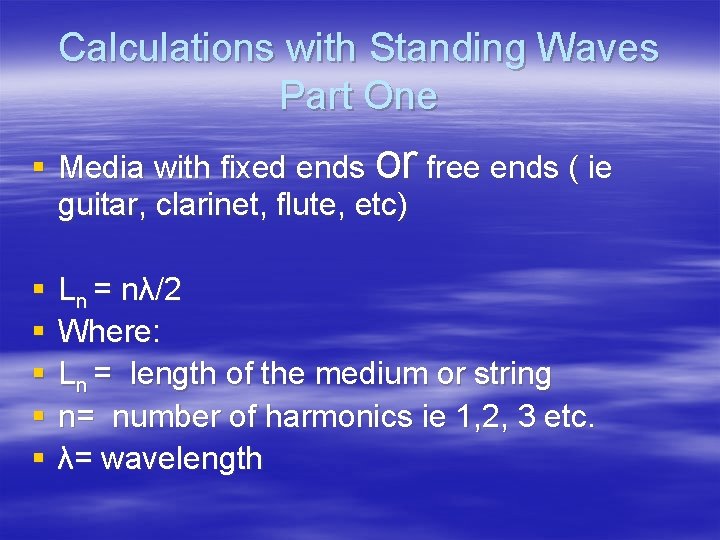
Calculations with Standing Waves Part One § Media with fixed ends or free ends ( ie guitar, clarinet, flute, etc) § § § Ln = nλ/2 Where: Ln = length of the medium or string n= number of harmonics ie 1, 2, 3 etc. λ= wavelength
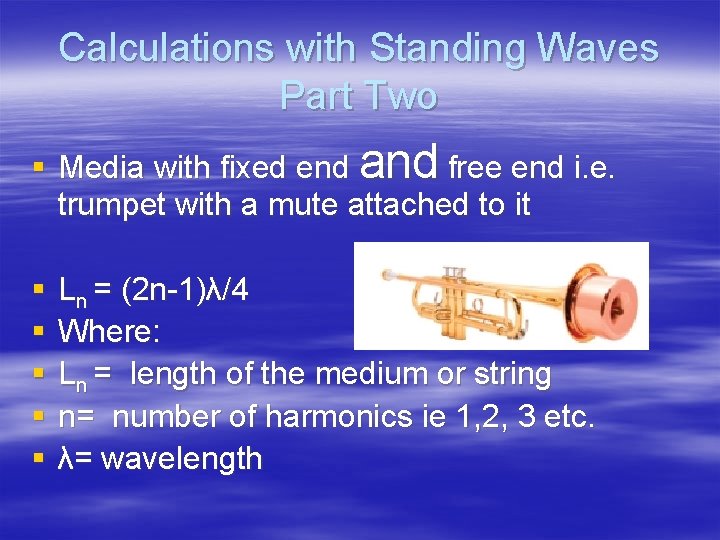
Calculations with Standing Waves Part Two § Media with fixed end and free end i. e. trumpet with a mute attached to it § § § Ln = (2 n-1)λ/4 Where: Ln = length of the medium or string n= number of harmonics ie 1, 2, 3 etc. λ= wavelength
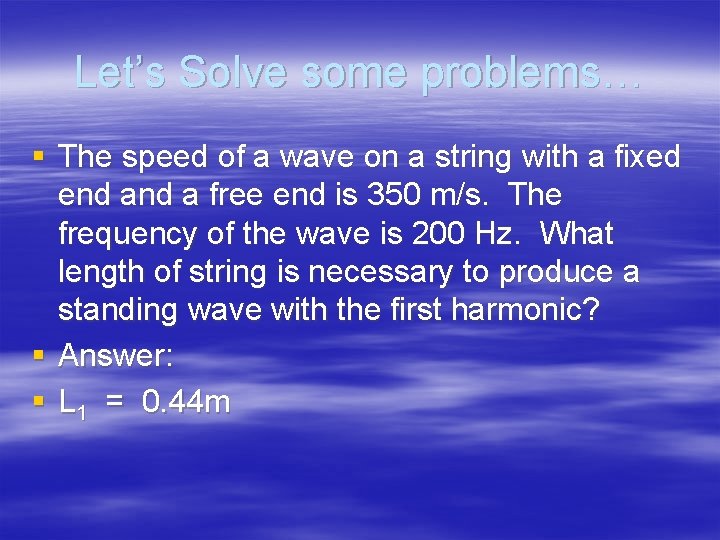
Let’s Solve some problems… § The speed of a wave on a string with a fixed end a free end is 350 m/s. The frequency of the wave is 200 Hz. What length of string is necessary to produce a standing wave with the first harmonic? § Answer: § L 1 = 0. 44 m
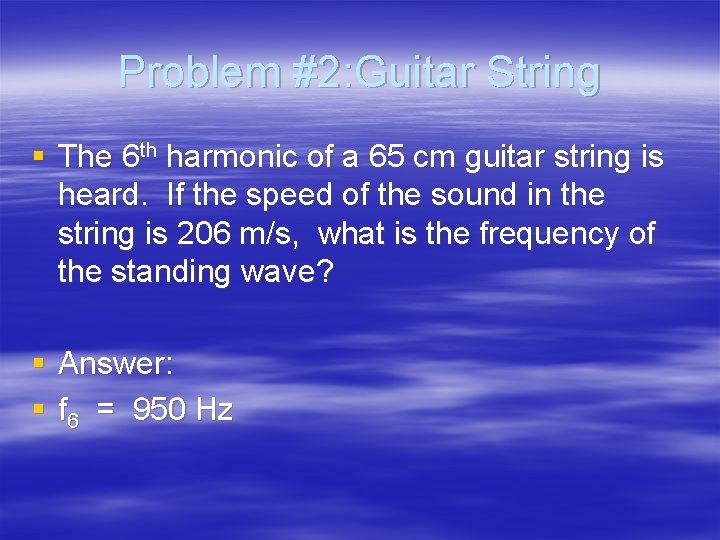
Problem #2: Guitar String § The 6 th harmonic of a 65 cm guitar string is heard. If the speed of the sound in the string is 206 m/s, what is the frequency of the standing wave? § Answer: § f 6 = 950 Hz
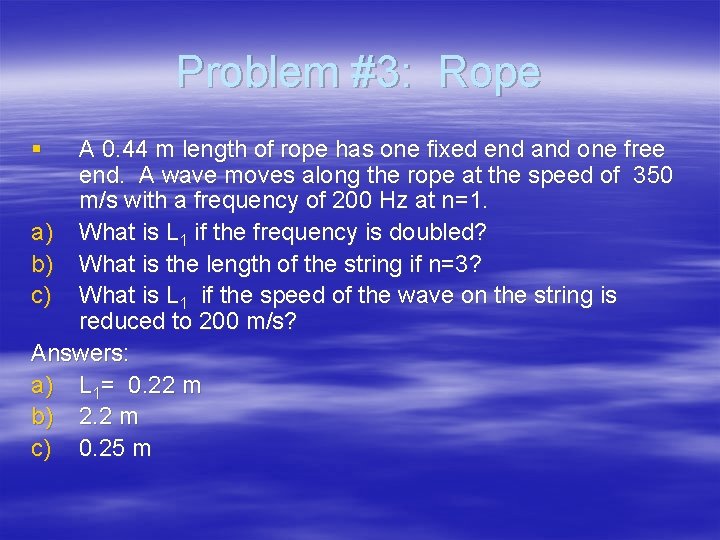
Problem #3: Rope § A 0. 44 m length of rope has one fixed end and one free end. A wave moves along the rope at the speed of 350 m/s with a frequency of 200 Hz at n=1. a) What is L 1 if the frequency is doubled? b) What is the length of the string if n=3? c) What is L 1 if the speed of the wave on the string is reduced to 200 m/s? Answers: a) L 1= 0. 22 m b) 2. 2 m c) 0. 25 m
Your Turn… § MHR pg. 352 # 1 -7
- Slides: 19