
Waves AP Schedule PCR Waves Lesson 1 all
- Slides: 57
Waves
AP Schedule • • • PCR Waves Lesson 1 (all) and 2 a, b Lab, PLQ Finish PCR Standing Waves Lab Quest Quiz
Waves https: //www. youtube. com/watch? v=g 9 o. OT FXx 7 ck
Essential Questions: What do you already know about waves? What knowledge of waves is important?
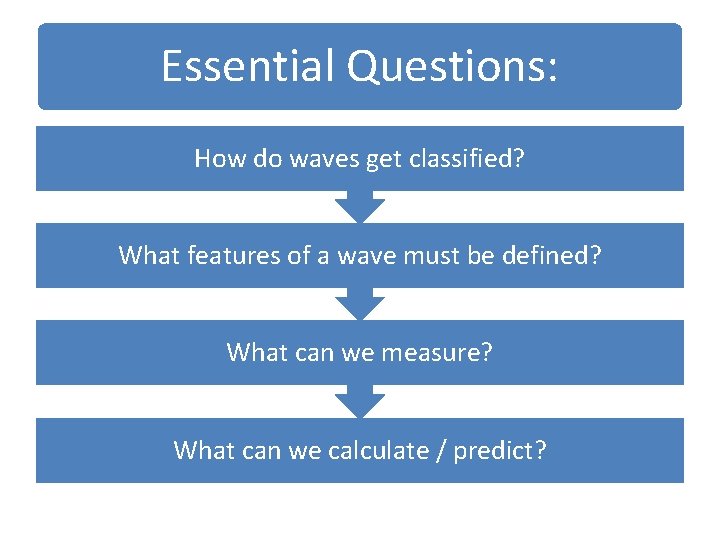
Essential Questions: How do waves get classified? What features of a wave must be defined? What can we measure? What can we calculate / predict?
Lets start with… What is a wave?
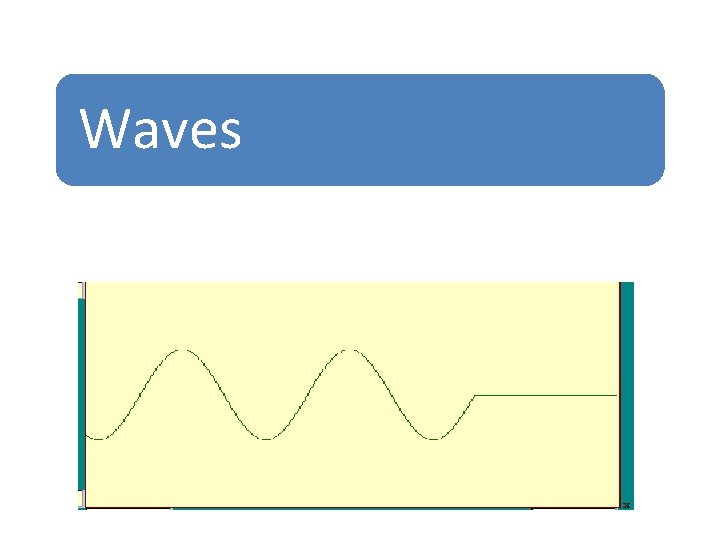
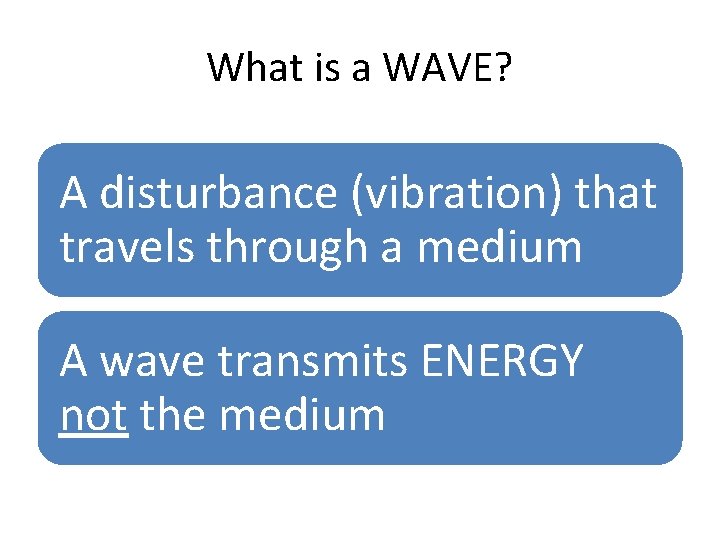
What is a WAVE? A disturbance (vibration) that travels through a medium A wave transmits ENERGY not the medium
Where should we start? How do we classify waves?
What is a wave? How do we classify waves? Read the Physics Classroom (PCR) SKIM Waves: Lesson 1 a-c (5 min or less) Record the most important info on white board (10 -15 min) AFTER notes are complete, use the check your understanding (CYU) questions on pages b and c to determine if your notes cover the basic info (10 -15 min)
Do you remember? Contrast mechanical waves with electromagnetic waves. What is a medium? Give an example. Name two categories of mechanical waves. Give an example of each.
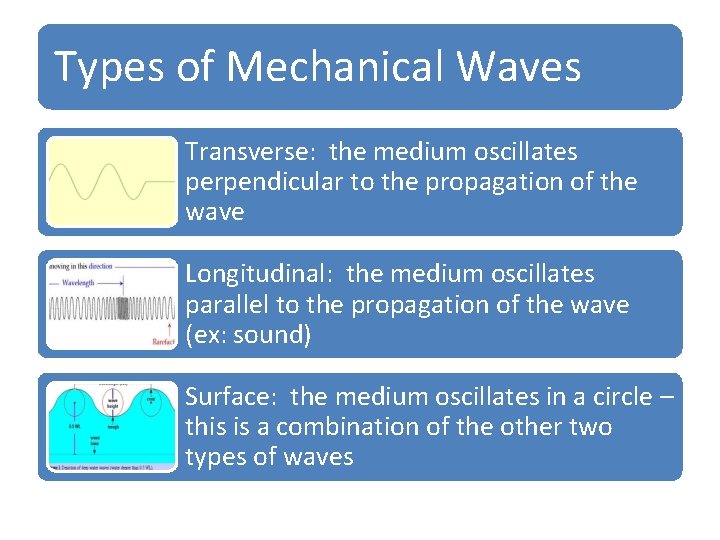
Types of Mechanical Waves Transverse: the medium oscillates perpendicular to the propagation of the wave Longitudinal: the medium oscillates parallel to the propagation of the wave (ex: sound) Surface: the medium oscillates in a circle – this is a combination of the other two types of waves
What’s next?
What’s next? What are the (anatomical) features of waves? What can we measure?
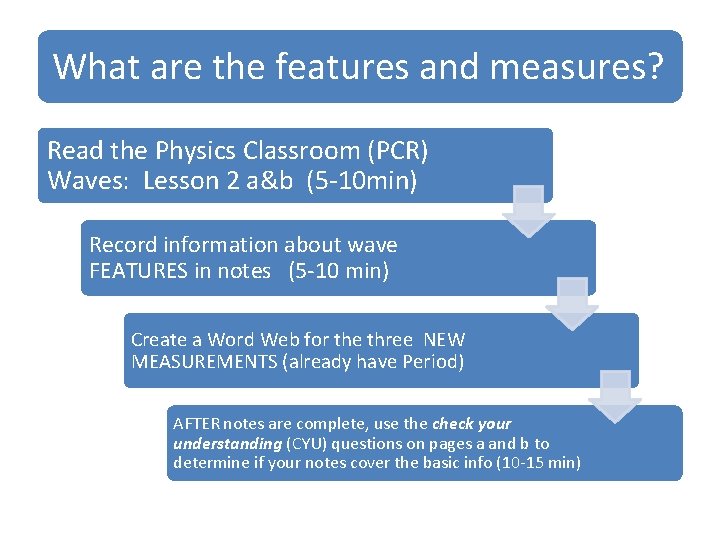
What are the features and measures? Read the Physics Classroom (PCR) Waves: Lesson 2 a&b (5 -10 min) Record information about wave FEATURES in notes (5 -10 min) Create a Word Web for the three NEW MEASUREMENTS (already have Period) AFTER notes are complete, use the check your understanding (CYU) questions on pages a and b to determine if your notes cover the basic info (10 -15 min)
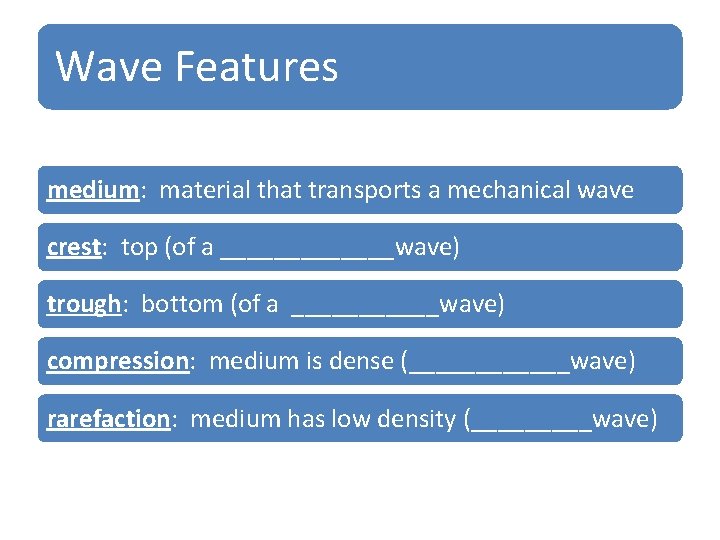
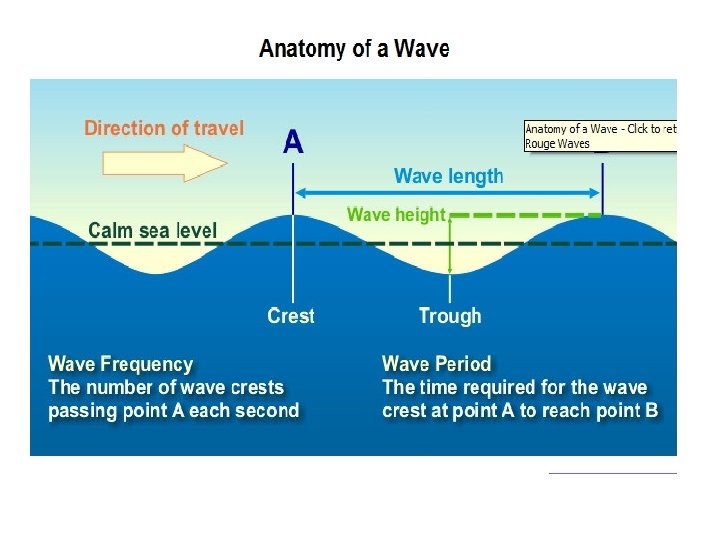
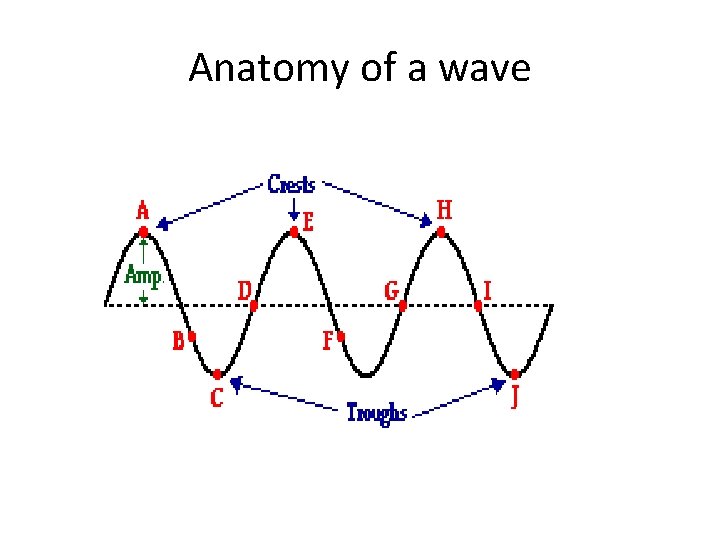
Wave Features medium: material that transports a mechanical wave crest: top (of a _______wave) trough: bottom (of a ______wave) compression: medium is dense (______wave) rarefaction: medium has low density (_____wave)
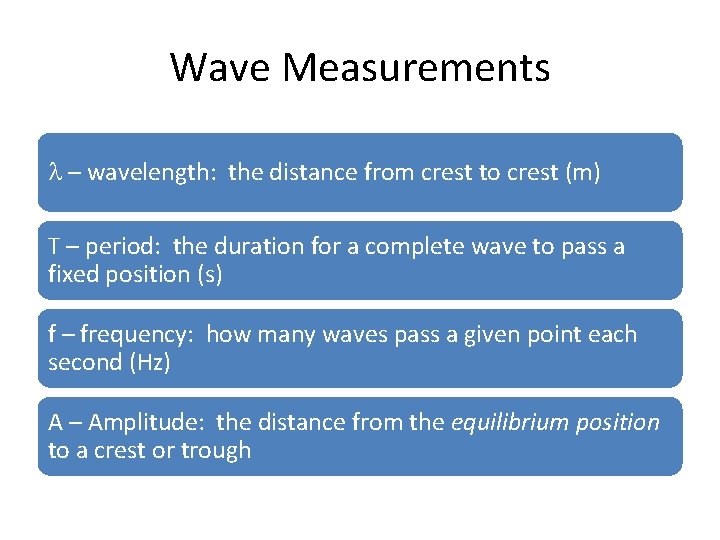
Wave Measurements l – wavelength: the distance from crest to crest (m) T – period: the duration for a complete wave to pass a fixed position (s) f – frequency: how many waves pass a given point each second (Hz) A – Amplitude: the distance from the equilibrium position to a crest or trough
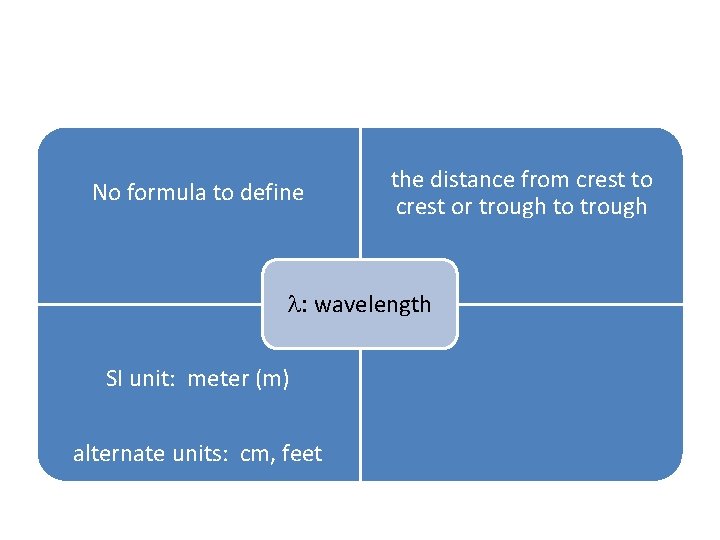
No formula to define the distance from crest to crest or trough to trough l: wavelength SI unit: meter (m) alternate units: cm, feet
Anatomy of a wave
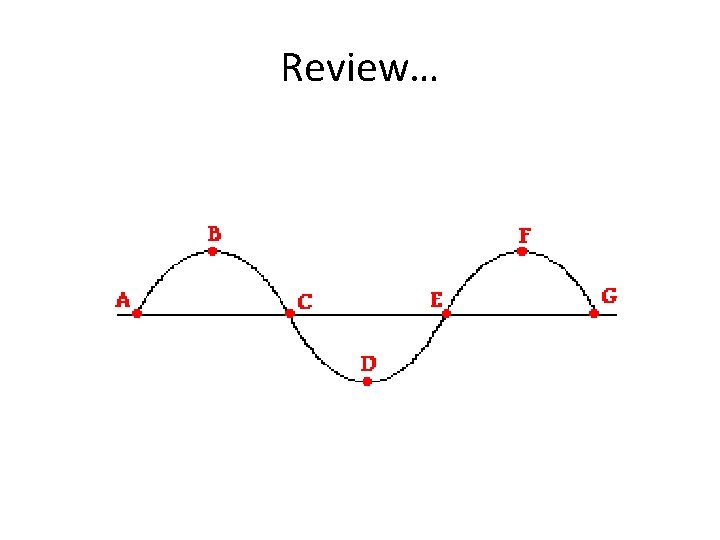
Review…
Waves and ENERGY • Waves transmit energy. Which measurement is most closely linked to the amount of energy the wave transmits?
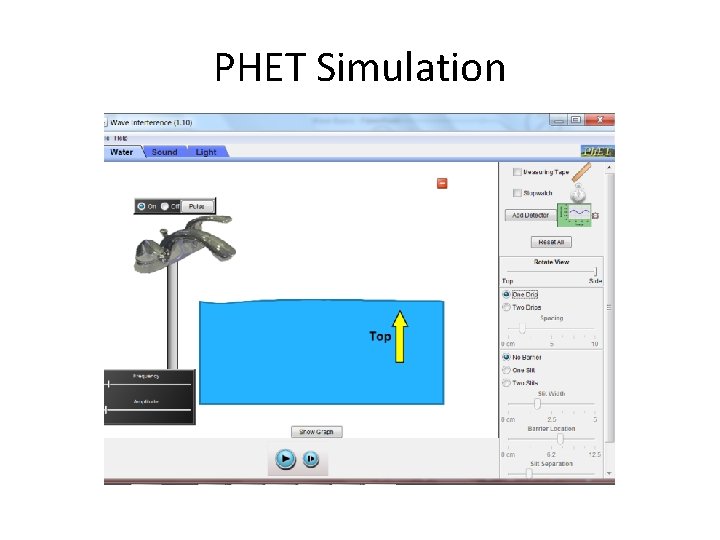
PHET Simulation • If you are finished the assignment early, you will benefit by: – Googling Ph. ET – Going to Physics Simulations – Choosing Sound & Waves – Selecting Wave Interference – Using the first tab (Water) to investigate what affects the wave measurements
PHET Simulation
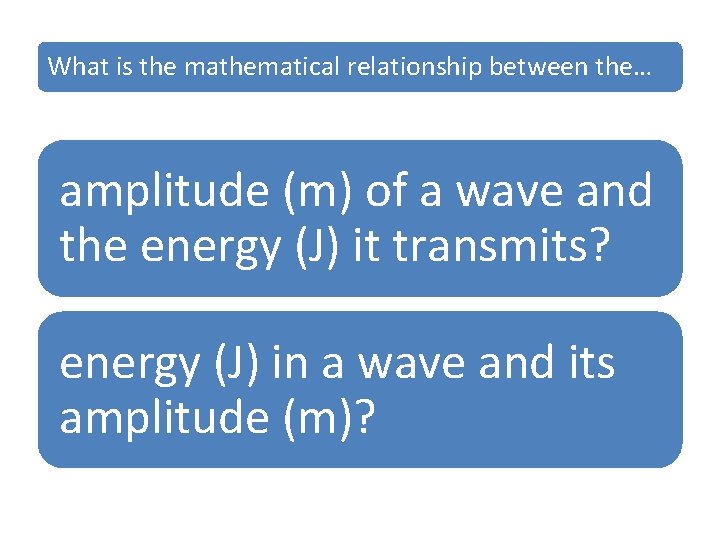
What is the mathematical relationship between the…
What is the mathematical relationship between the… amplitude (m) of a wave and the energy (J) it transmits? energy (J) in a wave and its amplitude (m)?
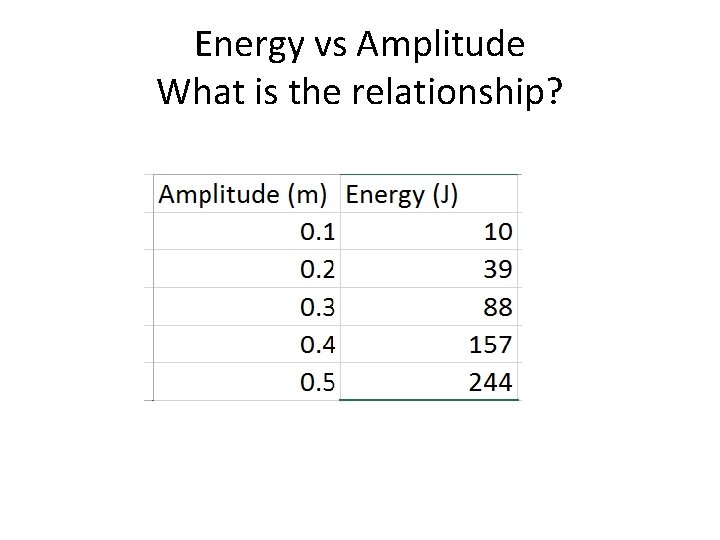
Energy vs Amplitude What is the relationship?
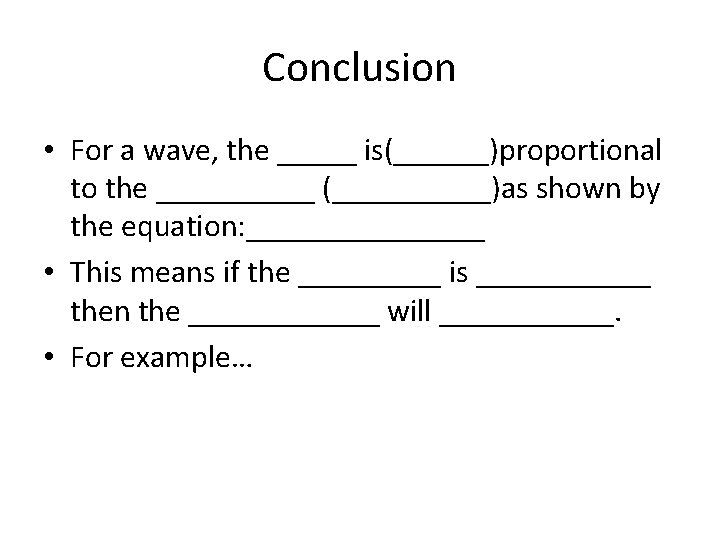
Conclusion • For a wave, the _____ is(______)proportional to the _____ (_____)as shown by the equation: ________ • This means if the _____ is ______ then the ______ will ______. • For example…
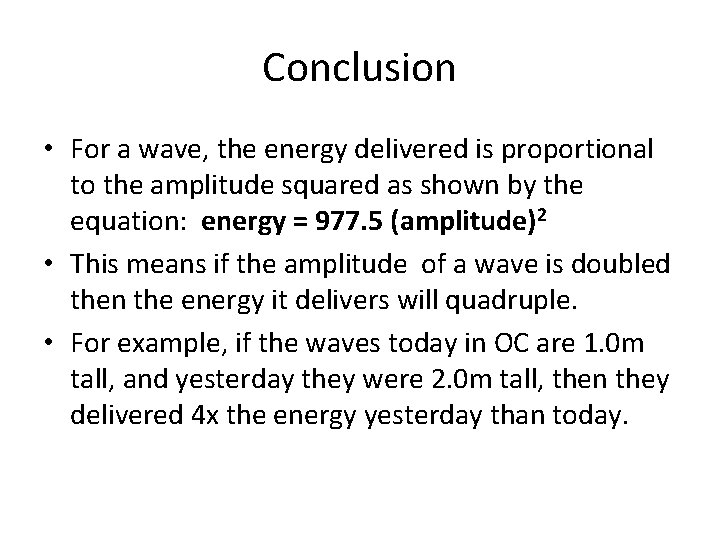
Conclusion • For a wave, the energy delivered is proportional to the amplitude squared as shown by the equation: energy = 977. 5 (amplitude)2 • This means if the amplitude of a wave is doubled then the energy it delivers will quadruple. • For example, if the waves today in OC are 1. 0 m tall, and yesterday they were 2. 0 m tall, then they delivered 4 x the energy yesterday than today.
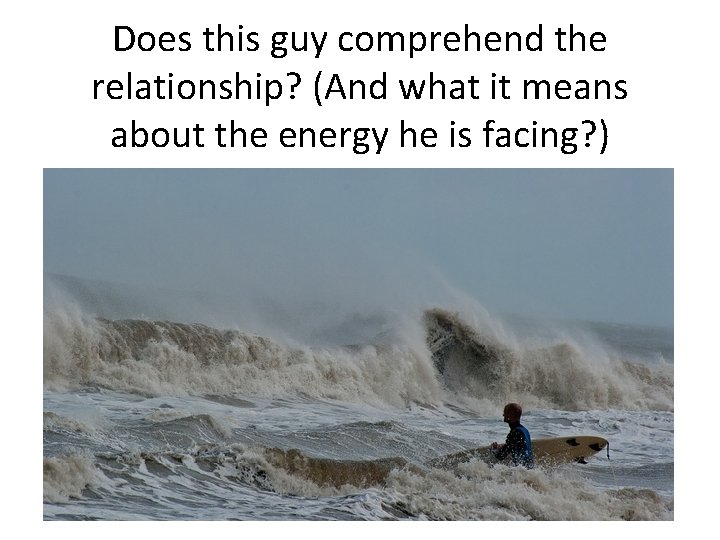
Does this guy comprehend the relationship? (And what it means about the energy he is facing? )
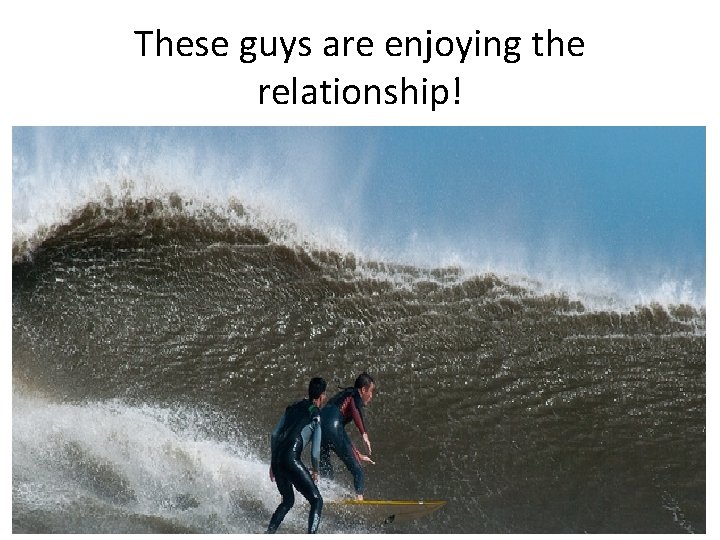
These guys are enjoying the relationship!
Can you use the proportionality? • On a nice summer day, the waves at the beach have an amplitude of 0. 5 m. On another, stormy day, the waves have an amplitude of 2. 0 m. Compare the energy delivered to the beach from individual waves on these two days.
What’s next? Or, what else do we need to know about waves? Or, are there any other relationships?
What are the relationships between… • wavelength (m)and frequency (Hz) … • wavelength (m) and amplitude (m) … • frequency (Hz) and amplitude (m) … …for a wave on a string?
What is the relationship between… wavelength (m) and frequency (Hz) for a wave on a string?
Conclusions • For a wave, the _____ is______proportional to the _____ as shown by the equation: __________ • This means if the _____ is ______ then the ______ will ______. (use: double, triple, quadruple, halve, quarter, etc) • For example…
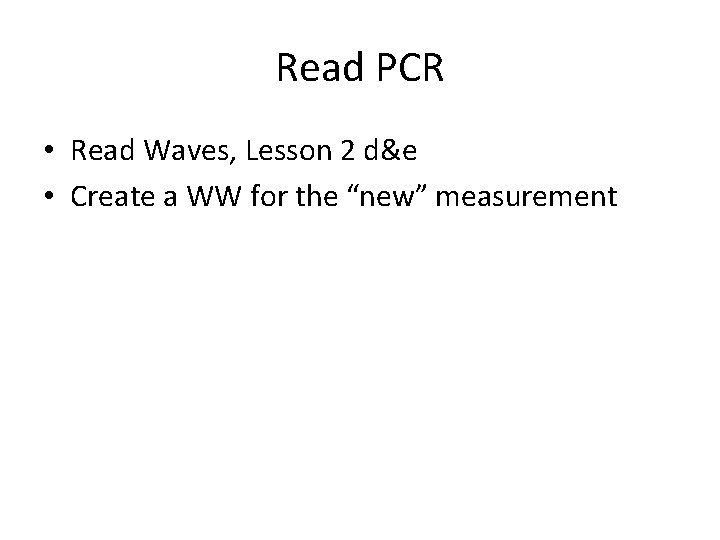
Quizzes, … • • • Quiz on Lessons 1 and 2 a&b PLQ Read Waves, Lesson 2 d&e Create a WW for the “new” measurement Try some of the CYU on each page. How did you do?
Read PCR • Read Waves, Lesson 2 d&e • Create a WW for the “new” measurement
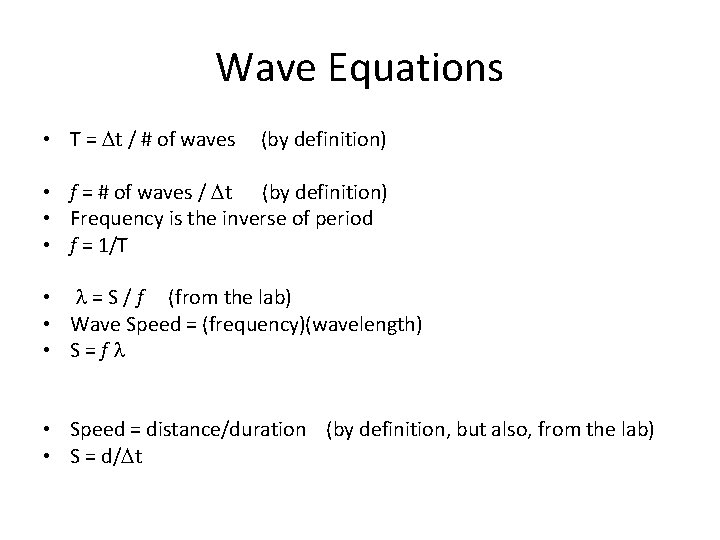
Wave Equations • T = Dt / # of waves (by definition) • f = # of waves / Dt (by definition) • Frequency is the inverse of period • f = 1/T • l = S / f (from the lab) • Wave Speed = (frequency)(wavelength) • S=fl • Speed = distance/duration (by definition, but also, from the lab) • S = d/Dt
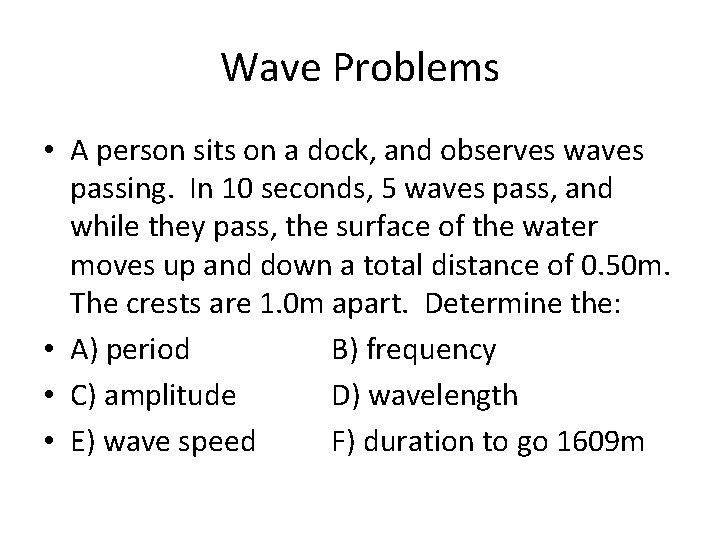
Wave Problems • A person sits on a dock, and observes waves passing. In 10 seconds, 5 waves pass, and while they pass, the surface of the water moves up and down a total distance of 0. 50 m. The crests are 1. 0 m apart. Determine the: • A) period B) frequency • C) amplitude D) wavelength • E) wave speed F) duration to go 1609 m
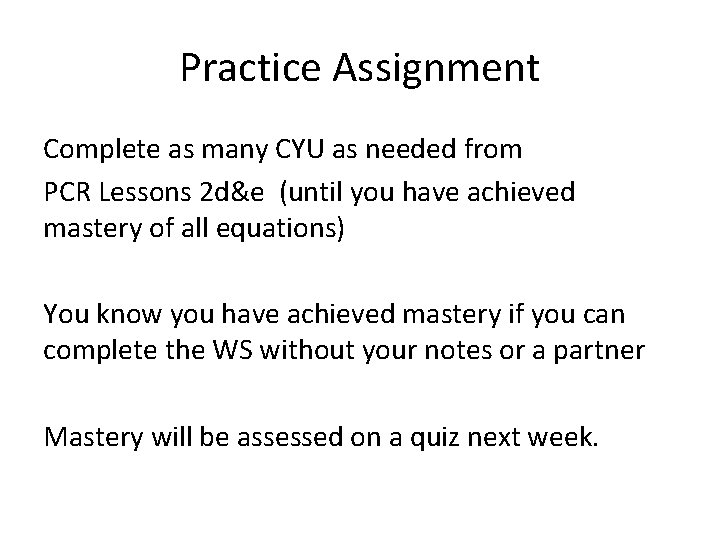
Practice Assignment Complete as many CYU as needed from PCR Lessons 2 d&e (until you have achieved mastery of all equations) You know you have achieved mastery if you can complete the WS without your notes or a partner Mastery will be assessed on a quiz next week.
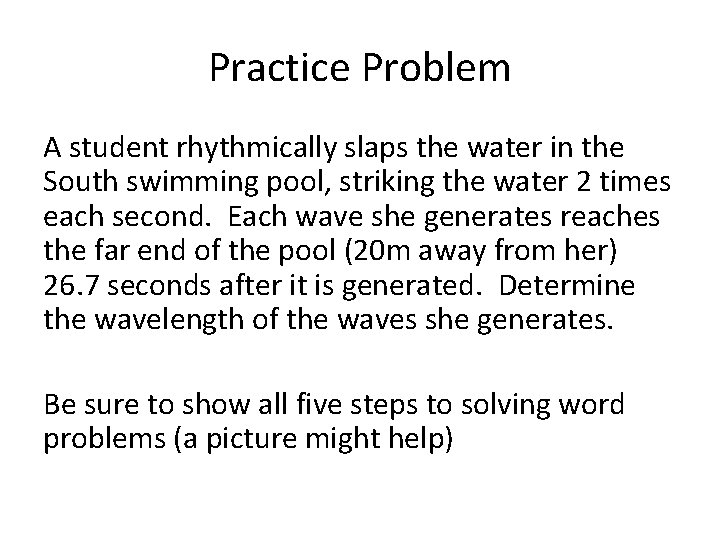
Practice Problem A student rhythmically slaps the water in the South swimming pool, striking the water 2 times each second. Each wave she generates reaches the far end of the pool (20 m away from her) 26. 7 seconds after it is generated. Determine the wavelength of the waves she generates. Be sure to show all five steps to solving word problems (a picture might help)
How do you know it is a wave? • It will do each of these….
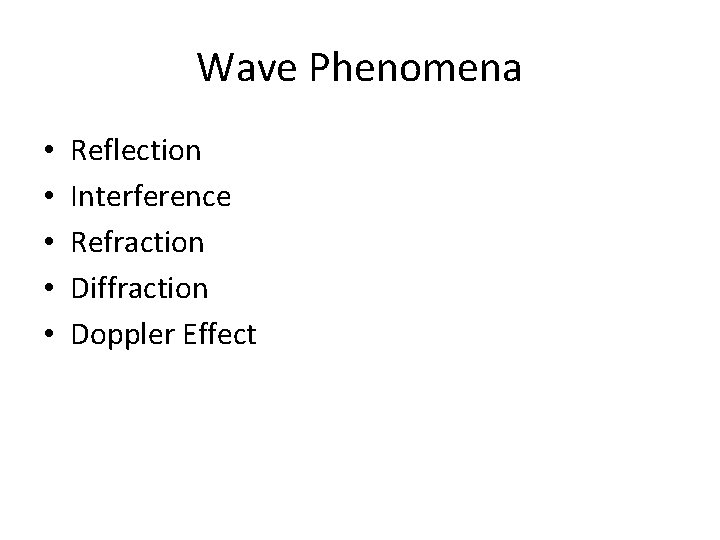
Wave Phenomena • • • Reflection Interference Refraction Diffraction Doppler Effect
Read PCR Waves Lesson 3 to… • Find definitions and examples of : – Reflection – Interference – Refraction – Diffraction – Doppler Effect
Reflection • When a wave strikes a barrier and is deflected off of the barrier (always at the same angle) • http: //www. youtube. com/watch? v=0 o 6 eyxtx B 2 s
Interference • Occurs when to waves that are traveling meet. Individual pulses add together when they are in the same location, and then continue on their way • Constructive Interference: crest meets crest, or trough meets trough – results in larger amplitude at that spot • Destructive Interference: crest meets trough – results in smaller (perhaps even ZERO) amplitude at that spot • http: //www. youtube. com/watch? v=5 Pmna. Pv. Av. QY&NR= 1 • http: //www. youtube. com/watch? v=P_r. K 66 GFe. I 4
Refraction • Refraction is the name of the phenomenon where a change of the medium causes a change of the wave’s ______, which causes a wave to bend, or change direction. • http: //www. youtube. com/watch? v=stdi 6 XJX 6 g. U&feature=related
Diffraction • Diffraction is the phenomenon that occurs when a wave passes through a narrow opening in a barrier, or passes the end of a barrier. • http: //www. youtube. com/watch? v=4 EDr 2 YY 9 ly. A&feature=related
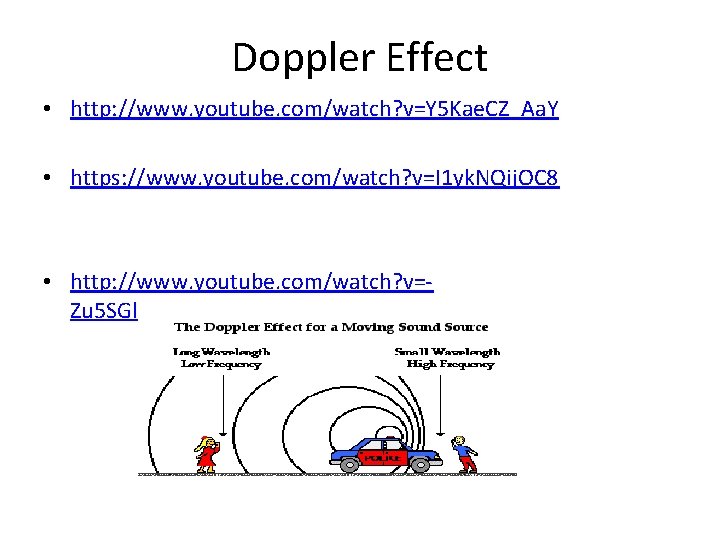
Doppler Effect • http: //www. youtube. com/watch? v=Y 5 Kae. CZ_Aa. Y • https: //www. youtube. com/watch? v=I 1 yk. NQij. OC 8 • http: //www. youtube. com/watch? v=Zu 5 SGllmwc&feature=related
Waves Lesson 4 • Skim: Determine your learning objectives • Re-read to achieve these learning objectives – Record notes that include explanations, examples and diagrams – Predict what you can do with your new learning
Traveling vs “Standing” Waves • Can a wave actually stand still? • What wave phenomenon / phenomena lead to the creation of “standing” waves?
Interference Causes… • Nodes and Anti-nodes (what are these? ) • Resonance and Standing Waves • Beats (study this in sound)
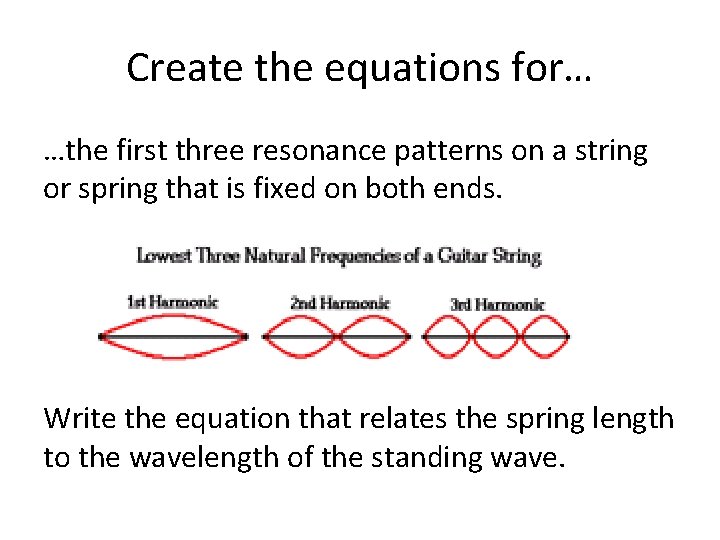
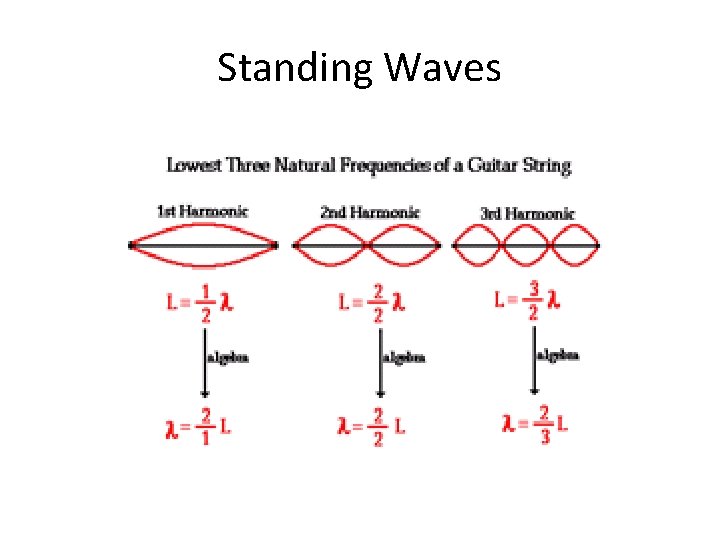
Create the equations for… …the first three resonance patterns on a string or spring that is fixed on both ends. Write the equation that relates the spring length to the wavelength of the standing wave.
Standing Waves
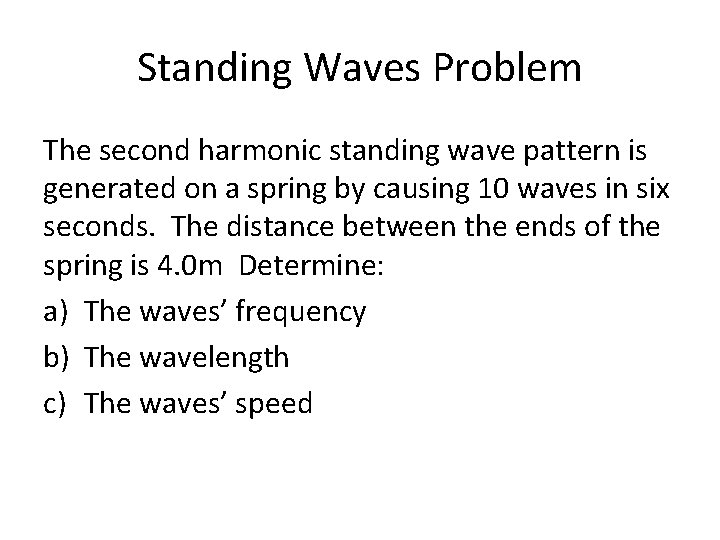
Standing Waves Problem The second harmonic standing wave pattern is generated on a spring by causing 10 waves in six seconds. The distance between the ends of the spring is 4. 0 m Determine: a) The waves’ frequency b) The wavelength c) The waves’ speed
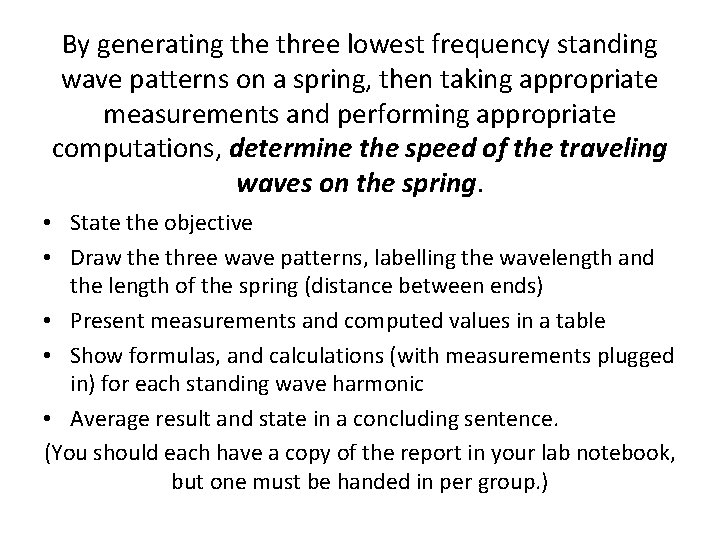
Lab: “Standing Wave” • By generating the three lowest frequency “standing wave” patterns on a spring, then taking appropriate measurements and performing appropriate computations, determine the speed of waves on the spring.
By generating the three lowest frequency standing wave patterns on a spring, then taking appropriate measurements and performing appropriate computations, determine the speed of the traveling waves on the spring. • State the objective • Draw the three wave patterns, labelling the wavelength and the length of the spring (distance between ends) • Present measurements and computed values in a table • Show formulas, and calculations (with measurements plugged in) for each standing wave harmonic • Average result and state in a concluding sentence. (You should each have a copy of the report in your lab notebook, but one must be handed in per group. )