
Waves AP Physics 1 End Slide Definitions Wave
- Slides: 33
Waves AP Physics 1
End Slide Definitions • Wave – A disturbance in a given medium that carries energy from one place to another • Medium – substance through which a wave travels; not all ways need mediums (plural: media) • Pulse Wave – A single disturbance in a medium • Continuous Wave – A set of disturbances occurring over and over usually in a pattern 2
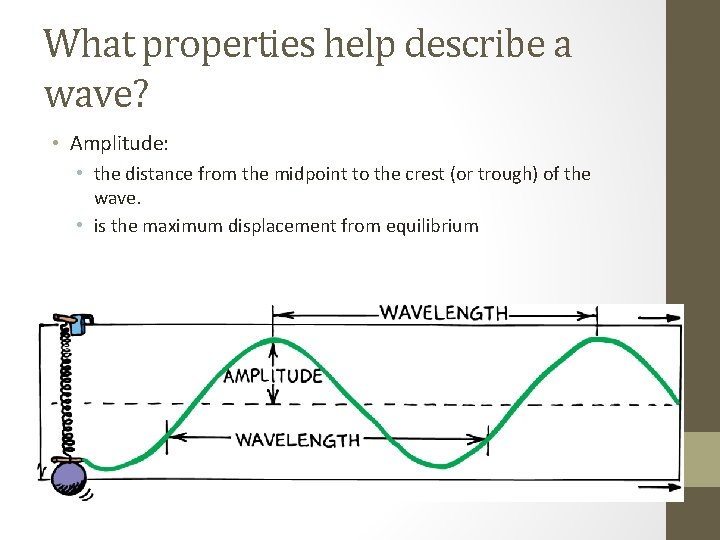
What properties help describe a wave? • Amplitude: • the distance from the midpoint to the crest (or trough) of the wave. • is the maximum displacement from equilibrium
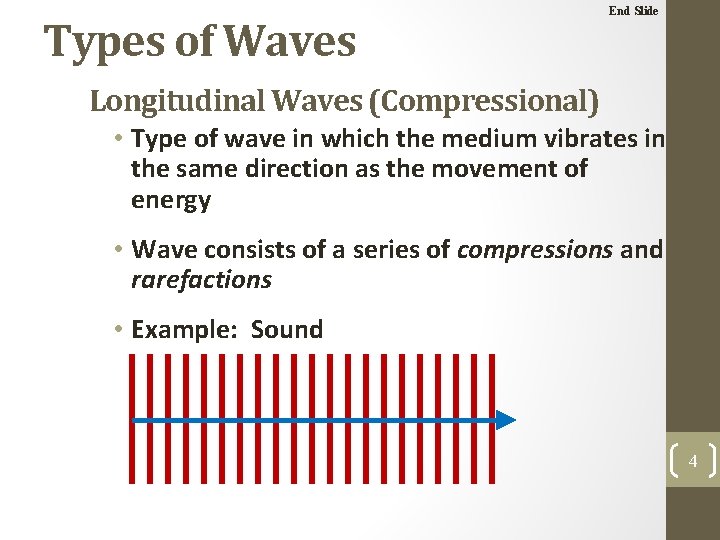
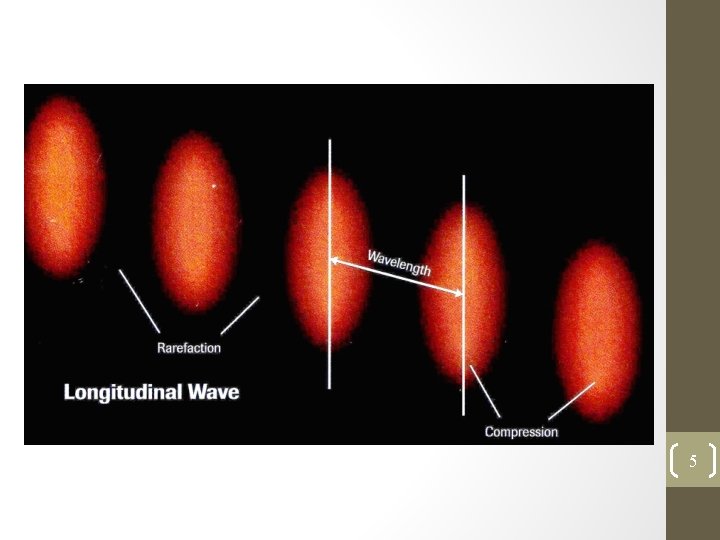
Types of Waves End Slide Longitudinal Waves (Compressional) • Type of wave in which the medium vibrates in the same direction as the movement of energy • Wave consists of a series of compressions and rarefactions • Example: Sound 4
5
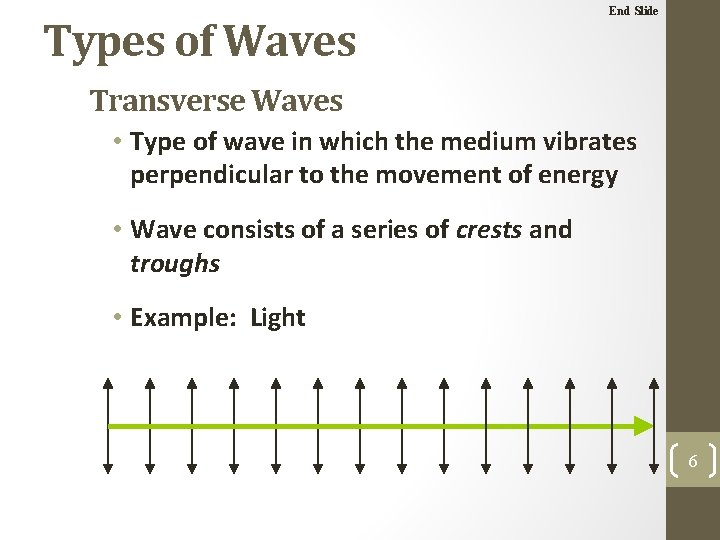
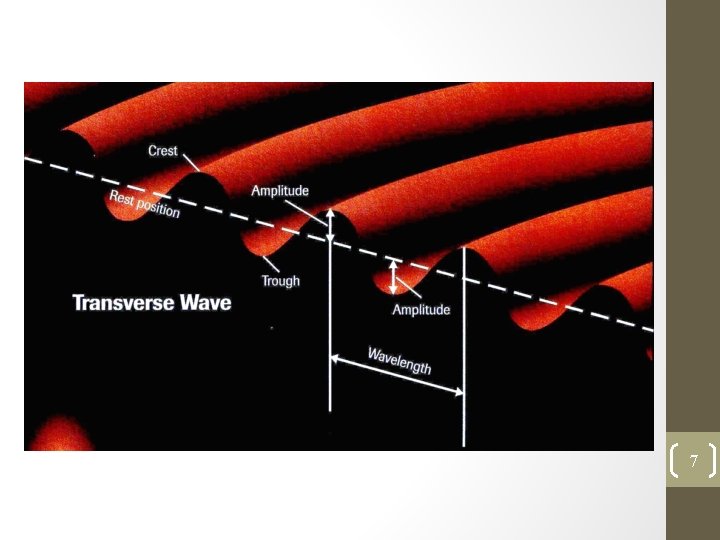
Types of Waves End Slide Transverse Waves • Type of wave in which the medium vibrates perpendicular to the movement of energy • Wave consists of a series of crests and troughs • Example: Light 6
7
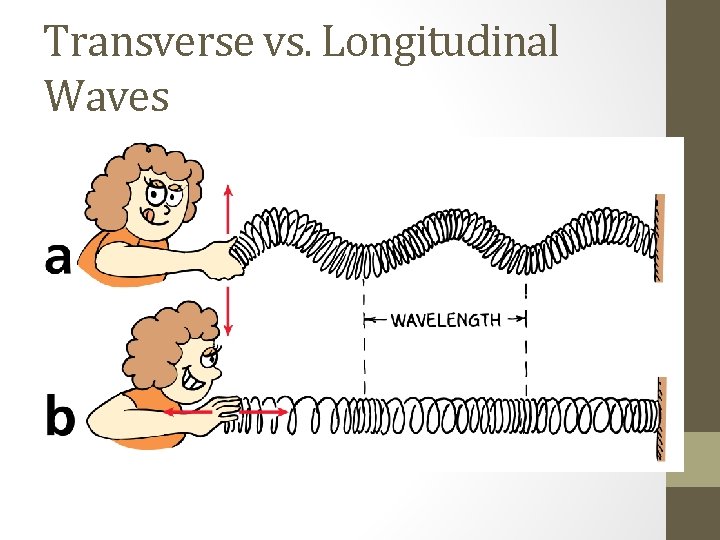
Transverse vs. Longitudinal Waves
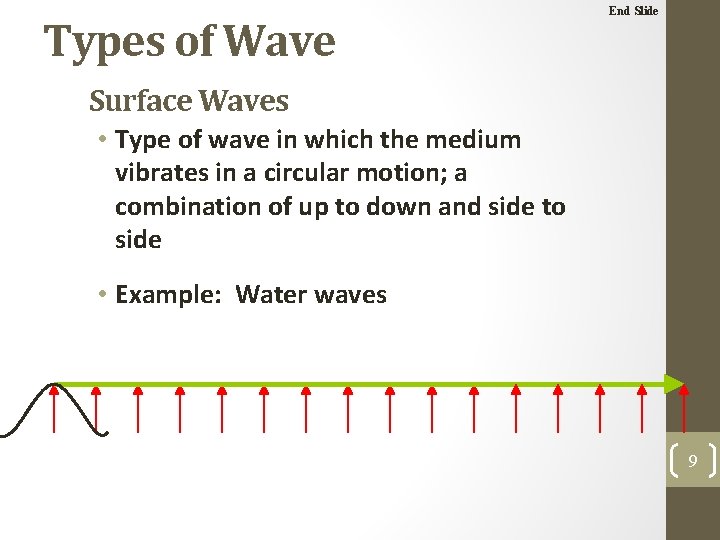
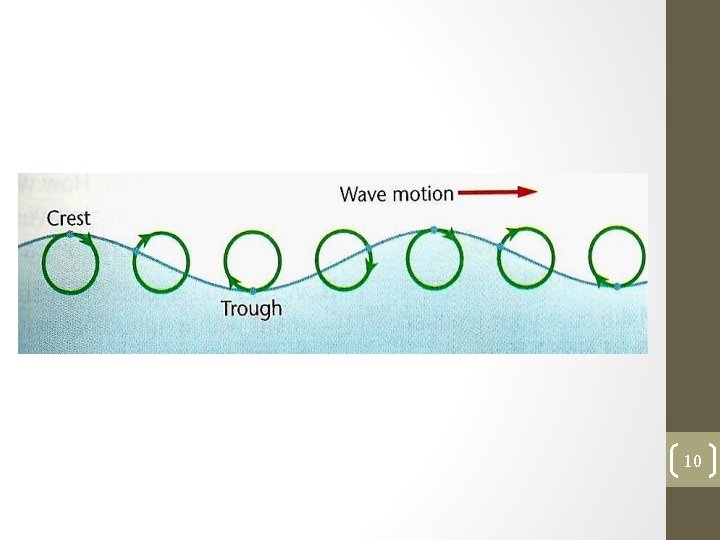
Types of Wave End Slide Surface Waves • Type of wave in which the medium vibrates in a circular motion; a combination of up to down and side to side • Example: Water waves 9
10
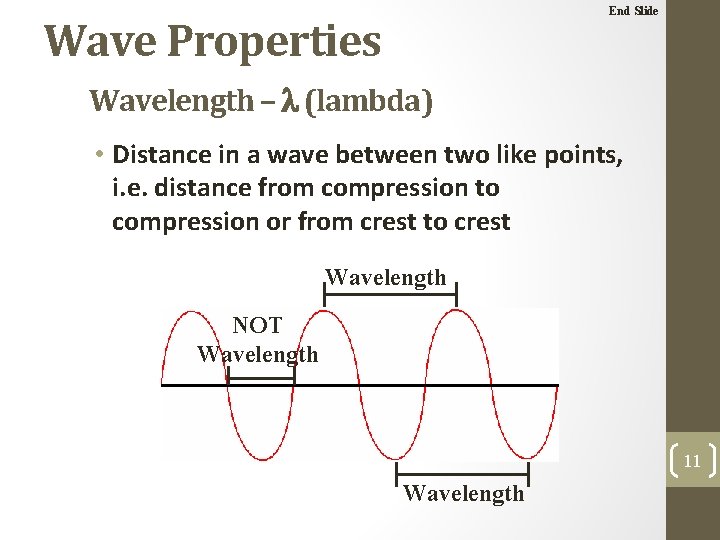
End Slide Wave Properties Wavelength – l (lambda) • Distance in a wave between two like points, i. e. distance from compression to compression or from crest to crest Wavelength NOT Wavelength 11 Wavelength
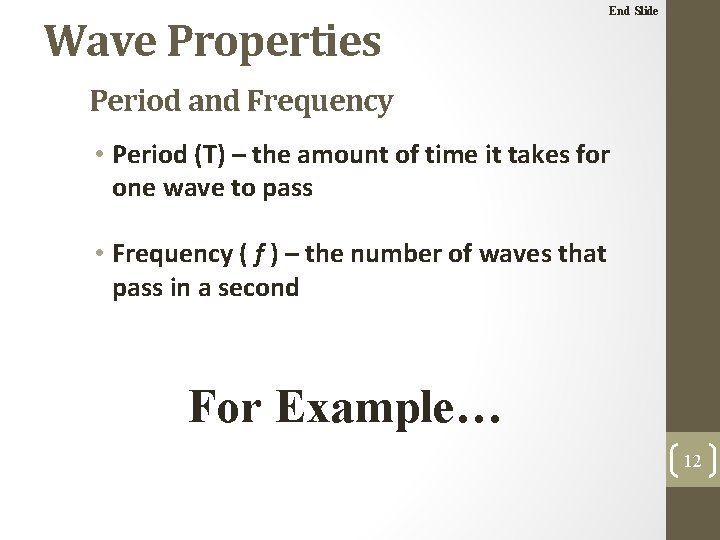
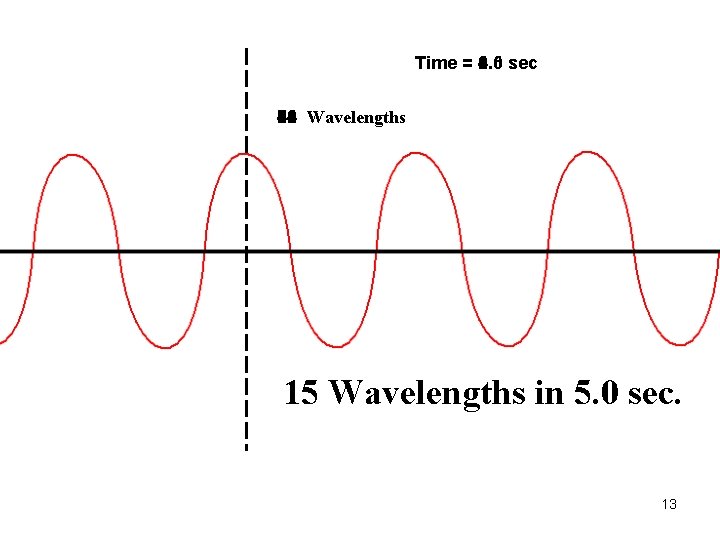
Wave Properties End Slide Period and Frequency • Period (T) – the amount of time it takes for one wave to pass • Frequency ( f ) – the number of waves that pass in a second For Example… 12
Time = 5. 0 0. 0 sec 0. 5 1. 0 1. 5 2. 0 2. 5 3. 0 3. 5 4. 0 4. 5 90 Wavelengths 8 7 6 5 4 3 2 1 0 15 14 13 12 11 15 Wavelengths in 5. 0 sec. 13
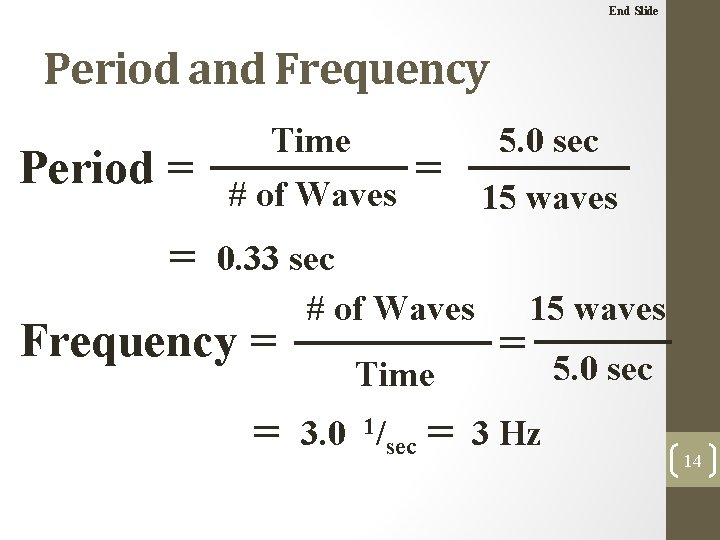
End Slide Period and Frequency Period = = Time # of Waves 5. 0 sec = 15 waves 0. 33 sec # of Waves Frequency = = Time 3. 0 1/sec = = 15 waves 3 Hz 5. 0 sec 14
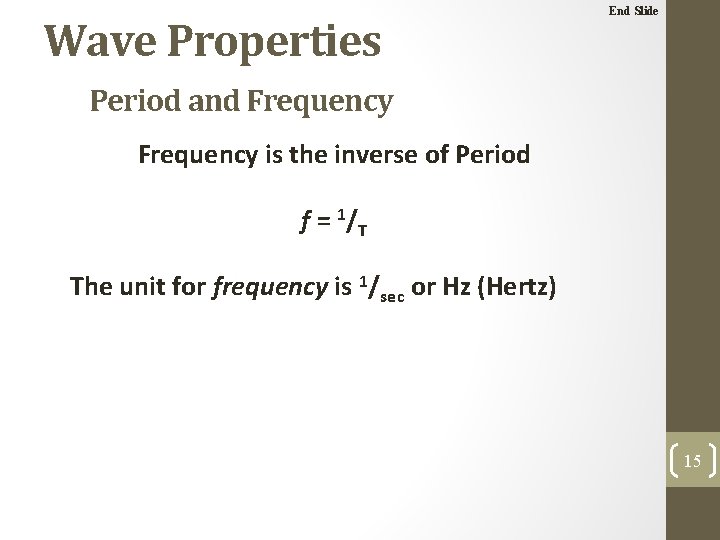
Wave Properties End Slide Period and Frequency is the inverse of Period f = 1/T The unit for frequency is 1/sec or Hz (Hertz) 15
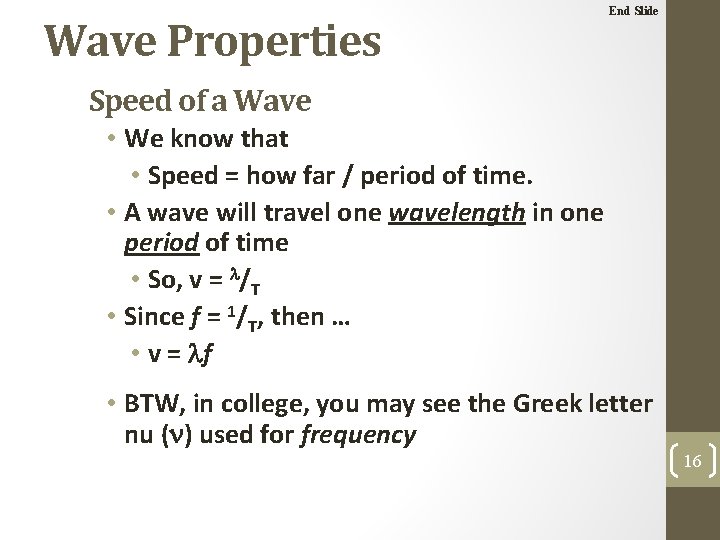
Wave Properties End Slide Speed of a Wave • We know that • Speed = how far / period of time. • A wave will travel one wavelength in one period of time • So, v = l/T • Since f = 1/T, then … • v = lf • BTW, in college, you may see the Greek letter nu (n) used for frequency 16
Wave Properties End Slide Speed of a Wave (cont. ) • The speed of a wave DOES NOT change unless the medium changes. • i. e. , for sound, temperature and pressure can change the speed of sound. • The electro-magnetic fields can not be changed; so the speed of light will be constant. 17 End Slide
End Slide Wave Properties Speed of a Wave (cont. ) • Assuming a medium doesn’t change, what has to happen to the wavelength of a wave if you increase the frequency? • Wavelength will decrease v = lf • What has to happen to the frequency of a wave if you shorten the wavelength? • Frequency will increase 18
End Slide Example #1 • In music, the note B has a f = 247 Hz and a l = 1. 34 m. What is the speed of these waves in air (a. k. a. sound)? v = lf = (1. 34 m)(247 Hz) = 331 m*Hz = 331 m/s 19
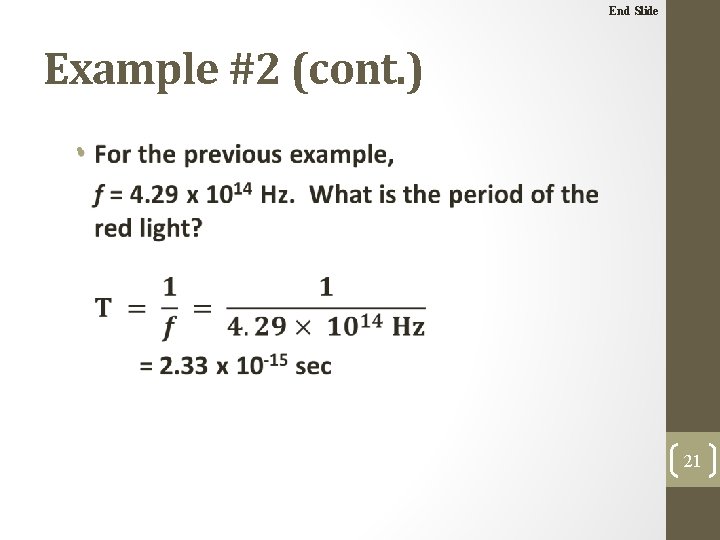
End Slide Example#2 • Suppose a planet is emitting a red light. Red light is known to have a wavelength of 7. 00 x 10 -7 m. Knowing the speed of light, what is the frequency of the light? f = v/l = (3. 00 x 108 m/s)/(7. 00 x 10 -7 m) = 4. 29 x 1014 Hz 20
End Slide Example #2 (cont. ) • 21
Wave Behaviors End Slide Superposition of Waves • When two objects meet, they cannot occupy the same time and space; however, waves can pass through each other 22
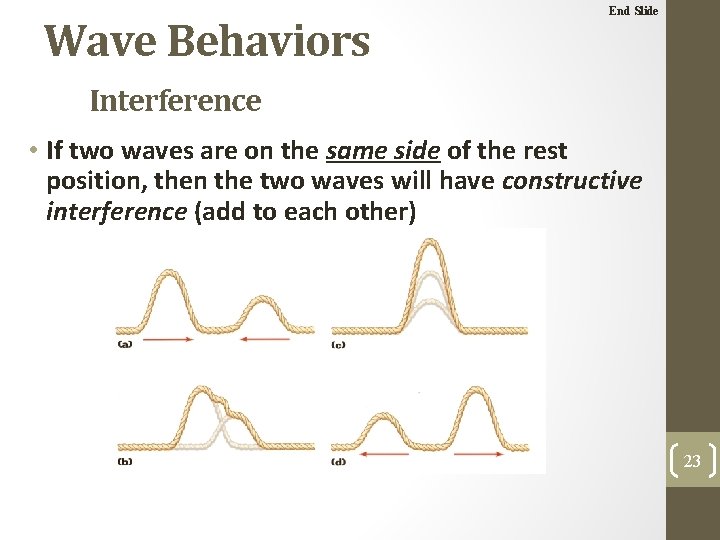
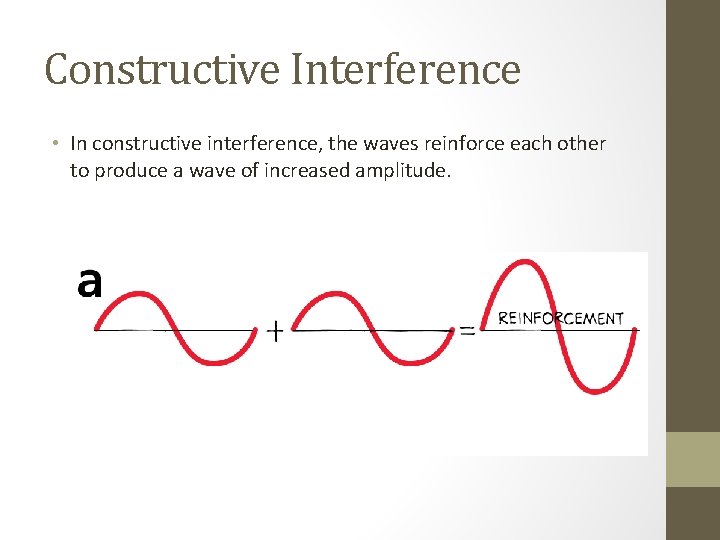
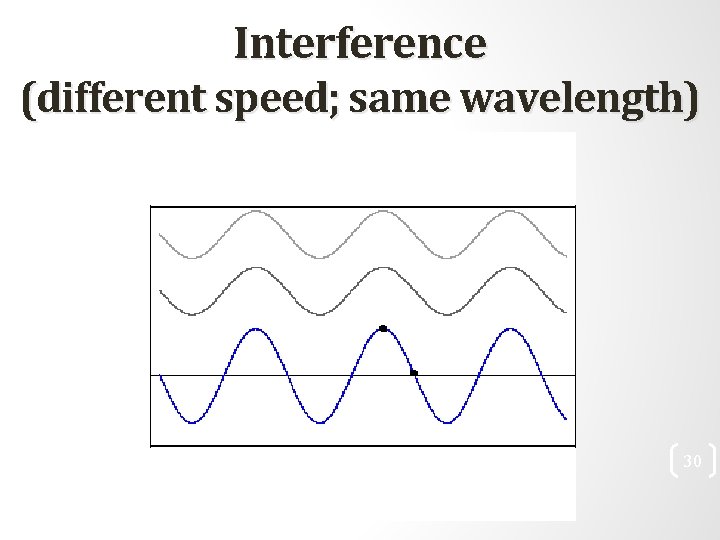
Wave Behaviors End Slide Interference • If two waves are on the same side of the rest position, then the two waves will have constructive interference (add to each other) 23
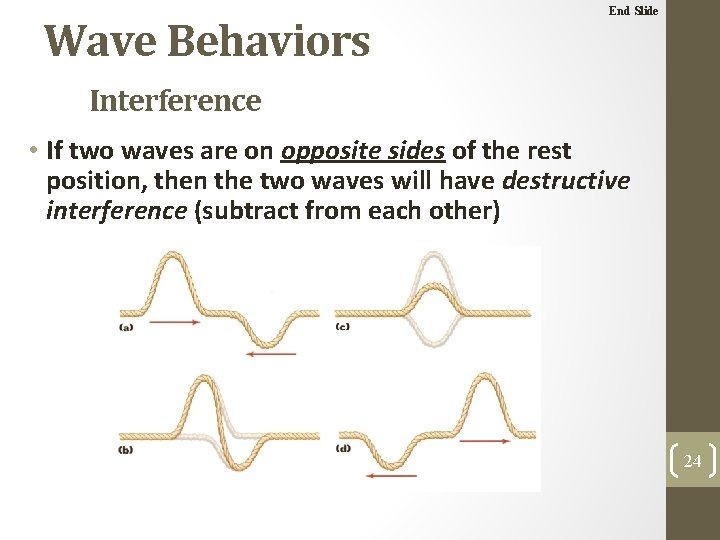
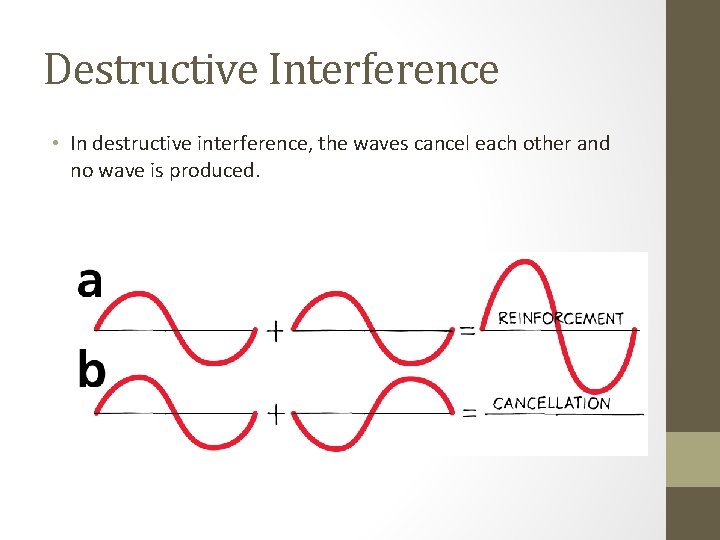
Wave Behaviors End Slide Interference • If two waves are on opposite sides of the rest position, then the two waves will have destructive interference (subtract from each other) 24
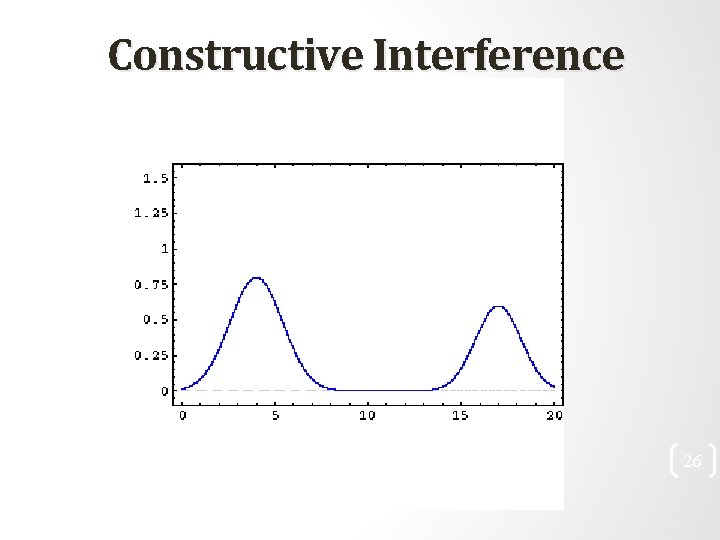
Constructive Interference • In constructive interference, the waves reinforce each other to produce a wave of increased amplitude.
Constructive Interference 26
Destructive Interference • In destructive interference, the waves cancel each other and no wave is produced.
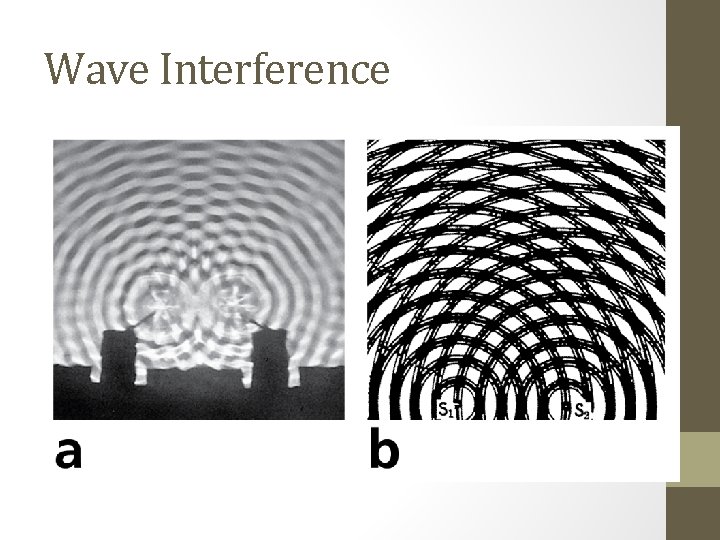
Wave Interference
• Wave interference demo 29
Interference (different speed; same wavelength) 30
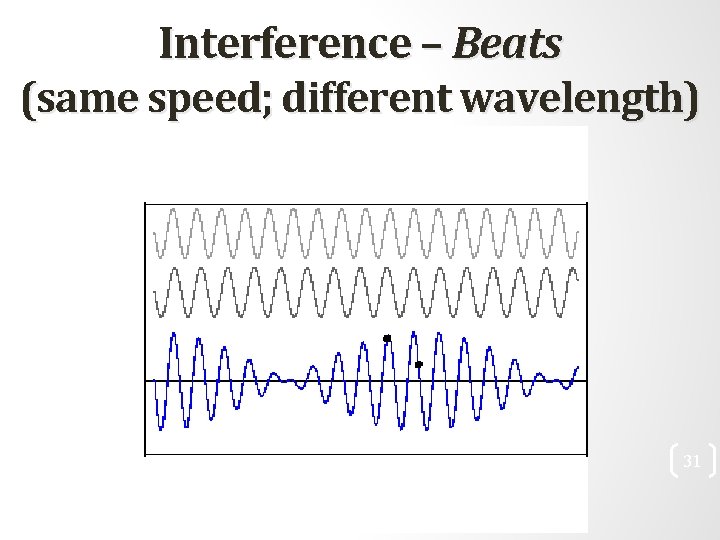
Interference – Beats (same speed; different wavelength) 31
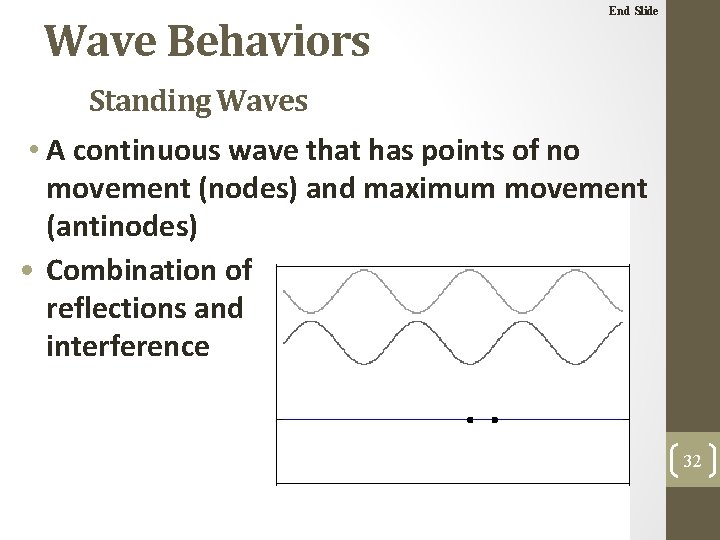
Wave Behaviors End Slide Standing Waves • A continuous wave that has points of no movement (nodes) and maximum movement (antinodes) • Combination of reflections and interference 32
End Slide Measuring Speed Using Standing Waves • Measure Wavelength • Count number of crests in a given time period; time for 10 crests? • Divide 10 by that time to get frequency • v = fl 33