
Waves and Wave Properties Why are we able
Waves and Wave Properties
Why are we able to see? Answer: Because there is light. And…what is light? Answer: Light is a wave.
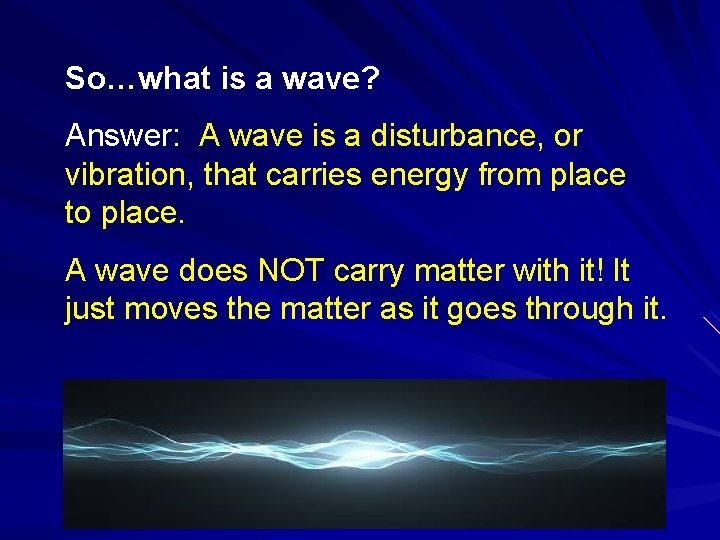
So…what is a wave? Answer: A wave is a disturbance, or vibration, that carries energy from place to place. A wave does NOT carry matter with it! It just moves the matter as it goes through it.
For the most part waves MUST have a medium in order to move. Example of Waves: Sound, light, radio waves, earthquakes and many more. These are called mechanical waves.
Three Types of Waves Transverse Longitudinal Surface

Wave Types 1. Transverse waves: Waves in which the particles move perpendicular to the direction of the wave. Sound Waves and Light Waves behave like Transverse Waves
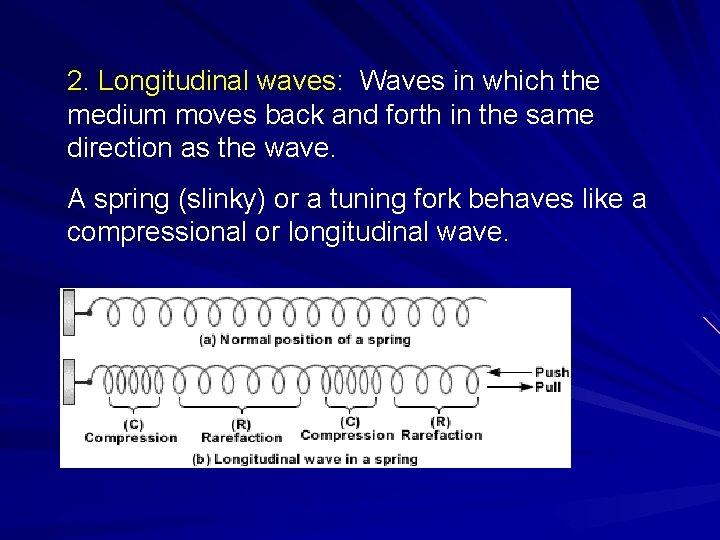
2. Longitudinal waves: Waves in which the medium moves back and forth in the same direction as the wave. A spring (slinky) or a tuning fork behaves like a compressional or longitudinal wave.
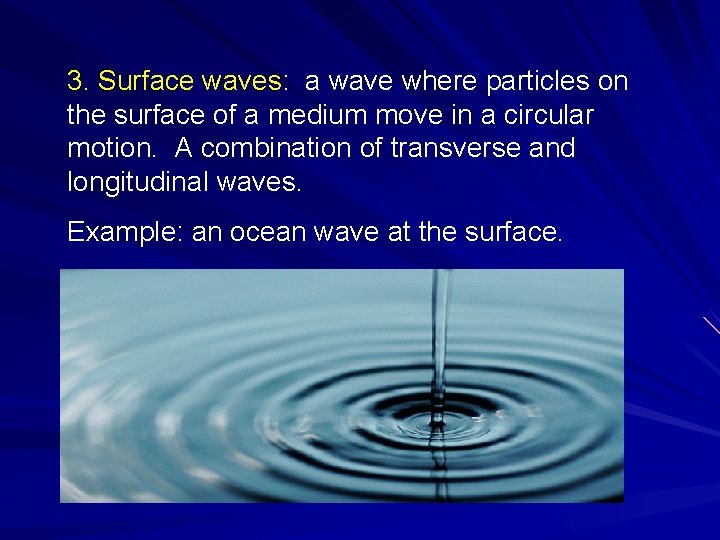
3. Surface waves: a wave where particles on the surface of a medium move in a circular motion. A combination of transverse and longitudinal waves. Example: an ocean wave at the surface.
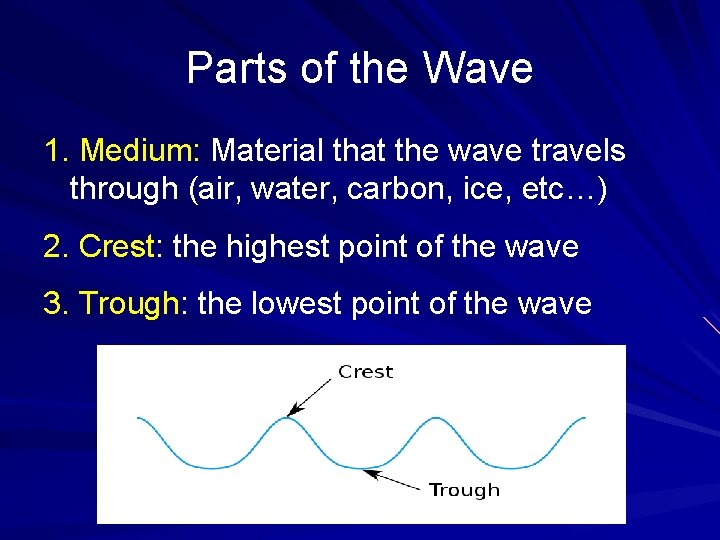
Parts of the Wave 1. Medium: Material that the wave travels through (air, water, carbon, ice, etc…) 2. Crest: the highest point of the wave 3. Trough: the lowest point of the wave
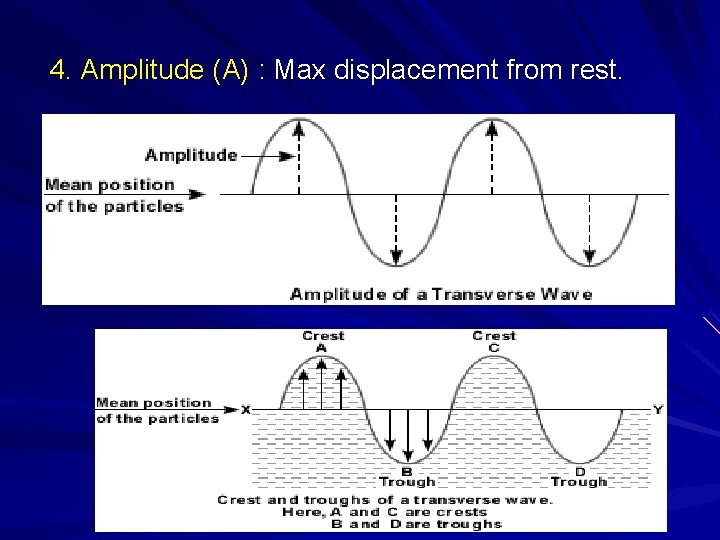
4. Amplitude (A) : Max displacement from rest.
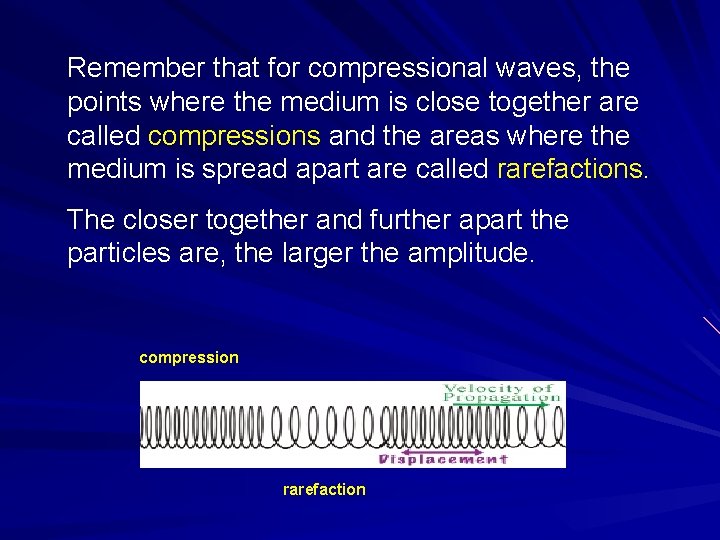
Remember that for compressional waves, the points where the medium is close together are called compressions and the areas where the medium is spread apart are called rarefactions. The closer together and further apart the particles are, the larger the amplitude. compression rarefaction
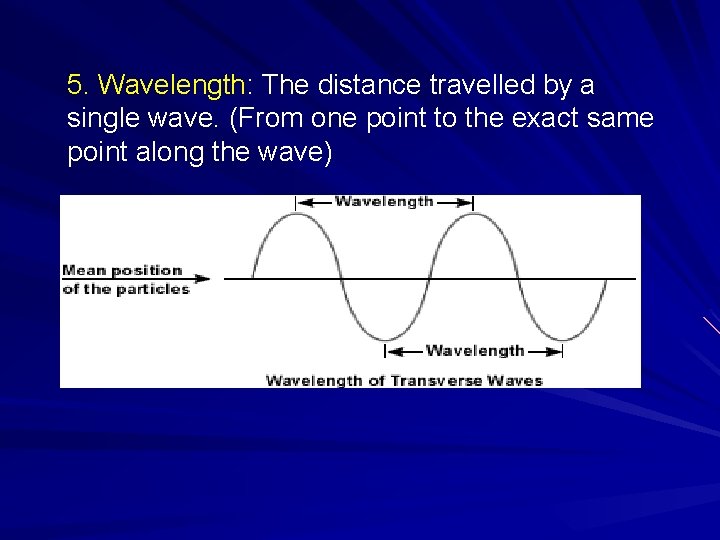
5. Wavelength: The distance travelled by a single wave. (From one point to the exact same point along the wave)
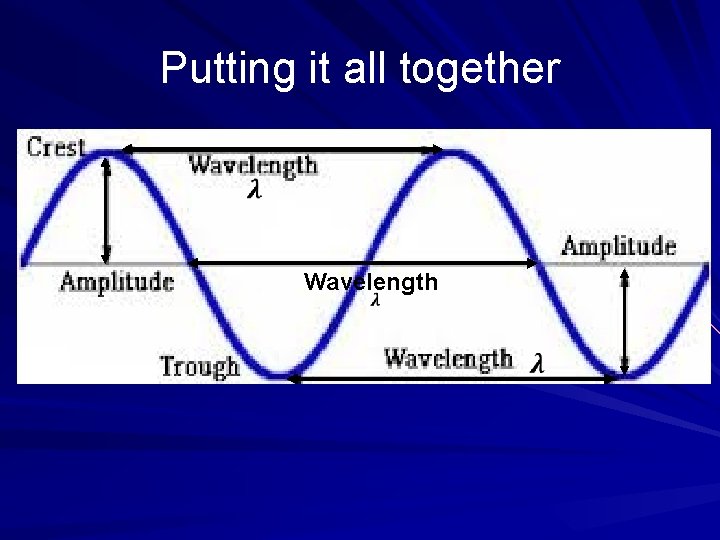
Putting it all together Wavelength
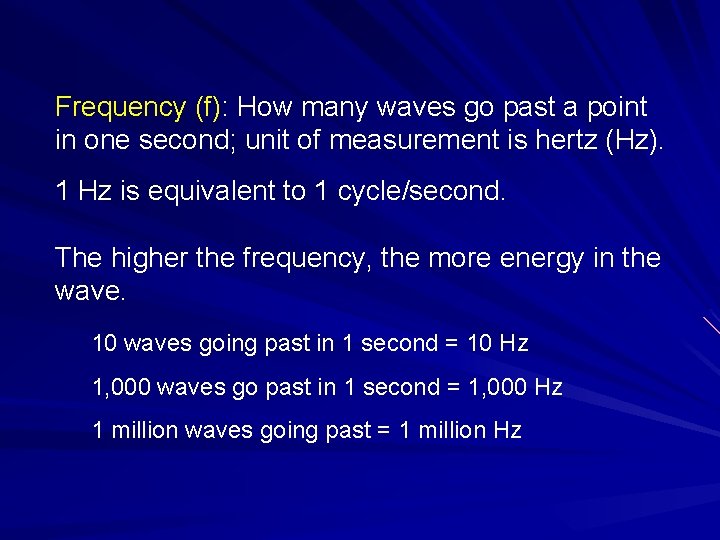
Frequency (f): How many waves go past a point in one second; unit of measurement is hertz (Hz). 1 Hz is equivalent to 1 cycle/second. The higher the frequency, the more energy in the wave. 10 waves going past in 1 second = 10 Hz 1, 000 waves go past in 1 second = 1, 000 Hz 1 million waves going past = 1 million Hz
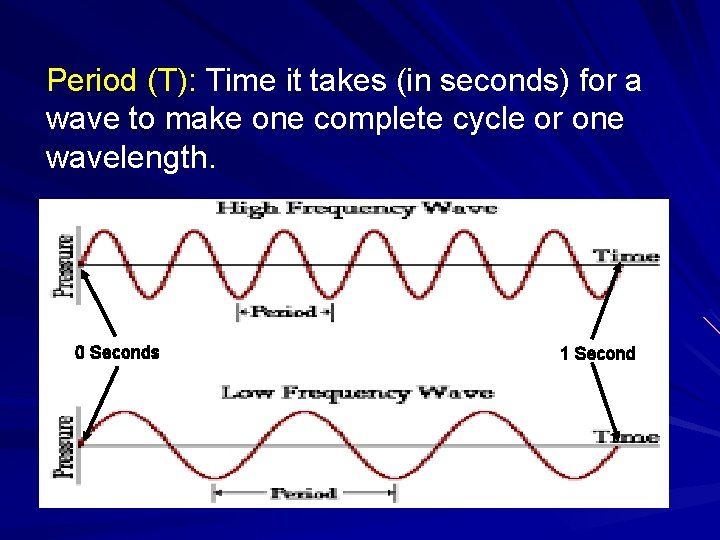
Period (T): Time it takes (in seconds) for a wave to make one complete cycle or one wavelength. 0 Seconds 1 Second
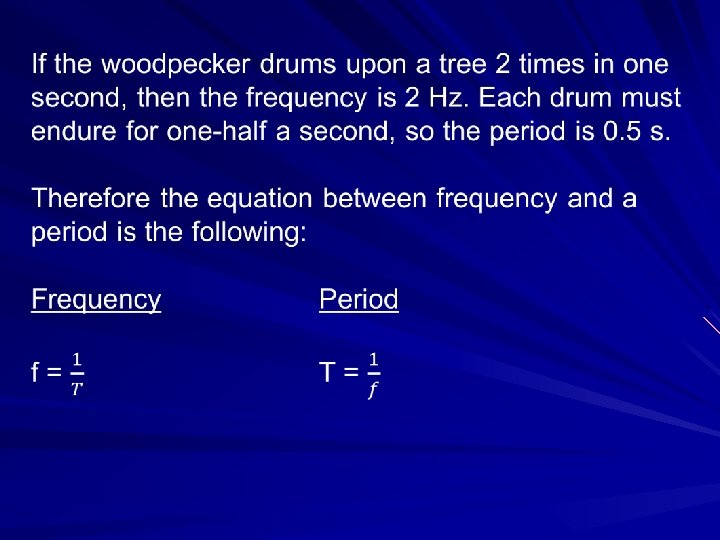
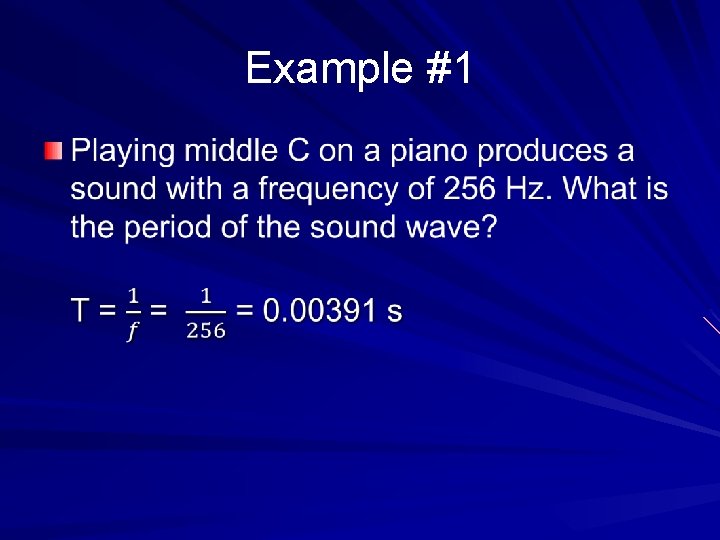
Example #1
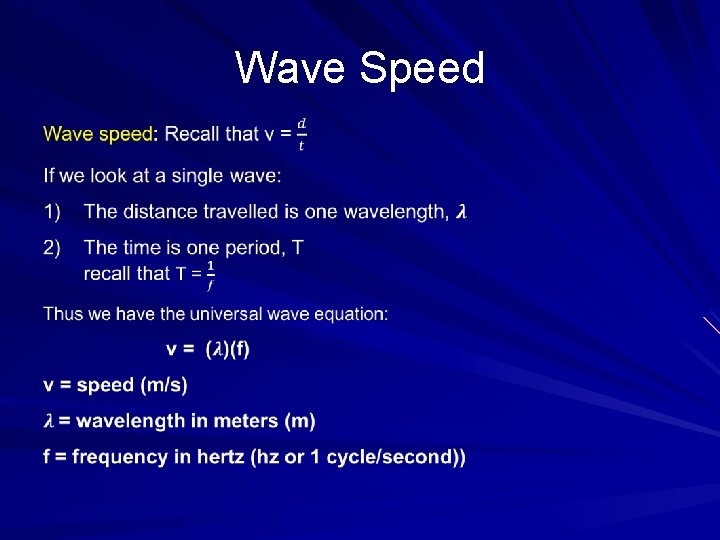
Wave Speed
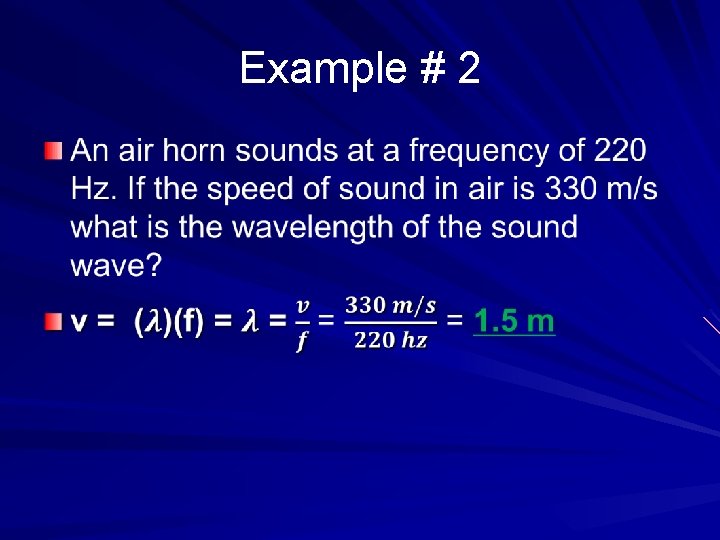
Example # 2
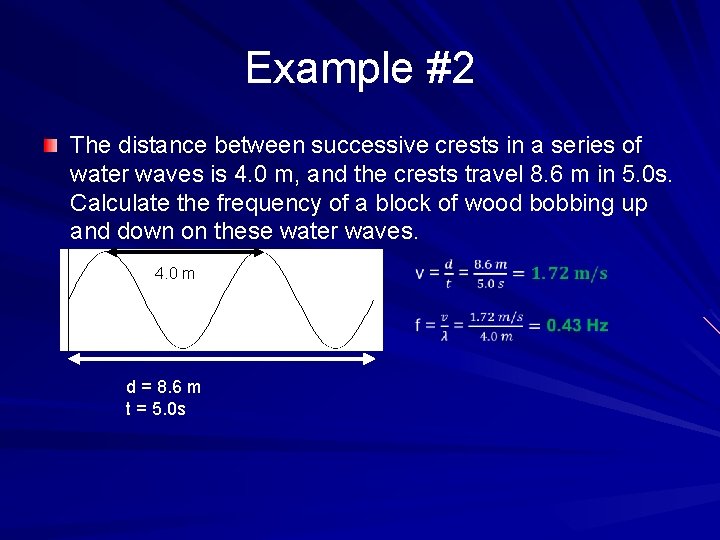
Example #2 The distance between successive crests in a series of water waves is 4. 0 m, and the crests travel 8. 6 m in 5. 0 s. Calculate the frequency of a block of wood bobbing up and down on these water waves. 4. 0 m d = 8. 6 m t = 5. 0 s
- Slides: 20