
Waves and Wave Properties 6 th grade science
- Slides: 27
Waves and Wave Properties 6 th grade science
Wave Is any type of disturbance that carries energy It may move matter, but DOES NOT carry it Waves are moving energy
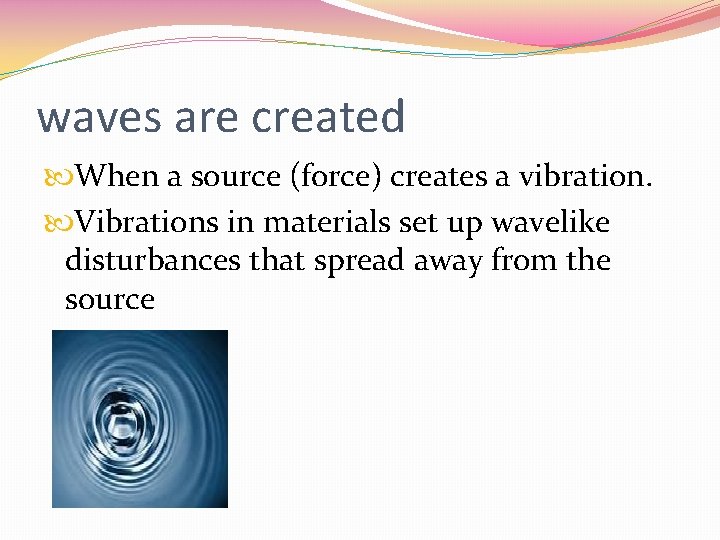
waves are created When a source (force) creates a vibration. Vibrations in materials set up wavelike disturbances that spread away from the source
How waves behave Wave behavior can be described in the following ways: 1) How fast the disturbance spreads 2) Wavelength- the distance between successive peaks of the disturbance. Waves move at different speeds in different materials
2 Main types of waves 1) Electromagnetic- Waves that can travel through empty space ie–Electromagnetic waves they do not require a medium to travel 2)Mechanical-waves that must have matter (a medium) to travel through. ie- Sound, earthquake( seismic waves)
Mechanical Waves Mechanical waves must have a medium such as a solid, liquid or a gas (matter) to travel through. They are all carrying energy, but what medium or matter do they travel through? Waves at the beachocean or water Sound waves from TV air “The Wave” at a stadium people Seismic waves that cause earthquakes ground or earth
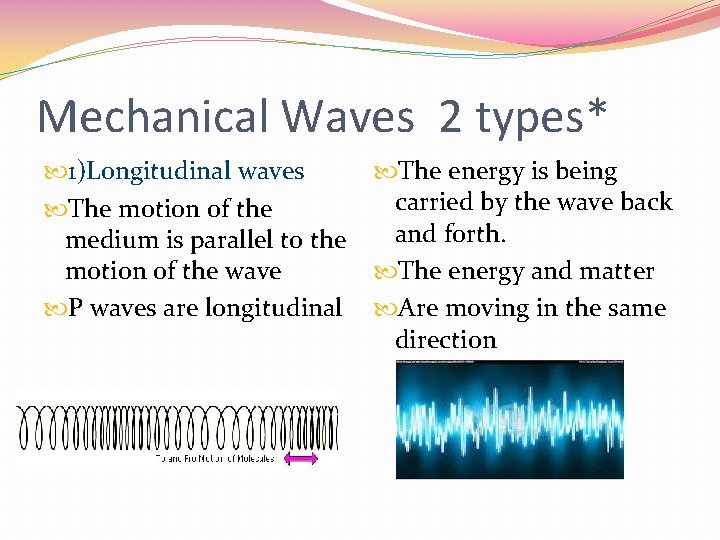
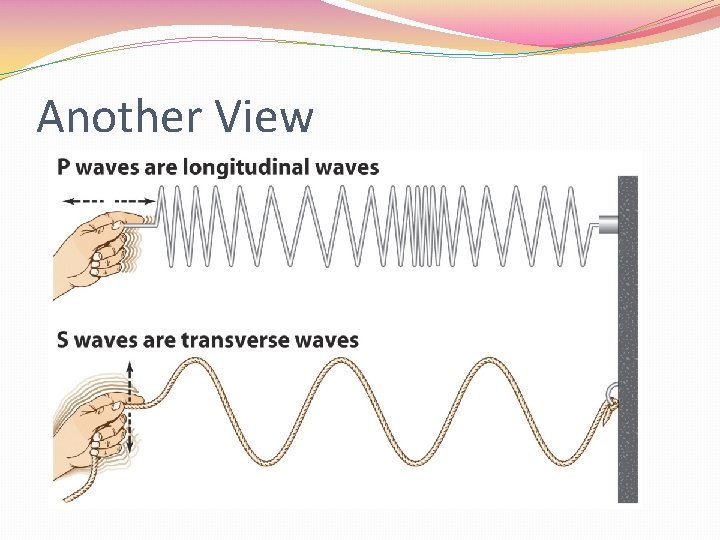
Mechanical Waves 2 types* 1)Longitudinal waves The motion of the medium is parallel to the motion of the wave P waves are longitudinal The energy is being carried by the wave back and forth. The energy and matter Are moving in the same direction
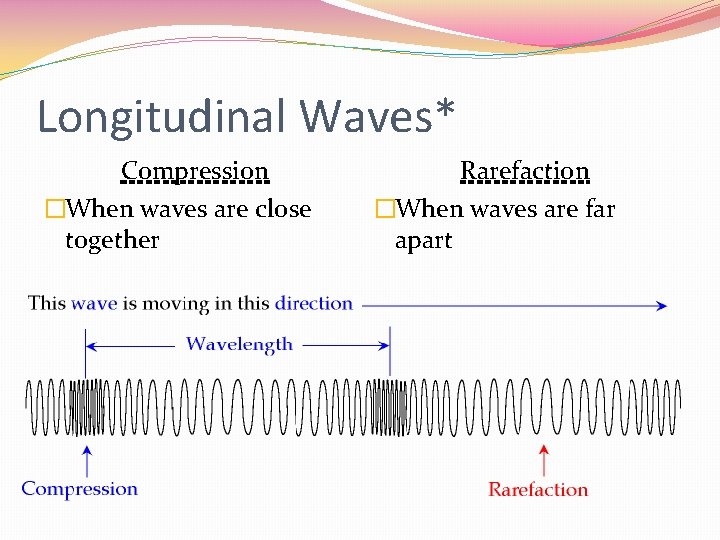
Longitudinal Waves* Compression �When waves are close together Rarefaction �When waves are far apart
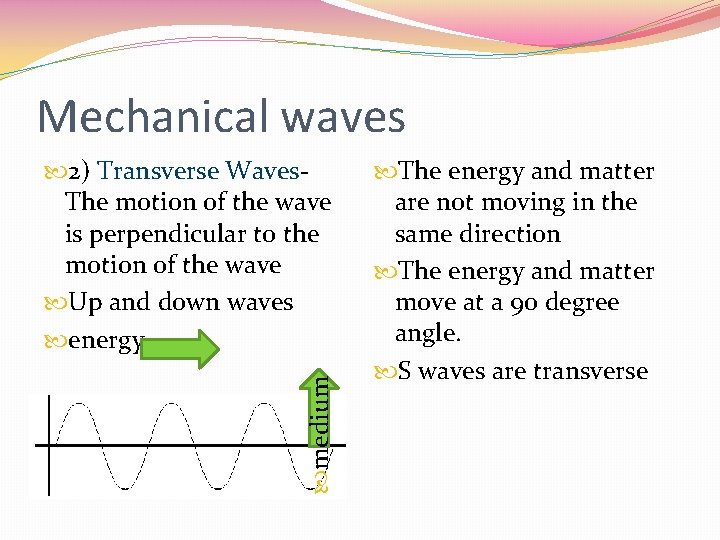
Mechanical waves medium 2) Transverse Waves. The motion of the wave is perpendicular to the motion of the wave Up and down waves energy The energy and matter are not moving in the same direction The energy and matter move at a 90 degree angle. S waves are transverse
Another View
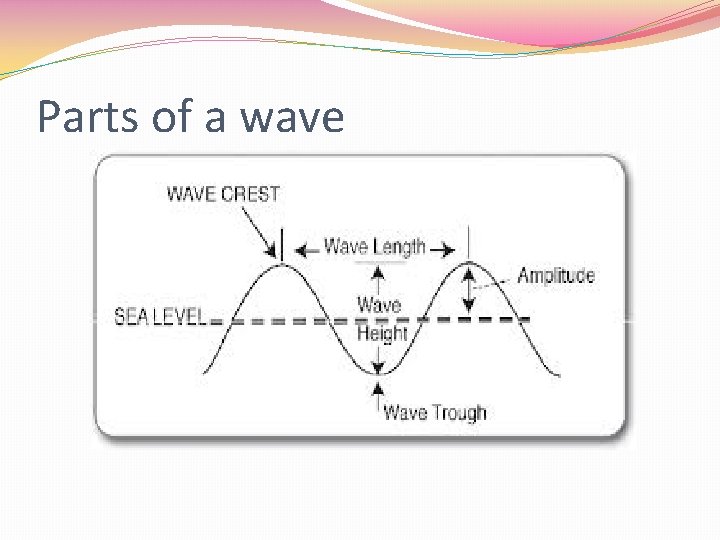
Parts of a wave
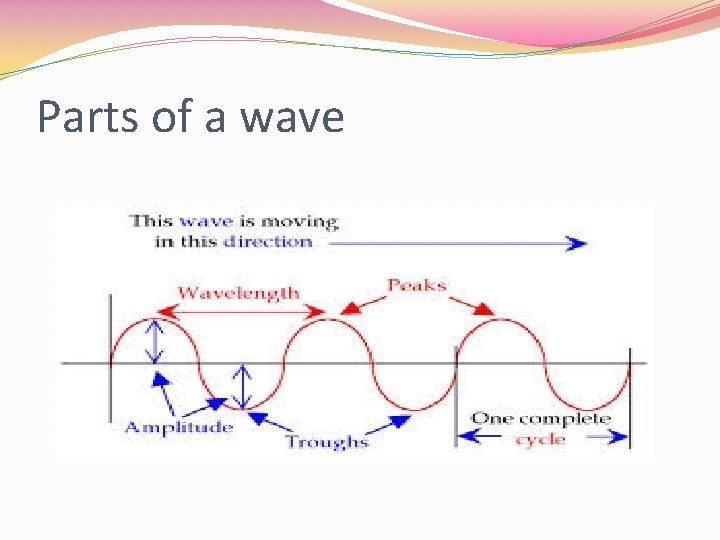
Parts of a wave
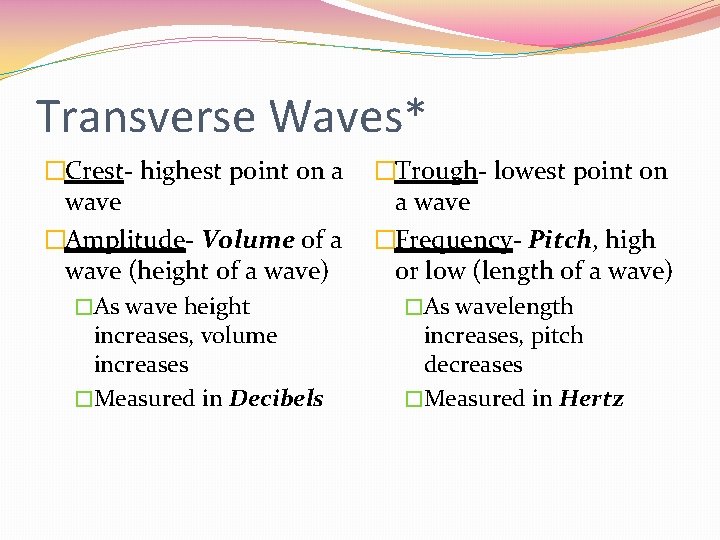
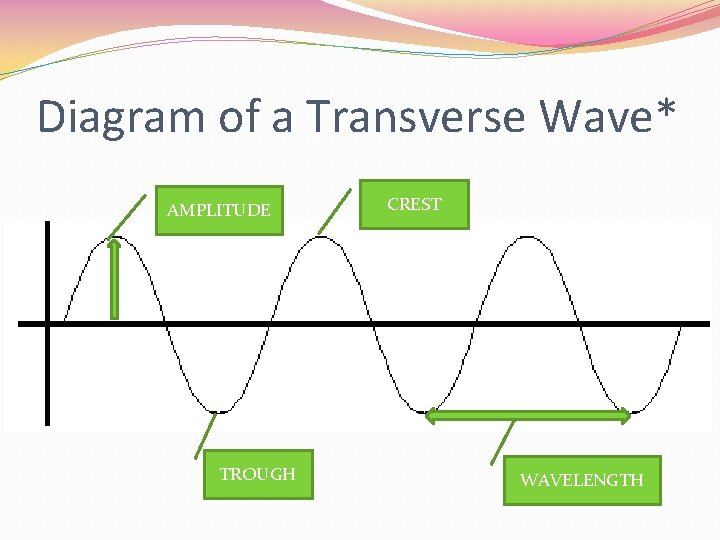
Transverse Waves* �Crest- highest point on a wave �Amplitude- Volume of a wave (height of a wave) �As wave height increases, volume increases �Measured in Decibels �Trough- lowest point on a wave �Frequency- Pitch, high or low (length of a wave) �As wavelength increases, pitch decreases �Measured in Hertz
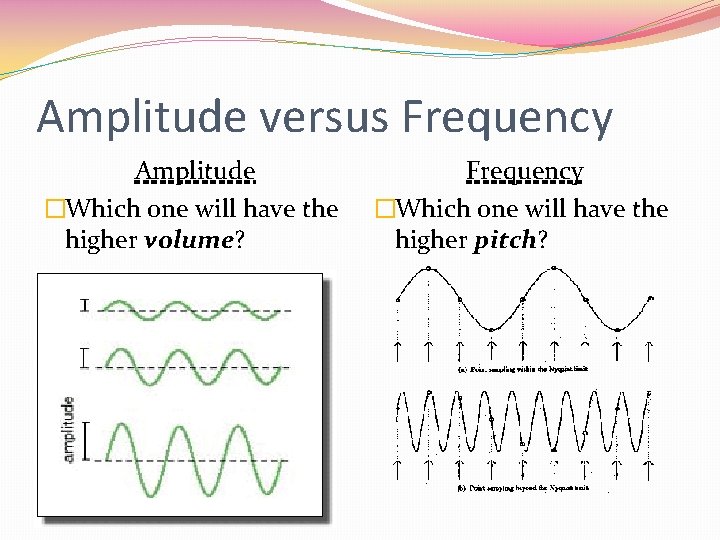
Amplitude versus Frequency Amplitude �Which one will have the higher volume? Frequency �Which one will have the higher pitch?
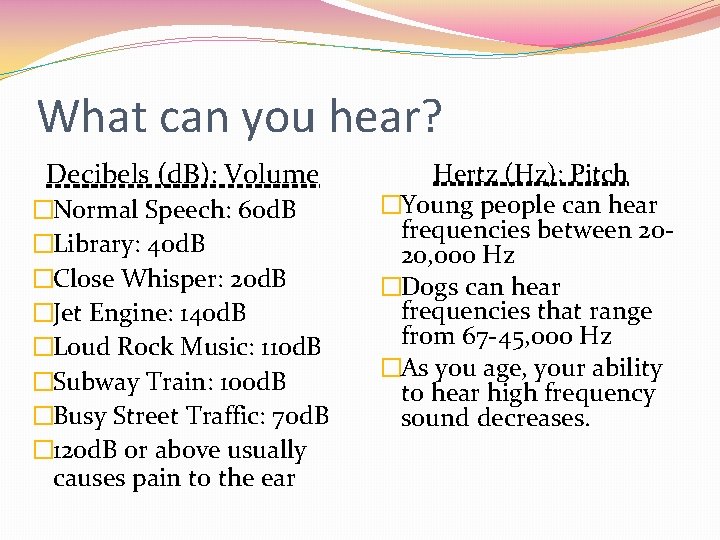
What can you hear? Decibels (d. B): Volume �Normal Speech: 60 d. B �Library: 40 d. B �Close Whisper: 20 d. B �Jet Engine: 140 d. B �Loud Rock Music: 110 d. B �Subway Train: 100 d. B �Busy Street Traffic: 70 d. B � 120 d. B or above usually causes pain to the ear Hertz (Hz): Pitch �Young people can hear frequencies between 2020, 000 Hz �Dogs can hear frequencies that range from 67 -45, 000 Hz �As you age, your ability to hear high frequency sound decreases.
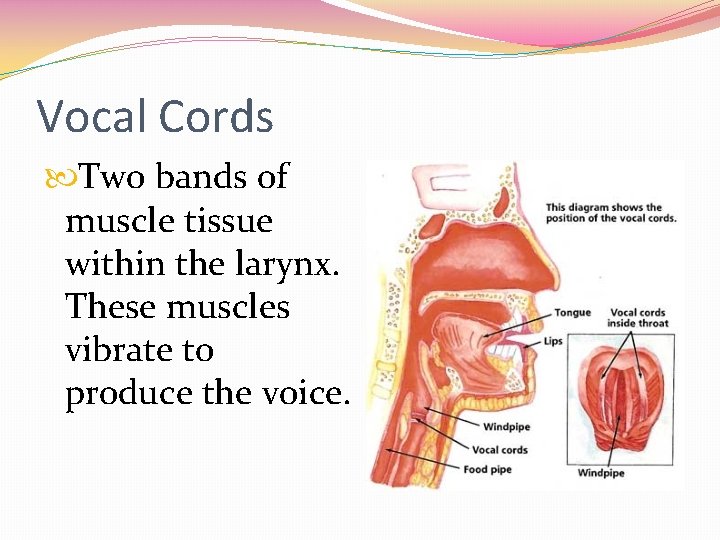
Vocal Cords Two bands of muscle tissue within the larynx. These muscles vibrate to produce the voice.
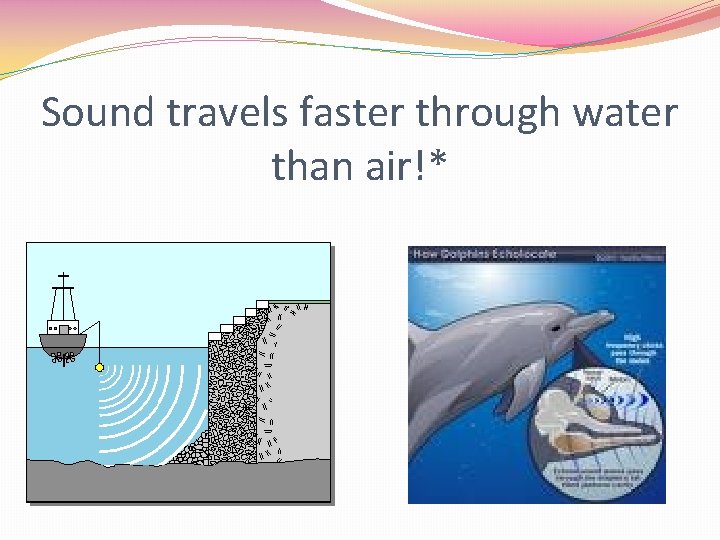
Sound travels faster through water than air!*
Diagram of a Transverse Wave* AMPLITUDE TROUGH CREST WAVELENGTH
How the Ear Works 6 th Grade Science
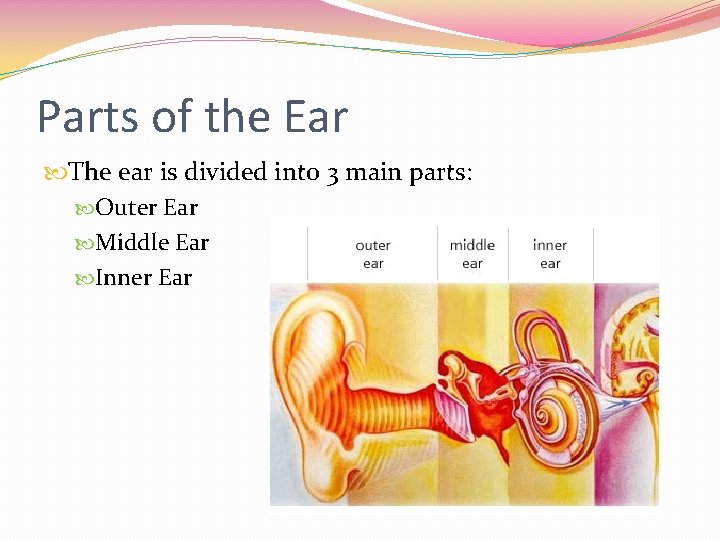
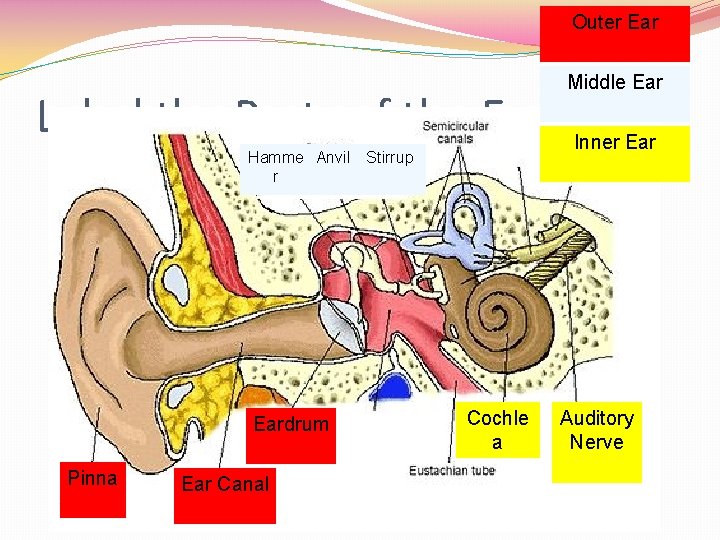
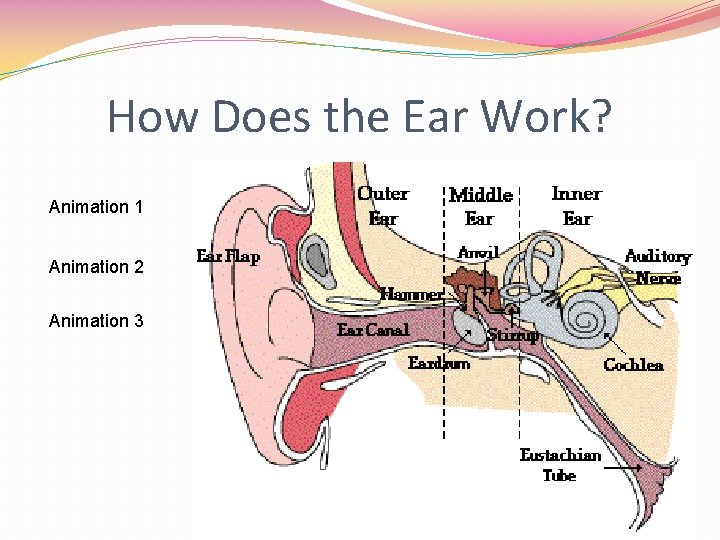
Parts of the Ear The ear is divided into 3 main parts: Outer Ear Middle Ear Inner Ear
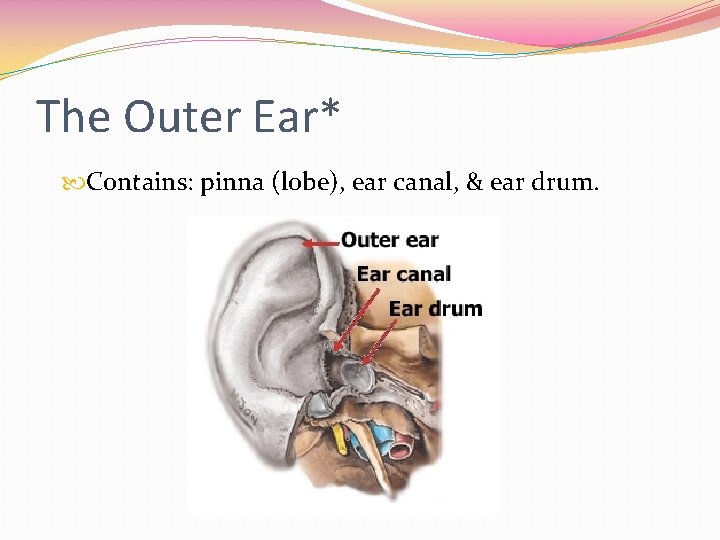
The Outer Ear* Contains: pinna (lobe), ear canal, & ear drum.
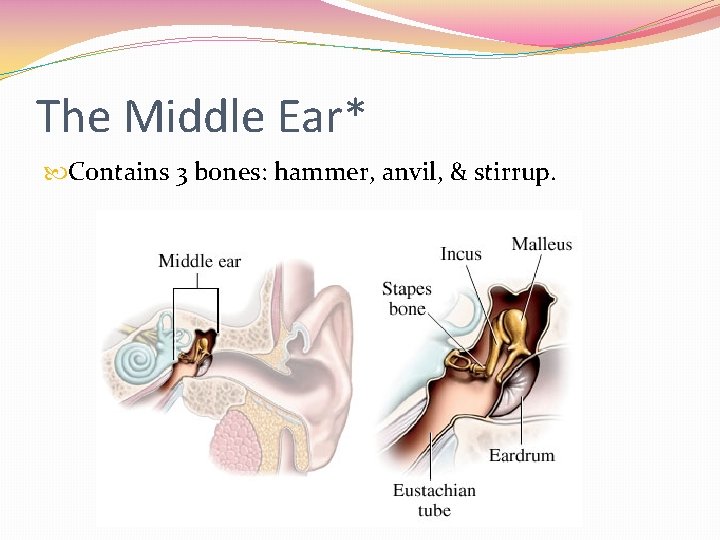
The Middle Ear* Contains 3 bones: hammer, anvil, & stirrup.
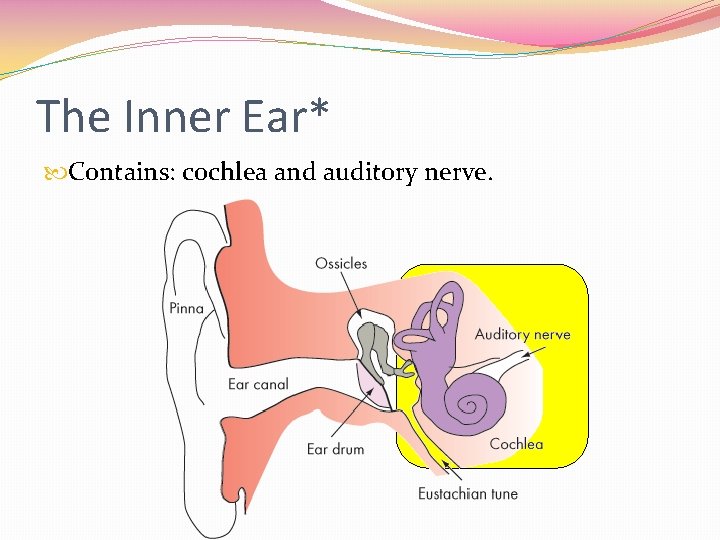
The Inner Ear* Contains: cochlea and auditory nerve.
Outer Ear Middle Ear Label the Parts of the Ear* Hamme Anvil r Eardrum Pinna Ear Canal Stirrup Cochle a Inner Ear Auditory Nerve
How Does the Ear Work? Animation 1 Animation 2 Animation 3
Steps to Hearing: * 1. 2. 3. 4. 5. Vibrations move through the outer ear canal and vibrate the eardrum. The eardrum passes its energy through a chain of three tiny bones, the anvil, hammer, and stirrup, in the middle of the ear. The anvil, hammer, and stirrup pass the energy onto the cochlea. The vibrations activate hair cells and fluid inside the cochlea. Electrical signals are sent to the brain through the auditory nerve.
Video on how the ear works: