
Waves and Wave Interactions Chapter 14 15 Physical
- Slides: 35
Waves and Wave Interactions Chapter 14 - 15 Physical Science
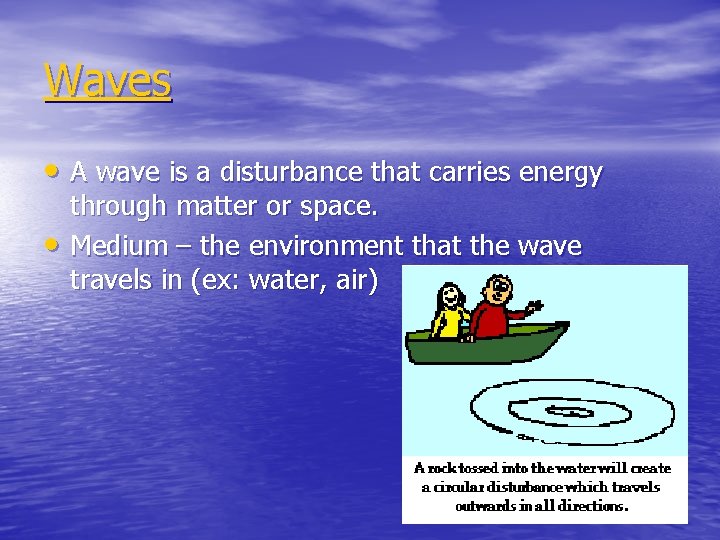
Waves • A wave is a disturbance that carries energy • through matter or space. Medium – the environment that the wave travels in (ex: water, air)
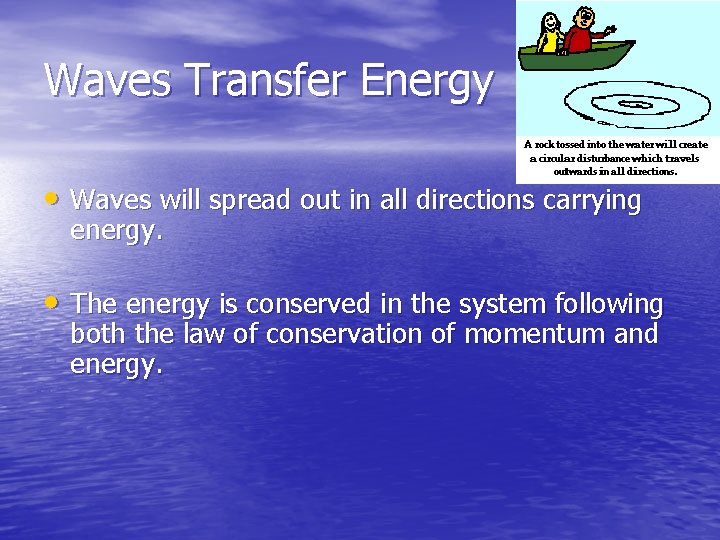
Waves Transfer Energy • Waves will spread out in all directions carrying energy. • The energy is conserved in the system following both the law of conservation of momentum and energy.
Waves transfer Energy • EX: Water waves do work on a boat • EX: Sound waves do work on your eardrum • EX: Light waves do work on your eye
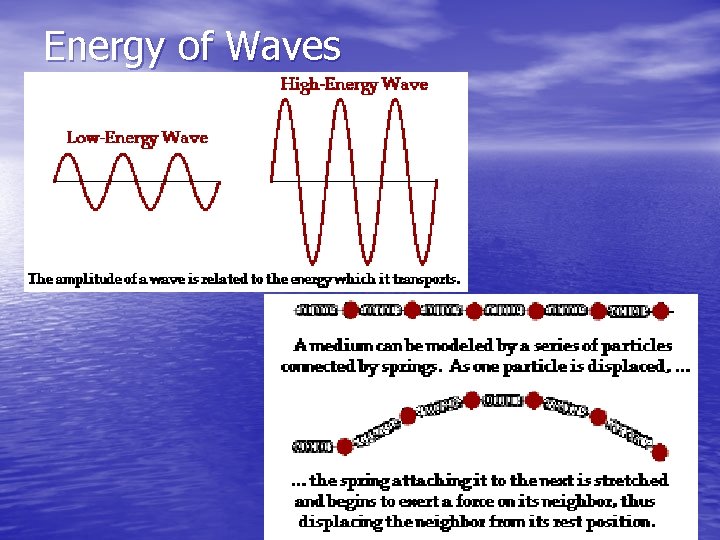
Energy of Waves
Wave Speed • The speed of a wave will depend on the medium it travels through • The state of matter determines the speed of the wave. – EX: In gases the particles are spread out so the wave travels slower in gases – EX: In liquids, the particles are closer together so the energy is transferred quicker between particles of that medium – EX: In solids, the particles are tightly packed together so the wave travels very quickly through solids
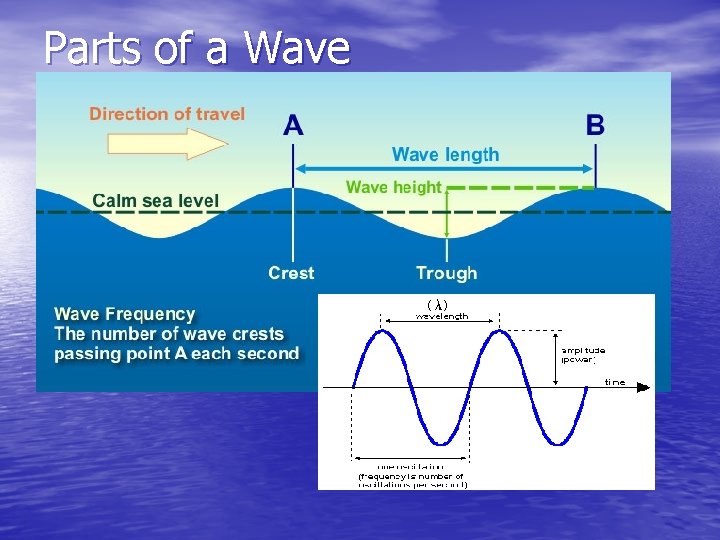
Parts of a Wave
Doppler Effect – Occurs when the wave source is moving. http: //www. physicslessons. com/phe/doppler eff. htm • Image Simulation • Breaking the sound barrier
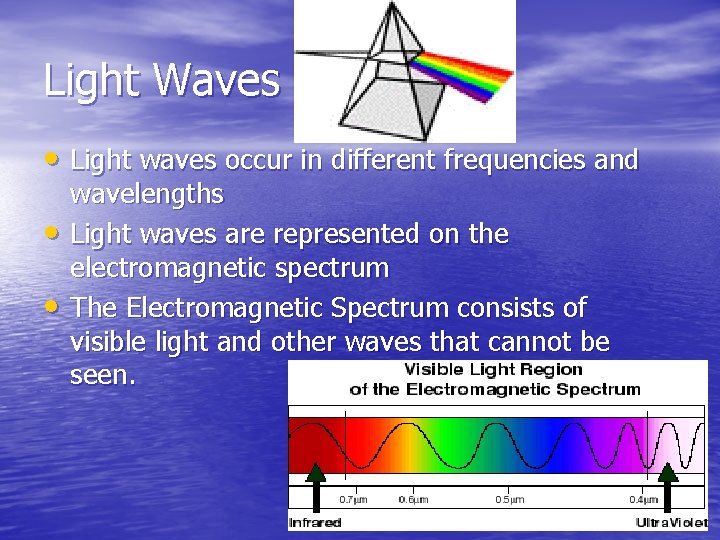
Light Waves • Light waves occur in different frequencies and • • wavelengths Light waves are represented on the electromagnetic spectrum The Electromagnetic Spectrum consists of visible light and other waves that cannot be seen.
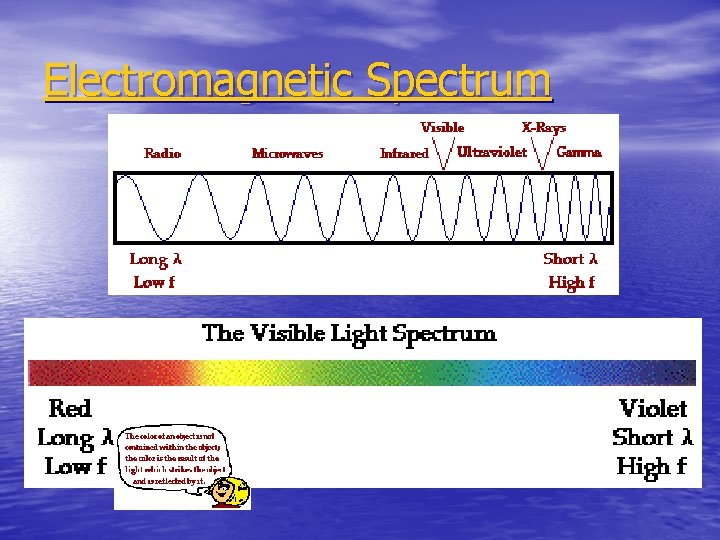
Electromagnetic Spectrum
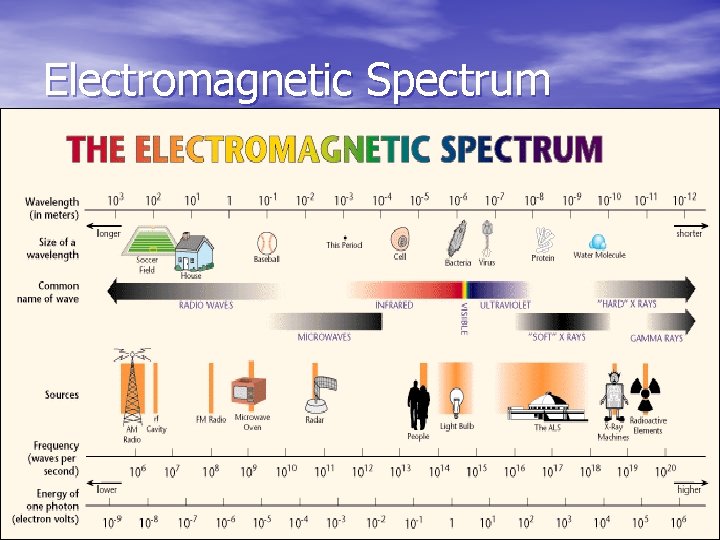
Electromagnetic Spectrum
The Electromagnetic Spectrum • Consists of light at all possible energies, frequencies, and wavelengths. • Visible light is only a small part of the spectrum. • The spectrum also contains X-rays, Ultraviolet rays, Radio Waves, Gamma waves.
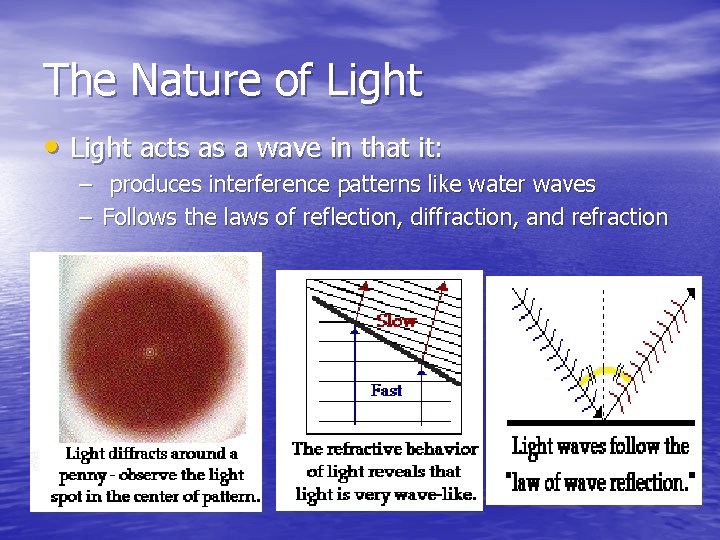
The Nature of Light • Light acts as a wave in that it: – produces interference patterns like water waves – Follows the laws of reflection, diffraction, and refraction
The Nature of Light • Light also acts as a particle – These particles are called PHOTONS – A beam of light is considered to be a stream of photons. – Photons do not have mass…they are like “bundles of energy”
Light Wave Speed • All electromagnetic waves in empty space travel at the same speed • The speed of light is: 3. 00 x 108 m/s or 186, 000 miles/second • Light will travel slower when it has to pass through a medium such as air or water
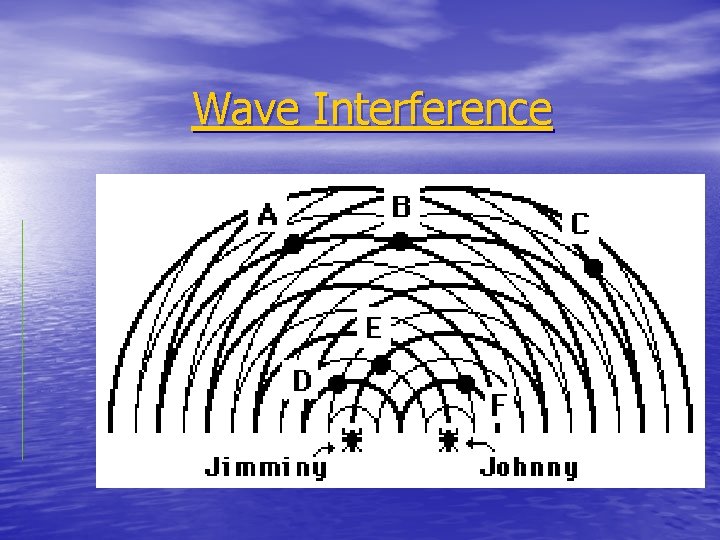
Wave Interference
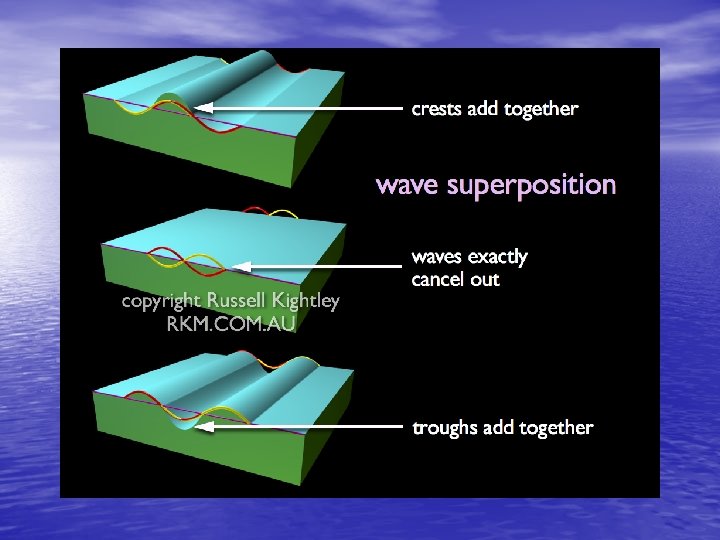
Wave Interference • The combination of two or more waves of the same frequency that result in a single wave • Two types: – Constructive Interference – Destructive Interference
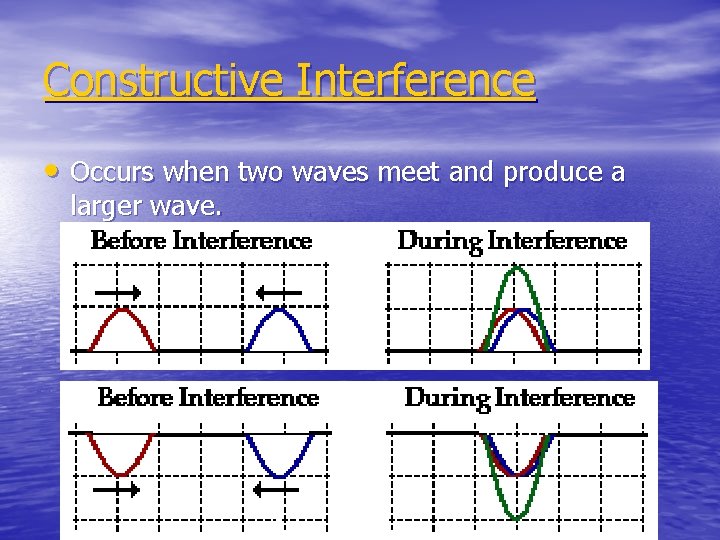
Constructive Interference • Occurs when two waves meet and produce a larger wave.
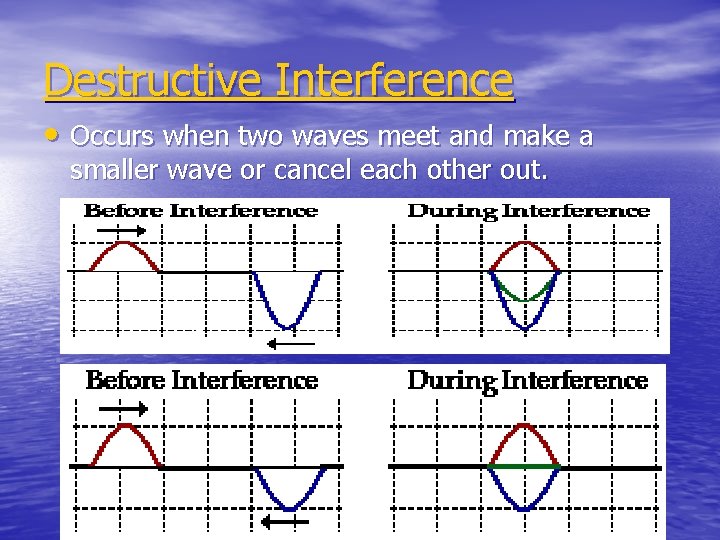
Destructive Interference • Occurs when two waves meet and make a smaller wave or cancel each other out.
Wave Interference • Interference of Light Waves produce colorful displays • Ex: Soap bubbles often show reds, blues, and yellows on their surface because of the interference of light.
Wave Interference Simulation
Wave Interactions
Wave Interactions • Waves may interact with each other when traveling through a medium • There are 3 possible outcomes: – Reflection, Diffraction, and Refraction
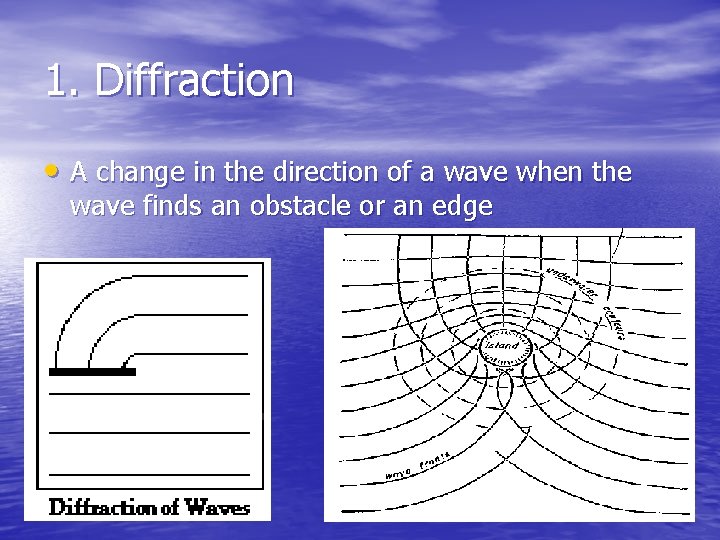
1. Diffraction • A change in the direction of a wave when the wave finds an obstacle or an edge
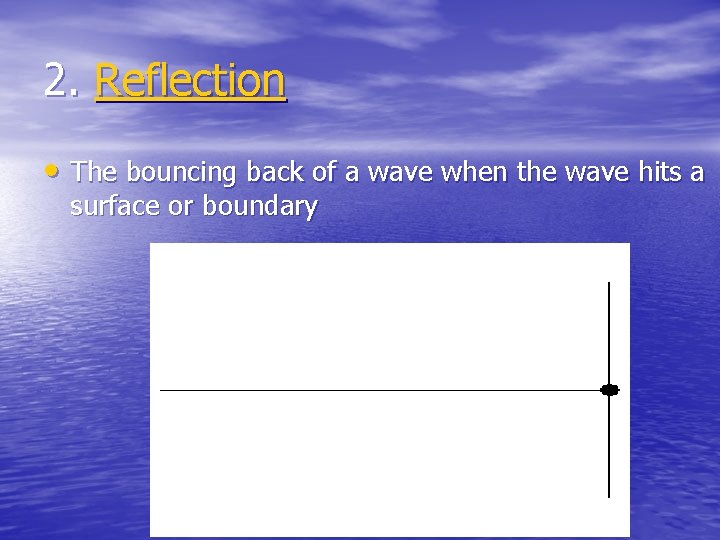
2. Reflection • The bouncing back of a wave when the wave hits a surface or boundary
Reflection of light • Every object reflects some light • Rough surfaces reflect light in many directions • Smooth surfaces reflect light in one direction
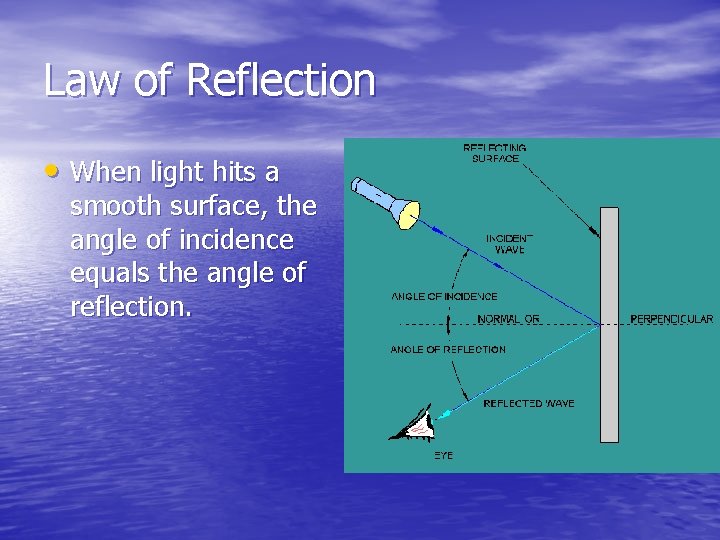
Law of Reflection • When light hits a smooth surface, the angle of incidence equals the angle of reflection.
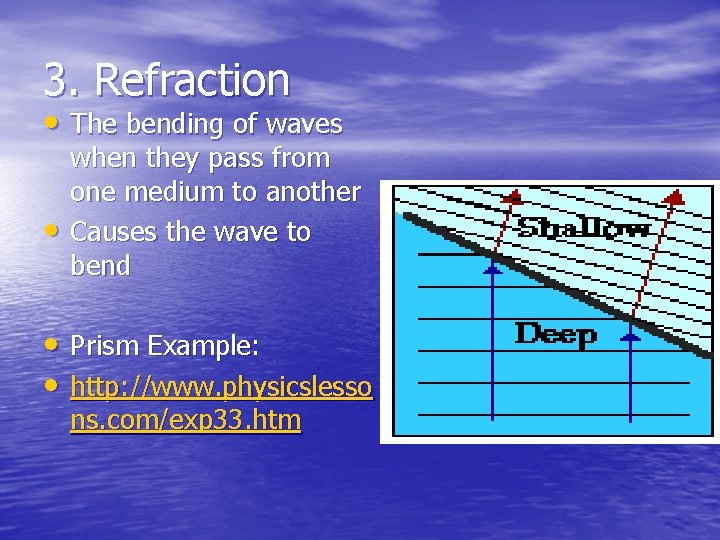
3. Refraction • The bending of waves • when they pass from one medium to another Causes the wave to bend • Prism Example: • http: //www. physicslesso ns. com/exp 33. htm
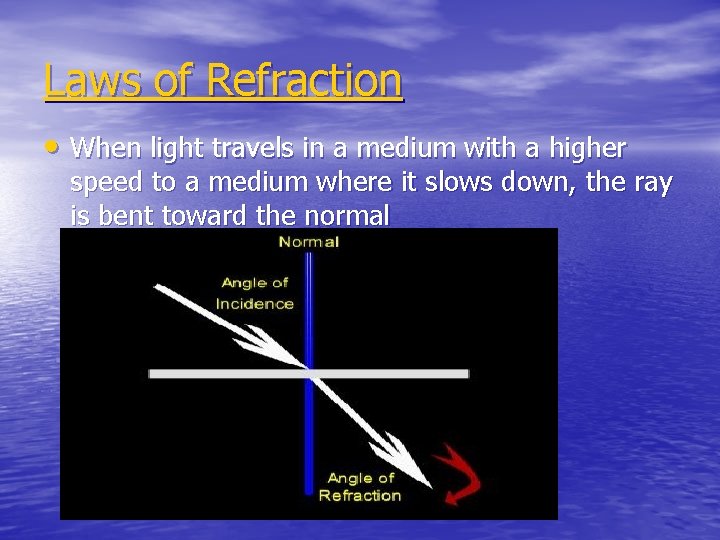
Laws of Refraction • When light travels in a medium with a higher speed to a medium where it slows down, the ray is bent toward the normal
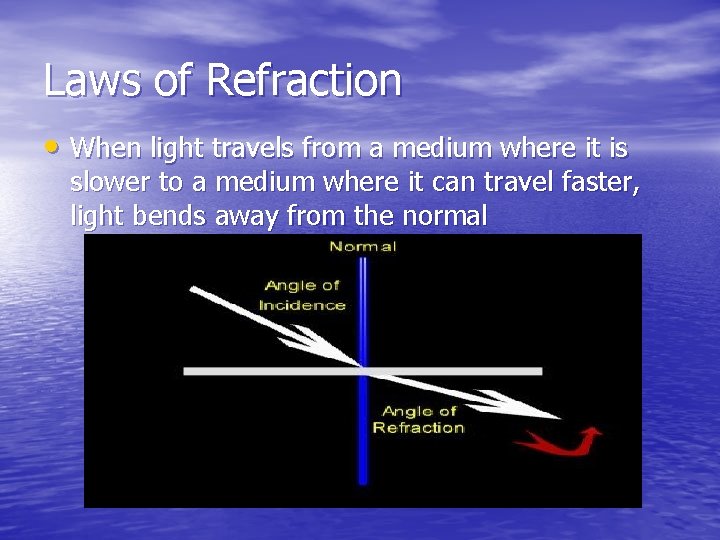
Laws of Refraction • When light travels from a medium where it is slower to a medium where it can travel faster, light bends away from the normal
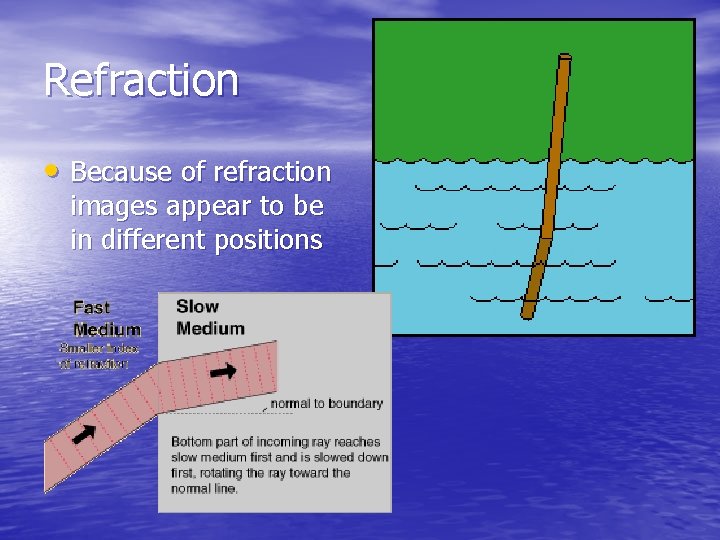
Refraction • Because of refraction images appear to be in different positions
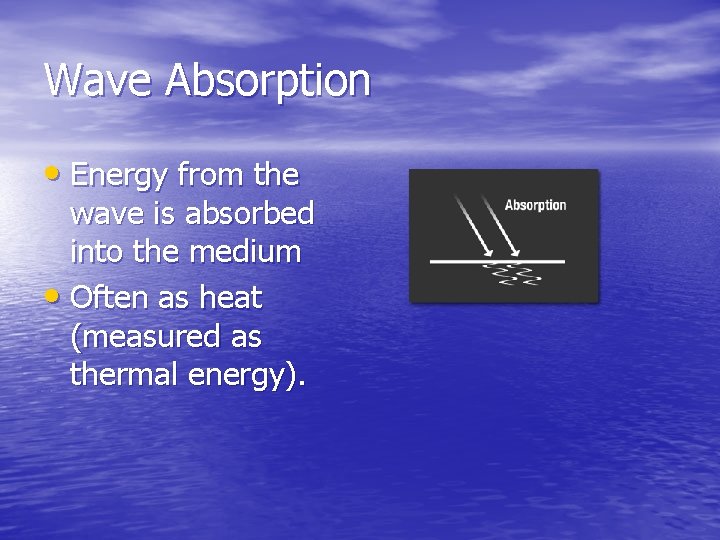
Wave Absorption • Energy from the wave is absorbed into the medium • Often as heat (measured as thermal energy).
Thermal Energy • Thermal conductors have a high rate of energy transfer • Thermal insulators have a slow rate of thermal energy transfer • Rate of thermal energy transfer is dependent on temperature, color, texture and exposed surface area of the object.
Thermal Equilibrium • The amount of thermal energy absorbed is equal to the amount of thermal energy emitted. • The temperature remains constant.