
WAVES AND QUANTA Unit 3 Introduction to quantum
- Slides: 12
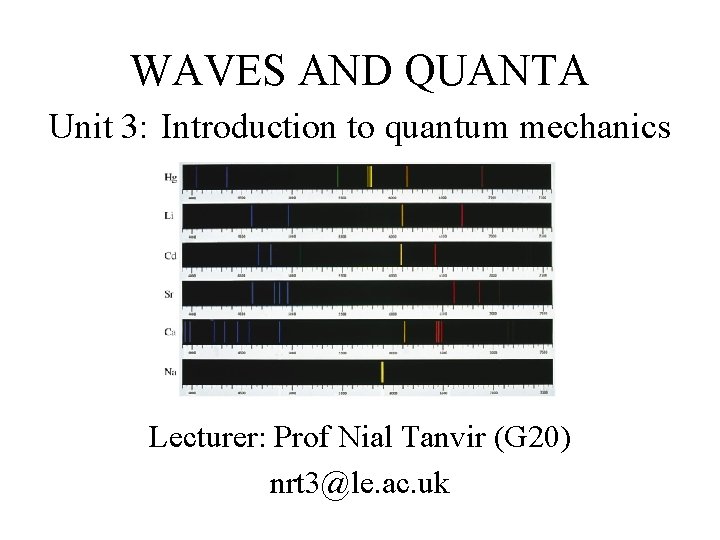
WAVES AND QUANTA Unit 3: Introduction to quantum mechanics Lecturer: Prof Nial Tanvir (G 20) nrt 3@le. ac. uk
Reading Chapter 34 in Tipler 6 th edition
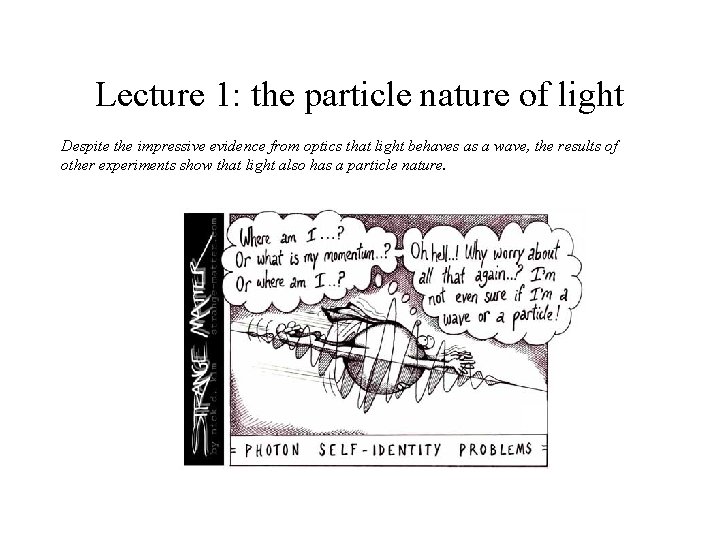
Lecture 1: the particle nature of light Despite the impressive evidence from optics that light behaves as a wave, the results of other experiments show that light also has a particle nature.
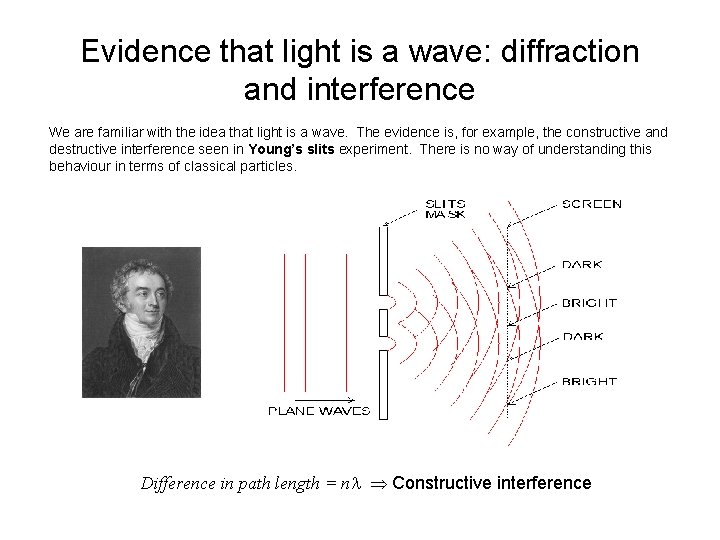
Evidence that light is a wave: diffraction and interference We are familiar with the idea that light is a wave. The evidence is, for example, the constructive and destructive interference seen in Young’s slits experiment. There is no way of understanding this behaviour in terms of classical particles. Difference in path length = n Constructive interference
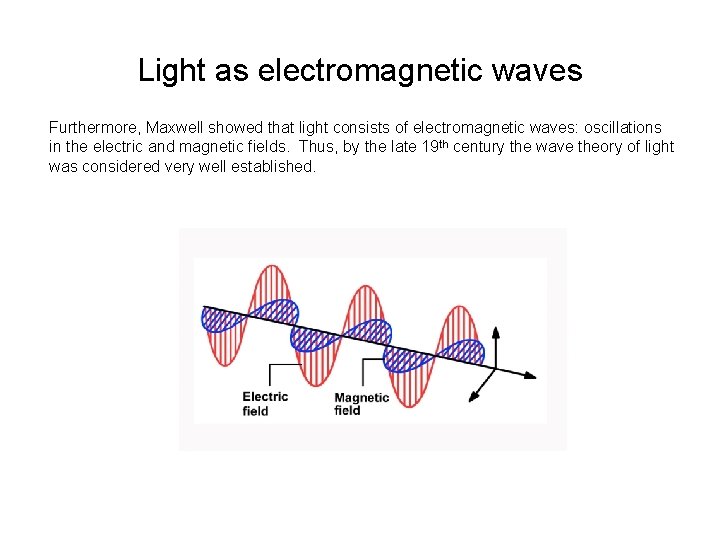
Light as electromagnetic waves Furthermore, Maxwell showed that light consists of electromagnetic waves: oscillations in the electric and magnetic fields. Thus, by the late 19 th century the wave theory of light was considered very well established.
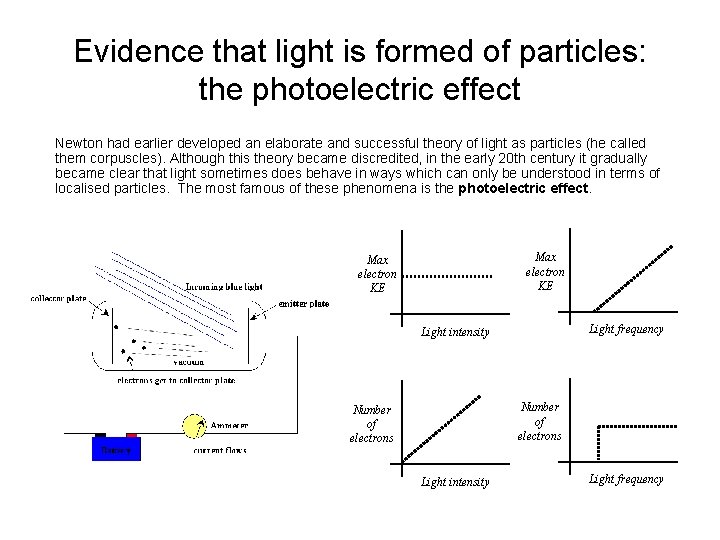
Evidence that light is formed of particles: the photoelectric effect Newton had earlier developed an elaborate and successful theory of light as particles (he called them corpuscles). Although this theory became discredited, in the early 20 th century it gradually became clear that light sometimes does behave in ways which can only be understood in terms of localised particles. The most famous of these phenomena is the photoelectric effect. Max electron KE Light frequency Light intensity Number of electrons Light intensity Light frequency
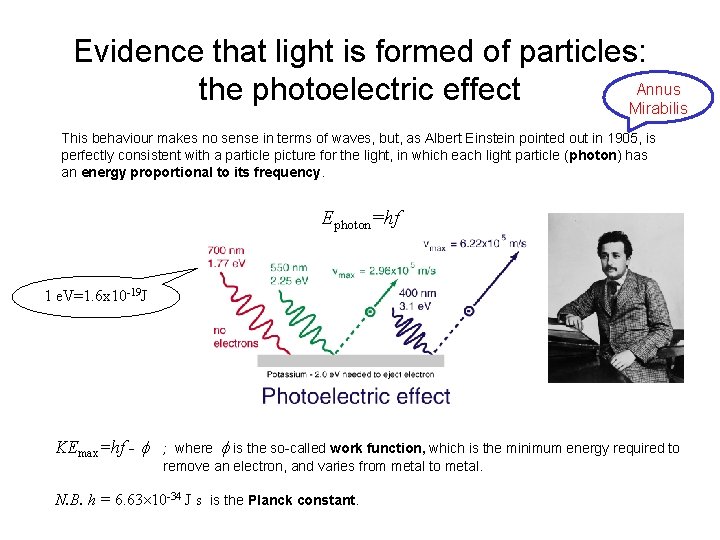
Evidence that light is formed of particles: Annus the photoelectric effect Mirabilis This behaviour makes no sense in terms of waves, but, as Albert Einstein pointed out in 1905, is perfectly consistent with a particle picture for the light, in which each light particle (photon) has an energy proportional to its frequency. Ephoton=hf 1 e. V=1. 6 x 10 -19 J KEmax=hf - ; where is the so-called work function, which is the minimum energy required to remove an electron, and varies from metal to metal. N. B. h = 6. 63 10 -34 J s is the Planck constant.
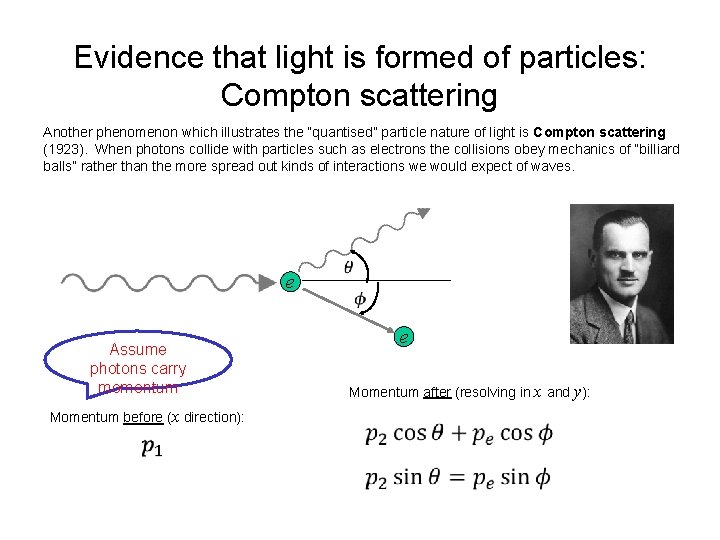
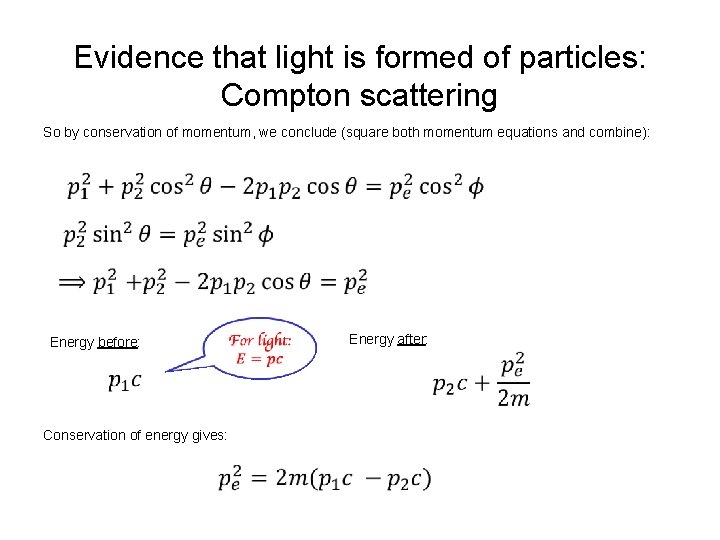
Evidence that light is formed of particles: Compton scattering Another phenomenon which illustrates the “quantised” particle nature of light is Compton scattering (1923). When photons collide with particles such as electrons the collisions obey mechanics of “billiard balls” rather than the more spread out kinds of interactions we would expect of waves. e Assume photons carry momentum Momentum before (x direction): e Momentum after (resolving in x and y):
Evidence that light is formed of particles: Compton scattering So by conservation of momentum, we conclude (square both momentum equations and combine): Energy before: Conservation of energy gives: Energy after:
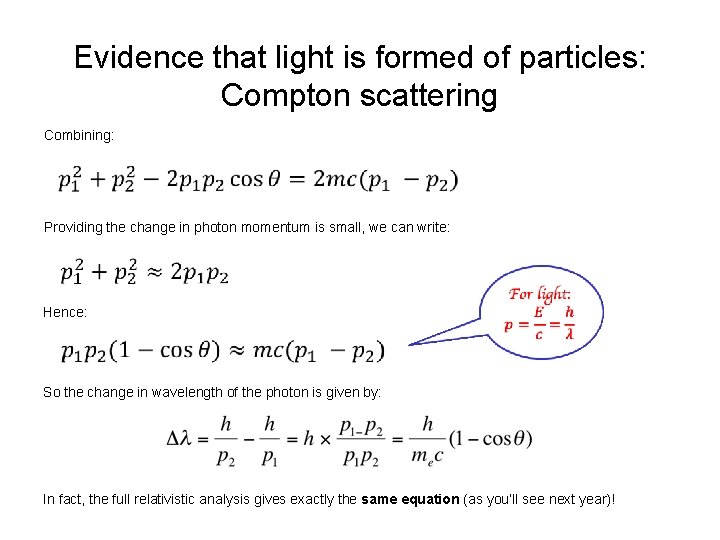
Evidence that light is formed of particles: Compton scattering Combining: Providing the change in photon momentum is small, we can write: Hence: So the change in wavelength of the photon is given by: In fact, the full relativistic analysis gives exactly the same equation (as you’ll see next year)!
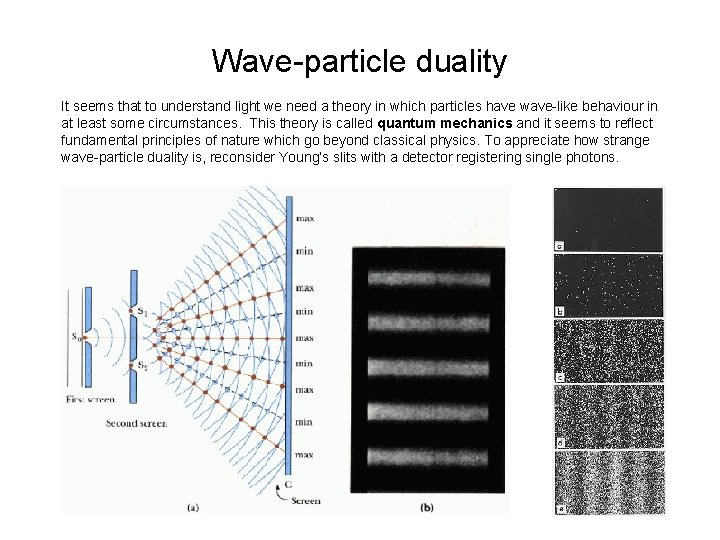
Wave-particle duality It seems that to understand light we need a theory in which particles have wave-like behaviour in at least some circumstances. This theory is called quantum mechanics and it seems to reflect fundamental principles of nature which go beyond classical physics. To appreciate how strange wave-particle duality is, reconsider Young’s slits with a detector registering single photons.
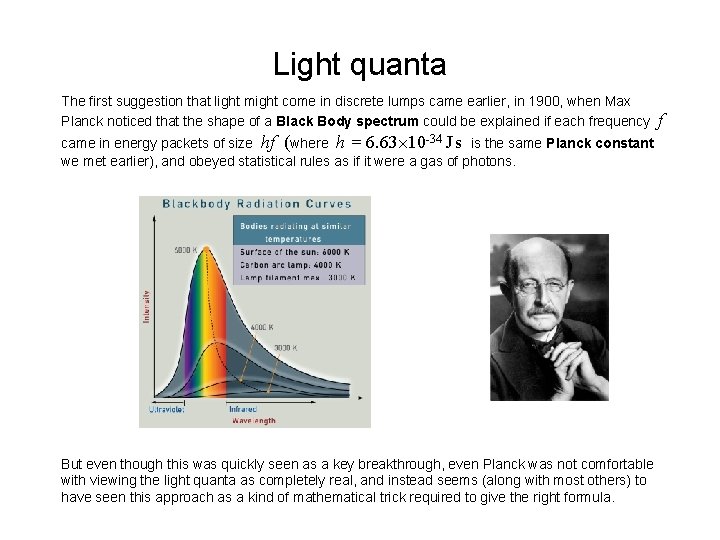
Light quanta The first suggestion that light might come in discrete lumps came earlier, in 1900, when Max Planck noticed that the shape of a Black Body spectrum could be explained if each frequency came in energy packets of size hf (where h = 6. 63 10 -34 J s is the same Planck constant we met earlier), and obeyed statistical rules as if it were a gas of photons. But even though this was quickly seen as a key breakthrough, even Planck was not comfortable with viewing the light quanta as completely real, and instead seems (along with most others) to have seen this approach as a kind of mathematical trick required to give the right formula. f