
Waves An Introduction Waves Water and Seismic Waves

- Slides: 19
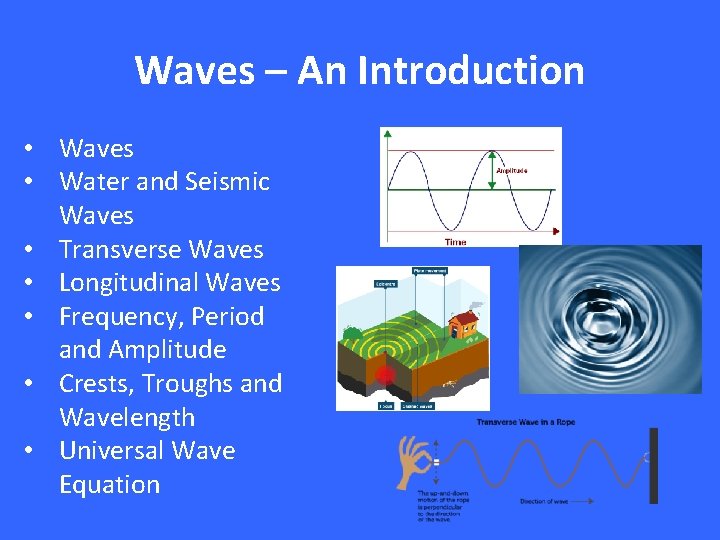
Waves – An Introduction • Waves • Water and Seismic Waves • Transverse Waves • Longitudinal Waves • Frequency, Period and Amplitude • Crests, Troughs and Wavelength • Universal Wave Equation
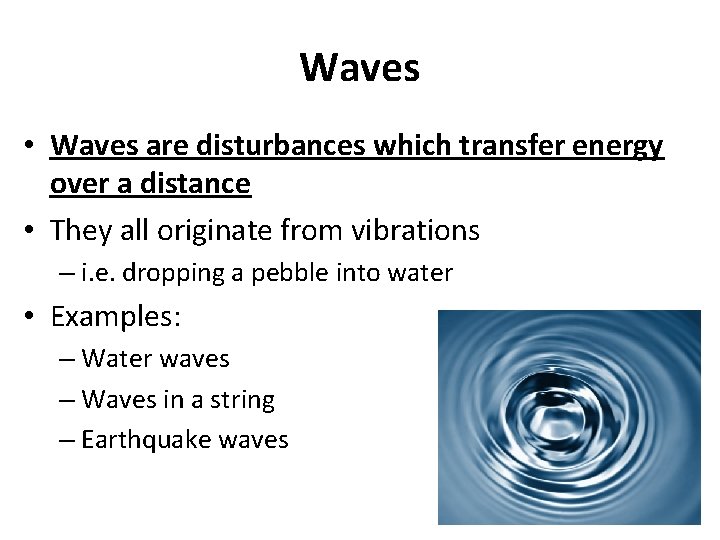
Waves • Waves are disturbances which transfer energy over a distance • They all originate from vibrations – i. e. dropping a pebble into water • Examples: – Water waves – Waves in a string – Earthquake waves
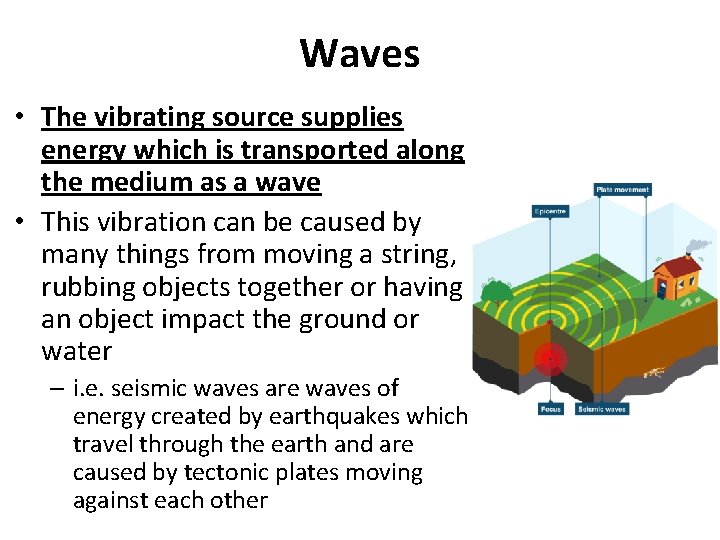
Waves • The vibrating source supplies energy which is transported along the medium as a wave • This vibration can be caused by many things from moving a string, rubbing objects together or having an object impact the ground or water – i. e. seismic waves are waves of energy created by earthquakes which travel through the earth and are caused by tectonic plates moving against each other
Waves • Waves pass their energy from one particle to another until it runs out of energy • Example: Water waves created from tectonic activity, volcanic eruptions, winds, impacts, etc. carry a lot of energy which can be used to inflict serious damage
VIDEO - TSUNAMI
Waves • We will be discussing two main types of waves 1) Transverse Waves 2) Longitudinal Waves
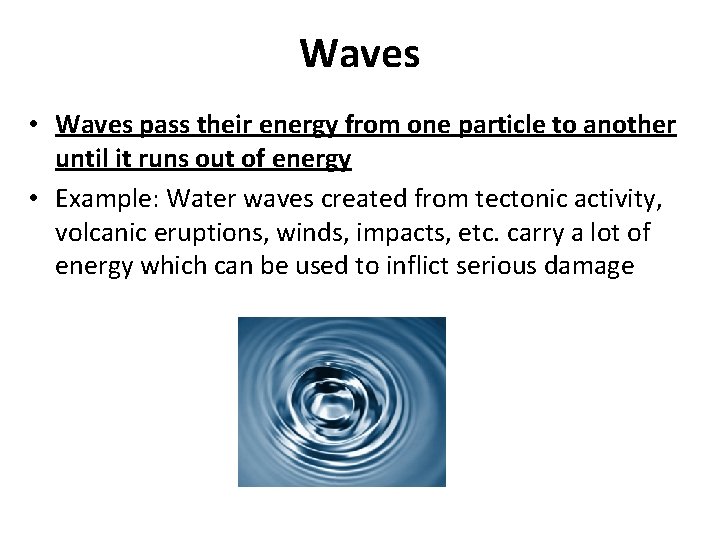
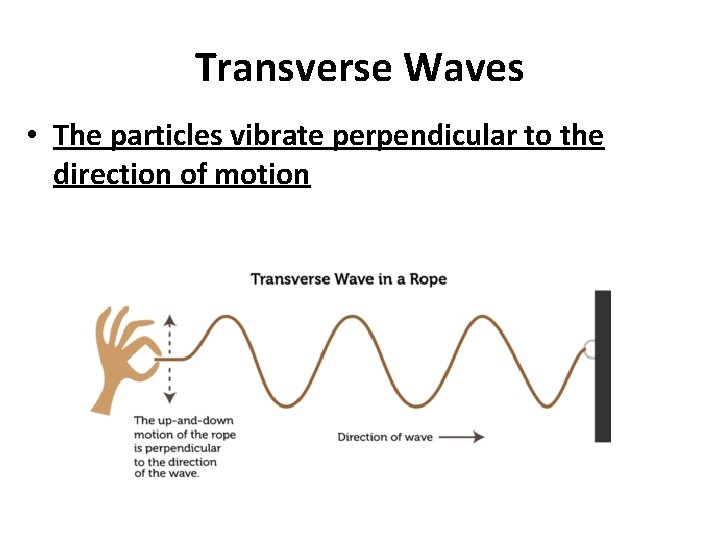
Transverse Waves • The particles vibrate perpendicular to the direction of motion
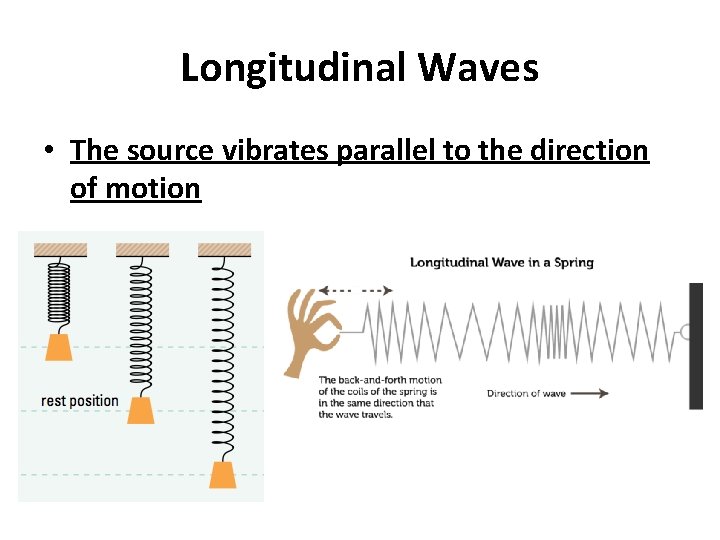
Longitudinal Waves • The source vibrates parallel to the direction of motion
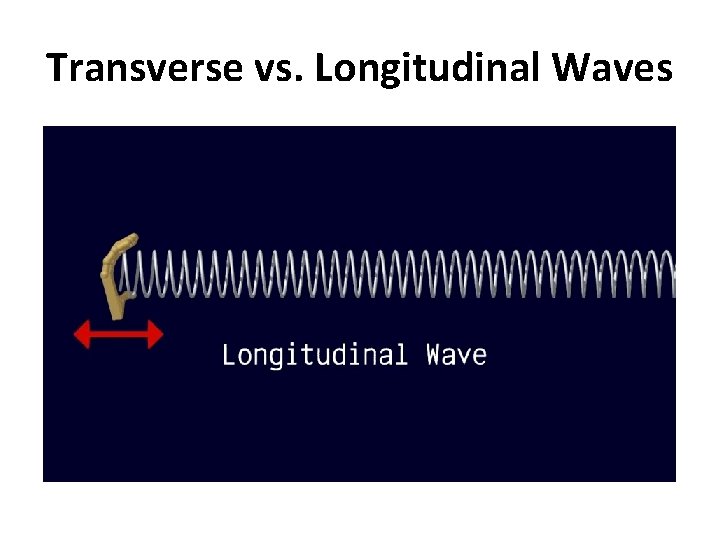
Transverse vs. Longitudinal Waves
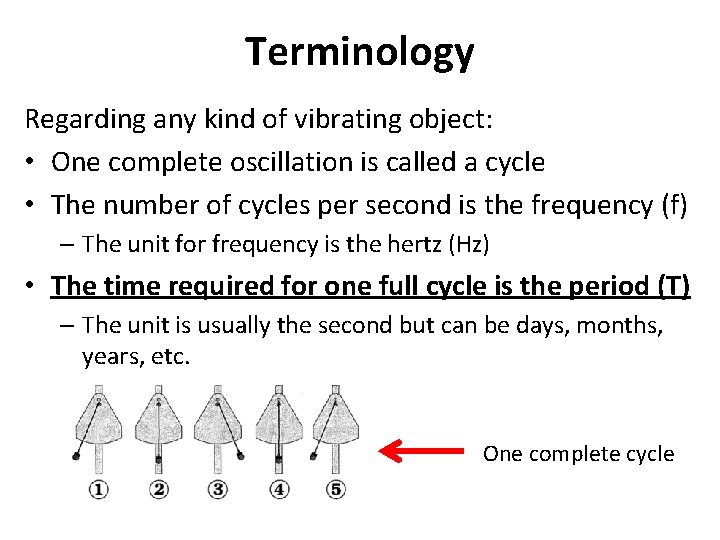
Terminology Regarding any kind of vibrating object: • One complete oscillation is called a cycle • The number of cycles per second is the frequency (f) – The unit for frequency is the hertz (Hz) • The time required for one full cycle is the period (T) – The unit is usually the second but can be days, months, years, etc. One complete cycle
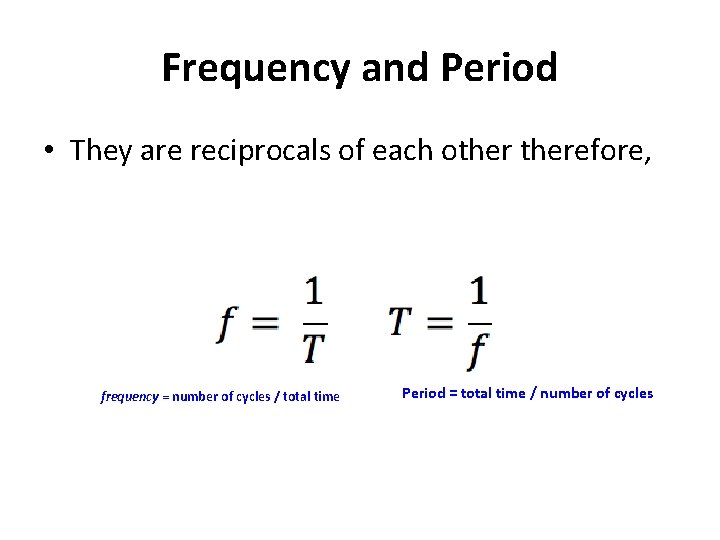
Frequency and Period • They are reciprocals of each otherefore, frequency = number of cycles / total time Period = total time / number of cycles
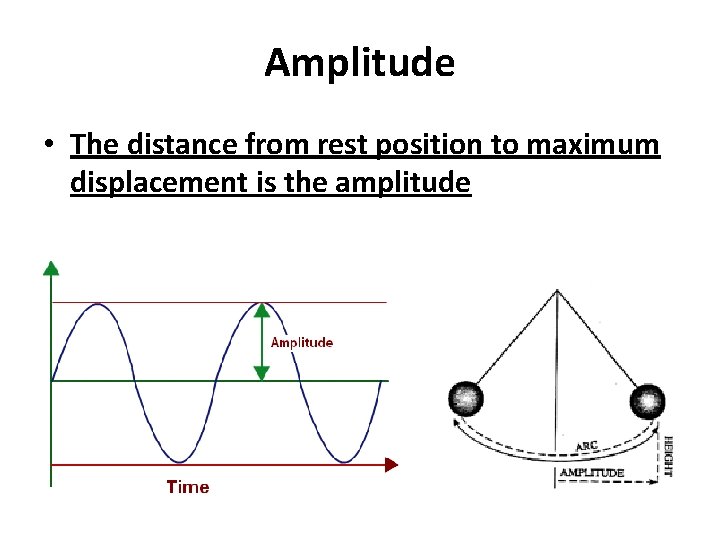
Amplitude • The distance from rest position to maximum displacement is the amplitude
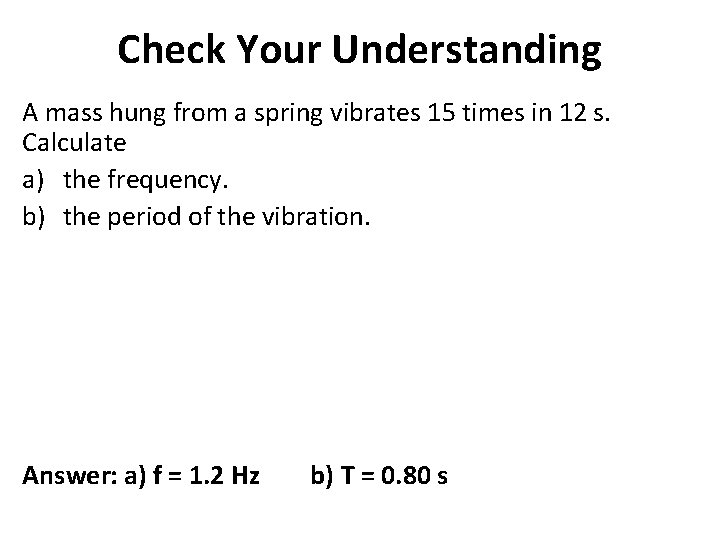
Check Your Understanding A mass hung from a spring vibrates 15 times in 12 s. Calculate a) the frequency. b) the period of the vibration. Answer: a) f = 1. 2 Hz b) T = 0. 80 s
Check Your Understanding A child is swinging on a swing with a constant amplitude of 1. 2 m. What total distance does the child move through horizontally in 3 cycles? Answer: 14. 4 m
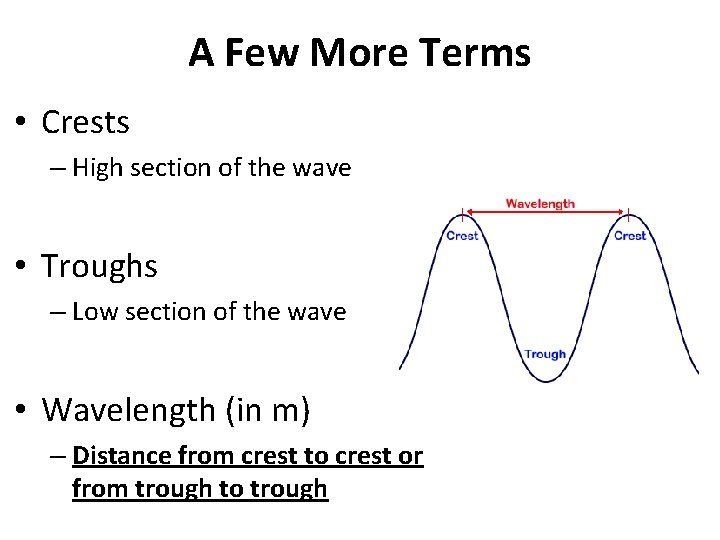
A Few More Terms • Crests – High section of the wave • Troughs – Low section of the wave • Wavelength (in m) – Distance from crest to crest or from trough to trough
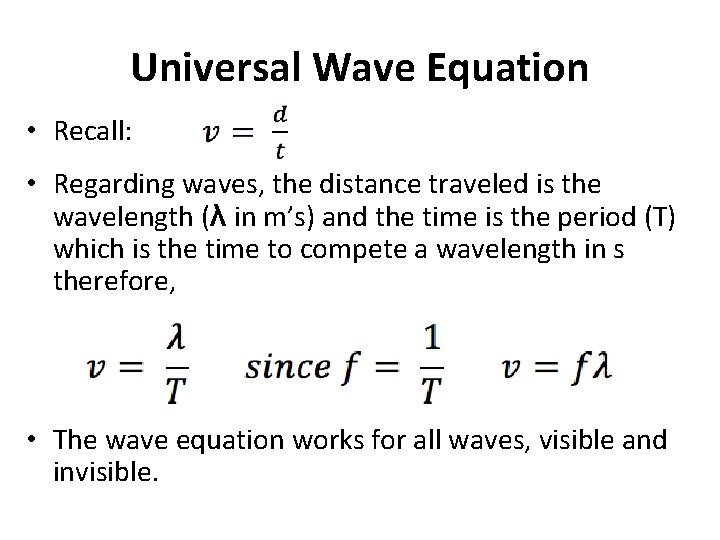
Universal Wave Equation • Recall: • Regarding waves, the distance traveled is the wavelength (λ in m’s) and the time is the period (T) which is the time to compete a wavelength in s therefore, • The wave equation works for all waves, visible and invisible.
Check Your Understanding The wavelength of a water wave in a ripple tank is 0. 080 m. If the frequency of the wave is 2. 5 Hz, what is its speed? Answer: 0. 20 m/s
Check Your Understanding The distance between successive crests in a series of water waves is 4. 0 m, and the crests travel 9. 0 m in 4. 5 s. What is the frequency of the waves? Answer: 0. 50 Hz
Check Your Understanding The period of a sound wave from a piano is 1. 18 × 10– 3 s. If the speed of the wave in the air is 3. 4 × 10² m/s, what is its wavelength? Answer: 0. 40 m