
WaveParticle Duality WaveParticle Duality The property of electromagnetic
- Slides: 10
Wave-Particle Duality
Wave-Particle Duality: • The property of electromagnetic radiation (light) that defines its dual nature of displaying both wave-like and particle-like characteristics. • The best way to think of wp duality for a photon is that the electromagnetic wave relates the probability that a photon is in a certain spot
Principle of Complementarity: • One must use either the wave theory or photon theory, but not both at the same time when trying to understand a specific experiment. • Generally, when light travels through space it tends to behave like a wave. When it interacts with matter, it tends to behave like a particle
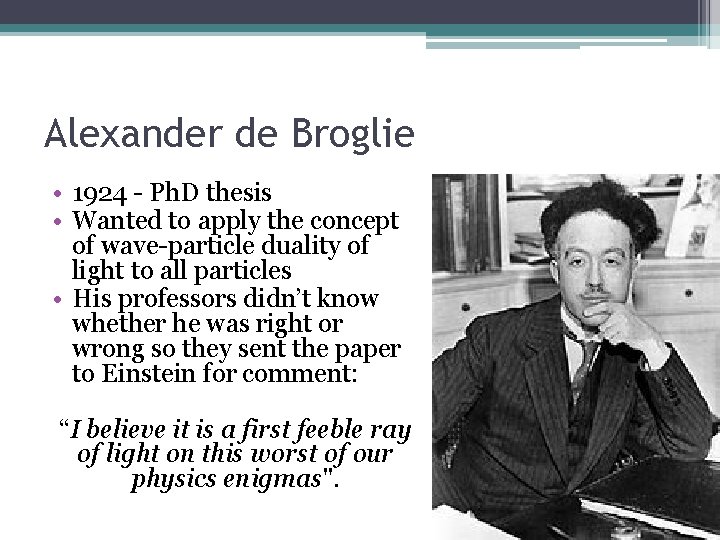
Alexander de Broglie • 1924 - Ph. D thesis • Wanted to apply the concept of wave-particle duality of light to all particles • His professors didn’t know whether he was right or wrong so they sent the paper to Einstein for comment: “I believe it is a first feeble ray of light on this worst of our physics enigmas".
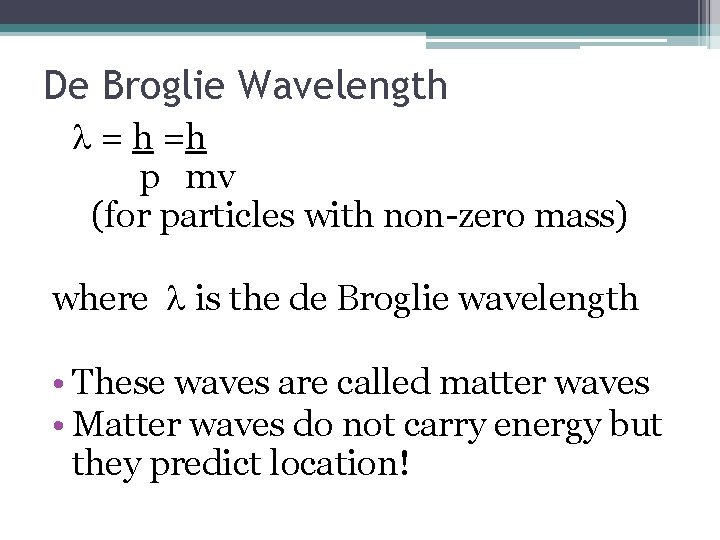
De Broglie Wavelength = h =h p mv (for particles with non-zero mass) where is the de Broglie wavelength • These waves are called matter waves • Matter waves do not carry energy but they predict location!
Double Slit Experiment • Video
In 2012… De. Broglie continued • Thomas Juffman and associates conducted the experiment on molecules of up to 100 atoms
• In 1927, experimenters demonstrated that an electron showed diffraction effects (commonly seen in waves) • This was backed up by the mathematics which used the de Broglie wavelength to predict the diffraction effects perfectly
For a bowling ball, • h is very small, momentum is big • When divided, the wavelength is very, very small so we don’t see the wave length effects when we go bowling • When dealing with electrons and other subatomic particles, we can see the wave effects
Wave Mechanics Was Born!!! • The mathematical interpretation of the structure and interactions of matter based on the concept that particles have a wave nature