
Wavelike Properties of Electromagnetic Radiation 1 Wave parameters

- Slides: 14
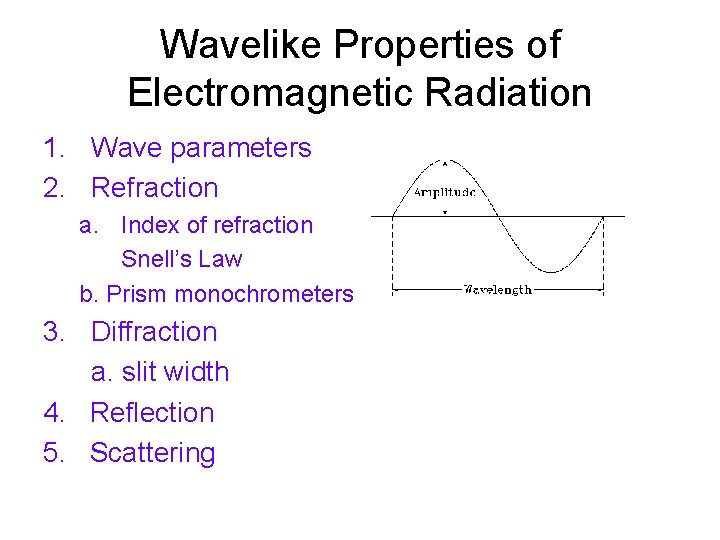
Wavelike Properties of Electromagnetic Radiation 1. Wave parameters 2. Refraction a. Index of refraction Snell’s Law b. Prism monochrometers 3. Diffraction a. slit width 4. Reflection 5. Scattering
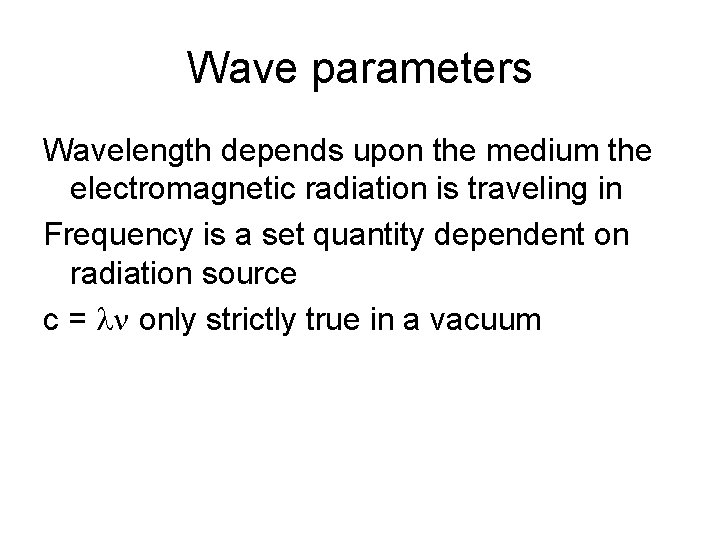
Wave parameters Wavelength depends upon the medium the electromagnetic radiation is traveling in Frequency is a set quantity dependent on radiation source c = ln only strictly true in a vacuum
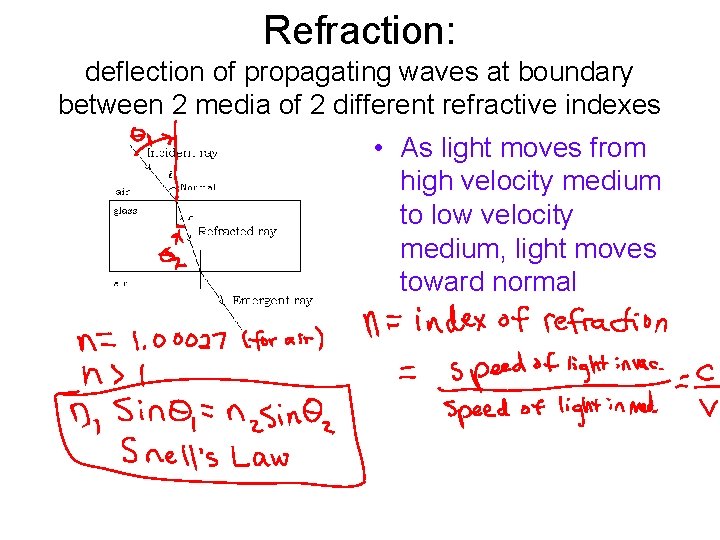
Refraction: deflection of propagating waves at boundary between 2 media of 2 different refractive indexes • As light moves from high velocity medium to low velocity medium, light moves toward normal
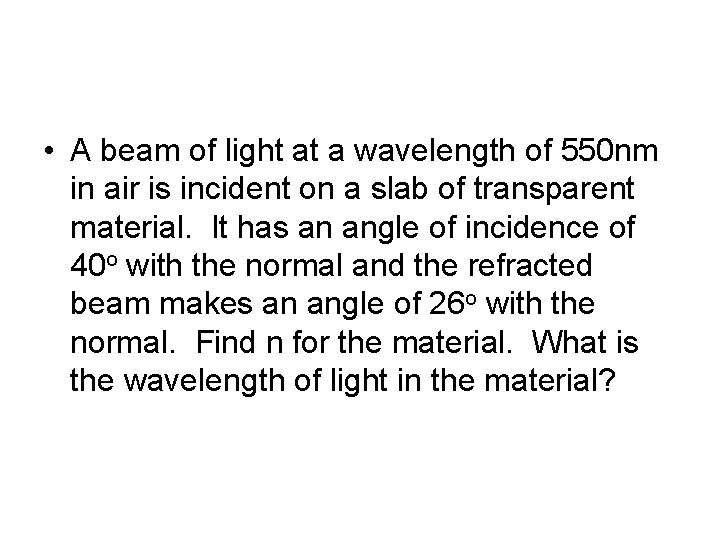
• A beam of light at a wavelength of 550 nm in air is incident on a slab of transparent material. It has an angle of incidence of 40 o with the normal and the refracted beam makes an angle of 26 o with the normal. Find n for the material. What is the wavelength of light in the material?
Refraction is most common way wavelike properties of light manifest themselves Instruments benefit from this in: monochrometer design What is a monochrometer? Something which selects for just one wavelength of light.
• Prism
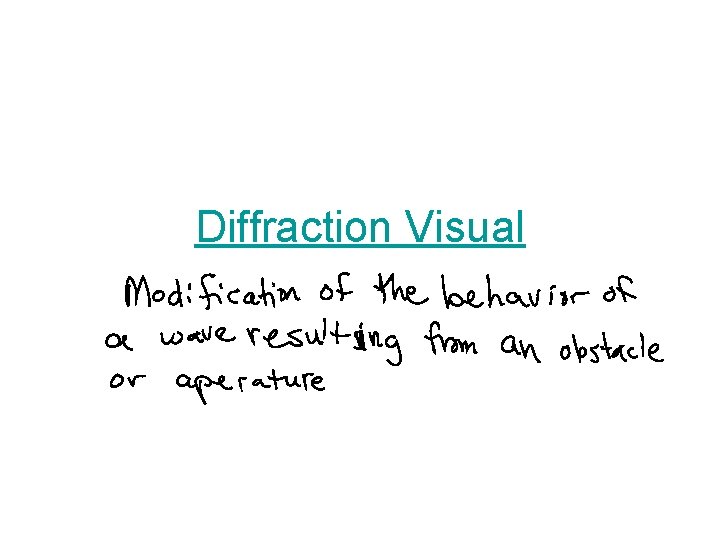
Diffraction Visual
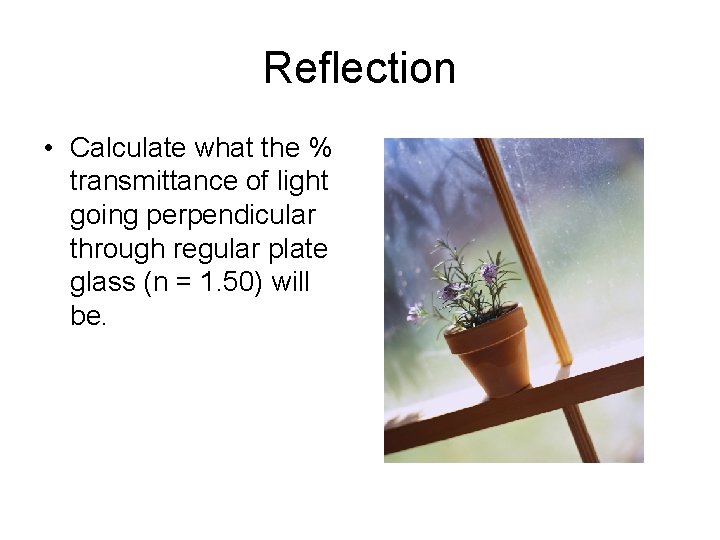
Reflection • Calculate what the % transmittance of light going perpendicular through regular plate glass (n = 1. 50) will be.
Ways to reduce reflected losses • 1) Coating with a low reflectance material • 2) Cementing optical elements that are in contact with a material of similar refractive index (rather than leaving air gaps in between).
• Reflectance as a function of angle of incidence
Scattering Particles will scatter light if: 1) The particles have dimensions on the order of magnitude or smaller than incident wavelengths 2) Are randomly distributed in a medium of refractive index different than their own
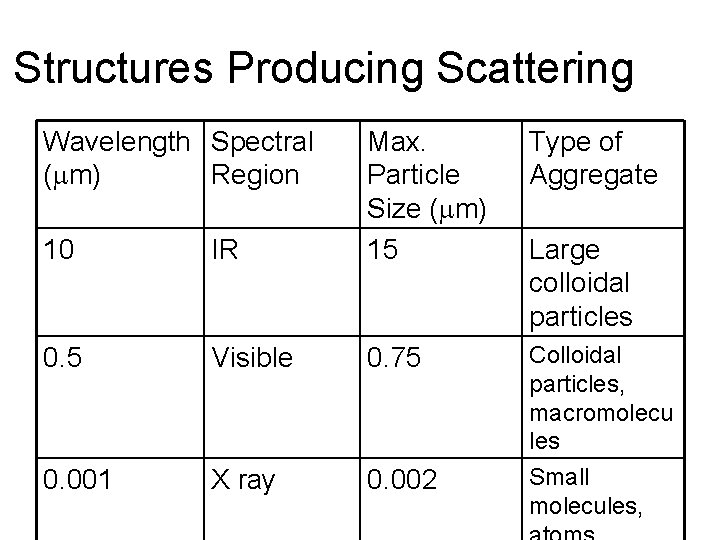
Structures Producing Scattering Wavelength Spectral (mm) Region 10 IR Max. Particle Size (mm) 15 Type of Aggregate 0. 5 Visible 0. 75 Colloidal particles, macromolecu les 0. 001 X ray 0. 002 Small molecules, Large colloidal particles
A Chemical Sunset Demo 1. How is this reaction similar to a natural sunset? 2. What causes the different colors to be produced? 3. What other compounds might produce a similar reaction? 4. What is a colloidal suspension?
What color light will be scattered the most? Why is the sky blue? Some forms of spectroscopy rely upon scattering like Raman spectroscopy Why should you not touch cuvettes?