
Wavelet Transform Yuan F Zheng Dept of Electrical


- Slides: 16
Wavelet Transform Yuan F. Zheng Dept. of Electrical Engineering The Ohio State University DAGSI Lecture Note
Wavelet Transform (WT) • Wavelet transform decomposes a signal into a set of basis functions. • These basis functions are called wavelets • Wavelets are obtained from a single prototype wavelet y(t) called mother wavelet by dilations and shifting: • (1) where a is the scaling parameter and b is the shifting parameter
• The continuous wavelet transform (CWT) of a function f is defined as • If y is such that f can be reconstructed by an inverse wavelet transform:
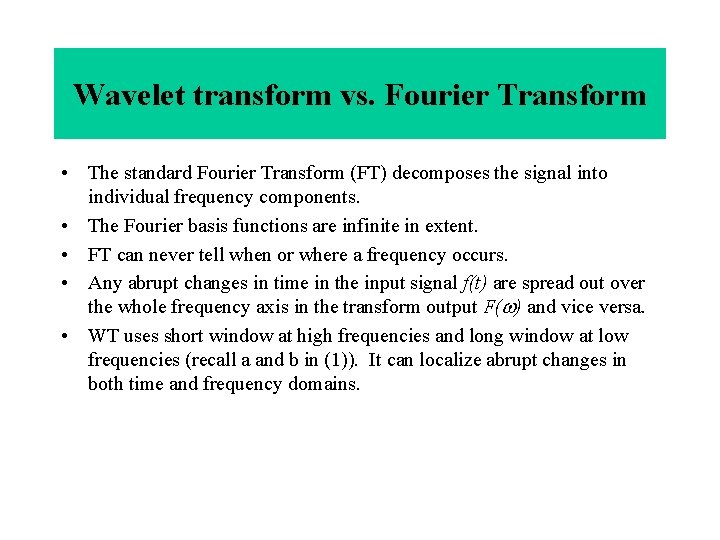
Wavelet transform vs. Fourier Transform • The standard Fourier Transform (FT) decomposes the signal into individual frequency components. • The Fourier basis functions are infinite in extent. • FT can never tell when or where a frequency occurs. • Any abrupt changes in time in the input signal f(t) are spread out over the whole frequency axis in the transform output F( ) and vice versa. • WT uses short window at high frequencies and long window at low frequencies (recall a and b in (1)). It can localize abrupt changes in both time and frequency domains.
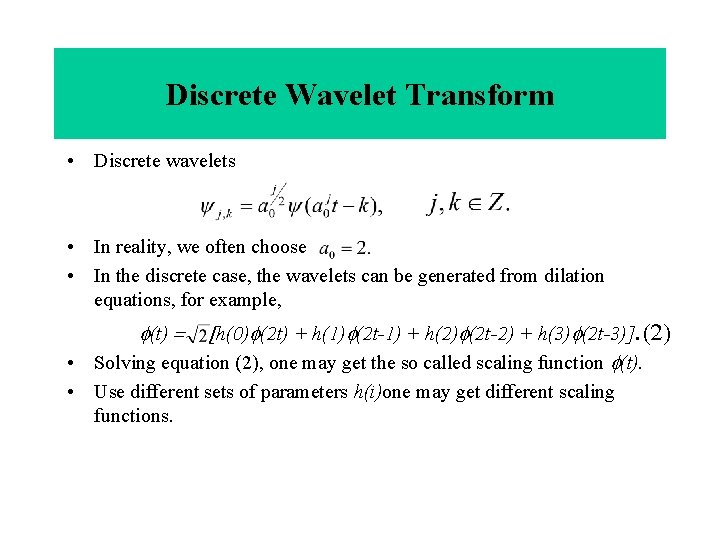
Discrete Wavelet Transform • Discrete wavelets • In reality, we often choose • In the discrete case, the wavelets can be generated from dilation equations, for example, [h(0)f(2 t) + h(1)f(2 t-1) + h(2)f(2 t-2) + h(3)f(2 t-3)]. (2) • Solving equation (2), one may get the so called scaling function f(t). • Use different sets of parameters h(i)one may get different scaling f(t) = functions.
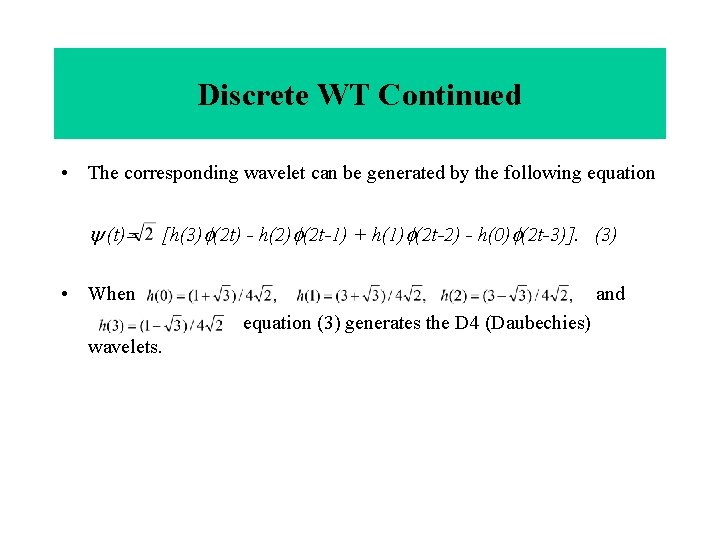
Discrete WT Continued • The corresponding wavelet can be generated by the following equation y (t)= [h(3)f(2 t) - h(2)f(2 t-1) + h(1)f(2 t-2) - h(0)f(2 t-3)]. (3) • When and equation (3) generates the D 4 (Daubechies) wavelets.
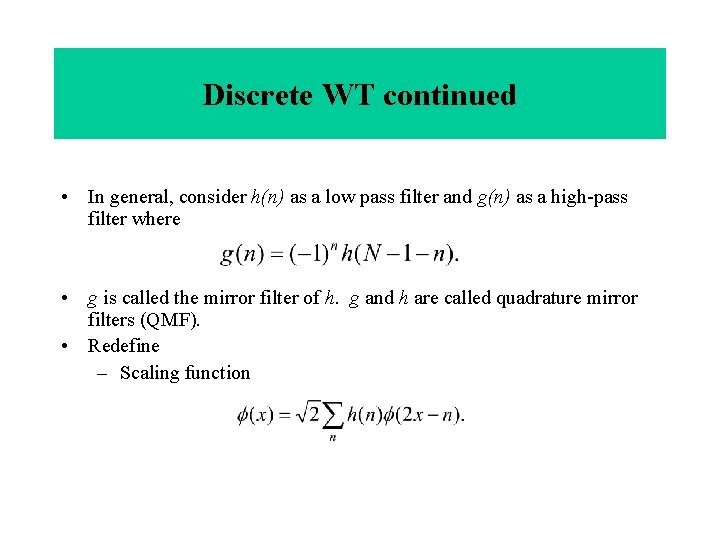
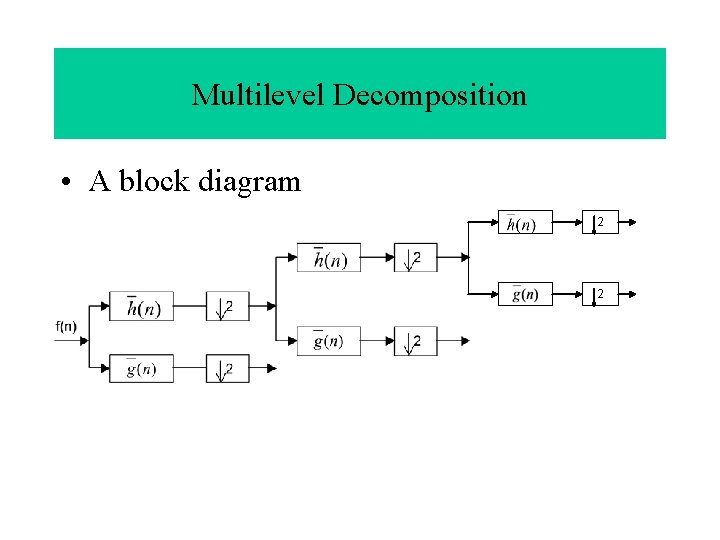
Discrete WT continued • In general, consider h(n) as a low pass filter and g(n) as a high-pass filter where • g is called the mirror filter of h. g and h are called quadrature mirror filters (QMF). • Redefine – Scaling function
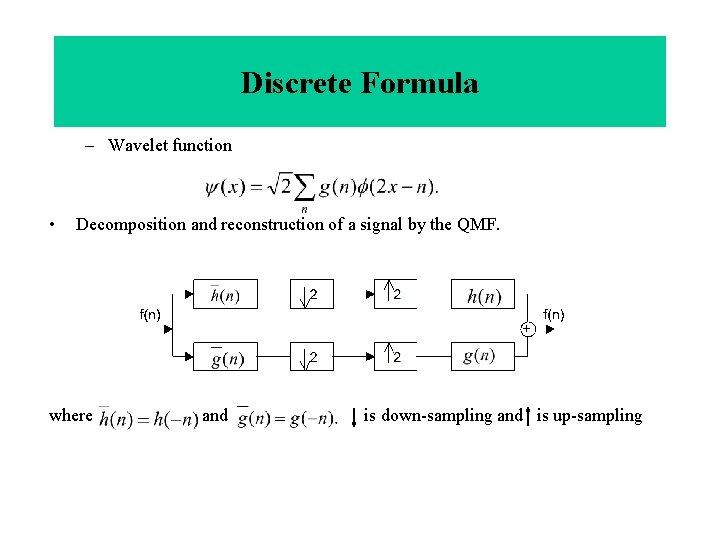
Discrete Formula – Wavelet function • Decomposition and reconstruction of a signal by the QMF. where and is down-sampling and is up-sampling
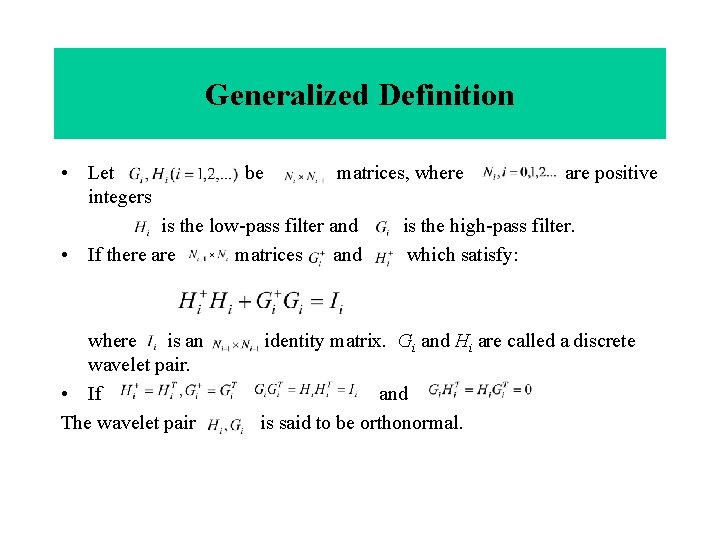
Generalized Definition • Let be matrices, where are positive integers is the low-pass filter and is the high-pass filter. • If there are matrices and which satisfy: where is an identity matrix. Gi and Hi are called a discrete wavelet pair. • If and The wavelet pair is said to be orthonormal.
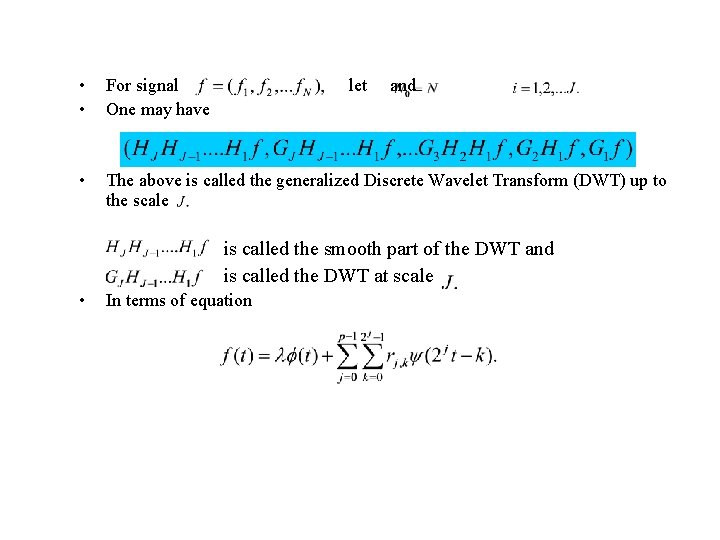
• • For signal One may have • The above is called the generalized Discrete Wavelet Transform (DWT) up to the scale let and is called the smooth part of the DWT and is called the DWT at scale • In terms of equation
Multilevel Decomposition • A block diagram 2 2
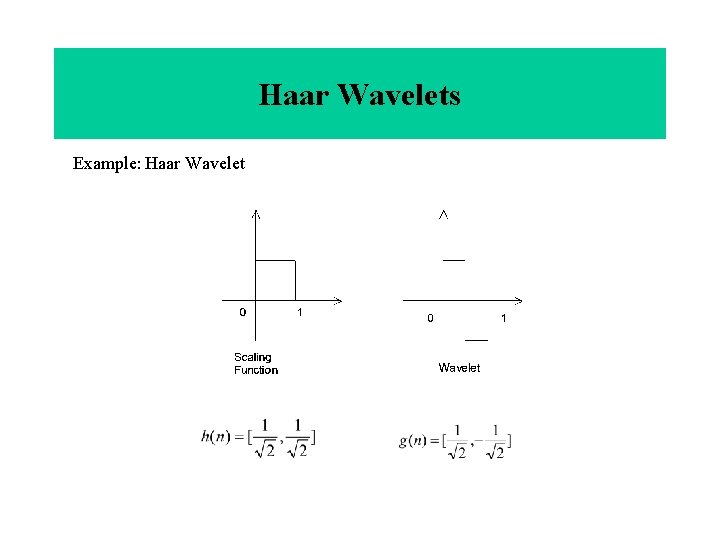
Haar Wavelets Example: Haar Wavelet
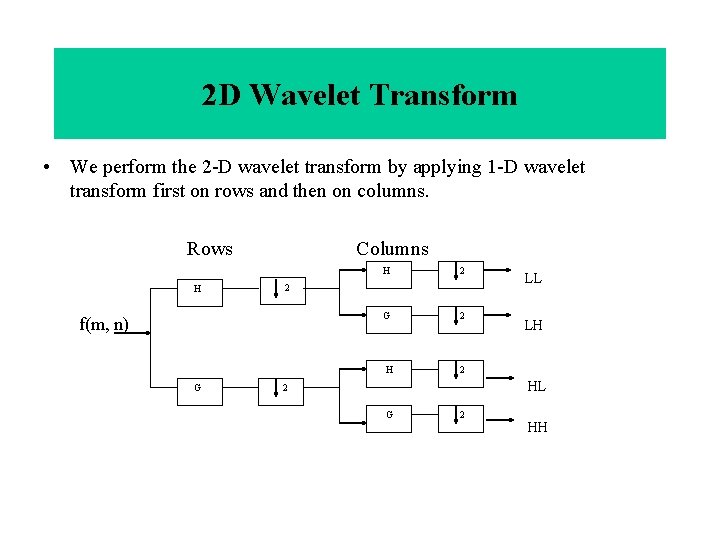
2 D Wavelet Transform • We perform the 2 -D wavelet transform by applying 1 -D wavelet transform first on rows and then on columns. Rows H Columns 2 LL G 2 LH H 2 f(m, n) G H HL 2 G 2 HH
Integer-Based Wavelets • By using a so-called lifting scheme, integer-based wavelets can be created. • Using the integer-based wavelet, one can simplify the computation. • Integer-based wavelets are also easier to implement by a VLSI chip than non-integer wavelets.
Applications • Signal processing – Target identification. – Seismic and geophysical signal processing. – Medical and biomedical signal and image processing. • • Image compression (very good result for high compression ratio). Video compression (very good result for high compression ratio). Audio compression (a challenge for high-quality audio). Signal de-noising.
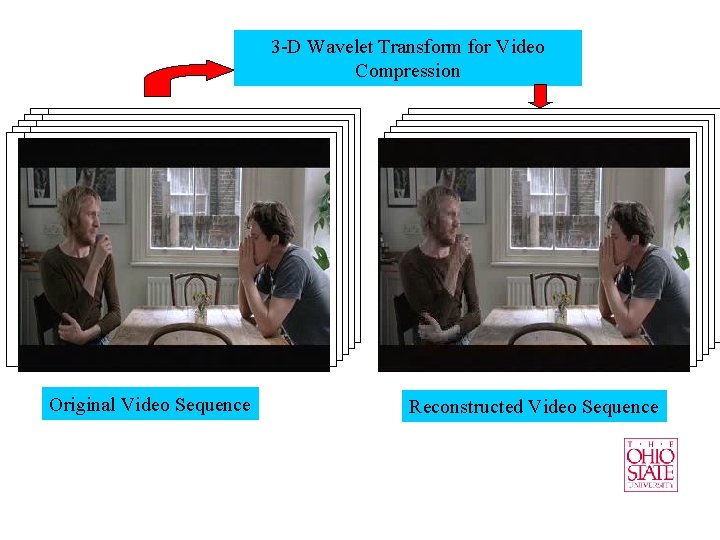
3 -D Wavelet Transform for Video Compression Original Video Sequence Reconstructed Video Sequence