
Wavelet Transform A very brief look Wavelets vs
Wavelet Transform A very brief look
Wavelets vs. Fourier Transform In Fourier transform (FT) we represent a signal in terms of sinusoids n FT provides a signal which is localized only in the frequency domain n It does not give any information of the signal in the time domain n 2
Wavelets vs. Fourier Transform Basis functions of the wavelet transform (WT) are small waves located in different times n They are obtained using scaling and translation of a scaling function and wavelet function n Therefore, the WT is localized in both time and frequency n 3
Wavelets vs. Fourier Transform In addition, the WT provides a multiresolution system n Multiresolution is useful in several applications n For instance, image communications and image data base are such applications n 4
Wavelets vs. Fourier Transform If a signal has a discontinuity, FT produces many coefficients with large magnitude (significant coefficients) n But WT generates a few significant coefficients around the discontinuity n Nonlinear approximation is a method to benchmark the approximation power of a transform n 5
Wavelets vs. Fourier Transform n n In nonlinear approximation we keep only a few significant coefficients of a signal and set the rest to zero Then we reconstruct the signal using the significant coefficients WT produces a few significant coefficients for the signals with discontinuities Thus, we obtain better results for WT nonlinear approximation when compared with the FT 6
Wavelets vs. Fourier Transform n n Most natural signals are smooth with a few discontinuities (are piece-wise smooth) Speech and natural images are such signals Hence, WT has better capability for representing these signal when compared with the FT Good nonlinear approximation results in efficiency in several applications such as compression and denoising 7
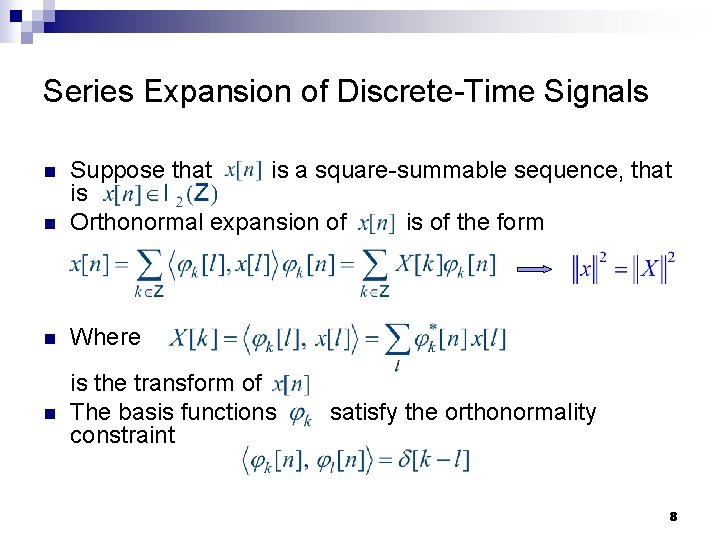
Series Expansion of Discrete-Time Signals n Suppose that is a square-summable sequence, that is Orthonormal expansion of is of the form n Where n is the transform of The basis functions constraint n satisfy the orthonormality 8
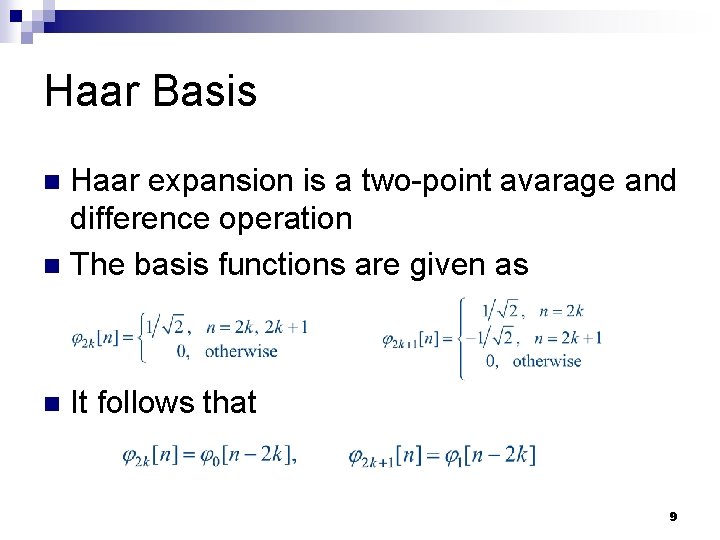
Haar Basis Haar expansion is a two-point avarage and difference operation n The basis functions are given as n n It follows that 9
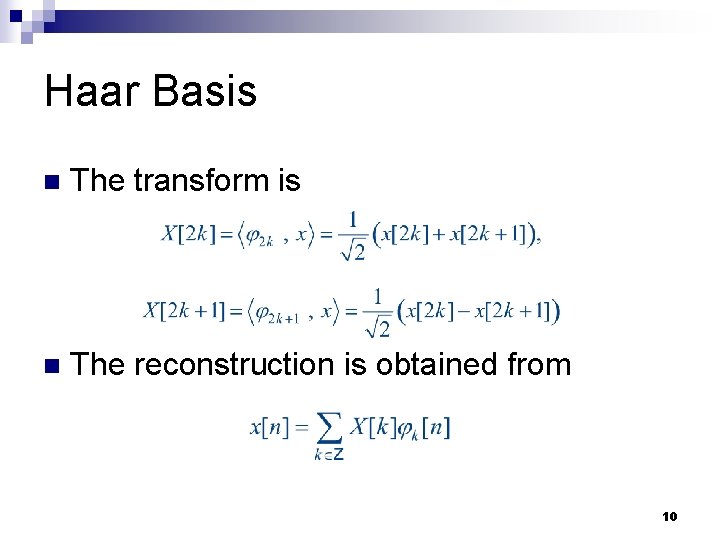
Haar Basis n The transform is n The reconstruction is obtained from 10
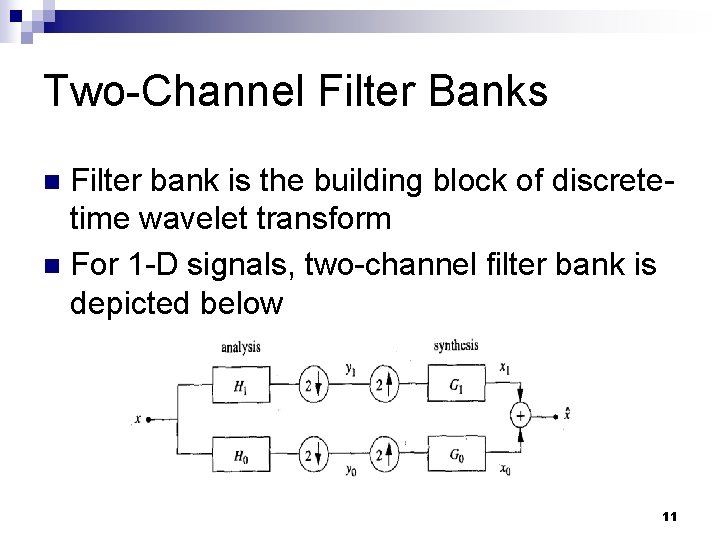
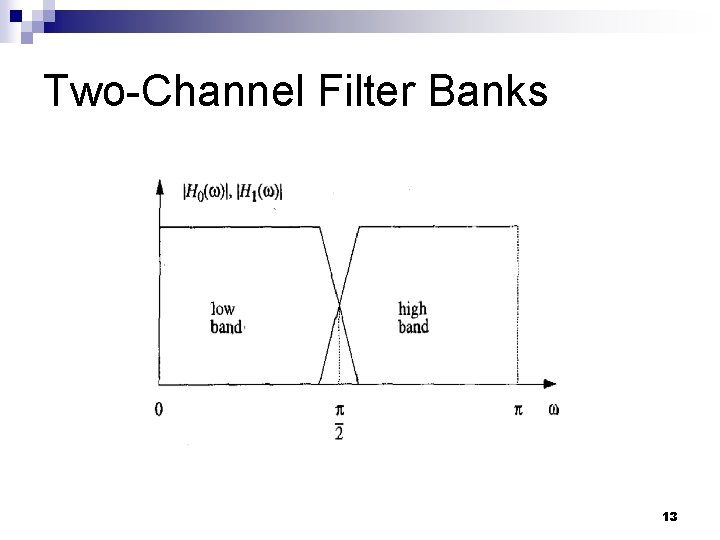
Two-Channel Filter Banks Filter bank is the building block of discretetime wavelet transform n For 1 -D signals, two-channel filter bank is depicted below n 11
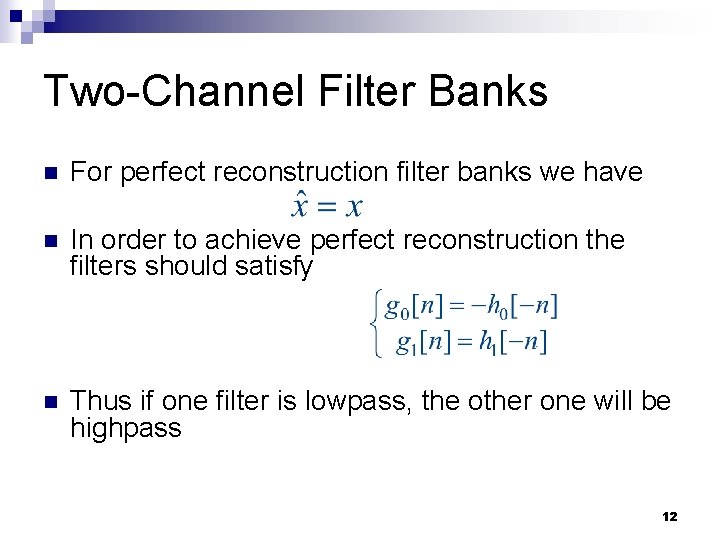
Two-Channel Filter Banks n For perfect reconstruction filter banks we have n In order to achieve perfect reconstruction the filters should satisfy n Thus if one filter is lowpass, the other one will be highpass 12
Two-Channel Filter Banks 13
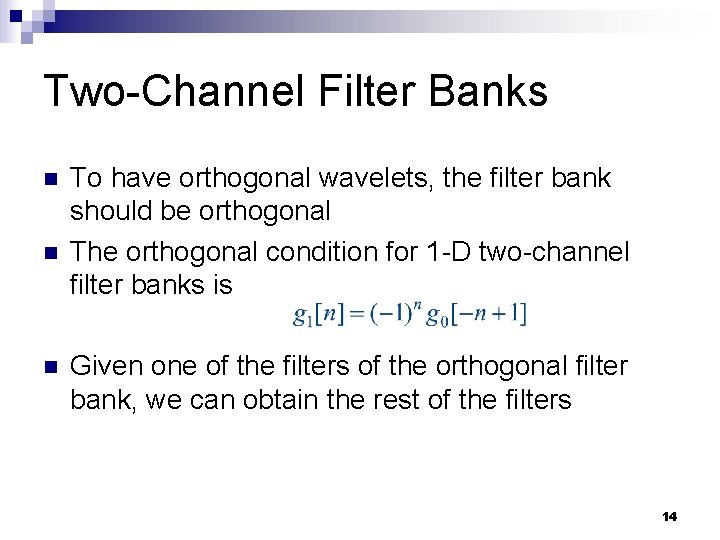
Two-Channel Filter Banks n n n To have orthogonal wavelets, the filter bank should be orthogonal The orthogonal condition for 1 -D two-channel filter banks is Given one of the filters of the orthogonal filter bank, we can obtain the rest of the filters 14
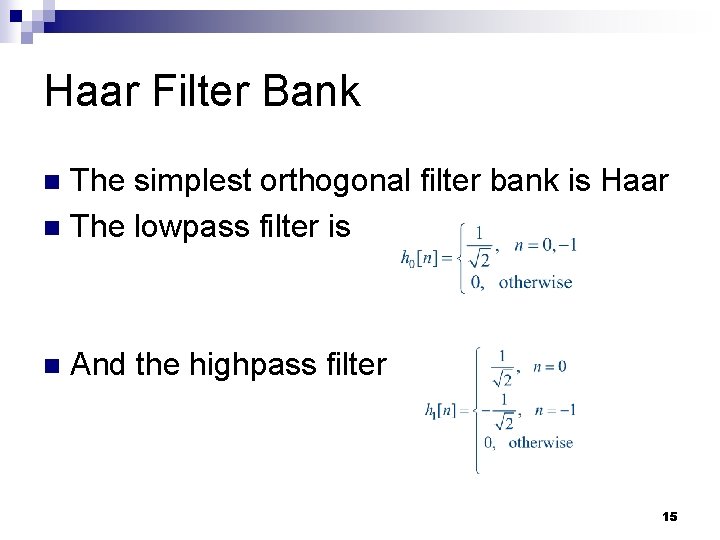
Haar Filter Bank The simplest orthogonal filter bank is Haar n The lowpass filter is n n And the highpass filter 15
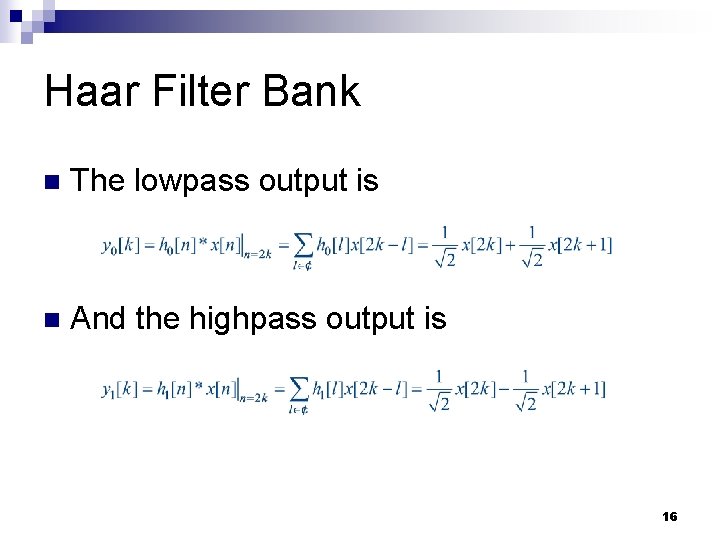
Haar Filter Bank n The lowpass output is n And the highpass output is 16
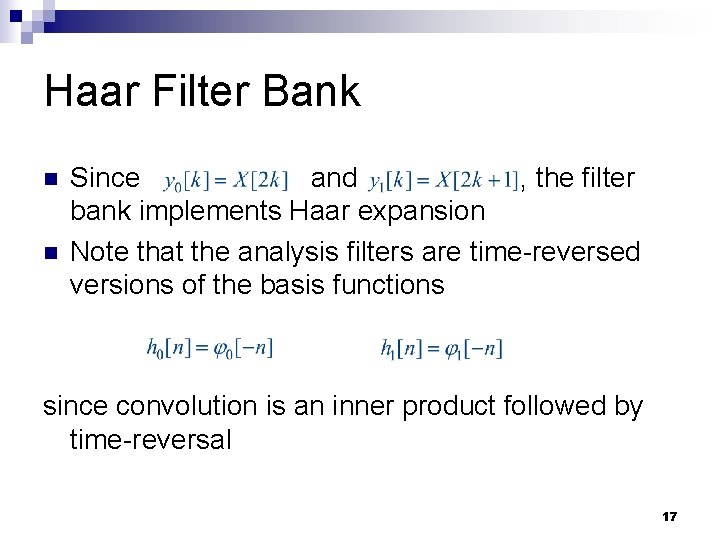
Haar Filter Bank n n Since and , the filter bank implements Haar expansion Note that the analysis filters are time-reversed versions of the basis functions since convolution is an inner product followed by time-reversal 17
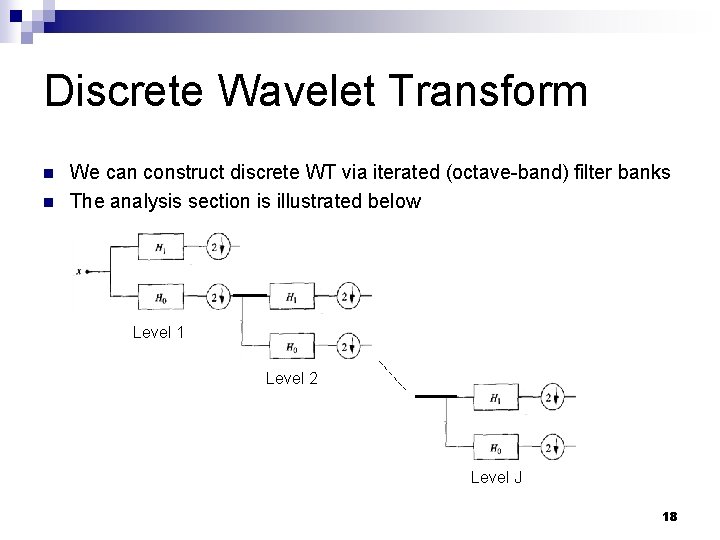
Discrete Wavelet Transform n n We can construct discrete WT via iterated (octave-band) filter banks The analysis section is illustrated below Level 1 Level 2 Level J 18
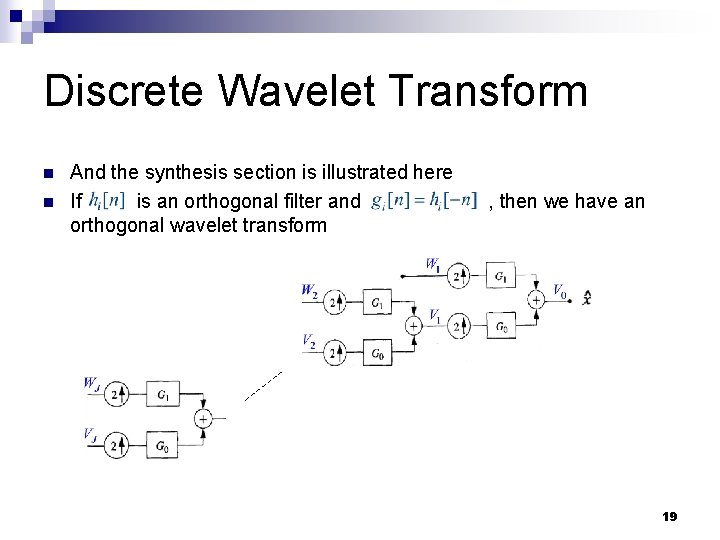
Discrete Wavelet Transform n n And the synthesis section is illustrated here If is an orthogonal filter and orthogonal wavelet transform , then we have an 19
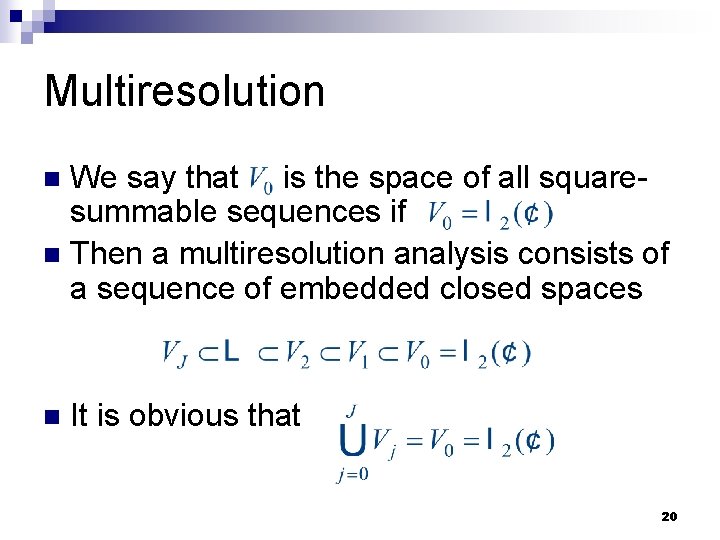
Multiresolution We say that is the space of all squaresummable sequences if n Then a multiresolution analysis consists of a sequence of embedded closed spaces n n It is obvious that 20
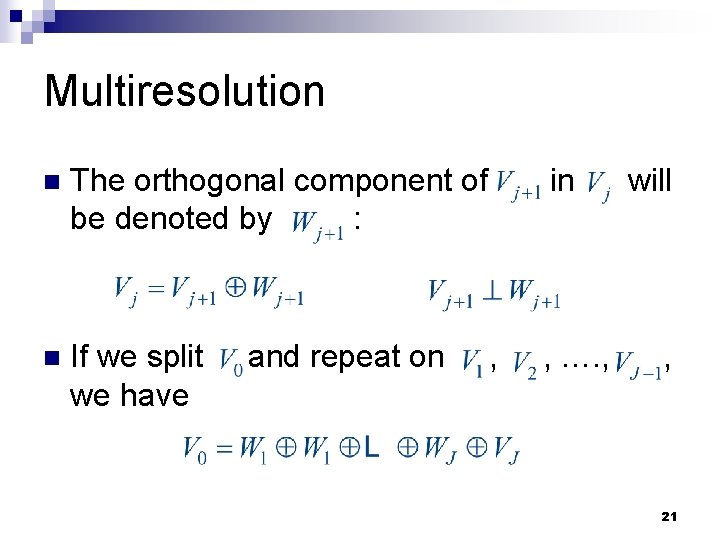
Multiresolution n The orthogonal component of be denoted by : n If we split we have and repeat on in , , …. , will , 21
2 -D Separable WT n n n For images we use separable WT First we apply a 1 -D filter bank to the rows of the image Then we apply same transform to the columns of each channel of the result Therefore, we obtain 3 highpass channels corresponding to vertical, horizontal, and diagonal, and one approximation image We can iterate the above procedure on the lowpass channel 22
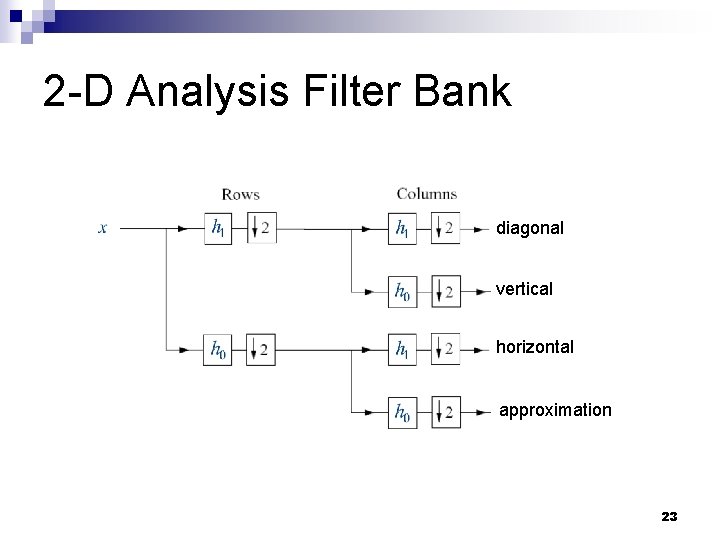
2 -D Analysis Filter Bank diagonal vertical horizontal approximation 23
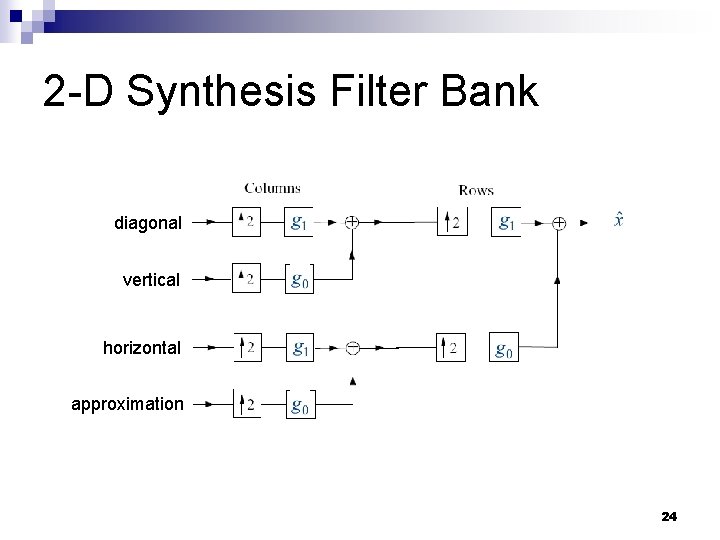
2 -D Synthesis Filter Bank diagonal vertical horizontal approximation 24
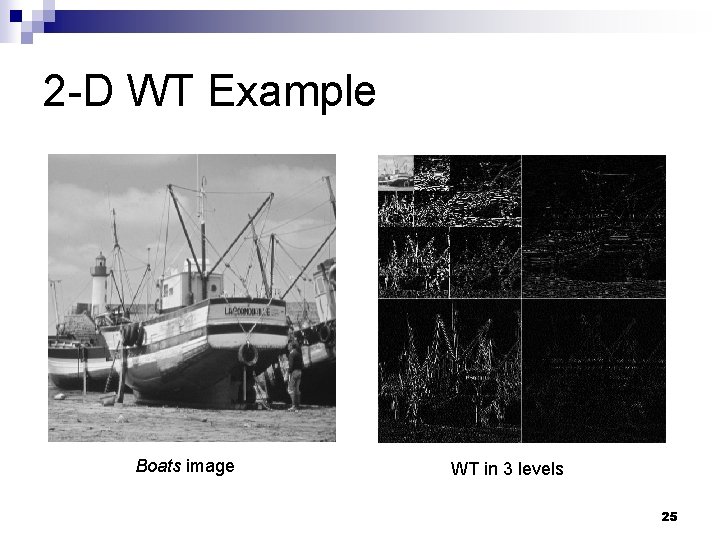
2 -D WT Example Boats image WT in 3 levels 25
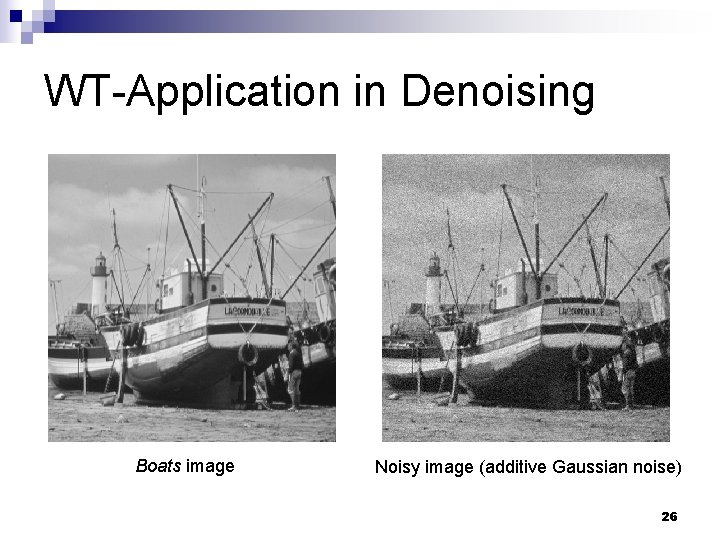
WT-Application in Denoising Boats image Noisy image (additive Gaussian noise) 26
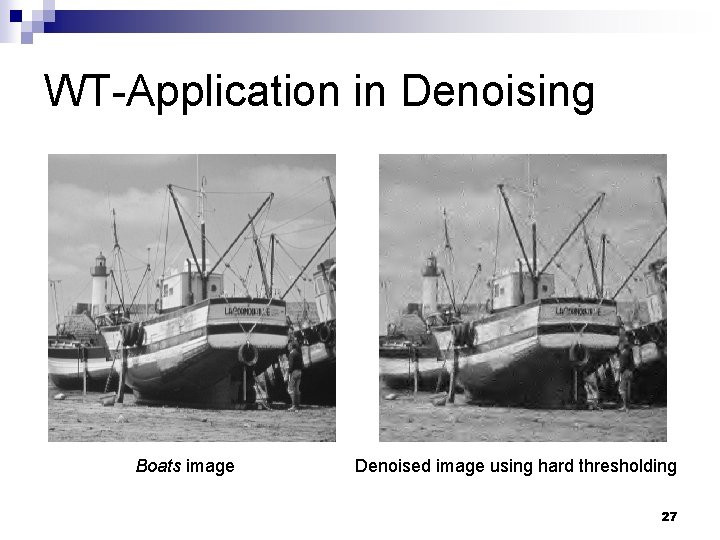
WT-Application in Denoising Boats image Denoised image using hard thresholding 27
Reference n Martin Vetterli and Jelena Kovacevic, Wavelets and Subband Coding. Prentice Hall, 1995. 28
- Slides: 28