
Wavelet Neural Control Of Cascaded Continuous Stirred Tank
- Slides: 19
Wavelet Neural Control Of Cascaded Continuous Stirred Tank Reactors Tariq Ahamed
AIM �The main objective of the project is to control the concentration of reactant in the CSTR. �The tank is controlled by manipulating the coolant flow rate. �The system is subjected to step changes and load disturbances and the responses by different controllers are noted.
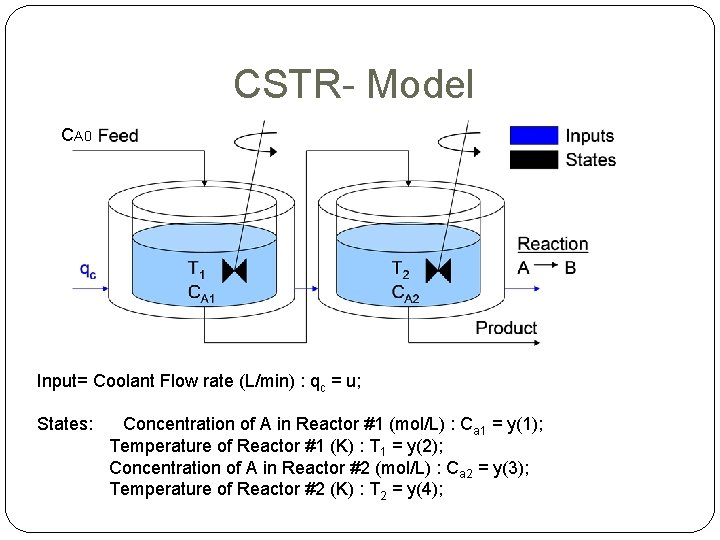
CSTR- Model CA 0 Input= Coolant Flow rate (L/min) : qc = u; States: Concentration of A in Reactor #1 (mol/L) : Ca 1 = y(1); Temperature of Reactor #1 (K) : T 1 = y(2); Concentration of A in Reactor #2 (mol/L) : Ca 2 = y(3); Temperature of Reactor #2 (K) : T 2 = y(4);
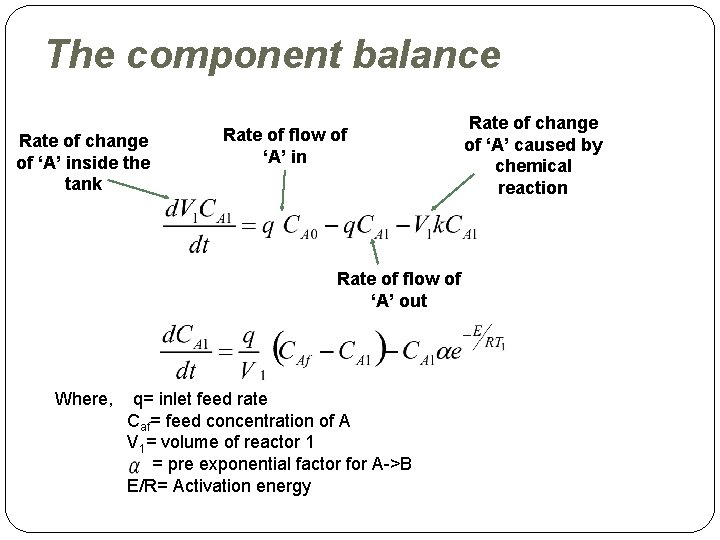
The component balance Rate of change of ‘A’ inside the tank Rate of flow of ‘A’ in Rate of flow of ‘A’ out Where, q= inlet feed rate Caf= feed concentration of A V 1= volume of reactor 1 = pre exponential factor for A->B E/R= Activation energy Rate of change of ‘A’ caused by chemical reaction
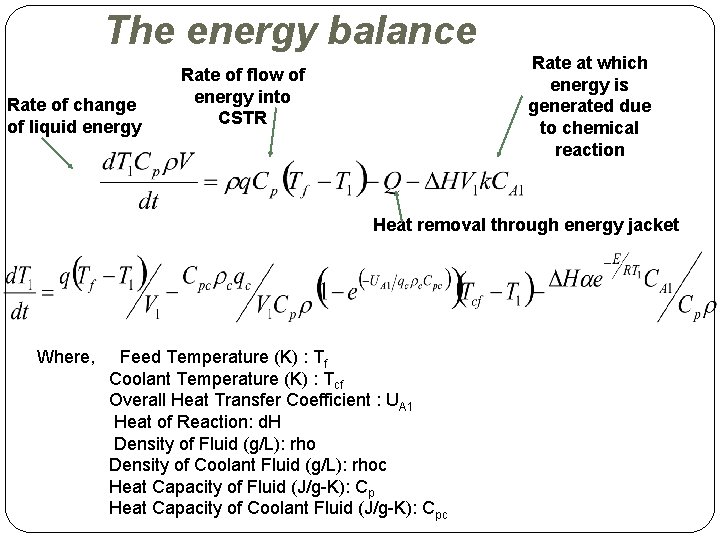
The energy balance Rate of change of liquid energy Rate at which energy is generated due to chemical reaction Rate of flow of energy into CSTR Heat removal through energy jacket Where, Feed Temperature (K) : Tf Coolant Temperature (K) : Tcf Overall Heat Transfer Coefficient : UA 1 Heat of Reaction: d. H Density of Fluid (g/L): rho Density of Coolant Fluid (g/L): rhoc Heat Capacity of Fluid (J/g-K): Cp Heat Capacity of Coolant Fluid (J/g-K): Cpc
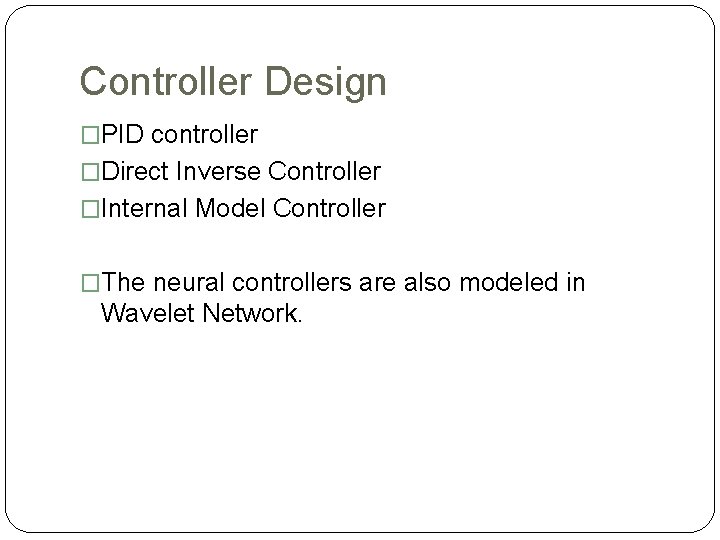
Controller Design �PID controller �Direct Inverse Controller �Internal Model Controller �The neural controllers are also modeled in Wavelet Network.
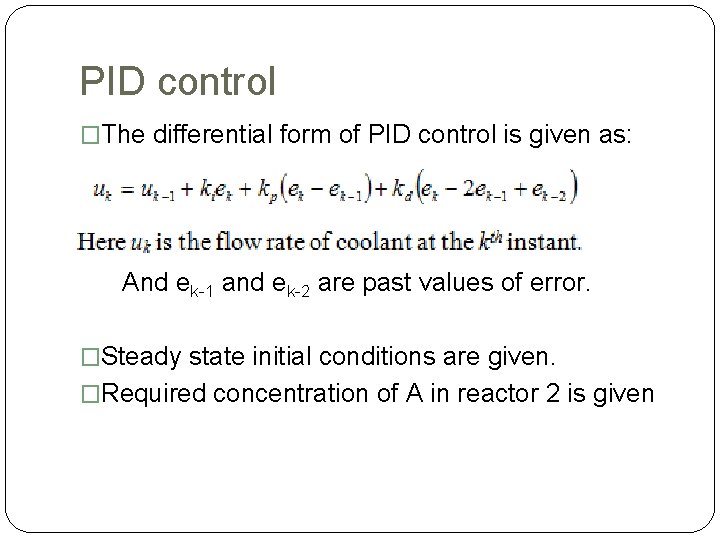
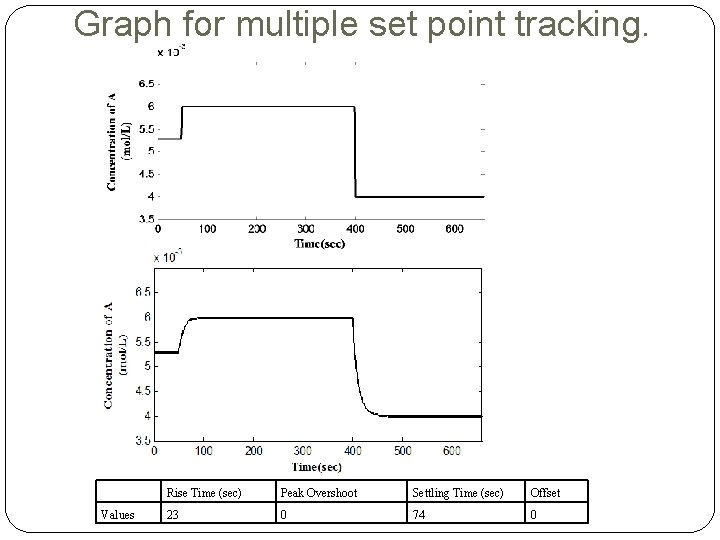
PID control �The differential form of PID control is given as: e= Creq- Ca(t) And ek-1 and ek-2 are past values of error. �Steady state initial conditions are given. �Required concentration of A in reactor 2 is given
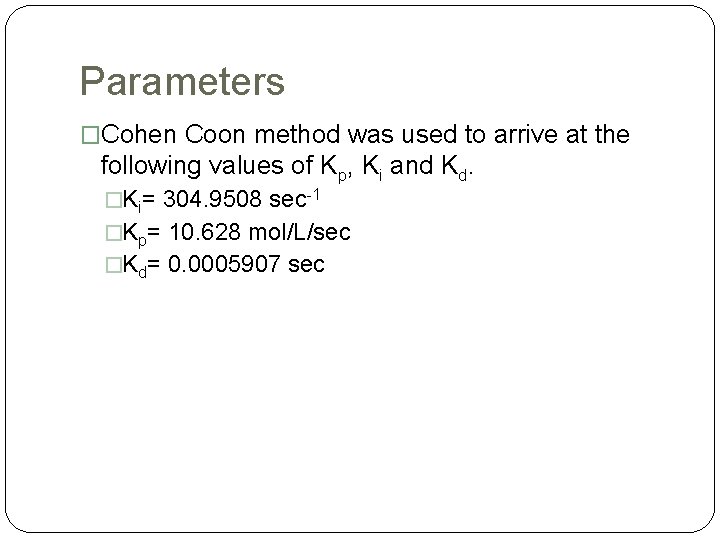
Parameters �Cohen Coon method was used to arrive at the following values of Kp, Ki and Kd. �Ki= 304. 9508 sec-1 �Kp= 10. 628 mol/L/sec �Kd= 0. 0005907 sec
Graph for multiple set point tracking. Values Rise Time (sec) Peak Overshoot Settling Time (sec) Offset 23 0 74 0
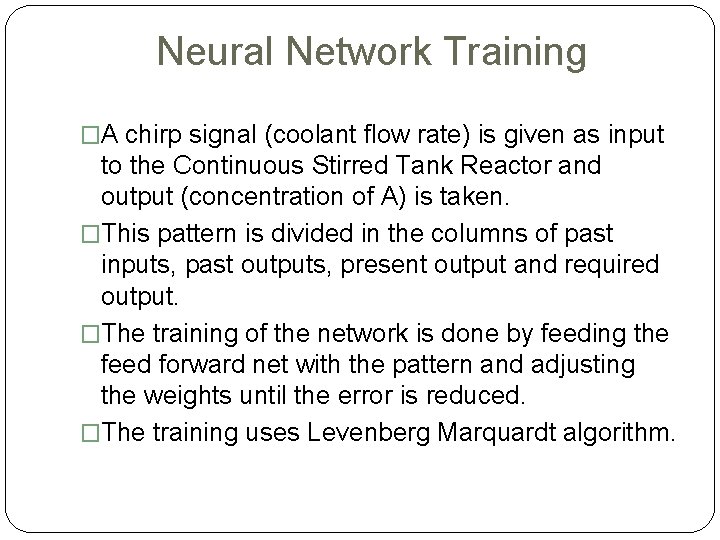
Neural Network Training �A chirp signal (coolant flow rate) is given as input to the Continuous Stirred Tank Reactor and output (concentration of A) is taken. �This pattern is divided in the columns of past inputs, past outputs, present output and required output. �The training of the network is done by feeding the feed forward net with the pattern and adjusting the weights until the error is reduced. �The training uses Levenberg Marquardt algorithm.
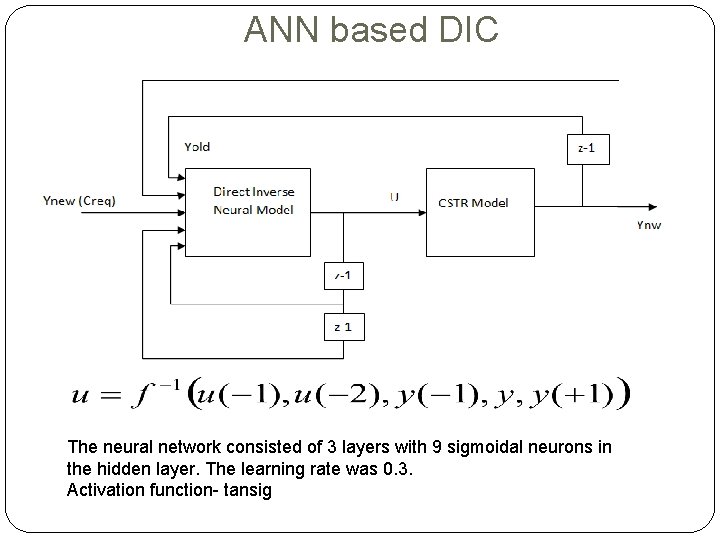
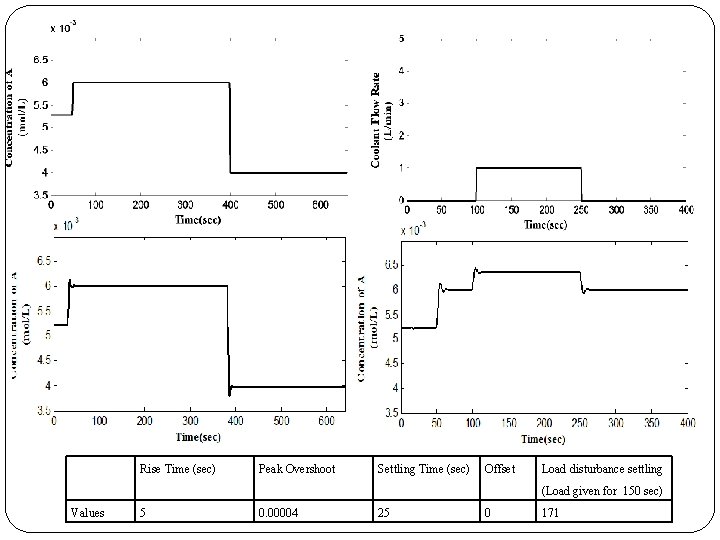
ANN based DIC The neural network consisted of 3 layers with 9 sigmoidal neurons in the hidden layer. The learning rate was 0. 3. Activation function- tansig
Rise Time (sec) Peak Overshoot Settling Time (sec) Offset Load disturbance settling (Load given for 150 sec) Values 5 0. 00004 25 0 171
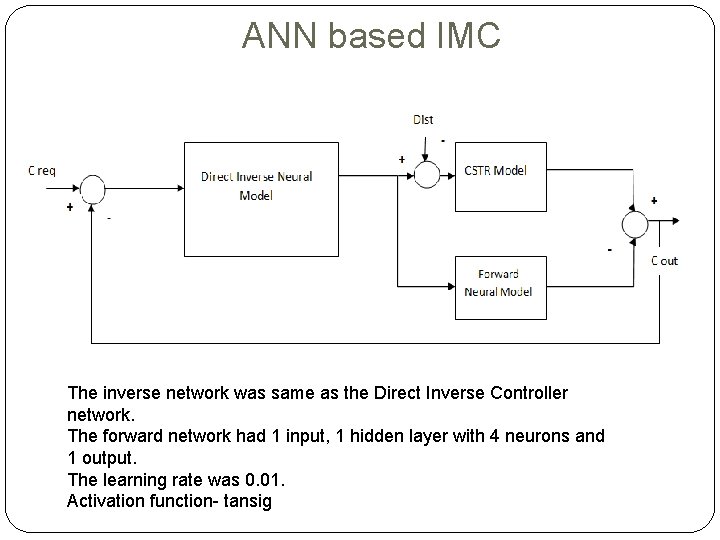
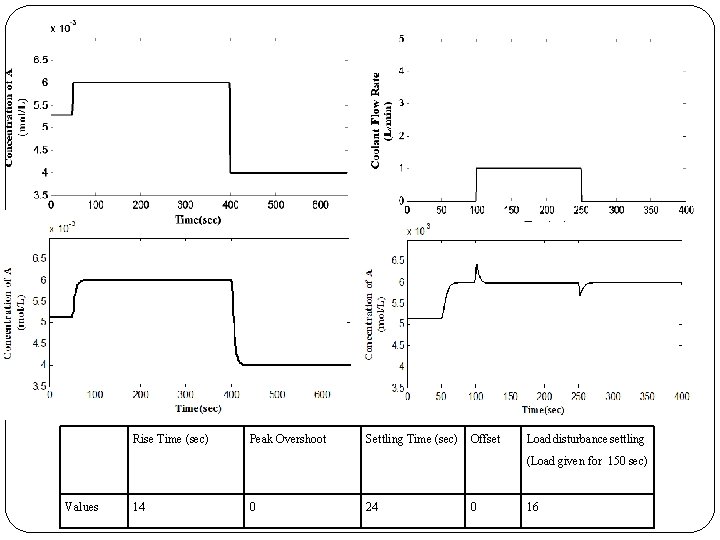
ANN based IMC The inverse network was same as the Direct Inverse Controller network. The forward network had 1 input, 1 hidden layer with 4 neurons and 1 output. The learning rate was 0. 01. Activation function- tansig
Rise Time (sec) Peak Overshoot Settling Time (sec) Offset Load disturbance settling (Load given for 150 sec) Values 14 0 24 0 16
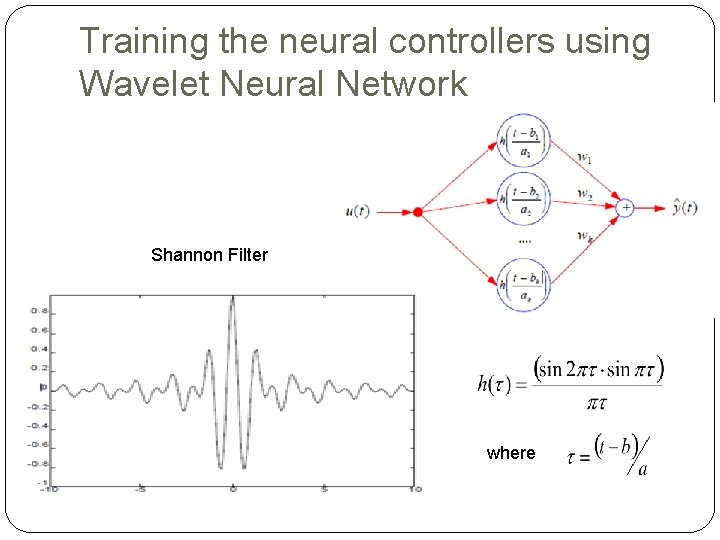
Training the neural controllers using Wavelet Neural Network Shannon Filter where
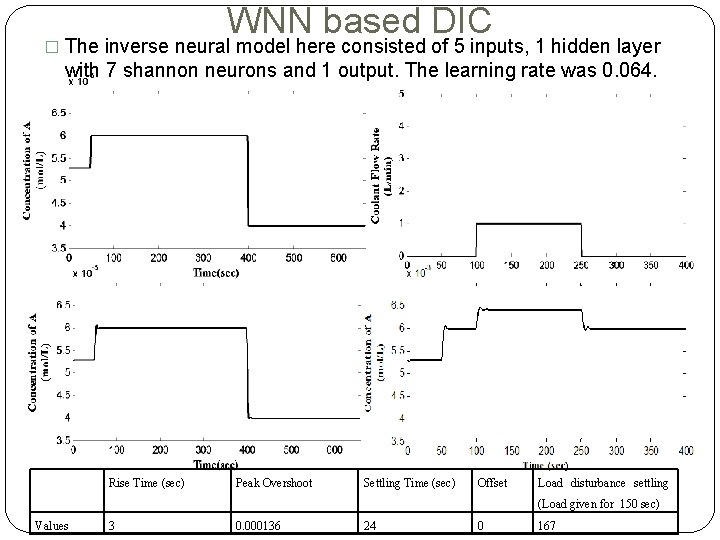
WNN based DIC � The inverse neural model here consisted of 5 inputs, 1 hidden layer with 7 shannon neurons and 1 output. The learning rate was 0. 064. Rise Time (sec) Peak Overshoot Settling Time (sec) Offset Load disturbance settling (Load given for 150 sec) Values 3 0. 000136 24 0 167
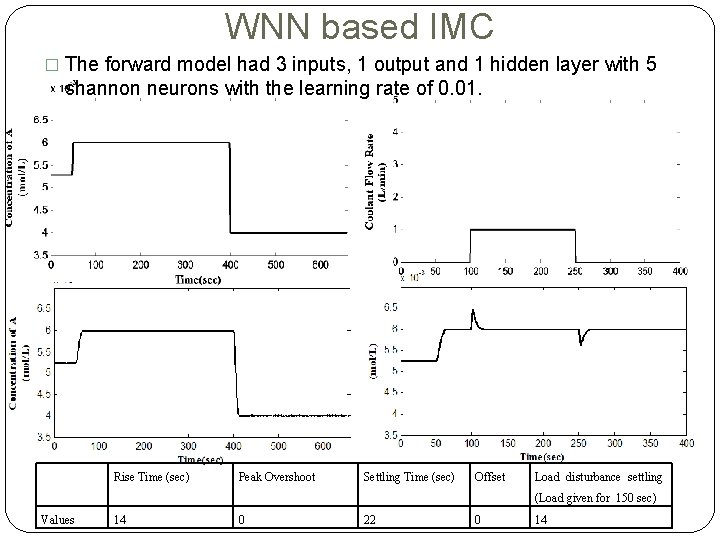
WNN based IMC � The forward model had 3 inputs, 1 output and 1 hidden layer with 5 shannon neurons with the learning rate of 0. 01. Rise Time (sec) Peak Overshoot Settling Time (sec) Offset Load disturbance settling (Load given for 150 sec) Values 14 0 22 0 14
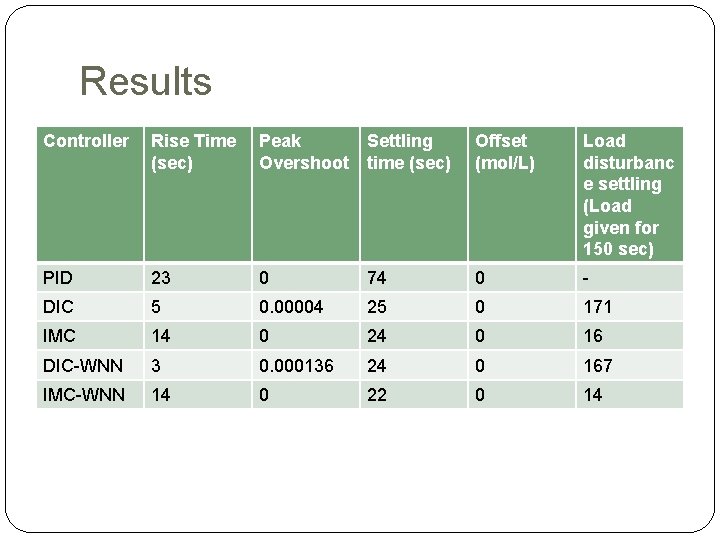
Results Controller Rise Time (sec) Peak Overshoot Settling time (sec) Offset (mol/L) Load disturbanc e settling (Load given for 150 sec) PID 23 0 74 0 - DIC 5 0. 00004 25 0 171 IMC 14 0 24 0 16 DIC-WNN 3 0. 000136 24 0 167 IMC-WNN 14 0 22 0 14
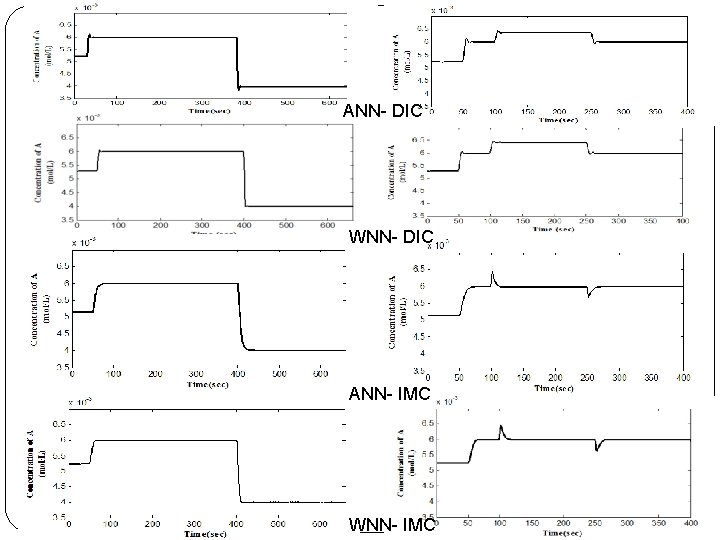
ANN- DIC WNN- DIC ANN- IMC WNN- IMC