
Wavelet domain image denoising via support vector regression



- Slides: 29
Wavelet domain image denoising via support vector regression Source: Electronics Letters, Volume: 40, Issue: 2004 PP : 1479 -1481 Authors: H. Cheng, J. W. Tian, J. Liu and Q. Z. Yu Presented by: C. Y. Gun Date: 4/7 2005 1
Outline Abstract Introduction( Mother Wavelet, Father Wavelet) Support vector regression Proposed theory and algorithm Experimental results and discussion 2
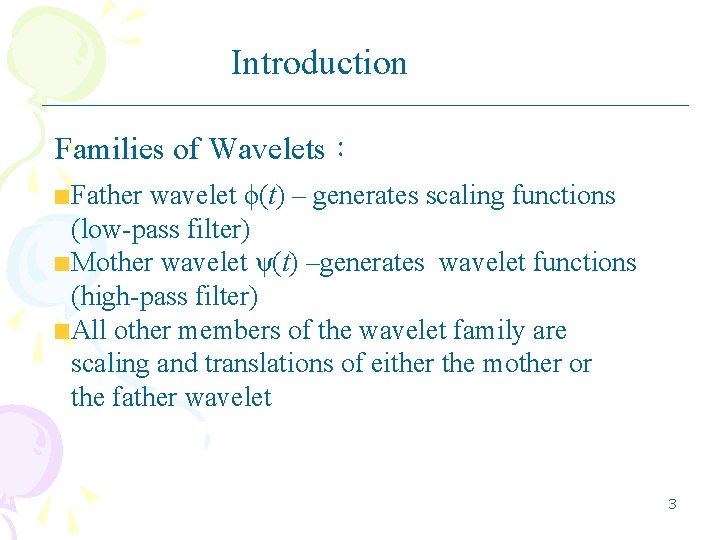
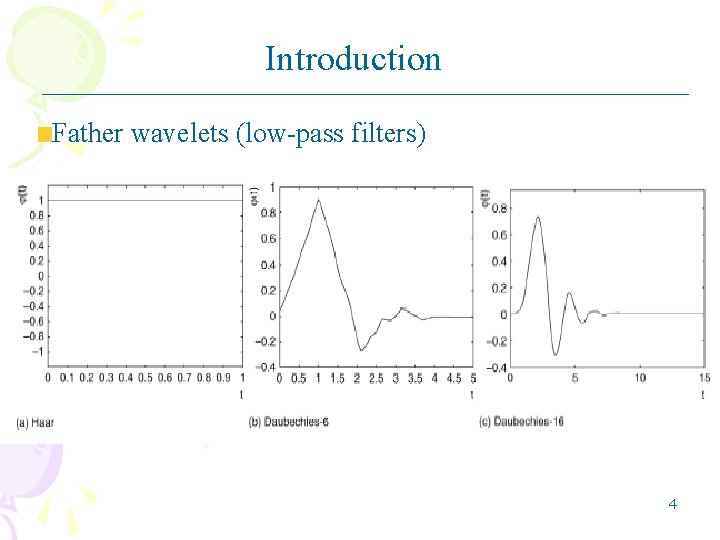
Introduction Families of Wavelets: Father wavelet ϕ(t) – generates scaling functions (low-pass filter) Mother wavelet ψ(t) –generates wavelet functions (high-pass filter) All other members of the wavelet family are scaling and translations of either the mother or the father wavelet 3
Introduction Father wavelets (low-pass filters) 4
Introduction Mother wavelets (high-pass filters) 5
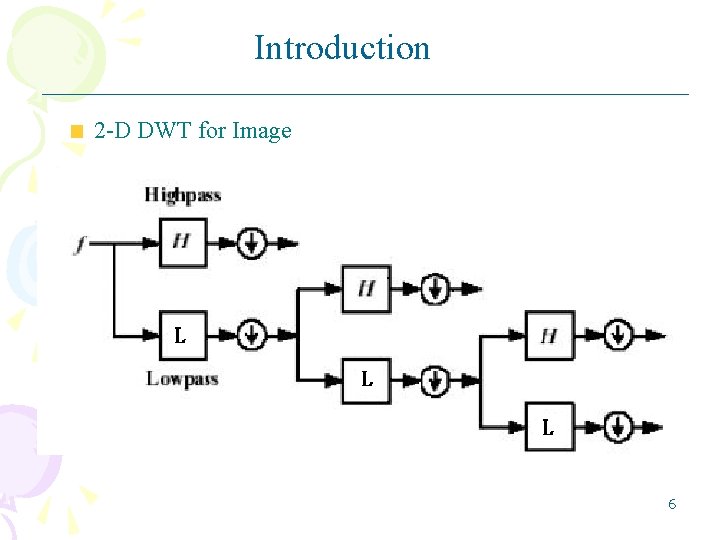
Introduction 2 -D DWT for Image 6
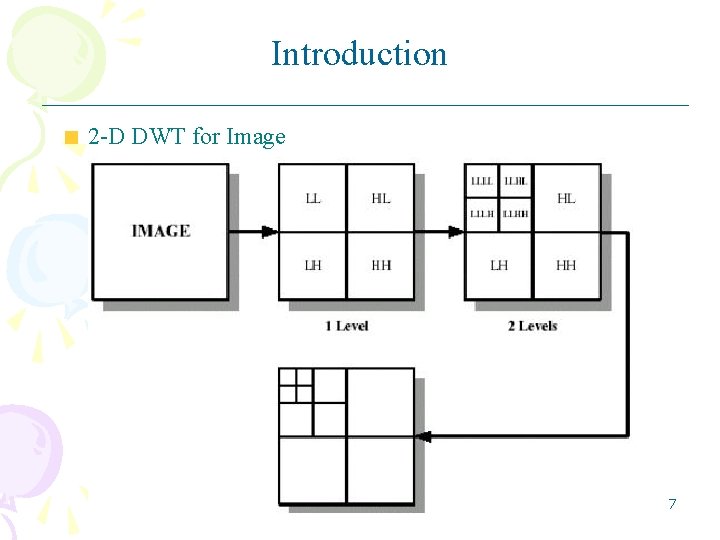
Introduction 2 -D DWT for Image 7
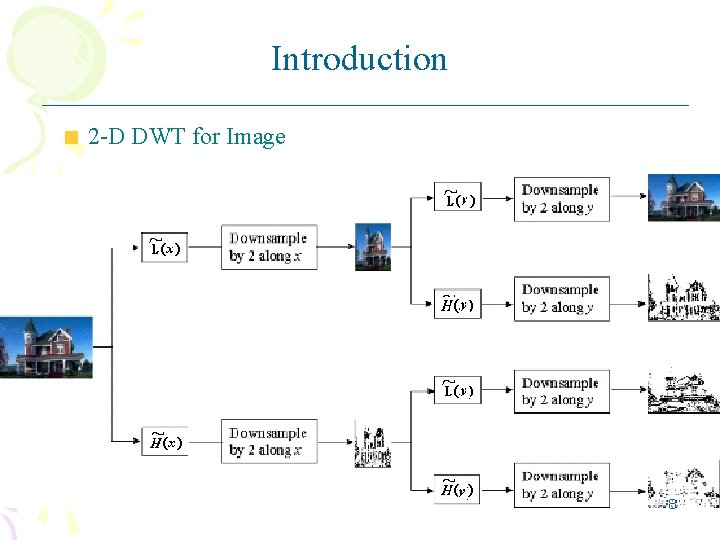
Introduction 2 -D DWT for Image 8
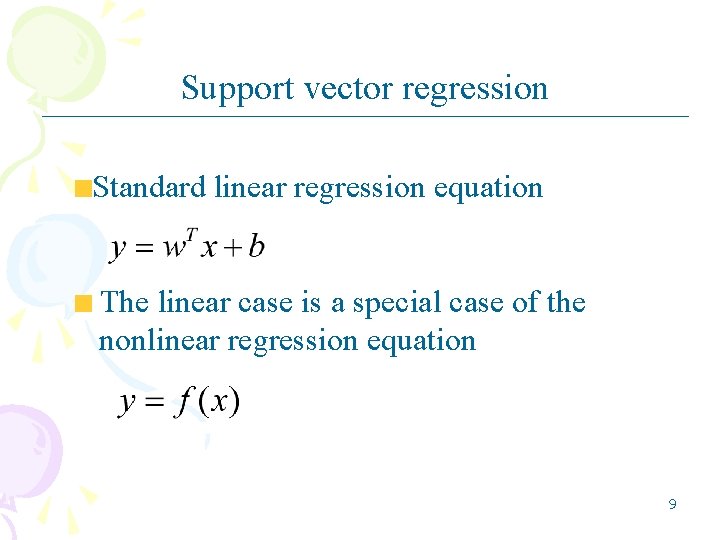
Support vector regression Standard linear regression equation The linear case is a special case of the nonlinear regression equation 9
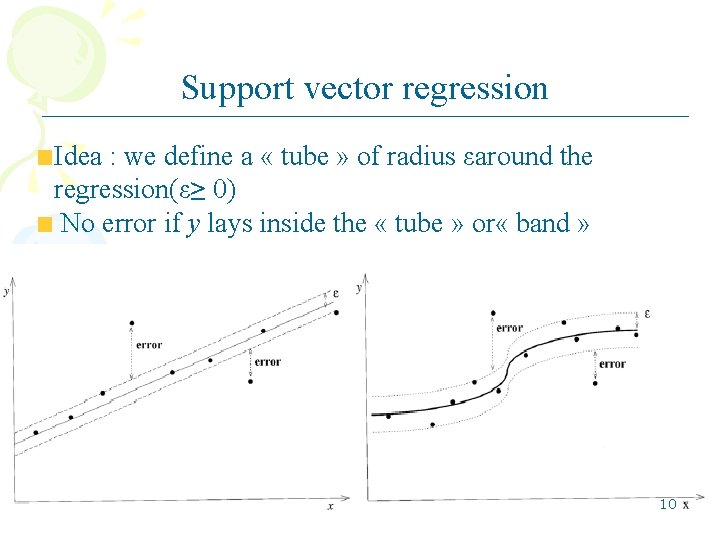
Support vector regression Idea : we define a « tube » of radius εaround the regression(ε≥ 0) No error if y lays inside the « tube » or « band » 10
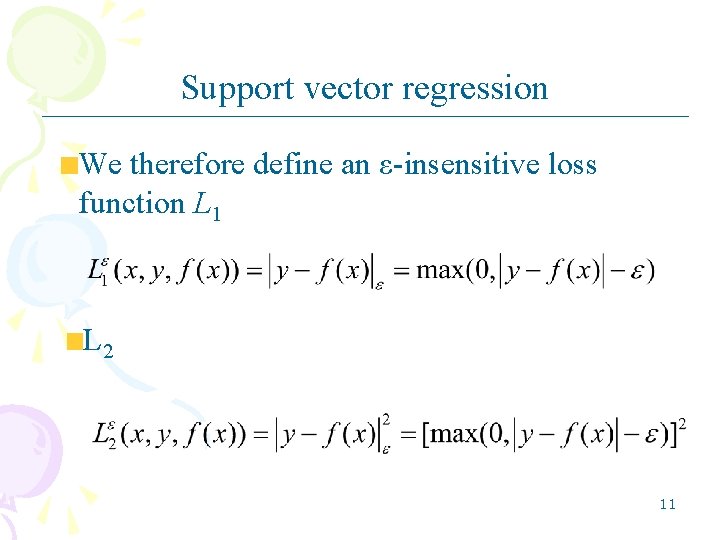
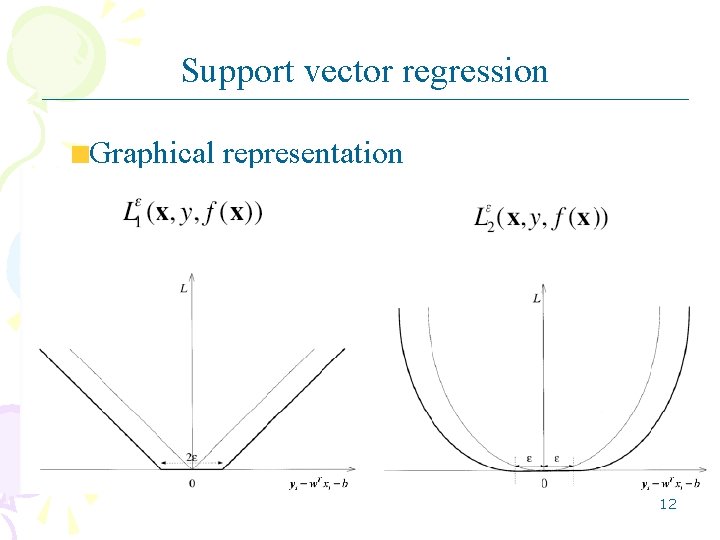
Support vector regression We therefore define an ε-insensitive loss function L 1 L 2 11
Support vector regression Graphical representation 12
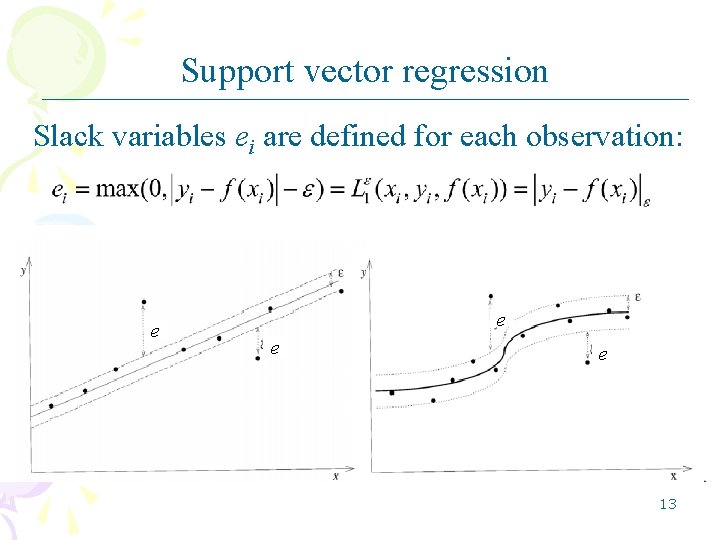
Support vector regression Slack variables ei are defined for each observation: e e 13
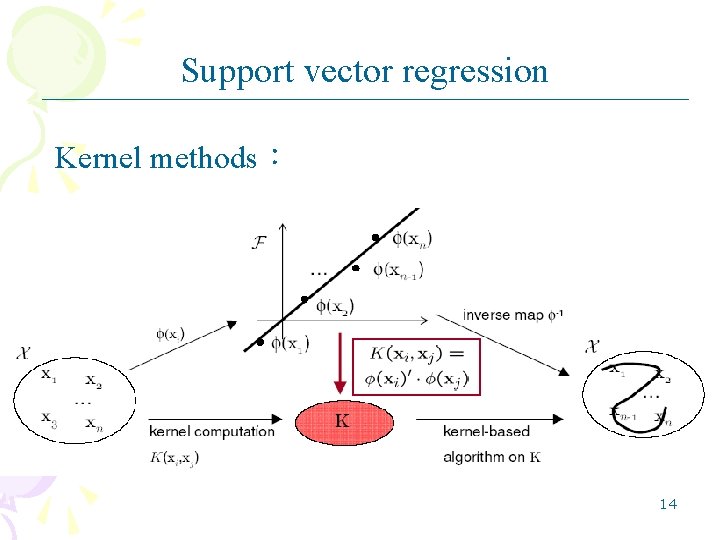
Support vector regression Kernel methods: 14
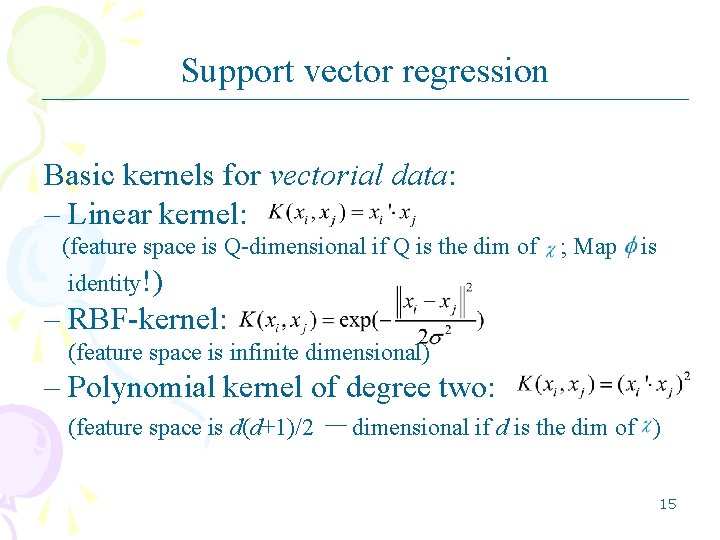
Support vector regression Basic kernels for vectorial data: – Linear kernel: (feature space is Q-dimensional if Q is the dim of ; Map is identity!) – RBF-kernel: (feature space is infinite dimensional) – Polynomial kernel of degree two: (feature space is d(d+1)/2 -dimensional if d is the dim of ) 15
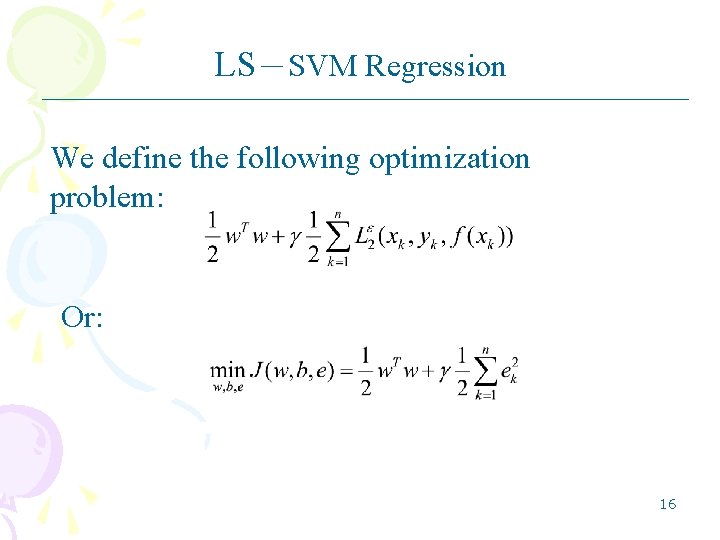
LS-SVM Regression We define the following optimization problem: Or: 16
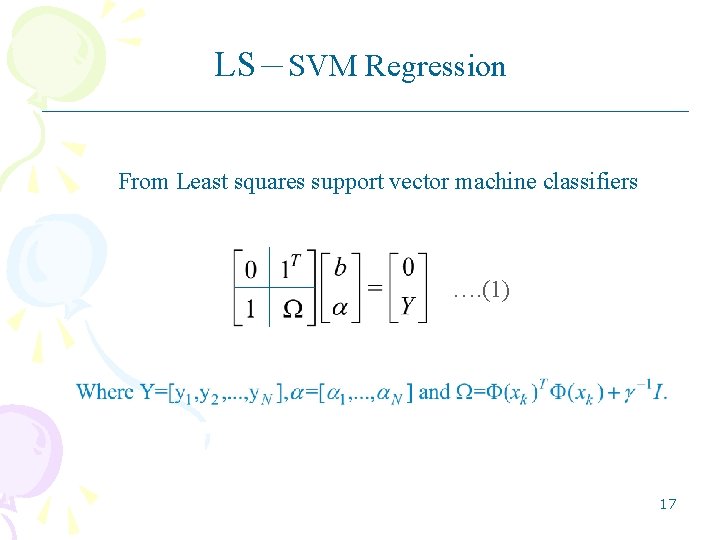
LS-SVM Regression From Least squares support vector machine classifiers …. (1) 17
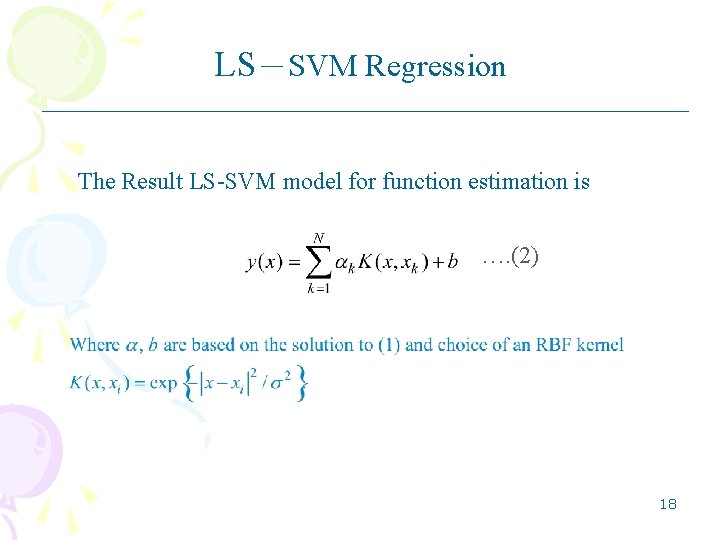
LS-SVM Regression The Result LS-SVM model for function estimation is …. (2) 18
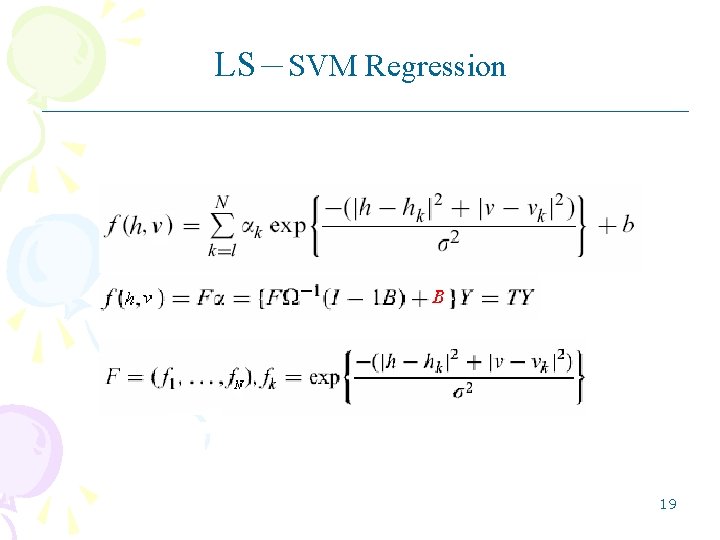
LS-SVM Regression 19
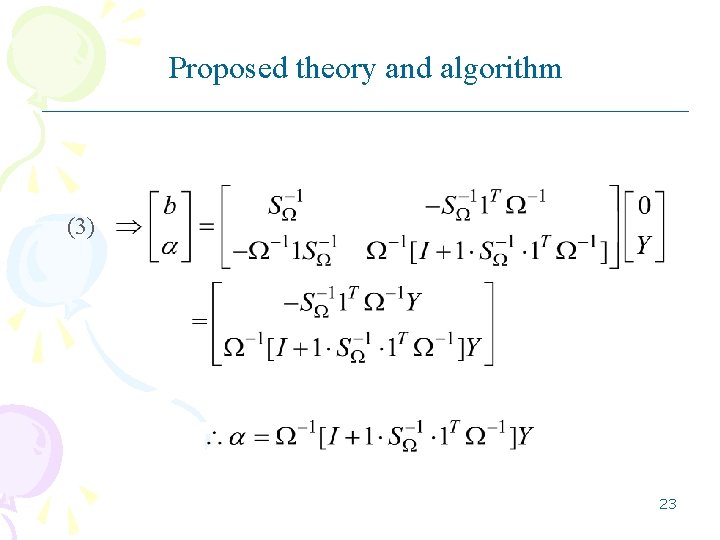
LS-SVM Regression (1) …. (3) 20
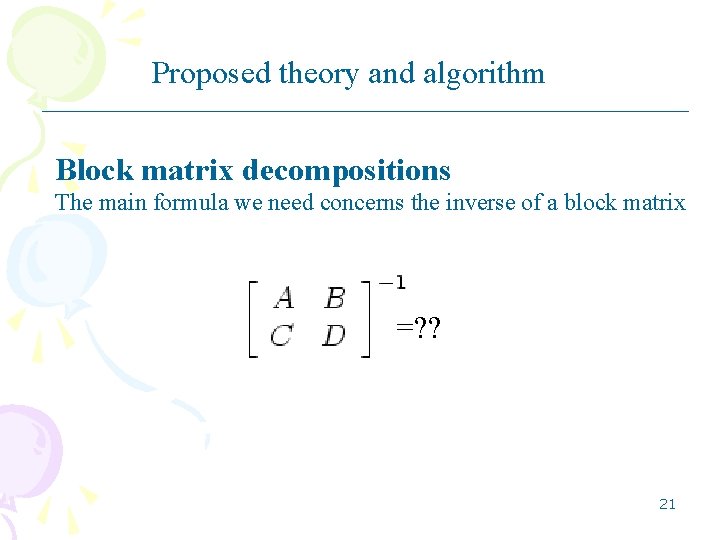
Proposed theory and algorithm Block matrix decompositions The main formula we need concerns the inverse of a block matrix =? ? 21
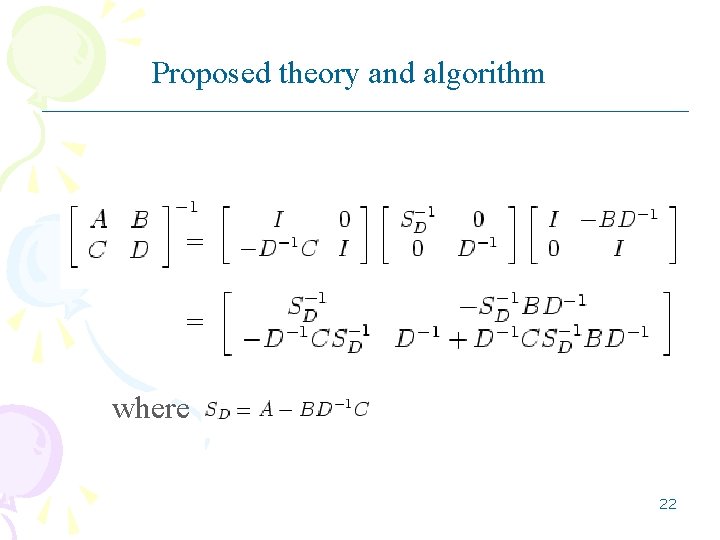
Proposed theory and algorithm = = where 22
Proposed theory and algorithm (3) 23
Proposed theory and algorithm 24
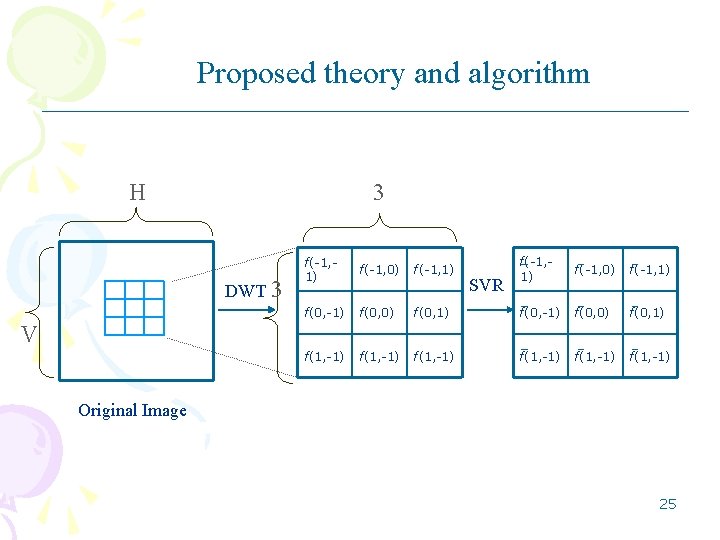
Proposed theory and algorithm H 3 DWT 3 f(-1, 1) f(-1, 0) f(-1, 1) f(0, -1) f(0, 0) f(0, 1) f(1, -1) f(-1, 0) f(-1, 1) f(0, -1) f(0, 0) f(1, -1) SVR V Original Image 25
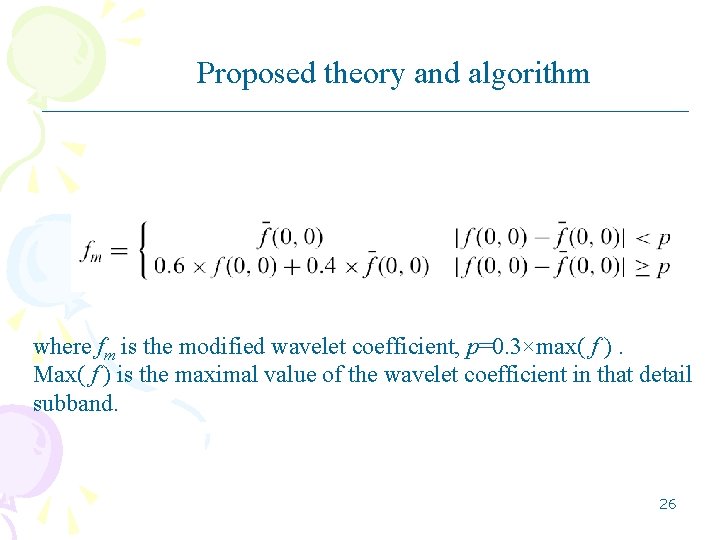
Proposed theory and algorithm where fm is the modified wavelet coefficient, p=0. 3×max( f ). Max( f ) is the maximal value of the wavelet coefficient in that detail subband. 26
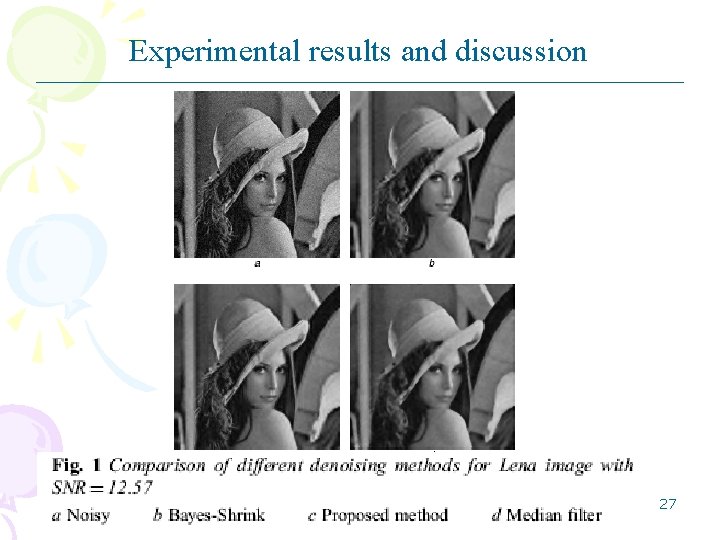
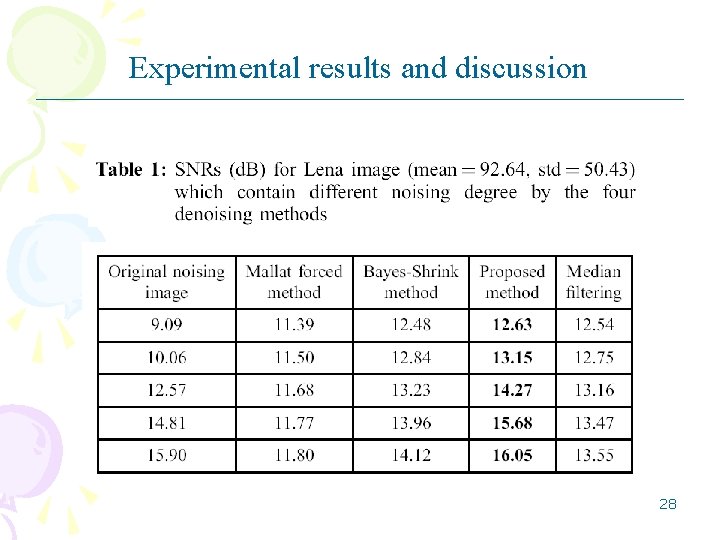
Experimental results and discussion 27
Experimental results and discussion 28
Reference • 1 Mallat, S. G. : ‘A theory for multiresolution signal decomposition: the wavelet representation’, IEEE Trans. Pattern Anal. Mach. Intell. , 1989, 11, (7), pp. 674– 693 • 2 Donoho, D. L. , and Johnstone, I. M. : ‘Ideal spatial adaptation via waveletshrinkage’, Biometrica, 1994, 81, pp. 425– 455 • 3 Chang, S. G. , Yu, B. , and Vetterli, M. : ‘Adaptive wavelet thresholding forimage denoising and compression’, IEEE Trans. Image Process. , 2000, 9, pp. 1532– 1546 • 4 Vapnik, V. : ‘The nature of statistical learning theory’ (Springer-Verlag, New York, 1995) • 5 Suykens, J. A. K. , and Vandewalle, J. : ‘Least squares support vectormachine classifiers’, Neural Process. Lett. , 1999, 9, (3), pp. 293– 300 29