
Waveguides This is the conduit that links the

- Slides: 11
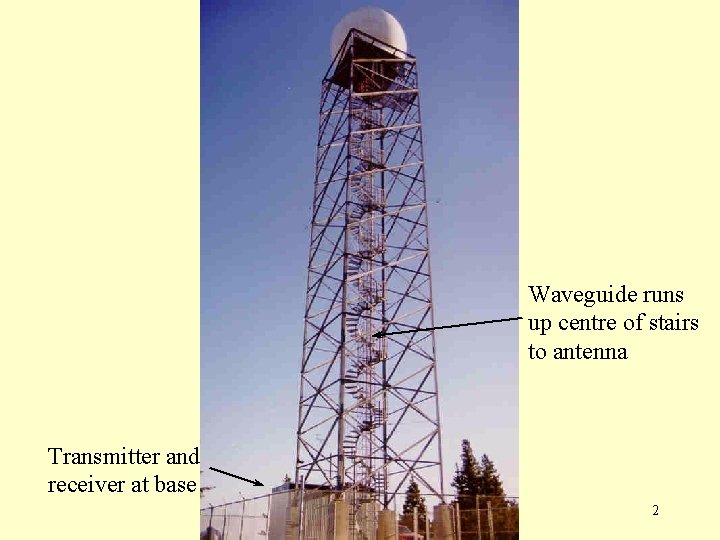
Waveguides • This is the conduit that links the transmitter to the duplexer and antenna • It is a hollow conducting tube along which the microwave energy moves • A 30 m run of waveguide is typical for the radars • The two-way signal loss is about 1 d. B 1
Waveguide Diagram Waveguide runs up centre of stairs to antenna Transmitter and receiver at base 2
Transmitter Magnetron and Modulator 3
Transmitter • The transmitter produces the microwave pulses emitted by the radar • The transmitter’s main components are the source and the modulator • There are three basic types of microwave sources used in transmitters: – magnetron (co-axial) – klystron – solid-state 4
Basic Principle of a Magnetron • Electrons emitted from negatively charged cathode in centre of magnetron • Background magnetic field is directed along axis • Electrons spiral outward, passing cavities in the anode • Resulting microwave signal is radiated into the waveguide by the “probe” 5
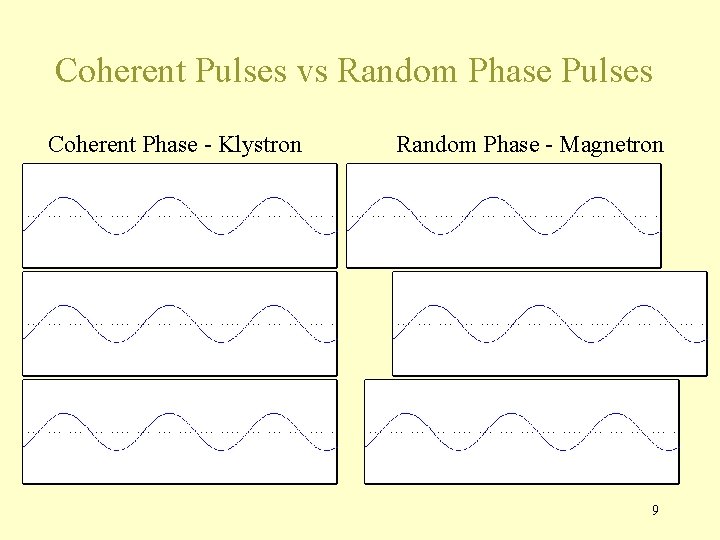
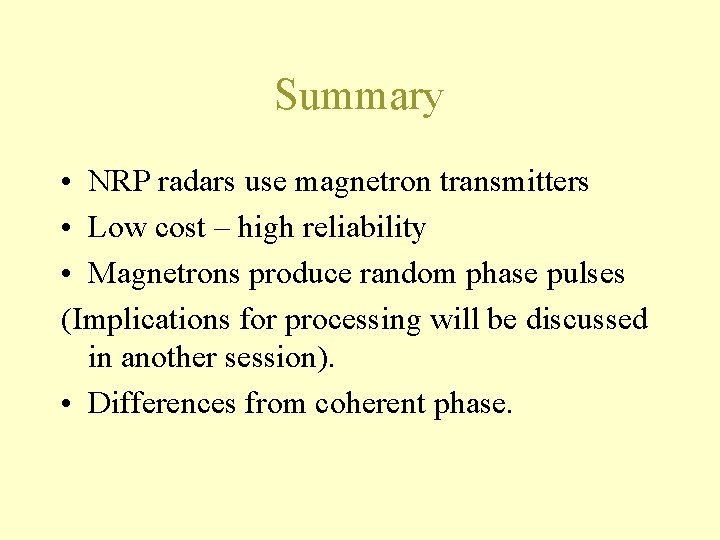
Magnetron • Emitted pulse of random phase • Makes Doppler signal processing more challenging, but allows certain techniques to be used to advantage (see discussion on Doppler signal processing) 6
Klystron • True amplifiers - can control waveform of emitted pulse • Thus, phase can be the same for many cycles with little drift • Often found on higher-powered weather radars (e. g. WSR 88 D-NEXRAD) 7
Microwave Sources • Magnetron – used in all NRP radars and typical in Europe – relatively low transmission power: 250 k. W – pulses transmitted with different phases: “random phase” • Klystron – used by NEXRAD radars – higher power possible (NEXRAD is 750 k. W) – successive pulses are “in phase” 8
Coherent Pulses vs Random Phase Pulses Coherent Phase - Klystron Random Phase - Magnetron 9
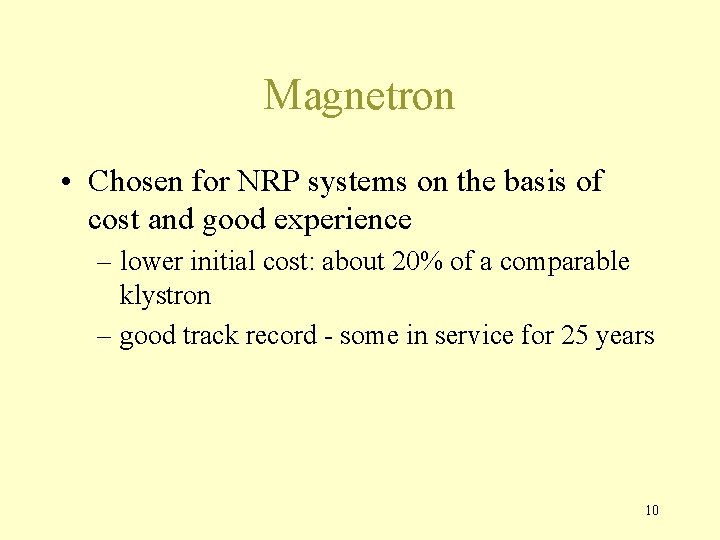
Magnetron • Chosen for NRP systems on the basis of cost and good experience – lower initial cost: about 20% of a comparable klystron – good track record - some in service for 25 years 10
Summary • NRP radars use magnetron transmitters • Low cost – high reliability • Magnetrons produce random phase pulses (Implications for processing will be discussed in another session). • Differences from coherent phase.