
Wavefront Tracing for Precise Bokeh Evaluation Realtime Rendering

Wavefront Tracing for Precise Bokeh Evaluation Real-time Rendering of Physically Based Optical Effects in Theory and Practice Masanori KAKIMOTO Tokyo University of Technology
Wavefront Tracing for Precise Bokeh Evaluation Table of Contents • • Introduction Brief overview of wavefront tracing Examples from eyeglass lens simulation Conclusion
Real-time Rendering of Physically Based Optical Effects in Theory and Practice Wavefront Tracing for Precise Bokeh Evaluation INTRODUCTION
[Kneisly 1968] Applications of Wavefront Tracing • Caustics [Stavroudis 1972] [Mitchell 1992] • Rendering with bokeh – Accurate evaluation of bokeh size – Can take human visual acuity into account – Utilized in engineering fields (eyeglass lens design, ophthalmology)
Basic Premises • An option for ray tracing – Rays are given input • Pay attention to a point on the wave front – The cross point of the ray and the wave front • Note that wavefront tracing is a geometric optics technique, not a wave optics method
Input / Output for Each Trace • Input: – A series of rays (from screen to an object surface point) – Wave source point (either end point of the rays) – Refractive indices or power of the media on the way (eyeglass lens, eye lens) – Aperture (Pupil) diameter • Output: – Wave front curvatures – Extent of the light beam at any point of the ray
Real-time Rendering of Physically Based Optical Effects in Theory and Practice Wavefront Tracing for Precise Bokeh Evaluation BRIEF OVERVIEW OF WAVEFRONT TRACING
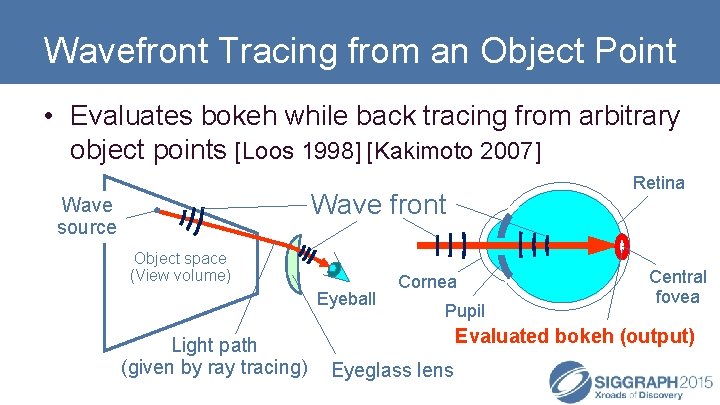
Wavefront Tracing from an Object Point • Evaluates bokeh while back tracing from arbitrary object points [Loos 1998] [Kakimoto 2007] Retina Wave front Wave source Object space (View volume) Eyeball Light path (given by ray tracing) Cornea Pupil Central fovea Evaluated bokeh (output) Eyeglass lens
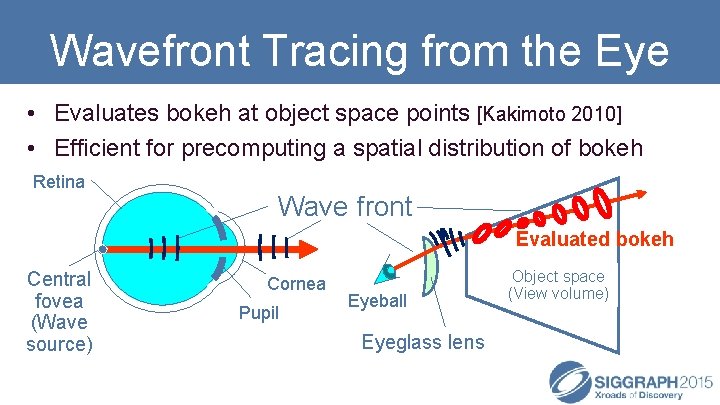
Wavefront Tracing from the Eye • Evaluates bokeh at object space points [Kakimoto 2010] • Efficient for precomputing a spatial distribution of bokeh Retina Wave front Evaluated bokeh Central fovea (Wave source) Cornea Pupil Eyeball Eyeglass lens Object space (View volume)
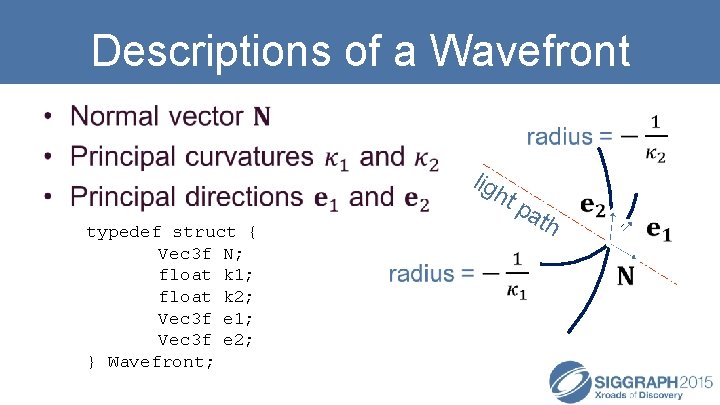
Descriptions of a Wavefront • lig ht p typedef struct { Vec 3 f N; float k 1; float k 2; Vec 3 f e 1; Vec 3 f e 2; } Wavefront; ath
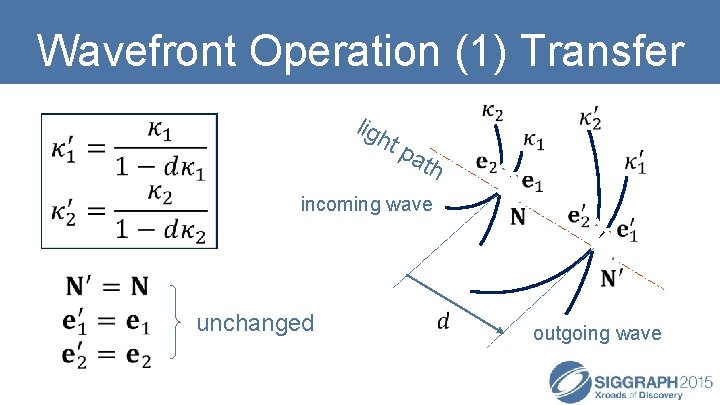
Wavefront Operation (1) Transfer lig ht pa th incoming wave unchanged outgoing wave
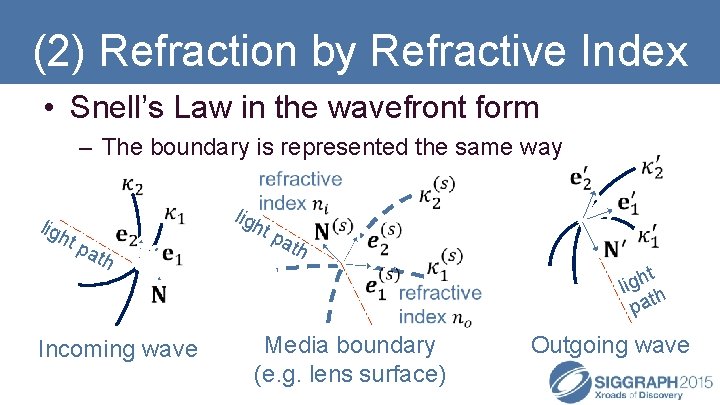
(2) Refraction by Refractive Index • Snell’s Law in the wavefront form – The boundary is represented the same way ligh tp ath Incoming wave ligh tp ath Media boundary (e. g. lens surface) t ligh h pat Outgoing wave
Other Wavefront Operations • Refraction by a refractive power – Human visual acuity is represented by a refractive power • Reflection • Optionally accompanied by Conoid Tracing – Assumes a circular aperture – Traces the shapes of ellipses along the ray – For details, see [Kakimoto 2011]
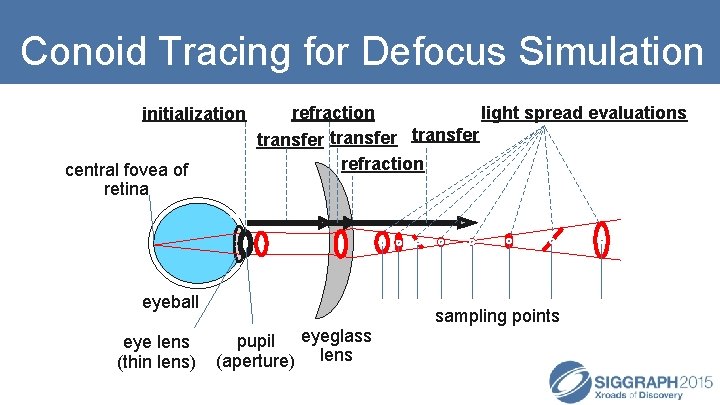
Conoid Tracing for Defocus Simulation initialization central fovea of retina refraction light spread evaluations transfer refraction eyeball eye lens (thin lens) pupil eyeglass (aperture) lens sampling points
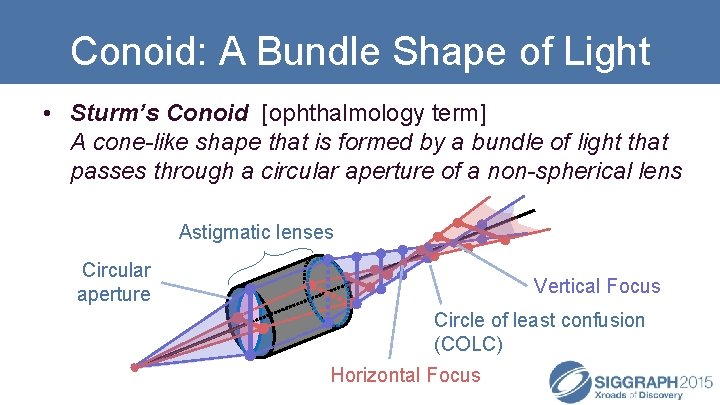
Conoid: A Bundle Shape of Light • Sturm’s Conoid [ophthalmology term] A cone-like shape that is formed by a bundle of light that passes through a circular aperture of a non-spherical lens Astigmatic lenses Circular aperture Vertical Focus Circle of least confusion (COLC) Horizontal Focus
Real-time Rendering of Physically Based Optical Effects in Theory and Practice Wavefront Tracing for Precise Bokeh Evaluation EXAMPLES
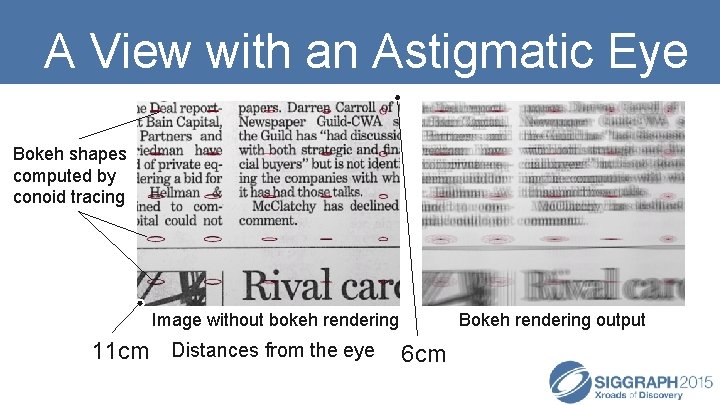
A View with an Astigmatic Eye Bokeh shapes computed by conoid tracing Image without bokeh rendering 11 cm Distances from the eye Bokeh rendering output 6 cm
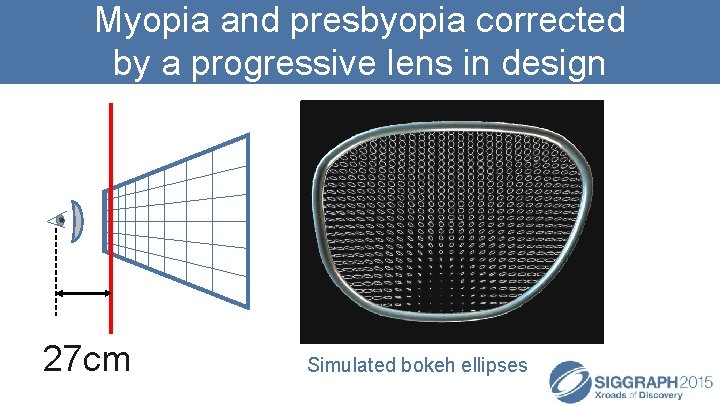
Myopia and presbyopia corrected by a progressive lens in design 27 cm Simulated bokeh ellipses
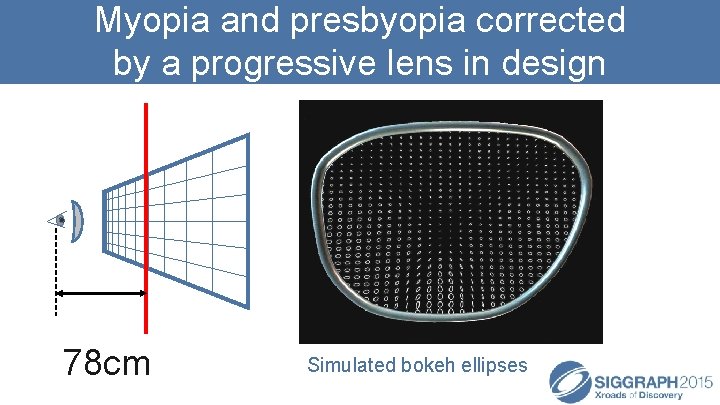
Myopia and presbyopia corrected by a progressive lens in design 78 cm Simulated bokeh ellipses
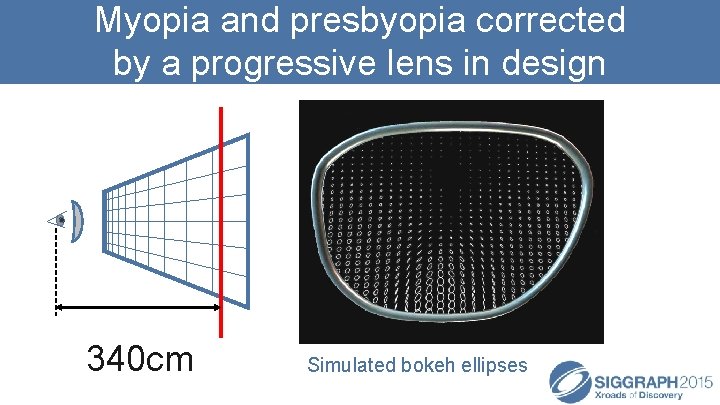
Myopia and presbyopia corrected by a progressive lens in design 340 cm Simulated bokeh ellipses
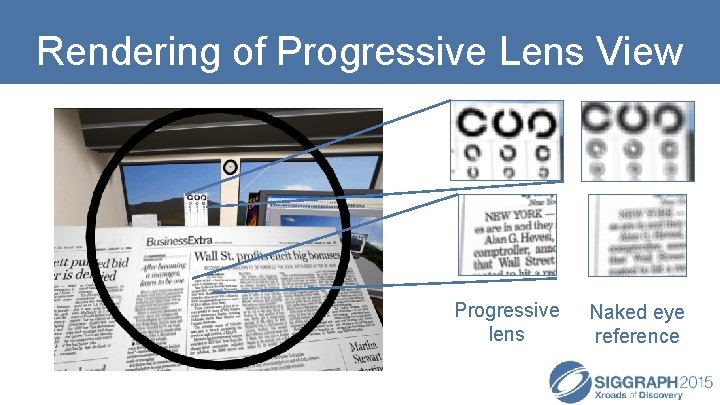
Rendering of Progressive Lens View Progressive lens Naked eye reference
Near Real-Time Bokeh Rendering with Vertex Displacement • Use of precomputed bokeh distribution in the view volume • Vertex shader Implementation – Displaces vertex within the bokeh ellipse at the point • Blend images with sampled displacements • Pixel shader implementation may be possible
Real-time Rendering of Physically Based Optical Effects in Theory and Practice Wavefront Tracing for Precise Bokeh Evaluation CONCLUSION
Conclusion • Wavefront tracing is a powerful tool to analyze spread of light precisely • Conoid tracing evaluates the bokeh sizes derived from a circular aperture – Applied to eyeglass lens design verification – Not yet used in the game or content community
References • • Gullstrand, A. , VON Helmholtz, V. H. 1909. Handbuch der Physiologischen Optik. p. 335. Kneisly, J. A. 1964. Local curvature of wavefronts in an optical system. Journal of the Optical Society of America, 54, 2, 229– 235. Stavroudis, O. N. 1972. The Optics of Rays, Wavefronts, and Caustics. Academic Press, New York and London. Mitchell, D. , Hanrahan, P. 1992. Illumination from Curved Reflectors. Proc. SIGGRAPH’ 92, 283– 291. Loos, J. , Slusallek, P. , Seidel, H. -P. 1998. Using wavefront tracing for the visualization and optimization of progressive lenses. Computer Graphics Forum 17, 3 (Proc. Eurographics 1998), 255– 263. Kakimoto, M. , Tatsukawa, T. , Mukai, Y. , Nishita, T. 2007. Interactive simulation of the human eye depth of field and its correction by spectacle lenses. Computer Graphics Forum 26, 3 (Proc. Eurographics 2007) , 627– 636. Kakimoto, M. , Tatsukawa, T. , Nishita, T. 2010. An Eyeglass Simulator Using Conoid Tracing. Computer Graphics Forum, 29, 8, 2427 -2437.
- Slides: 26