
Wavefront Guided LASIK Eye Surgery Vi Tran BME
Wavefront Guided LASIK Eye Surgery Vi Tran BME 181 Feburary 25, 2013
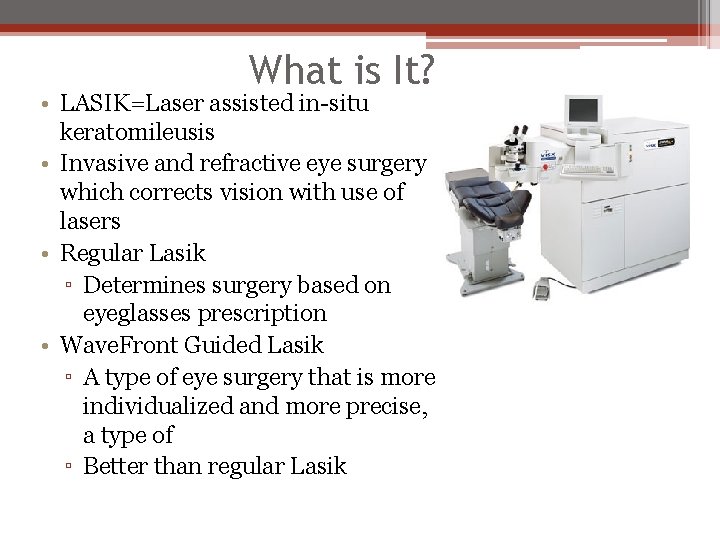
What is It? • LASIK=Laser assisted in-situ keratomileusis • Invasive and refractive eye surgery which corrects vision with use of lasers • Regular Lasik ▫ Determines surgery based on eyeglasses prescription • Wave. Front Guided Lasik ▫ A type of eye surgery that is more individualized and more precise, a type of ▫ Better than regular Lasik
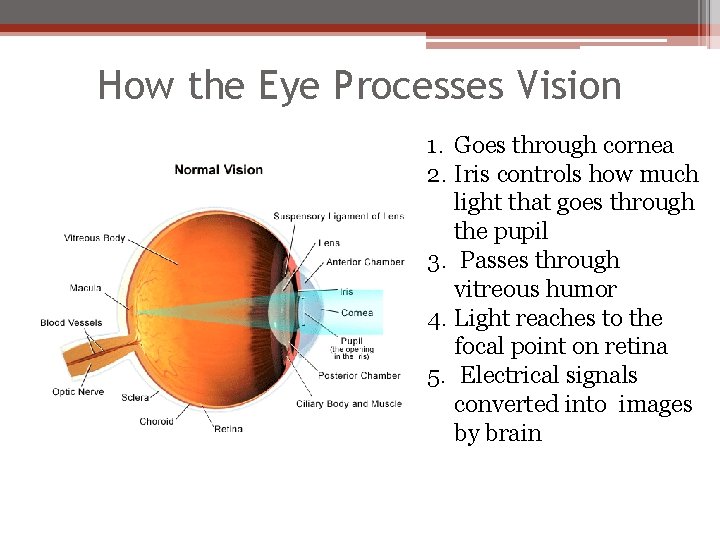
How the Eye Processes Vision 1. Goes through cornea 2. Iris controls how much light that goes through the pupil 3. Passes through vitreous humor 4. Light reaches to the focal point on retina 5. Electrical signals converted into images by brain
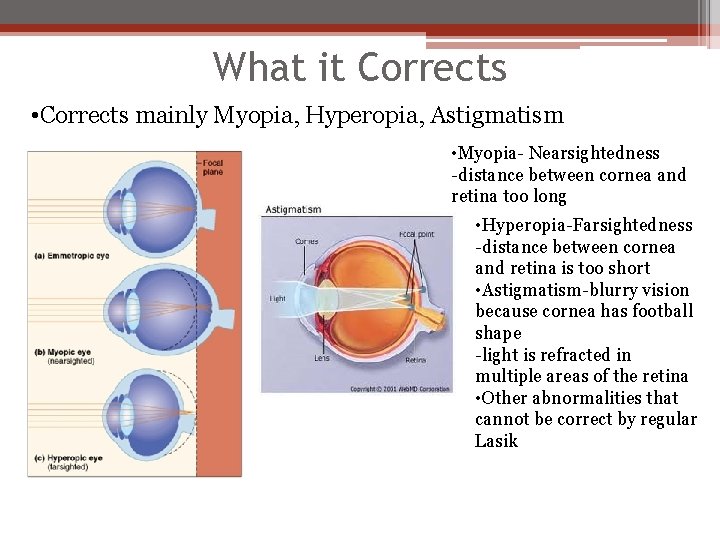
What it Corrects • Corrects mainly Myopia, Hyperopia, Astigmatism • Myopia- Nearsightedness -distance between cornea and retina too long • Hyperopia-Farsightedness -distance between cornea and retina is too short • Astigmatism-blurry vision because cornea has football shape -light is refracted in multiple areas of the retina • Other abnormalities that cannot be correct by regular Lasik

Before Surgery • Doctors use Wave. Scan to create a 3 D image of eye • Individualizes Surgery • Iris Recognition • Information gathered used during surgery
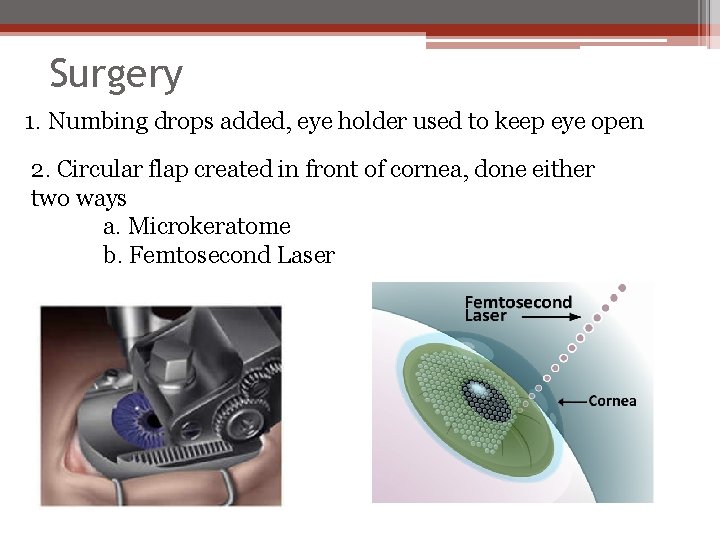
Surgery 1. Numbing drops added, eye holder used to keep eye open 2. Circular flap created in front of cornea, done either two ways a. Microkeratome b. Femtosecond Laser
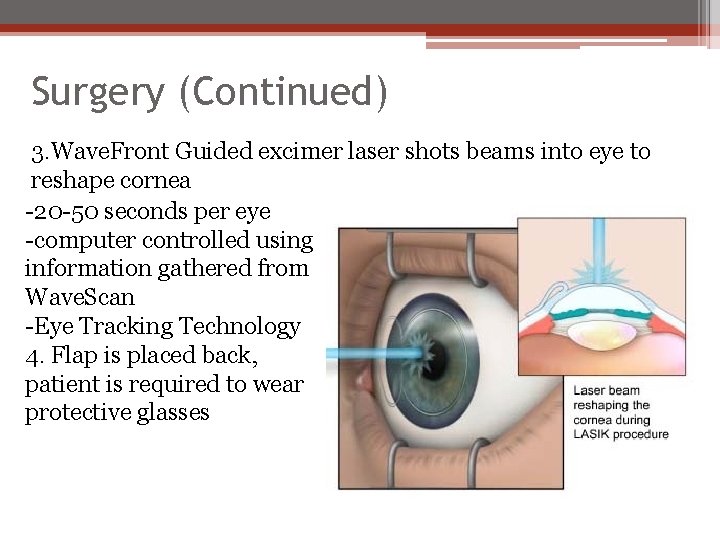
Surgery (Continued) 3. Wave. Front Guided excimer laser shots beams into eye to reshape cornea -20 -50 seconds per eye -computer controlled using information gathered from Wave. Scan -Eye Tracking Technology 4. Flap is placed back, patient is required to wear protective glasses

Results/Benefits of Wave. Front Lasik • 2 -3 months for vision to reach best • Safe procedure • Can leave hospital same day • Higher Chance of getting 20/20 Vision • Although it is expensive, $5000 but it is a one time cost • Lower chance of losing vision • Less glares and halos

Complications Associated • Very Rare with Wave. Front LASIK • Common Symptoms after Surgery • Eye Dryness • Irritation and Inflammation • Double Vision • Night Vision • “halos and glares” while driving • Overcorrection or Undercorrection • Thinning of Cornea • Additional Surgery
Statistics and Results • Total of 12 million people have undergone (general)LASIK surgery • With Wave. Front Lasik • 95% have 20/20 vision • 74% have 20/15 or better vision • 25% better than Regular Lasik • Number of LASIK surgeries are increasing • Better Technology is developed each year
References Questions? "The Anatomy of the Eye. " The Physics Classroom, 2013. Web. 21 Feb. 2013. <http: //www. physicsclassroom. com/class/refrn/u 14 l 6 a. cfm>. Croes, Keith. "Custom LASIK or Wavefront LASIK: Individualized Vision Correction. " All About Vision, Mar. 2011. Web. 21 Feb. 2013. <http: //www. allaboutvision. com/visionsurgery/custom_lasik. ht m>. "How Does ILASIK Work? " Red. Box. Studio. com, 2013. Web. 21 Feb. 2013. <http: //adventist-ilasik. com/ilasik/the-technology/>. "LASIK, Eye Surgery. " Eye Surgery Education, n. d. Web. 22 Feb. 2013. <http: //eyesurgeryeducation. org/surgery-options-lasikabout. php>. "LASIK. " Wikipedia. N. p. , 13 Feb. 2013. Web. 22 Feb. 2013. <http: //en. wikipedia. org/wiki/Lasik>. "What Are the Different Types of Laser Eye Surgery? " Conjecture Corporation, 2013. Web. 21 Feb. 2013. <http: //www. wisegeek. org/what-are-the-different-types-of-lasereye-surgery. htm>.
- Slides: 11