
Wave Types and Characteristics www assignmentpoint com www
- Slides: 21
Wave Types and Characteristics www. assignmentpoint. com
www. assignmentpoint. com
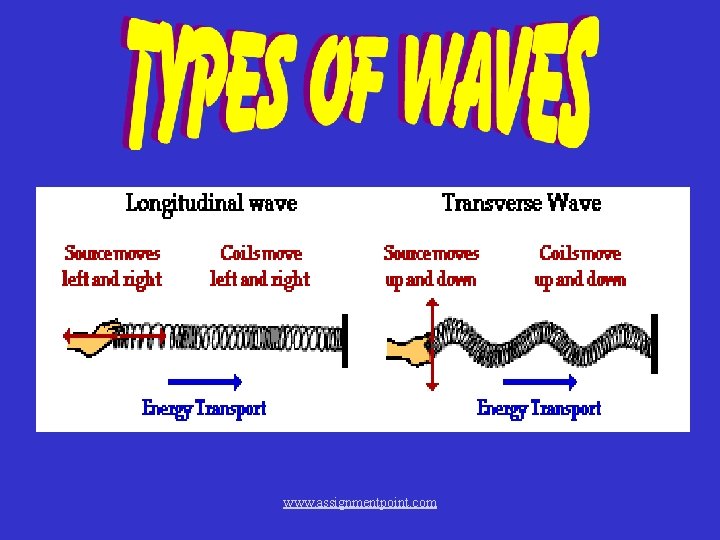
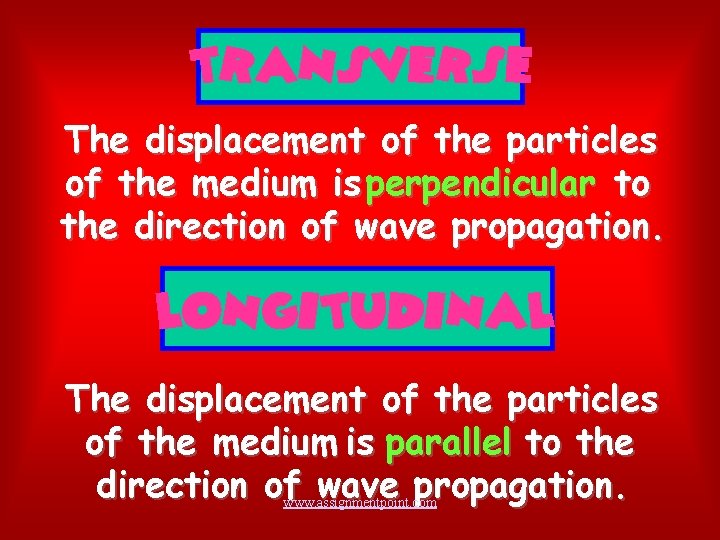
TRANSVERSE The displacement of the particles of the medium is perpendicular to the direction of wave propagation. LONGITUDINAL The displacement of the particles of the medium is parallel to the direction of wave propagation. www. assignmentpoint. com
SURFACE A combination of transverse and longitudinal. Click here, and here to view simulations of transverse and longitudinal waves. www. assignmentpoint. com
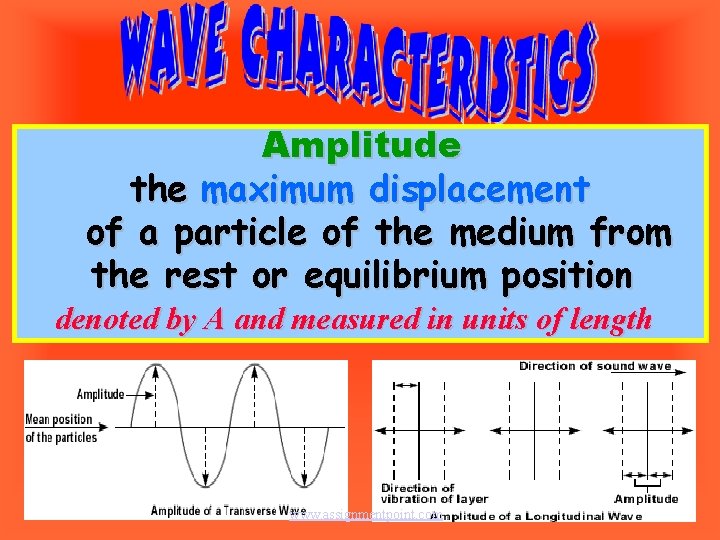
Amplitude the maximum displacement of a particle of the medium from the rest or equilibrium position denoted by A and measured in units of length www. assignmentpoint. com
Phase related to the position and motion of the particles of the medium www. assignmentpoint. com
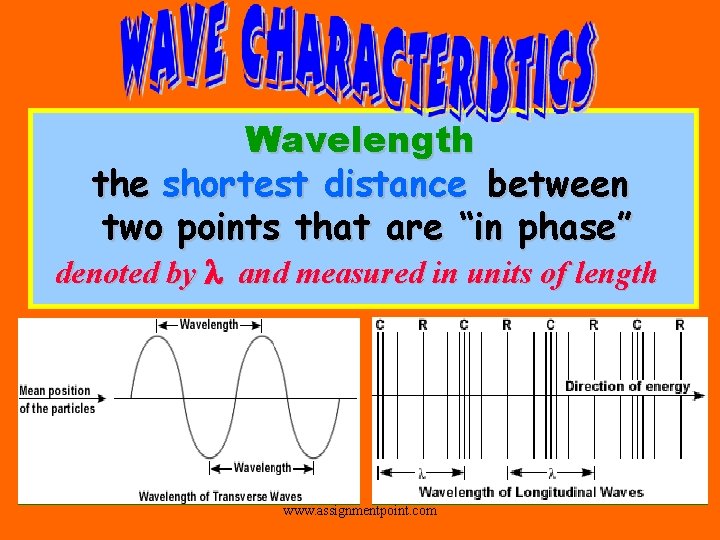
Wavelength the shortest distance between two points that are “in phase” denoted by l and measured in units of length www. assignmentpoint. com
Frequency - the number of complete vibrations per unit time denoted by f and measured in units of Hz Period -the shortest time interval during which the motion of the wave repeats itself denoted by T and measured in units of time T = 1/f & www. assignmentpoint. com f = 1/T
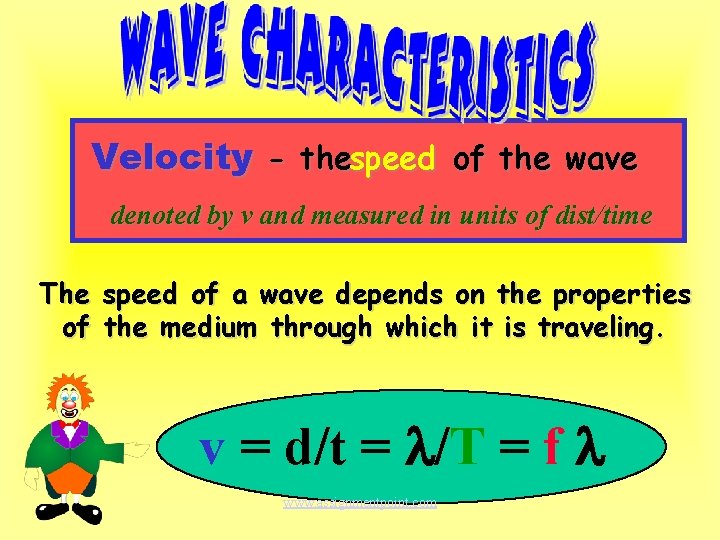
Velocity - thespeed of the wave denoted by v and measured in units of dist/time The speed of a wave depends on the properties of the medium through which it is traveling. v = d/t = l/T = f l www. assignmentpoint. com
Reflection the turning back of a wave when it reaches the boundary of the medium through which it is traveling www. assignmentpoint. com
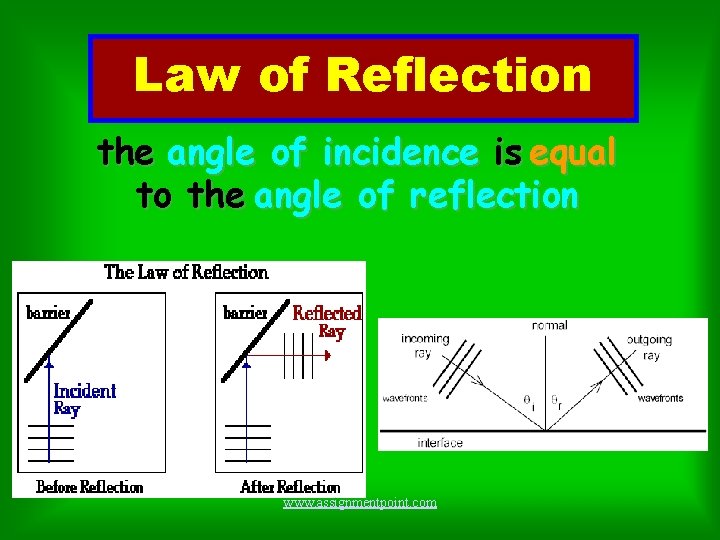
Law of Reflection the angle of incidence is equal to the angle of reflection www. assignmentpoint. com
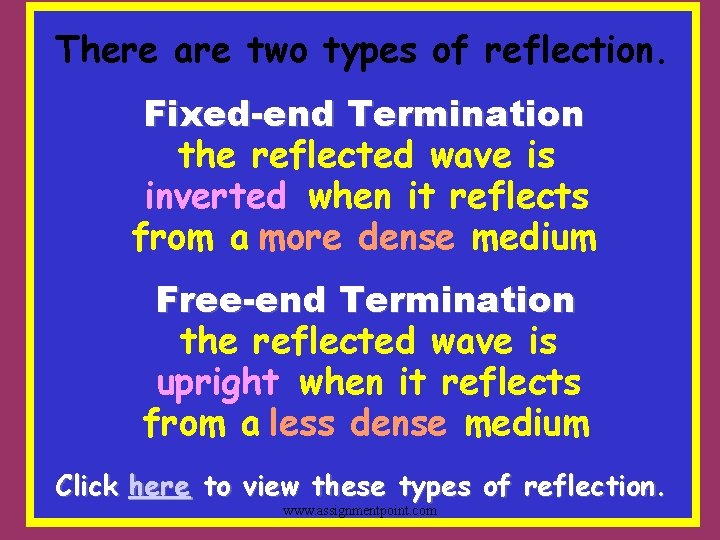
There are two types of reflection. Fixed-end Termination the reflected wave is inverted when it reflects from a more dense medium Free-end Termination the reflected wave is upright when it reflects from a less dense medium Click here to view these types of reflection. www. assignmentpoint. com
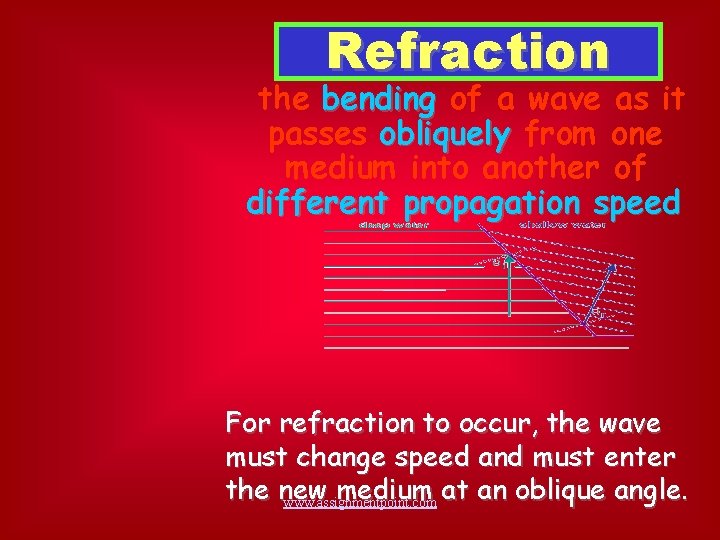
Refraction the bending of a wave as it passes obliquely from one medium into another of different propagation speed For refraction to occur, the wave must change speed and must enter the new medium at an oblique angle. www. assignmentpoint. com
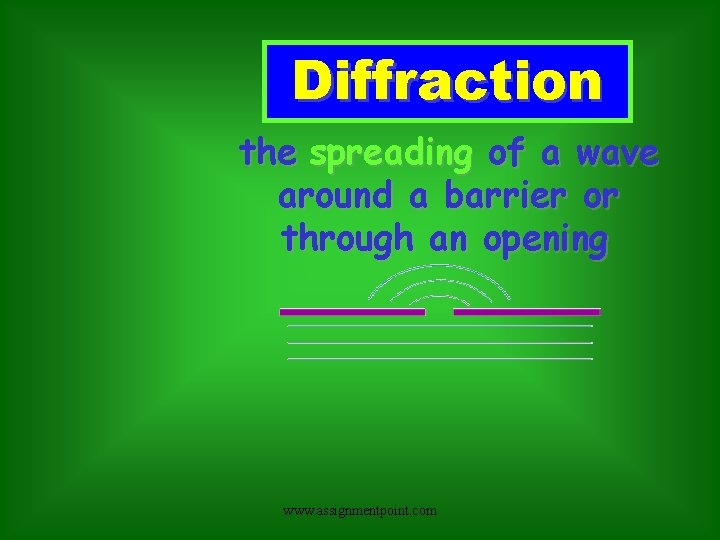
Diffraction the spreading of a wave around a barrier or through an opening www. assignmentpoint. com
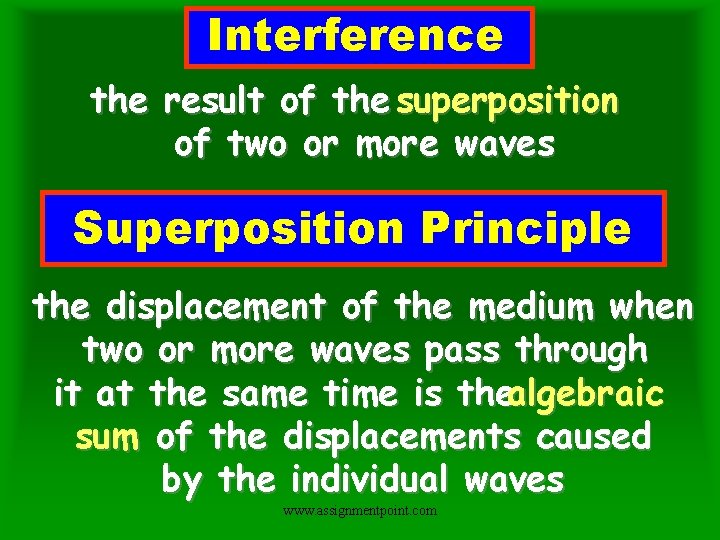
Interference the result of the superposition of two or more waves Superposition Principle the displacement of the medium when two or more waves pass through it at the same time is thealgebraic sum of the displacements caused by the individual waves www. assignmentpoint. com
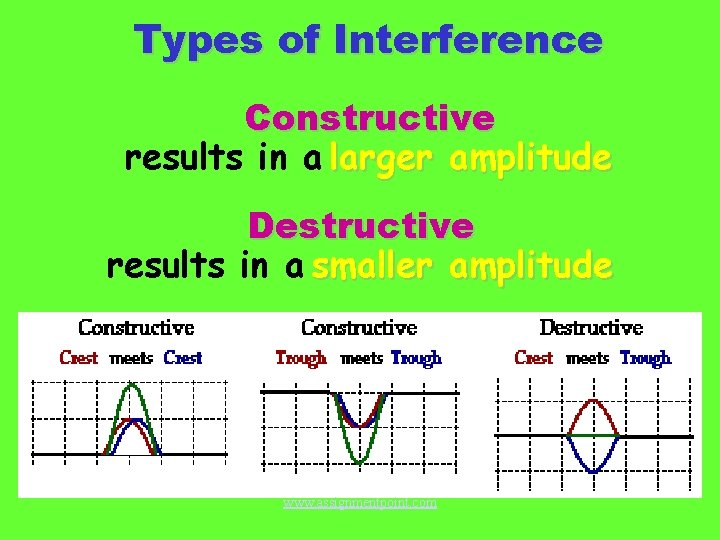
Types of Interference Constructive results in a larger amplitude Destructive results in a smaller amplitude www. assignmentpoint. com
Read more about interference here. Click here to view the interference pattern resulting from the superposition of two transverse waves. Click here and here to view simulations of the interference of two circular waves. www. assignmentpoint. com
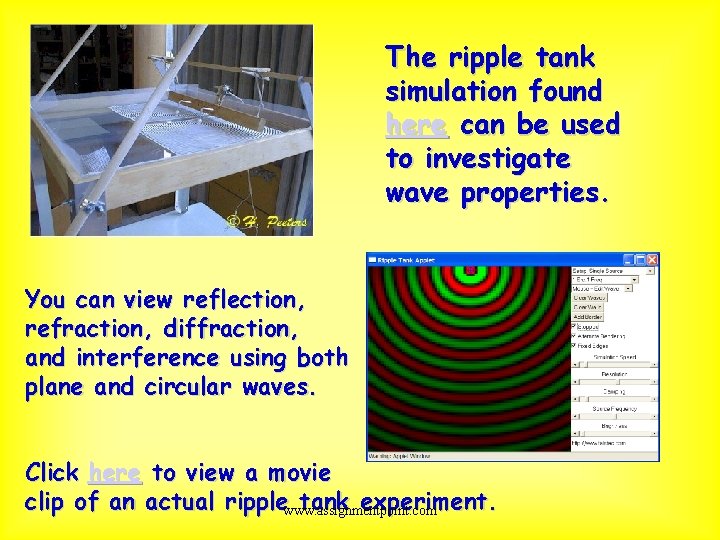
The ripple tank simulation found here can be used to investigate wave properties. You can view reflection, refraction, diffraction, and interference using both plane and circular waves. Click here to view a movie clip of an actual ripplewww. assignmentpoint. com tank experiment.
A standing wave is the result of two wave trains of the same wavelength , frequency , and amplitude traveling in opposite directions through the same medium. www. assignmentpoint. com
Learn more about standing waves here, and here. Click here to view a simulation of the interference of two traveling waves that can result in a standing wave. Click here to view a simulation of standing waves on a string. Standing waves may be produced easily in water, string, and air columns. www. assignmentpoint. com
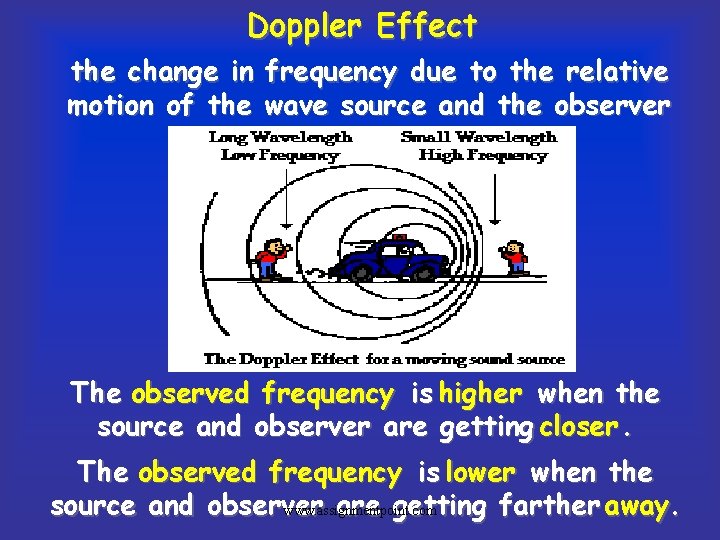
Doppler Effect the change in frequency due to the relative motion of the wave source and the observer The observed frequency is higher when the source and observer are getting closer. The observed frequency is lower when the source and observer are getting farther away. www. assignmentpoint. com